wheel Hyundai Coupe 2004 Workshop Manual
[x] Cancel search | Manufacturer: HYUNDAI, Model Year: 2004, Model line: Coupe, Model: Hyundai Coupe 2004Pages: 389, PDF Size: 10.22 MB
Page 305 of 389
3
IN CASE OF EMERGENCY
7
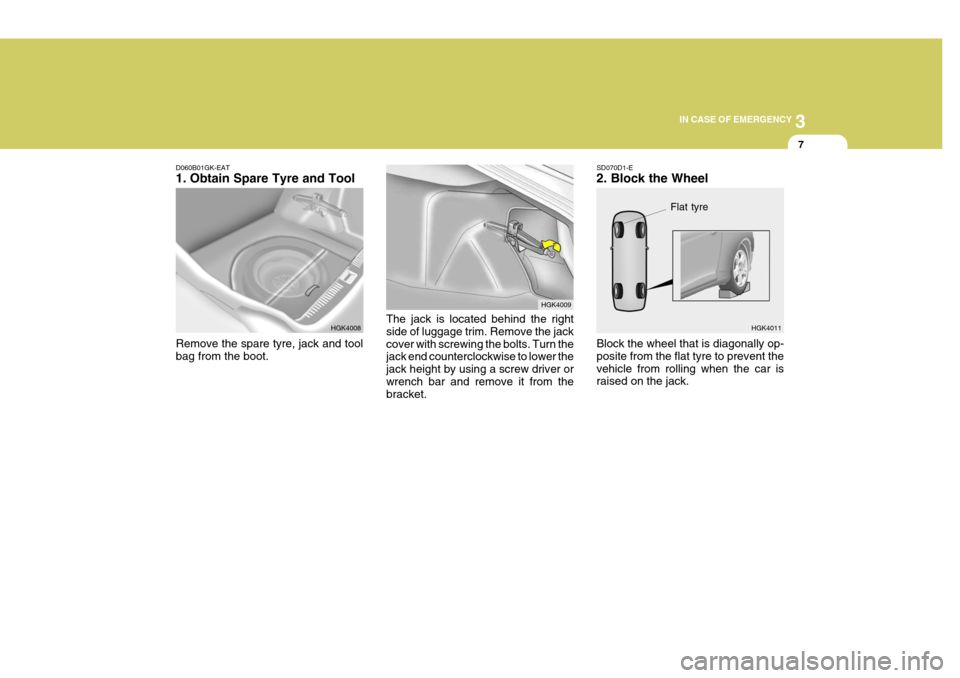
D060B01GK-EAT 1. Obtain Spare Tyre and Tool Remove the spare tyre, jack and tool bag from the boot. HGK4008
HGK4009
The jack is located behind the right side of luggage trim. Remove the jackcover with screwing the bolts. Turn the jack end counterclockwise to lower the jack height by using a screw driver orwrench bar and remove it from the bracket.
Flat tyre
SD070D1-E 2. Block the Wheel Block the wheel that is diagonally op- posite from the flat tyre to prevent thevehicle from rolling when the car is raised on the jack. HGK4011
Page 306 of 389
3 IN CASE OF EMERGENCY
8
HGK4013 Wrench barHGK4012
HFC4022
Wheel nutwrench
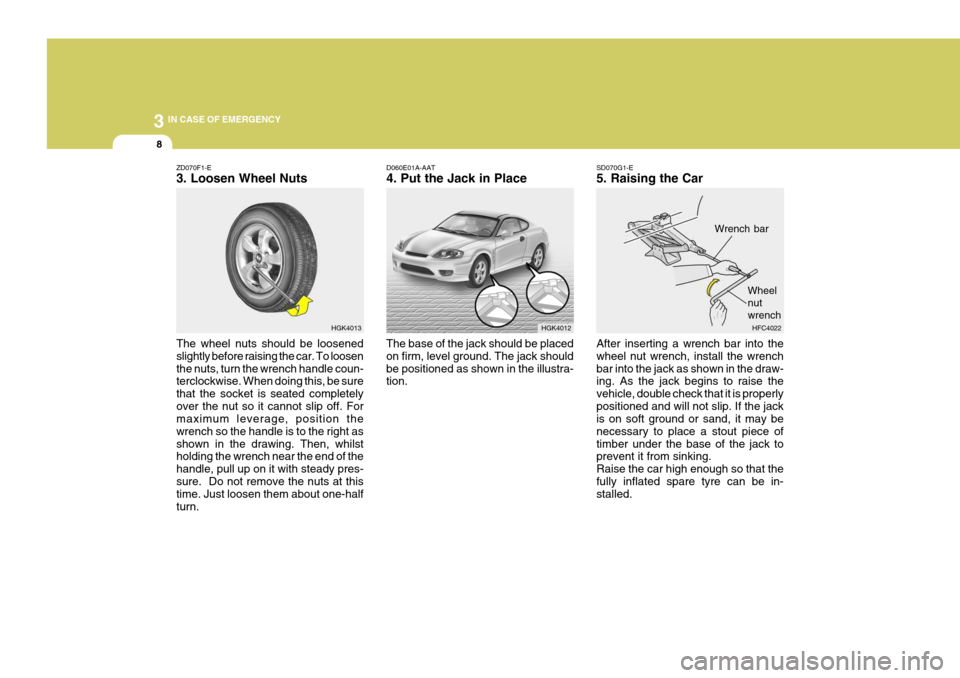
ZD070F1-E 3. Loosen Wheel Nuts The wheel nuts should be loosened slightly before raising the car. To loosenthe nuts, turn the wrench handle coun- terclockwise. When doing this, be sure that the socket is seated completelyover the nut so it cannot slip off. For maximum leverage, position the wrench so the handle is to the right asshown in the drawing. Then, whilst holding the wrench near the end of the handle, pull up on it with steady pres-sure. Do not remove the nuts at this time. Just loosen them about one-half turn. SD070G1-E 5. Raising the Car After inserting a wrench bar into the wheel nut wrench, install the wrenchbar into the jack as shown in the draw- ing. As the jack begins to raise the vehicle, double check that it is properlypositioned and will not slip. If the jack is on soft ground or sand, it may be necessary to place a stout piece oftimber under the base of the jack to prevent it from sinking. Raise the car high enough so that thefully inflated spare tyre can be in- stalled.
D060E01A-AAT 4. Put the Jack in Place
The base of the jack should be placed on firm, level ground. The jack shouldbe positioned as shown in the illustra- tion.
Page 307 of 389
3
IN CASE OF EMERGENCY
9
!WARNING:
Do not get under the car when it is supported by the jack! The jack is solely designed for wheel chang- ing and is not intended to supportthe vehicle for other purposes. The use of purpose designed supports is necessary whilst the vehicle israised and the operator is required to get underneath.
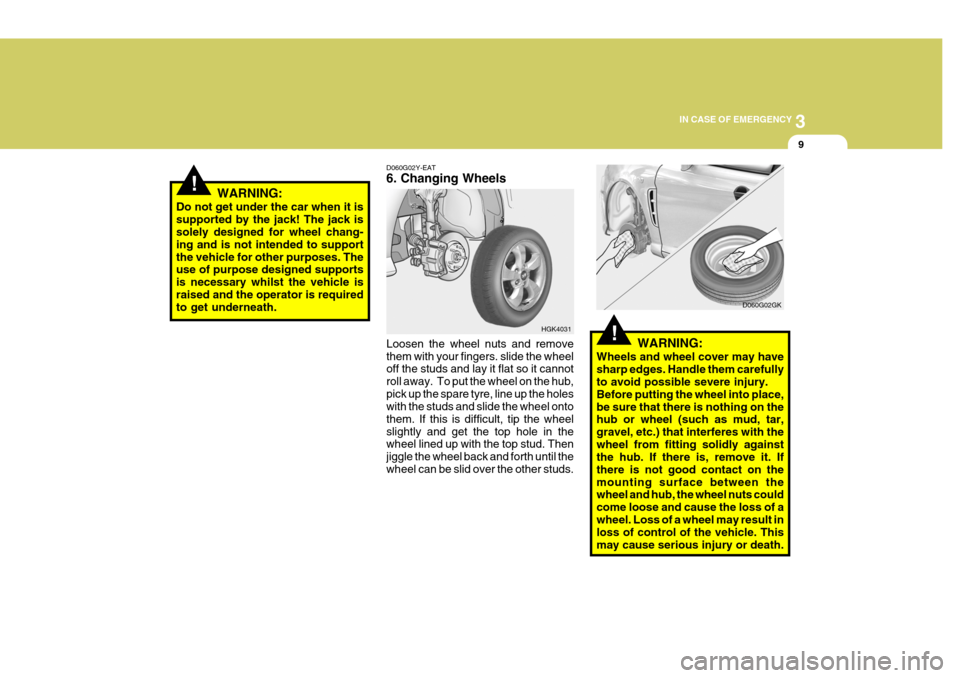
Loosen the wheel nuts and remove them with your fingers. slide the wheel off the studs and lay it flat so it cannot roll away. To put the wheel on the hub,pick up the spare tyre, line up the holes with the studs and slide the wheel onto them. If this is difficult, tip the wheelslightly and get the top hole in the wheel lined up with the top stud. Then jiggle the wheel back and forth until thewheel can be slid over the other studs.
HGK4031
D060G02Y-EAT 6. Changing Wheels!WARNING:
Wheels and wheel cover may have sharp edges. Handle them carefully to avoid possible severe injury. Before putting the wheel into place,be sure that there is nothing on the hub or wheel (such as mud, tar, gravel, etc.) that interferes with thewheel from fitting solidly against the hub. If there is, remove it. If there is not good contact on themounting surface between the wheel and hub, the wheel nuts could come loose and cause the loss of awheel. Loss of a wheel may result in loss of control of the vehicle. This may cause serious injury or death. D060G02GK
Page 308 of 389
3 IN CASE OF EMERGENCY
10
HGK4014
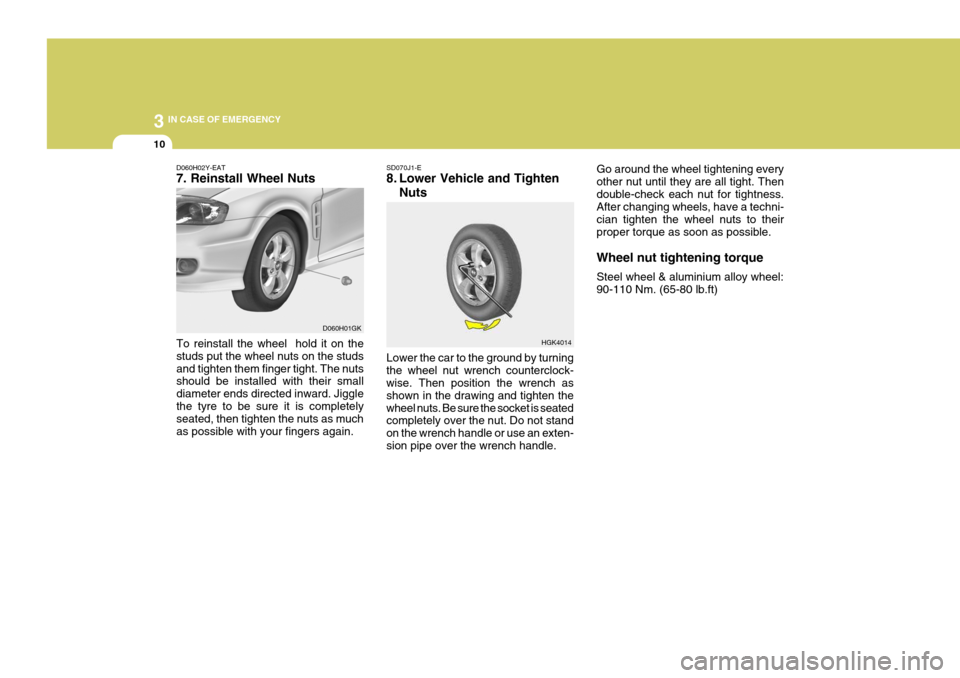
D060H02Y-EAT 7. Reinstall Wheel Nuts To reinstall the wheel hold it on the studs put the wheel nuts on the studsand tighten them finger tight. The nuts should be installed with their small diameter ends directed inward. Jigglethe tyre to be sure it is completely seated, then tighten the nuts as much as possible with your fingers again. SD070J1-E
8. Lower Vehicle and Tighten
Nuts
Lower the car to the ground by turning the wheel nut wrench counterclock- wise. Then position the wrench as shown in the drawing and tighten thewheel nuts. Be sure the socket is seated completely over the nut. Do not stand on the wrench handle or use an exten-sion pipe over the wrench handle.
D060H01GK Go around the wheel tightening everyother nut until they are all tight. Thendouble-check each nut for tightness. After changing wheels, have a techni- cian tighten the wheel nuts to theirproper torque as soon as possible. Wheel nut tightening torque Steel wheel & aluminium alloy wheel: 90-110 Nm. (65-80 lb.ft)
Page 309 of 389
3
IN CASE OF EMERGENCY
11
SD070K1-E AFTER CHANGING WHEELS The pressure of the spare tyre should be checked at the first available oppor-tunity. If any doubt exists as to the tyre pressure, the vehicle should be driven slowly to the nearest service stationand the tyre pressure checked and adjusted as required. If the valve cap is lost from any of thevalves, a replacement should be ob- tained and fitted at the first available opportunity. The valve cap preventsthe ingress of dirt which may cause the valve to stick and therefore leak and is part of the valve sealing function. Ensure that the spare wheel, jack and wheel nut wrench as well tools are correctly located in the boot of the vehicle to prevent damage and noise. HGK4032
IF YOUR VEHICLE MUST BE TOWED
D080A01O-GAT If your vehicle has to be towed, it should be done by your Hyundai dealeror a commercial tow truck service. This will help assure that your vehicle is not damaged in towing. Also, profes-sionals are generally aware of local laws governing towing. In any case, rather than risk damage to your car, itis suggested that you show this infor- mation to the tow truck operator. Be sure that a safety chain system is usedand that all local laws are observed. It is recommended that your vehicle be towed with a wheel lift and dollies orflatbed equipment with all the wheels off the ground.
! CAUTION:
o Your vehicle can be damaged if towed incorrectly!
o Be sure the transaxle is in neu-
tral.
o When the engine will not start, be
sure the steering is unlocked by placing the key in the "ACC" po- sition.
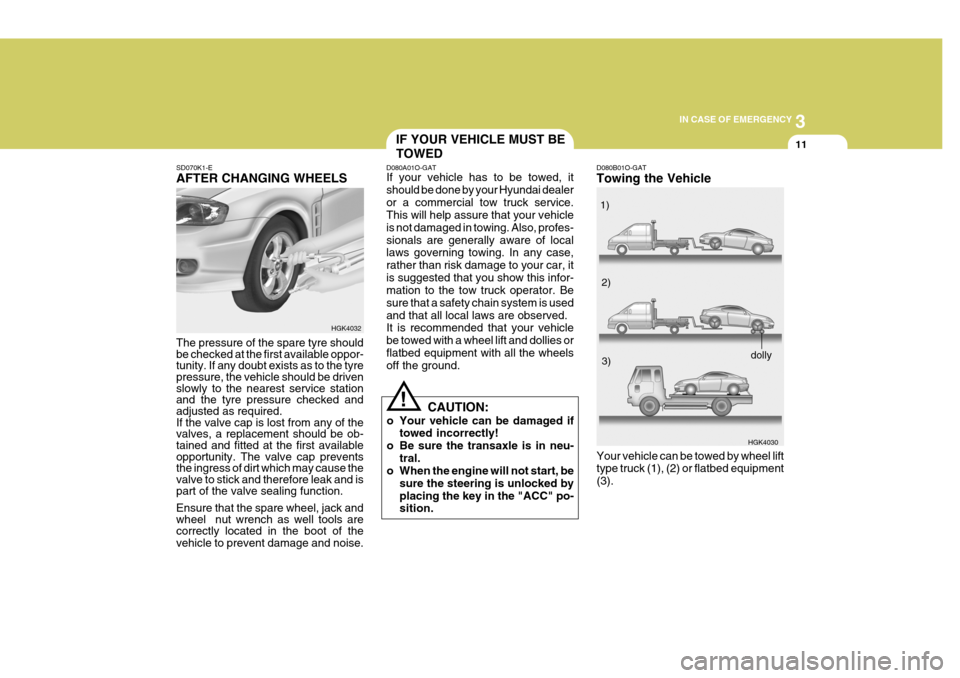
D080B01O-GAT Towing the Vehicle
HGK4030
Your vehicle can be towed by wheel lift type truck (1), (2) or flatbed equipment (3). 1)
2)
3)
dolly
Page 310 of 389
3 IN CASE OF EMERGENCY
12
!
HGK4017
!
!
1) If the vehicle is being towed with the
rear wheels on the ground, be sure the parking brake is released.
NOTE: Before towing, check the level of the automatic transaxle fluid. If it is below the "HOT" range on the dip-stick, add fluid. If you cannot add fluid, a towing dolly must be used.
2) If any of the loaded wheels or sus- pension components are damaged or the vehicle is being towed with the front wheels on the ground, use a towing dolly under the front wheels.
o Manual Transaxle: If you do not use a towing dolly,place the ignition key in the "ACC"position and put the transaxle in "N (Neutral)".
CAUTION:
Do not tow with the key removed or in the "LOCK" position when tow- ing from the rear without a towing dolly. o Automatic Transaxle:
Be sure to use a towing dolly underthe front wheels.
CAUTION:
A vehicle with an automatictransaxle should never be towed from the rear with the front wheels on the ground. This can cause seri-ous damage to the transaxle.
3) It is recommended that your vehicle be towed with all the wheels off the ground.
CAUTION:
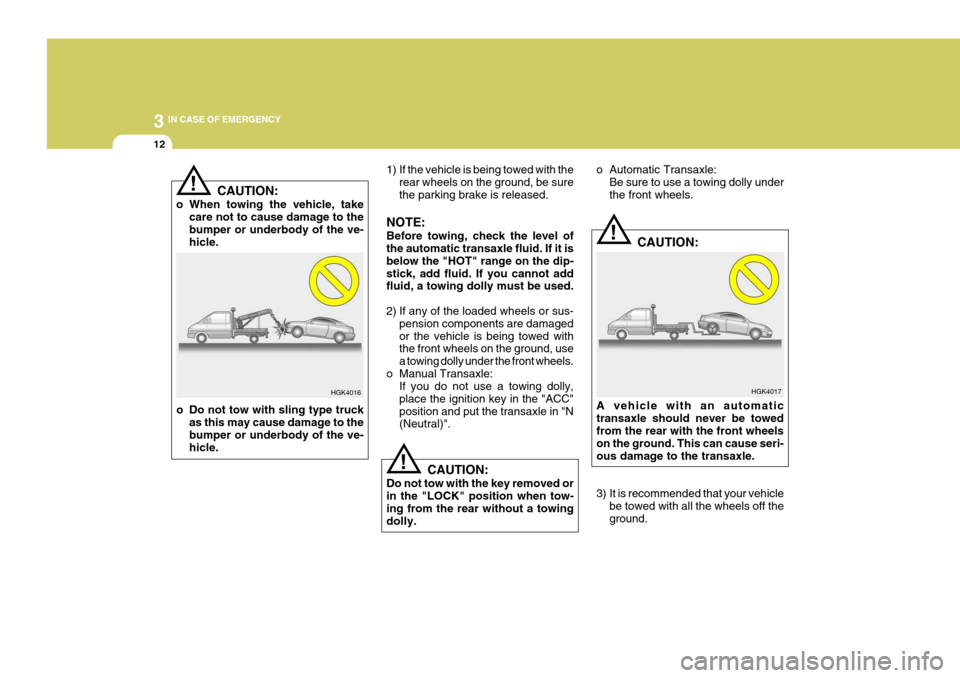
o When towing the vehicle, take care not to cause damage to the bumper or underbody of the ve- hicle.
o Do not tow with sling type truck as this may cause damage to thebumper or underbody of the ve-hicle. HGK4016
Page 311 of 389
3
IN CASE OF EMERGENCY
13
HGK4018
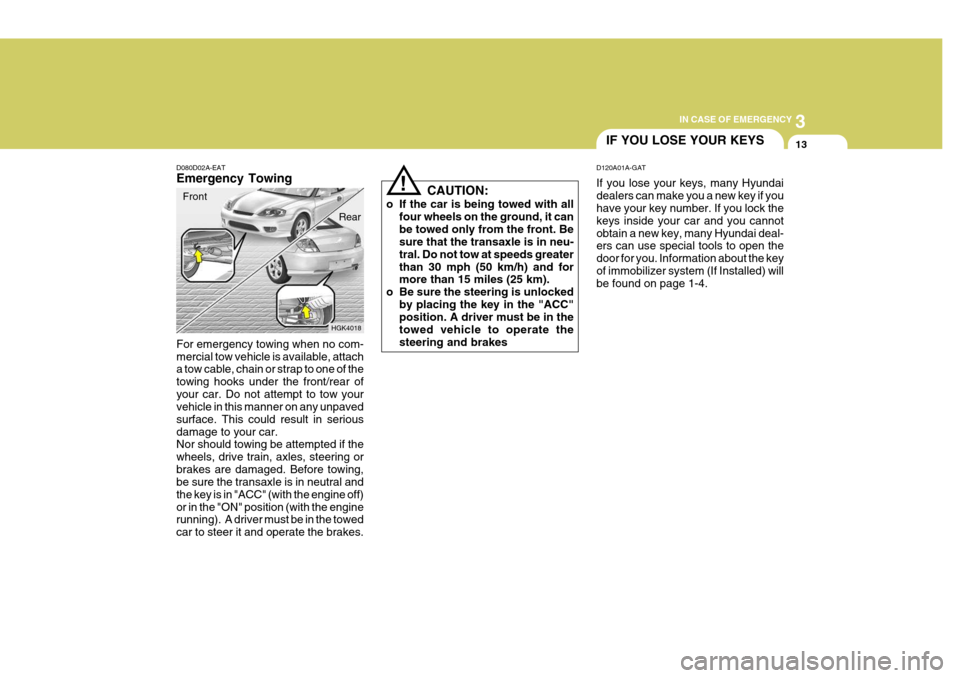
D080D02A-EAT Emergency Towing For emergency towing when no com- mercial tow vehicle is available, attach a tow cable, chain or strap to one of the towing hooks under the front/rear ofyour car. Do not attempt to tow your vehicle in this manner on any unpaved surface. This could result in seriousdamage to your car. Nor should towing be attempted if the wheels, drive train, axles, steering orbrakes are damaged. Before towing, be sure the transaxle is in neutral and the key is in "ACC" (with the engine off)or in the "ON" position (with the engine running). A driver must be in the towed car to steer it and operate the brakes. Front
Rear
!CAUTION:
o If the car is being towed with all four wheels on the ground, it can be towed only from the front. Be sure that the transaxle is in neu- tral. Do not tow at speeds greaterthan 30 mph (50 km/h) and for more than 15 miles (25 km).
o Be sure the steering is unlocked by placing the key in the "ACC"position. A driver must be in the towed vehicle to operate thesteering and brakes
IF YOU LOSE YOUR KEYS
D120A01A-GAT If you lose your keys, many Hyundai dealers can make you a new key if you have your key number. If you lock the keys inside your car and you cannotobtain a new key, many Hyundai deal- ers can use special tools to open the door for you. Information about the keyof immobilizer system (If Installed) will be found on page 1-4.
Page 313 of 389
44APPEARANCE CARE
2PROTECTING YOUR HYUNDAI FROM CORROSION
ZE020A1-E In using the most advanced design and construction practices, every Hyundai is built to retain its original factory finish for many years. How-ever, long term durability is also greatly dependant upon maintaining the vari- ous protection systems and coatingsused in manufacture since constant exposure to the elements will eventu- ally result in their breakdown and lossof effectiveness. The following sug- gestions are made to assist in the maintenance of the vehicle bodywork. ZE020B1-E UNDERBODY COATINGS Every Hyundai passenger car receives a full underbody and cavity injectiontreatment during production. In order that this treatment may retain maxi- mum effectiveness, it is recommendedthat the underbody receives a power wash and a thorough inspection after each winter season. In doing so anyaccumulations of mud, which act as moisture traps and combine with road salts to accelerate corrosion, will beremoved. Should any damage to or deterioration of the underbody coating be apparent, the advice of a Hyundaidealer regarding the use of a compat- ible repair material should be sought. NOTE: The underbody should never be steam cleaned since the underbody coating may be removed by thisprocess. During the interim period between power washing the underbody, themore vulnerable areas such as wheelarches should be hosed off, particularly during the winter sea-son to prevent prolonged contact of road salt with the body. Ensure that the various drain pointslocated at bottom of the door pan- els are kept clear, to prevent water becoming trapped within the cavi-ties. Wherever possible, the park- ing of the vehicle in a confined, poorly ventilated location (e.g.)garage should be avoided when the vehicle is wet or covered with snow or ice. Under these conditions, theinternal cavities of the vehicle will remain damp for long periods of time which encourage corrosion.Parking the vehicle where good ventilation exists is preferable.
Page 314 of 389
4
CORROSION PREVENTION AND APPEARANCE CARE
3
4
APPEARANCE CARE
3VALETING
ZE020C1-E INTERIOR During the winter period, it is possible that the carpet within the passengercompartment may become wet. The carpet should not be allowed to remain in this condition for prolonged periodssince the carpet may begin to create musty smells and promote internal corrosion of the floorpan. JE050A2-E Regular cleaning of the exterior paintwork serves two important func- tions. Firstly, the removal of abrasive dirt and contaminants will maintain thelustre of the paintwork and will prevent discolouration and dulling due to pro- longed contact.Secondly, the presence of damage through impact or abrasion will be ap- parent allowing early rectification to bemade thus preventing corrosion from becoming established and spreading beneath the paint film. To avoid "waterspotting" the vehicle should not be washed in direct sunlight particularly in the case of vehicles having dark bodycolours. The heat from the sun rays is absorbed by the paint film increasing the surface temperature. This actioncauses water used for washing to evaporate quickly leaving behind the deposits from the water and the sham-poo used.Use only a shampoo intended for thepurpose and ensure that the body workis thoroughly wetted to soften the dirt film prior to attempting to remove this. After removing the dirt film with a softsponge, the body work should be thor- oughly rinsed and then dried with a good quality chamois leather to pre-vent streaking or spotting of the paint work. Household detergents, solvents andabrasive cleaning materials should not be used in order to avoid damaging the paint film.High pressure car washes may cause water to enter your car. Plastic wheel covers should be cleanedusing a sponge and water. Cast alloy wheels should be cleaned using a mild soap or neutral detergent. Abrasivecompounds must not be used since in the event of these damaging the lac- quer coating, oxidisation of the alu-minium wheel will occur, spoiling the appearance. The use of a toothbrush will facilitatecleaning between the wheel "spokes".
Page 321 of 389

5
VEHICLE MAINTENANCE REQUIREMENTS
5
NO. 1 23 4 5678 9
10 11121314 15 1617181920 21 DESCRIPTION
GENERAL MAINTENANCE COOLING SYSTEMCOOLANTCOOLANT SPECIFIC GRAVITYMANUAL TRANSAXLE OILAUTOMATIC TRANSAXLE FLUID BRAKE PIPES, HOSES, AND CONNECTIONS BRAKE FLUIDCLUTCH FLUIDREAR BRAKE LININGS AND CYLINDERSBRAKE PADS SUSPENSION AND STEERING SYSTEM FRONT SUSPENSION BALL JOINTSPOLLEN FILTER (For Blower unit)REAR WHEEL BEARINGSTYRE CONDITION AND PRESSURE (incl. Spare)LUBRICATE LOCKS AND HINGES CHECK ALL ELECTRICAL SYSTEMS ROAD TESTCHECK ALL SYSTEMS WITH HI-SCANCHECK 4 GASDRIVE SHAFT & BOOT
F030C02GK-EAT R : REPLACE I : INSPECT AND, AFTER INSPECTION, CLEAN, ADJUST, REPAIR OR REPLACE IF NECESSARY
60 72
I
R I I
R
I
RR
III I
R
I III I III
50 60
I I III I I I I I
R I III I III
40 48
I
R
I III
RR
III I
R I III I III
30 36
I I III I I I I I
R I III I III
20 24
I
R I III
RR
III I
R I III I III
10 12
I I III I I I I I
R I III I III
MILES X 1000 MONTHS