warning Hyundai Coupe 2004 Repair Manual
[x] Cancel search | Manufacturer: HYUNDAI, Model Year: 2004, Model line: Coupe, Model: Hyundai Coupe 2004Pages: 389, PDF Size: 10.22 MB
Page 155 of 389

DO-IT-YOURSELF MAINTENANCE 6-23
Wattage55/55 105
51 21 55
G280A02GK-GATPart Name
Head Light (High/Low) Map Light Front Position Light Front Fog Light (If installed)Front Turn Signal Light Front Door Edge Warning Light Luggage Compartment Light
No.
12 3 45 6 7 No.
8 9
10 11 12 13 Part Name
High Mounted Without spoiler
Stop LIght With spoilerRear Turn Signal Light
Combination Sto p/Tail Light
Back-up Light
License Plate Light Rear Fog Light (If installed)Wattage
2.4 (LED) 3.5 (LED) 21
21/5
215
21
5111213346
HGK035A
1182
(High) (Low)
109
7
Page 157 of 389

DO-IT-YOURSELF MAINTENANCE 6-25
DESCRIPTION
IG COIL
AMP
B/UP LAMP
A/BAG IND
A/BAG
HTD MIR HAZARD
R/WIPER TAIL-RH
F/WIPER
A/C SW
RR DEFOG STOP
TAIL-LH
A/CON ECU
CLUSTER
ROOM LP
P/WINDOW T/GATE
IGN
RR FOG C/LIGHT
S/ROOF S/HTR ABS
AUDIO
G200D01GK-GAT
Inner Panel
HGK204-E
PROTECTED COMPONENTS
Ignition Coil, ECM
AMP. Multi Gauge Unit B/Up LampAir Bag Indicator Air Bag Outside Mirror DefrosterHazard Warning Light Rear Window Wiper
Tail LightFront Window Wiper A/Conditioner Rear Window DefrosterStop Light
Tail Light A/Conditioner
ECM, Multi Gauge Unit, TCMCluster Map Light, Clock, Audio Power WindowTail Gate Open A/Con, A.Q.S Sensor Rear FogC/Lighter, Outside Mirror Sunroof Seat WarmerABS. TCS Audio, Clock
FUSERATING
20A20A 10A10A 15A 10A10A 15A 10A20A 10A 30A15A 10A 10A10A 10A 10A30A 15A 10A10A 15A 15A20A 10A 10A
Page 161 of 389

CONSUMER INFORMATION
8-2
o Lower-than-recommended tire pressures
cause uneven tread wear and poor han- dling.
o Higher-than-recommended tire pressures increase the chance of damage from im-pacts and cause uneven tread wear.
CAUTION: Always observe the following:
o Check pressures when the tires are cold. That is, after the car has been parked for at least three hours and hasn't been driv-en more than 1.6 km or one mile sincestarting up.
o Check the pressure of your spare tire each time you check the pressure ofother tires. I050A02GK-GAT
TIRE CHAINS
Tire chains, if necessary, should be installed onthe front wheels. Be sure that the chains areinstalled in accordance with the manufacturer'sinstructions. Refer to the following information. I060A02GK-GAT
TIRE ROTATION
I040A01S-GAT
SNOW TIRES If you equip your car with snow tires, they should be the same size and have the sameload capacity as the original tires. Snow tiresshould be installed on all four wheels; other-wise, poor handling may result. Snow tires should carry 28 kPa (4 psi) more air pressure than the pressure recommended forthe standard tires on the tire label on the driveside center pillar outer panel, or up to themaximum pressure shown on the tire sidewall whichever is less. Do not drive faster than 120 km/h (75 mph)when your car is equipped with snow tires. Tires should be rotated every 10,000 km (6,000miles). If you notice that tires are wearing un-evenly between rotations, have the car checkedby a Hyundai dealer so the cause may becorrected.After rotating, adjust the tire pressures and besure to check wheel nut torque. WARNING: Do not mix bias-ply and radial-ply tires un- der any circumstances. This may cause dan-gerous handling characteristics.
I060A01GK
To minimize tire and chain wear, do not contin-ue to use tire chains when they are no longerneeded. WARNING:
o When driving on roads covered with snow or ice, drive at less than 30 km/h (20 mph).
o Use tire chains less than 10mm (0.39 in.) for 16" and 17" tires.
o Avoid sudden stop and turns.
o Tighten firmly to avoid contact with the verticle body, if you have noise caused by chaws contacting the body, removethe chains for damage protection. 15", 16" Tire
Tire size
195/65 R 15 205/55 R 16 215/45 R 17
Snow Chain Thickness Max. 15 mm Max. 10 mmMax. 10 mm
17" Tire
Page 162 of 389

CONSUMER INFORMATION 8-3
1.6 mm (0.06 in.)HGK248
I090A01S-GAT
WHEN TO REPLACE TIRES
Wear indicator
I070A01A-AAT
TIRE BALANCING A tire that is out of balance may affect handling
and tire wear. The tires on your Hyundai were balanced before the car was delivered but mayneed balancing again during the years you ownthe car.
Whenever a tire is dismounted for repair, it
should be rebalanced before being reinstalled
on the car. I080A01A-AAT
TIRE TRACTION
Tire traction can be reduced if you drive on
worn tires, tires that are improperly inflated oron slippery road surfaces. Tires should be re-placed when tread wear indicators appear. Toreduce the possibility of losing control, slowdown whenever there is rain, snow or ice on theroad.
The original tires on your car have tread wearindicators. The tread wear indicators appearwhen the tread depth is 1.6 mm (0.06 in.). Thetire should be replaced when these appear as asolid bar across two or more grooves of thetread. Always replace your tires with those ofthe recommended size. If you change wheels,the new wheel's rim width and offset must meetHyundai specification. I100A01FC-GAT
SPARE TIRE AND TOOLS
Your Hyundai is delivered with the following: Spare tire and wheel Wheel nut wrench, Wrench bar, Spanner, DriverJack
HGK189
I060A02GK
WARNING: When rotating the 215/45 R17 tires, the tires
must be mounted following the "ROTATION" direction marked on the sidewall of the tires.
If rotating the tires from the left side to the
right side and from the right side to the leftside, separate the wheel from the tire andthen remount them. WARNING:
o Driving on worn-out tires is dangerous! Worn-out tires can cause loss of brakingeffectiveness, steering control and trac-
tion. When replacing tires, never mix ra-dial and bias-ply tires on the same car. Ifyou replace radial tires with bias-ply tires,they must be installed in sets of four.
o Using tires and wheels of other than the recommended sizes may cause unusualhandling characteristics that may causedeath, serious injury or property dam-age.
Sidewall
Tire rotation direction
Page 169 of 389

INDEX
10-4
Tires
Balancing ........................................................................................ 8-3
Chains ............................................................................................ 8-2
Changing a flat tire ......................................................................... 3-4
If you have a fl at tire ...................................................................... 3-4
Information ...................................................................................... 8-1
Pressure ......................................................................................... 8-1
Replacement ................................................................................... 8-3
Rotation .......................................................................................... 8-2
Snow tires ....................................................................................... 8-2
Spare ti re ........................................................................................ 3-3
Traction ........................................................................................... 8-3
Towing Emergency ..................................................................................... 3-9
If your car must be towed .............................................................. 3-8
Trailer or vehicle towing ............................................................... 2-13
Transaxle Automatic ........................................................................................ 2-6
Automatic transaxle fluid checking ...............................................6-11
Manual ............................................................................................ 2-4
Manual transaxle oil checking ...................................................... 6-11
Trip Computer ................................................................................... 1-31
Trip Odometer ................................................................................... 1-30
V Vehicle Identificat ion Number (VIN) .................................................... 8-1
Vehicle Specification ........................................................................... 9-1Ventilation Center ventilator ........................................................................... 1-50
Side ventilator ............................................................................... 1-50WWasher fluid
...................................................................................... 6-10
Warning Lights ....................................................................... 1-28 ~ 1-29
Windows Glass ................................................................................... 1-7
Windshield Wiper and Washer ......................................................... 1-34
Windshield Wiper Blades .................................................................. 6-10
Page 175 of 389
!
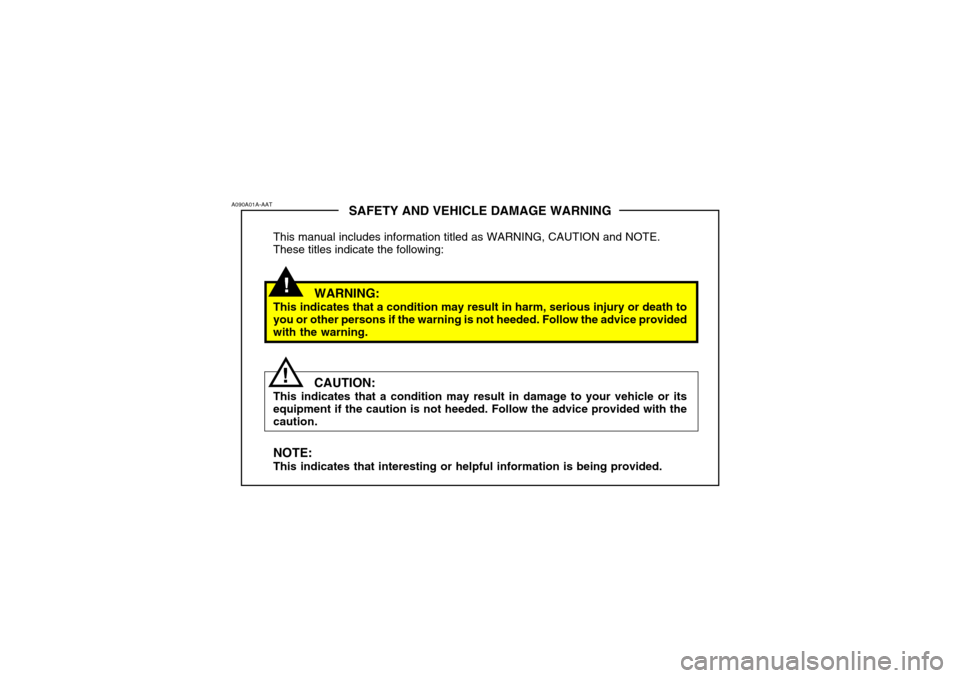
SAFETY AND VEHICLE DAMAGE WARNING
This manual includes information titled as WARNING, CAUTION and NOTE. These titles indicate the following:
WARNING:
This indicates that a condition may result in harm, serious injury or death to you or other persons if the warning is not heeded. Follow the advice provided with the warning.
CAUTION:
This indicates that a condition may result in damage to your vehicle or its equipment if the caution is not heeded. Follow the advice provided with the caution. NOTE: This indicates that interesting or helpful information is being provided.
A090A01A-AAT
!
Page 179 of 389
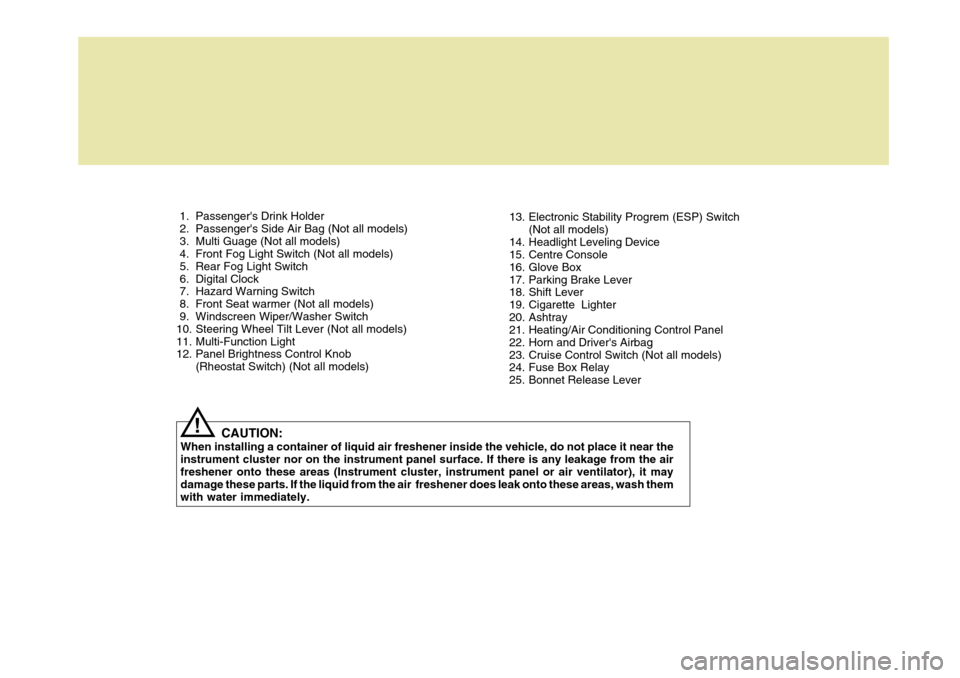
CAUTION:
When installing a container of liquid air freshener inside the vehicle, do not place it near the instrument cluster nor on the instrument panel surface. If there is any leakage from the air freshener onto these areas (Instrument cluster, instrument panel or air ventilator), it may damage these parts. If the liquid from the air freshener does leak onto these areas, wash themwith water immediately.!
1. Passenger's Drink Holder
2. Passenger's Side Air Bag (Not all models)
3. Multi Guage (Not all models)
4. Front Fog Light Switch (Not all models)
5. Rear Fog Light Switch
6. Digital Clock
7. Hazard Warning Switch
8. Front Seat warmer (Not all models)
9. Windscreen Wiper/Washer Switch
10. Steering Wheel Tilt Lever (Not all models)
11. Multi-Function Light
12. Panel Brightness Control Knob
(Rheostat Switch) (Not all models) 13. Electronic Stability Progrem (ESP) Switch
(Not all models)
14. Headlight Leveling Device
15. Centre Console
16. Glove Box
17. Parking Brake Lever
18. Shift Lever
19. Cigarette Lighter
20. Ashtray
21. Heating/Air Conditioning Control Panel
22. Horn and Driver's Airbag
23. Cruise Control Switch (Not all models)
24. Fuse Box Relay
25. Bonnet Release Lever
Page 180 of 389

YOUR VEHICLE AT A GLANCE
B255A01GK-EAT INDICATOR SYMBOLS ON THE INSTRUMENT PANEL * More detailed explanations of these items will be found beginning on page 1-40.
Malfunction Indicator Light (Not all models)
SRS (Airbag) Service Reminder Indicator (SRI)(Not all models)
Hatchback Door Open Warning Light
Low Fuel Level Warning Light
Door Ajar Warning Light (Not all models)
ABS Service Reminder Indicator (Not all models)
Turn Signal Indicator Lights
High Beam Indicator Light Low Oil Pressure Warning Light Parking Brake/Brake Fluid Level Warning Light Charging System Warning Light
Cruise Indicator (Not all models)
Seat Belt Warning Light
CRUISE SET Indicator Light (Not all models)
Electronic Stability Program (ESP) Indicator Light (Not all models)
Immobiliser Warning Light
Page 181 of 389
1
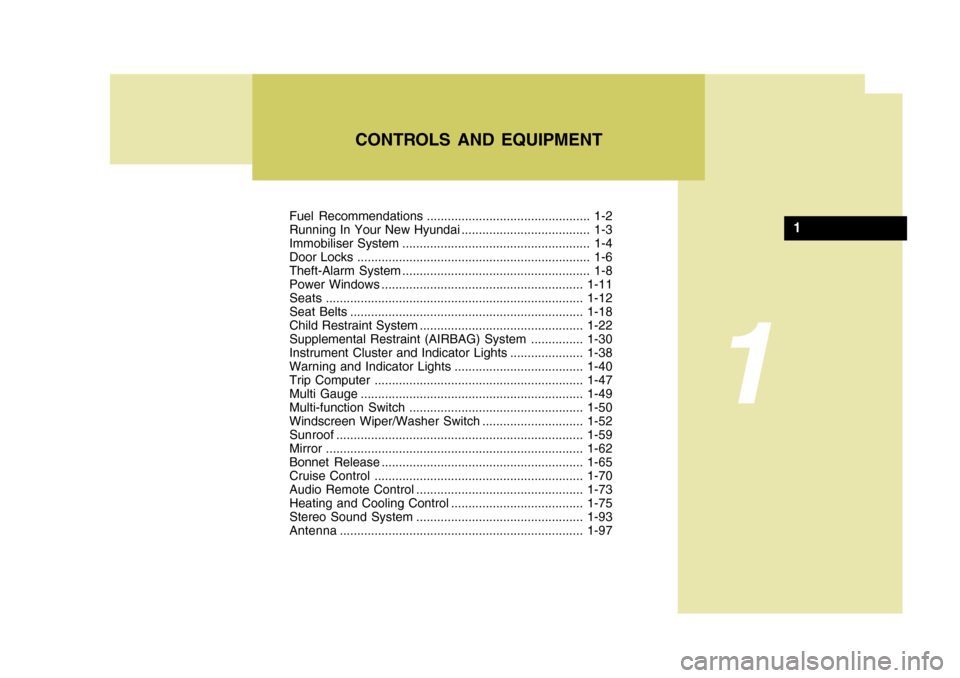
Fuel Recommendations ............................................... 1-2
Running In Your New Hyundai ..................................... 1-3
Immobiliser System ...................................................... 1-4
Door Locks ................................................................... 1-6
Theft-Alarm System ...................................................... 1-8
Power Windows ..........................................................1-11
Seats .......................................................................... 1-12
Seat Belts ................................................................... 1-18
Child Restraint System............................................... 1-22
Supplemental Restraint (AIRBAG) System ............... 1-30
Instrument Cluster and Indicator Lights ..................... 1-38
Warning and Indicator Lights ..................................... 1-40
Trip Computer ............................................................ 1-47
Multi Gauge ................................................................ 1-49
Multi-function Switch .................................................. 1-50
Windscreen Wiper/Washer Switch ............................. 1-52
Sunroof ....................................................................... 1-59
Mirror .......................................................................... 1-62
Bonnet Release .......................................................... 1-65
Cruise Control ............................................................ 1-70
Audio Remote Control ................................................ 1-73
Heating and Cooling Control ...................................... 1-75
Stereo Sound System ................................................ 1-93
Antenna ...................................................................... 1-97
CONTROLS AND EQUIPMENT
1
Page 183 of 389
1
CONTROLS AND EQUIPMENT
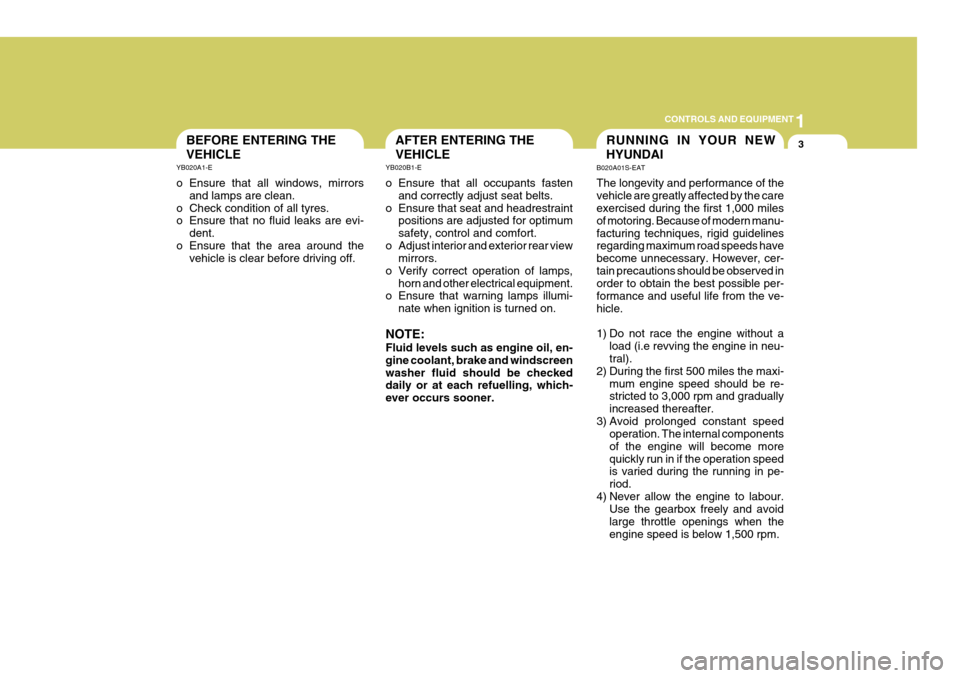
3RUNNING IN YOUR NEW HYUNDAI
B020A01S-EAT The longevity and performance of the vehicle are greatly affected by the care exercised during the first 1,000 miles of motoring. Because of modern manu-facturing techniques, rigid guidelines regarding maximum road speeds have become unnecessary. However, cer-tain precautions should be observed in order to obtain the best possible per- formance and useful life from the ve-hicle.
1) Do not race the engine without a
load (i.e revving the engine in neu- tral).
2) During the first 500 miles the maxi- mum engine speed should be re-stricted to 3,000 rpm and gradually increased thereafter.
3) Avoid prolonged constant speed operation. The internal componentsof the engine will become morequickly run in if the operation speed is varied during the running in pe- riod.
4) Never allow the engine to labour. Use the gearbox freely and avoidlarge throttle openings when theengine speed is below 1,500 rpm.BEFORE ENTERING THE VEHICLEAFTER ENTERING THE VEHICLE
YB020A1-E
o Ensure that all windows, mirrors
and lamps are clean.
o Check condition of all tyres.
o Ensure that no fluid leaks are evi-
dent.
o Ensure that the area around the vehicle is clear before driving off. YB020B1-E
o Ensure that all occupants fasten
and correctly adjust seat belts.
o Ensure that seat and headrestraint positions are adjusted for optimum safety, control and comfort.
o Adjust interior and exterior rear view mirrors.
o Verify correct operation of lamps, horn and other electrical equipment.
o Ensure that warning lamps illumi-
nate when ignition is turned on.
NOTE: Fluid levels such as engine oil, en- gine coolant, brake and windscreenwasher fluid should be checked daily or at each refuelling, which- ever occurs sooner.