warning Hyundai Coupe 2005 Owner's Manual
[x] Cancel search | Manufacturer: HYUNDAI, Model Year: 2005, Model line: Coupe, Model: Hyundai Coupe 2005Pages: 478, PDF Size: 13.44 MB
Page 382 of 478
2
DRIVING YOUR HYUNDAI
15
SC150A1-F You can save fuel and get more miles from your car if you follow these sug- gestions:
o Drive smoothly. Accelerate at a
moderate rate. Don't make "jack- rabbit" starts or full-throttle shiftsand maintain a steady cruising speed. Don't race between stop- lights. Try to adjust your speed tothat of the other traffic so you don't have to change speeds unneces- sarily.Avoid heavy traffic whenever pos- sible. Always maintain a safe dis- tance from other vehicles so youcan avoid unnecessary brak-ing. This also reduces brake wear.
o Drive at a moderate speed. The faster you drive, the more fuel yourcar uses. Driving at a moderate speed, especially on the highway, isone of the most effective ways to reduce fuel consumption.
DRIVING FOR ECONOMY
C310B01JM-AAT ESP ON/OFF Mode When the ESP is operating, the ESP indicator in the instrument cluster willblink. If you turn the system off by pressing the ESP switch, the ESP-OFF indica-tor will come on and stay on. In the ESP-OFF mode, the stability control will be deactivated. Adjust your drivingaccordingly. To turn the system back on, press the switch again. The ESP- OFF indicator should go off. NOTE: The ESP mode will automatically be turned ON after the engine is turnedoff and restarted. C310D01JM-EAT Indicators and Warning The indicators should illuminate when the ignition key is turned to ON orSTART but should go out after approxi- mately 3 seconds. If the indicators do not illuminate, or theESP or ESP-OFF indicator does not go out after approximately 3 seconds, have the vehicle checked by an authorizeddealer. Should there be any unusual conditions in the device while driving, ESP-OFF indicator illuminates as a warning. If ESP-OFF indicator illuminates, pullyour car to a safe place and stop the engine. Then, start the engine again to check ifthe ESP-OFF indicator goes out. If the indicator remains lit even after the engine has been started, have your car checked by an authorized Hyundai dealer.
gkfluk-2.p65
11/21/2005, 2:58 PM
15
Page 389 of 478
2DRIVING YOUR HYUNDAI
22
!WARNING:
Improper loading of your car and trailer can seriously affect its steer- ing and braking performance caus- ing a crash which could cause seri-ous injury or death. Without Brake Type
Maximum
Towable Weight
Trailer
1,212(550)
2,645(1,200) 3,086(1,400)
With Brake Type1.6 L
2.0/2.7 L Lbs. (Kg)
7. The vehicle/trailer combination is
more affected by crosswind and buffeting. When being passed by a large ve- hicle, keep a constant speed andsteer straight ahead. If there is too much wind buffeting, slow down to get out of the other vehicle's airturbulence.
8. When parking your car and trailer,
especially on a hill, be sure to followall the normal precautions. Turn your front wheels into the curb, set the parking brake firmly, and putthe transaxle in 1st or Reverse (manual) or Park (automatic). In addition, we advise the use of wheelchocks at each of the trailer's tires.
9. If the trailer has electric brakes,
start your vehicle and trailer mov-ing, and then apply the trailer brake controller by hand to be sure the brakes are working. This lets youcheck your electrical connection at the same time.
10.During your trip, check occasion- ally to be sure that the load issecure, and that the lights and any trailer brakes are still working.
YC200E1-E Trailer or Vehicle Towing Tips
1. Before towing, check towbar ball
and safety cable connections as well as proper operation of the trailer running lights, brake lights, and turn signals.
2. Always drive your vehicle at a mod- erate speed (Less than 60mph).
3. Trailer towing requires more fuel than normal conditions.
4. To maintain engine braking effi-
ciency, do not tow a trailer with thetransaxle engaged in an overdrive gear.
5. Always secure items in the trailer to prevent load shift while driving.
6. Check the condition and air pres-
sure of all tires on the trailer and your car. Low tire pressure can seriously affect the handling. Also check the spare tire.
gkfluk-2.p65 11/21/2005, 2:58 PM
22
Page 392 of 478
3 IN CASE OF EMERGENCY
2IF THE ENGINE WILL NOT START
!
SD020A1-E Seek assistance from the nearest Hyundai authorised repairer with regard to the method of ignition and fuel sys- tem diagnosis.
WARNING:
If the engine refuses to start, noattempt should be made to push ortow start the vehicle. Vehicles with automatic transaxle or fuel injec- tion will not be able to be started in this manner since no drive is trans- mitted through the automatictransaxle whilst the engine is not running, and in the case of fuel injected derivatives, the fuel pumpwill not operate under tow start conditions. In addition, if the ve- hicle is equipped with an exhaustcatalyst, damage to the catalyst may result if the vehicle is tow started. SD020B1-E IF THE ENGINE CANNOT BE CRANKED
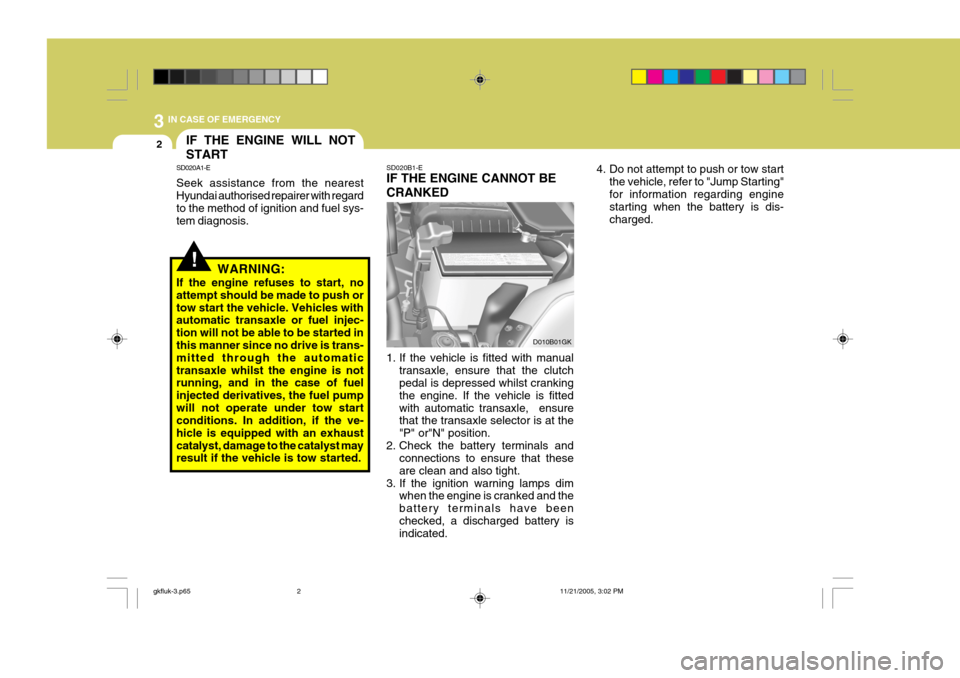
1. If the vehicle is fitted with manual
transaxle, ensure that the clutch pedal is depressed whilst cranking the engine. If the vehicle is fittedwith automatic transaxle, ensure that the transaxle selector is at the "P" or"N" position.
2. Check the battery terminals and connections to ensure that theseare clean and also tight.
3. If the ignition warning lamps dim when the engine is cranked and thebattery terminals have beenchecked, a discharged battery is indicated. D010B01GK
4. Do not attempt to push or tow start
the vehicle, refer to "Jump Starting" for information regarding engine starting when the battery is dis- charged.
gkfluk-3.p65 11/21/2005, 3:02 PM
2
Page 393 of 478
3
IN CASE OF EMERGENCY
3
!
!
D010C01A-EAT If Engine Turns Over Normally but Does Not Start
1. Check fuel level.
2. With the key in the off position,
Check all connectors at ignition coils and spark plugs. Reconnect any that may be disconnected or loose.
3. Check the fuel line in the engine room.
4. If engine still refuses to start, call a Hyundai authorised repairer or seek other qualified assistance.
D010D01A-EAT If Engine Stalls While Driving
1. Reduce your speed gradually, keep- ing a straight line. Move cautiously off the road to a safe place.
2. Turn on your hazard lamp.
3. Try to start the engine again. If your vehicle will not start, contact aHyundai authorised repairer or seekother qualified assistance. SD030A2-E
CAUTION:
Personal injury and damage to thevehicle may occur if jump startingis not performed correctly. If any doubt exists as to how this opera- tion should be performed, seek as-sistance from qualified personnel.
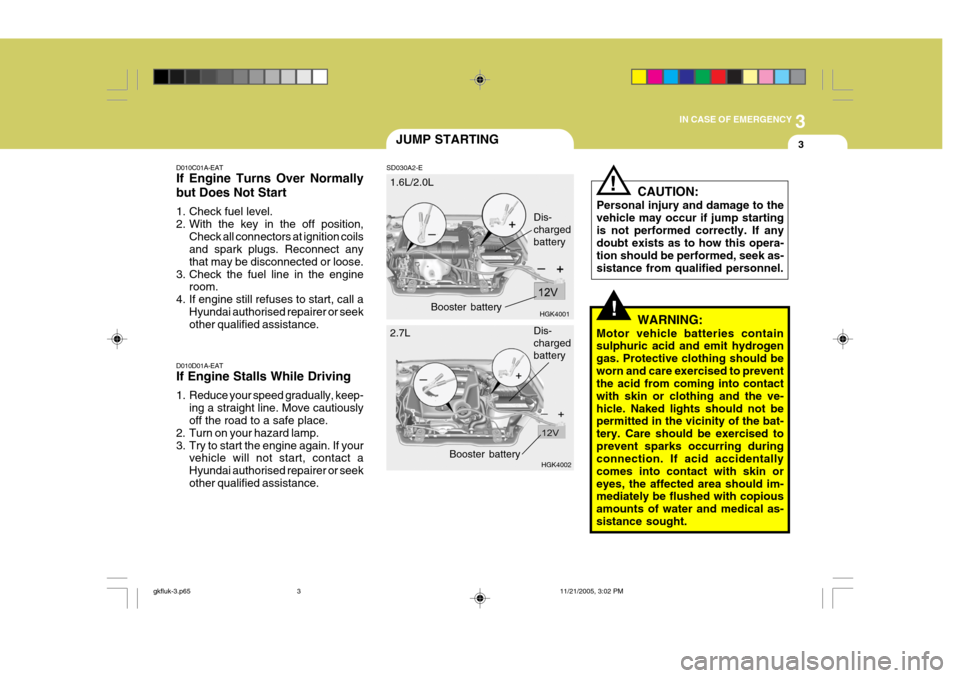
JUMP STARTING
WARNING:
Motor vehicle batteries contain sulphuric acid and emit hydrogen gas. Protective clothing should beworn and care exercised to prevent the acid from coming into contact with skin or clothing and the ve-hicle. Naked lights should not be permitted in the vicinity of the bat- tery. Care should be exercised toprevent sparks occurring during connection. If acid accidentally comes into contact with skin oreyes, the affected area should im- mediately be flushed with copious amounts of water and medical as-sistance sought.
1.6L/2.0L
HGK4001
HGK4002
Dis- chargedbattery
2.7L Booster battery
Dis- chargedbattery
Booster battery
gkfluk-3.p65 11/21/2005, 3:02 PM
3
Page 395 of 478
3
IN CASE OF EMERGENCY
5
!
!WARNING:
Whilst the engine is running, keep hands and clothing away from mov- ing parts such as the fan and drive belts to prevent injury.
5. If the water pump drive belt is broken or coolant is leaking out, stop the engine immediately and call the near- est Hyundai authorised repairer forassistance.
WARNING:
Do not remove the radiator cap when the engine is hot since steam and boiling water may be ejected fromthe radiator resulting in burns or scalding.
!
6. If the cause of the overheating can- not be found, wait until the engine temperature has returned to normal. Then, if coolant has been lost, care- fully add coolant to the reservoir(page 6-11) to bring the fluid level in the reservoir up to the base of the radiator fill opening. Fill the coolantexpansion tank to the halfway mark. To ensure the correct water to cool- ant mix is obtained after top up,testing by an authorised repairer is required.
7. Proceed with caution until it is estab- lished that the engine is operatingnormally. If the engine overheats repeatedly, the advice of a Hyundaiauthorised repairer should be sought.
CAUTION:
Serious loss of coolant indicates there is a leak in the cooling system and this should be checked as soonas possible by a Hyundai authorised repairer.D040A01GK-EAT TEMPORARY SPARE TYRE The following instructions for the tem- porary spare tyre should be observed:
1. Check inflation pressure as soon as practical after installing the spare tyre, and adjust to the specified pressure. The tyre pressure should be periodically checked and main-tained at the specified pressure while the tyre is stored.
2. The spare tyre should only be used temporarily and should be returnedto the luggage compartment as soon as the original tyre can be repairedor replaced.
SPARE TYRE
Tyre Size
Inflation Pressure T125/70 R16
420 kPa (60 psi)
Spare Tyre Pressure
3. Continuous use at speeds of over 50 mph (80 km/h) is not recom- mended.
4. As the temporary spare tyre is spe-
cifically designed for your car, itshould not be used on any other vehicle.
gkfluk-3.p65 11/21/2005, 3:02 PM
5
Page 399 of 478
3
IN CASE OF EMERGENCY
9
!WARNING:
Do not get under the car when it is supported by the jack! The jack is solely designed for wheel chang- ing and is not intended to supportthe vehicle for other purposes. The use of purpose designed supports is necessary whilst the vehicle israised and the operator is required to get underneath.
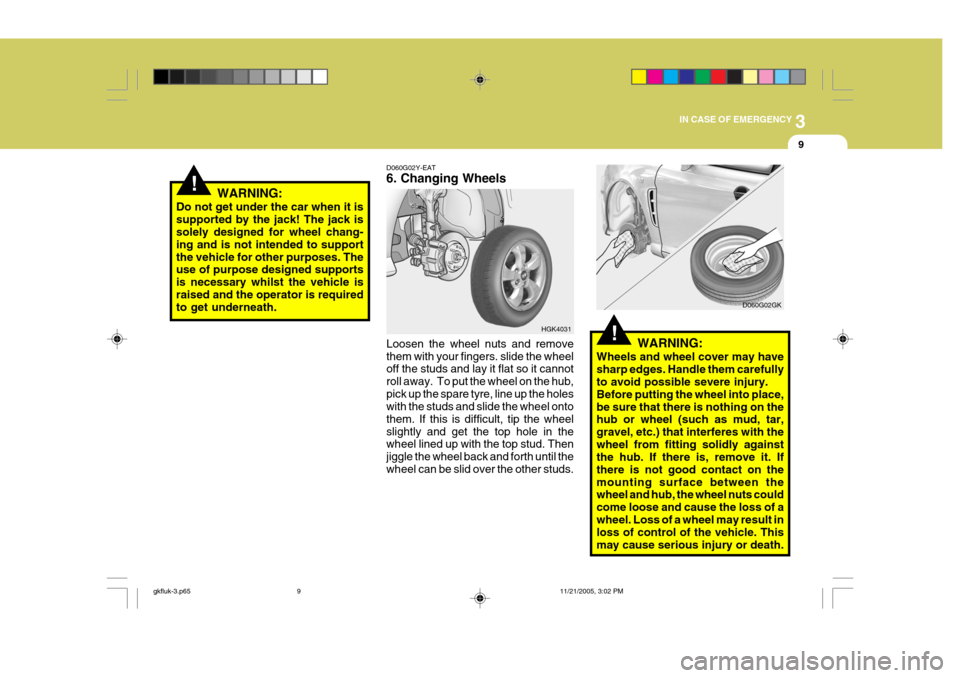
Loosen the wheel nuts and remove them with your fingers. slide the wheel off the studs and lay it flat so it cannot roll away. To put the wheel on the hub,pick up the spare tyre, line up the holes with the studs and slide the wheel onto them. If this is difficult, tip the wheelslightly and get the top hole in the wheel lined up with the top stud. Then jiggle the wheel back and forth until thewheel can be slid over the other studs.
HGK4031
D060G02Y-EAT 6. Changing Wheels!WARNING:
Wheels and wheel cover may have sharp edges. Handle them carefully to avoid possible severe injury. Before putting the wheel into place,be sure that there is nothing on the hub or wheel (such as mud, tar, gravel, etc.) that interferes with thewheel from fitting solidly against the hub. If there is, remove it. If there is not good contact on themounting surface between the wheel and hub, the wheel nuts could come loose and cause the loss of awheel. Loss of a wheel may result in loss of control of the vehicle. This may cause serious injury or death. D060G02GK
gkfluk-3.p65
11/21/2005, 3:02 PM
9
Page 423 of 478
6
OWNER MAINTENANCE
5ENGINE OIL
SG030A1-E The correct engine oil level is of para-
mount importance. An excessively high or low oil level may result inirreparable damage being sustained by the engine. The engine oil level must be checked on a daily basis orwhenever the vehicle is refuelled, whichever occurs sooner.
In addition, it is imperative that only
an approved grade and specificationof oil is used to avoid the possibility of serious engine damage and prema-ture wear. The use of "budget price" oil is a false economy that must be avoided if the maximum reliability anduseful life is to be obtained from the vehicle.
SG020B1-E The following items should be checked on a daily basis or whenever the vehicle is refuelled, whichever occurssooner.
o Engine oil level.
o Engine coolant level.
o Power steering fluid level.
o Brake fluid level.
o Windscreen washer fluid level.
o Battery condition.
o Tyre condition and pressures.
o Operation and cleanliness of all lighting equip-ment.
o Windscreen wiper and washer op-
eration.
o Horn operation.
o Warning lamp operation.
o Adjustment and cleanliness of mir- rors.
o Seat and seat belt adjustment and operation.
o Fluid leakage.
The vehicle must not be driven if the daily operating checks indicate that any item of equipment related to the safety or roadworthiness of the ve-hicle is not functioning correctly. DAILY OPERATING CHECKS
G030B02O-EAT Recommended Oil
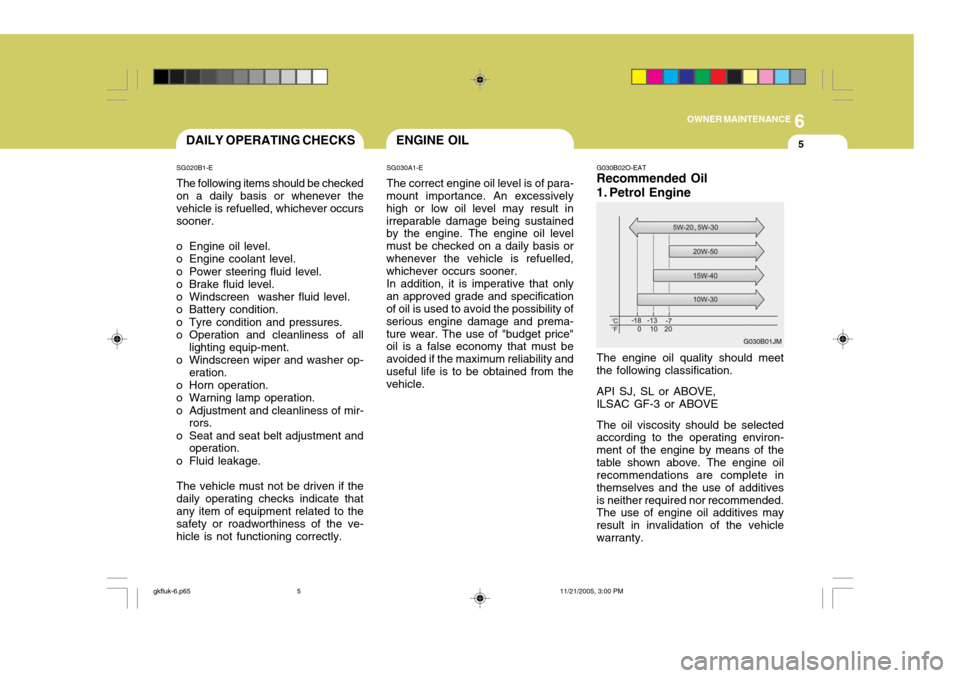
1. Petrol Engine The engine oil quality should meet the following classification. API SJ, SL or ABOVE, ILSAC GF-3 or ABOVE The oil viscosity should be selected according to the operating environ- ment of the engine by means of thetable shown above. The engine oil recommendations are complete in themselves and the use of additivesis neither required nor recommended. The use of engine oil additives may result in invalidation of the vehiclewarranty.
G030B01JM
gkfluk-6.p6511/21/2005, 3:00 PM
5
Page 424 of 478
6OWNER MAINTENANCE
6
SG030C2-E
Engine Oil Level
The engine oil level should be checked
with the engine at normal operating temperature and the vehicle parked upon level ground.
Prior to checking the level, the ve-
hicle should be allowed to stand forseveral minutes after the engine has been switched off to allow the oil todrain back to the sump. Withdraw the dipstick and wipe it with
a clean rag. Replace the dipstick fully and withdraw again when the oil level may be read from the stick.
!
HGK5004
1.6L/2.0L
2.7LNormal oil level is indicated when the
oil is present between the two marks on the stick. It is not necessary to add oil if the level is above the lower mark and in any case, oil must not beadded to the degree that the level exceeds the upper mark. Replace the dipstick fully after checking the level.
WARNING:
Be very careful not to touch the
radiator hose when checking the engine oil as it may be hot enough to burn you.
NOTE: SAE 5W-20 (5W-30), ILSAC GF-3 engine oil is preferred regardlessof regional option and engine varia- tion. If SAE 5W-20, ILSAC GF-3 engine oil is not available, sec-ondary recommended engine oil for corresponding temperature range can be used.
gkfluk-6.p65
11/21/2005, 3:00 PM
6
Page 425 of 478
6
OWNER MAINTENANCE
7
HGK5005
SG030D2-E
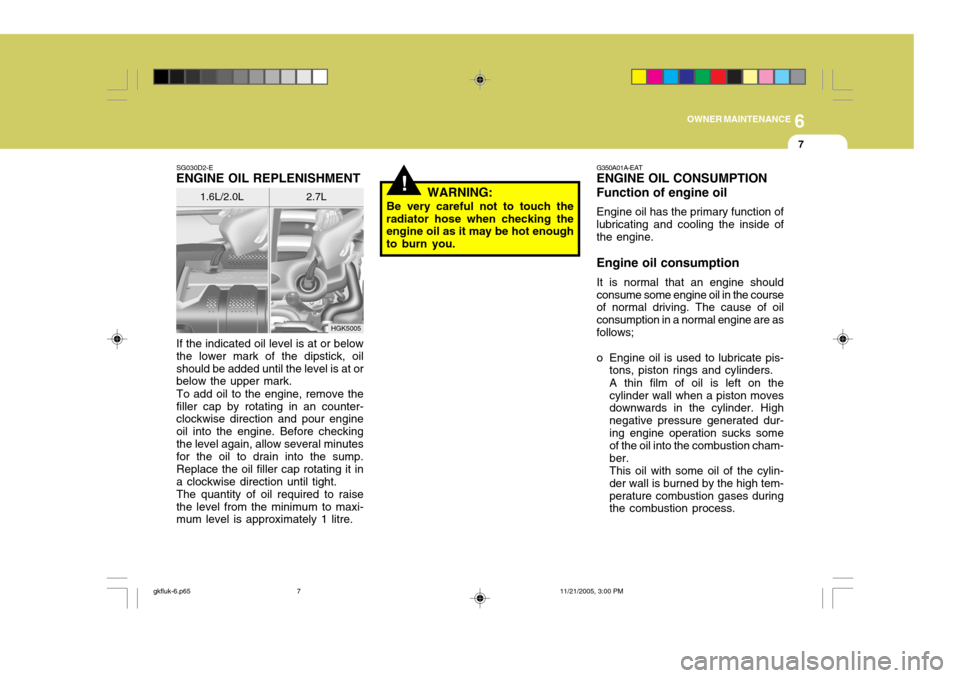
ENGINE OIL REPLENISHMENT
If the indicated oil level is at or below the lower mark of the dipstick, oilshould be added until the level is at or below the upper mark. To add oil to the engine, remove the filler cap by rotating in an counter- clockwise direction and pour engine oil into the engine. Before checkingthe level again, allow several minutes for the oil to drain into the sump. Replace the oil filler cap rotating it ina clockwise direction until tight.The quantity of oil required to raisethe level from the minimum to maxi- mum level is approximately 1 litre. 1.6L/2.0L
G350A01A-EAT ENGINE OIL CONSUMPTION Function of engine oil Engine oil has the primary function of lubricating and cooling the inside of the engine. Engine oil consumption It is normal that an engine should consume some engine oil in the course of normal driving. The cause of oil consumption in a normal engine are asfollows;
o Engine oil is used to lubricate pis-
tons, piston rings and cylinders. A thin film of oil is left on the cylinder wall when a piston moves downwards in the cylinder. High negative pressure generated dur-ing engine operation sucks some of the oil into the combustion cham- ber.This oil with some oil of the cylin-der wall is burned by the high tem-perature combustion gases during the combustion process.
2.7L
!WARNING:
Be very careful not to touch the
radiator hose when checking the engine oil as it may be hot enough to burn you.
gkfluk-6.p65 11/21/2005, 3:00 PM
7
Page 427 of 478
6
OWNER MAINTENANCE
9
!
3. Prepare a suitable receptacle to
collect the displaced oil and re- move the drain plug from the sump.
WARNING:
The oil being drained from the
engine will be hot. Care should beexercised to prevent scalding. 6. Install a new oil filter having
smeared the sealing ring with cleanoil and rotating clockwise until the filter contacts the mounting and then a further one half turn. Do notover-tighten. Tightening torque: 1.2 ~ 1.6 kgf.m
7. Remove the engine oil level dip- stick.
8. Pour the specified quantity of the recom-mended oil into the engine and replace the filler cap. Start theengine and ensure that no oil leaks exist. Turn off the engine and after a couple minutes, recheck the oillevel.
4. When the oil has drained from the
sump, replace the drain plug usinga new gasket ensuring that the plug is not over tightened. Tightening torque: 4.5 ~ 4.0 kgf.m (1.6/2.0L) 4.5 ~ 3.5 kgf.m (2.7L)
5. Remove the oil filter by rotating counterclock-wise, using a propri-etary oil filter removal tool if neces- sary. Note that the oil filter will contain approximately 0.5 litres ofoil and this should be collected in a suitable receptacle. WARNING:
Prolonged and repeated contact with used engine oils may result inserious skin disorders including dermatitis and cancer. Avoid con- tact with skin as far as possibleand always wash thoroughly after any contact. Keep used oils out of reach of children. It is illegal topollute drains, water courses and soil. Use only authorized waste collection facilities including civic amenity sites and garages for the disposal of used oil and oil filters.If in doubt, contact the local au- thority for disposal instructions.
!
gkfluk-6.p65 11/21/2005, 3:00 PM
9