warning Hyundai Coupe 2005 Owners Manual
[x] Cancel search | Manufacturer: HYUNDAI, Model Year: 2005, Model line: Coupe, Model: Hyundai Coupe 2005Pages: 478, PDF Size: 13.44 MB
Page 288 of 478
1
CONTROLS AND EQUIPMENT
17
!WARNING:
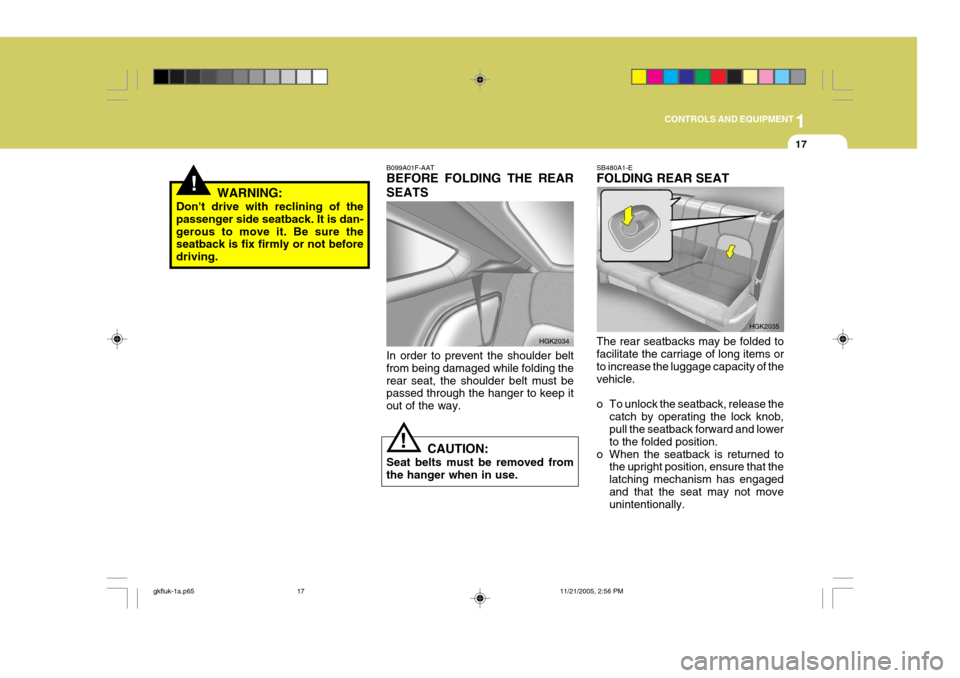
Don't drive with reclining of the passenger side seatback. It is dan-gerous to move it. Be sure the seatback is fix firmly or not before driving. SB480A1-E FOLDING REAR SEAT The rear seatbacks may be folded to facilitate the carriage of long items or to increase the luggage capacity of thevehicle.
o To unlock the seatback, release the
catch by operating the lock knob, pull the seatback forward and lower to the folded position.
o When the seatback is returned to the upright position, ensure that thelatching mechanism has engagedand that the seat may not move unintentionally.
B099A01F-AAT BEFORE FOLDING THE REAR SEATS In order to prevent the shoulder belt from being damaged while folding therear seat, the shoulder belt must be passed through the hanger to keep it out of the way.
HGK2034
HGK2035
CAUTION:
Seat belts must be removed from the hanger when in use.
!
gkfluk-1a.p65 11/21/2005, 2:56 PM
17
Page 289 of 478
1CONTROLS AND EQUIPMENT
18
SB090B1-E Babies/Small Children Babies and small children must be restrained using a restraint system specifically designed for this purpose. Under no circumstances should a childbe carried in the vehicle without the use of a suitable restraint which meets the regulations in force in the countrywhere the vehicle is in operation.
SEAT BELTS
!WARNING:
The folding rear seats are intended to allow the carriage of longer ob- jects than could otherwise be ac-commodated. Do not allow passen- gers to sit on top of the folded- down seatback whilst the car is inmotion since the folded seat does not provide a suitable sitting facil- ity and no seat belts are availablefor use. Objects carried on the folded seatback should not extend higher than the top of the frontseats and must be securely re- strained to prevent injury or dam- age during sudden deceleration. SB500A1-E REAR PARCEL SHELF Large or heavy items must not be placed upon the rear parcel shelf to prevent the possibility of injury arisingfrom such items in the event of impact.
SB090A1-E SEAT BELT PRECAUTIONS Seat belts should be worn at all times by all occupants front and rear. Thepossibility of injury or the severity of injuries suffered in the event of an accident will be greatly reduced by thewearing of seat belts. In addition the following recommenda- tions should be observed.
B140A01GK
o Luggage which is carried within the
passenger compartment must besecurely restrained in order to pre- vent injury in the event of sudden deceleration.
gkfluk-1a.p65 11/21/2005, 2:56 PM
18
Page 290 of 478
1
CONTROLS AND EQUIPMENT
19
WARNING:
Sitting in a reclined position or ly- ing down when your vehicle is in motion can be dangerous. Even if you buckle up, your seat belts can'tdo their job when you're reclined. The shoulder belt can't do its job because it won't be against yourbody. Instead, it will be in front of you. In a crash you could go into it with great force, receiving seriousneck or other injuries. The lap belt can't do its job either. In a crash the belt could go up over your abdomen. The belt forces would be applied there, not at yourstrong pelvic bones. This could cause serious internal injuries. For proper protection when the ve-hicle is in motion, have the seatback upright. Then sit back in the seat and wear your seat belt properly.See page 1-21.
SB090C1-E Larger Children Larger children should occupy the rear seat and be restrained at all times. Therestraint may take the form of a special safety belt or the original factory fitted seat belt used in conjunction with anapproved booster cushion depending upon the size and weight of the child. Under no circumstances should chil-dren be allowed to travel standing, kneeling or lying on the seat. Never allow children to ride in the frontpassenger seat. SB090O1-E Pregnant Women The use of a seat belt is recommended for pregnant women. The seat belt should be worn as low and snugly as possible across the hips, not acrossthe abdomen. A qualified Medical Prac- titioner should be consulted for further information. SB090E1-E Injured Persons A seat belt should be used when an injured person is being transported.For specific recommendations, the advice of a qualified Medical Practioner should be sought. SB090F1-E Seat Belt Occupancy The seat belts are designed to be used by one seat occupant only. The use of a seat belt by more than one person increases the levels of injury which may be sustained in the event of anaccident.!
SE090G1-E Do Not Lie Down To ensure that the maximum level of protection may be afforded by the seat belt system, all passengers should besitting in an upright position throughout the journey. The seat belt will be un- able to afford maximum protection ifthe front seats are at or near the fully reclined position.
gkfluk-1a.p65
11/21/2005, 2:56 PM
19
Page 292 of 478
1
CONTROLS AND EQUIPMENT
21
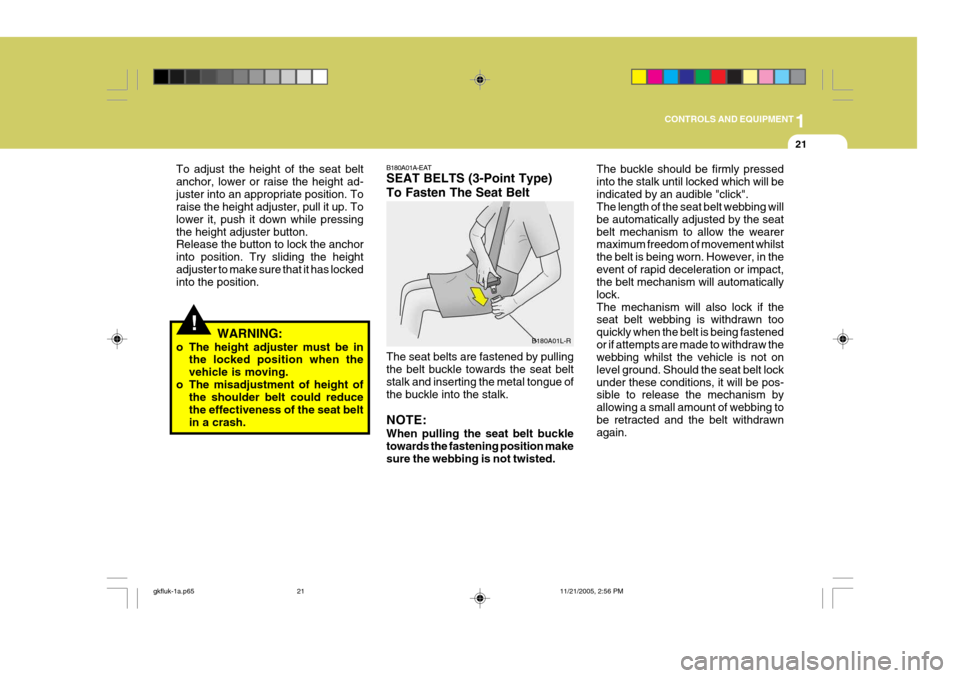
B180A01A-EAT SEAT BELTS (3-Point Type) To Fasten The Seat Belt The seat belts are fastened by pulling the belt buckle towards the seat belt stalk and inserting the metal tongue ofthe buckle into the stalk. NOTE: When pulling the seat belt buckle towards the fastening position make sure the webbing is not twisted. B180A01L-R
!
To adjust the height of the seat belt anchor, lower or raise the height ad-juster into an appropriate position. To raise the height adjuster, pull it up. To lower it, push it down while pressingthe height adjuster button. Release the button to lock the anchor into position. Try sliding the heightadjuster to make sure that it has locked into the position.
WARNING:
o The height adjuster must be in the locked position when the vehicle is moving.
o The misadjustment of height of the shoulder belt could reducethe effectiveness of the seat beltin a crash. The buckle should be firmly pressedinto the stalk until locked which will beindicated by an audible "click". The length of the seat belt webbing will be automatically adjusted by the seatbelt mechanism to allow the wearer maximum freedom of movement whilst the belt is being worn. However, in theevent of rapid deceleration or impact, the belt mechanism will automatically lock.The mechanism will also lock if the seat belt webbing is withdrawn too quickly when the belt is being fastenedor if attempts are made to withdraw the webbing whilst the vehicle is not on level ground. Should the seat belt lockunder these conditions, it will be pos- sible to release the mechanism by allowing a small amount of webbing tobe retracted and the belt withdrawn again.
gkfluk-1a.p65
11/21/2005, 2:56 PM
21
Page 294 of 478
1
CONTROLS AND EQUIPMENT
23
!WARNING:
o A child restraint system must be placed in the rear seat. Never install a child or infant seat on the front passenger's seat.Should an accident occur and cause the passenger side airbag to deploy, it could severely in-jure or kill an infant or child seated in an infant or child seat. Thus, only use a child restraint in therear seat of your vehicle.
o Since a safety belt or child re-
straint system can become very hot if it is left in a closed vehicle, be sure to check the seat coverand buckles before placing a child there.
o When the child restraint system is not in use, store it in the lug-gage compartment or fasten it with a safety belt so that it willnot be thrown forward in the case of a sudden stop or an accident. o Never use an infant carrier or child
safety seat that "hooks" over aseatback; it may not provide ad- equate security in an accident.
o Never allow a child to be held in a person's arms whilst they are in amoving vehicle, as this could re-sult in serious injury to the child in the event of an accident or a sudden stop. Holding a child in amoving vehicle does not provide the child with any means of pro- tection during an accident, even ifthe person holding the child is wearing a seat belt.
o If the child restraint seat is not
anchored properly, the risk of achild being seriously injured or killed in a collision greatly in-creases.
o Children who are too large to be in
a child restraint should sit in therear seat and be restrained with the available lap/shoulder belts. Never allow children to ride in thefront passanger seat.
o Always make sure that the shoul-
der belt portion of the outboardlap/shoulder belt is positioned midway over the shoulder, never across the neck. Moving the childcloser to the centre of the vehicle may help provide a good shoul- der belt fit. The lap belt portion ofthe lap/shoulder belt or the cen- tre seat lap belt must always be positioned as low as possible onthe child's hips and as snug as possible.
o If the seat belt will not properly fit the child, we recommend the useof an approved booster seat in the rear seat in order to raise thechild's seating height so that the seat belt will properly fit the child.
o Never allow a child to stand up or kneel on the seat.
gkfluk-1a.p65 11/21/2005, 2:56 PM
23
Page 295 of 478
1CONTROLS AND EQUIPMENT
24
!
If you need to tighten the belt, pull more webbing toward the retractor.When you unbuckle the seat belt and allow it to retract, the retractor will automatically revert back to its normalseated passenger emergency locking usage condition. NOTE:
o Before installing the child re-
straint system, read the instruc- tions supplied by the child re- straint system manufacturer.
o If the seat belt does not operate
as described, have the systemchecked immediately by your Hyundai authorised repairer.
WARNING:
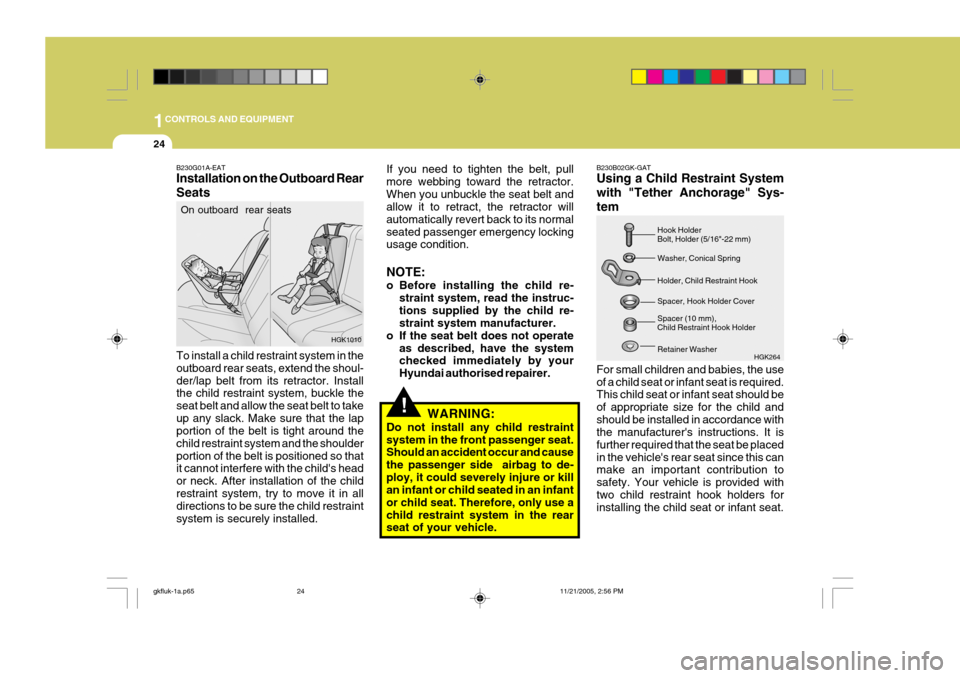
Do not install any child restraintsystem in the front passenger seat. Should an accident occur and cause the passenger side airbag to de-ploy, it could severely injure or kill an infant or child seated in an infant or child seat. Therefore, only use achild restraint system in the rear seat of your vehicle. B230B02GK-GAT Using a Child Restraint System with "Tether Anchorage" Sys-tem For small children and babies, the use of a child seat or infant seat is required. This child seat or infant seat should be of appropriate size for the child andshould be installed in accordance with the manufacturer's instructions. It is further required that the seat be placedin the vehicle's rear seat since this can make an important contribution to safety. Your vehicle is provided withtwo child restraint hook holders for installing the child seat or infant seat.
HGK264
Hook Holder Bolt, Holder (5/16"-22 mm) Washer, Conical Spring Holder, Child Restraint Hook Spacer, Hook Holder Cover Spacer (10 mm), Child Restraint Hook Holder Retainer Washer
B230G01A-EAT Installation on the Outboard Rear Seats To install a child restraint system in the outboard rear seats, extend the shoul-der/lap belt from its retractor. Install the child restraint system, buckle the seat belt and allow the seat belt to takeup any slack. Make sure that the lap portion of the belt is tight around the child restraint system and the shoulderportion of the belt is positioned so that it cannot interfere with the child's head or neck. After installation of the childrestraint system, try to move it in all directions to be sure the child restraint system is securely installed.On outboard rear seats
HGK1010
gkfluk-1a.p65 11/21/2005, 2:56 PM
24
Page 298 of 478
1
CONTROLS AND EQUIPMENT
27
!WARNING:
o There is no rear centre seating position.
o Do not install a child restraint seat at the center of the rear seat using the vehicle's ISOFIX anchors. TheISOFIX anchors are only provided for the left and right outboard rear seating positions. Do not misusethe ISOFIX anchors by attempting to attach a child restraint seat in the middle of the rear seat to theISOFIX anchors. In a crash, the child restraint seat ISOFIX attach- ments may not be strong enoughto secure the child restraint seat properly in the center of the rear seat and may break, causing se-rious injury or death.
o When using the vehicle’s
“ISOFIX” system to install a childrestraint system in the rear seat, all unused vehicle rear seat belt metal latch plates or tabs must belatched securely in their seat belt buckles and the seat belt web- bing must be retracted behind the child restraint to
prevent the child
from reaching and taking hold of
unretracted seat belts. Unlatched metal latch plates or tabs may allow the child to reach theunretracted seat belts which may result in strangulation and a seri- ous injury or death to the child inthe child restraint.
o Do not mount more than one child
restraint to a child restraint loweranchorage point. Over-loading may cause the anchorage points or tether anchor to break, causingserious injury or death.
o Attach the ISOFIX or ISOFIX-com-
patible child restraint seat onlyto the appropriate locations shown in the illustration.
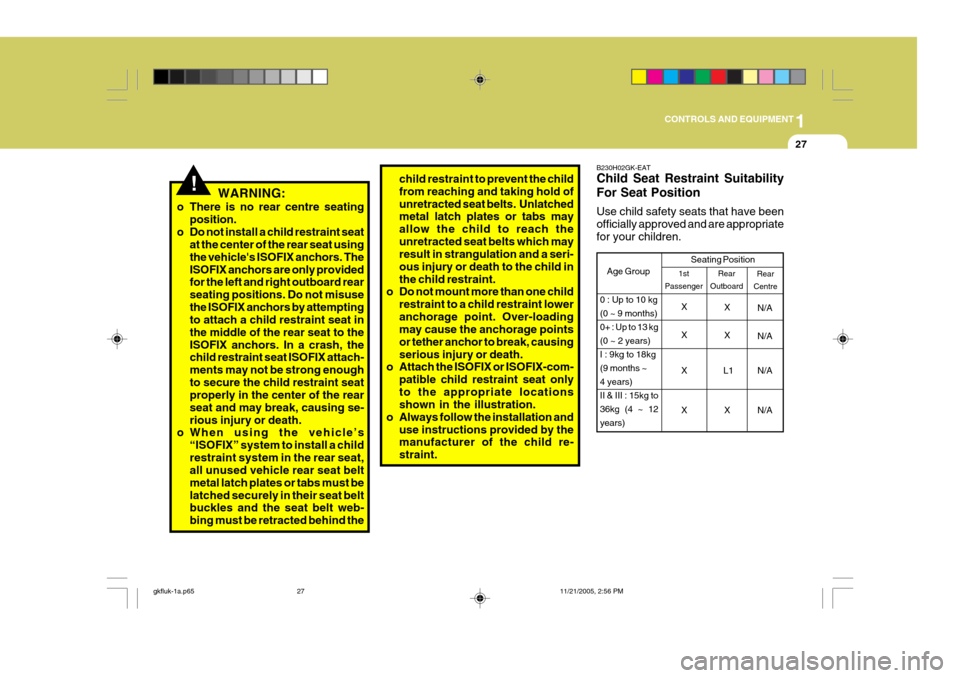
o Always follow the installation and use instructions provided by themanufacturer of the child re- straint. B230H02GK-EAT Child Seat Restraint Suitability For Seat Position Use child safety seats that have been officially approved and are appropriatefor your children.
Rear
Centre
Age Group Seating Position
X
N/A
X X
N/A
X L1 N/A
X X N/A Rear
Outboard
1st
Passenger
0 : Up to 10 kg (0 ~ 9 months)0+ : Up to 13 kg(0 ~ 2 years)I : 9kg to 18kg(9 months ~4 years)II & III : 15kg to36kg (4 ~ 12years) X
gkfluk-1a.p65
11/21/2005, 2:56 PM
27
Page 300 of 478
1
CONTROLS AND EQUIPMENT
29
!
!
NOTE:
o Both the driver's and front
passenger's pre-tensioner seat belts will be activated in certainfrontal collisions. The pre- tensioner seat belts can be acti- vated alone or, where the frontalcollision is severe enough, to- gether with the airbags.
o When the pre-tensioner seat belts are activated, a loud noise maybe heard and fine dust, which may appear to be smoke, may bevisible in the passenger compart- ment. These are normal operat- ing conditions and are not haz-ardous.
o Although it is harmless, the fine
dust may cause skin irritationand should not be breathed for prolonged periods. Wash your hands and face thoroughly afteran accident in which the pre- tensioner seat belts were acti- vated. CAUTION:
o Because the sensor that activates the SRS airbag is connected withpre-tensioner seat belt, the SRSairbag warning light on the instrument panel will come on for approximately 6 seconds af-ter the ignition key has been turned to the "ON" position, and then it should turn off.
o If pre-tensioner seat belt is not working properly, this warninglight will illuminate even if the SRS system is not functioning. If the SRS airbag warning light doesnot illuminate when the ignition key is turned to "ON", or if it re- mains illuminated after comingfor approximately 6 seconds, or if it illuminates while the vehicle is being driven, please have aHyundai authorised repairer in- spect the pre-tensioner seat belts and SRS airbag system as soon aspossible.
AIR
BAG
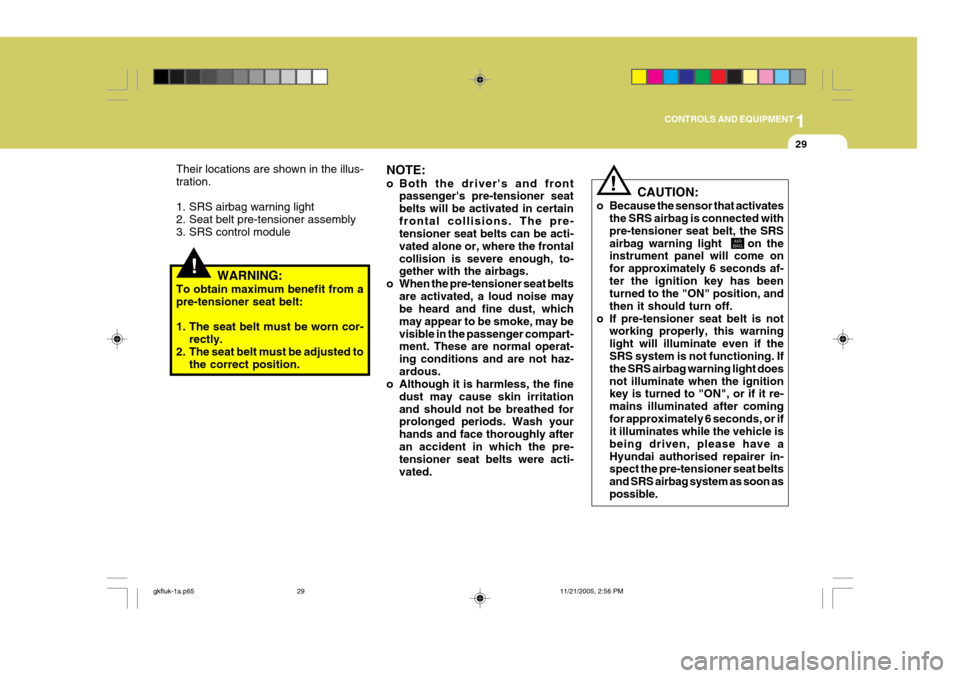
Their locations are shown in the illus- tration.
1. SRS airbag warning light
2. Seat belt pre-tensioner assembly
3. SRS control module
WARNING:
To obtain maximum benefit from apre-tensioner seat belt:
1. The seat belt must be worn cor- rectly.
2. The seat belt must be adjusted to
the correct position.
gkfluk-1a.p65 11/21/2005, 2:56 PM
29
Page 301 of 478
1CONTROLS AND EQUIPMENT
30
o Improper handling of the pre-
tensioner seat belt assemblies, and failure to heed the warnings to not strike, modify, inspect, re-place, service or repair the pre- tensioner seat belt assemblies may lead to improper operationor inadvertent activation and se- rious injury.
o Always wear seat belts when driv- ing or riding in a motor vehicle.
SUPPLEMENTAL RESTRAINT (AIRBAG) SYSTEM (SRS)
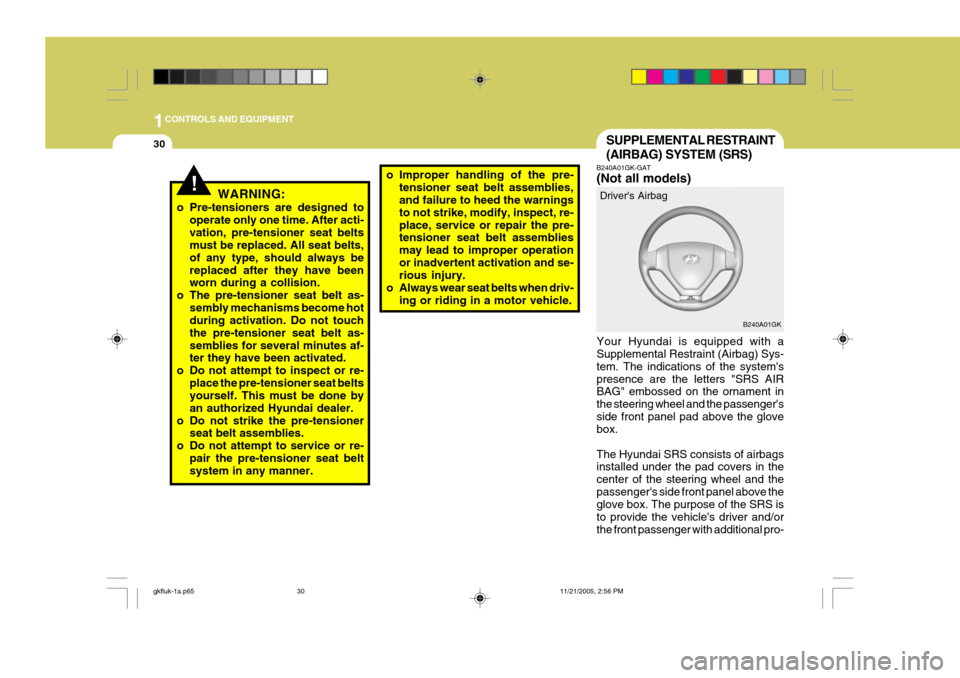
B240A01GK-GAT (Not all models) Your Hyundai is equipped with a Supplemental Restraint (Airbag) Sys- tem. The indications of the system'spresence are the letters "SRS AIR BAG" embossed on the ornament in the steering wheel and the passenger'sside front panel pad above the glove box. The Hyundai SRS consists of airbags installed under the pad covers in the center of the steering wheel and thepassenger's side front panel above the glove box. The purpose of the SRS is to provide the vehicle's driver and/orthe front passenger with additional pro- Driver's Airbag
B240A01GK
!WARNING:
o Pre-tensioners are designed to operate only one time. After acti- vation, pre-tensioner seat belts must be replaced. All seat belts, of any type, should always bereplaced after they have been worn during a collision.
o The pre-tensioner seat belt as- sembly mechanisms become hotduring activation. Do not touch the pre-tensioner seat belt as-semblies for several minutes af- ter they have been activated.
o Do not attempt to inspect or re- place the pre-tensioner seat beltsyourself. This must be done by an authorized Hyundai dealer.
o Do not strike the pre-tensioner seat belt assemblies.
o Do not attempt to service or re- pair the pre-tensioner seat belt system in any manner.
gkfluk-1a.p65 11/21/2005, 2:56 PM
30
Page 302 of 478
1
CONTROLS AND EQUIPMENT
31
!
tection than that offered by the seat belt system alone, in case of a frontalimpact of sufficient severity. NOTE: Be sure to read information about the SRS on the labels provided onthe front side of the sun visor and in the glove box.
WARNING:
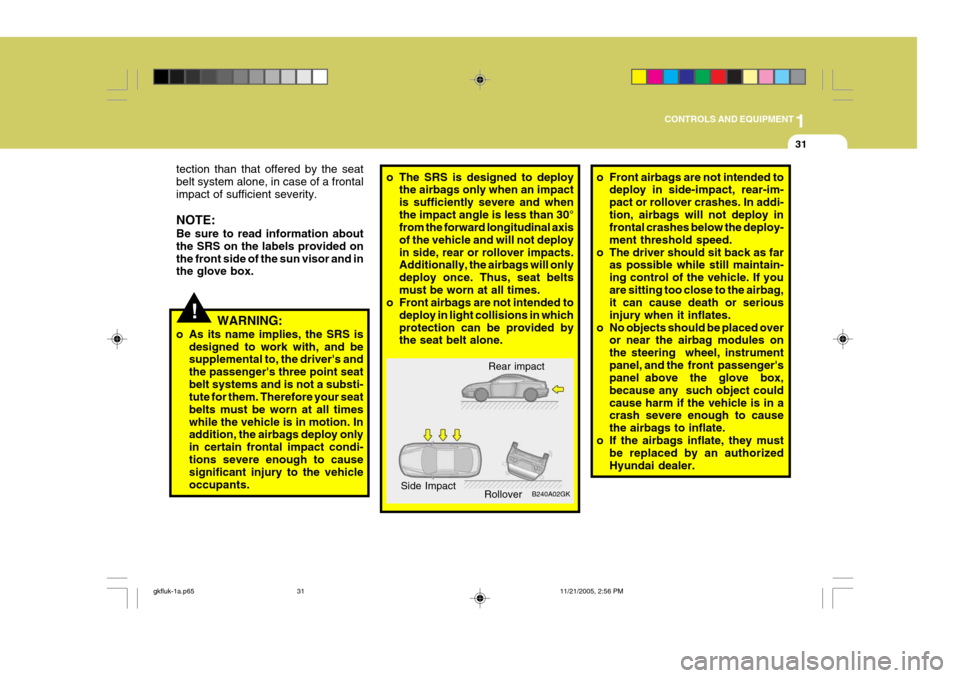
o As its name implies, the SRS is designed to work with, and besupplemental to, the driver's and the passenger's three point seatbelt systems and is not a substi- tute for them. Therefore your seat belts must be worn at all timeswhile the vehicle is in motion. In addition, the airbags deploy only in certain frontal impact condi-tions severe enough to cause significant injury to the vehicle occupants.o The SRS is designed to deploy the airbags only when an impact is sufficiently severe and whenthe impact angle is less than 30° from the forward longitudinal axis of the vehicle and will not deployin side, rear or rollover impacts. Additionally, the airbags will only deploy once. Thus, seat beltsmust be worn at all times.
o Front airbags are not intended to
deploy in light collisions in whichprotection can be provided by the seat belt alone. o Front airbags are not intended to
deploy in side-impact, rear-im- pact or rollover crashes. In addi-tion, airbags will not deploy in frontal crashes below the deploy- ment threshold speed.
o The driver should sit back as far as possible while still maintain-ing control of the vehicle. If youare sitting too close to the airbag, it can cause death or serious injury when it inflates.
o No objects should be placed over or near the airbag modules onthe steering wheel, instrumentpanel, and the front passenger's panel above the glove box, because any such object couldcause harm if the vehicle is in a crash severe enough to cause the airbags to inflate.
o If the airbags inflate, they must be replaced by an authorizedHyundai dealer.
Rear impact
B240A02GK
Side Impact
Rollover
gkfluk-1a.p65 11/21/2005, 2:56 PM
31