maintenance schedule Hyundai Coupe 2005 User Guide
[x] Cancel search | Manufacturer: HYUNDAI, Model Year: 2005, Model line: Coupe, Model: Hyundai Coupe 2005Pages: 478, PDF Size: 13.44 MB
Page 209 of 478
6
DO-IT-YOURSELF MAINTENANCE
11
HGK4006
G050C01A-AAT
To Check the Coolant Level
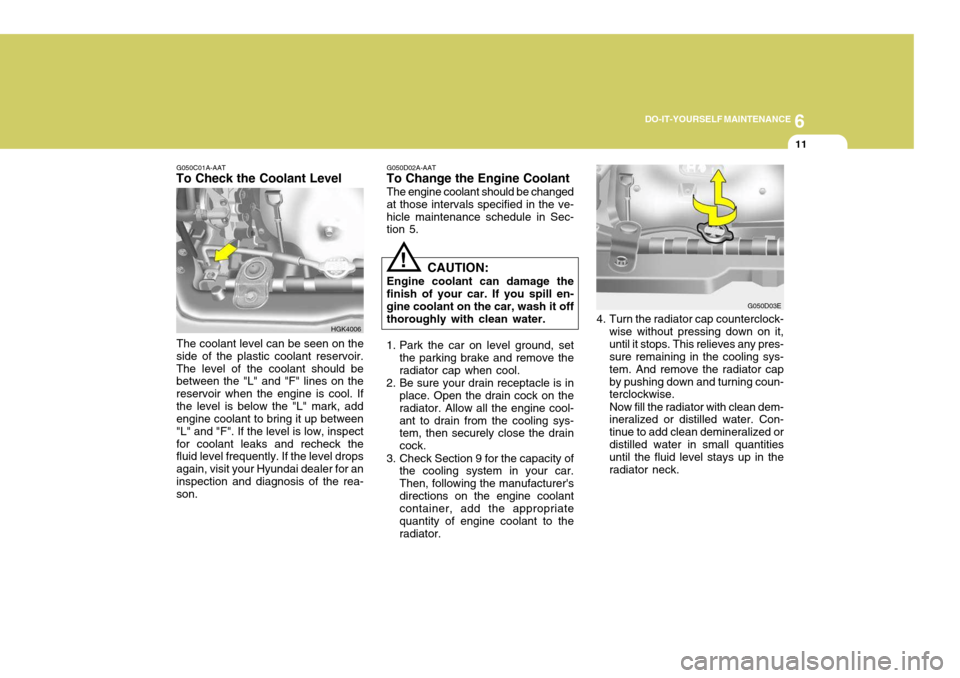
The coolant level can be seen on the
side of the plastic coolant reservoir. The level of the coolant should be between the "L" and "F" lines on the reservoir when the engine is cool. Ifthe level is below the "L" mark, add engine coolant to bring it up between "L" and "F". If the level is low, inspectfor coolant leaks and recheck the fluid level frequently. If the level drops again, visit your Hyundai dealer for aninspection and diagnosis of the rea- son. G050D02A-AAT
To Change the Engine Coolant
The engine coolant should be changed at those intervals specified in the ve-hicle maintenance schedule in Sec- tion 5.
CAUTION:
Engine coolant can damage the finish of your car. If you spill en- gine coolant on the car, wash it off thoroughly with clean water.
!
1. Park the car on level ground, set the parking brake and remove the radiator cap when cool.
2. Be sure your drain receptacle is in place. Open the drain cock on the radiator. Allow all the engine cool-ant to drain from the cooling sys- tem, then securely close the drain cock.
3. Check Section 9 for the capacity of the cooling system in your car.Then, following the manufacturer'sdirections on the engine coolant container, add the appropriate quantity of engine coolant to theradiator. 4. Turn the radiator cap counterclock-
wise without pressing down on it,until it stops. This relieves any pres- sure remaining in the cooling sys- tem. And remove the radiator capby pushing down and turning coun- terclockwise. Now fill the radiator with clean dem- ineralized or distilled water. Con- tinue to add clean demineralized ordistilled water in small quantities until the fluid level stays up in the radiator neck. G050D03E
Page 214 of 478
6 DO-IT-YOURSELF MAINTENANCE
16CHECKING THE TRANSAXLE OIL (MANUAL)
HGK5009
!
G100A04GK-GAT
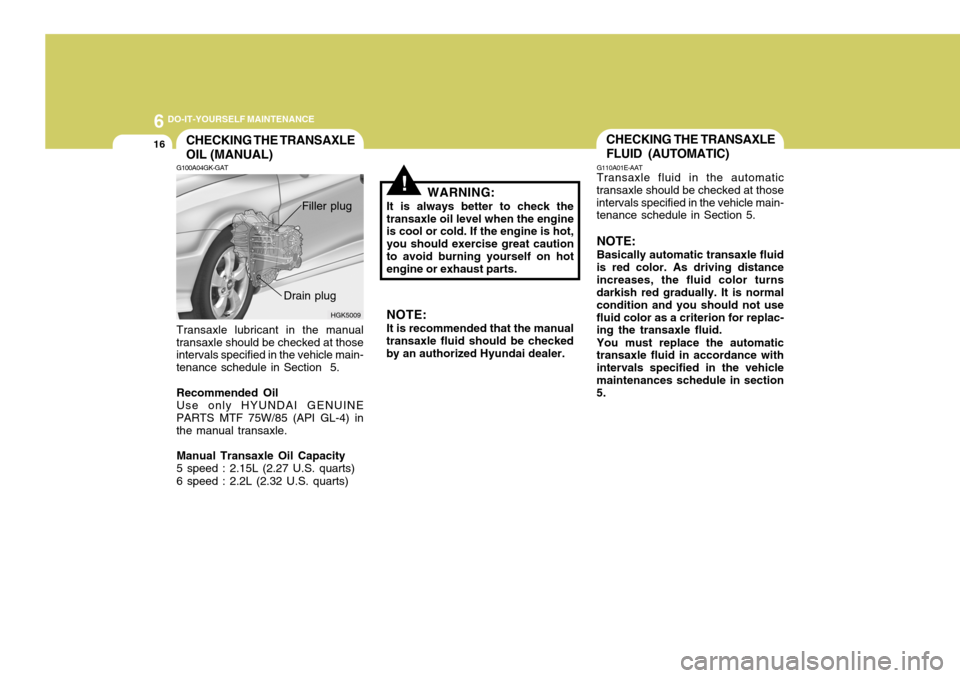
Transaxle lubricant in the manual
transaxle should be checked at those intervals specified in the vehicle main- tenance schedule in Section 5.
Recommended OilUse only HYUNDAI GENUINE
PARTS MTF 75W/85 (API GL-4) inthe manual transaxle.
Manual Transaxle Oil Capacity5 speed : 2.15L (2.27 U.S. quarts) 6 speed : 2.2L (2.32 U.S. quarts) WARNING:
It is always better to check the transaxle oil level when the engine is cool or cold. If the engine is hot, you should exercise great cautionto avoid burning yourself on hot engine or exhaust parts.
Drain plugG110A01E-AAT Transaxle fluid in the automatic
transaxle should be checked at those intervals specified in the vehicle main- tenance schedule in Section 5.
NOTE: Basically automatic transaxle fluid
is red color. As driving distance increases, the fluid color turns darkish red gradually. It is normal condition and you should not usefluid color as a criterion for replac- ing the transaxle fluid.
You must replace the automatic
transaxle fluid in accordance with intervals specified in the vehiclemaintenances schedule in section 5. CHECKING THE TRANSAXLE FLUID (AUTOMATIC)
Filler plug
NOTE: It is recommended that the manual
transaxle fluid should be checked by an authorized Hyundai dealer.
Page 216 of 478
6 DO-IT-YOURSELF MAINTENANCE
18
HGK5008
!WARNING:
The cooling fan is controlled by engine coolant temperature and may sometimes operate even when the engine is not running. Useextreme caution when working near the blades of the cooling fan, so that you are not injured by arotating fan blade. As the engine coolant temperature decreases, the fan will automatically shut off. Thisis a normal condition. Fluid level should be within this
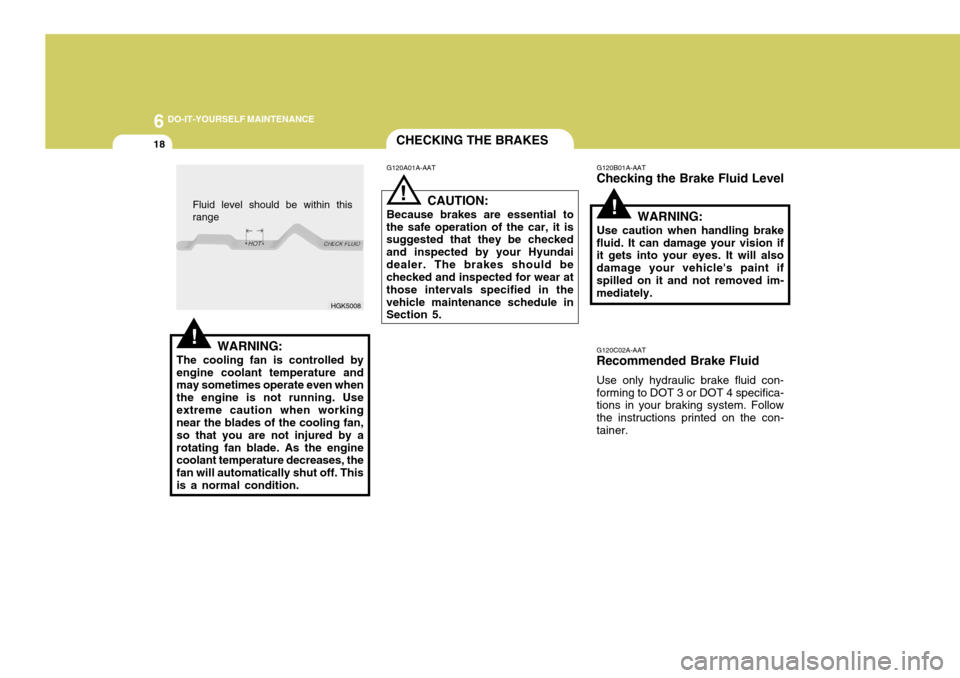
range
!
!
G120A01A-AAT CHECKING THE BRAKES
CAUTION:
Because brakes are essential to
the safe operation of the car, it is suggested that they be checked and inspected by your Hyundaidealer. The brakes should be checked and inspected for wear at those intervals specified in thevehicle maintenance schedule in Section 5. G120B01A-AAT
Checking the Brake Fluid Level
WARNING:
Use caution when handling brake
fluid. It can damage your vision ifit gets into your eyes. It will also damage your vehicle's paint ifspilled on it and not removed im- mediately. G120C02A-AAT
Recommended Brake Fluid
Use only hydraulic brake fluid con- forming to DOT 3 or DOT 4 specifica- tions in your braking system. Follow the instructions printed on the con-tainer.
Page 243 of 478
7EMISSION CONTROL SYSTEMS
2
H010A01A-GAT (If Installed) Your Hyundai is equipped with an emission control system to meet all requirements of the Emission prohibi- tion rules of your province.There are three emission control sys-tems which are as follows.
(1) Crankcase emission control sys-
tem
(2) Evaporative emission control sys-
tem
(3) Exhaust emission control systemIn order to assure the proper function of the emission control systems, it isrecommended that you have your car inspected and maintained by an au- thorized Hyundai dealer in accordancewith the maintenance schedule in this manual. EMISSION CONTROL SYS- TEMS
H010B01F-GAT 1. Crankcase Emission Control
System
The positive crankcase ventilation system is employed to prevent air pollution caused by blow-by gases being emitted from the crankcase.This system supplies fresh air to the crankcase through the air cleaner. Inside the crankcase, the fresh airmixes with blow-by gases, then passes through the PCV valve into the induction system.
H010C01F-GAT
2. Evaporative Emission Control
System (If Installed)
The evaporative emission control sys-
tem is designed to prevent fuel va-pors from escaping into the atmo-sphere. H010D01A-AAT
3. Exhaust Emission Control
System
The exhaust emission control system is a highly effective system which controls exhaust emissions while maintaining good vehicle performace.
Canister While the engine is inoperative, fuel vapors generated inside the fuel tank are absorbed and stored in the canis-ter. When the engine is running, the fuel vapors absorbed in the canister are drawn into the induction systemthrough the purge control solenoid valve. Purge Control Solenoid Valve The purge control solenoid valve is controlled by the ECM; when the en- gine coolant temperature is low, and during idling, it closes, so that evapo- rated fuel is not taken into the engine. After engine warm-up, during ordi-nary driving, it opens so as to intro- duce evaporated fuel to the engine.
Page 258 of 478
10INDEX
4
H Hazard Warning System ............................................. 1-57
Headlight Leveling Device S ystem .............................1-60
Heating and Air Conditioning Control Rotary type .............................................................. 1-78
Automatic type ........................................................ 1-86
High-mounted rear stoplight ........................................1-66
Hood Release ............................................................. 1-67
Horn 1-71 I Ignition Sw itch ............................................................. 2-4
Immobilizer S ystem ..................................................... 1-4
Infinity Sound System (B260) ................................. 1-120
Anti-Theft Devi ce ................................................. 1-121
General operation ................................................ 1-121
Radio opera tion.................................................... 1-123
CD operation ........................................................ 1-125
Instrument Cluster and Indicator Li ghts................... 1-40
Instrument Panel Light Control (Rheo stat)............... 1-58
Intermittent Wiper ..................................................... 1-55
JJump Starting .............................................................. 3-3 KKeys
............................................................................ 1-4
If you lose your keys .............................................. 3-13
Positions ................................................................... 2-3
L
Light Bulb Replacement .............................................. 6-31
Lubrication Chart .......................................................... 9-4
Luggage Net ............................................................... 1-72
M Maintenance Intervals Explanation of scheduled maintenance items
................................................................................. 5-7
Maintenance under severe usage conditions .......... 5-6Scheduled maintenance ........................................... 5-4
Service requ irements............................................... 5-2
Map Light .................................................................. 1-63
Mirros
Day-night inside rearview ....................................... 1-65
Outside rearview folding ......... ...............................1-65
Outsde rearview heating . .......................................1-65
Multi gauge ............................................................... 1-51
OOdometer .................................................................. 1-48
Page 263 of 478

Responsibilty For Maintenance
It is the responsibility of the vehicle owner/driver to ensure that all routine mainte- nance services are undertaken in line with the recommendations specified in Section 5 of this manual. In addition, in order to ensure continued validity of the new vehiclewarranty and safe operation of the vehicle, non scheduled maintenance/running repairs should be undertaken at the earliest available opportunity. Under severe operating conditions, more frequent maintenance is required. Detailsof the maintenance schedule for such conditions are also given in section 5. It is recommended that all maintenance operations and repairs are entrusted to a Hyundai authorised repairer to ensure that the latest repair methods, specialised toolingand genuine Hyundai parts are used to ensure the continued reliability and safety of the vehicle.
SA020A1-E
gkfluk-0.p65
11/21/2005, 3:03 PM
4
Page 379 of 478
2DRIVING YOUR HYUNDAI
12EFFECTIVE BRAKING
SC140A2-E Braking system performance and fric- tion material life are greatly affected by the driving style adopted. The follow- ing suggestions are made to assist inachieving the best results from the braking system.
o Anticipate the road and conditions ahead in order that heavy braking may be avoided.
o When descending long gradients, use the engine to assist in retardingthe vehicle to minimise the possibil-ity of brake fade occurring.
o When trailer towing, ensure that the
trailer brakes function correctly anduse engine braking to assist the vehicle braking system.
o Use only genuine Hyundai replace- ment brake pads and shoes to en-sure consistent friction characteris- tics and wear rates.
o After driving through deep water (e.g. fording), the brakes may be-come wet and performance reduced.Always check brake efficiency after emerging from the water and dry the brakes by lightly depressing the brakepedal several times whilst driving slowly. o Apply the parking brake only when
the vehicle is at rest.
o Since the power assistance pro- vided by the brake servo is derived from the engine, coasting with theengine turned off or towing of the vehicle with the engine turned off will result in greatly increased pedalpressures being required to stop the vehicle.
o Do not hold the vehicle on an incline with the accelerator pedal. This cancause the transaxle to overheat. Al- ways use the brake pedal or parkingbrake.
o Use caution when parking on a hill.
Engage the parking brake and placethe gear selector lever in "P" (auto- matic transaxle) or in first or reverse gear (manual transaxle). If your caris facing downhill, turn the front wheels into the curb to help keep the car from rolling. If your car is facinguphill, turn the front wheels away from the curb to help keep the car from rolling.If there is no curb or if it is required by other conditions to keep the car from rolling, block the wheels.
o Check the automatic transaxle fluid
level regularly, and add fluid asnecessary. See the maintenance schedule for the proper fluid recommendation.
gkfluk-2.p65 11/21/2005, 2:58 PM
12
Page 383 of 478
2DRIVING YOUR HYUNDAI
16
o Don't "ride" the brake or clutch pedal.This can increase fuel consumption and also increase wear on these components. In addition, driving with your foot resting on the brake pedalmay cause the brakes to overheat, which reduces their effectiveness and may lead to more serious con-sequences.
o Take care of your tires. Keep them
inflated to the recommended pres-sure. Incorrect inflation, either too much or too little, results in unnec- essary tire wear. Check the tire pres-sures at least once a month.
o Be sure that the wheels are aligned
correctly. Improper alignment canresult from hitting curbs or driving too fast over irregular surfaces. Poor alignment causes faster tire wearand may also result in other prob- lems as well as greater fuel con- sumption.
o Keep your car in good condition. For better fuel economy and reducedmaintenance costs, maintain yourcar in accordance with the mainte- nance schedule in Section 5. If you drive your car in severe conditions, more frequent maintenance is re-quired (see Section 5 for details).
o Keep your car clean. For maximum service, your car should be keptclean and free of corrosive materi-als. It is especially important that mud, dirt, ice, etc. not be allowed to accumulate on the underside of thecar. This extra weight can result in increased fuel consumption and also contribute to corrosion.
o Travel lightly. Don't carry unneces- sary weight in your car. Weight is anenemy of good fuel economy.
o Don't let the engine idle longer than necessary. If you are waiting (andnot in traffic), turn off your engineand restart only when you're ready to go.
o Remember, your car does not re- quire extended warm-up. As soonas the engine is running smoothly, you can drive away. In very coldweather, however, give your engine a slightly longer warm-up period. o Don't "lug" or "over-rev" the engine.
Lugging is driving too slowly in too high a gear resulting in the engine bucking. If this happens to you, shift to a lower gear.Over-revving is racing the engine
beyond its safe limit. This can be avoided by shifting at the recom-mended speeds.
o Use your air conditioning sparingly.
The air conditioning system is
operated by the engine power so your fuel economy is reduced when you use it.
gkfluk-2.p65 11/21/2005, 2:58 PM
16
Page 409 of 478

5
Maintenance and Servicing Requirements ................... 5-2
Scheduled Maintenance ............................................... 5-4
Maintenance under Severe Usage Conditions ............. 5-6
Explanation of Scheduled Maintenance Items .............. 5-7VEHICLE MAINTENANCE REQUIREMENTS
5
gkfluk-5.p65
11/21/2005, 3:01 PM
1
Page 410 of 478

5VEHICLE MAINTENANCE REQUIREMENTS
2MAINTENANCE AND SER- VICING REQUIREMENTS
SF020A1-E To ensure the continued reliability and safety of the vehicle, certain routinemaintenance operations are required at specific mileage or time intervals. It is the responsibility of the vehicle owner to ensure that the maintenance schedules shown in both this OwnersManual and the Warranty and Service Passport are adhered to. The new vehicle warranty may be invalidated if the routine maintenance operations are not performed in line with the recommendations outlined andthe safety and durability of the vehicle adversely affected. It is recommended that all mainte- nance operations with the exception of the daily operating checks are en-trusted to a Hyundai authorised re- pairer to ensure that the latest repair and maintenance procedures andspecialised servicing tools are em- ployed. In addition, the use of genuine Hyundai replacement parts will ensurethat the vehicle safety and perfor- mance will not be compromised. NOTE:
The inspection and testing of cer-
tain electronic fuel injection/enginemanagement and automatic trans- mission control systems requirespecialised electronic equipment specifically designed for Hyundai vehicles. The use of general pur-pose electrical test equipment may result in damage to the control unit microprocessors. SF020C2-E
Specified Scheduled Procedures
The Specified scheduled procedures
are listed in the maintenance charts beginning at page 5-3. The operations specified must be performed at thetime or mileage intervals shown irre- spective of whether the mileage inter- val has been reached before the speci-fied time interval.
Certain lubricants and components
degrade with both time and mileage (e.g. engine oil and brake fluid) and therefore it is not permissable to basethe maintenance schedule upon mile- age alone. It is strongly recommended that the maintenance operations areperformed by the factory-trained or distributor-trained technicians at your Hyundai authorised repairer becauseof the need for specialised knowledge and tooling and to ensure that no possibility of invalidating the manufac-turers warranty exists. The maintenance schedules relate to
vehicles operated under normal condi-tions, vehicles which are operated under adverse conditions will require more frequent maintenance which isdescribed at page 5-6.
gkfluk-5.p65 11/21/2005, 3:01 PM
2