ESP Hyundai Coupe 2005 Owner's Guide
[x] Cancel search | Manufacturer: HYUNDAI, Model Year: 2005, Model line: Coupe, Model: Hyundai Coupe 2005Pages: 478, PDF Size: 13.44 MB
Page 157 of 478
2 DRIVING YOUR HYUNDAI
14
o Don't coast down hills with the car
out of gear. This is extremely haz- ardous. Keep the car in gear at all times, use the brakes to slow down, then shift to a lower gear so thatengine braking will help you main- tain a safe speed.
o Don't "ride" the brake pedal. Rest- ing your foot on the brake pedalwhile driving can be dangerous be- cause it can result in the brakesoverheating and losing their effec- tiveness. It also increases the wear of the brake components.
o If a tire goes flat while you are driving, apply the brakes gently andkeep the car pointed straight aheadwhile you slow down. When you are moving slowly enough for it to be safe to do so, pull off the road andstop in a safe place.
o If your car is equipped with an auto-
matic transaxle, don't let your carcreep forward. To avoid creeping forward, keep your foot on the brake pedal when the car is stopped.
o Use caution when parking on a hill. Engage the parking brake and placethe gear selector lever in "P" (auto- matic transaxle) or in first or reversegear (manual transaxle). If your caris facing downhill, turn the front wheels into the curb to help keep the car from rolling. If your car is facinguphill, turn the front wheels away from the curb to help keep the car from rolling.If there is no curb or if it is required by other conditions to keep the car from rolling, block the wheels.
o Under some conditions your park- ing brake can freeze in the engagedposition. This is most likely to hap-pen when there is an accumulation of snow or ice around or near the rear brakes or if the brakes are wet.If there is a risk that the parking brake may freeze, apply it only tem- porarily while you put the gear se-lector lever in "P" (automatic) or in first or reverse gear (manual transaxle) and block the rear wheelsso the car cannot roll. Then release the parking brake.
o Do not hold the vehicle on the up- grade with the accelerator pedal.This can cause the transmission to overheat. Always use the brakepedal or parking brake.
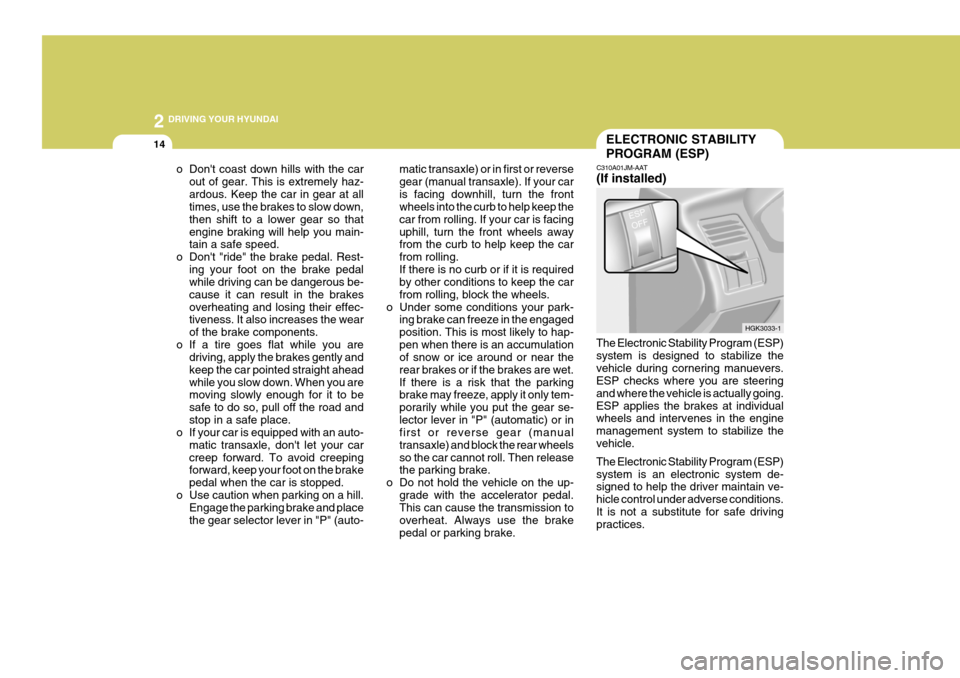
ELECTRONIC STABILITY PROGRAM (ESP)
C310A01JM-AAT (If installed)
The Electronic Stability Program (ESP) system is designed to stabilize thevehicle during cornering manuevers. ESP checks where you are steering and where the vehicle is actually going.ESP applies the brakes at individual wheels and intervenes in the engine management system to stabilize thevehicle. The Electronic Stability Program (ESP) system is an electronic system de- signed to help the driver maintain ve- hicle control under adverse conditions.It is not a substitute for safe driving practices. HGK3033-1
Page 158 of 478

2
DRIVING YOUR HYUNDAI
15
C310B01JM-AAT ESP ON/OFF Mode When the ESP is operating, the ESP indicator in the instrument cluster willblink. If you turn the system off by pressing the ESP switch, the ESP-OFF indica-tor will come on and stay on. In the ESP-OFF mode, the stability control will be deactivated. Adjust your drivingaccordingly. To turn the system back on, press the switch again. The ESP- OFF indicator should go off. NOTE: The ESP mode will automatically be turned ON after the engine is turnedoff and restarted.
!
Factors including speed, road condi- tions and driver steering input can allaffect whether ESP will be effective in preventing a loss of control. It is still your responsibility to drive and cornerat reasonable speeds and to leave a sufficient margin of safety.
CAUTION:
Driving with varying tire or wheelsize may cause the ESP system to malfunction. When replacing tires,make sure they are the same size as your original tires.
WARNING:
Electronic stability program is only a driving aid; all normal precautions for driving in inclement weather and on slippery road surfaces should beobserved.
! C310D01JM-AAT Indicators and Warning The indicators should illuminate when the ignition key is turned to ON orSTART but should go out after three seconds. If the indicators do not illuminate, or theESP or ESP-OFF indicator does not go out after 3 seconds, have the vehicle checked by an authorized dealer. Should there be any unusual conditions in the device while driving, ESP-OFFindicator illuminates as a warning. If ESP-OFF indicator illuminates, pull your car to a safe place and stop theengine. Then, start the engine again to check if the ESP-OFF indicator goes out. If the indicator remains lit even after the engine has been started, have your carchecked by an authorized Hyundai dealer.
Page 159 of 478
2 DRIVING YOUR HYUNDAI
16
C140A01A-GAT You can save fuel and get more kilo- meters from your car if you follow these suggestions:
o Drive smoothly. Accelerate at a
moderate rate. Don't make "jack- rabbit" starts or full-throttle shiftsand maintain a steady cruising speed. Don't race between stop- lights. Try to adjust your speed tothat of the other traffic so you don't have to change speeds unneces- sarily. Avoid heavy traffic wheneverpossible. Always maintain a safe distance from other vehicles so you can avoidunnecessary braking. This also re- duces brake wear.
o Drive at a moderate speed. The faster you drive, the more fuel yourcar uses. Driving at a moderate speed, especially on the highway, isone of the most effective ways to reduce fuel consumption.
DRIVING FOR ECONOMY
o Don't "ride" the brake or clutch pedal.This can increase fuel consumption and also increase wear on these components. In addition, driving with your foot resting on the brake pedalmay cause the brakes to overheat, which reduces their effectiveness and may lead to more serious con-sequences.
o Take care of your tires. Keep them
inflated to the recommended pres-sure. Incorrect inflation, either too much or too little, results in unnec- essary tire wear. Check the tire pres-sures at least once a month.
o Be sure that the wheels are aligned
correctly. Improper alignment canresult from hitting curbs or driving too fast over irregular surfaces. Poor alignment causes faster tire wearand may also result in other prob- lems as well as greater fuel con- sumption.
o Keep your car in good condition. For better fuel economy and reducedmaintenance costs, maintain yourcar in accordance with the mainte- nance schedule in Section 5. If you drive your car in severe conditions, more frequent maintenance is re-quired (see Section 5 for details).
o Keep your car clean. For maximum service, your Hyundai should bekept clean and free of corrosivematerials. It is especially important that mud, dirt, ice, etc. not be al- lowed to accumulate on the under-side of the car. This extra weight can result in increased fuel con- sumption and also contribute to cor-rosion.
o Travel lightly. Don't carry unneces-
sary weight in your car. Weight re-duces fuel economy.
o Don't let the engine idle longer than
necessary. If you are waiting (andnot in traffic), turn off your engine and restart only when you're ready to go.
o Remember, your Hyundai does not require extended warm-up. As soonas the engine is running smoothly,you can drive away. In very cold weather, however, give your engine a slightly longer warm-up period.
Page 160 of 478
2
DRIVING YOUR HYUNDAI
17
o Don't "lug" or "over-rev" the engine. Lugging is driving too slowly in too high a gear resulting in the engine bucking. If this happens, shift to a lower gear. Over-revving is racingthe engine beyond its safe limit. This can be avoided by shifting at the recommended speeds.
o Use your air conditioning sparingly. The air conditioning system is oper-ated by engine power so your fueleconomy is reduced when you use it.
C150A01A-AAT Avoid braking or gear changing in cor- ners, especially when roads are wet. Ideally, corners should always be taken under gentle acceleration. If you followthese suggestions, tire wear will be held to a minimum.SMOOTH CORNERINGC160A01A-AAT The more severe weather conditions of winter result in greater wear and other problems. To minimize the prob- lems of winter driving, you should fol-low these suggestions:
WINTER DRIVING
Page 167 of 478

2 DRIVING YOUR HYUNDAI
24
C190F01A-GAT Trailer or Vehicle Towing Tips
1. Before towing, check hitch andsafety chain connections as well as proper operation of the trailer run- ning lights, brake lights, and turn signals.
2. Always drive your vehicle at a mod- erate speed (Less than 100 km/H).
3. Trailer towing requires more fuel than normal conditions.
4. To maintain engine braking effi-
ciency and electrical chaarging per-formance, do not use fifth gear (manual transaxle) or overdrive (au- tomatic transaxle).
5. Always secure items in the trailer to prevent load shift while driving.
6. Check the condition and air pres- sure of all tires on the trailer and your car. Low tire pressure can seriously affect the handling. Alsocheck the spare tire. 7. The vehicle/trailer combination is
more affected by crosswind andbuffeting. When being passed by a large ve- hicle, keep a constant speed andsteer straight ahead. If there is too much wind buffeting, slow down to get out of the other vehicle's airturbulence.
8. When parking your car and trailer,
especially on a hill, be sure to followall the normal precautions. Turn your front wheel into the curb, set the parking brake firmly, and putthe transmission in 1st or Reverse (manual) or Park (automatic). In addition, place wheel chocks ateach of the trailer's tires.
9. If the trailer has electric brakes,
start your vehicle and trailer mov-ing, and then apply the trailer brake controller by hand to be sure the brakes are working. This lets youcheck your electrical connection at the same time.
10.During your trip, check occasion- ally to be sure that the load issecure, and that the lights and any trailer brakes are still working. 11. Avoid jerky starts, sudden accel-
eration or sudden stops.
12.Avoid sharp turns and rapid lane changes.
13.Avoid holding the brake pedal down too long or too frequently. This could cause the brakes to overheat, re- sulting in reduced braking efficiency.
14.When going down a hill, shift into a lower gear and use the engine brak-ing effect.When ascending a long grade, downshift the transmission to a lower gear and reduce speed toreduce chances of engine over- loading and/or overheating.
15.If you have to stop while going
uphill, do not hold the vehicle inplace by pressing on the accelera- tor. This can cause the automatictransmission to overheat. Use the parking brake or footbrake.
NOTE: When towing check transaxle fluid more frequently.
Page 190 of 478
5VEHICLE MAINTENANCE REQUIREMENTS
2MAINTENANCE INTERVALS
F010A01A-GAT Service Requirements To assure that you receive the great- est number of kilometers of satisfyingoperation from your Hyundai, certain maintenance procedures must be per- formed. Although careful design andengineering have reduced these to a minimum, those that are required are of the utmost importance. It is your responsibility to have these maintenance procedures performed to comply with the terms of the warran-ties covering your new Hyundai. The Service Passport supplied with your new vehicle provides further informa-tion about these warranties. F010B01A-AAT
Maintenance Requirements
The maintenance required for your Hyundai can be divided into three main areas:
o Specified scheduled procedures o General checks o Do-it-yourself maintenance F010C01A-GAT
Specified Scheduled Procedures
These are the procedures such asinspections, adjustments and replace-ments that are listed in the mainte- nance charts starting on page 5-4. These procedures must be performedat the intervals shown in the mainte- nance schedule to assure that your warranty remains in effect. Although itis strongly recommended that they be performed by the factory-trained or distributor-trained technicians at yourHyundai dealer, these procedures may be performed at any qualified service facility. It is suggested that genuine Hyundai service parts be used for any required repairs or replacements. Other parts ofequivalent quality such as engine oil, engine coolant, manual or auto transaxle oil, brake fluid and so onwhich are not supplied by Hyundai Motor Company or its distributor may be used without affecting your war-ranty coverage but you should always be sure these are equivalent to the quality of the original Hyundai parts.Your Service Passport provides fur- ther information about your warranty coverage. F010D01A-AAT
General Checks
These are the regular checks you
should perform when you drive yourHyundai or you fill the fuel tank. A list of these items will be found on page 6- 5. F010E01A-AAT
Do-It-Yourself Maintenance
If you are mechanically inclined, own a few tools that are required and want to take the time to do so, you can inspect and service a number of items. Formore information about doing it your- self, see Section 6.
Page 191 of 478
5
VEHICLE MAINTENANCE REQUIREMENTS
3SCHEDULED MAINTE- NANCE REQUIREMENTS
F010F01A-GAT
A Few Tips
Whenever you have your Hyundai ser-
viced, keep copies of the service records in your glove box. This will help ensure that you can document that the required procedures have beenperformed to keep your warranties in effect. This is especially important when service is not performed by anauthorized Hyundai dealer. F020A02A-GAT Inspection should be performed any
time a malfunction is experienced or suspected. Receipts for all emission control system services should be re- tained to demonstrate compliance withconditions of the emissions system warranty.
For severe usage maintenance require-
ments, see page 5-6 of this section.
Page 204 of 478
6 DO-IT-YOURSELF MAINTENANCE
6
G030C02A-AAT
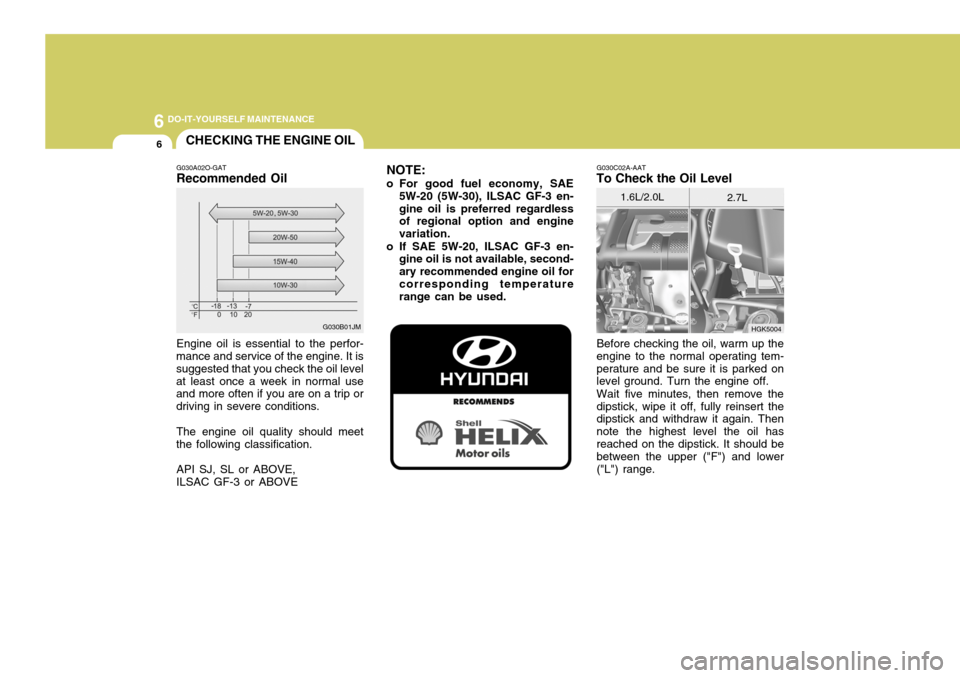
To Check the Oil Level
Before checking the oil, warm up the engine to the normal operating tem-perature and be sure it is parked on level ground. Turn the engine off. Wait five minutes, then remove the dipstick, wipe it off, fully reinsert the dipstick and withdraw it again. Then note the highest level the oil hasreached on the dipstick. It should be between the upper ("F") and lower ("L") range. HGK5004
CHECKING THE ENGINE OIL
G030A02O-GAT Recommended Oil Engine oil is essential to the perfor-
mance and service of the engine. It is suggested that you check the oil levelat least once a week in normal use and more often if you are on a trip or driving in severe conditions.
The engine oil quality should meet
the following classification.
API SJ, SL or ABOVE,ILSAC GF-3 or ABOVE G030B01JM
NOTE:
o For good fuel economy, SAE 5W-20 (5W-30), ILSAC GF-3 en-gine oil is preferred regardless of regional option and engine variation.
o If SAE 5W-20, ILSAC GF-3 en- gine oil is not available, second-ary recommended engine oil forcorresponding temperature range can be used. 1.6L/2.0L
2.7L
Page 239 of 478

6
DO-IT-YOURSELF MAINTENANCE
41
PROTECTED COMPONENTS
Generator(1.6L/2.0L) BCM BOX(Tail lamp relay,Power connector,Fuse(2,7,12,13,19,20,24))Condenser fan relayRadiator fan relayEngine control relay, Fuel pump relay, A/T control relay, Generator,ECM(1.6L/2.7L),PCM(2.0L) Ignition switch,Start relayABS/ESP control module,ESP Air bleeding connectorABS/ESP control module,ESP Air bleeding connectorBlower relayInjector Oxygen sensor,Camshaft position sensor, Idle speed control actuator DRL control moduleFront fog lamp relayTCM(2.7L),ECM(2.7L/1.6L)Horn relay,A/C relay Head lamp relay(High) Head lamp relay(Low)
FUSERATING 120A50A 30A30A 30A 30A 40A40A30A 15A 10A15A15A10A15A 15A 15A
DESCRIPTION
BATTBATT
COND RAD ECU
IGN
ABS 1 ABS 2
BLOWER INJ
SNSR DRL
F/FOG ECU
HORN,A/CON H/LP (HI)
H/LP (LO)
Page 241 of 478

6
DO-IT-YOURSELF MAINTENANCE
43
DESCRIPTION IG COIL
AMP
B/UP LAMP
A/BAG IND A/BAG
HTD MIR HAZARD
R/WIPER TAIL-RH
F/WIPER A/C SW
RR DEFOG STOP
TAIL-LH A/CON
ECU
CLUSTER
ROOM LP
P/WINDOW
T/GATE IGN
RR FOG C/LIGHT
S/ROOF S/HTR
ABS
AUDIO
PROTECTED COMPONENTS
Ignition coil(1.6l/2.7L), Electronic chrome mirror AMP Back-up lamp switch,Transaxle range switch,Cruise control module,Stop lamp switch Instrument cluster (A/BAG IND.) SRS control module Mirror defogger Hazard relay Rear wiper motor,Rear intermittent wiper relay Right tail lamps,Glove box lamp Front wiper motor,Front wiper relay Blower relay,Blower motor Defogger relay Stop lamp switch,Burglar alarm horn relay,Folding/Unfolding relay Left tail lamps A/C control module, Blower relay ECM, Multi gauge unit, TCM, Vehicle speed sensor Instrument cluster (Power), Per-excitation resister, DRL Control module,Generator Room lamp,Clock,Audio,Data link connector,Multi gauge unit Power window relay Trunk lid switch AQS sensor,Head lamp relay,DRL Control module Rear fog lamp Cigarette lighter,Outside mirror switch Sunroof,Power door lock/Unlock relay Seat warmer ESP/ABS control module Audio,Digital clock
FUSERATING
20A20A 10A 10A 15A 10A 10A 15A 10A 20A 10A 30A 15A 10A 10A 10A 10A 10A 30A 15A 10A 10A 15A 15A 20A 10A 10A