wheel Hyundai Coupe 2005 Owner's Guide
[x] Cancel search | Manufacturer: HYUNDAI, Model Year: 2005, Model line: Coupe, Model: Hyundai Coupe 2005Pages: 478, PDF Size: 13.44 MB
Page 163 of 478
2 DRIVING YOUR HYUNDAI
20HIGHER SPEED MOTORING
C160J01A-AAT Don't Let Ice and Snow Accumu- late Underneath Under some conditions, snow and ice can build up under the fenders andinterfere with the steering. When driv- ing in severe winter conditions where this may happen, you should periodi-cally check underneath the car to be sure the movement of the front wheels and the steering components is notobstructed. C160K01A-AAT Carry Emergency Equipment Depending on the severity of the weather where you drive your car, you should carry appropriate emergency equipment. Some of the items youmay want to carry include tire chains, tow straps or chains, flashlight, emer- gency flares, sand, a shovel, jumpercables, a window scraper, gloves, ground cloth, coveralls, a blanket, etc. C170A01A-AAT Pre-Trip Inspections 1. Tires: Adjust the tire inflation pressures to specification. Low tire inflation pres-sures will result in overheating and possible failure of the tires. Avoid using worn or damaged tireswhich may result in reduced traction or tire failure. NOTE: Never exceed the maximum tire in- flation pressure shown on the tires. 2. Fuel, engine coolant and en-
gine oil:
High speed travel consumes more fuel than urban motoring. Do not forget tocheck both engine coolant and engine oil. 3. Drive belt: A loose or damaged drive belt may result in overheating of the engine. C180A01A-AAT Check your lights regularly for correct operation and always keep them clean. When driving during the day in condi- tions of poor visibility, it is helpful todrive with headlights on low beam. This enables you to be seen as well as to see.
USE OF LIGHTS
Page 167 of 478

2 DRIVING YOUR HYUNDAI
24
C190F01A-GAT Trailer or Vehicle Towing Tips
1. Before towing, check hitch andsafety chain connections as well as proper operation of the trailer run- ning lights, brake lights, and turn signals.
2. Always drive your vehicle at a mod- erate speed (Less than 100 km/H).
3. Trailer towing requires more fuel than normal conditions.
4. To maintain engine braking effi-
ciency and electrical chaarging per-formance, do not use fifth gear (manual transaxle) or overdrive (au- tomatic transaxle).
5. Always secure items in the trailer to prevent load shift while driving.
6. Check the condition and air pres- sure of all tires on the trailer and your car. Low tire pressure can seriously affect the handling. Alsocheck the spare tire. 7. The vehicle/trailer combination is
more affected by crosswind andbuffeting. When being passed by a large ve- hicle, keep a constant speed andsteer straight ahead. If there is too much wind buffeting, slow down to get out of the other vehicle's airturbulence.
8. When parking your car and trailer,
especially on a hill, be sure to followall the normal precautions. Turn your front wheel into the curb, set the parking brake firmly, and putthe transmission in 1st or Reverse (manual) or Park (automatic). In addition, place wheel chocks ateach of the trailer's tires.
9. If the trailer has electric brakes,
start your vehicle and trailer mov-ing, and then apply the trailer brake controller by hand to be sure the brakes are working. This lets youcheck your electrical connection at the same time.
10.During your trip, check occasion- ally to be sure that the load issecure, and that the lights and any trailer brakes are still working. 11. Avoid jerky starts, sudden accel-
eration or sudden stops.
12.Avoid sharp turns and rapid lane changes.
13.Avoid holding the brake pedal down too long or too frequently. This could cause the brakes to overheat, re- sulting in reduced braking efficiency.
14.When going down a hill, shift into a lower gear and use the engine brak-ing effect.When ascending a long grade, downshift the transmission to a lower gear and reduce speed toreduce chances of engine over- loading and/or overheating.
15.If you have to stop while going
uphill, do not hold the vehicle inplace by pressing on the accelera- tor. This can cause the automatictransmission to overheat. Use the parking brake or footbrake.
NOTE: When towing check transaxle fluid more frequently.
Page 173 of 478
3
WHAT TO DO IN AN EMERGENCY
5
!
!
!WARNING:
Do not remove the radiator cap when the engine is hot. This can allow coolant to be blown out of the open- ing and cause serious burns.
6. If you cannot find the cause of the overheating, wait until the engine temperature has returned to nor- mal. Then, if the engine coolant has been lost, carefully add coolant tothe reservoir (page 6-11) to bring the fluid level in the reservoir up to the halfway mark.
7. Proceed with caution, keeping alert for further signs of overheating. Ifoverheating happens again, call aHyundai dealer for assistance.
CAUTION:
Serious loss of engine coolant indi-cates there is a leak in the cooling system and this should be checked as soon as possible by a Hyundaidealer. D040A01GK-GAT The following instructions for the tem- porary spare tire should be observed:
1. Check inflation pressure as soon as
practical after installing the spare tire, and adjust to the specified pres- sure. The tire pressure should beperiodically checked and maintained at the specified pressure while the tire is stored.
Spare Tire Pressure TEMPORARY SPARE TIRE
5. The temporary spare tire should notbe used on any other wheels, norshould standard tires, snow tires, wheel covers or trim rings be used with the temporary spare wheel. Ifsuch use is attempted, damage to these items or other car compo- nents may occur.
6. The temporary spare tire pressure should be checked once a monthwhile the tire is stored.
Tire Size
Inflation Pressure T125/70R 16
420 kPa (60 psi)
2. The spare tire should only be used temporarily and should be returned to the luggage compartment as soon as the original tire can be repaired orreplaced.
3. Continuous use at speeds of over
80 km/h (50 mph) is not recom-mended.
4. As the temporary spare tire is spe-
cifically designed for your car, itshould not be used on any other vehicle. CAUTION:
o Do not use snow chains with your temporary spare tire.
o Do not use more than one tempo-
rary spare tire at a time.
Page 175 of 478
3
WHAT TO DO IN AN EMERGENCY
7
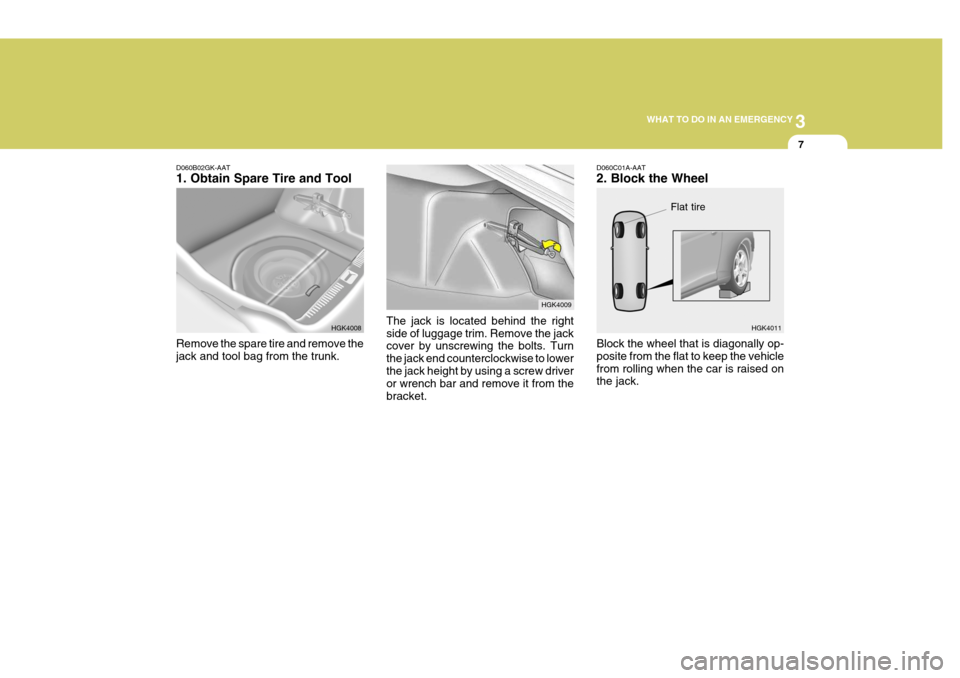
D060B02GK-AAT 1. Obtain Spare Tire and Tool Remove the spare tire and remove the jack and tool bag from the trunk. The jack is located behind the rightside of luggage trim. Remove the jack cover by unscrewing the bolts. Turn the jack end counterclockwise to lowerthe jack height by using a screw driver or wrench bar and remove it from the bracket.
HGK4008
HGK4009
Flat tire
D060C01A-AAT 2. Block the Wheel Block the wheel that is diagonally op- posite from the flat to keep the vehiclefrom rolling when the car is raised on the jack. HGK4011
Page 176 of 478
3 WHAT TO DO IN AN EMERGENCY
8
HGK4013
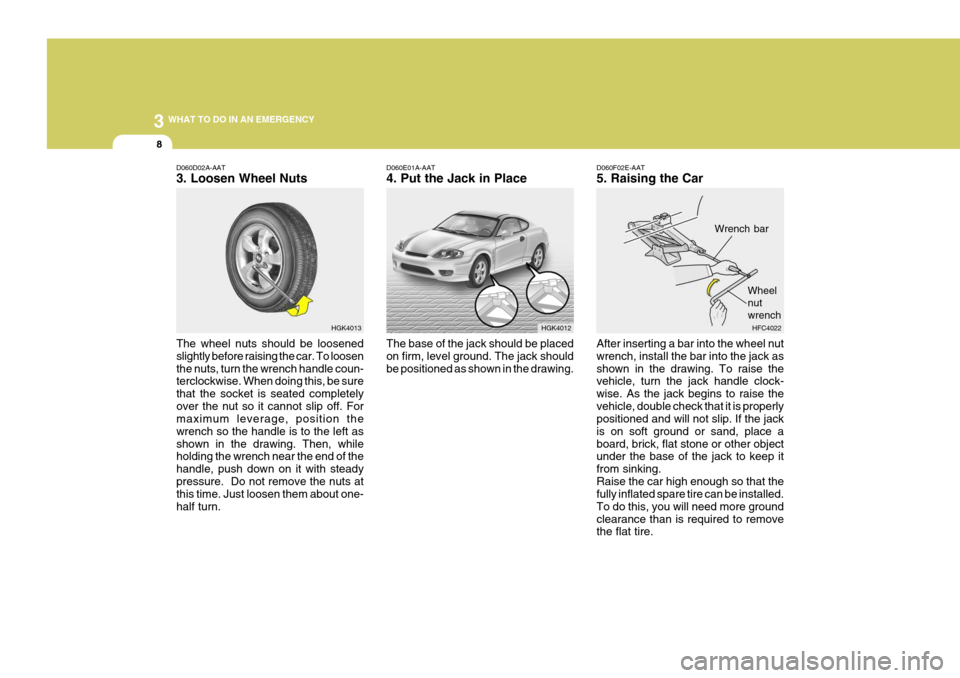
D060D02A-AAT 3. Loosen Wheel Nuts The wheel nuts should be loosened slightly before raising the car. To loosenthe nuts, turn the wrench handle coun- terclockwise. When doing this, be sure that the socket is seated completelyover the nut so it cannot slip off. For maximum leverage, position the wrench so the handle is to the left asshown in the drawing. Then, while holding the wrench near the end of the handle, push down on it with steadypressure. Do not remove the nuts at this time. Just loosen them about one- half turn. D060E01A-AAT 4. Put the Jack in Place The base of the jack should be placed on firm, level ground. The jack shouldbe positioned as shown in the drawing.
D060F02E-AAT 5. Raising the Car After inserting a bar into the wheel nut wrench, install the bar into the jack asshown in the drawing. To raise the vehicle, turn the jack handle clock- wise. As the jack begins to raise thevehicle, double check that it is properly positioned and will not slip. If the jack is on soft ground or sand, place aboard, brick, flat stone or other object under the base of the jack to keep it from sinking.Raise the car high enough so that the fully inflated spare tire can be installed. To do this, you will need more groundclearance than is required to remove the flat tire.Wrench barHGK4012
HFC4022
Wheel nutwrench
Page 177 of 478
3
WHAT TO DO IN AN EMERGENCY
9
HGK4031
!WARNING:
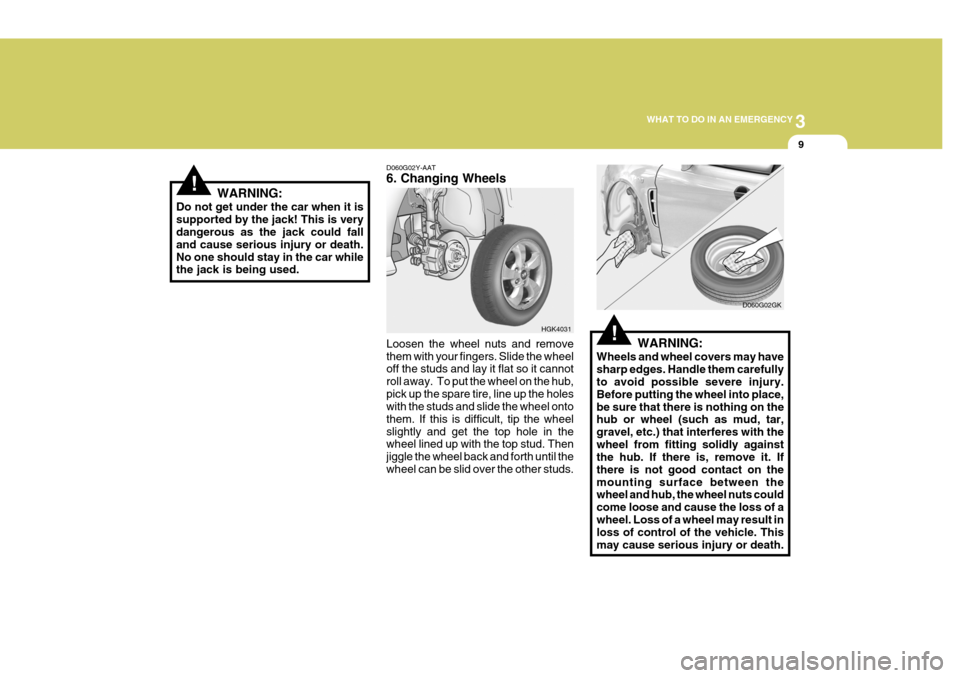
Do not get under the car when it is supported by the jack! This is very dangerous as the jack could fall and cause serious injury or death.No one should stay in the car while the jack is being used. D060G02Y-AAT 6. Changing Wheels Loosen the wheel nuts and remove them with your fingers. Slide the wheel off the studs and lay it flat so it cannot roll away. To put the wheel on the hub,pick up the spare tire, line up the holes with the studs and slide the wheel onto them. If this is difficult, tip the wheelslightly and get the top hole in the wheel lined up with the top stud. Then jiggle the wheel back and forth until thewheel can be slid over the other studs.
!WARNING:
Wheels and wheel covers may have sharp edges. Handle them carefully to avoid possible severe injury. Before putting the wheel into place,be sure that there is nothing on the hub or wheel (such as mud, tar, gravel, etc.) that interferes with thewheel from fitting solidly against the hub. If there is, remove it. If there is not good contact on themounting surface between the wheel and hub, the wheel nuts could come loose and cause the loss of awheel. Loss of a wheel may result in loss of control of the vehicle. This may cause serious injury or death. D060G02GK
Page 178 of 478
3 WHAT TO DO IN AN EMERGENCY
10
HGK4014
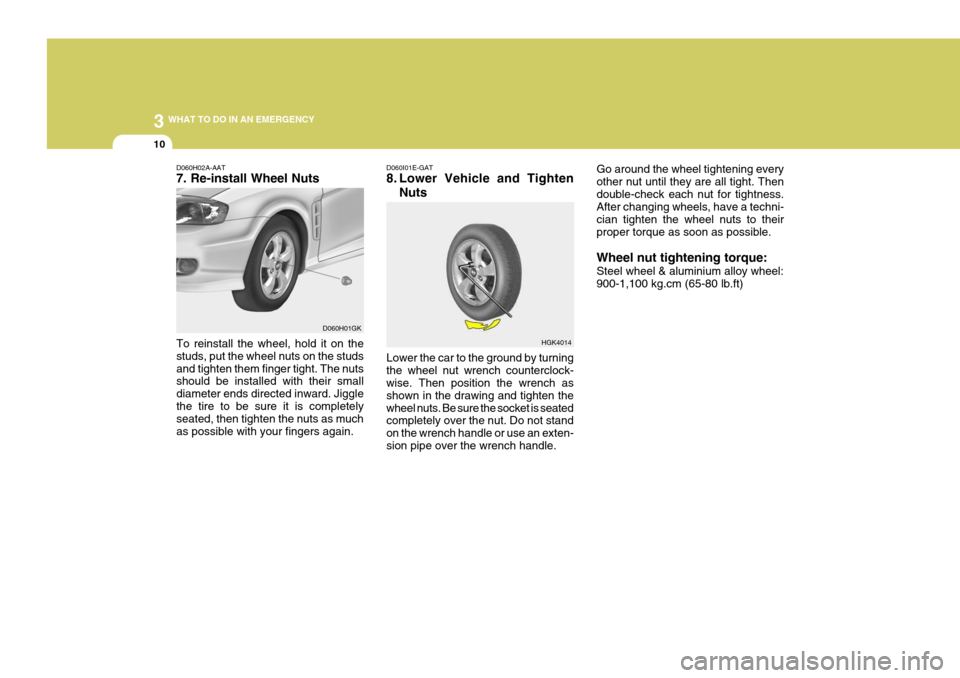
D060H02A-AAT 7. Re-install Wheel Nuts To reinstall the wheel, hold it on the studs, put the wheel nuts on the studsand tighten them finger tight. The nuts should be installed with their small diameter ends directed inward. Jigglethe tire to be sure it is completely seated, then tighten the nuts as much as possible with your fingers again. D060I01E-GAT
8. Lower Vehicle and Tighten
Nuts
Lower the car to the ground by turning the wheel nut wrench counterclock- wise. Then position the wrench as shown in the drawing and tighten thewheel nuts. Be sure the socket is seated completely over the nut. Do not stand on the wrench handle or use an exten-sion pipe over the wrench handle.
D060H01GK Go around the wheel tightening everyother nut until they are all tight. Thendouble-check each nut for tightness. After changing wheels, have a techni- cian tighten the wheel nuts to theirproper torque as soon as possible. Wheel nut tightening torque: Steel wheel & aluminium alloy wheel: 900-1,100 kg.cm (65-80 lb.ft)
Page 179 of 478
3
WHAT TO DO IN AN EMERGENCY
11
D060J01FC-GAT After Changing Wheels If you have a tire gauge, remove the valve cap and check the air pressure.If the pressure is lower than recom- mended, drive slowly to the nearest service station and inflate to the cor-rect pressure. If it is too high, adjust it until it is correct. Always reinstall the valve cap after checking or adjustingtire pressure. If the cap is not replaced, air mayleak from the tire. If you lose a valve cap, buy another and install it assoon as possible. After you have changed wheels, al- ways secure the flat tire in its place inthe luggage compartment and return the jack and tools to their proper stor- age locations.
IF YOUR VEHICLE MUST BE TOWED
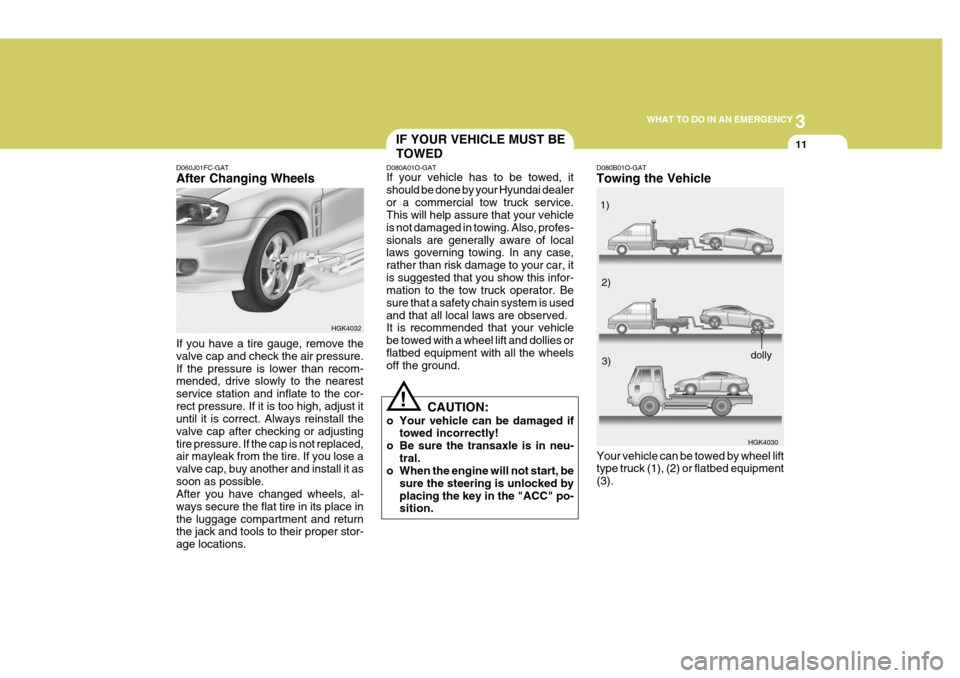
D080A01O-GAT If your vehicle has to be towed, it should be done by your Hyundai dealeror a commercial tow truck service. This will help assure that your vehicle is not damaged in towing. Also, profes-sionals are generally aware of local laws governing towing. In any case, rather than risk damage to your car, itis suggested that you show this infor- mation to the tow truck operator. Be sure that a safety chain system is usedand that all local laws are observed. It is recommended that your vehicle be towed with a wheel lift and dollies orflatbed equipment with all the wheels off the ground.
! CAUTION:
o Your vehicle can be damaged if towed incorrectly!
o Be sure the transaxle is in neu-
tral.
o When the engine will not start, be
sure the steering is unlocked by placing the key in the "ACC" po- sition.
HGK4032
D080B01O-GAT Towing the Vehicle
HGK4030
Your vehicle can be towed by wheel lift type truck (1), (2) or flatbed equipment (3). 1)
2)
3)
dolly
Page 180 of 478
3 WHAT TO DO IN AN EMERGENCY
12
HGK4017
!
!
1) If the vehicle is being towed with the
rear wheels on the ground, be sure the parking brake is released.
NOTE: Before towing, check the level of the automatic transaxle fluid. If it is below the "HOT" range on the dip-stick, add fluid. If you cannot add fluid, a towing dolly must be used.
2) If any of the loaded wheels or sus- pension components are damaged or the vehicle is being towed with the front wheels on the ground, use a towing dolly under the front wheels.
o Manual Transaxle: If you do not use a towing dolly,place the ignition key in the "ACC"position and put the transaxle in "N (Neutral)".
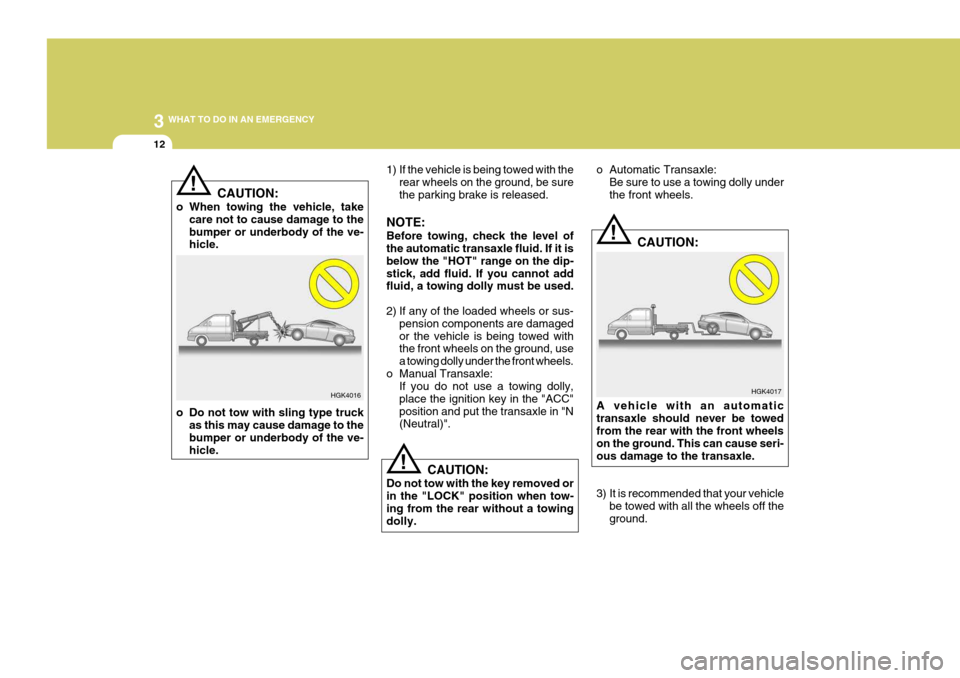
CAUTION:
Do not tow with the key removed or in the "LOCK" position when tow- ing from the rear without a towing dolly. o Automatic Transaxle:
Be sure to use a towing dolly underthe front wheels.
CAUTION:
A vehicle with an automatictransaxle should never be towed from the rear with the front wheels on the ground. This can cause seri-ous damage to the transaxle.
3) It is recommended that your vehicle be towed with all the wheels off the ground.
o When towing the vehicle, take
care not to cause damage to the bumper or underbody of the ve- hicle.
o Do not tow with sling type truck as this may cause damage to the bumper or underbody of the ve-hicle. HGK4016
!
CAUTION:
Page 181 of 478
3
WHAT TO DO IN AN EMERGENCY
13
D080D01GK
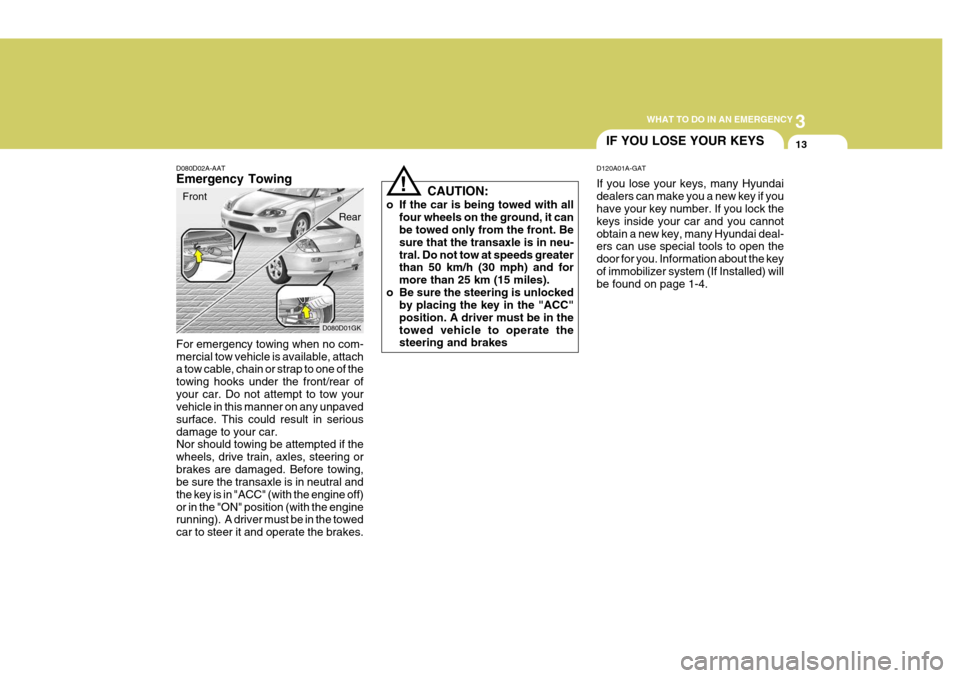
!
D080D02A-AAT Emergency Towing For emergency towing when no com- mercial tow vehicle is available, attach a tow cable, chain or strap to one of the towing hooks under the front/rear ofyour car. Do not attempt to tow your vehicle in this manner on any unpaved surface. This could result in seriousdamage to your car. Nor should towing be attempted if the wheels, drive train, axles, steering orbrakes are damaged. Before towing, be sure the transaxle is in neutral and the key is in "ACC" (with the engine off)or in the "ON" position (with the engine running). A driver must be in the towed car to steer it and operate the brakes. CAUTION:
o If the car is being towed with all four wheels on the ground, it can be towed only from the front. Be sure that the transaxle is in neu-tral. Do not tow at speeds greater than 50 km/h (30 mph) and for more than 25 km (15 miles).
o Be sure the steering is unlocked by placing the key in the "ACC"position. A driver must be in thetowed vehicle to operate the steering and brakes
IF YOU LOSE YOUR KEYS
D120A01A-GAT If you lose your keys, many Hyundai dealers can make you a new key if you have your key number. If you lock the keys inside your car and you cannotobtain a new key, many Hyundai deal- ers can use special tools to open the door for you. Information about the keyof immobilizer system (If Installed) will be found on page 1-4.
Front
Rear