coolant level Hyundai Coupe 2006 User Guide
[x] Cancel search | Manufacturer: HYUNDAI, Model Year: 2006, Model line: Coupe, Model: Hyundai Coupe 2006Pages: 483, PDF Size: 12.73 MB
Page 208 of 483
6
DO-IT-YOURSELF MAINTENANCE
9
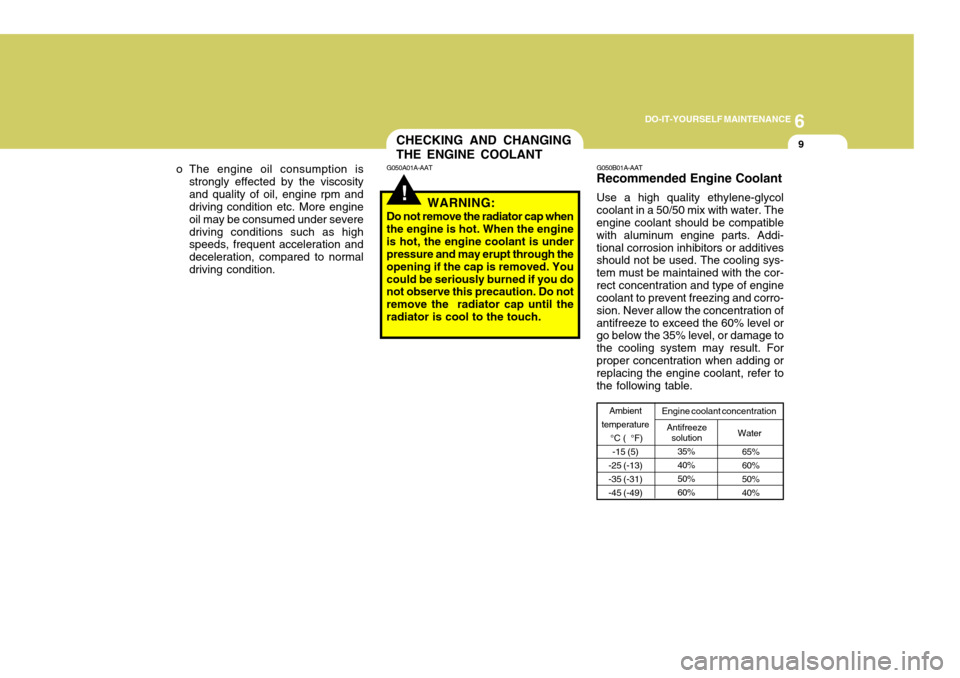
o The engine oil consumption is strongly effected by the viscosity and quality of oil, engine rpm and driving condition etc. More engine oil may be consumed under severedriving conditions such as high speeds, frequent acceleration and deceleration, compared to normaldriving condition. G050B01A-AAT Recommended Engine Coolant Use a high quality ethylene-glycol coolant in a 50/50 mix with water. The engine coolant should be compatible with aluminum engine parts. Addi-tional corrosion inhibitors or additives should not be used. The cooling sys- tem must be maintained with the cor-rect concentration and type of engine coolant to prevent freezing and corro- sion. Never allow the concentration ofantifreeze to exceed the 60% level or go below the 35% level, or damage to the cooling system may result. Forproper concentration when adding or replacing the engine coolant, refer to the following table.
Water
65% 60%50%40%
35%40%50%60%
Ambient
temperature °C ( °F)-15 (5)
-25 (-13) -35 (-31)-45 (-49) Engine coolant concentration
Antifreezesolution
!
CHECKING AND CHANGING THE ENGINE COOLANT
G050A01A-AAT
WARNING:
Do not remove the radiator cap when the engine is hot. When the engineis hot, the engine coolant is under pressure and may erupt through the opening if the cap is removed. Youcould be seriously burned if you do not observe this precaution. Do not remove the radiator cap until theradiator is cool to the touch.
Page 209 of 483
6 DO-IT-YOURSELF MAINTENANCE
10
HGK4006
G050C01A-AAT To Check the Coolant Level
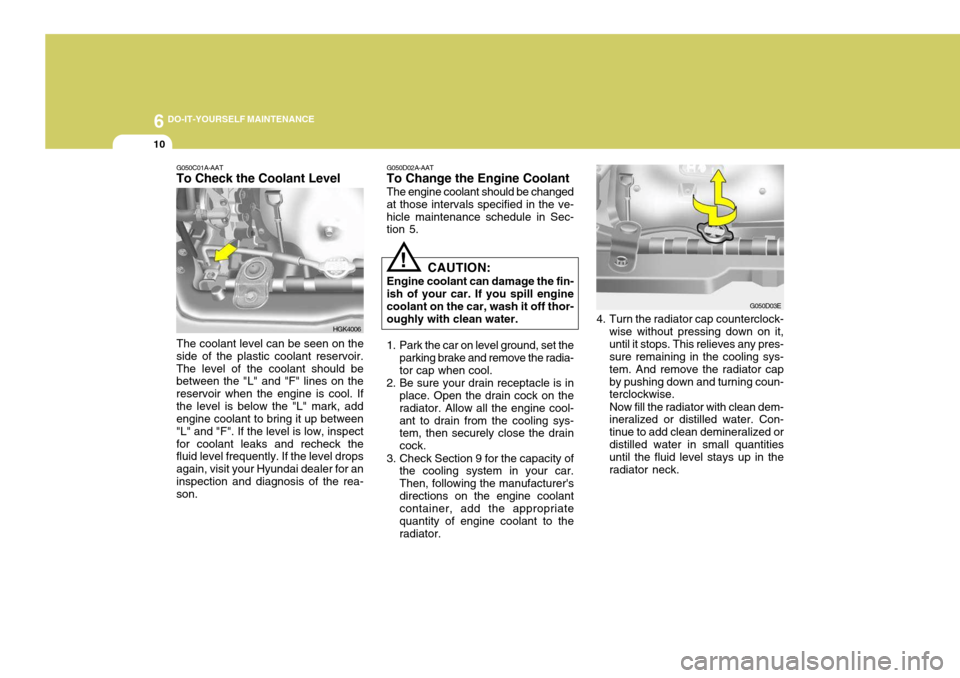
The coolant level can be seen on the
side of the plastic coolant reservoir. The level of the coolant should be between the "L" and "F" lines on the reservoir when the engine is cool. Ifthe level is below the "L" mark, add engine coolant to bring it up between "L" and "F". If the level is low, inspectfor coolant leaks and recheck the fluid level frequently. If the level drops again, visit your Hyundai dealer for aninspection and diagnosis of the rea- son. G050D02A-AAT To Change the Engine Coolant The engine coolant should be changed at those intervals specified in the ve-hicle maintenance schedule in Sec- tion 5.
CAUTION:
Engine coolant can damage the fin- ish of your car. If you spill engine coolant on the car, wash it off thor- oughly with clean water.
!
1. Park the car on level ground, set the parking brake and remove the radia- tor cap when cool.
2. Be sure your drain receptacle is in place. Open the drain cock on the radiator. Allow all the engine cool-ant to drain from the cooling sys- tem, then securely close the drain cock.
3. Check Section 9 for the capacity of the cooling system in your car.Then, following the manufacturer'sdirections on the engine coolant container, add the appropriate quantity of engine coolant to theradiator. 4. Turn the radiator cap counterclock-
wise without pressing down on it,until it stops. This relieves any pres- sure remaining in the cooling sys- tem. And remove the radiator capby pushing down and turning coun- terclockwise. Now fill the radiator with clean dem- ineralized or distilled water. Con- tinue to add clean demineralized ordistilled water in small quantities until the fluid level stays up in the radiator neck. G050D03E
Page 210 of 483
6
DO-IT-YOURSELF MAINTENANCE
11CHANGING THE AIR CLEANER FILTER
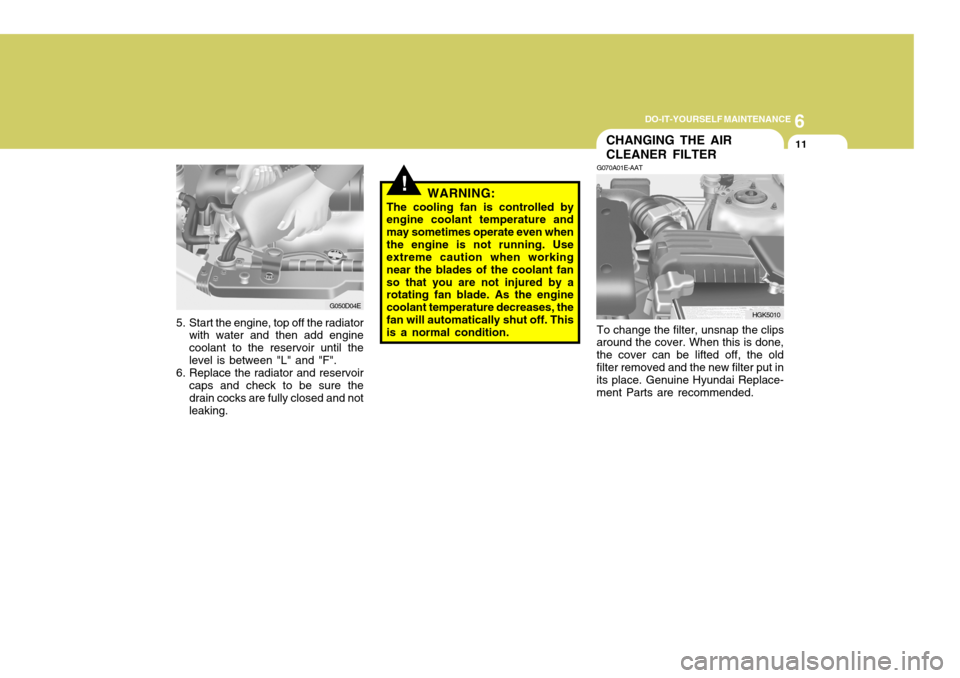
G070A01E-AAT To change the filter, unsnap the clips
around the cover. When this is done, the cover can be lifted off, the oldfilter removed and the new filter put in its place. Genuine Hyundai Replace- ment Parts are recommended.
HGK5010G050D04E
!WARNING:
The cooling fan is controlled by engine coolant temperature and may sometimes operate even whenthe engine is not running. Use extreme caution when working near the blades of the coolant fanso that you are not injured by a rotating fan blade. As the engine coolant temperature decreases, thefan will automatically shut off. This is a normal condition.
5. Start the engine, top off the radiator
with water and then add engine coolant to the reservoir until the level is between "L" and "F".
6. Replace the radiator and reservoir caps and check to be sure thedrain cocks are fully closed and not leaking.
Page 215 of 483
6 DO-IT-YOURSELF MAINTENANCE
16
HGK5007
G110D03Y-AAT
To Check the Transaxle Fluid Level
1.6/2.0L 2.7L
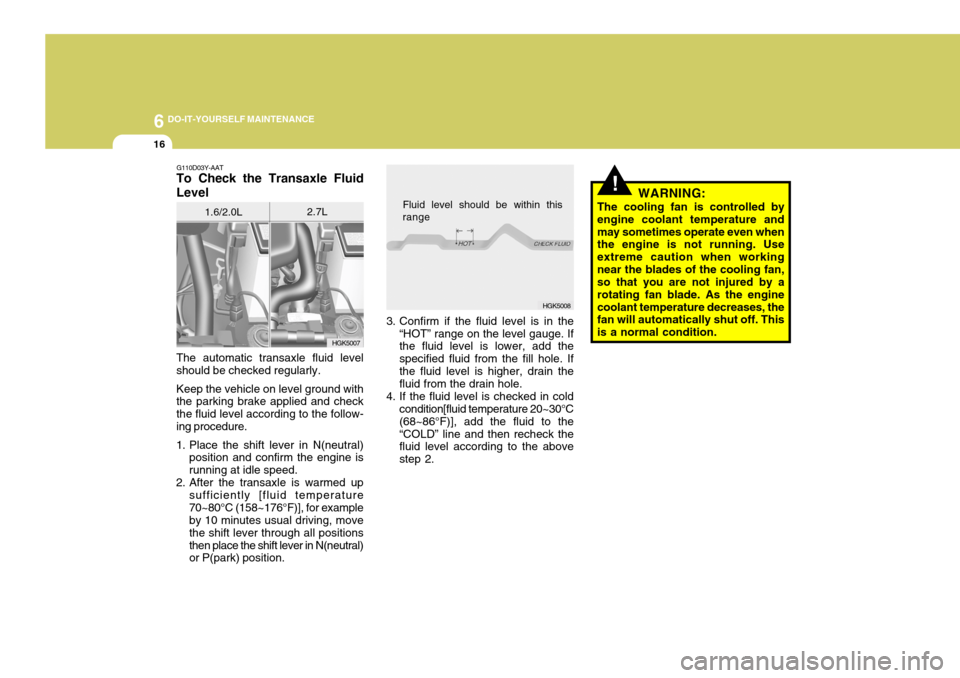
The automatic transaxle fluid level should be checked regularly. Keep the vehicle on level ground with the parking brake applied and check the fluid level according to the follow-ing procedure.
1. Place the shift lever in N(neutral) position and confirm the engine isrunning at idle speed.
2. After the transaxle is warmed up
sufficiently [fluid temperature70~80°C (158~176°F)], for example by 10 minutes usual driving, move the shift lever through all positionsthen place the shift lever in N(neutral) or P(park) position. 3. Confirm if the fluid level is in the
“HOT” range on the level gauge. Ifthe fluid level is lower, add the specified fluid from the fill hole. If the fluid level is higher, drain the fluid from the drain hole.
4. If the fluid level is checked in cold condition[fluid temperature 20~30°C(68~86°F)], add the fluid to the“COLD” line and then recheck the fluid level according to the above step 2.
HGK5008
!WARNING:
The cooling fan is controlled by engine coolant temperature andmay sometimes operate even when the engine is not running. Use extreme caution when workingnear the blades of the cooling fan, so that you are not injured by a rotating fan blade. As the enginecoolant temperature decreases, the fan will automatically shut off. This is a normal condition.
Fluid level should be within this
range
Page 224 of 483
6
DO-IT-YOURSELF MAINTENANCE
25
G220B01A-AAT
Checking Engine Cooling Fan
The engine coolant fan should come on automatically if the engine coolant temperature is high. G220C01A-AAT
Checking Condenser Cooling Fan
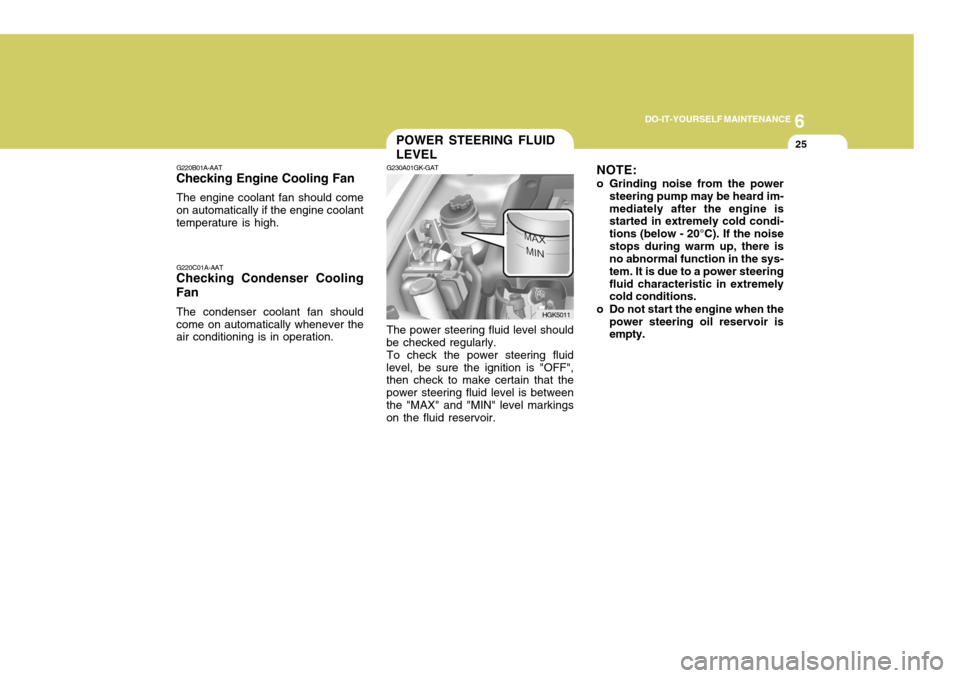
The condenser coolant fan should come on automatically whenever the air conditioning is in operation. G230A01GK-GAT
POWER STEERING FLUID LEVEL
The power steering fluid level should
be checked regularly.
To check the power steering fluid
level, be sure the ignition is "OFF", then check to make certain that the power steering fluid level is betweenthe "MAX" and "MIN" level markings on the fluid reservoir. NOTE:
o Grinding noise from the power
steering pump may be heard im- mediately after the engine is started in extremely cold condi- tions (below - 20°C). If the noisestops during warm up, there is no abnormal function in the sys- tem. It is due to a power steeringfluid characteristic in extremely cold conditions.
o Do not start the engine when the power steering oil reservoir isempty.
HGK5011
Page 225 of 483
6 DO-IT-YOURSELF MAINTENANCE
26
OGK076068N
G240A01A-AAT Power Steering Hoses It is suggested that you check the power steering hose connections for fluid leakage daily. The power steer- ing hoses should be replaced if thereis severe surface cracking, pulling, scuffing or worn spots. Deterioration of the hose could cause prematurefailure. G290A02GK-GAT
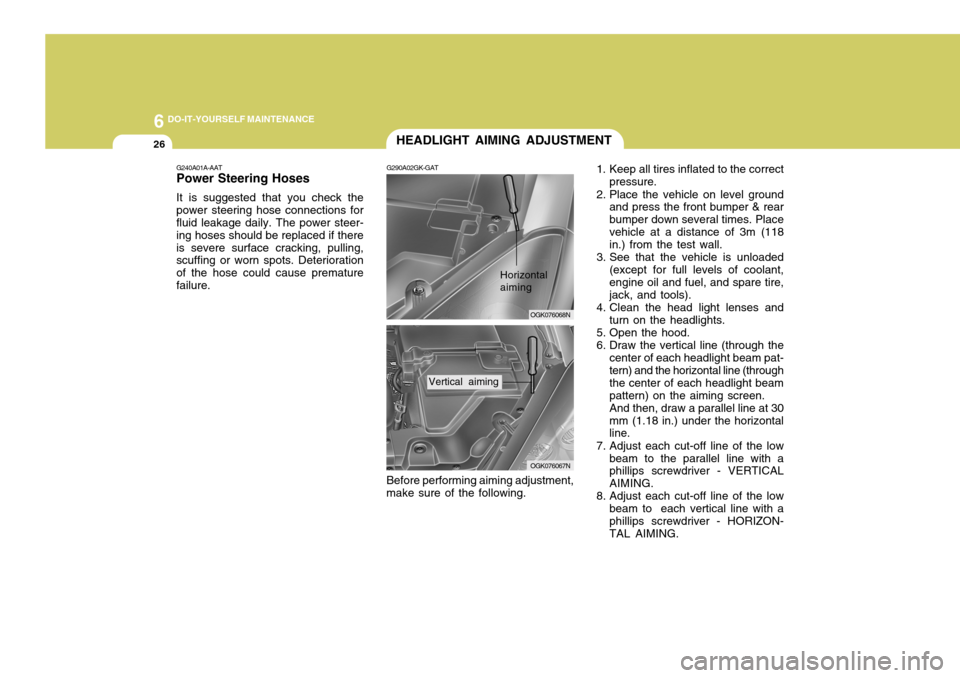
HEADLIGHT AIMING ADJUSTMENT
1. Keep all tires inflated to the correctpressure.
2. Place the vehicle on level ground and press the front bumper & rearbumper down several times. Placevehicle at a distance of 3m (118 in.) from the test wall.
3. See that the vehicle is unloaded (except for full levels of coolant, engine oil and fuel, and spare tire,jack, and tools).
4. Clean the head light lenses and
turn on the headlights.
5. Open the hood.
6. Draw the vertical line (through the center of each headlight beam pat- tern) and the horizontal line (through the center of each headlight beampattern) on the aiming screen.And then, draw a parallel line at 30mm (1.18 in.) under the horizontal line.
7. Adjust each cut-off line of the low beam to the parallel line with aphillips screwdriver - VERTICAL AIMING.
8. Adjust each cut-off line of the low
beam to each vertical line with aphillips screwdriver - HORIZON- TAL AIMING.
Before performing aiming adjustment,
make sure of the following.
OGK076067N
Horizontal aiming
Vertical aiming
Page 255 of 483

10
INDEX
3
Driving Economical driving .................................................. 2-16
Smooth corneri ng ..................................................... 2-17
Winter driving ........................................................... 2-17
E Electronic Stability Program (ESP) ............................2-13
Emissions Control Systems ........................................ 7-2 Engine Before starting the engine ........................................ 2-3
Changing the oil and filter ......................................... 6-6Compartment (1.6L, 2.0L, 2.7L) ................................ 6-2
Coolant ..................................................................... 6-9
Coolant temperature gauge ......................................1-50
If the engine overheats ............................................. 3-4
Number ..................................................................... 8-2
Oil ............................................................................. 6-6Oil consumption ........................................................ 6-8
Starting ..................................................................... 2-5
Engine Exhaust Can Be Dangerous ............................ 2-2
FFog Light .................................................................... 1-60
Front Seats Adjustable front seats .............................................. 1-13
Adjustable headrests ............................................... 1-14
Adjusting seat forward and rearward ........................ 1-13
Adjusting seatback angle ........................................ 1-14
Lumbar support control ............................................ 1-16
Seat cushion height adjustment .............................. 1-16Seat warmer
............................................................ 1-16
Fuel Capacity ................................................................... 9-2
Gauge ...................................................................... 1-50
Recommendations .................................................... 1-2
Fuel Filler Lid Remote release ....................................................... 1-74
Fuse Panel Description .............................................. 6-37
Fuses ......................................................................... 6-21
G
General Everyday Checks ..... ...................................... 6-5
Glove box ................................................................... 1-69
H Hazard Warning System ............................................. 1-61
Headlight Leveling Device S ystem .............................1-64
Heating and Air Conditioning Control Rotary type .............................................................. 1-84
Automatic type ........................................................ 1-93
High-mounted rear stoplight .. ......................................1-72
Hood Release ............................................................. 1-73
Horn ............................................................................ 1-78
I Ignition Switch ............................................................. 2-4
Immobilizer System ..................................................... 1-4
Instrument Cluster and Indicator Lights ...................... 1-42
Instrument Panel Light Control (Rheostat) .................. 1-62
Intermittent Wiper ....................................................... 1-59
Page 270 of 483
1
CONTROLS AND EQUIPMENT
3RUNNING IN YOUR NEW HYUNDAI
B020A01S-EAT The longevity and performance of the vehicle are greatly affected by the care exercised during the first 1,000 miles of motoring. Because of modern manu-facturing techniques, rigid guidelines regarding maximum road speeds have become unnecessary. However, cer-tain precautions should be observed in order to obtain the best possible per- formance and useful life from the ve-hicle.
1) Do not race the engine without a
load (i.e revving the engine in neu- tral).
2) During the first 500 miles the maxi- mum engine speed should be re-stricted to 3,000 rpm and gradually increased thereafter.
3) Avoid prolonged constant speed operation. The internal componentsof the engine will become morequickly run in if the operation speed is varied during the running in pe- riod.
4) Never allow the engine to labour. Use the gearbox freely and avoidlarge throttle openings when theengine speed is below 1,500 rpm.BEFORE ENTERING THE VEHICLEAFTER ENTERING THE VEHICLE
YB020A1-E
o Ensure that all windows, mirrors
and lamps are clean.
o Check condition of all tyres.
o Ensure that no fluid leaks are evi-
dent.
o Ensure that the area around the vehicle is clear before driving off. YB020B1-E
o Ensure that all occupants fasten
and correctly adjust seat belts.
o Ensure that seat and head restraint positions are adjusted for optimum safety, control and comfort.
o Adjust interior and exterior rear view mirrors.
o Verify correct operation of lamps, horn and other electrical equipment.
o Ensure that warning lamps illumi-
nate when ignition is turned on.
NOTE: Fluid levels such as engine oil, en- gine coolant, brake and windscreenwasher fluid should be checked daily or at each refuelling, which- ever occurs sooner.
gkfluk-1a.p65 12/26/2006, 5:11 PM
3
Page 308 of 483
1
CONTROLS AND EQUIPMENT
41
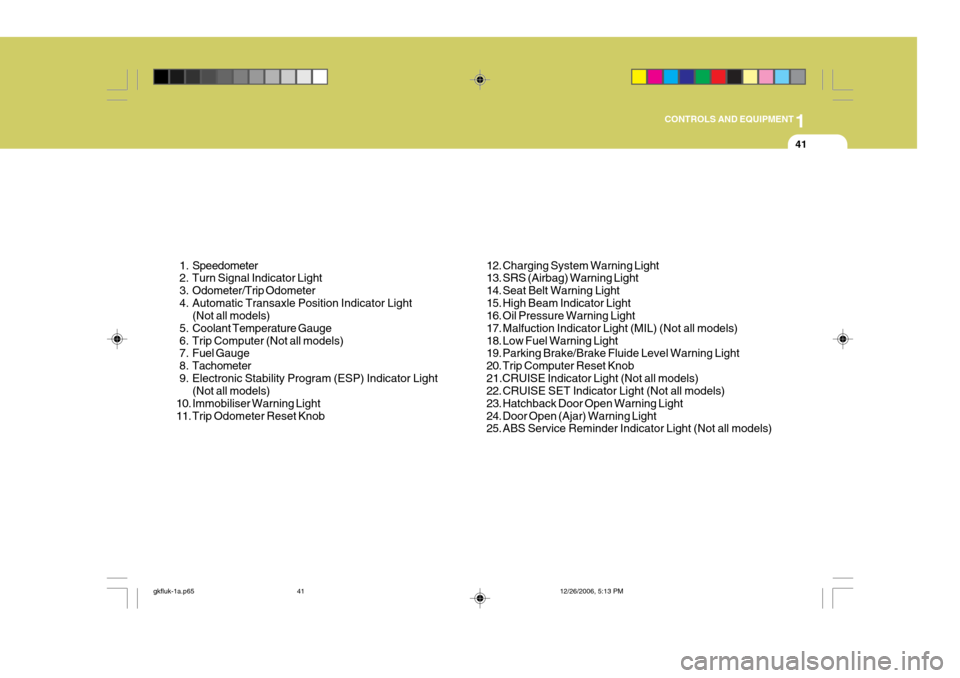
1. Speedometer
2. Turn Signal Indicator Light
3. Odometer/Trip Odometer
4. Automatic Transaxle Position Indicator Light (Not all models)
5. Coolant Temperature Gauge
6. Trip Computer (Not all models)
7. Fuel Gauge
8. Tachometer
9. Electronic Stability Program (ESP) Indicator Light (Not all models)
10. Immobiliser Warning Light
11. Trip Odometer Reset Knob 12. Charging System Warning Light
13. SRS (Airbag) Warning Light
14. Seat Belt Warning Light
15. High Beam Indicator Light
16. Oil Pressure Warning Light
17. Malfuction Indicator Light (MIL) (Not all models)
18. Low Fuel Warning Light
19. Parking Brake/Brake Fluide Level Warning Light
20. Trip Computer Reset Knob21.CRUISE Indicator Light (Not all models)
22. CRUISE SET Indicator Light (Not all models)
23. Hatchback Door Open Warning Light
24. Door Open (Ajar) Warning Light
25. ABS Service Reminder Indicator Light (Not all models)
gkfluk-1a.p65
12/26/2006, 5:13 PM
41
Page 314 of 483
1
CONTROLS AND EQUIPMENT
47
!
INSTRUMENT CLUSTER
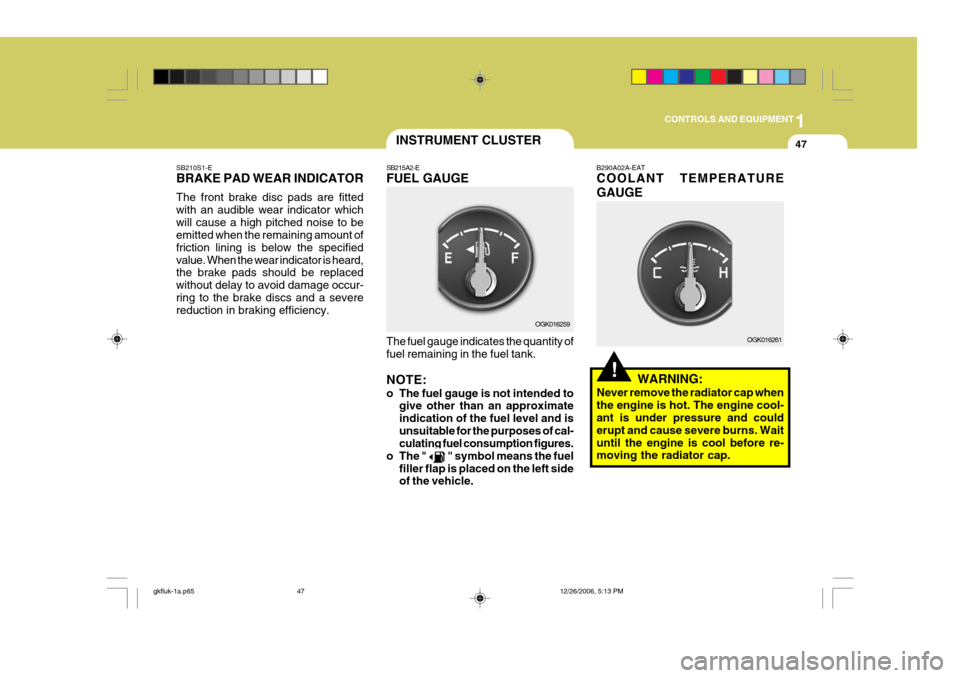
SB210S1-E BRAKE PAD WEAR INDICATOR The front brake disc pads are fitted with an audible wear indicator whichwill cause a high pitched noise to be emitted when the remaining amount of friction lining is below the specifiedvalue. When the wear indicator is heard, the brake pads should be replaced without delay to avoid damage occur-ring to the brake discs and a severe reduction in braking efficiency. SB215A2-E FUEL GAUGE The fuel gauge indicates the quantity of fuel remaining in the fuel tank. NOTE:
o The fuel gauge is not intended to
give other than an approximate indication of the fuel level and isunsuitable for the purposes of cal- culating fuel consumption figures.
o The "
" symbol means the fuel
filler flap is placed on the left side of the vehicle. B290A02A-EAT COOLANT TEMPERATURE GAUGE
WARNING:
Never remove the radiator cap when the engine is hot. The engine cool- ant is under pressure and could erupt and cause severe burns. Waituntil the engine is cool before re- moving the radiator cap.
OGK016259
OGK016261
gkfluk-1a.p65 12/26/2006, 5:13 PM
47