ECU Hyundai Coupe 2006 Owner's Guide
[x] Cancel search | Manufacturer: HYUNDAI, Model Year: 2006, Model line: Coupe, Model: Hyundai Coupe 2006Pages: 483, PDF Size: 12.73 MB
Page 286 of 483
1
CONTROLS AND EQUIPMENT
19
SB090B1-E Babies/Small Children Babies and small children must be restrained using a restraint system specifically designed for this purpose. Under no circumstances should a childbe carried in the vehicle without the use of a suitable restraint which meets the regulations in force in the countrywhere the vehicle is in operation.
SEAT BELTS
!WARNING:
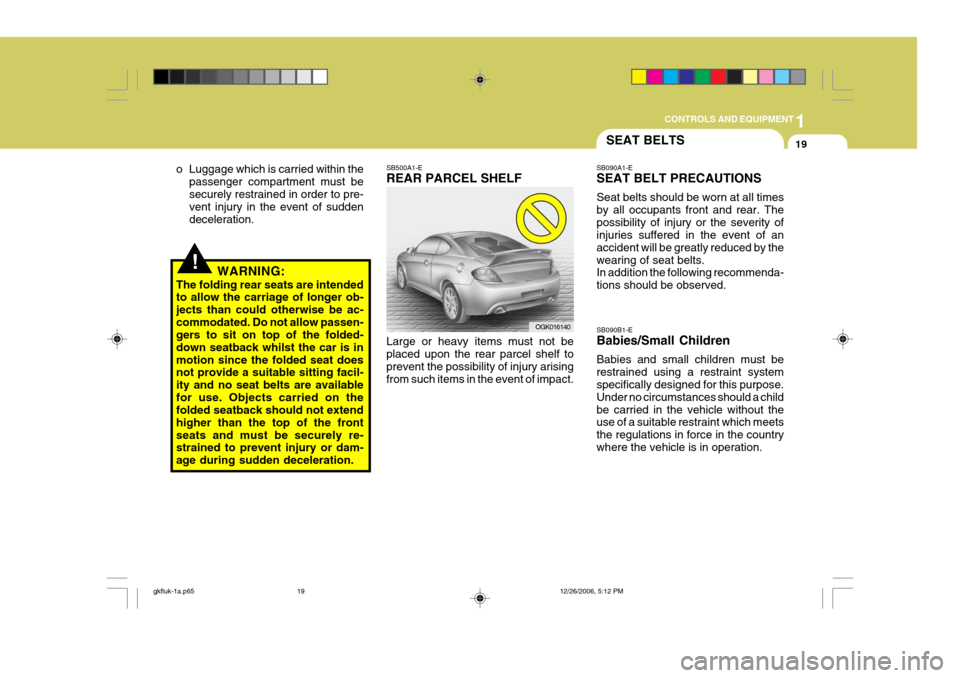
The folding rear seats are intended to allow the carriage of longer ob- jects than could otherwise be ac-commodated. Do not allow passen- gers to sit on top of the folded- down seatback whilst the car is inmotion since the folded seat does not provide a suitable sitting facil- ity and no seat belts are availablefor use. Objects carried on the folded seatback should not extend higher than the top of the frontseats and must be securely re- strained to prevent injury or dam- age during sudden deceleration. SB500A1-E REAR PARCEL SHELF Large or heavy items must not be placed upon the rear parcel shelf to prevent the possibility of injury arisingfrom such items in the event of impact.
SB090A1-E SEAT BELT PRECAUTIONS Seat belts should be worn at all times by all occupants front and rear. Thepossibility of injury or the severity of injuries suffered in the event of an accident will be greatly reduced by thewearing of seat belts. In addition the following recommenda- tions should be observed.
OGK016140
o Luggage which is carried within the
passenger compartment must besecurely restrained in order to pre- vent injury in the event of sudden deceleration.
gkfluk-1a.p65 12/26/2006, 5:12 PM
19
Page 290 of 483
1
CONTROLS AND EQUIPMENT
23
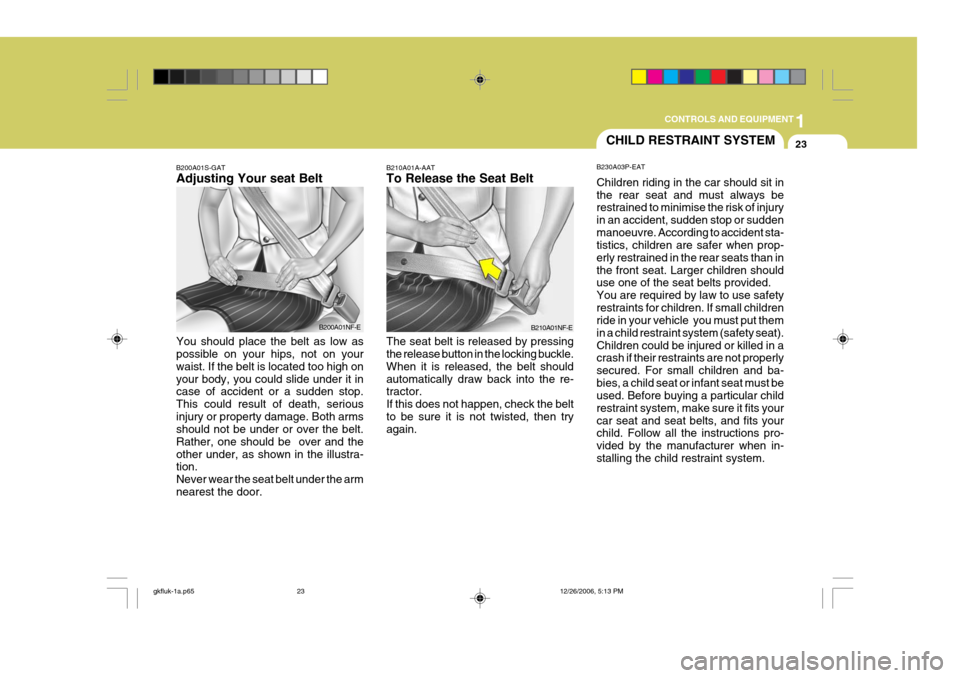
B210A01A-AAT To Release the Seat Belt The seat belt is released by pressing the release button in the locking buckle. When it is released, the belt shouldautomatically draw back into the re- tractor. If this does not happen, check the beltto be sure it is not twisted, then try again.
CHILD RESTRAINT SYSTEM
B230A03P-EAT Children riding in the car should sit in the rear seat and must always be restrained to minimise the risk of injury in an accident, sudden stop or suddenmanoeuvre. According to accident sta- tistics, children are safer when prop- erly restrained in the rear seats than inthe front seat. Larger children should use one of the seat belts provided. You are required by law to use safetyrestraints for children. If small children ride in your vehicle you must put them in a child restraint system (safety seat).Children could be injured or killed in a crash if their restraints are not properly secured. For small children and ba-bies, a child seat or infant seat must be used. Before buying a particular child restraint system, make sure it fits yourcar seat and seat belts, and fits your child. Follow all the instructions pro- vided by the manufacturer when in-stalling the child restraint system.
B210A01NF-E
B200A01S-GAT Adjusting Your seat Belt You should place the belt as low as possible on your hips, not on your waist. If the belt is located too high onyour body, you could slide under it in case of accident or a sudden stop. This could result of death, seriousinjury or property damage. Both arms should not be under or over the belt. Rather, one should be over and theother under, as shown in the illustra- tion. Never wear the seat belt under the armnearest the door. B200A01NF-E
gkfluk-1a.p65
12/26/2006, 5:13 PM
23
Page 291 of 483
1CONTROLS AND EQUIPMENT
24
!WARNING:
o A child restraint system must be placed in the rear seat. Never install a child or infant seat on the front passenger's seat.Should an accident occur and cause the passenger side airbag to deploy, it could severely in-jure or kill an infant or child seated in an infant or child seat. Thus, only use a child restraint in therear seat of your vehicle.
o Since a safety belt or child re-
straint system can become very hot if it is left in a closed vehicle, be sure to check the seat coverand buckles before placing a child there.
o When the child restraint system is not in use, fasten it with a safetybelt so that it will not be thrown forward in the case of a suddenstop or an accident. o Never use an infant carrier or child
safety seat that "hooks" over a seatback; it may not provide ad- equate security in an accident.
o Never allow a child to be held in a person's arms whilst they are in amoving vehicle, as this could re-sult in serious injury to the child in the event of an accident or a sudden stop. Holding a child in amoving vehicle does not provide the child with any means of pro- tection during an accident, even ifthe person holding the child is wearing a seat belt.
o If the child restraint seat is not
anchored properly, the risk of achild being seriously injured or killed in a collision greatly in-creases.
o Children who are too large to be in
a child restraint should sit in therear seat and be restrained with the available lap/shoulder belts. Never allow children to ride in thefront passanger seat.
o Always make sure that the shoul-
der belt portion of the outboardlap/shoulder belt is positioned midway over the shoulder, never across the neck. Moving the childcloser to the centre of the vehicle may help provide a good shoul- der belt fit. The lap belt portion ofthe lap/shoulder belt or the cen- tre seat lap belt must always be positioned as low as possible onthe child's hips and as snug as possible.
o If the seat belt will not properly fit the child, we recommend the useof an approved booster seat in the rear seat in order to raise thechild's seating height so that the seat belt will properly fit the child.
o Never allow a child to stand up or kneel on the seat.
gkfluk-1a.p65 12/26/2006, 5:13 PM
24
Page 292 of 483
1
CONTROLS AND EQUIPMENT
25
!
If you need to tighten the belt, pull more webbing toward the retractor.When you unbuckle the seat belt and allow it to retract, the retractor will automatically revert back to its normalseated passenger emergency locking usage condition. NOTE:
o Before installing the child re-
straint system, read the instruc- tions supplied by the child re- straint system manufacturer.
o If the seat belt does not operate
as described, have the systemchecked immediately by your Hyundai authorised repairer.
WARNING:
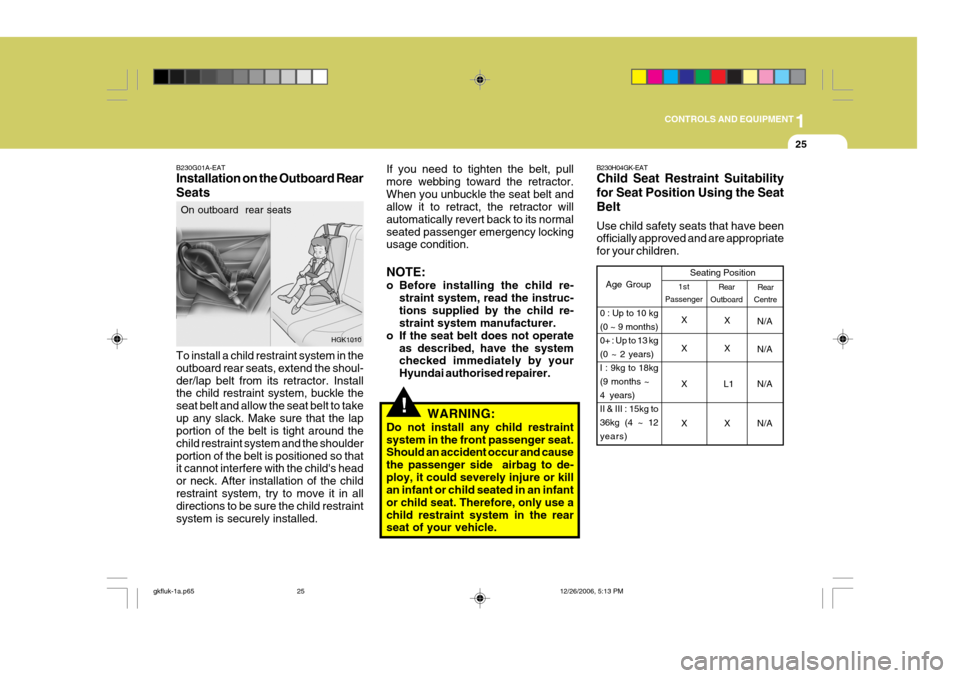
Do not install any child restraintsystem in the front passenger seat. Should an accident occur and cause the passenger side airbag to de-ploy, it could severely injure or kill an infant or child seated in an infant or child seat. Therefore, only use achild restraint system in the rear seat of your vehicle.B230G01A-EAT Installation on the Outboard Rear Seats To install a child restraint system in the outboard rear seats, extend the shoul-der/lap belt from its retractor. Install the child restraint system, buckle the seat belt and allow the seat belt to takeup any slack. Make sure that the lap portion of the belt is tight around the child restraint system and the shoulderportion of the belt is positioned so that it cannot interfere with the child's head or neck. After installation of the childrestraint system, try to move it in all directions to be sure the child restraint system is securely installed. On outboard rear seats
HGK1010 B230H04GK-EAT Child Seat Restraint Suitability for Seat Position Using the SeatBelt Use child safety seats that have been officially approved and are appropriate for your children.
Rear
Centre
Age Group Seating Position
X
N/A
XX N/A
X L1 N/A
X X N/A Rear
Outboard
1st
Passenger
0 : Up to 10 kg (0 ~ 9 months)0+ : Up to 13 kg(0 ~ 2 years)I : 9kg to 18kg(9 months ~4 years)II & III : 15kg to36kg (4 ~ 12years) X
gkfluk-1a.p65
12/26/2006, 5:13 PM
25
Page 293 of 483
1CONTROLS AND EQUIPMENT
26
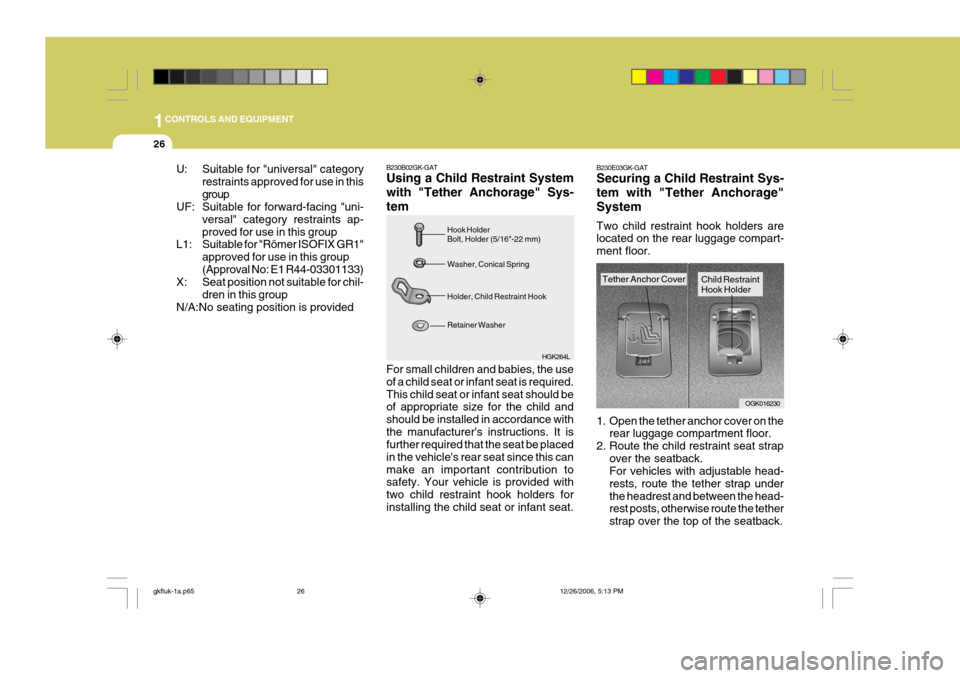
B230E03GK-GAT Securing a Child Restraint Sys- tem with "Tether Anchorage"System Two child restraint hook holders are located on the rear luggage compart- ment floor.
OGK016230
Tether Anchor Cover
Child Restraint Hook Holder
1. Open the tether anchor cover on the
rear luggage compartment floor.
2. Route the child restraint seat strap over the seatback. For vehicles with adjustable head- rests, route the tether strap underthe headrest and between the head- rest posts, otherwise route the tether strap over the top of the seatback.
B230B02GK-GAT Using a Child Restraint System with "Tether Anchorage" Sys-tem For small children and babies, the use of a child seat or infant seat is required.This child seat or infant seat should be of appropriate size for the child and should be installed in accordance withthe manufacturer's instructions. It is further required that the seat be placed in the vehicle's rear seat since this canmake an important contribution to safety. Your vehicle is provided with two child restraint hook holders forinstalling the child seat or infant seat. HGK264L
Hook Holder Bolt, Holder (5/16"-22 mm) Washer, Conical Spring Holder, Child Restraint Hook Retainer Washer
U: Suitable for "universal" category
restraints approved for use in this group
UF: Suitable for forward-facing "uni-
versal" category restraints ap-proved for use in this group
L1: Suitable for "Römer ISOFIX GR1"
approved for use in this group(Approval No: E1 R44-03301133)
X: Seat position not suitable for chil-
dren in this group
N/A:No seating position is provided
gkfluk-1a.p65 12/26/2006, 5:13 PM
26
Page 294 of 483
1
CONTROLS AND EQUIPMENT
27
B230D02GK
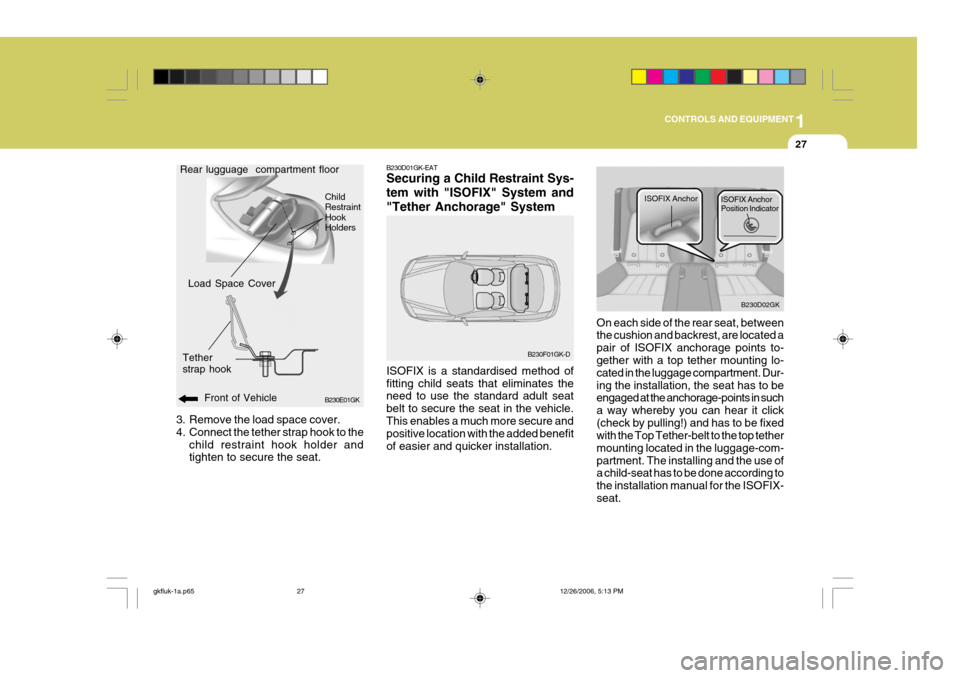
ISOFIX Anchor
ISOFIX Anchor Position Indicator
3. Remove the load space cover.
4. Connect the tether strap hook to the
child restraint hook holder and tighten to secure the seat. B230D01GK-EAT Securing a Child Restraint Sys- tem with "ISOFIX" System and"Tether Anchorage" System ISOFIX is a standardised method of fitting child seats that eliminates the need to use the standard adult seat belt to secure the seat in the vehicle.This enables a much more secure and positive location with the added benefit of easier and quicker installation.
B230E01GK
Front of Vehicle
Load Space Cover
Tether strap hook
Rear lugguage compartment floor
B230F01GK-D
Child RestraintHookHoldersOn each side of the rear seat, between the cushion and backrest, are located a pair of ISOFIX anchorage points to- gether with a top tether mounting lo- cated in the luggage compartment. Dur-ing the installation, the seat has to be engaged at the anchorage-points in such a way whereby you can hear it click(check by pulling!) and has to be fixed with the Top Tether-belt to the top tether mounting located in the luggage-com-partment. The installing and the use of a child-seat has to be done according to the installation manual for the ISOFIX-seat.
gkfluk-1a.p65 12/26/2006, 5:13 PM
27
Page 295 of 483
1CONTROLS AND EQUIPMENT
28
!WARNING:
o There is no rear centre seating position.
o Do not install a child restraint seat at the center of the rear seat using the vehicle's ISOFIX anchors. TheISOFIX anchors are only provided for the left and right outboard rear seating positions. Do not misusethe ISOFIX anchors by attempting to attach a child restraint seat in the middle of the rear seat to theISOFIX anchors. In a crash, the child restraint seat ISOFIX attach- ments may not be strong enoughto secure the child restraint seat properly in the center of the rear seat and may break, causing se-rious injury or death.
o When using the vehicle’s
“ISOFIX” system to install a childrestraint system in the rear seat, all unused vehicle rear seat belt metal latch plates or tabs must belatched securely in their seat belt buckles and the seat belt web- bing must be retracted behind the
NOTE: An ISOFIX-child-seat can only be installed if the seat has a vehicle-specific approval according to ECE- R44. Before using the ISOFIX-child- seat, which was bought for anothercar, ask your Hyundai authorised repairer whether this seat-type is ap- proved and recommended for yourHyundai. To secure the child restraint seat
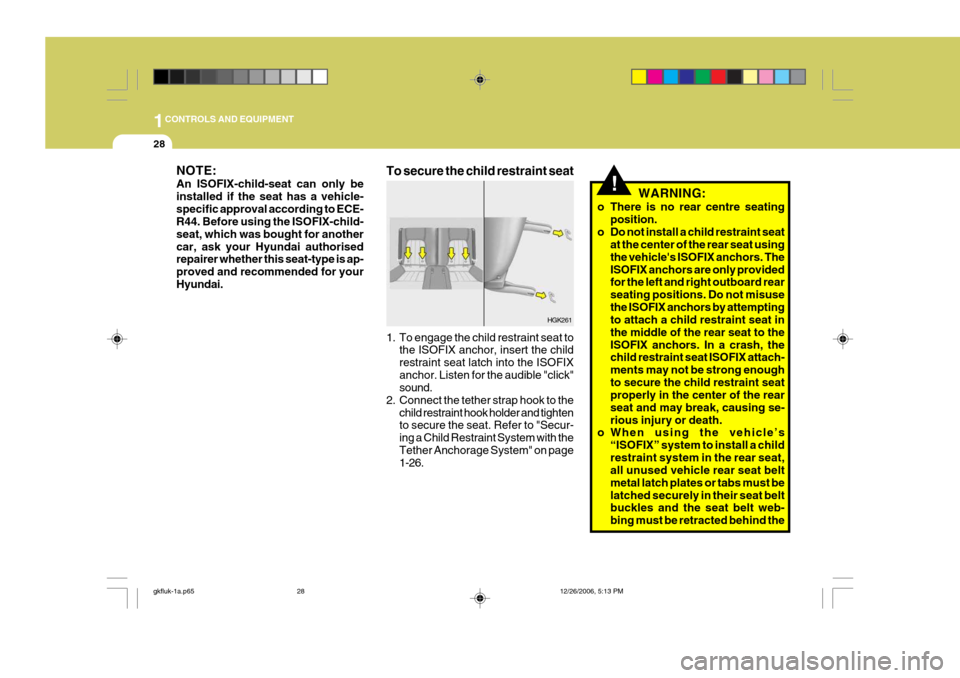
1. To engage the child restraint seat to
the ISOFIX anchor, insert the child restraint seat latch into the ISOFIXanchor. Listen for the audible "click" sound.
2. Connect the tether strap hook to the child restraint hook holder and tightento secure the seat. Refer to "Secur- ing a Child Restraint System with theTether Anchorage System" on page 1-26. HGK261
gkfluk-1a.p65
12/26/2006, 5:13 PM
28
Page 339 of 483
1CONTROLS AND EQUIPMENT
72
o Automotive fuels are flammable/
explosive materials. When refuel- ing, please note the following guidelines carefully. Failure tofollow these guidelines may re- sult in severe personal injury, se- vere burns or death by fire orexplosion.
- Before refueling always note the
location of the Emergency Fuel Shut-Off, if available, at the fuel station facility.
- Before touching the fuel nozzle or fuel filler cap, you shouldeliminate potentially dangerous static electricity discharge bytouching another metal part of the front of the vehicle, a safe distance away from the fuel fillerneck, nozzle, or other fuel source.
- Do not get back into a vehicle once you have begun refueling.Do not touch, rub or slide against any item or fabric (polyester,satin, nylon, etc.) capable of pro- ducing static electricity. Static electricity discharge can ignitefuel vapors resulting in explo sion.If you must re-enter the vehicle, you should once again elimi- nate potentially dangerous staticelectricity discharge by touch- ing a metal part of the vehicle, away from the fuel filler neck,nozzle or other fuel source.
- When using a portable fuel con-
tainer be sure to place the con-tainer on the ground prior to refueling. Static electricity dis- charge from the container canignite fuel vapors causing a fire. Once refueling has begun, con- tact with the vehicle should bemaintained until the filling is complete. Use only portable fuel containers designed to carry andstore fuel.
- Do not use cellular phones
around a fuel station or whilstrefueling any vehicle. Electric current and/or electronic inter- ference from cellular phones canpotentially ignite fuel vapors causing a fire. If you must use your cellular phone use it in aplace away from the fuel station. - When refueling always shut the
engine off. Sparks produced by electrical components related to the engine can ignite fuel va-pors causing a fire. Always in- sure that the engine is OFF be- fore and during refueling. Oncerefueling is complete, check to make sure the fuel filler cap and door are securely closed, beforestarting the engine.
- Do not light any fire around a
fuel station. DO NOT use matchesor a lighter and DO NOT SMOKE or leave a lit cigarette in your vehicle whilst at a gas stationespecially during refueling. Automotive fuel is highly flam- mable and can, when ignited,result in explosion by flames.
- If a fire breaks out during refuel-
ing, leave the vicinity of the ve-hicle, and immediately contact the manager of the fuel station or contact the police and localfire department. Follow any safety instructions they provide.
gkfluk-1a.p65 12/26/2006, 5:14 PM
72
Page 340 of 483
1
CONTROLS AND EQUIPMENT
73HATCHBACK DOOR
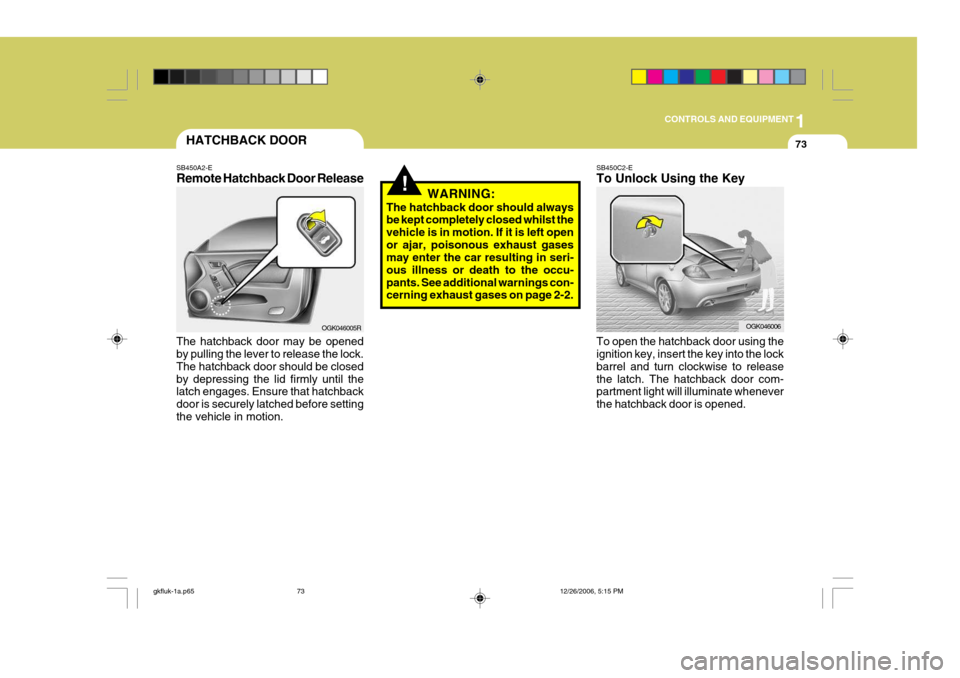
SB450A2-E Remote Hatchback Door Release The hatchback door may be opened by pulling the lever to release the lock. The hatchback door should be closedby depressing the lid firmly until the latch engages. Ensure that hatchback door is securely latched before settingthe vehicle in motion. OGK046005R
!WARNING:
The hatchback door should always be kept completely closed whilst the vehicle is in motion. If it is left openor ajar, poisonous exhaust gases may enter the car resulting in seri- ous illness or death to the occu-pants. See additional warnings con- cerning exhaust gases on page 2-2.
SB450C2-E To Unlock Using the Key To open the hatchback door using the ignition key, insert the key into the lock barrel and turn clockwise to releasethe latch. The hatchback door com- partment light will illuminate whenever the hatchback door is opened. OGK046006
gkfluk-1a.p65
12/26/2006, 5:15 PM
73
Page 383 of 483
2
DRIVING YOUR HYUNDAI
11
!
UP (+) :
Push the selector lever forward
once to shift up one gear. DOWN (-) : Pull the selector lever back-
wards once to shift down one gear.
CAUTION:
o In sports mode, the driver must execute shifts in accordance withprevailing road conditions, tak- ing care to keep the engine speed below the red zone.
o For engine protection, upward shifts are made automaticallywhen the engine rpm reaches thered zone.
o By rapidly moving the selector
lever backwards (-) twice it ispossible to skip one gear by us- ing the sports mode. Since sud- den engine braking and/or rapidacceleration can cause a loss of traction, however, downshifts must be made carefully in accor-dance with the vehicle's speed.
C090E01O-AAT
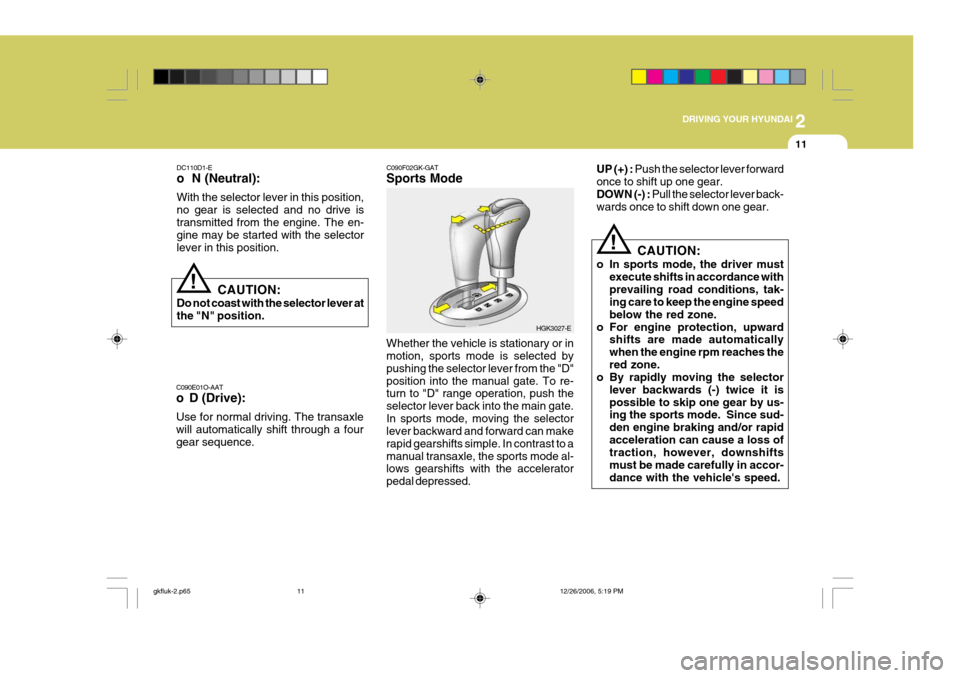
o D (Drive): Use for normal driving. The transaxle will automatically shift through a fourgear sequence. C090F02GK-GAT Sports Mode Whether the vehicle is stationary or in motion, sports mode is selected by pushing the selector lever from the "D"position into the manual gate. To re- turn to "D" range operation, push the selector lever back into the main gate.In sports mode, moving the selector lever backward and forward can make rapid gearshifts simple. In contrast to amanual transaxle, the sports mode al- lows gearshifts with the accelerator pedal depressed.
HGK3027-E
DC110D1-E o N (Neutral): With the selector lever in this position, no gear is selected and no drive istransmitted from the engine. The en- gine may be started with the selector lever in this position.
CAUTION:
Do not coast with the selector lever atthe "N" position.
!
gkfluk-2.p65 12/26/2006, 5:19 PM
11