belt Hyundai Coupe 2006 Owner's Guide
[x] Cancel search | Manufacturer: HYUNDAI, Model Year: 2006, Model line: Coupe, Model: Hyundai Coupe 2006Pages: 483, PDF Size: 12.73 MB
Page 153 of 483
2 DRIVING YOUR HYUNDAI
12ANTI-LOCK BRAKE SYSTEM (ABS)
!
o Slow down before shifting to a lower
gear. Otherwise, the lower gear may not be engaged.
o Always use the parking brake. Do
not depend on placing the transaxlein "P" to keep the car from moving.
o Exercise extreme caution when driv-
ing on a slippery surface. Be espe-cially careful when braking, acceler- ating or shifting gears. On a slippery surface, an abrupt change in vehiclespeed can cause the drive wheels to lose traction and the vehicle to go out of control.
o Optimum vehicle performance and economy is obtained by smoothlydepressing and releasing the accel-erator pedal. o The risk of rollover is greatly in-
creased if you lose control of your vehicle at highway speeds.
o Loss of control often occurs if two
or more wheels drop off the road-way and the driver oversteers to reenter the roadway.
o In the event your vehicle leaves the roadway, do not steer sharply.Instead, slow down before pull-ing back into the travel lanes.
o Never exceed posted speed lim-
its.
o If your vehicle becomes stuck in snow, mud, sand, etc., then youmay attempt to rock the vehiclefree by moving it forward and back- ward. Do not attempt this proce- dure if people or objects are any-where near the vehicle. During the rocking operation the vehicle may suddenly move forward of back-ward as it becomes unstuck, caus- ing injury or damage to nearby people or objects.
WARNING:
o Avoid high cornering speeds.
o Do not make quick steering wheel movements, such as sharp lane changes or fast, sharp turns.
o Always wear your seat belts.
In a collision crash, un unbeltedperson is significantly more likely to die than a person wearing a seatbelt. C120A03A-AAT (If Installed) The Anti-Lock Brake System (ABS) is designed to prevent wheel lock-upduring sudden braking or on hazard- ous road surfaces. The ABS control module monitors the wheel speed andcontrols the pressure applied to each brake. Thus, in emergency situations or on slick roads, ABS will increasevehicle control during braking. NOTE:
o A click sound may be heard in the
engine compartment when the ve- hicle begins to move after the en- gine is started. These conditionsare normal and indicate that the anti-lock brake system (Electronic Stability Program) is functioningproperly.
o During ABS (ESP) operation, a
slight pulsation may be felt in thebrake pedal when the brakes are applied. Also, a noise may be heard in the engine compartment whilebraking. These conditions are normal and indicate that the anti- lock brake system is functioningproperly.
Page 161 of 483
2 DRIVING YOUR HYUNDAI
20HIGHER SPEED MOTORING
C160J01A-AAT Don't Let Ice and Snow Accumu- late Underneath Under some conditions, snow and ice can build up under the fenders andinterfere with the steering. When driv- ing in severe winter conditions where this may happen, you should periodi-cally check underneath the car to be sure the movement of the front wheels and the steering components is notobstructed. C160K01A-AAT Carry Emergency Equipment Depending on the severity of the weather where you drive your car, you should carry appropriate emergency equipment. Some of the items youmay want to carry include tire chains, tow straps or chains, flashlight, emer- gency flares, sand, a shovel, jumpercables, a window scraper, gloves, ground cloth, coveralls, a blanket, etc. C170A01A-AAT Pre-Trip Inspections 1. Tires: Adjust the tire inflation pressures to specification. Low tire inflation pres-sures will result in overheating and possible failure of the tires. Avoid using worn or damaged tireswhich may result in reduced traction or tire failure. NOTE: Never exceed the maximum tire in- flation pressure shown on the tires. 2. Fuel, engine coolant and en-
gine oil:
High speed travel consumes more fuel than urban motoring. Do not forget tocheck both engine coolant and engine oil. 3. Drive belt: A loose or damaged drive belt may result in overheating of the engine. C180A01A-AAT Check your lights regularly for correct operation and always keep them clean. When driving during the day in condi- tions of poor visibility, it is helpful todrive with headlights on low beam. This enables you to be seen as well as to see.
USE OF LIGHTS
Page 170 of 483
3 WHAT TO DO IN AN EMERGENCY
4
!
booster battery. Then attach the other end of that cable to a solidmetal part of the engine away from the battery. Do not connect the cable to any moving part.
4. Start the engine in the car with the booster battery and let it run for afew minutes. This will help to as-sure that the booster battery is fully charged. During the jumping opera- tion, run the engine in this vehicle atabout 2000 rpm.
5. Start the engine in the car with the
discharged battery using the nor-mal starting procedure. After the engine starts, leave the jumper cables connected and let the enginerun at fast idle or about 2000 rpm for several minutes.
6. carefully remove the jumper cables in the reverse order of attachment.
If you do not know why your battery became discharged (because the lights were left on, etc.), have the charging system checked by your Hyundaidealer. D030A02A-AAT If your temperature gauge indicates overheating, you experience a loss of power, or hear loud pinging or knock- ing, the engine is probably too hot. Ifthis happens to you, you should:
1. Pull off the road and stop as soon as
it is safe to do so.
2. Place the gear selector lever in "P"
(automatic), or neutral (manual transaxle) and set the parking brake. If the air conditioning is on, turn it off.
3. If engine coolant is running out un- der the car or steam is coming outfrom the hood, stop the engine. Donot open the hood until the engine coolant has stopped running or the steaming has stopped. If there is novisible loss of engine coolant and no steam, leave the engine running and check to be sure the enginecooling fan is operating. If the fan is not running, turn the engine off.
IF THE ENGINE OVERHEATS
4. Check to see if the water pump drivebelt is missing. If it is not missing, check to see that it is tight. If the drive belt seems to be satisfactory, check for engine coolant leakingfrom the radiator, hoses or under the car. (If the air conditioning had been in use, it is normal for coldwater to be draining from it when you stop).
WARNING:
While the engine is running, keephair, hands, and clothing away from moving parts such as the fan anddrive belts to prevent injury.
5. If the water pump drive belt is bro- ken or engine coolant is leaking out, stop the engine immediately andcall the nearest Hyundai dealer for assistance.
Page 188 of 483
4
CORROSION PREVENTION AND APPEARANCE CARE
7
4
CORROSION PREVENTION AND APPEARANCE CARE
7ANY QUESTIONS?
E040D01A-AAT Cleaning the Seat Belts To clean the seat belts, use a cloth or sponge with mild soap or detergentand warm water. Do not use strong detergents, dye, bleach or abrasive materials on the seat belts as this mayweaken the fabric. While cleaning the belts, inspect them for excessive wear, cuts, fraying orother signs of damage and replace them if necessary. E040E01A-AAT Cleaning the Windows You may use any household window cleaner on the windows. However,when cleaning the inside of the rear window be careful not to damage the rear window defroster wiring. E050A01A-AAT If you have any questions about the care of your car, consult your Hyundai dealer.
Page 192 of 483
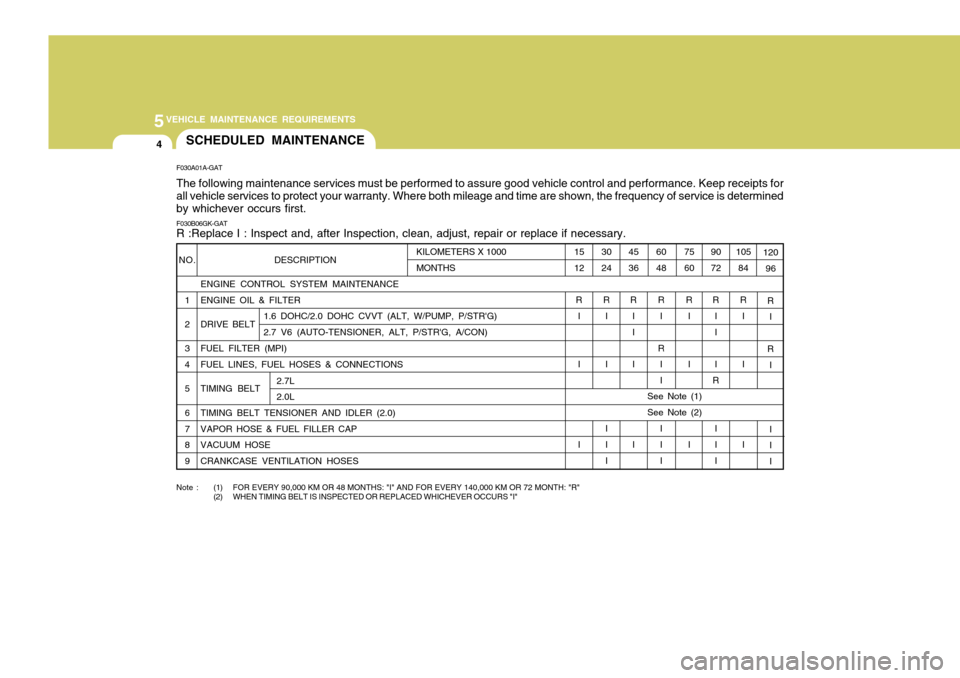
5VEHICLE MAINTENANCE REQUIREMENTS
4
75 60R I I I
NO.
1 2 3 4 5 6 7 8 9
F030A01A-GAT The following maintenance services must be performed to assure good vehicle control and performance. Keep receipts for all vehicle services to protect your warranty. Where both mileage and time are shown, the frequency of service is determined by whichever occurs first. F030B06GK-GAT R :Replace I : Inspect and, after Inspection, clean, adjust, repair or replace if necessary.105
84
R I I I 120
96
R I
R I I I I
90 72
R II I
R
I I I
6048
R I
R I I I I I
4536
R II I I
30 24
R I I I I I
1512
R I I I
KILOMETERS X 1000 MONTHS
SCHEDULED MAINTENANCE
DESCRIPTION ENGINE CONTROL SYSTEM MAINTENANCE ENGINE OIL & FILTER DRIVE BELT FUEL FILTER (MPI) FUEL LINES, FUEL HOSES & CONNECTIONS TIMING BELT TIMING BELT TENSIONER AND IDLER (2.0) VAPOR HOSE & FUEL FILLER CAP VACUUM HOSE CRANKCASE VENTILATION HOSES
1.6 DOHC/2.0 DOHC CVVT (ALT, W/PUMP, P/STR'G) 2.7 V6 (AUTO-TENSIONER, ALT, P/STR'G, A/CON)
See Note (1)See Note (2)
2.7L 2.0L
Note : (1) FOR EVERY 90,000 KM OR 48 MONTHS: "I" AND FOR EVERY 140,000 KM OR 72 MONTH: "R"
(2) WHEN TIMING BELT IS INSPECTED OR REPLACED WHICHEVER OCCURS "I"
Page 194 of 483
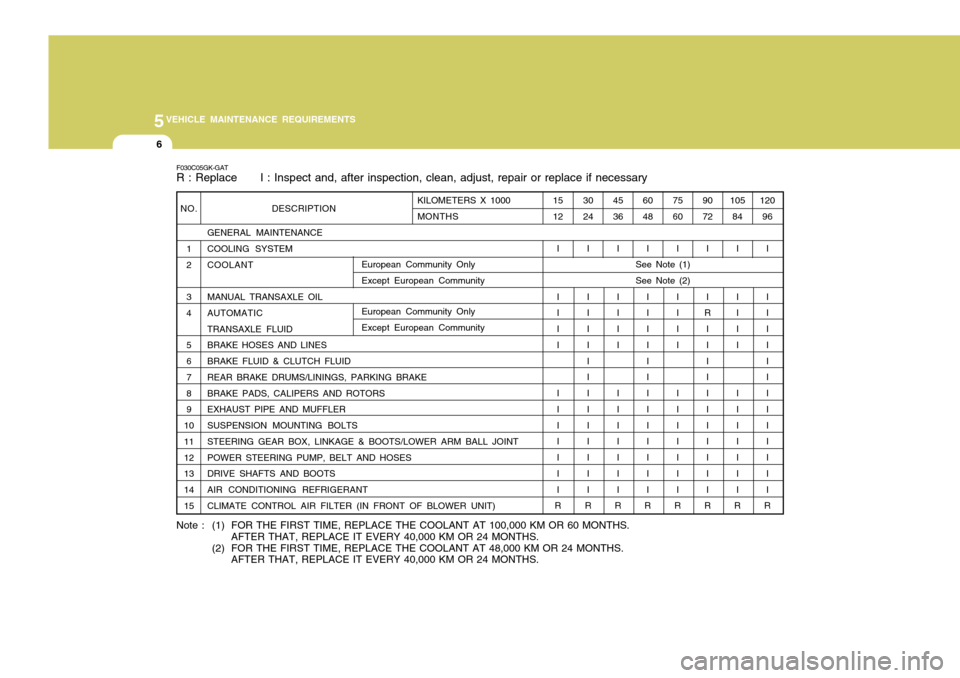
5VEHICLE MAINTENANCE REQUIREMENTS
6
75 60I I I I I I I I I I I I
R
NO.
12 3 4 5 6 7 8 9
1011 12 13 14 15 DESCRIPTION
GENERAL MAINTENANCECOOLING SYSTEM COOLANT MANUAL TRANSAXLE OIL AUTOMATIC TRANSAXLE FLUID BRAKE HOSES AND LINES BRAKE FLUID & CLUTCH FLUID REAR BRAKE DRUMS/LININGS, PARKING BRAKE BRAKE PADS, CALIPERS AND ROTORS EXHAUST PIPE AND MUFFLER SUSPENSION MOUNTING BOLTS STEERING GEAR BOX, LINKAGE & BOOTS/LOWER ARM BALL JOINT POWER STEERING PUMP, BELT AND HOSES DRIVE SHAFTS AND BOOTS AIR CONDITIONING REFRIGERANT CLIMATE CONTROL AIR FILTER (IN FRONT OF BLOWER UNIT)
F030C05GK-GAT R : Replace I : Inspect and, after inspection, clean, adjust, repair or replace if necessary
Note : (1) FOR THE FIRST TIME, REPLACE THE COOLANT AT 100,000 KM OR 60 MONTHS.
AFTER THAT, REPLACE IT EVERY 40,000 KM OR 24 MONTHS.
(2) FOR THE FIRST TIME, REPLACE THE COOLANT AT 48,000 KM OR 24 MONTHS. AFTER THAT, REPLACE IT EVERY 40,000 KM OR 24 MONTHS.
120
96
I I I I I I I I I I I I I I
R
105
84
I I I I I I I I I I I I
R
90 72
I I
R
I I I I I I I I I I I
R
60 48
I I I I I I I I I I I I I I
R
45 36
I I I I I I I I I I I I
R
30 24
I I I I I I I I I I I I I I
R
15 12
I I I I I I I I I I I I
R
KILOMETERS X 1000 MONTHS
European Community Only Except European Community
See Note (1) See Note (2)European Community Only Except European Community
Page 195 of 483
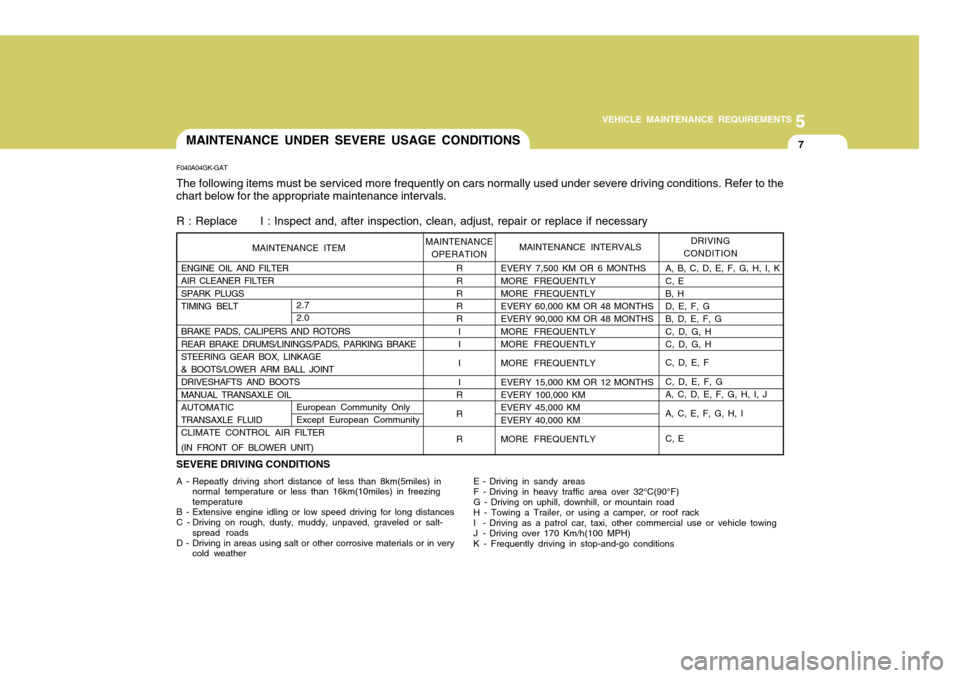
5
VEHICLE MAINTENANCE REQUIREMENTS
7
ENGINE OIL AND FILTER AIR CLEANER FILTER SPARK PLUGS TIMING BELT BRAKE PADS, CALIPERS AND ROTORS REAR BRAKE DRUMS/LININGS/PADS, PARKING BRAKE STEERING GEAR BOX, LINKAGE & BOOTS/LOWER ARM BALL JOINT DRIVESHAFTS AND BOOTS MANUAL TRANSAXLE OIL AUTOMATIC TRANSAXLE FLUID CLIMATE CONTROL AIR FILTER
(IN FRONT OF BLOWER UNIT) European Community OnlyExcept European Community
F040A04GK-GAT The following items must be serviced more frequently on cars normally used under severe driving conditions. Refer to the chart below for the appropriate maintenance intervals. R : Replace I : Inspect and, after inspection, clean, adjust, repair or replace if necessary
SEVERE DRIVING CONDITIONS A - Repeatly driving short distance of less than 8km(5miles) in normal temperature or less than 16km(10miles) in freezing temperature
B - Extensive engine idling or low speed driving for long distances
C - Driving on rough, dusty, muddy, unpaved, graveled or salt- spread roads
D - Driving in areas using salt or other corrosive materials or in very cold weather
MAINTENANCE UNDER SEVERE USAGE CONDITIONS
MAINTENANCE INTERVALS
A, B, C, D, E, F, G, H, I, K C, E B, H D, E, F, G B, D, E, F, G C, D, G, H C, D, G, H C, D, E, F C, D, E, F, G A, C, D, E, F, G, H, I, J A, C, E, F, G, H, I C, E
MAINTENANCE ITEM
DRIVING
CONDITION
EVERY 7,500 KM OR 6 MONTHS MORE FREQUENTLY MORE FREQUENTLY EVERY 60,000 KM OR 48 MONTHS EVERY 90,000 KM OR 48 MONTHS MORE FREQUENTLY MORE FREQUENTLY MORE FREQUENTLYEVERY 15,000 KM OR 12 MONTHS EVERY 100,000 KM EVERY 45,000 KM EVERY 40,000 KM MORE FREQUENTLYR R R R R II II
RR R
MAINTENANCE
OPERATION
E - Driving in sandy areas
F - Driving in heavy traffic area over 32°C(90°F)G - Driving on uphill, downhill, or mountain road H - Towing a Trailer, or using a camper, or roof rack
I - Driving as a patrol car, taxi, other commercial use or vehicle towing
J - Driving over 170 Km/h(100 MPH)K - Frequently driving in stop-and-go conditions
2.7 2.0
Page 196 of 483
5VEHICLE MAINTENANCE REQUIREMENTS
8EXPLANATION OF SCHEDULED MAINTENANCE ITEMS
F060M01A-AAT o Engine Oil and Filter The engine oil and filter should be changed at the intervals specified in the maintenance schedule. If the car is being driven in severe conditions,more frequent oil and filter changes are required. F060B02A-AAT
o Drive Belts Inspect all drive belts for evidence of cuts, cracks, excessive wear or oilsaturation and replace if necessary. Drive belts should be checked periodi- cally for proper tension and adjustedas necessary. F060C01A-AAT
o Fuel Filter
A clogged filter can limit the speed at
which the vehicle may be driven, dam- age the emission system and cause hard starting. If an excessive amountof foreign matter accumulates in the fuel tank, the filter may require re- placement more frequently. After installing a new filter, run the
engine for several minutes, and checkfor leaks at the connections. Fuel fil- ters should be installed by trained technicians.
F060D01A-AAT
o Fuel Lines, Fuel Hoses and
Connections
Check the fuel lines, fuel hoses and
connections for leakage and damage. Have a trained technician replace any damaged or leaking parts immediately. F060E01A-AAT
o Timing Belt
Inspect all parts related to the timing
belt for damage and deformation. Re- place any damaged parts immediately.
F060G01A-AAT
o Vapor Hose and Fuel Filler cap
The vapor hose and fuel filler cap
should be inspected at those intervalsspecified in the maintenance sched- ule. Make sure that a new vapor hoseor fuel filler cap is correctly replaced.
Page 199 of 483

5
VEHICLE MAINTENANCE REQUIREMENTS
11
F070M01A-AAT
o Steering Gear Box, Linkage &
Boots/Lower Arm Ball Joint
With the vehicle stopped and engine off, check for excessive free-play in the steering wheel. Check the linkage for bends or damage. Check the dustboots and ball joints for deterioration, cracks, or damage. Replace any dam- aged parts. F070N01A-AAT
o Power Steering Pump, Belt
and Hoses
Check the power steering pump and hoses for leakage and damage. Re- place any damaged or leaking partsimmediately. Inspect the power steer- ing belt for evidence of cuts, cracks, excessive wear, oiliness and propertension. Replace or adjust it if neces- sary. F070P01A-AAT
o Drive Shafts and Boots
Check the drive shafts, boots and
clamps for cracks, deterioration, ordamage. Replace any damaged parts and, if necessary, repack the grease.
F070Q01A-AAT
o Air Conditioning Refrigerant
Check the air conditioning lines and
connections for leakage and damage. Check air conditioning performance according to the relevant shop manualif necessary.
Page 204 of 483
6
DO-IT-YOURSELF MAINTENANCE
5
G020B01A-AAT
Vehicle Exterior
The following should be checked
monthly:
o Overall appearance and condition
o Wheel condition and wheel nut
torque
o Exhaust system condition
o Light condition and operation
o Windshield glass condition
o Wiper blade condition
o Paint condition and body corrosion
o Fluid leaks
o Door and hood lock condition
o Tire pressure and condition (in- cluding spare tire) G020C01A-AAT
Vehicle Interior
The following should be checked each time when the vehicle is driven:
o Lights operation
o Windshield wiper operation
o Horn operation
o Defroster, heating system opera- tion (and air conditioning, if installed)
o Steering operation and condition
o Mirror condition and operation
o Turn signal operation
o Accelerator pedal operation
o Brake operation, including parking
brake
o Manual transaxle operation, includ-
ing clutch operation
o Automatic transaxle operation, in- cluding "Park" mechanism opera-tion
o Seat control condition and opera-
tion
o Seat belt condition and operation
o Sunvisor operation
If you notice anything that does notoperate correctly or appears to be functioning incorrectly, inspect it care- fully and seek assistance from yourHyundai dealer if service is needed.
G020A01A-AAT
Engine Compartment
The following should be checked regu-larly:
o Engine oil level and condition
o Transaxle fluid level and condition
o Brake fluid level
o Clutch fluid level
o Engine coolant level
o Windshield washer fluid level
o Accessory drive belt condition
o Engine Coolant hose condition
o Fluid leaks (on or below compo- nents)
o Power steering fluid level
o Battery condition
o Air filter condition GENERAL CHECKS