warning Hyundai Coupe 2007 Owner's Manual
[x] Cancel search | Manufacturer: HYUNDAI, Model Year: 2007, Model line: Coupe, Model: Hyundai Coupe 2007Pages: 487, PDF Size: 12.96 MB
Page 446 of 487
6
OWNER MAINTENANCE
17
HGK5013-E
CHECKING THE CLUTCH FLUID
SG130A1-C
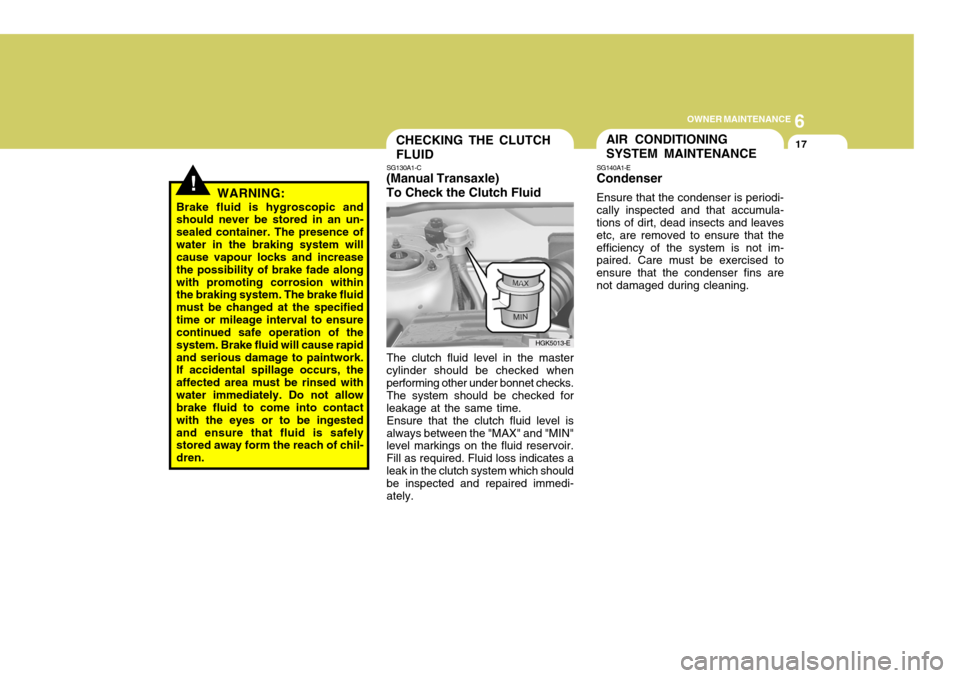
(Manual Transaxle)To Check the Clutch Fluid
The clutch fluid level in the master cylinder should be checked when performing other under bonnet checks. The system should be checked forleakage at the same time.Ensure that the clutch fluid level isalways between the "MAX" and "MIN" level markings on the fluid reservoir. Fill as required. Fluid loss indicates aleak in the clutch system which should be inspected and repaired immedi- ately.
WARNING:
Brake fluid is hygroscopic and should never be stored in an un- sealed container. The presence ofwater in the braking system will cause vapour locks and increase the possibility of brake fade alongwith promoting corrosion within the braking system. The brake fluid must be changed at the specifiedtime or mileage interval to ensure continued safe operation of the system. Brake fluid will cause rapidand serious damage to paintwork. If accidental spillage occurs, the affected area must be rinsed withwater immediately. Do not allow brake fluid to come into contact with the eyes or to be ingestedand ensure that fluid is safely stored away form the reach of chil- dren.
!
SG140A1-E Condenser Ensure that the condenser is periodi- cally inspected and that accumula- tions of dirt, dead insects and leaves etc, are removed to ensure that theefficiency of the system is not im- paired. Care must be exercised to ensure that the condenser fins arenot damaged during cleaning. AIR CONDITIONING SYSTEM MAINTENANCE
Page 449 of 487
6OWNER MAINTENANCE
20
!
G200A01E
FUSIBLE LINKS
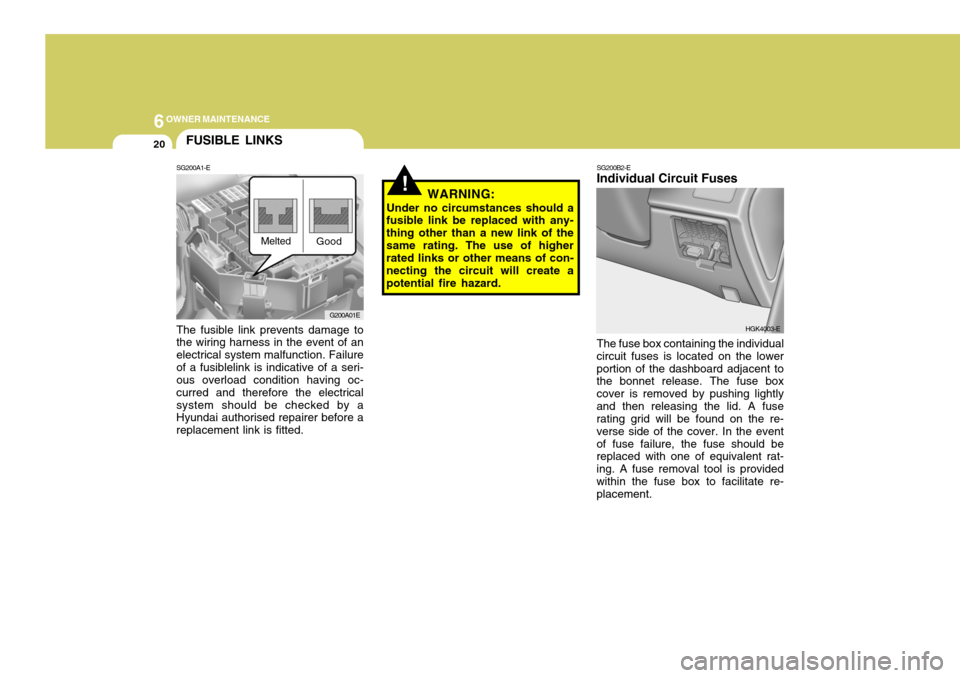
SG200A1-E The fusible link prevents damage to the wiring harness in the event of an electrical system malfunction. Failureof a fusiblelink is indicative of a seri- ous overload condition having oc- curred and therefore the electricalsystem should be checked by a Hyundai authorised repairer before a replacement link is fitted. WARNING:
Under no circumstances should a
fusible link be replaced with any-thing other than a new link of thesame rating. The use of higher rated links or other means of con- necting the circuit will create apotential fire hazard.
Melted SG200B2-E
Individual Circuit Fuses
The fuse box containing the individual
circuit fuses is located on the lowerportion of the dashboard adjacent to the bonnet release. The fuse box cover is removed by pushing lightlyand then releasing the lid. A fuse rating grid will be found on the re- verse side of the cover. In the eventof fuse failure, the fuse should be replaced with one of equivalent rat- ing. A fuse removal tool is providedwithin the fuse box to facilitate re- placement.
Good
HGK4003-E
Page 450 of 487
6
OWNER MAINTENANCE
21
!
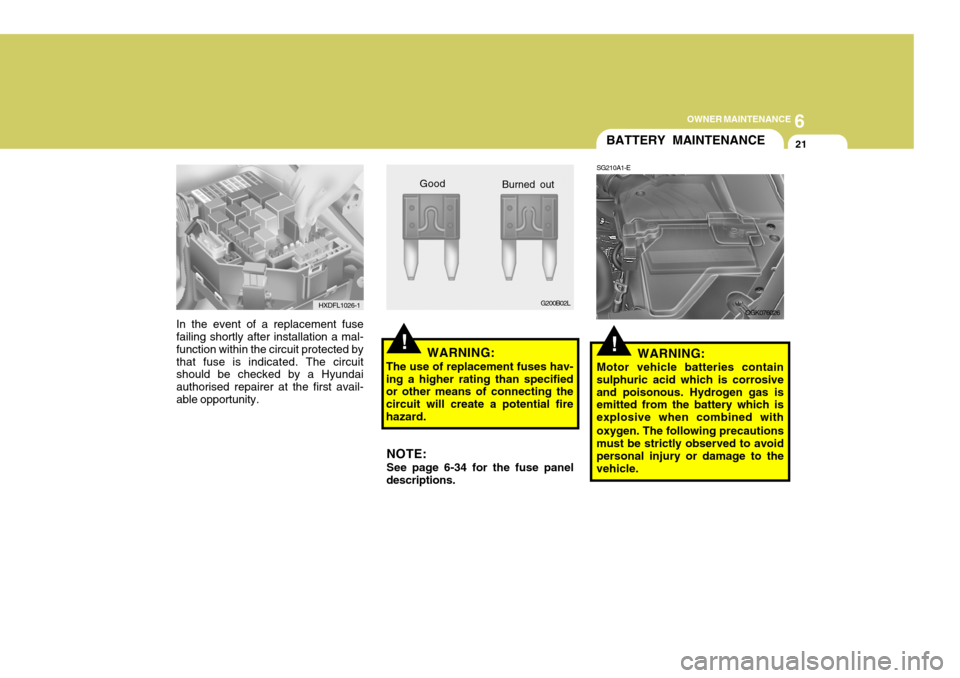
In the event of a replacement fuse failing shortly after installation a mal- function within the circuit protected bythat fuse is indicated. The circuit should be checked by a Hyundai authorised repairer at the first avail-able opportunity. WARNING:
The use of replacement fuses hav-ing a higher rating than specified or other means of connecting the circuit will create a potential firehazard. Good
HXDFL1026-1
G200B02L
Burned out
NOTE: See page 6-34 for the fuse panel
descriptions.
!
BATTERY MAINTENANCE
SG210A1-E
WARNING:
Motor vehicle batteries contain sulphuric acid which is corrosiveand poisonous. Hydrogen gas is emitted from the battery which is explosive when combined with oxygen. The following precautions must be strictly observed to avoid personal injury or damage to the vehicle. OGK076026
Page 451 of 487
6OWNER MAINTENANCE
22
o If battery electrolyte is spilled ontoskin or into eyes, the effected area must be flushed with copious amounts of water and medical as- sistance sought.
o If battery electrolyte is ingested, copious amounts of water or milkfollowed by an ant-acid (raw egg ormilk of magnesia) must be drunk. Vomiting should not be induced and medical assistance must besought.
o Batteries must only be charged in well ventilated areas from which naked lights or sources of sparks are excluded.
o Ensure that children, pets or other unauthorised persons are kept awayfrom batteries.
o Do not allow anything to bridge the
positive (+) and negative (-) termi-nals of the battery.
o Never invert the battery.
The battery fitted during production isof the "Maintenance Free" type.
If electrolyte gets on your skin, thoroughly wash the contacted area. If you feel a pain or a burn- ing sensation, get medical attention immediately. Wear eye protection when charging or working near a battery.Always provide ventilationwhen working in an en-closed space.
o When lifting a plastic-cased bat- tery, excessive pressure on thecase may cause battery acid toleak, resulting in personal injury. Lift with a battery carrier or with your hands on opposite corners.
o Never attempt to charge the bat- tery when the battery cables areconnected.
o The electrical ignition system works with high voltage.Never touch these componentswith the engine running or theignition switched on.!WARNING:
Always read the following instructions carefully when handling a battery. Keep lighted cigarettes and all other flames or sparks away from the battery.Hydrogen, which is a highlycombustible gas, is alwayspresent in battery cells and may explode if ignited. Keep batteries out of the reach of children because
batteries contain highly cor-rosive SULPHURIC ACID. Do not allow battery acid to
contact your skin, eyes,
clothing or paint finish.If any electrolyte gets intoyour eyes, flush your eyeswith clean water for at least 15 minutes and get imme- diate medical attention. Ifpossible, continue to apply water with a sponge or cloth until medical atten-tion is received.
Page 452 of 487
6
OWNER MAINTENANCE
23POWER STEERING FLUID LEVELELECTRIC COOLING FANS
!
YG210A1-E
WARNING:
The cooling fan is controlled by
engine coolant temperature and may sometimes operate even whenthe engine is not running. Do not touch the radiator fan until it is completely stopped.
As the coolant temperature de-
creases the fan will automaticallyshut off. This is a normal condi- tion. Checking Engine Cooling Fan
The engine cooling fan should auto-
matically come on if the engine cool- ant temperature is high. Checking Condenser Cooling Fan
The condenser cooling fan (in front of
the condenser) should come on auto- matically whenever the air conditioneris in operation. YG220A1-E Power Steering Hoses It is suggested that you check the power steering hose connections for fluid leakage at those intervals speci- fied in the vehicle maintenance sched-ule in Section 5. The power steering hoses should be replaced if there are severe surface cracking, pulling, scuff-ing or worn spots. Deterioration of the hoses could cause premature failure.
HGK5011
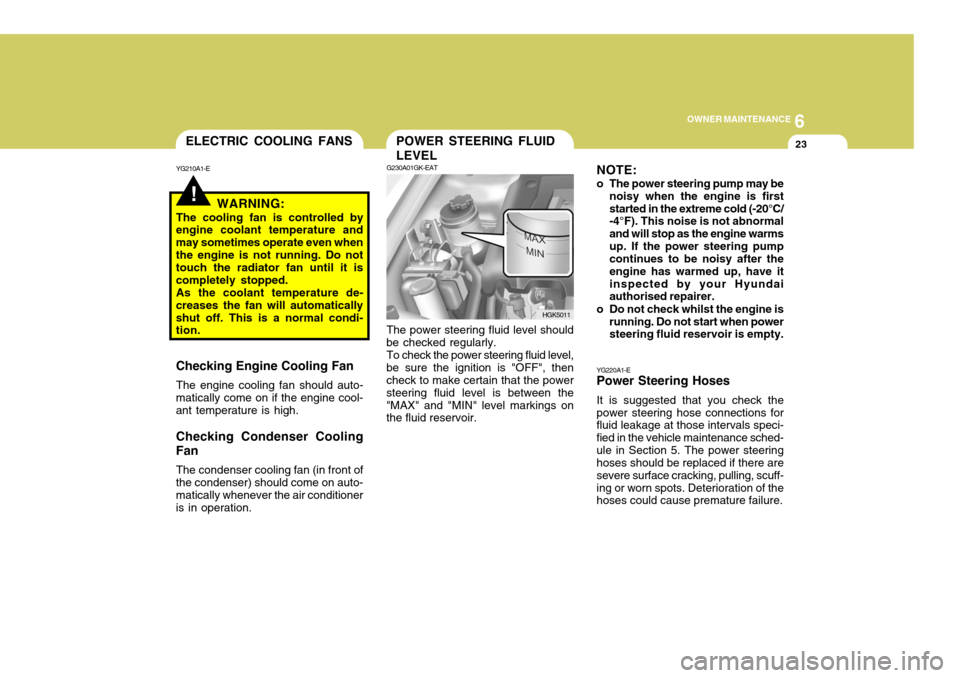
G230A01GK-EAT The power steering fluid level should
be checked regularly.
To check the power steering fluid level,
be sure the ignition is "OFF", then check to make certain that the power steering fluid level is between the"MAX" and "MIN" level markings on the fluid reservoir. NOTE:
o The power steering pump may be
noisy when the engine is first started in the extreme cold (-20°C/ -4°F). This noise is not abnormal and will stop as the engine warmsup. If the power steering pump continues to be noisy after the engine has warmed up, have itinspected by your Hyundai authorised repairer.
o Do not check whilst the engine is running. Do not start when powersteering fluid reservoir is empty.
Page 456 of 487
6
OWNER MAINTENANCE
27
!WARNING:
Halogen bulbs contains gas under pressure and if impacted could shat- ter, resulting in flying fragments. Always wear eye protection whenservicing the bulb. Protect the bulb against abrasions or scratches and against liquids when lighted. Turnthe bulb on only when installing in a headlight. Replace the headlight if damaged or cracked. Keep the bulbout of the reach of children and dispose of the used bulb with care.
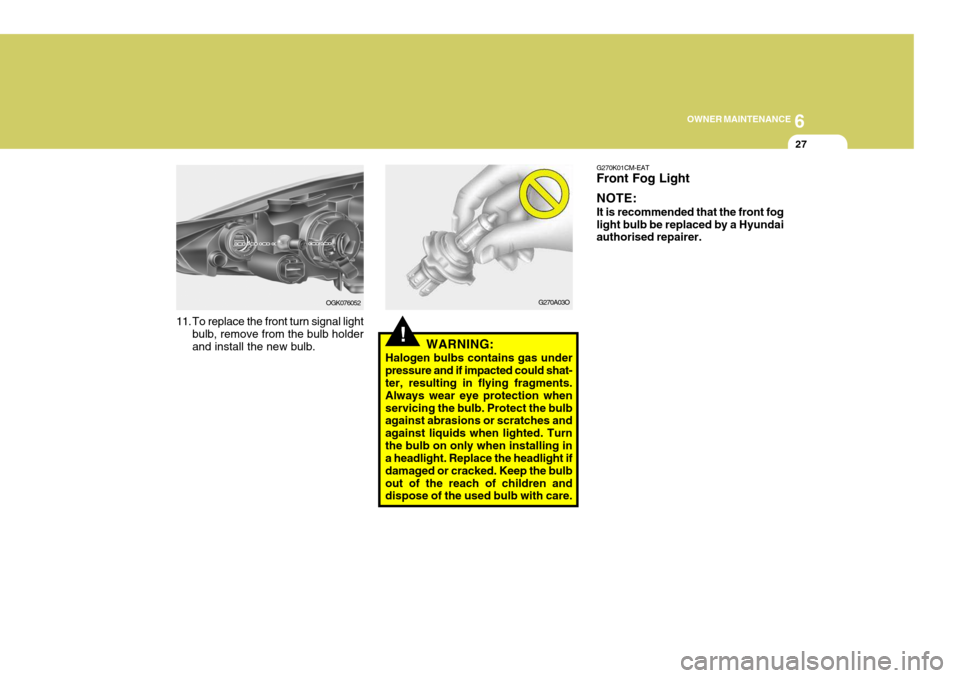
11. To replace the front turn signal light
bulb, remove from the bulb holderand install the new bulb. OGK076052
G270A03OG270K01CM-EAT Front Fog Light NOTE: It is recommended that the front fog light bulb be replaced by a Hyundai authorised repairer.
Page 462 of 487
6
OWNER MAINTENANCE
33BULB WATTAGE
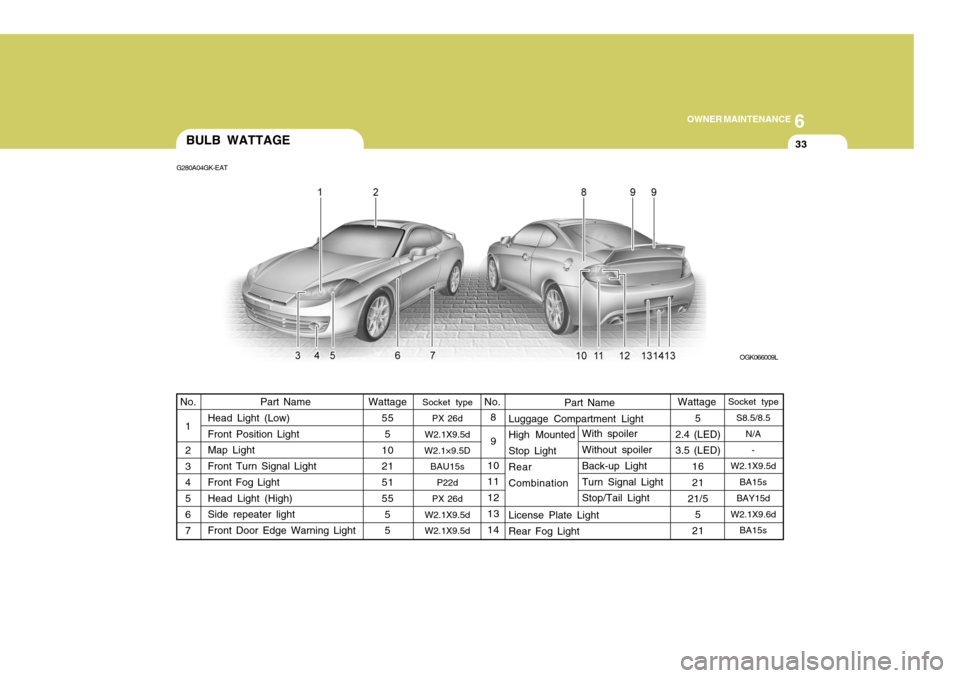
G280A04GK-EAT
OGK066009L
Part Name
Luggage Compartment Light High Mounted Stop Light Rear Combination License Plate Light Rear Fog Light With spoiler Without spoiler Back-up Light Turn Signal Light Stop/Tail Light
8 9
10 11 12 13 14
Part Name
Head Light (Low)Front Position Light Map Light Front Turn Signal Light Front Fog Light Head Light (High) Side repeater light Front Door Edge Warning Light Socket type
PX 26d
W2.1X9.5d
W2.1×9.5D BAU15s
P22d
PX 26d
W2.1X9.5d W2.1X9.5d Wattage
No.No.
1 2 3 4 5 6 7Wattage 555
10 21 51 55 55
5
2.4 (LED) 3.5 (LED) 1621
21/5 5
21 Socket type
S8.5/8.5 N/A
-
W2.1X9.5d
BA15s
BAY15d
W2.1X9.6d BA15s
Page 473 of 487
8CONSUMER INFORMATION
4
!
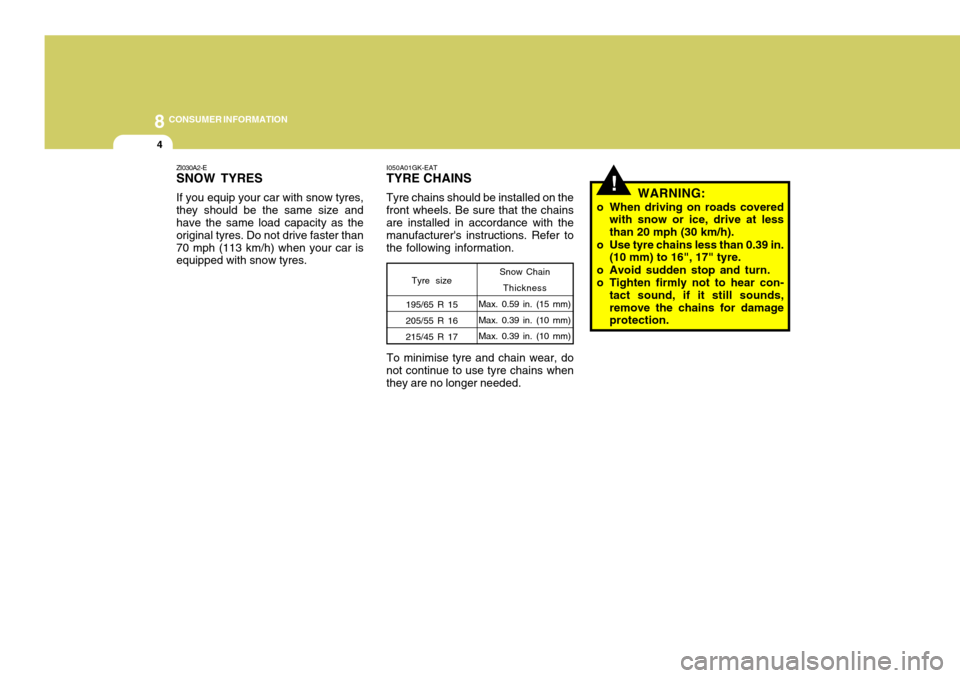
I050A01GK-EAT TYRE CHAINS Tyre chains should be installed on the front wheels. Be sure that the chains are installed in accordance with the manufacturer's instructions. Refer tothe following information.
To minimise tyre and chain wear, do
not continue to use tyre chains when they are no longer needed. WARNING:
o When driving on roads covered with snow or ice, drive at less than 20 mph (30 km/h).
o Use tyre chains less than 0.39 in. (10 mm) to 16", 17" tyre.
o Avoid sudden stop and turn.
o Tighten firmly not to hear con- tact sound, if it still sounds,remove the chains for damage protection.
ZI030A2-E SNOW TYRES If you equip your car with snow tyres, they should be the same size and have the same load capacity as the original tyres. Do not drive faster than70 mph (113 km/h) when your car is equipped with snow tyres.
Tyre size
195/65 R 15 205/55 R 16 215/45 R 17 Snow Chain
Thickness
Max. 0.59 in. (15 mm)Max. 0.39 in. (10 mm) Max. 0.39 in. (10 mm)
Page 474 of 487
8
CONSUMER INFORMATION
5
HGK5016
!
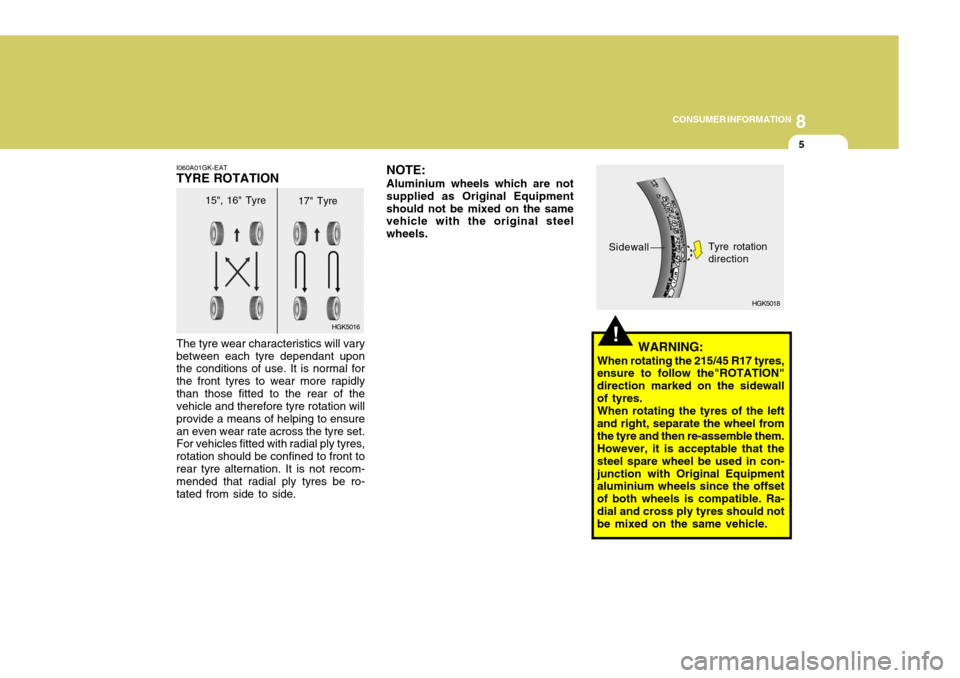
I060A01GK-EAT TYRE ROTATION The tyre wear characteristics will vary between each tyre dependant upon the conditions of use. It is normal for the front tyres to wear more rapidlythan those fitted to the rear of the vehicle and therefore tyre rotation will provide a means of helping to ensurean even wear rate across the tyre set. For vehicles fitted with radial ply tyres, rotation should be confined to front torear tyre alternation. It is not recom- mended that radial ply tyres be ro- tated from side to side. NOTE: Aluminium wheels which are not supplied as Original Equipmentshould not be mixed on the same vehicle with the original steel wheels.
15", 16" Tyre
Sidewall
HGK5018
17" Tyre Tyre rotation direction
WARNING:
When rotating the 215/45 R17 tyres,
ensure to follow the"ROTATION" direction marked on the sidewallof tyres.
When rotating the tyres of the left
and right, separate the wheel fromthe tyre and then re-assemble them. However, it is acceptable that the steel spare wheel be used in con-junction with Original Equipment aluminium wheels since the offset of both wheels is compatible. Ra-dial and cross ply tyres should not be mixed on the same vehicle.
Page 475 of 487
8CONSUMER INFORMATION
6
SI060B2-E
TYRE REPLACEMENT
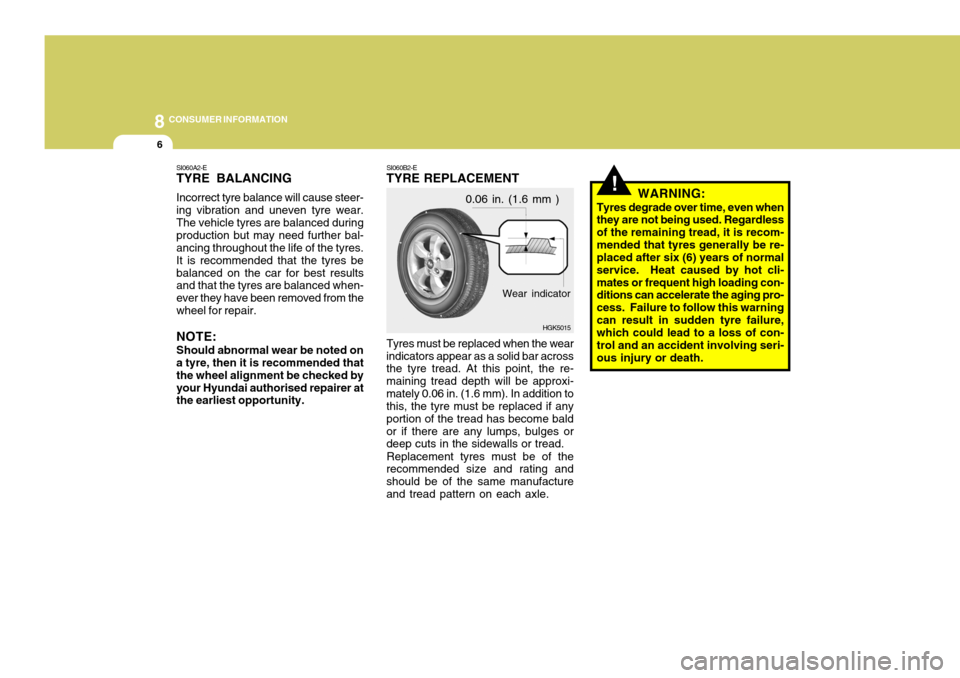
Tyres must be replaced when the wear
indicators appear as a solid bar across the tyre tread. At this point, the re- maining tread depth will be approxi-mately 0.06 in. (1.6 mm). In addition to this, the tyre must be replaced if any portion of the tread has become baldor if there are any lumps, bulges or deep cuts in the sidewalls or tread.
Replacement tyres must be of the
recommended size and rating and should be of the same manufactureand tread pattern on each axle. HGK5015
0.06 in. (1.6 mm )
Wear indicator
SI060A2-E TYRE BALANCING Incorrect tyre balance will cause steer- ing vibration and uneven tyre wear. The vehicle tyres are balanced during production but may need further bal-ancing throughout the life of the tyres.It is recommended that the tyres bebalanced on the car for best results and that the tyres are balanced when- ever they have been removed from thewheel for repair. NOTE: Should abnormal wear be noted on a tyre, then it is recommended that the wheel alignment be checked byyour Hyundai authorised repairer at the earliest opportunity.
!WARNING:
Tyres degrade over time, even when they are not being used. Regardless of the remaining tread, it is recom-mended that tyres generally be re- placed after six (6) years of normal service. Heat caused by hot cli-mates or frequent high loading con- ditions can accelerate the aging pro- cess. Failure to follow this warningcan result in sudden tyre failure, which could lead to a loss of con- trol and an accident involving seri-ous injury or death.