warning Hyundai Coupe 2007 Owner's Manual
[x] Cancel search | Manufacturer: HYUNDAI, Model Year: 2007, Model line: Coupe, Model: Hyundai Coupe 2007Pages: 487, PDF Size: 12.96 MB
Page 377 of 487
2DRIVING YOUR HYUNDAI
4KEY POSITIONS
!
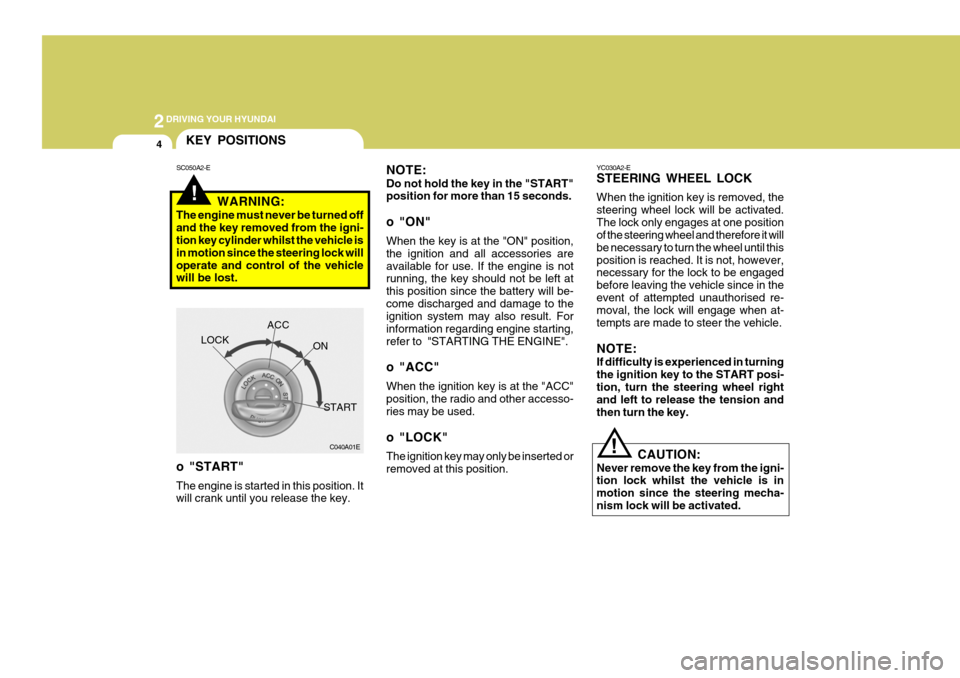
NOTE: Do not hold the key in the "START" position for more than 15 seconds.
o "ON" When the key is at the "ON" position, the ignition and all accessories areavailable for use. If the engine is not running, the key should not be left at this position since the battery will be-come discharged and damage to the ignition system may also result. For information regarding engine starting,refer to "STARTING THE ENGINE".
o "ACC" When the ignition key is at the "ACC" position, the radio and other accesso- ries may be used.
o "LOCK" The ignition key may only be inserted or removed at this position.
SC050A2-E
WARNING:
The engine must never be turned offand the key removed from the igni- tion key cylinder whilst the vehicle is in motion since the steering lock willoperate and control of the vehicle will be lost.
C040A01E
LOCK
ACC
ON
START
o "START" The engine is started in this position. It will crank until you release the key. YC030A2-E STEERING WHEEL LOCK When the ignition key is removed, the steering wheel lock will be activated.The lock only engages at one position of the steering wheel and therefore it will be necessary to turn the wheel until thisposition is reached. It is not, however, necessary for the lock to be engaged before leaving the vehicle since in theevent of attempted unauthorised re- moval, the lock will engage when at- tempts are made to steer the vehicle. NOTE: If difficulty is experienced in turning the ignition key to the START posi-tion, turn the steering wheel right and left to release the tension and then turn the key.
!
CAUTION:
Never remove the key from the igni- tion lock whilst the vehicle is in motion since the steering mecha-nism lock will be activated.
Page 379 of 487
2DRIVING YOUR HYUNDAI
6FUEL ECONOMY
4. Turn the ignition key to the "START" position and release it when the en- gine starts. SC060B1-E The following suggestions are made to assist in achieving the greatest degree of fuel economy.
o Maintaining a constant check on fuel
consumption will enable the most economical use pattern and drivingstyle to be adopted.
o Avoid using the vehicle for very short journeys if possible, particularly whena cold start is involved.
o Ensure that tyre pressures are main- tained at the correct level.
o Use only the recommended grade of
fuel.
o Avoid carrying unnecessary weight, and if a roof rack is in use, remove itas soon as possible after use.
o Anticipate the road and conditions ahead to enable adjustments in speedto be made smoothly. Avoid heavyacceleration and sharp braking.
o Avoid cruising at unnecessary high speeds.
o Always ensure that the periodic main- tenance services are performed by aHyundai authorised repairer at the
time and/or mileage intervals speci-fied.
o Use the air conditioning only when necessary.
!
C050B01A-EAT Normal Conditions The Starting Procedure:
1. Insert key, and fasten the seat belt.
2. Depress the clutch pedal fully and
place the gearshift lever (manual transaxle) in neutral or the selector lever (automatic transaxle) in "P" (park) position.
3. After turning the ignition key to the "ON" position, make certain all warn-ing lights and gauges are function-ing properly before starting the en- gine.
WARNING:
Be sure that the clutch is fully de- pressed when starting a manual transaxle vehicle. This will prevent sudden movement should the ve-hicle be started in gear without the clutch depressed. Otherwise there is the potential tocause damage to the vehicle or in- jury to a person inside or outside of the vehicle as a result of this suddenvehicle movement.
Page 381 of 487
2DRIVING YOUR HYUNDAI
8
o If you've come to a complete stopand it's hard to shift into 1st or R(Reverse), put the gearshift lever in N(Neutral) position and let upon the clutch. Press the clutch pedal back down, and then shift into 1st or R(Reverse) gear posi-tion.
o Do not use the gearshift lever as a
handrest during driving, as thiscan result in premature wear of the transaxle shift forks.
o Do not downshift more than 2 gears at once or when the engine isrunning at high speed (5,000 RPM or higher). Such downshifting maydamage the engine.
C070B01A-EAT Using the Clutch The clutch should be pressed all the way to the floor before shifting, thenreleased slowly. The clutch pedal should always be used after fully returning to the original position. Do not rest yourfoot on the clutch pedal whilst driving. This can cause unnecessary wear. Do not partially engage the clutch tohold the car on an incline. This causes unnecessary wear. Use the parking brake to hold the car onan incline. Do not operate the clutch pedal rapidly and repeatedly.
!WARNING:
o Avoid high cornering speeds.
o Do not make quick steering wheel movements, such as sharp lane changes or fast, sharp turns.
o Always wear your seat belts.
In a collision crash, an unbeltedperson is significantly more likely to die than a person wearing aseat belt.
o The risk of rollover is greatly in-
creased if you lose control of your vehicle at motorway speeds.
o Loss of control often occurs if two
or more wheels drop off the road-way and the driver oversteers to reenter the roadway.
o In the event your vehicle leaves the roadway, do not steer sharply.Instead, slow down before pullingback into the travel lanes.
o Never exceed posted speed limits.
!WARNING:
Starting the engine without depress- ing the clutch pedal, when the park- ing brake is released and the shiftlever not in the N(Neutral) position, the vehicle may move and cause a serious accident.
Page 387 of 487
2DRIVING YOUR HYUNDAI
14
!o If your vehicle becomes stuck in
snow, mud, sand, etc., then you may attempt to rock the vehicle free by moving it forward and back-ward. Do not attempt this proce- dure if people or objects are any- where near the vehicle. During therocking operation the vehicle may suddenly move forward of back- ward as it becomes unstuck, caus-ing injury or damage to nearby people or objects.
WARNING:
o Avoid high cornering speeds.
o Do not make quick steering wheel movements, such as sharp lane changes or fast, sharp turns.
o Always wear your seat belts. In a collision crash, an unbeltedperson is significantly more likely to die than a person wearing aseatbelt.
o The risk of rollover is greatly in-
creased if you lose control of yourvehicle at motorway speeds.
o Loss of control often occurs if two
or more wheels drop off the road-way and the driver oversteers to reenter the roadway.
o In the event your vehicle leaves
the roadway, do not steer sharply.Instead, slow down before pulling back into the travel lanes.
o Never exceed posted speed limits.
ANTI-LOCK BRAKE SYSTEM (ABS)
C120A01FC-EAT (Not all models) The Anti-Lock Brake System (ABS) is designed to prevent wheel lock-up dur-ing sudden braking or on hazardous road surfaces. The ABS control module monitors the wheel speed and controlsthe pressure applied to each brake. Thus, in emergency situations or on slick roads, ABS will increase vehiclecontrol during braking. NOTE:
o A click sound may be heard in the
engine compartment when the ve- hicle begins to move after the en- gine is started. These conditionsare normal and indicate that the anti-lock brake system (Electronic Stability Program) is functioningproperly.
o During ABS (ESP) operation, a
slight pulsation may be felt in thebrake pedal when the brakes are applied. Also, a noise may be heard in the engine compartment whilstbraking. These conditions are nor- mal and indicate that the anti-lock brake system (Electronic StabilityProgram) is functioning properly.
Page 388 of 487
2
DRIVING YOUR HYUNDAI
15
!WARNING:
ABS (ESP) will not prevent accidents due to improper or dangerous driv- ing manoeuvres. Even though ve- hicle control is improved duringemergency braking, always main- tain a safe distance between you and objects ahead. Vehicle speedsshould always be reduced during extreme road conditions. The braking distance for carsequipped with an anti-lock braking system (Electronic Stability Program) may be longer than for those without it, in the following road conditions. These roads should be driven atreduced speeds.
o Rough, gravel or snow-covered roads.
o With tyre chains installed.
o On roads where the road surface
is pitted or has different surface height.
The safety features of an ABS (ESP)equipped vehicle should not be tested by high speed driving or cornering.This could endanger the safety of yourself or others.
!
!
ELECTRONIC STABILITY PROGRAM (ESP)
C310A01JM-EAT (Not all models) It is not a substitute for safe driving practices. Factors including speed, roadconditions and driver steering input can all affect whether ESP will be effective in preventing a loss of control. It is stillyour responsibility to drive and corner at reasonable speeds and to leave a sufficient margin of safety.
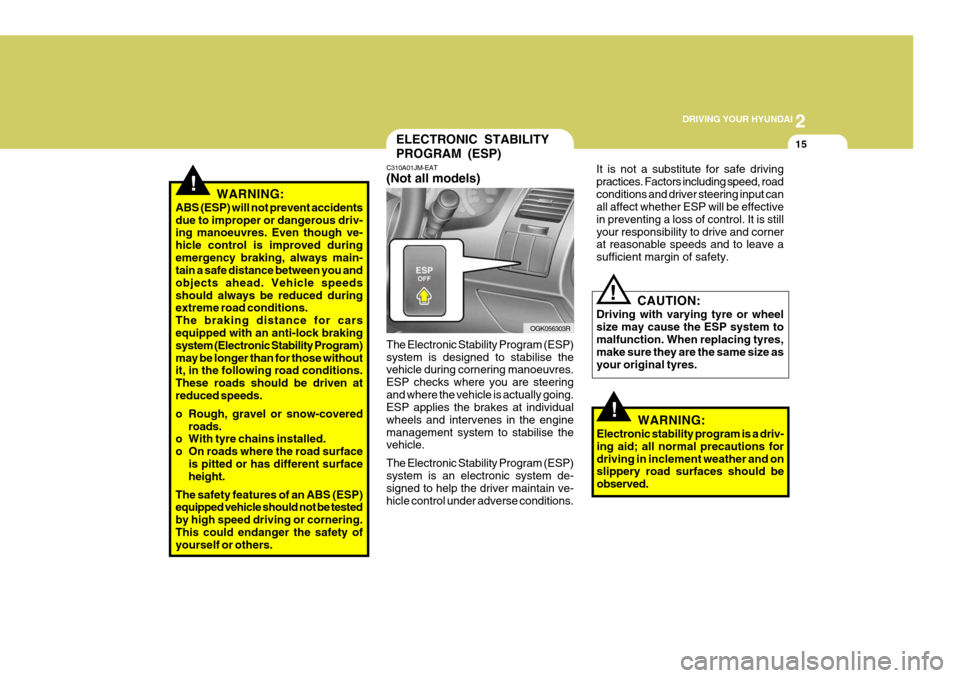
The Electronic Stability Program (ESP)system is designed to stabilise the vehicle during cornering manoeuvres. ESP checks where you are steeringand where the vehicle is actually going. ESP applies the brakes at individual wheels and intervenes in the enginemanagement system to stabilise the vehicle. The Electronic Stability Program (ESP) system is an electronic system de- signed to help the driver maintain ve-hicle control under adverse conditions.
OGK056303R CAUTION:
Driving with varying tyre or wheel size may cause the ESP system to malfunction. When replacing tyres, make sure they are the same size asyour original tyres.
WARNING:
Electronic stability program is a driv-ing aid; all normal precautions fordriving in inclement weather and on slippery road surfaces should be observed.
Page 389 of 487
2DRIVING YOUR HYUNDAI
16EFFECTIVE BRAKING
SC140A2-E Braking system performance and fric- tion material life are greatly affected by the driving style adopted. The following suggestions are made to assist inachieving the best results from the braking system.
o Anticipate the road and conditions ahead in order that heavy braking may be avoided.
o When descending long gradients, use the engine to assist in retarding thevehicle to minimise the possibility ofbrake fade occurring.
o When trailer towing, ensure that the
trailer brakes function correctly anduse engine braking to assist the vehicle braking system.
o Use only genuine Hyundai replace- ment brake pads and shoes to en-sure consistent friction characteris- tics and wear rates.
o After driving through deep water (e.g. fording), the brakes may becomewet and performance reduced. Al-ways check brake efficiency after emerging from the water and dry the brakes by lightly depressing the brakepedal several times whilst driving slowly.
C310B01JM-AAT ESP ON/OFF Mode When the ESP is operating, the ESP indicator in the instrument cluster willblink. If you turn the system off by pressing the ESP switch, the ESP-OFF indica-tor will come on and stay on. In the ESP-OFF mode, the stability control will be deactivated. Adjust your drivingaccordingly. To turn the system back on, press the switch again. The ESP- OFF indicator should go off. NOTE: The ESP mode will automatically be turned ON after the engine is turnedoff and restarted.
C310D02JM-EAT Indicators and Warning The indicators should illuminate when the ignition key is turned ON or STARTbut should go out after approximately 3 seconds. If the indicators do not illuminate, or theESP-OFF indicator does not go out after approximately 3 seconds, have the vehicle checked by a Hyundaiauthorised repairer. Should there be any unusual conditions in the device whilst driving, ESP-OFF indicator illuminates as a warning. If ESP-OFF indicator illuminates, pullyour car to a safe place and stop the engine. Then, start the engine again to check ifthe ESP-OFF indicator goes out. If the indicator remains lit even after the engine has been started, have your car checked by a Hyundai authorised re- pairer.
Page 396 of 487
2
DRIVING YOUR HYUNDAI
23
3. The front or rear axle weight must
not exceed the Gross Axle Weight Rating (GAWR) shown on the ve- hicle identification plate (see page 8-2). It is possible that yourtowing package does not exceed the GVWR but exceeds the GAWR.Improper trailer loading and/or too much luggage in the luggage compartment can overload therear axle. Redistribute the load and check the axle weight again.
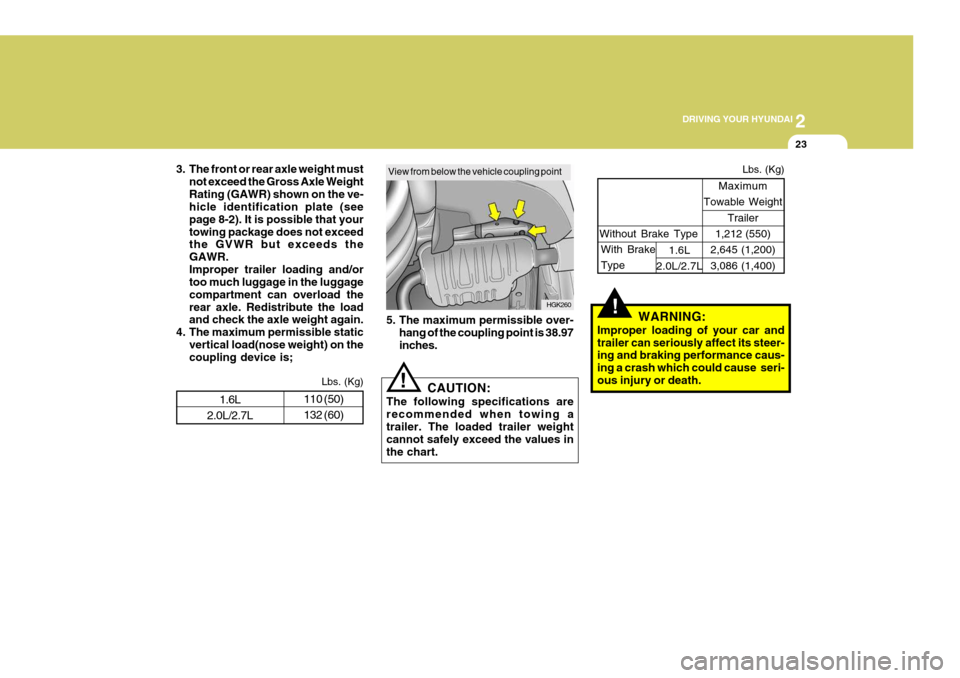
4. The maximum permissible static vertical load(nose weight) on thecoupling device is;
1.6L
2.0L/2.7L 110 (50) 132 (60)
CAUTION:
The following specifications are recommended when towing a trailer. The loaded trailer weight cannot safely exceed the values inthe chart.!
5. The maximum permissible over-
hang of the coupling point is 38.97 inches.
Lbs. (Kg) View from below the vehicle coupling point
HGK260!WARNING:
Improper loading of your car and trailer can seriously affect its steer- ing and braking performance caus- ing a crash which could cause seri-ous injury or death. Without Brake Type
Maximum
Towable Weight
Trailer
1,212 (550)
2,645 (1,200) 3,086 (1,400)
With Brake Type1.6L
2.0L/2.7L Lbs. (Kg)
Page 400 of 487
3 IN CASE OF EMERGENCY
2IF THE ENGINE WILL NOT START
!
SD020A1-E Seek assistance from the nearest Hyundai authorised repairer with regard to the method of ignition and fuel sys- tem diagnosis.
WARNING:
If the engine refuses to start, noattempt should be made to push ortow start the vehicle. Vehicles with automatic transaxle or fuel injec- tion will not be able to be started in this manner since no drive is trans- mitted through the automatictransaxle whilst the engine is not running, and in the case of fuel injected derivatives, the fuel pumpwill not operate under tow start conditions. In addition, if the ve- hicle is equipped with an exhaustcatalyst, damage to the catalyst may result if the vehicle is tow started. SD020B1-E If the Engine Cannot be Cranked
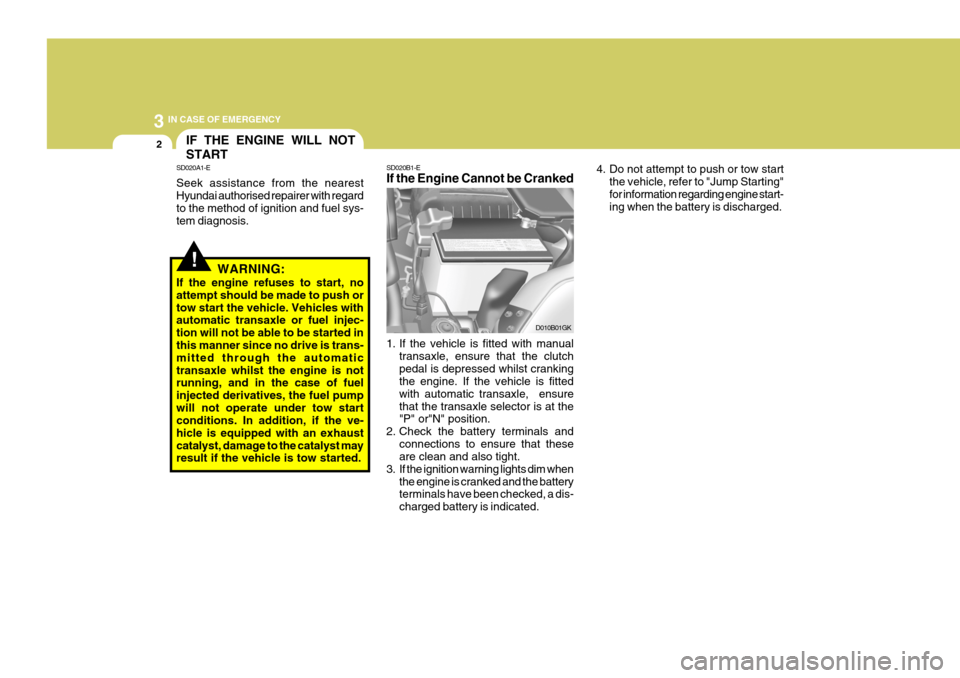
1. If the vehicle is fitted with manual
transaxle, ensure that the clutch pedal is depressed whilst cranking the engine. If the vehicle is fitted with automatic transaxle, ensurethat the transaxle selector is at the "P" or"N" position.
2. Check the battery terminals and connections to ensure that theseare clean and also tight.
3. If the ignition warning lights dim when the engine is cranked and the batteryterminals have been checked, a dis- charged battery is indicated. D010B01GK
4. Do not attempt to push or tow start
the vehicle, refer to "Jump Starting"for information regarding engine start- ing when the battery is discharged.
Page 401 of 487
3
IN CASE OF EMERGENCY
3
!
!
D010C01A-EAT If Engine Turns Over Normally but Does Not Start
1. Check fuel level.
2. With the key in the off position,
Check all connectors at ignition coils and spark plugs. Reconnect any that may be disconnected or loose.
3. Check the fuel line in the engine room.
4. If engine still refuses to start, call a Hyundai authorised repairer or seek other qualified assistance.
D010D01A-EAT If Engine Stalls While Driving
1. Reduce your speed gradually, keep- ing a straight line. Move cautiously off the road to a safe place.
2. Turn on your hazard lights.
3. Try to start the engine again. If your vehicle will not start, contact aHyundai authorised repairer or seekother qualified assistance. SD030A2-E
CAUTION:
Personal injury and damage to thevehicle may occur if jump startingis not performed correctly. If any doubt exists as to how this opera- tion should be performed, seek as-sistance from qualified personnel.
JUMP STARTING
WARNING:
Motor vehicle batteries contain sulphuric acid and emit hydrogen gas. Protective clothing should beworn and care exercised to prevent the acid from coming into contact with skin or clothing and the ve-hicle. Naked lights should not be permitted in the vicinity of the bat- tery. Care should be exercised toprevent sparks occurring during connection. If acid accidentally comes into contact with skin oreyes, the affected area should im- mediately be flushed with copious amounts of water and medical as-sistance sought.
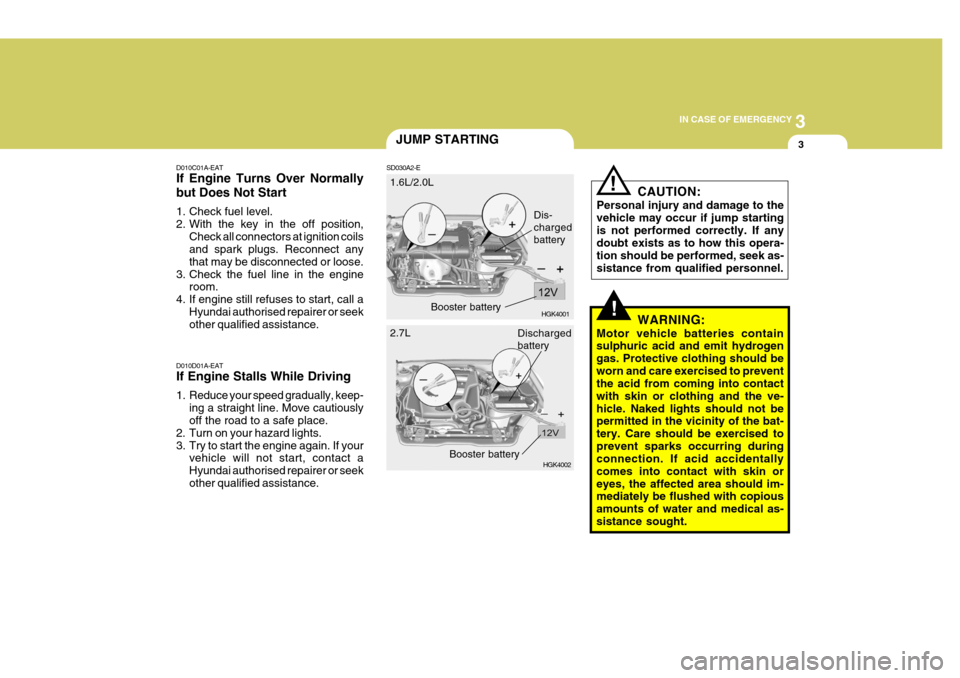
1.6L/2.0L
HGK4001
HGK4002
Dis- chargedbattery
2.7L Booster battery
Discharged battery
Booster battery
Page 403 of 487
3
IN CASE OF EMERGENCY
5
!
!WARNING:
Whilst the engine is running, keep hands and clothing away from mov- ing parts such as the fan and drive belts to prevent injury.
5. If the water pump drive belt is broken or coolant is leaking out, stop the engine immediately and call the near- est Hyundai authorised repairer forassistance.
WARNING:
Do not remove the radiator cap when the engine is hot since steam and boiling water may be ejected fromthe radiator resulting in burns or scalding.
!
6. If the cause of the overheating can- not be found, wait until the engine temperature has returned to normal. Then, if coolant has been lost, care- fully add coolant to the reservoir(page 6-10) to bring the fluid level in the reservoir up to the base of the radiator fill opening. Fill the coolantexpansion tank to the halfway mark. To ensure the correct water to cool- ant mix is obtained after top up,testing by an authorised repairer is required.
7. Proceed with caution until it is estab- lished that the engine is operatingnormally. If the engine overheats repeatedly, the advice of a Hyundaiauthorised repairer should be sought.
CAUTION:
Serious loss of coolant indicates there is a leak in the cooling system and this should be checked as soonas possible by a Hyundai authorised repairer.D040A01GK-EAT The following instructions for the tem- porary spare tyre should be observed:
1. Check inflation pressure as soon as practical after installing the spare tyre, and adjust to the specified pressure. The tyre pressure shouldbe periodically checked and main- tained at the specified pressure whilst the tyre is stored.
TEMPORARY SPARE TYRE
Tyre Size
Inflation Pressure T125/70 R16
420 kPa (60 psi)
Spare Tyre Pressure
2. The spare tyre should only be used temporarily and should be returned to the luggage compartment as soonas the original tyre can be repaired or replaced.
3. Continuous use at speeds of over 50 mph (80 km/h) is not recom-mended.
4. As the temporary spare tyre is spe- cifically designed for your car, itshould not be used on any other vehicle.