ABS Hyundai Coupe 2007 User Guide
[x] Cancel search | Manufacturer: HYUNDAI, Model Year: 2007, Model line: Coupe, Model: Hyundai Coupe 2007Pages: 487, PDF Size: 12.96 MB
Page 240 of 487

7EMISSION CONTROL SYSTEMS
2
H010A01A-GAT (If Installed) Your Hyundai is equipped with an emission control system to meet all requirements of the Emission prohibi- tion rules of your province.There are three emission control sys-tems which are as follows.
(1) Crankcase emission control sys-
tem
(2) Evaporative emission control sys-
tem
(3) Exhaust emission control systemIn order to assure the proper function of the emission control systems, it isrecommended that you have your car inspected and maintained by an au- thorized Hyundai dealer in accordancewith the maintenance schedule in this manual. EMISSION CONTROL SYSTEMS
H010B01F-GAT 1. Crankcase Emission ControlSystem
The positive crankcase ventilation system is employed to prevent air pollution caused by blow-by gases being emitted from the crankcase.This system supplies fresh air to the crankcase through the air cleaner. Inside the crankcase, the fresh airmixes with blow-by gases, then passes through the PCV valve into the induction system.
H010C01F-GAT
2. Evaporative Emission Control
System (If Installed)
The evaporative emission control sys-
tem is designed to prevent fuel va-pors from escaping into the atmo-sphere. H010D01A-AAT
3. Exhaust Emission Control
System
The exhaust emission control system is a highly effective system which controls exhaust emissions while maintaining good vehicle performace.
Canister While the engine is inoperative, fuel vapors generated inside the fuel tank are absorbed and stored in the canis-ter. When the engine is running, the fuel vapors absorbed in the canister are drawn into the induction systemthrough the purge control solenoid valve. Purge Control Solenoid Valve The purge control solenoid valve is controlled by the ECM; when the en- gine coolant temperature is low, and during idling, it closes, so that evapo- rated fuel is not taken into the engine. After engine warm-up, during ordi-nary driving, it opens so as to intro- duce evaporated fuel to the engine.
Page 268 of 487

YOUR VEHICLE AT A GLANCE
F10B255A02GK-EAT INDICATOR SYMBOLS ON THE INSTRUMENT PANEL
* More detailed explanations of these items will be found beginning on page 1-42.
Turn Signal Indicator Lights Electronic Stability Program (ESP) Indicator Lights (Not all models)Malfunction Indicator Light (Not all models)
SRS (Airbag) Service Reminder Indicator (SRI)
Low Fuel Level Warning Light
High Beam Indicator Light Low Oil Pressure Warning Light
Charging System Warning Light
Seat Belt Warning Light
Immobiliser Warning Light
Hatchback Door Open Warning Light
Door Open (Ajar) Warning Light
ABS Service Reminder Indicator (Not all models)
Parking Brake/Low Brake Fluid Level Warning Light
CRUISE Indicator Light (Not all models)
CRUISE SET Indicator Light (Not all models)
Page 296 of 487
1CONTROLS AND EQUIPMENT
28
!WARNING:
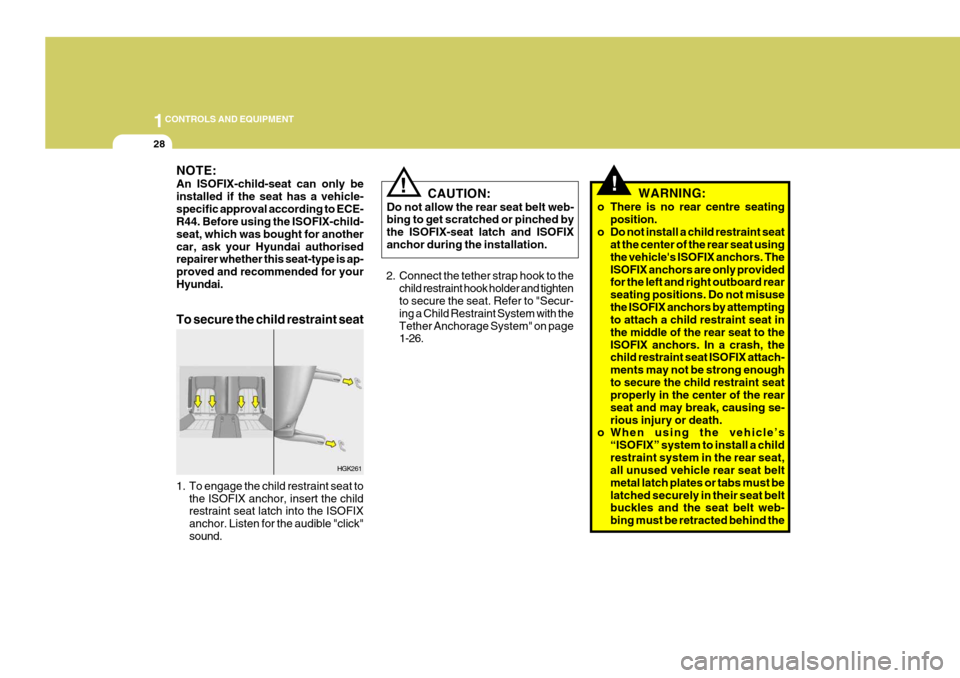
o There is no rear centre seating position.
o Do not install a child restraint seat at the center of the rear seat using the vehicle's ISOFIX anchors. TheISOFIX anchors are only provided for the left and right outboard rear seating positions. Do not misusethe ISOFIX anchors by attempting to attach a child restraint seat in the middle of the rear seat to theISOFIX anchors. In a crash, the child restraint seat ISOFIX attach- ments may not be strong enoughto secure the child restraint seat properly in the center of the rear seat and may break, causing se-rious injury or death.
o When using the vehicle’s
“ISOFIX” system to install a childrestraint system in the rear seat, all unused vehicle rear seat belt metal latch plates or tabs must belatched securely in their seat belt buckles and the seat belt web- bing must be retracted behind the
NOTE: An ISOFIX-child-seat can only be installed if the seat has a vehicle-specific approval according to ECE- R44. Before using the ISOFIX-child- seat, which was bought for anothercar, ask your Hyundai authorised repairer whether this seat-type is ap- proved and recommended for yourHyundai. To secure the child restraint seat
1. To engage the child restraint seat tothe ISOFIX anchor, insert the child restraint seat latch into the ISOFIX anchor. Listen for the audible "click"sound. HGK261
!
CAUTION:
Do not allow the rear seat belt web- bing to get scratched or pinched by the ISOFIX-seat latch and ISOFIXanchor during the installation.
2. Connect the tether strap hook to the child restraint hook holder and tighten to secure the seat. Refer to "Secur- ing a Child Restraint System with theTether Anchorage System" on page 1-26.
Page 297 of 487
1
CONTROLS AND EQUIPMENT
29
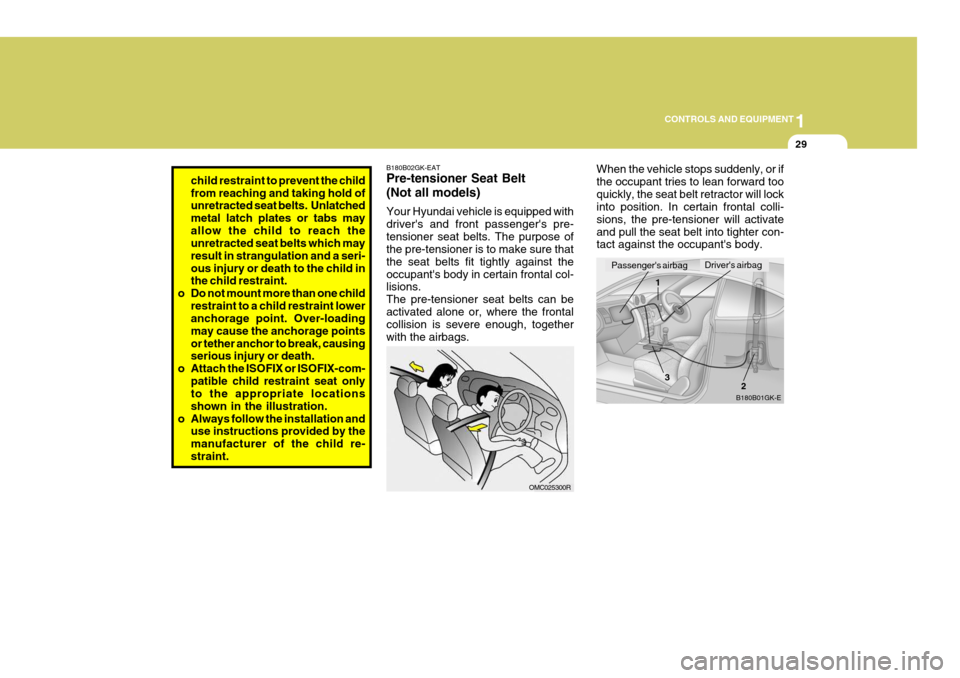
B180B02GK-EAT Pre-tensioner Seat Belt (Not all models) Your Hyundai vehicle is equipped with driver's and front passenger's pre-tensioner seat belts. The purpose of the pre-tensioner is to make sure that the seat belts fit tightly against theoccupant's body in certain frontal col- lisions. The pre-tensioner seat belts can beactivated alone or, where the frontal collision is severe enough, together with the airbags. When the vehicle stops suddenly, or ifthe occupant tries to lean forward tooquickly, the seat belt retractor will lock into position. In certain frontal colli- sions, the pre-tensioner will activateand pull the seat belt into tighter con- tact against the occupant's body.
OMC025300R B180B01GK-E
Driver's airbag
1
2
3
Passenger's airbag
child restraint to
prevent the child
from reaching and taking hold of
unretracted seat belts. Unlatched metal latch plates or tabs mayallow the child to reach the unretracted seat belts which may result in strangulation and a seri-ous injury or death to the child in the child restraint.
o Do not mount more than one child restraint to a child restraint loweranchorage point. Over-loading may cause the anchorage pointsor tether anchor to break, causing serious injury or death.
o Attach the ISOFIX or ISOFIX-com- patible child restraint seat onlyto the appropriate locations shown in the illustration.
o Always follow the installation and use instructions provided by themanufacturer of the child re-straint.
Page 309 of 487

1
CONTROLS AND EQUIPMENT
41
1. Speedometer
2. Turn Signal Indicator Light
3. Odometer/Trip Odometer
4. Automatic Transaxle Position Indicator Light (Not all models)
5. Coolant Temperature Gauge
6. Trip Computer (Not all models)
7. Fuel Gauge
8. Tachometer
9. Electronic Stability Program (ESP) Indicator Light (Not all models)
10. Immobiliser Warning Light
11. Trip Odometer Reset Knob 12. Charging System Warning Light
13. SRS (Airbag) Warning Light
14. Seat Belt Warning Light
15. High Beam Indicator Light
16. Oil Pressure Warning Light
17. Malfuction Indicator Light (MIL) (Not all models)
18. Low Fuel Warning Light
19. Parking Brake/Brake Fluide Level Warning Light
20. Trip Computer Reset Knob21.CRUISE Indicator Light (Not all models)
22. CRUISE SET Indicator Light (Not all models)
23. Hatchback Door Open Warning Light
24. Door Open (Ajar) Warning Light
25. ABS Service Reminder Indicator Light (Not all models)
Page 314 of 487
1CONTROLS AND EQUIPMENT
46
SB210S1-E BRAKE PAD WEAR INDICATOR The front brake disc pads are fitted with an audible wear indicator which will cause a high pitched noise to be emitted when the remaining amount offriction lining is below the specified value. When the wear indicator is heard, the brake pads should be replacedwithout delay to avoid damage occur- ring to the brake discs and a severe reduction in braking efficiency.
B260K01F-EAT
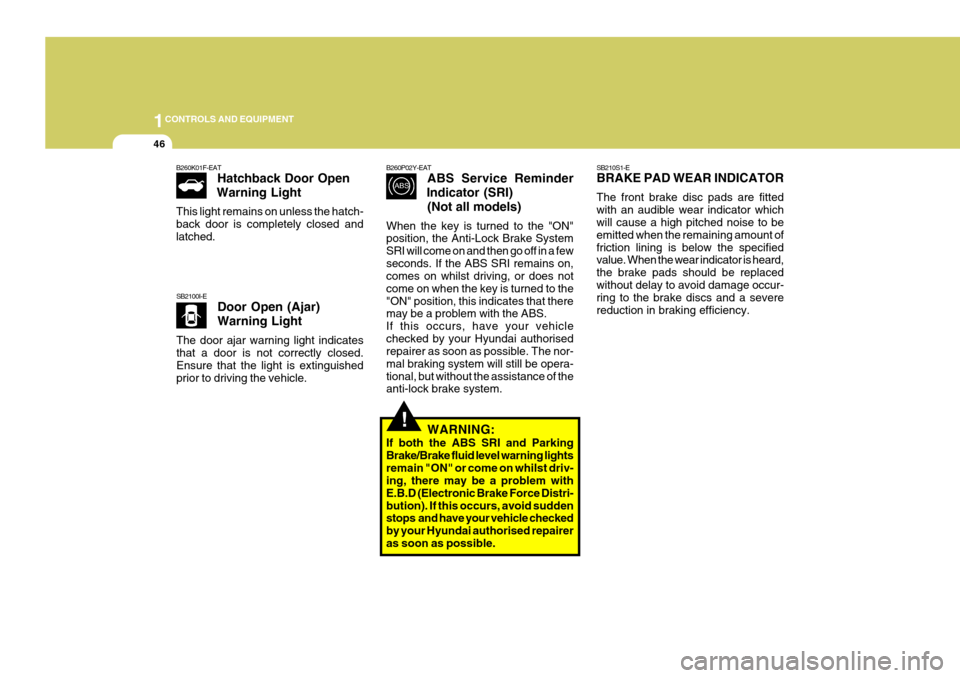
Hatchback Door Open
Warning Light
This light remains on unless the hatch-back door is completely closed andlatched.
SB2100I-E Door Open (Ajar) Warning Light
The door ajar warning light indicates that a door is not correctly closed. Ensure that the light is extinguishedprior to driving the vehicle.
B260P02Y-EAT ABS Service Reminder
Indicator (SRI)
(Not all models)
When the key is turned to the "ON" position, the Anti-Lock Brake System SRI will come on and then go off in a fewseconds. If the ABS SRI remains on, comes on whilst driving, or does not come on when the key is turned to the"ON" position, this indicates that there may be a problem with the ABS. If this occurs, have your vehiclechecked by your Hyundai authorised repairer as soon as possible. The nor- mal braking system will still be opera-tional, but without the assistance of the anti-lock brake system.
WARNING:
If both the ABS SRI and Parking Brake/Brake fluid level warning lightsremain "ON" or come on whilst driv- ing, there may be a problem with E.B.D (Electronic Brake Force Distri-bution). If this occurs, avoid sudden stops and have your vehicle checked by your Hyundai authorised repaireras soon as possible.
!
Page 374 of 487
2
Engine Exhaust Can Be Dangerous! ............................ 2-2
Before Starting the Engine ............................................ 2-3
Key Positions ................................................................ 2-4Starting ......................................................................... 2-5
Fuel Economy ............................................................... 2-6
Manual Transaxle ......................................................... 2-7
Automatic Transaxle ..................................................... 2-9Anti-Lock Brake System (ABS) ................................... 2-14
Electronic Stability Program (ESP) ..............................2-15
Effective Braking ......................................................... 2-16
Driving for Economy .................................................... 2-17
Smooth Cornering ........................................................ 2-18
Winter Motoring ............................................................ 2-19
Trailer or Vehicle Towing ............................................. 2-20
DRIVING YOUR HYUNDAI
2
Page 387 of 487
2DRIVING YOUR HYUNDAI
14
!o If your vehicle becomes stuck in
snow, mud, sand, etc., then you may attempt to rock the vehicle free by moving it forward and back-ward. Do not attempt this proce- dure if people or objects are any- where near the vehicle. During therocking operation the vehicle may suddenly move forward of back- ward as it becomes unstuck, caus-ing injury or damage to nearby people or objects.
WARNING:
o Avoid high cornering speeds.
o Do not make quick steering wheel movements, such as sharp lane changes or fast, sharp turns.
o Always wear your seat belts. In a collision crash, an unbeltedperson is significantly more likely to die than a person wearing aseatbelt.
o The risk of rollover is greatly in-
creased if you lose control of yourvehicle at motorway speeds.
o Loss of control often occurs if two
or more wheels drop off the road-way and the driver oversteers to reenter the roadway.
o In the event your vehicle leaves
the roadway, do not steer sharply.Instead, slow down before pulling back into the travel lanes.
o Never exceed posted speed limits.
ANTI-LOCK BRAKE SYSTEM (ABS)
C120A01FC-EAT (Not all models) The Anti-Lock Brake System (ABS) is designed to prevent wheel lock-up dur-ing sudden braking or on hazardous road surfaces. The ABS control module monitors the wheel speed and controlsthe pressure applied to each brake. Thus, in emergency situations or on slick roads, ABS will increase vehiclecontrol during braking. NOTE:
o A click sound may be heard in the
engine compartment when the ve- hicle begins to move after the en- gine is started. These conditionsare normal and indicate that the anti-lock brake system (Electronic Stability Program) is functioningproperly.
o During ABS (ESP) operation, a
slight pulsation may be felt in thebrake pedal when the brakes are applied. Also, a noise may be heard in the engine compartment whilstbraking. These conditions are nor- mal and indicate that the anti-lock brake system (Electronic StabilityProgram) is functioning properly.
Page 388 of 487
2
DRIVING YOUR HYUNDAI
15
!WARNING:
ABS (ESP) will not prevent accidents due to improper or dangerous driv- ing manoeuvres. Even though ve- hicle control is improved duringemergency braking, always main- tain a safe distance between you and objects ahead. Vehicle speedsshould always be reduced during extreme road conditions. The braking distance for carsequipped with an anti-lock braking system (Electronic Stability Program) may be longer than for those without it, in the following road conditions. These roads should be driven atreduced speeds.
o Rough, gravel or snow-covered roads.
o With tyre chains installed.
o On roads where the road surface
is pitted or has different surface height.
The safety features of an ABS (ESP)equipped vehicle should not be tested by high speed driving or cornering.This could endanger the safety of yourself or others.
!
!
ELECTRONIC STABILITY PROGRAM (ESP)
C310A01JM-EAT (Not all models) It is not a substitute for safe driving practices. Factors including speed, roadconditions and driver steering input can all affect whether ESP will be effective in preventing a loss of control. It is stillyour responsibility to drive and corner at reasonable speeds and to leave a sufficient margin of safety.
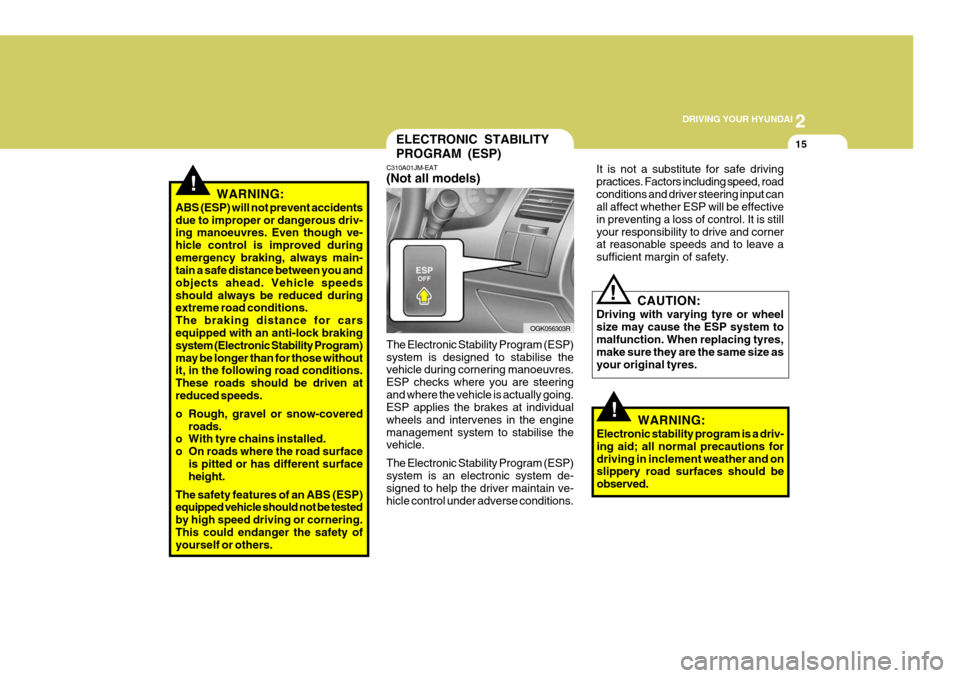
The Electronic Stability Program (ESP)system is designed to stabilise the vehicle during cornering manoeuvres. ESP checks where you are steeringand where the vehicle is actually going. ESP applies the brakes at individual wheels and intervenes in the enginemanagement system to stabilise the vehicle. The Electronic Stability Program (ESP) system is an electronic system de- signed to help the driver maintain ve-hicle control under adverse conditions.
OGK056303R CAUTION:
Driving with varying tyre or wheel size may cause the ESP system to malfunction. When replacing tyres, make sure they are the same size asyour original tyres.
WARNING:
Electronic stability program is a driv-ing aid; all normal precautions fordriving in inclement weather and on slippery road surfaces should be observed.
Page 415 of 487

4
CORROSION PREVENTION AND APPEARANCE CARE
3
4
APPEARANCE CARE
3VALETING
ZE020C1-E INTERIOR During the winter period, it is possible that the carpet within the passengercompartment may become wet. The carpet should not be allowed to remain in this condition for prolonged periodssince the carpet may begin to create musty smells and promote internal corrosion of the floorpan. GKE050A2-E Regular cleaning of the exterior paintwork serves two important func- tions. Firstly, the removal of abrasive dirt and contaminants will maintain thelustre of the paintwork and will prevent discolouration and dulling due to pro- longed contact.Secondly, the presence of damage through impact or abrasion will be ap- parent allowing early rectification to bemade thus preventing corrosion from becoming established and spreading beneath the paint film. To avoid "waterspotting" the vehicle should not be washed in direct sunlight particularly in the case of vehicles having dark bodycolours. The heat from the sun rays is absorbed by the paint film increasing the surface temperature. This actioncauses water used for washing to evaporate quickly leaving behind the deposits from the water and the sham-poo used.Use only a shampoo intended for thepurpose and ensure that the body workis thoroughly wet to soften the dirt film prior to removal. After removing the dirt film with a softsponge, the body work should be thor- oughly rinsed and then dried with a good quality chamois leather to pre-vent streaking or spotting of the paint work. Household detergents, solvents andabrasive cleaning materials should not be used in order to avoid damaging the paint film.High pressure car washes may cause water to enter your car. Plastic wheel covers should be cleanedusing a sponge and water. Cast alloy wheels should be cleaned using a mild soap or neutral detergent. Abrasivecompounds must not be used since in the event of these damaging the lac- quer coating, oxidisation of the alu-minium wheel will occur, spoiling the appearance. The use of a toothbrush will facilitatecleaning between the wheel "spokes".