cooling Hyundai Coupe 2007 User Guide
[x] Cancel search | Manufacturer: HYUNDAI, Model Year: 2007, Model line: Coupe, Model: Hyundai Coupe 2007Pages: 487, PDF Size: 12.96 MB
Page 169 of 487
3 WHAT TO DO IN AN EMERGENCY
4
!
booster battery. Then attach the other end of that cable to a solid metal partof the engine away from the battery. Do not connect the cable to any moving part.
4. Start the engine in the car with the booster battery and let it run for afew minutes. This will help to as-sure that the booster battery is fully charged. During the jumping opera- tion, run the engine in this vehicle atabout 2000 rpm.
5. Start the engine in the car with the
discharged battery using the nor-mal starting procedure. After the engine starts, leave the jumper cables connected and let the enginerun at fast idle or about 2000 rpm for several minutes.
6. carefully remove the jumper cables in the reverse order of attachment.
If you do not know why your battery became discharged (because the lights were left on, etc.), have the charging system checked by your Hyundaidealer. D030A02A-AAT If your temperature gauge indicates overheating, you experience a loss of power, or hear loud pinging or knock- ing, the engine is probably too hot. Ifthis happens to you, you should:
1. Pull off the road and stop as soon as
it is safe to do so.
2. Place the gear selector lever in "P"
(automatic), or neutral (manual transaxle) and set the parking brake. If the air conditioning is on, turn it off.
3. If engine coolant is running out un- der the car or steam is coming outfrom the hood, stop the engine. Donot open the hood until the engine coolant has stopped running or the steaming has stopped. If there is novisible loss of engine coolant and no steam, leave the engine running and check to be sure the enginecooling fan is operating. If the fan is not running, turn the engine off.
IF THE ENGINE OVERHEATS
4. Check to see if the water pump drivebelt is missing. If it is not missing, check to see that it is tight. If the drive belt seems to be satisfactory, check for engine coolant leakingfrom the radiator, hoses or under the car. (If the air conditioning had been in use, it is normal for coldwater to be draining from it when you stop).
WARNING:
While the engine is running, keephair, hands, and clothing away from moving parts such as the fan anddrive belts to prevent injury.
5. If the water pump drive belt is broken or engine coolant is leaking out, stop the engine immediately and call thenearest Hyundai dealer for assis- tance.
Page 170 of 487
3
WHAT TO DO IN AN EMERGENCY
5
!
!
!WARNING:
Do not remove the radiator cap when the engine is hot. This can allow coolant to be blown out of the open- ing and cause serious burns.
6. If you cannot find the cause of the overheating, wait until the engine temperature has returned to nor- mal. Then, if the engine coolant has been lost, carefully add coolant tothe reservoir (page 6-10) to bring the fluid level in the reservoir up to the halfway mark.
7. Proceed with caution, keeping alert for further signs of overheating. Ifoverheating happens again, call aHyundai dealer for assistance.
CAUTION:
Serious loss of engine coolant indi-cates there is a leak in the cooling system and this should be checked as soon as possible by a Hyundaidealer. D040A01GK-GAT Temporary Spare Tire The following instructions for the tem- porary spare tire should be observed:
1. Check inflation pressure as soon as
practical after installing the spare tire, and adjust to the specified pres- sure. The tire pressure should be periodically checked and maintainedat the specified pressure while the tire is stored. 5. The temporary spare tire should not
be used on any other wheels, nor should standard tires, snow tires, wheel covers or trim rings be used with the temporary spare wheel. Ifsuch use is attempted, damage to these items or other car compo- nents may occur.
6. The temporary spare tire pressure should be checked once a monthwhile the tire is stored.
Tire Size
Inflation Pressure T125/70R 16
420 kPa (60 psi)
Spare Tire Pressure
2. The spare tire should only be used temporarily and should be returned to the luggage compartment as soon as the original tire can be repaired or replaced.
3. Continuous use at speeds of over 80 km/h (50 mph) is not recom-mended.
4. As the temporary spare tire is spe- cifically designed for your car, itshould not be used on any othervehicle. CAUTION:
o Do not use snow chains with your temporary spare tire.
o Do not use more than one tempo-
rary spare tire at a time.
SPARE TIRE
D040A01TG-AAT Full Size Spare Tire (If Installed) The following instructions for the FULL SIZE spare tire should be observed: Check inflation pressure as soon as practical after installing the spare tire,and adjust to the specified pressure.The tire pressure should be periodicallychecked and maintained at the speci-fied pressure while the tire is stored.
Page 193 of 487

5VEHICLE MAINTENANCE REQUIREMENTS
6
75 60I I I I I I I I I I I I
R
NO.
12 3 4 5 6 7 8 9
1011 12 13 14 15 DESCRIPTION
GENERAL MAINTENANCECOOLING SYSTEM COOLANT MANUAL TRANSAXLE OIL AUTOMATIC TRANSAXLE FLUID BRAKE HOSES AND LINES BRAKE FLUID & CLUTCH FLUID REAR BRAKE DRUMS/LININGS, PARKING BRAKE BRAKE PADS, CALIPERS AND ROTORS EXHAUST PIPE AND MUFFLER SUSPENSION MOUNTING BOLTS STEERING GEAR BOX, LINKAGE & BOOTS/LOWER ARM BALL JOINT POWER STEERING PUMP, BELT AND HOSES DRIVE SHAFTS AND BOOTS AIR CONDITIONING REFRIGERANT CLIMATE CONTROL AIR FILTER (IN FRONT OF BLOWER UNIT)
F030C05GK-GAT R : Replace I : Inspect and, after inspection, clean, adjust, repair or replace if necessary
Note : (1) FOR THE FIRST TIME, REPLACE THE COOLANT AT 90,000 KM OR 60 MONTHS.
AFTER THAT, REPLACE IT EVERY 45,000 KM OR 24 MONTHS.
(2) FOR EVERY 45,000 KM OR 24 MONTHS, WHICHEVER OCCURS FIRST : "R"
120
96
I I I I I I I I I I I I I I
R
105
84
I I I I I I I I I I I I
R
90 72
I I
R
I I I I I I I I I I I
R
60 48
I I I I I I I I I I I I I I
R
45 36
I I I I I I I I I I I I
R
30 24
I I I I I I I I I I I I I I
R
15 12
I I I I I I I I I I I I
R
KILOMETERS X 1000 MONTHS
European Community Only Except European Community
See Note (1) See Note (2)European Community Only Except European Community
Page 196 of 487

5
VEHICLE MAINTENANCE REQUIREMENTS
9
F060F02A-AAT
o Crankcase Ventilation Hoses
Inspect the surface of hoses for evi- dence of heat and/or mechanical dam- age. Hard and brittle rubber, cracking, tears, cuts, abrasions, and excessiveswelling indicate deterioration. Particu- lar attention should be paid to examin- ing those hose surfaces nearest tohigh heat sources, such as the ex- haust manifold. Inspect the hose routing to assure that the hoses do not come in contact with any heat source, sharp edges or mov-ing component which might cause heat damage or mechanical wear. Inspect all hose connections, such as clampsand couplings, to make sure they are secure, and that no leaks are present. Hoses should be replaced immedi-ately if there is any evidence of dete- rioration or damage. F060H01A-AAT
o Air Cleaner Filter
A Genuine Hyundai air cleaner filter is
recommended when the filter is re-placed.
F060J01A-AAT
o Spark Plugs
Make sure to install new spark plugs
of the correct heat range.
F060N02E-AAT
o Valve Clearance
Inspect excessive valve noise and/or
engine vibration and adjust if neces- sary. A qualified technician should perform the operation. F070B01A-GAT o Cooling System Check the cooling system part, such as radiator, coolant reservoir, hoses and connections for leakage and dam- age. Replace any damaged parts. F070C01A-AAT o Coolant The coolant should be changed at the intervals specified in the mainte-nance schedule. F070D01A-AAT o Manual Transaxle Oil Inspect the manual transaxle oil ac- cording to the maintenance schedule. NOTE: If the oil level is low, check for possible leaks before adding oil. Do not overfill.
Page 199 of 487
Engine Compartment .................................................... 6-2
General Checks ........................................................... 6-5
Checking the Engine Oil .............................................. 6-6
Checking and Changing the Engine Coolant ............... 6-9
Changing the Air Cleaner Filter ...................................6-11
Checking the Transaxle Oil (Manual) ......................... 6-15
Checking the Transaxle Fluid (Automatic) .................6-15
Checking the Brakes .................................................. 6-17
Checking the Clutch Fluid ........................................... 6-18
Air Conditioning Care .................................................. 6-18
Changing the Climate Control Air Filter .. ....................6-19
Checking and Replacing Fuses ..................................6-21
Checking the Battery .................................................. 6-23
Checking Electric Cooling Fans .................................6-24
Power Steering Fluid Level ......................................... 6-25
Headlight Aiming Adjustment ...................................... 6-26
Replacement of Light Bulbs ........................................6-27
Bulb Wattage ............................................................... 6-36
Fuse Panel D escription ............................................... 6-37
DO-IT-YOURSELF MAINTENANCE
6
6
Page 204 of 487
6 DO-IT-YOURSELF MAINTENANCE
6CHECKING THE ENGINE OIL
G030A02O-GAT
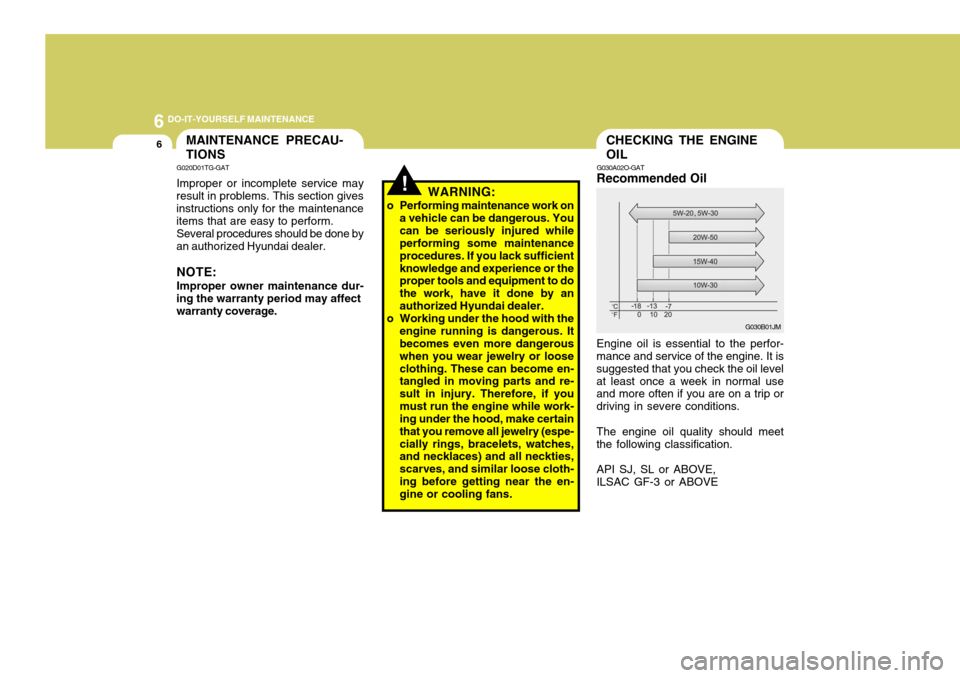
Recommended Oil Engine oil is essential to the perfor-
mance and service of the engine. It is suggested that you check the oil levelat least once a week in normal use and more often if you are on a trip or driving in severe conditions.
The engine oil quality should meet
the following classification.
API SJ, SL or ABOVE,ILSAC GF-3 or ABOVE G030B01JMMAINTENANCE PRECAU- TIONS
!
G020D01TG-GAT Improper or incomplete service may
result in problems. This section gives instructions only for the maintenanceitems that are easy to perform.
Several procedures should be done by
an authorized Hyundai dealer.
NOTE: Improper owner maintenance dur-
ing the warranty period may affect warranty coverage. WARNING:
o Performing maintenance work on a vehicle can be dangerous. You can be seriously injured while performing some maintenance procedures. If you lack sufficientknowledge and experience or the proper tools and equipment to do the work, have it done by anauthorized Hyundai dealer.
o Working under the hood with the engine running is dangerous. It becomes even more dangerous when you wear jewelry or looseclothing. These can become en- tangled in moving parts and re- sult in injury. Therefore, if youmust run the engine while work- ing under the hood, make certain that you remove all jewelry (espe-cially rings, bracelets, watches, and necklaces) and all neckties, scarves, and similar loose cloth-ing before getting near the en- gine or cooling fans.
Page 206 of 487
6 DO-IT-YOURSELF MAINTENANCE
8
!
HGK5005
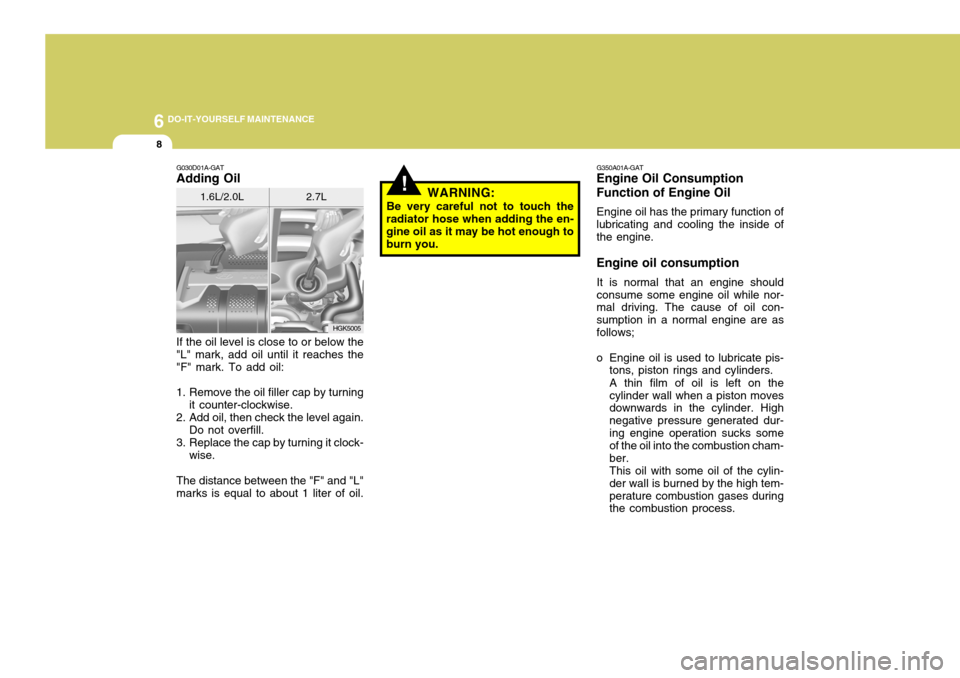
G030D01A-GAT Adding Oil
1.6L/2.0L G350A01A-GAT
Engine Oil Consumption Function of Engine Oil
Engine oil has the primary function of lubricating and cooling the inside of the engine.
Engine oil consumption It is normal that an engine should consume some engine oil while nor- mal driving. The cause of oil con- sumption in a normal engine are asfollows;
o Engine oil is used to lubricate pis- tons, piston rings and cylinders. A thin film of oil is left on the cylinder wall when a piston moves downwards in the cylinder. High negative pressure generated dur-ing engine operation sucks some of the oil into the combustion cham- ber.This oil with some oil of the cylin-der wall is burned by the high tem-perature combustion gases during the combustion process.
2.7L
If the oil level is close to or below the"L" mark, add oil until it reaches the "F" mark. To add oil:
1. Remove the oil filler cap by turning it counter-clockwise.
2. Add oil, then check the level again.
Do not overfill.
3. Replace the cap by turning it clock- wise.
The distance between the "F" and "L" marks is equal to about 1 liter of oil. WARNING:
Be very careful not to touch the
radiator hose when adding the en- gine oil as it may be hot enough to burn you.
Page 207 of 487
6
DO-IT-YOURSELF MAINTENANCE
9
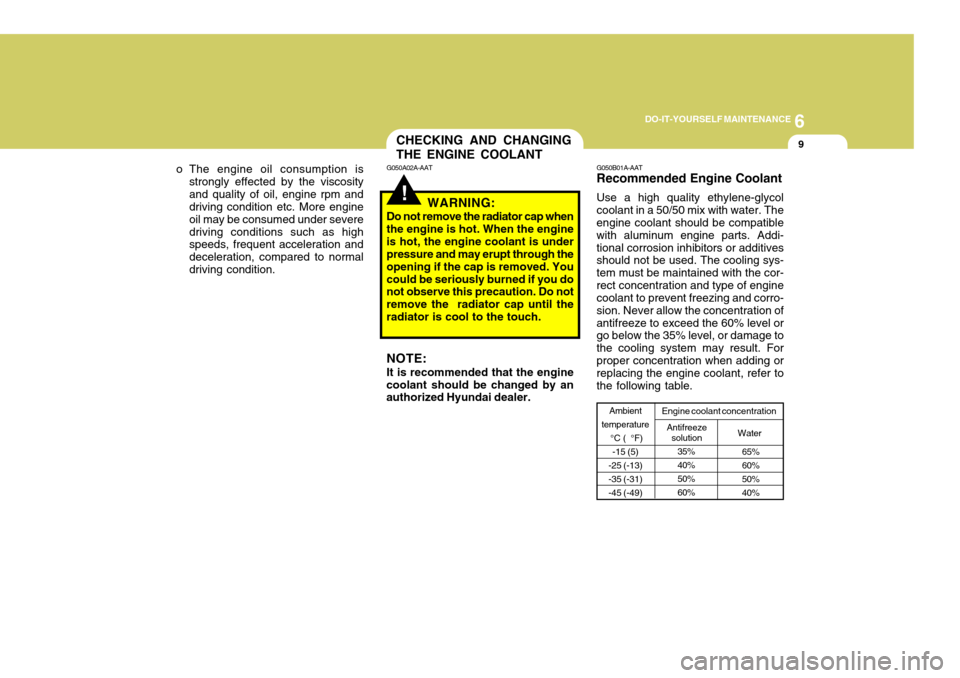
o The engine oil consumption is strongly effected by the viscosity and quality of oil, engine rpm and driving condition etc. More engine oil may be consumed under severedriving conditions such as high speeds, frequent acceleration and deceleration, compared to normaldriving condition. G050B01A-AAT Recommended Engine Coolant Use a high quality ethylene-glycol coolant in a 50/50 mix with water. The engine coolant should be compatible with aluminum engine parts. Addi-tional corrosion inhibitors or additives should not be used. The cooling sys- tem must be maintained with the cor-rect concentration and type of engine coolant to prevent freezing and corro- sion. Never allow the concentration ofantifreeze to exceed the 60% level or go below the 35% level, or damage to the cooling system may result. Forproper concentration when adding or replacing the engine coolant, refer to the following table.
Water
65% 60%50%40%
35%40%50%60%
Ambient
temperature °C ( °F)-15 (5)
-25 (-13) -35 (-31)-45 (-49) Engine coolant concentration
Antifreezesolution
!
CHECKING AND CHANGING THE ENGINE COOLANT
G050A02A-AAT
WARNING:
Do not remove the radiator cap when the engine is hot. When the engineis hot, the engine coolant is under pressure and may erupt through the opening if the cap is removed. Youcould be seriously burned if you do not observe this precaution. Do not remove the radiator cap until theradiator is cool to the touch. NOTE: It is recommended that the engine
coolant should be changed by an authorized Hyundai dealer.
Page 208 of 487
6 DO-IT-YOURSELF MAINTENANCE
10
HGK4006
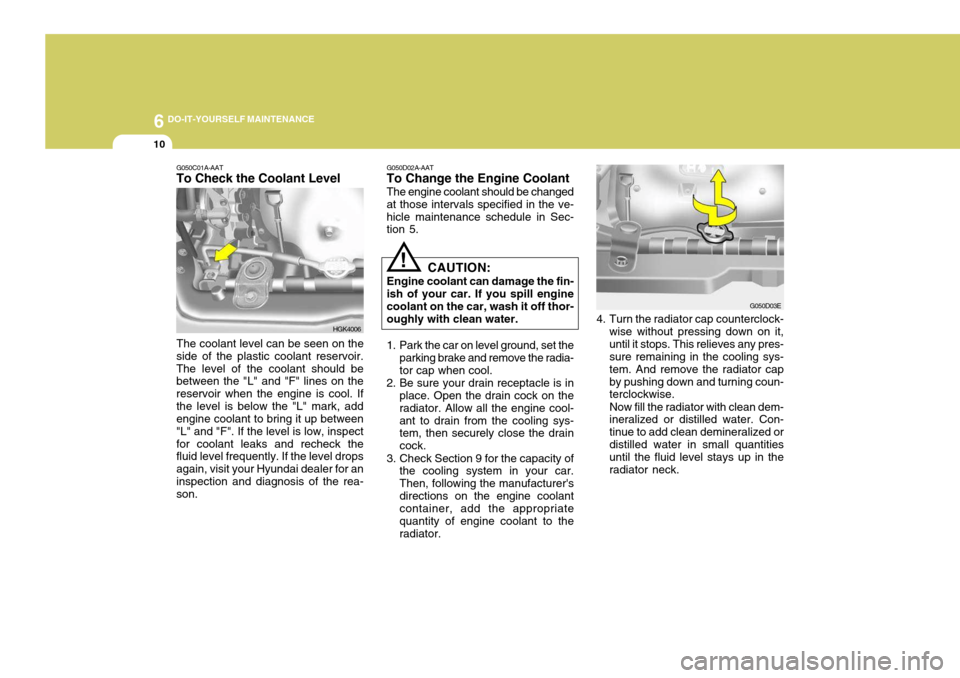
G050C01A-AAT To Check the Coolant Level
The coolant level can be seen on the
side of the plastic coolant reservoir. The level of the coolant should be between the "L" and "F" lines on the reservoir when the engine is cool. Ifthe level is below the "L" mark, add engine coolant to bring it up between "L" and "F". If the level is low, inspectfor coolant leaks and recheck the fluid level frequently. If the level drops again, visit your Hyundai dealer for aninspection and diagnosis of the rea- son. G050D02A-AAT To Change the Engine Coolant The engine coolant should be changed at those intervals specified in the ve-hicle maintenance schedule in Sec- tion 5.
CAUTION:
Engine coolant can damage the fin- ish of your car. If you spill engine coolant on the car, wash it off thor- oughly with clean water.
!
1. Park the car on level ground, set the parking brake and remove the radia- tor cap when cool.
2. Be sure your drain receptacle is in place. Open the drain cock on the radiator. Allow all the engine cool-ant to drain from the cooling sys- tem, then securely close the drain cock.
3. Check Section 9 for the capacity of the cooling system in your car.Then, following the manufacturer'sdirections on the engine coolant container, add the appropriate quantity of engine coolant to theradiator. 4. Turn the radiator cap counterclock-
wise without pressing down on it,until it stops. This relieves any pres- sure remaining in the cooling sys- tem. And remove the radiator capby pushing down and turning coun- terclockwise. Now fill the radiator with clean dem- ineralized or distilled water. Con- tinue to add clean demineralized ordistilled water in small quantities until the fluid level stays up in the radiator neck. G050D03E
Page 209 of 487
6
DO-IT-YOURSELF MAINTENANCE
11CHANGING THE AIR CLEANER FILTER
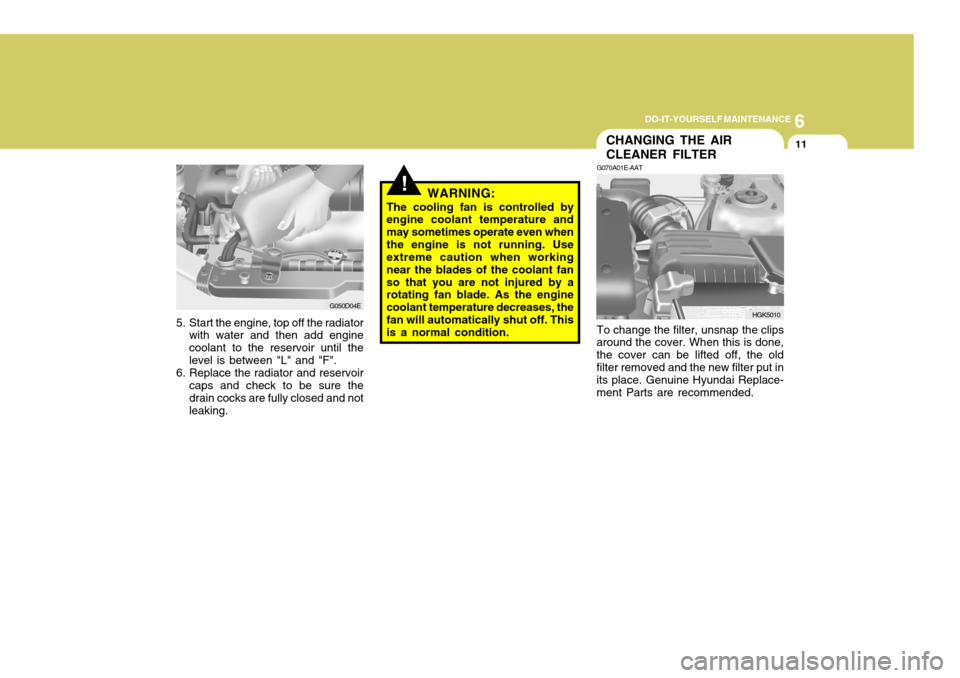
G070A01E-AAT To change the filter, unsnap the clips
around the cover. When this is done, the cover can be lifted off, the oldfilter removed and the new filter put in its place. Genuine Hyundai Replace- ment Parts are recommended.
HGK5010G050D04E
!WARNING:
The cooling fan is controlled by engine coolant temperature and may sometimes operate even whenthe engine is not running. Use extreme caution when working near the blades of the coolant fanso that you are not injured by a rotating fan blade. As the engine coolant temperature decreases, thefan will automatically shut off. This is a normal condition.
5. Start the engine, top off the radiator
with water and then add engine coolant to the reservoir until the level is between "L" and "F".
6. Replace the radiator and reservoir caps and check to be sure thedrain cocks are fully closed and not leaking.