cooling Hyundai Coupe 2007 Owner's Guide
[x] Cancel search | Manufacturer: HYUNDAI, Model Year: 2007, Model line: Coupe, Model: Hyundai Coupe 2007Pages: 487, PDF Size: 12.96 MB
Page 214 of 487
6 DO-IT-YOURSELF MAINTENANCE
16
HGK5007
G110D03Y-AAT
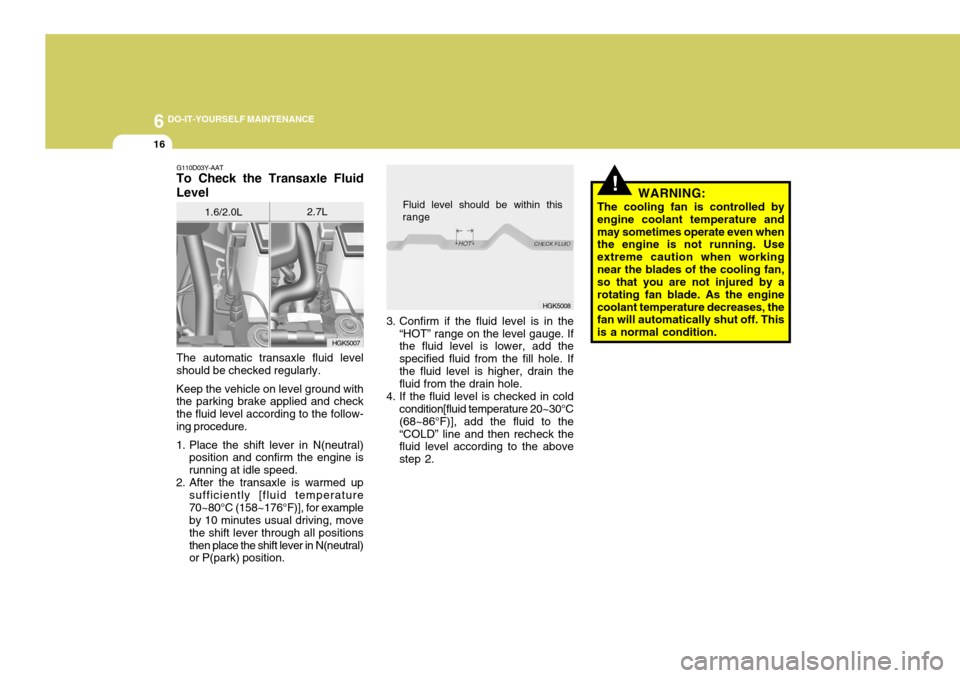
To Check the Transaxle Fluid Level
1.6/2.0L 2.7L
The automatic transaxle fluid level should be checked regularly. Keep the vehicle on level ground with the parking brake applied and check the fluid level according to the follow-ing procedure.
1. Place the shift lever in N(neutral) position and confirm the engine isrunning at idle speed.
2. After the transaxle is warmed up
sufficiently [fluid temperature70~80°C (158~176°F)], for example by 10 minutes usual driving, move the shift lever through all positionsthen place the shift lever in N(neutral) or P(park) position. 3. Confirm if the fluid level is in the
“HOT” range on the level gauge. Ifthe fluid level is lower, add the specified fluid from the fill hole. If the fluid level is higher, drain the fluid from the drain hole.
4. If the fluid level is checked in cold condition[fluid temperature 20~30°C(68~86°F)], add the fluid to the“COLD” line and then recheck the fluid level according to the above step 2.
HGK5008
!WARNING:
The cooling fan is controlled by engine coolant temperature andmay sometimes operate even when the engine is not running. Use extreme caution when workingnear the blades of the cooling fan, so that you are not injured by a rotating fan blade. As the enginecoolant temperature decreases, the fan will automatically shut off. This is a normal condition.
Fluid level should be within this
range
Page 216 of 487
6 DO-IT-YOURSELF MAINTENANCE
18
HGK5013
CHECKING THE CLUTCH FLUID
To add brake fluid, first wipe away any dirt then unscrew the fluid reservoircap. Slowly pour the recommended fluid into the reservoir. Do not overfill. Carefully replace the cap on the reser-voir and tighten. G130A01S-AAT
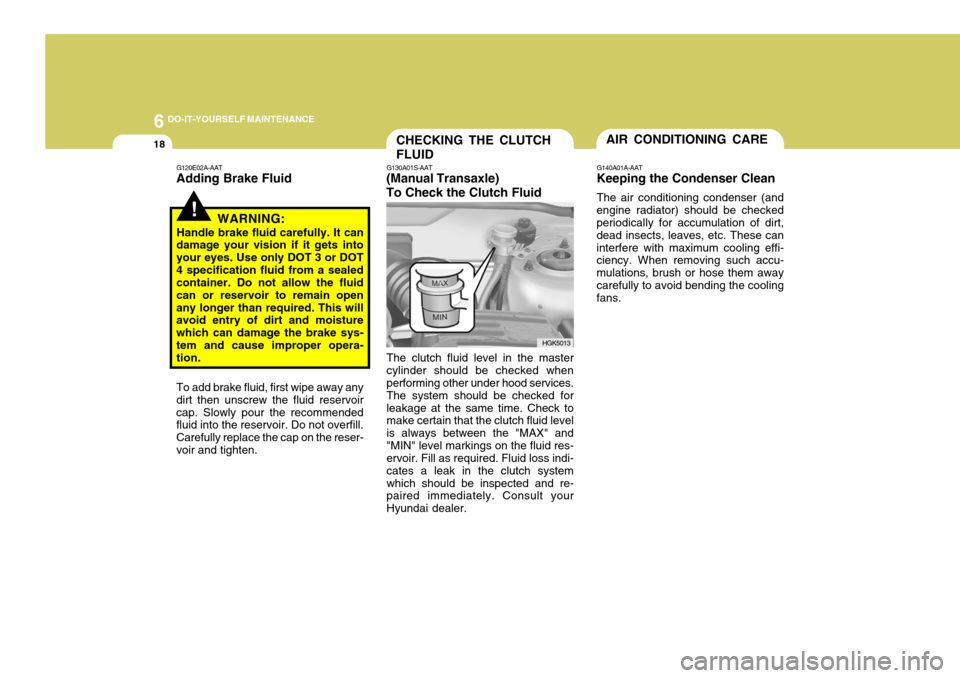
(Manual Transaxle) To Check the Clutch Fluid
!
G120E02A-AAT
Adding Brake Fluid
WARNING:
Handle brake fluid carefully. It can
damage your vision if it gets into your eyes. Use only DOT 3 or DOT4 specification fluid from a sealed container. Do not allow the fluid can or reservoir to remain openany longer than required. This will avoid entry of dirt and moisture which can damage the brake sys- tem and cause improper opera- tion. The clutch fluid level in the mastercylinder should be checked when performing other under hood services. The system should be checked forleakage at the same time. Check to make certain that the clutch fluid level is always between the "MAX" and"MIN" level markings on the fluid res- ervoir. Fill as required. Fluid loss indi- cates a leak in the clutch systemwhich should be inspected and re- paired immediately. Consult your Hyundai dealer.G140A01A-AAT
Keeping the Condenser Clean
The air conditioning condenser (and
engine radiator) should be checked periodically for accumulation of dirt, dead insects, leaves, etc. These caninterfere with maximum cooling effi- ciency. When removing such accu- mulations, brush or hose them awaycarefully to avoid bending the cooling fans. AIR CONDITIONING CARE
Page 222 of 487
6 DO-IT-YOURSELF MAINTENANCE
24
!
CHECKING ELECTRIC COOLING FANS
G220A01A-AAT
WARNING:
The cooling fan is controlled by engine coolant temperature and may sometimes operate even whenthe engine is not running. Use extreme caution when working near the blades of the coolant fan,so that you are not injured by a rotating fan blade. As the coolant temperature decreases the fan willautomatically shut off. This is a normal condition.
Keep batteries out of the reach of children because batteries contain highly corrosive SULFURIC ACID.Do not allow battery acid to contact your skin, eyes, clothing or paint finish.If any electrolyte gets intoyour eyes, flush your eyeswith clean water for at least 15 minutes and get imme- diate medical attention. Ifpossible, continue to ap- ply water with a sponge or cloth until medical atten-tion is received.If electrolyte gets on yourskin, thoroughly wash thecontacted area.If you feel a pain or a burn-ing sensation, get medi- cal attention immediately. Wear eye protection when charging or working near a battery. Always provide ventilation when working in an en- closed space.o When lifting a plastic-cased bat- tery, excessive pressure on the case may cause battery acid toleak, resulting in personal in- jury. Lift with a battery carrier or with your hands on oppositecorners.
o Never attempt to charge the bat- tery when the battery cables are connected.
o The electrical ignition system works with high voltage. Never touch these componentswith the engine running or the ignition switched on.
Page 223 of 487
6
DO-IT-YOURSELF MAINTENANCE
25
G220B01A-AAT
Checking Engine Cooling Fan
The engine coolant fan should come on automatically if the engine coolant temperature is high. G220C01A-AAT
Checking Condenser Cooling Fan
The condenser coolant fan should come on automatically whenever the air conditioning is in operation. G230A01GK-GAT
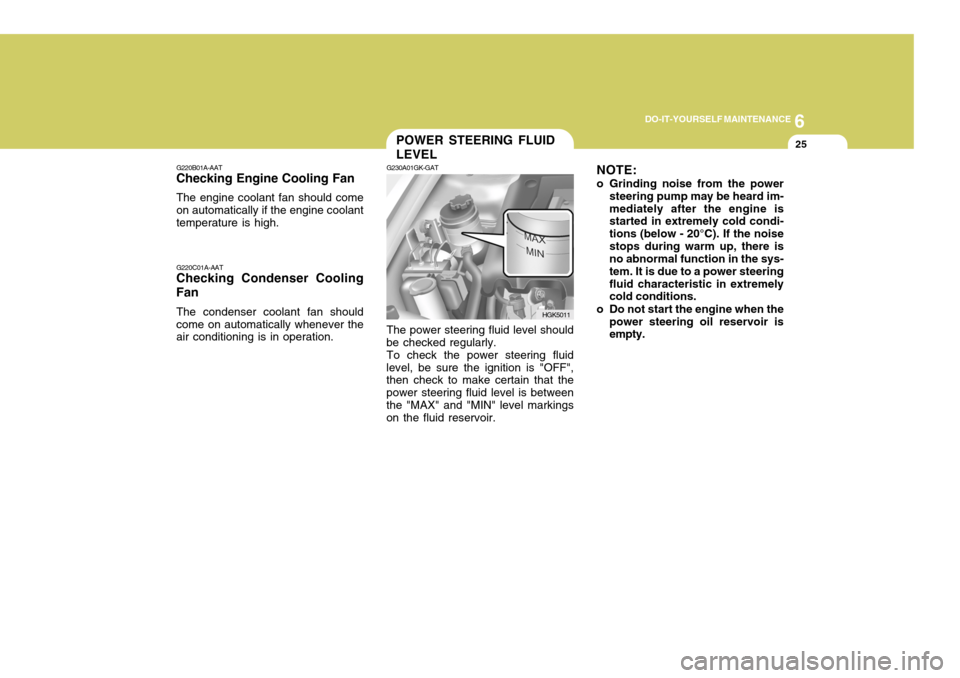
POWER STEERING FLUID LEVEL
The power steering fluid level should
be checked regularly.
To check the power steering fluid
level, be sure the ignition is "OFF", then check to make certain that the power steering fluid level is betweenthe "MAX" and "MIN" level markings on the fluid reservoir. NOTE:
o Grinding noise from the power
steering pump may be heard im- mediately after the engine is started in extremely cold condi- tions (below - 20°C). If the noisestops during warm up, there is no abnormal function in the sys- tem. It is due to a power steeringfluid characteristic in extremely cold conditions.
o Do not start the engine when the power steering oil reservoir isempty.
HGK5011
Page 253 of 487

10INDEX
2
A Air bag ........................................................................ 1-34
Air clean er filter .......................................................... 6-11
Air Conditioning
Care ......................................................................... 6-18
Operation ................................................................. 6-19
Switch ...................................................................... 1-84
Air Cond itioner filter .................................................... 1-93
Antenna .................................................................... 1-100
Ashtray ....................................................................... 1-63
Audio Remote Control ................................................. 1-82
Automatic Transaxle .................................................... 2-8
BBattery .............................................................. 2-18, 6-23
Brake
Anti-lock system ...................................................... 2-12
Checking the brakes ................................................ 6-17
Fluid ......................................................................... 6-17
Practices ................................................................. 2-15
Breaking-In your new Hyundai ..................................... 1-3
CCare of Cassette tapes ............................................ 1-127
Care of D iscs ........................................................... 1-126
Cassette Tape Player Operation (H280, H265, H465) .........................1-104, 1-113, 1-119
Catalytic Converter ...................................................... 7-3
Child Restraint system ............................................... 1-25Child Seat Restraint Suitability For Seat Position
Using the Seat Belt .................................................. 1-27
Cigarette Lighter ......................................................... 1-62
Clock .......................................................................... 1-62
Clutch Checking fluid .......................................................... 6-18
Combination Light
Daytime running lights ............................................. 1-57
Headlight flasher ...................................................... 1-58
Headlight swi tch ...................................................... 1-56
High-beam switch .................................................... 1-57
Lane change si gnal .................................................. 1-56
Turn signal operation ............................................... 1-56
Compact Disc Player Operation
(H280, H265, H465) .........................1-110, 1-116, 1-122
Cooling Fans ............................................................... 6-24
Corrosion Protection
Cleaning the interior .................................................. 4-6
Protecting your Hyundai from corrosion ................... 4-2
Washing and waxing ................................................. 4-4
Cruise Control ............................................................. 1-79
DDefrosting/Defogging ................................................... 1-89
Door
Central door lock ...................................................... 1-8
Door locks ................................................................ 1-7 Locking and unlocking front door with a key ............ 1-7
Drink Holder ................................................................ 1-63
Page 269 of 487
1
Fuel Recommendations ............................................... 1-2
Running In Your New Hyundai ..................................... 1-3
Immobiliser System ...................................................... 1-4
Door Locks ................................................................... 1-6
Anti-theft Alarm System ................................................ 1-8Power Windows........................................................... 1-11
Seats ........................................................................... 1-12
Seat Belts .................................................................... 1-19
Child Restraint System ................................................ 1-23
Supplemental Restraint (AIRBAG ) System................. 1-32
Instrument Cluster and Indicator Lights .......................1-40
Warning and Indicator Lights....................................... 1-42
Trip Computer .............................................................. 1-49
Multi Gauge ................................ ................................. 1-51
Multi-function Switch .................................................... 1-52
Windscreen Wiper/Washer Switch ..............................1-55
Sunroof ........................................................................ 1-63
Mirror ........................................................................... 1-68
Bonnet Release ........................................................... 1-71
Cruise Co ntrol.............................................................. 1-77
Audio Remote Contro l Switch ...................................... 1-81
Heating and Cooling Control .......... ..............................1-82
Antenna ....................................................................... 1-99
Stereo Sound System ............................................... 1-101
CONTROLS AND EQUIPMENT
1
Page 315 of 487
1
CONTROLS AND EQUIPMENT
47
!
INSTRUMENT CLUSTER
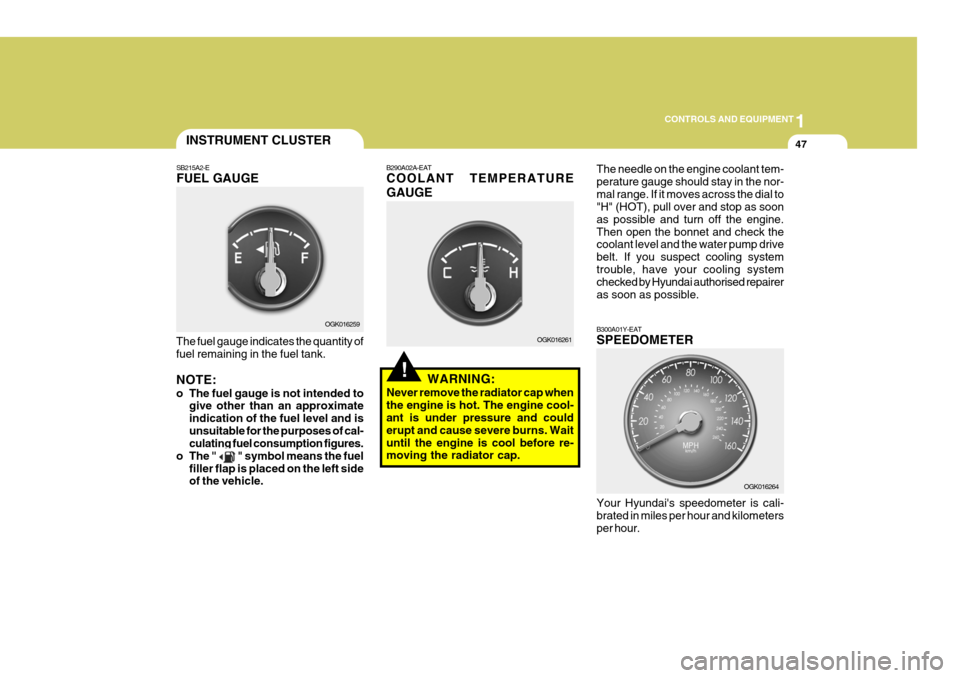
SB215A2-E FUEL GAUGE
The fuel gauge indicates the quantity of fuel remaining in the fuel tank. NOTE:
o The fuel gauge is not intended to give other than an approximate indication of the fuel level and isunsuitable for the purposes of cal- culating fuel consumption figures.
o The "
" symbol means the fuel
filler flap is placed on the left side of the vehicle. B290A02A-EAT COOLANT TEMPERATURE GAUGE
WARNING:
Never remove the radiator cap when the engine is hot. The engine cool- ant is under pressure and could erupt and cause severe burns. Waituntil the engine is cool before re- moving the radiator cap.
OGK016259
OGK016261The needle on the engine coolant tem- perature gauge should stay in the nor-mal range. If it moves across the dial to "H" (HOT), pull over and stop as soon as possible and turn off the engine.Then open the bonnet and check the coolant level and the water pump drive belt. If you suspect cooling systemtrouble, have your cooling system checked by Hyundai authorised repairer as soon as possible.
B300A01Y-EAT SPEEDOMETER Your Hyundai's speedometer is cali- brated in miles per hour and kilometers per hour.
OGK016264
Page 350 of 487
1FEATURES OF YOUR HYUNDAI
82HEATING AND COOLING CONTROL
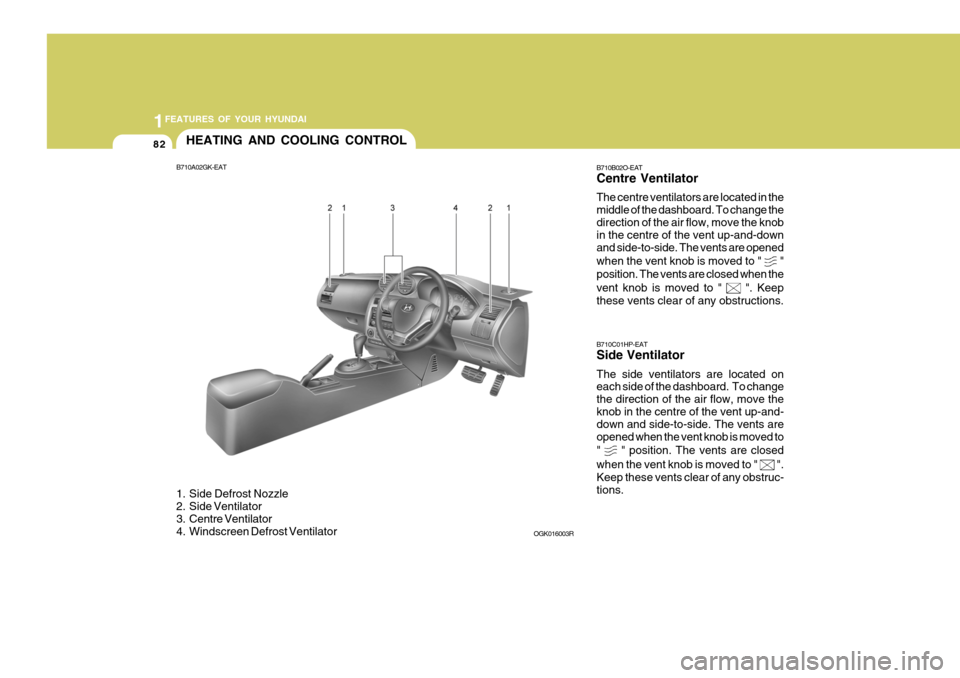
B710A02GK-EAT
1. Side Defrost Nozzle
2. Side Ventilator
3. Centre Ventilator
4. Windscreen Defrost Ventilator OGK016003R
B710B02O-EAT Centre Ventilator The centre ventilators are located in the middle of the dashboard. To change thedirection of the air flow, move the knob in the centre of the vent up-and-down and side-to-side. The vents are opened when the vent knob is moved to "
"
position. The vents are closed when the vent knob is moved to "
". Keep
these vents clear of any obstructions. B710C01HP-EAT Side Ventilator The side ventilators are located on each side of the dashboard. To change the direction of the air flow, move theknob in the centre of the vent up-and- down and side-to-side. The vents are opened when the vent knob is moved to "
" position. The vents are closed
when the vent knob is moved to "
".
Keep these vents clear of any obstruc- tions.
Page 351 of 487
1
FEATURES OF YOUR HYUNDAI
83HEATING AND VENTILATION
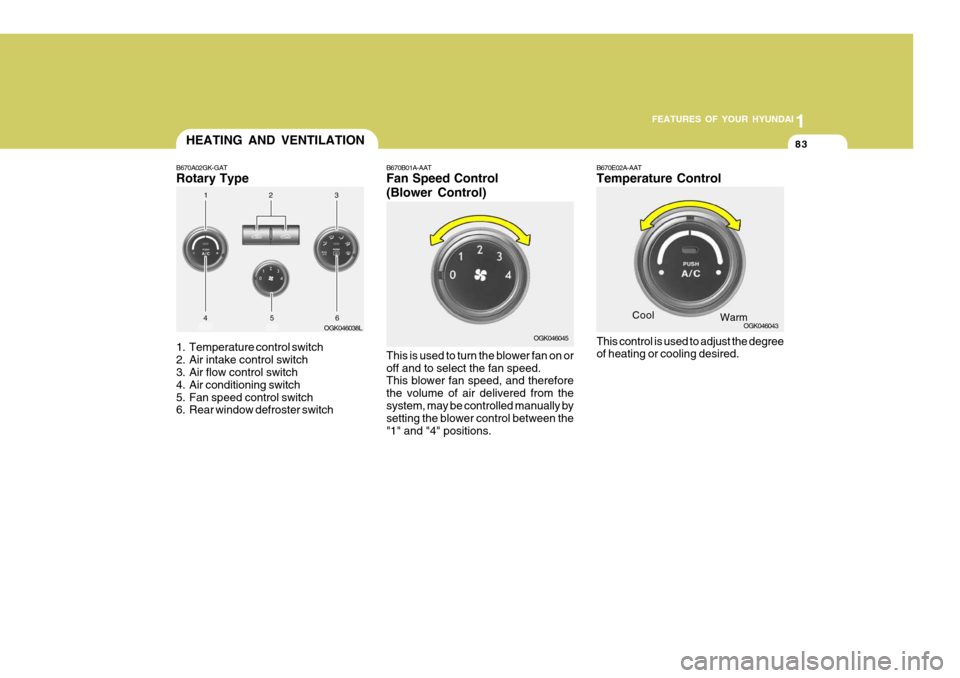
B670A02GK-GAT Rotary Type
1. Temperature control switch
2. Air intake control switch
3. Air flow control switch
4. Air conditioning switch
5. Fan speed control switch
6. Rear window defroster switch B670B01A-AAT Fan Speed Control (Blower Control) This is used to turn the blower fan on or off and to select the fan speed. This blower fan speed, and therefore the volume of air delivered from thesystem, may be controlled manually by setting the blower control between the "1" and "4" positions.B670E02A-AAT Temperature Control This control is used to adjust the degree of heating or cooling desired.
Cool
OGK046038L OGK046045 OGK046043
Warm
Page 357 of 487
1
FEATURES OF YOUR HYUNDAI
89AIR CONDITIONING SYSTEM
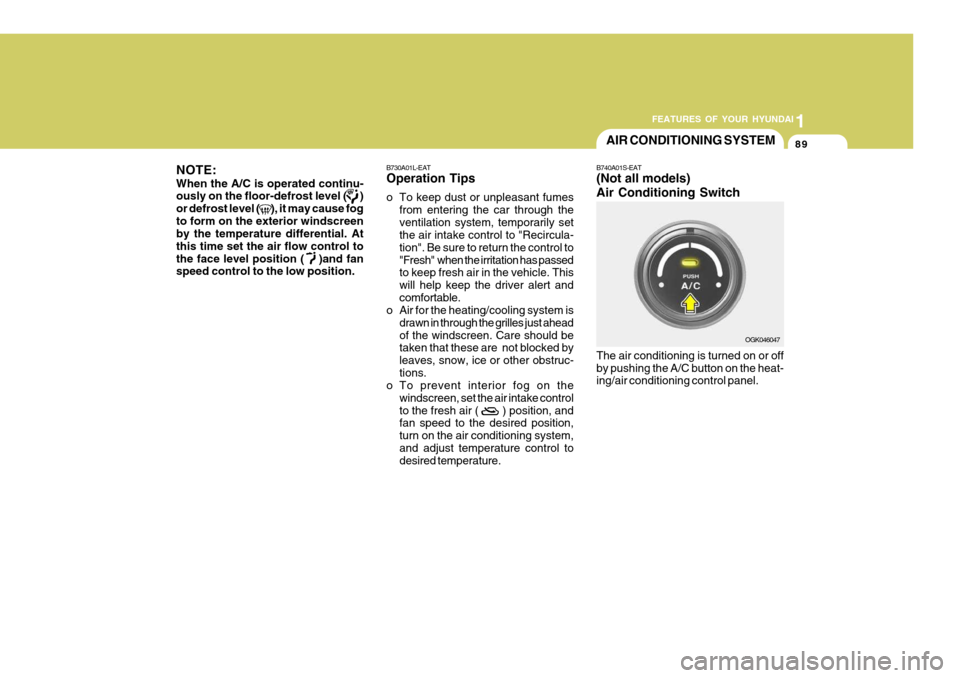
B740A01S-EAT (Not all models) Air Conditioning Switch The air conditioning is turned on or off by pushing the A/C button on the heat- ing/air conditioning control panel. OGK046047
NOTE: When the A/C is operated continu- ously on the floor-defrost level ( ) or defrost level ( ), it may cause fogto form on the exterior windscreen by the temperature differential. At this time set the air flow control tothe face level position ( )and fan speed control to the low position.
B730A01L-EAT Operation Tips
o To keep dust or unpleasant fumes
from entering the car through the ventilation system, temporarily set the air intake control to "Recircula- tion". Be sure to return the control to"Fresh" when the irritation has passed to keep fresh air in the vehicle. This will help keep the driver alert andcomfortable.
o Air for the heating/cooling system is
drawn in through the grilles just aheadof the windscreen. Care should be taken that these are not blocked by leaves, snow, ice or other obstruc-tions.
o To prevent interior fog on the
windscreen, set the air intake controlto the fresh air ( ) position, and fan speed to the desired position, turn on the air conditioning system,and adjust temperature control to desired temperature.