check engine Hyundai Coupe 2007 Service Manual
[x] Cancel search | Manufacturer: HYUNDAI, Model Year: 2007, Model line: Coupe, Model: Hyundai Coupe 2007Pages: 487, PDF Size: 12.96 MB
Page 217 of 487
6
DO-IT-YOURSELF MAINTENANCE
19CHANGING THE CLIMATE CONTROL AIR FILTER
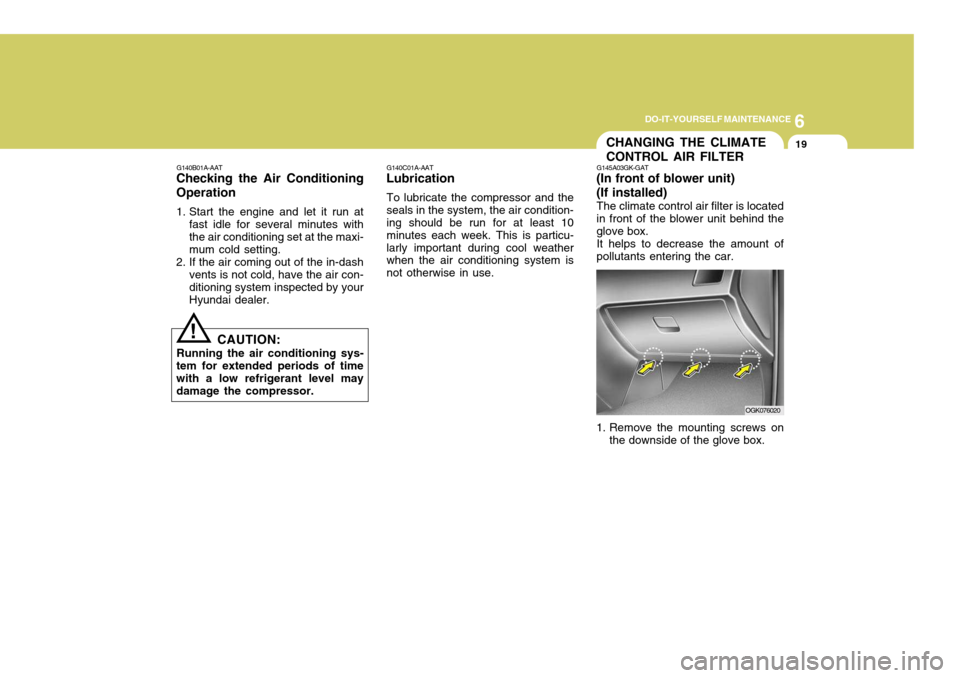
G145A03GK-GAT
(In front of blower unit)(If installed)
The climate control air filter is located in front of the blower unit behind the glove box.It helps to decrease the amount ofpollutants entering the car.
1. Remove the mounting screws on the downside of the glove box. OGK076020
G140C01A-AAT
Lubrication
To lubricate the compressor and theseals in the system, the air condition- ing should be run for at least 10 minutes each week. This is particu-larly important during cool weather when the air conditioning system is not otherwise in use.
!
G140B01A-AAT
Checking the Air Conditioning Operation
1. Start the engine and let it run at
fast idle for several minutes with the air conditioning set at the maxi- mum cold setting.
2. If the air coming out of the in-dash vents is not cold, have the air con-ditioning system inspected by yourHyundai dealer.
CAUTION:
Running the air conditioning sys-
tem for extended periods of timewith a low refrigerant level maydamage the compressor.
Page 222 of 487
6 DO-IT-YOURSELF MAINTENANCE
24
!
CHECKING ELECTRIC COOLING FANS
G220A01A-AAT
WARNING:
The cooling fan is controlled by engine coolant temperature and may sometimes operate even whenthe engine is not running. Use extreme caution when working near the blades of the coolant fan,so that you are not injured by a rotating fan blade. As the coolant temperature decreases the fan willautomatically shut off. This is a normal condition.
Keep batteries out of the reach of children because batteries contain highly corrosive SULFURIC ACID.Do not allow battery acid to contact your skin, eyes, clothing or paint finish.If any electrolyte gets intoyour eyes, flush your eyeswith clean water for at least 15 minutes and get imme- diate medical attention. Ifpossible, continue to ap- ply water with a sponge or cloth until medical atten-tion is received.If electrolyte gets on yourskin, thoroughly wash thecontacted area.If you feel a pain or a burn-ing sensation, get medi- cal attention immediately. Wear eye protection when charging or working near a battery. Always provide ventilation when working in an en- closed space.o When lifting a plastic-cased bat- tery, excessive pressure on the case may cause battery acid toleak, resulting in personal in- jury. Lift with a battery carrier or with your hands on oppositecorners.
o Never attempt to charge the bat- tery when the battery cables are connected.
o The electrical ignition system works with high voltage. Never touch these componentswith the engine running or the ignition switched on.
Page 223 of 487
6
DO-IT-YOURSELF MAINTENANCE
25
G220B01A-AAT
Checking Engine Cooling Fan
The engine coolant fan should come on automatically if the engine coolant temperature is high. G220C01A-AAT
Checking Condenser Cooling Fan
The condenser coolant fan should come on automatically whenever the air conditioning is in operation. G230A01GK-GAT
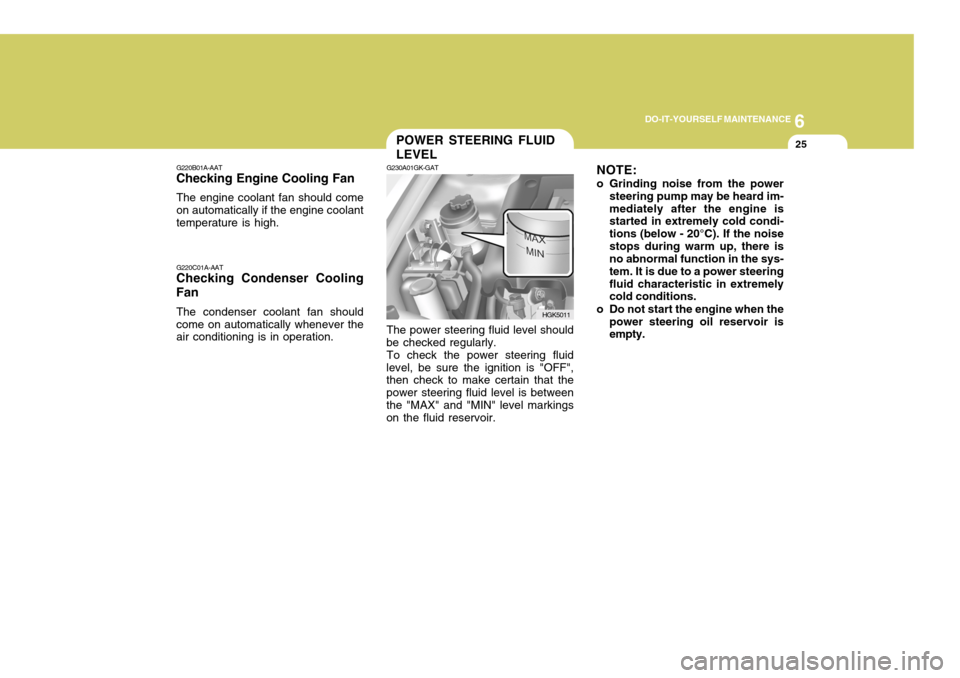
POWER STEERING FLUID LEVEL
The power steering fluid level should
be checked regularly.
To check the power steering fluid
level, be sure the ignition is "OFF", then check to make certain that the power steering fluid level is betweenthe "MAX" and "MIN" level markings on the fluid reservoir. NOTE:
o Grinding noise from the power
steering pump may be heard im- mediately after the engine is started in extremely cold condi- tions (below - 20°C). If the noisestops during warm up, there is no abnormal function in the sys- tem. It is due to a power steeringfluid characteristic in extremely cold conditions.
o Do not start the engine when the power steering oil reservoir isempty.
HGK5011
Page 224 of 487
6 DO-IT-YOURSELF MAINTENANCE
26
OGK076068N
G240A01A-AAT Power Steering Hoses It is suggested that you check the power steering hose connections for fluid leakage daily. The power steer- ing hoses should be replaced if thereis severe surface cracking, pulling, scuffing or worn spots. Deterioration of the hose could cause prematurefailure. G290A02GK-GAT
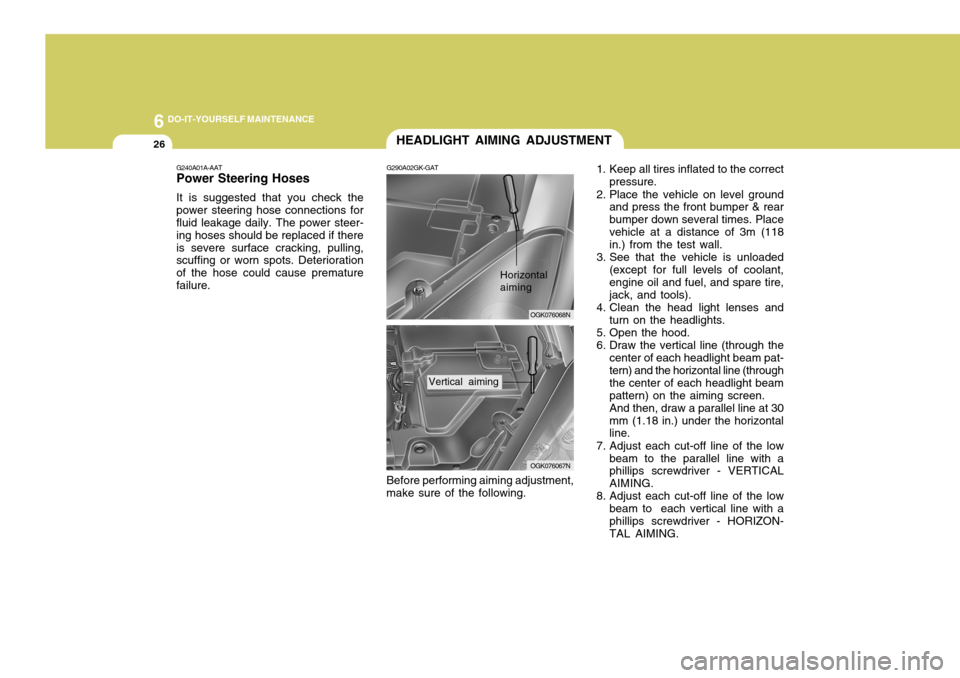
HEADLIGHT AIMING ADJUSTMENT
1. Keep all tires inflated to the correctpressure.
2. Place the vehicle on level ground and press the front bumper & rearbumper down several times. Placevehicle at a distance of 3m (118 in.) from the test wall.
3. See that the vehicle is unloaded (except for full levels of coolant, engine oil and fuel, and spare tire,jack, and tools).
4. Clean the head light lenses and
turn on the headlights.
5. Open the hood.
6. Draw the vertical line (through the center of each headlight beam pat- tern) and the horizontal line (through the center of each headlight beampattern) on the aiming screen.And then, draw a parallel line at 30mm (1.18 in.) under the horizontal line.
7. Adjust each cut-off line of the low beam to the parallel line with aphillips screwdriver - VERTICAL AIMING.
8. Adjust each cut-off line of the low
beam to each vertical line with aphillips screwdriver - HORIZON- TAL AIMING.
Before performing aiming adjustment,
make sure of the following.
OGK076067N
Horizontal aiming
Vertical aiming
Page 250 of 487

9
VEHICLE SPECIFICATIONS
3
SPECIFICATION 2.0 L
82 x 93.5 1,975
1 - 3 - 4 - 2
0.17 ~ 0.23 mm (0.0067 ~ 0.0091 in.) 0.25 ~ 0.31 mm (0.0098 ~ 0.0122 in.)
0.12 ~ 0.28 mm (0.0047 ~ 0.011 in.) 0.2 ~ 0.38 mm (0.0079 ~ 0.015 in.)
700 ± 100
BTDC 8° ± 5° 2.7 L
6-Cyl., V-type DOHC 86.7 x 75
2,656
1 - 2 - 3 - 4 - 5 - 6
AUTO LASH
750 ± 100
BTDC 12° ± 10°
4-Cyl., In-line DOHC
1.6 L
76.5 x 87 1,599
1 - 3 - 4 - 2
AUTO LASH
700 ± 100
BTDC 5° ± 5°
ITEMS
Engine TypeBore x Stroke (mm) Displacement (cc) Firing order Valve clearance (Cold Engine 20 ± 5°C) Idle speed (rpm) Ignition timing (Base)ENGINE
J070A05GK-GAT
For adjustingFor checking Intake ExhaustIntake Exhaust
Page 254 of 487

10
INDEX
3
Driving Economical driving .................................................. 2-16
Smooth corneri ng ..................................................... 2-17
Winter driving ........................................................... 2-17
E Electronic Stability Program (ESP) ............................2-13
Emissions Control Systems ........................................ 7-2 Engine Before starting the engine ........................................ 2-3
Changing the oil and filter ......................................... 6-6Compartment (1.6L, 2.0L, 2.7L) ................................ 6-2
Coolant ..................................................................... 6-9
Coolant temperature gauge ......................................1-50
If the engine overheats ............................................. 3-4
Number ..................................................................... 8-2
Oil ............................................................................. 6-6Oil consumption ........................................................ 6-8
Starting ..................................................................... 2-5
Engine Exhaust Can Be Dangerous ............................ 2-2
FFog Light .................................................................... 1-60
Front Seats Adjustable front seats .............................................. 1-13
Adjustable headrests ............................................... 1-14
Adjusting seat forward and rearward ........................ 1-13
Adjusting seatback angle ........................................ 1-14
Lumbar support control ............................................ 1-16
Seat cushion height adjustment .............................. 1-16Seat warmer
............................................................ 1-16
Fuel Capacity ................................................................... 9-2
Gauge ...................................................................... 1-50
Recommendations .................................................... 1-2
Fuel Filler Lid Remote release ....................................................... 1-74
Fuse Panel Description .............................................. 6-37
Fuses ......................................................................... 6-21
G
General Everyday Checks ..... ...................................... 6-5
Glove box ................................................................... 1-69
H Hazard Warning System ............................................. 1-61
Headlight Leveling Device S ystem .............................1-64
Heating and Air Conditioning Control Rotary type .............................................................. 1-84
Automatic type ........................................................ 1-93
High-mounted rear stoplight .. ......................................1-72
Hood Release ............................................................. 1-73
Horn ............................................................................ 1-78
I Ignition Switch ............................................................. 2-4
Immobilizer System ..................................................... 1-4
Instrument Cluster and Indicator Lights ...................... 1-42
Instrument Panel Light Control (Rheostat) .................. 1-62
Intermittent Wiper ....................................................... 1-59
Page 271 of 487
1
CONTROLS AND EQUIPMENT
3RUNNING IN YOUR NEW HYUNDAI
B020A01S-EAT The longevity and performance of the vehicle are greatly affected by the care exercised during the first 1,000 miles of motoring. Because of modern manu-facturing techniques, rigid guidelines regarding maximum road speeds have become unnecessary. However, cer-tain precautions should be observed in order to obtain the best possible per- formance and useful life from the ve-hicle.
1) Do not race the engine without a
load (i.e revving the engine in neu- tral).
2) During the first 500 miles the maxi- mum engine speed should be re-stricted to 3,000 rpm and gradually increased thereafter.
3) Avoid prolonged constant speed operation. The internal componentsof the engine will become morequickly run in if the operation speed is varied during the running in pe- riod.
4) Never allow the engine to labour. Use the gearbox freely and avoidlarge throttle openings when theengine speed is below 1,500 rpm.BEFORE ENTERING THE VEHICLEAFTER ENTERING THE VEHICLE
YB020A1-E
o Ensure that all windows, mirrors
and lamps are clean.
o Check condition of all tyres.
o Ensure that no fluid leaks are evi-
dent.
o Ensure that the area around the vehicle is clear before driving off. YB020B1-E
o Ensure that all occupants fasten
and correctly adjust seat belts.
o Ensure that seat and head restraint positions are adjusted for optimum safety, control and comfort.
o Adjust interior and exterior rear view mirrors.
o Verify correct operation of lamps, horn and other electrical equipment.
o Ensure that warning lamps illumi-
nate when ignition is turned on.
NOTE: Fluid levels such as engine oil, en- gine coolant, brake and windscreenwasher fluid should be checked daily or at each refuelling, which- ever occurs sooner.
Page 310 of 487
1CONTROLS AND EQUIPMENT
42WARNING AND INDICATOR LIGHTS
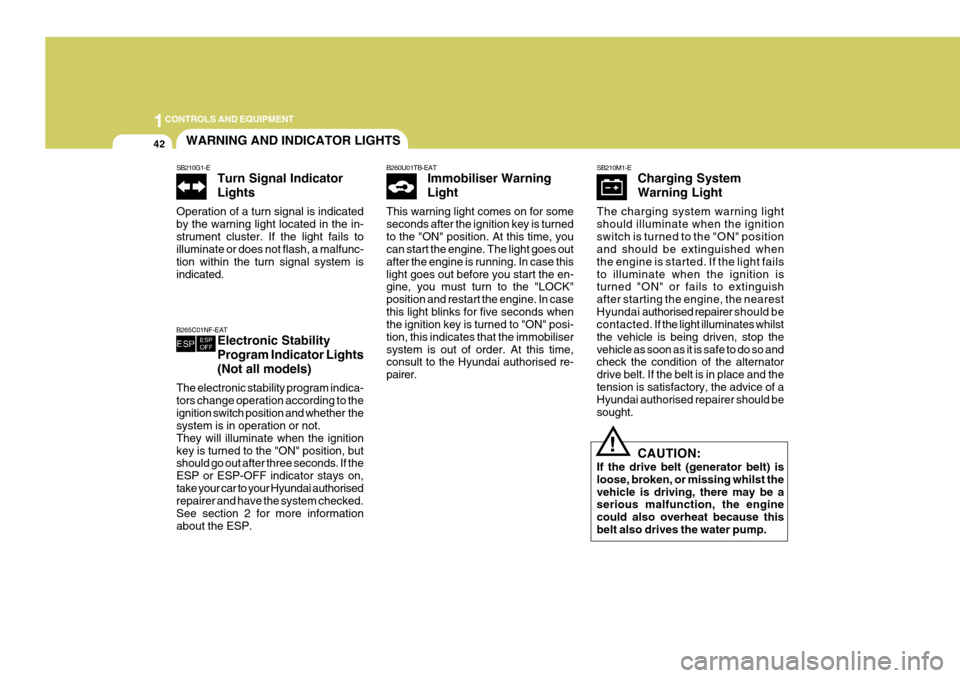
SB210G1-E Turn Signal Indicator Lights
Operation of a turn signal is indicated by the warning light located in the in-strument cluster. If the light fails to illuminate or does not flash, a malfunc- tion within the turn signal system isindicated.
B265C01NF-EAT Electronic Stability Program Indicator Lights(Not all models)
The electronic stability program indica- tors change operation according to theignition switch position and whether the system is in operation or not. They will illuminate when the ignitionkey is turned to the "ON" position, but should go out after three seconds. If the ESP or ESP-OFF indicator stays on,take your car to your Hyundai authorised repairer and have the system checked. See section 2 for more informationabout the ESP.
B260U01TB-EAT Immobiliser Warning Light
This warning light comes on for some seconds after the ignition key is turnedto the "ON" position. At this time, you can start the engine. The light goes out after the engine is running. In case thislight goes out before you start the en- gine, you must turn to the "LOCK" position and restart the engine. In casethis light blinks for five seconds when the ignition key is turned to "ON" posi- tion, this indicates that the immobilisersystem is out of order. At this time, consult to the Hyundai authorised re- pairer.SB210M1-E Charging System Warning Light
The charging system warning light should illuminate when the ignitionswitch is turned to the "ON" position and should be extinguished when the engine is started. If the light failsto illuminate when the ignition is turned "ON" or fails to extinguish after starting the engine, the nearestHyundai authorised repairer should be
contacted. If the light illuminates whilst
the vehicle is being driven, stop thevehicle as soon as it is safe to do so and check the condition of the alternator drive belt. If the belt is in place and thetension is satisfactory, the advice of a Hyundai authorised repairer should be sought.
CAUTION:
If the drive belt (generator belt) is loose, broken, or missing whilst thevehicle is driving, there may be a serious malfunction, the engine could also overheat because thisbelt also drives the water pump.!
Page 311 of 487

1
CONTROLS AND EQUIPMENT
43
B260B01JM-EAT SRS (Airbag) Service Reminder Indicator (SRI)(Not all models)
The SRS service reminder indicator (SRI) comes on for approximately 6 seconds after the ignition key is turnedto the "ON" position or after the engine is started, after which it will go out. This light also comes on when the SRS is not working properly. If the SRI does not come on, or continuously remainson after flashing for about 6 seconds when you turned the ignition key to the "ON" position or started the engine, orif it comes on whilst driving, have the SRS inspected by a Hyundai authorised repairer.
B260E01HP-GAT Seat Belt Warning Light
The seat belt warning light blinks for 6 about seconds when the ignition key is turned from the "OFF" position to "ON"or "START".
SB210J1-E High Beam Indicator Light
The high beam indicator light will illumi- nate whenever the headlights are switched to high beam of flash position.
SB210K1-E Low Oil Pressure Warning Light
!CAUTION:
If the oil pressure warning light illu- minates when the engine is running,an insufficient oil pressure level for continued safe operation of the en- gine exists. Continued operation ofthe engine in this condition may result in serious engine damage. Under normal circumstances, the light will illuminate when the igni- tion is turned "on" and will be extin-guished when the engine is started. If the oil pressure warning light illu- minates whilst the engine is run-ning, stop the engine immediately and check the engine oil level. If the level is insufficient, add the required amount of oil as indicated by the engine oil dipstick. If the light fails to extinguish when the engineis restarted, do not continue to oper- ate the vehicle. If the oil pressure light illuminatesduring normal operation and the cause is not an insufficient oil level, or the light fails to illuminate whenthe ignition is turned "on", contact the nearest Hyundai authorised re- pairer before further operating thevehicle.
Page 312 of 487
1CONTROLS AND EQUIPMENT
44
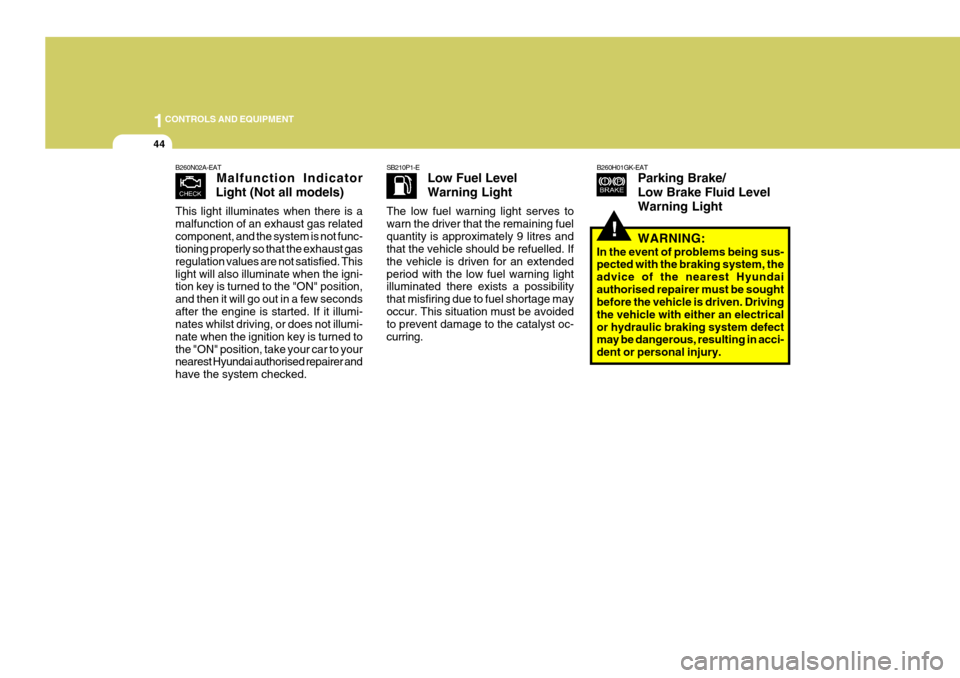
B260N02A-EAT Malfunction Indicator
Light (Not all models)
This light illuminates when there is a malfunction of an exhaust gas relatedcomponent, and the system is not func- tioning properly so that the exhaust gas regulation values are not satisfied. Thislight will also illuminate when the igni- tion key is turned to the "ON" position, and then it will go out in a few secondsafter the engine is started. If it illumi- nates whilst driving, or does not illumi- nate when the ignition key is turned tothe "ON" position, take your car to your nearest Hyundai authorised repairer and have the system checked.
SB210P1-E Low Fuel Level Warning Light
The low fuel warning light serves to warn the driver that the remaining fuelquantity is approximately 9 litres and that the vehicle should be refuelled. If the vehicle is driven for an extendedperiod with the low fuel warning light illuminated there exists a possibility that misfiring due to fuel shortage mayoccur. This situation must be avoided to prevent damage to the catalyst oc- curring.
!
B260H01GK-EAT Parking Brake/ Low Brake Fluid LevelWarning Light
WARNING:
In the event of problems being sus- pected with the braking system, the advice of the nearest Hyundaiauthorised repairer must be sought before the vehicle is driven. Driving the vehicle with either an electricalor hydraulic braking system defect may be dangerous, resulting in acci- dent or personal injury.