ESP Hyundai Coupe 2007 Workshop Manual
[x] Cancel search | Manufacturer: HYUNDAI, Model Year: 2007, Model line: Coupe, Model: Hyundai Coupe 2007Pages: 487, PDF Size: 12.96 MB
Page 435 of 487
6OWNER MAINTENANCE
6
NOTE:
o SAE 5W-20 (5W-30), ILSAC GF-3 engine oil is preferred regardless of regional option and engine variation.
o If SAE 5W-20, ILSAC GF-3 engine oil is not available, secondaryrecommended engine oil for cor- responding temperature rangecan be used.ENGINE OIL
SG030A1-E The correct engine oil level is of para- mount importance. An excessively high or low oil level may result inirreparable damage being sustained by the engine. The engine oil level must be checked on a daily basis orwhenever the vehicle is refuelled, whichever occurs sooner. In addition, it is imperative that only an approved grade and specification of oil is used to avoid the possibility of serious engine damage and prema-ture wear. The use of "budget price" oil is a false economy that must be avoided if the maximum reliability anduseful life is to be obtained from the vehicle. G030B02O-EAT
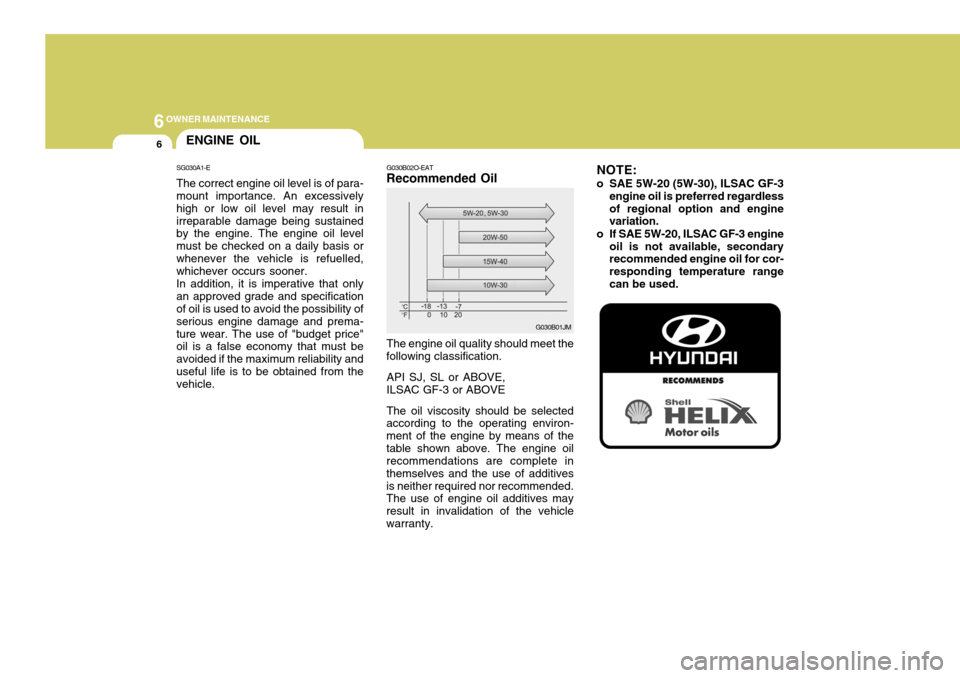
Recommended Oil
The engine oil quality should meet the
following classification.
API SJ, SL or ABOVE, ILSAC GF-3 or ABOVE The oil viscosity should be selected
according to the operating environ- ment of the engine by means of thetable shown above. The engine oil recommendations are complete in themselves and the use of additivesis neither required nor recommended. The use of engine oil additives may result in invalidation of the vehiclewarranty.
G030B01JM
Page 439 of 487
6OWNER MAINTENANCE
10
HGK4006
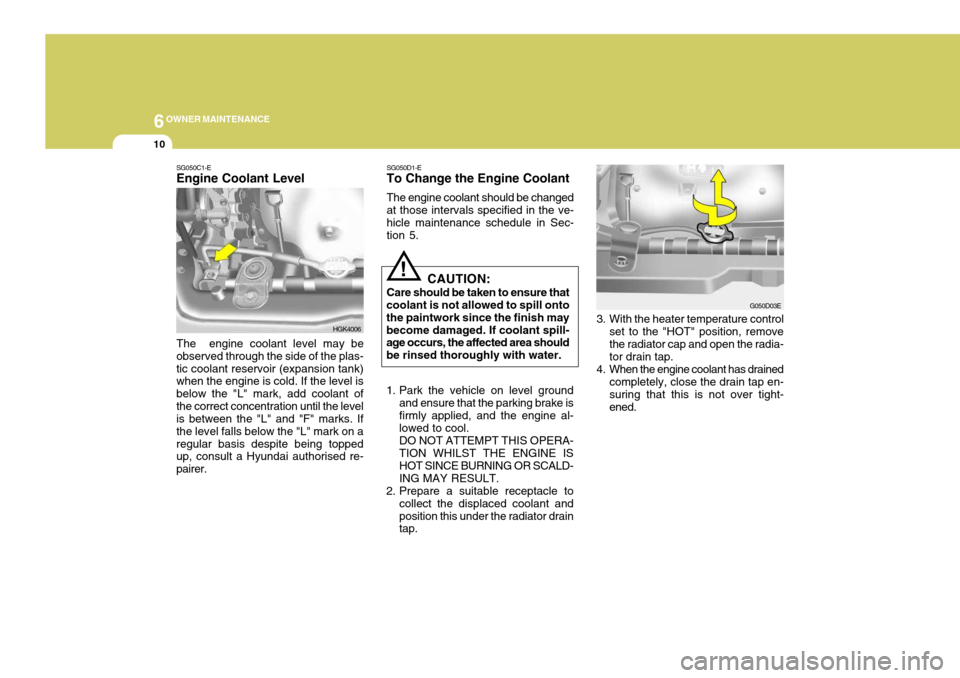
SG050C1-E Engine Coolant Level
The engine coolant level may be
observed through the side of the plas- tic coolant reservoir (expansion tank) when the engine is cold. If the level is below the "L" mark, add coolant ofthe correct concentration until the level is between the "L" and "F" marks. If the level falls below the "L" mark on aregular basis despite being topped up, consult a Hyundai authorised re- pairer. SG050D1-E To Change the Engine Coolant The engine coolant should be changed at those intervals specified in the ve- hicle maintenance schedule in Sec- tion 5.
3. With the heater temperature controlset to the "HOT" position, removethe radiator cap and open the radia- tor drain tap.
4. When the engine coolant has drained completely, close the drain tap en- suring that this is not over tight-ened. G050D03E
CAUTION:
Care should be taken to ensure that
coolant is not allowed to spill ontothe paintwork since the finish maybecome damaged. If coolant spill- age occurs, the affected area should be rinsed thoroughly with water.
!
1. Park the vehicle on level ground and ensure that the parking brake is firmly applied, and the engine al- lowed to cool. DO NOT ATTEMPT THIS OPERA- TION WHILST THE ENGINE IS HOT SINCE BURNING OR SCALD-ING MAY RESULT.
2. Prepare a suitable receptacle to
collect the displaced coolant andposition this under the radiator drain tap.
Page 464 of 487

6
OWNER MAINTENANCE
35
PROTECTED COMPONENTS
Generator(1.6L/2.0L) BCM BOX(Tail lamp relay,Power connector,Fuse(2,7,12,13,19,20,24))Condenser fan relayRadiator fan relayEngine control relay, Fuel pump relay, A/T control relay, Generator,ECM(1.6L/2.7L),PCM(2.0L) Ignition switch,Start relayABS/ESP control module,ESP Air bleeding connectorABS/ESP control module,ESP Air bleeding connectorBlower relayInjector Oxygen sensor,Camshaft position sensor, Idle speed control actuator DRL control moduleFront fog lamp relayTCM(2.7L),ECM(2.7L/1.6L)Horn relay,A/C relay Head lamp relay(High) Head lamp relay(Low)
FUSERATING 120A50A 30A30A 30A 30A 40A40A30A 15A 10A15A15A10A15A 15A 15A
DESCRIPTION
BATTBATT
COND RAD ECU
IGN
ABS 1 ABS 2
BLOWER INJ
SNSR DRL
F/FOG ECU
HORN,A/CON H/LP (HI)
H/LP (LO)
Page 466 of 487

6
OWNER MAINTENANCE
37
DESCRIPTION IG COIL
AMP
B/UP LAMP
A/BAG IND A/BAG
HTD MIR HAZARD
R/WIPER TAIL-RH
F/WIPER
RR DEFOG
STOP
TAIL-LH
A/CON ECU
CLUSTER
ROOM LP
P/WINDOW T/GATE
IGN
RR FOG
C/LIGHTS/ROOF
S/HTR ABS
AUDIO
PROTECTED COMPONENTS
Ignition coil(1.6L/2.7L), Electronic chrome mirror AMP Back-up lamp switch,Transaxle range switch,Cruise control module,Stop lamp switch Instrument cluster (A/BAG IND.) SRS control module Mirror defogger Hazard relay Rear wiper motor,Rear intermittent wiper relay Right tail lamps,Glove box lamp Front wiper motor,Front wiper relay Defogger relay Stop lamp switch,Burglar alarm horn relay,Folding/Unfolding relay Left tail lamps A/C control module, Blower relay ECM, Multi gauge unit, TCM, Vehicle speed sensor Instrument cluster (Power), Per-excitation resister, DRL Control module,Generator Room lamp,Clock,Audio,Data link connector,Multi gauge unit Power window relay Trunk lid switch AQS sensor,Head lamp relay,DRL Control module Rear fog lamp Cigarette lighter,Outside mirror switch Sunroof,Power door lock/Unlock relay Seat warmer ESP/ABS control module Audio,Digital clock
FUSERATING
20A 20A 10A 10A 15A 10A 10A 15A 10A 20A 30A 15A 10A 10A 10A 10A 10A 30A 15A 10A 10A 15A 15A 20A 10A 10A
Page 469 of 487
7
EMISSION CONTROL SYSTEMS
3CATALYTIC CONVERTOR
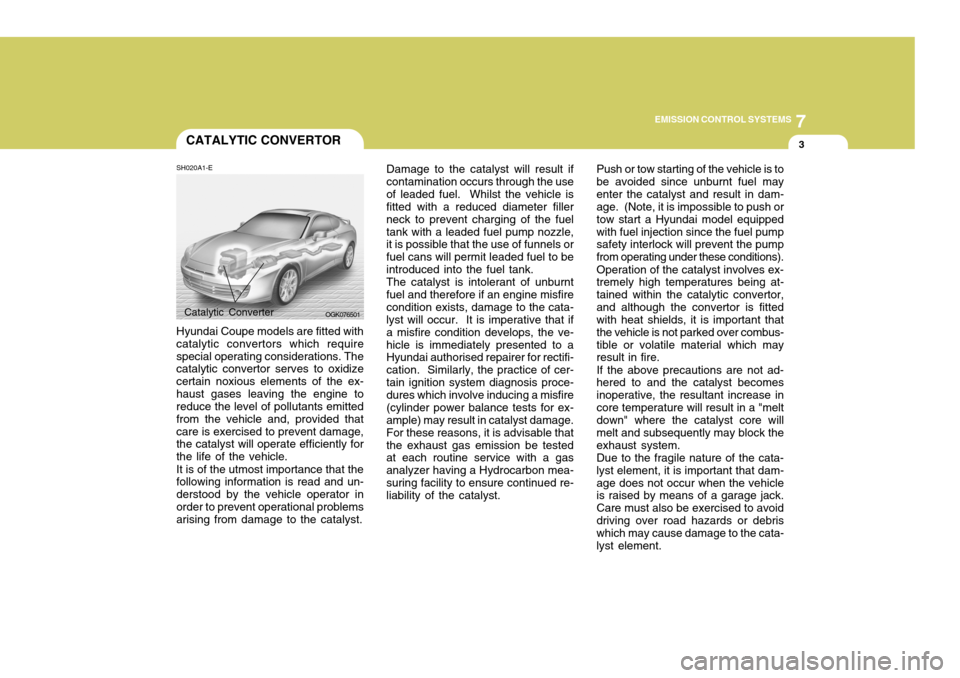
SH020A1-E Hyundai Coupe models are fitted with catalytic convertors which requirespecial operating considerations. The catalytic convertor serves to oxidize certain noxious elements of the ex-haust gases leaving the engine to reduce the level of pollutants emitted from the vehicle and, provided thatcare is exercised to prevent damage, the catalyst will operate efficiently for the life of the vehicle. It is of the utmost importance that the following information is read and un- derstood by the vehicle operator inorder to prevent operational problems arising from damage to the catalyst. Damage to the catalyst will result if contamination occurs through the useof leaded fuel. Whilst the vehicle is fitted with a reduced diameter filler neck to prevent charging of the fueltank with a leaded fuel pump nozzle, it is possible that the use of funnels or fuel cans will permit leaded fuel to beintroduced into the fuel tank.The catalyst is intolerant of unburntfuel and therefore if an engine misfirecondition exists, damage to the cata- lyst will occur. It is imperative that if a misfire condition develops, the ve-hicle is immediately presented to a Hyundai authorised repairer for rectifi- cation. Similarly, the practice of cer-tain ignition system diagnosis proce- dures which involve inducing a misfire (cylinder power balance tests for ex-ample) may result in catalyst damage.For these reasons, it is advisable thatthe exhaust gas emission be tested at each routine service with a gas analyzer having a Hydrocarbon mea-suring facility to ensure continued re- liability of the catalyst.
Catalytic Converter
OGK076501 Push or tow starting of the vehicle is to be avoided since unburnt fuel mayenter the catalyst and result in dam- age. (Note, it is impossible to push or tow start a Hyundai model equippedwith fuel injection since the fuel pump safety interlock will prevent the pump from operating under these conditions). Operation of the catalyst involves ex- tremely high temperatures being at- tained within the catalytic convertor,and although the convertor is fitted with heat shields, it is important that the vehicle is not parked over combus-tible or volatile material which may result in fire. If the above precautions are not ad- hered to and the catalyst becomes inoperative, the resultant increase incore temperature will result in a "melt down" where the catalyst core will melt and subsequently may block theexhaust system.Due to the fragile nature of the cata-lyst element, it is important that dam-age does not occur when the vehicle is raised by means of a garage jack. Care must also be exercised to avoiddriving over road hazards or debris which may cause damage to the cata- lyst element.
Page 472 of 487
8
CONSUMER INFORMATION
3
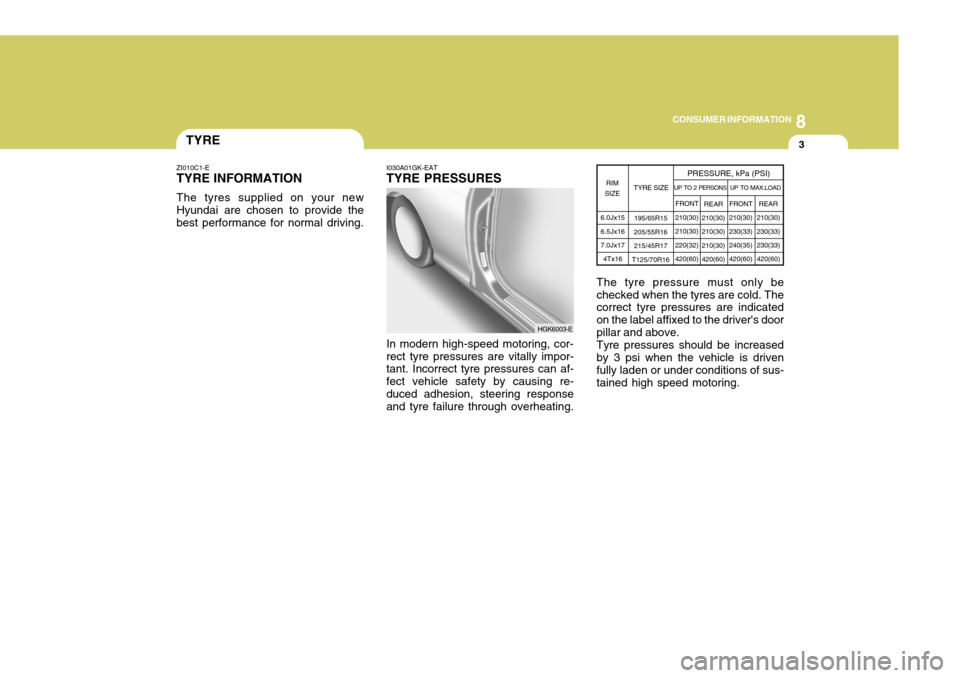
I030A01GK-EAT TYRE PRESSURES In modern high-speed motoring, cor- rect tyre pressures are vitally impor- tant. Incorrect tyre pressures can af- fect vehicle safety by causing re-duced adhesion, steering response and tyre failure through overheating. The tyre pressure must only be checked when the tyres are cold. The correct tyre pressures are indicated on the label affixed to the driver's doorpillar and above.Tyre pressures should be increasedby 3 psi when the vehicle is drivenfully laden or under conditions of sus- tained high speed motoring.
HGK6003-E
TYRE
ZI010C1-E TYRE INFORMATION The tyres supplied on your new Hyundai are chosen to provide the best performance for normal driving. 6.0Jx15 6.5Jx16 7.0Jx17
4Tx16 TYRE SIZE
RIM
SIZE PRESSURE, kPa (PSI)
REAR
210(30) 210(30)210(30)420(60) FRONT
210(30)230(33) 240(35) 420(60)
UP TO 2 PERSONS UP TO M
AX.LOAD
REAR
210(30)230(33) 230(33) 420(60)
FRONT
210(30)210(30)220(32) 420(60)
195/65R15 205/55R16215/45R17
T125/70R16
Page 482 of 487

10INDEX
2
A Airbag ......................................................................... 1-32
Air Cleaner Filter ......................................................... 6-11
Air Conditioning
Care ......................................................................... 6-18
Operation ....................................................... 1-90, 6-18
Switch ...................................................................... 1-89
Antenna ...................................................................... 1-99
Ashtray ....................................................................... 1-61
Audio Remote Control Switch ..................................... 1-81
B Battery ........................................................................ 6-21
Bonnet Release .......................................................... 1-71
Brake Anti-lock system ...................................................... 2-14
Checking the brakes ................................................ 6-16
Effective braking ...................................................... 2-16
Fluid ......................................................................... 6-16
C
Care of Cassette Tapes ........................................... 1-104
Care of D iscs ........................................................... 1-103
Catalytic Converter ...................................................... 7-3
Child Restraint System ............................................... 1-23
Cigar Lighter ............................................................... 1-61
Climate Control Air Filter .................................. 1-99, 6-18
Clock .......................................................................... 1-60
Clutch Checking fluid .......................................................... 6-17Combination Light
Auto light ................................................................. 1-54
High-beam switch .................................................... 1-53
Headlight flasher ...................................................... 1-54
Lighting switch ......................................................... 1-53
Lane change si gnal .................................................. 1-52
Turn signal operation ............................................... 1-52
Cooling Fans ............................................................... 6-23
Corrosion Protection Cleaning the interior .................................................. 4-5
Protecting your Hyundai from corrosion ................... 4-2
Valeting ..................................................................... 4-3
Cruise Control ............................................................. 1-77
DDaily Operating Checks ............................................... 6-5
Defrosting/Defogging ................................................... 1-88
Door Central door lock ...................................................... 1-7
Door locks ................................................................ 1-6
Locking and unlocking front doors with a key .......... 1-6
Drink Holder ................................................................ 1-62
Driving
Economical driving .................................................. 2-17
Smooth corneri ng ..................................................... 2-18
Winter motoring ....................................................... 2-19
EElectronic Stability Program (ESP) ............................2-15
Emission Control Systems .......................................... 7-2