manual Hyundai Coupe 2007 Repair Manual
[x] Cancel search | Manufacturer: HYUNDAI, Model Year: 2007, Model line: Coupe, Model: Hyundai Coupe 2007Pages: 487, PDF Size: 12.96 MB
Page 351 of 487
1
FEATURES OF YOUR HYUNDAI
83HEATING AND VENTILATION
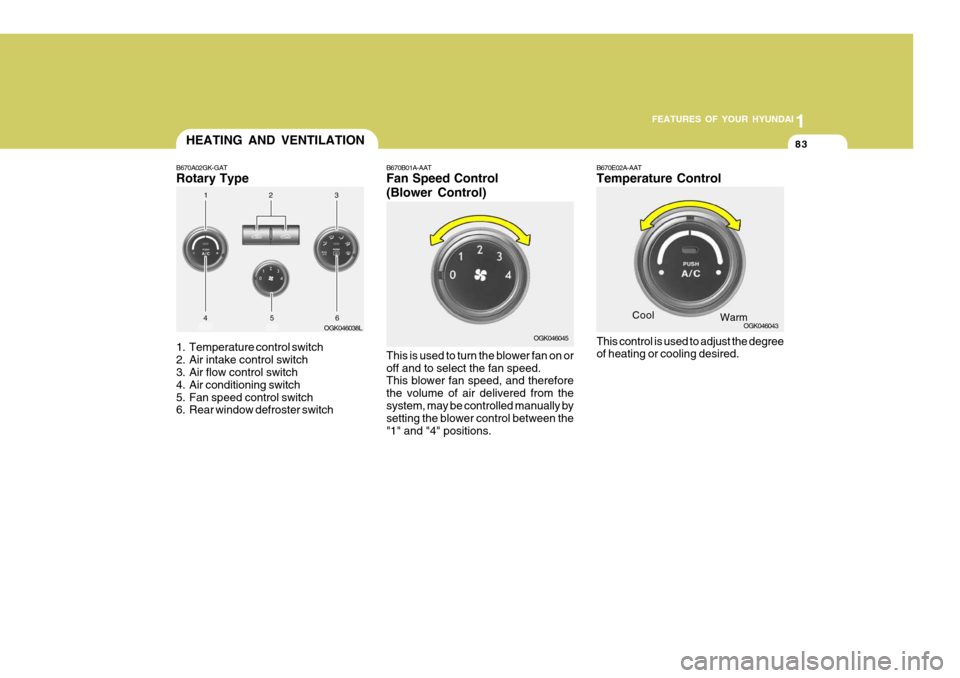
B670A02GK-GAT Rotary Type
1. Temperature control switch
2. Air intake control switch
3. Air flow control switch
4. Air conditioning switch
5. Fan speed control switch
6. Rear window defroster switch B670B01A-AAT Fan Speed Control (Blower Control) This is used to turn the blower fan on or off and to select the fan speed. This blower fan speed, and therefore the volume of air delivered from thesystem, may be controlled manually by setting the blower control between the "1" and "4" positions.B670E02A-AAT Temperature Control This control is used to adjust the degree of heating or cooling desired.
Cool
OGK046038L OGK046045 OGK046043
Warm
Page 362 of 487
1FEATURES OF YOUR HYUNDAI
94
B980A01Y-AAT MANUAL OPERATION The heating and cooling system can be controlled manually as well by pushingbuttons other than the "AUTO" button. In this state, the system sequentially works according to the order of buttonsselected. The function of the buttons which are not selected will be controlled automati-cally. Press the "AUTO" button in order to convert to automatic control of the sys-tem.
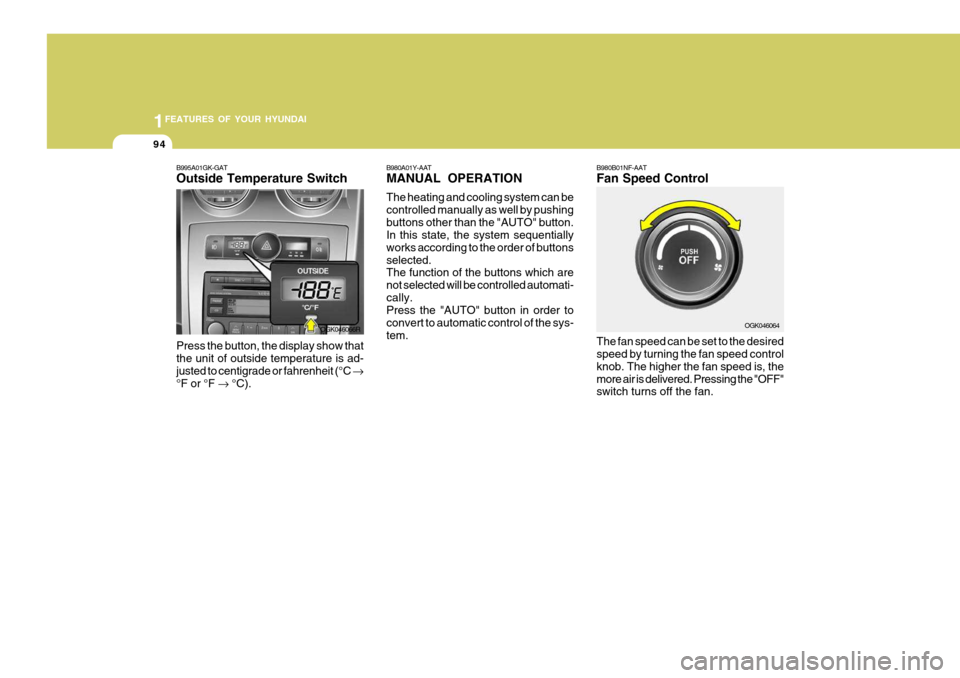
B995A01GK-GAT Outside Temperature Switch Press the button, the display show that the unit of outside temperature is ad- justed to centigrade or fahrenheit (°C
°F or °F °C). OGK046066RB980B01NF-AAT Fan Speed Control The fan speed can be set to the desired speed by turning the fan speed control knob. The higher the fan speed is, themore air is delivered. Pressing the "OFF" switch turns off the fan. OGK046064
Page 374 of 487
2
Engine Exhaust Can Be Dangerous! ............................ 2-2
Before Starting the Engine ............................................ 2-3
Key Positions ................................................................ 2-4Starting ......................................................................... 2-5
Fuel Economy ............................................................... 2-6
Manual Transaxle ......................................................... 2-7
Automatic Transaxle ..................................................... 2-9Anti-Lock Brake System (ABS) ................................... 2-14
Electronic Stability Program (ESP) ..............................2-15
Effective Braking ......................................................... 2-16
Driving for Economy .................................................... 2-17
Smooth Cornering ........................................................ 2-18
Winter Motoring ............................................................ 2-19
Trailer or Vehicle Towing ............................................. 2-20
DRIVING YOUR HYUNDAI
2
Page 376 of 487
2
DRIVING YOUR HYUNDAI
3TO START THE ENGINEBEFORE STARTING THE ENGINE
SC030A2-E Before you start the engine, you should always:
1. Look around the vehicle to be sure
there are no flat tyres, puddles of oil or water or other indications of pos- sible trouble.
2. After entering the car, check to be sure the parking brake is engaged.
3. Check that all windows, and lights
are clean.
4. Check that the interior and exterior mirrors are clean and in position.
5. Check your seat, seatback and head restraint to be sure they are intheir proper positions.
6. Close all the doors.
7. Fasten your seat belt and be sure that all other occupants have fas-tened theirs.
8. Turn off all lights and accessories that are not needed.
9. When you turn the ignition switch to "ON" check that all appropriate warn- ing lights are operating and that you have sufficient fuel.
10.Check the operation of warning lights and all bulbs when key is inthe "ON" position.
!WARNING:
Always wear appropriate shoes when operating your vehicle.Unsuitable shoes (high heels, ski boots, etc.) may interfere with your ability to use the brake and accelera-tor pedal, and the clutch (Not all models). C030A01A-EAT COMBINATION IGNITION SWITCH AND STEERING LOCK
o If your Hyundai is equipped with a
manual transaxle, place the gear- shift lever in neutral and depress the clutch pedal fully.
o If your Hyundai has an automatic
transaxle, place the selector lever in"P" (park).
o To start the engine, insert the ignition key and turn it to the "START" posi-tion. Release it as soon as the en- gine starts. Do not hold the key in the"START" position for more than 15 seconds.
NOTE: For safety, the engine will not start if the shift lever is not in "P" or "N" position (Automatic Transaxle).
Page 378 of 487
2
DRIVING YOUR HYUNDAI
5
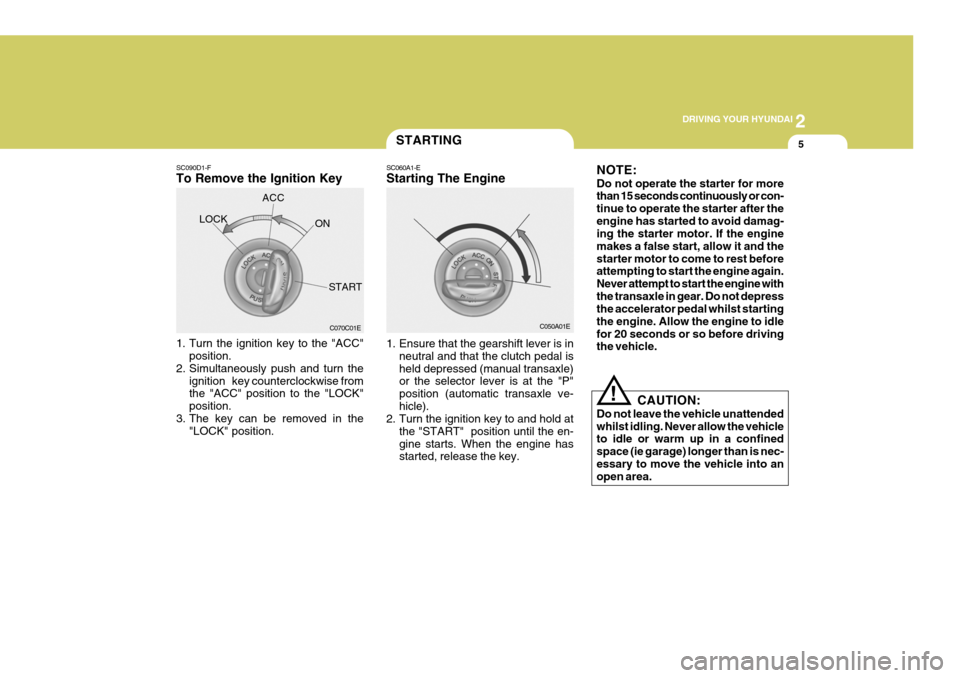
SC090D1-F To Remove the Ignition Key
1. Turn the ignition key to the "ACC"
position.
2. Simultaneously push and turn the
ignition key counterclockwise from the "ACC" position to the "LOCK" position.
3. The key can be removed in the "LOCK" position.LOCK
C070C01E
ACC
ON
START
STARTING
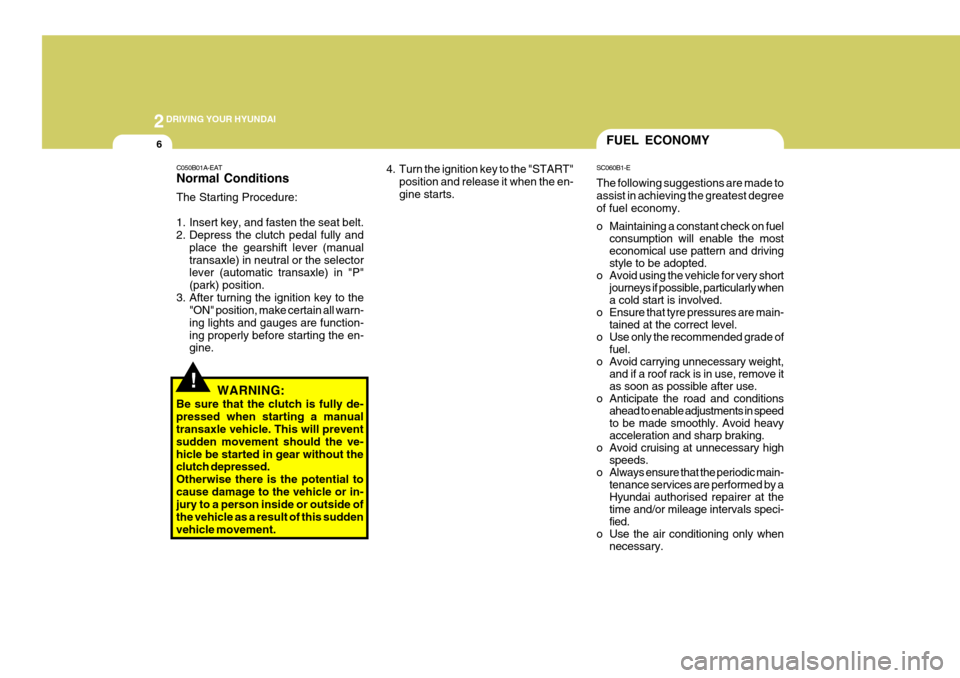
SC060A1-E Starting The Engine
1. Ensure that the gearshift lever is in neutral and that the clutch pedal is held depressed (manual transaxle) or the selector lever is at the "P" position (automatic transaxle ve-hicle).
2. Turn the ignition key to and hold at
the "START" position until the en-gine starts. When the engine has started, release the key. NOTE: Do not operate the starter for more than 15 seconds continuously or con- tinue to operate the starter after theengine has started to avoid damag- ing the starter motor. If the engine makes a false start, allow it and thestarter motor to come to rest before attempting to start the engine again. Never attempt to start the engine withthe transaxle in gear. Do not depress the accelerator pedal whilst starting the engine. Allow the engine to idlefor 20 seconds or so before driving the vehicle.
CAUTION:
Do not leave the vehicle unattended whilst idling. Never allow the vehicle to idle or warm up in a confined space (ie garage) longer than is nec-essary to move the vehicle into an open area.
!
C050A01E
Page 379 of 487
2DRIVING YOUR HYUNDAI
6FUEL ECONOMY
4. Turn the ignition key to the "START" position and release it when the en- gine starts. SC060B1-E The following suggestions are made to assist in achieving the greatest degree of fuel economy.
o Maintaining a constant check on fuel
consumption will enable the most economical use pattern and drivingstyle to be adopted.
o Avoid using the vehicle for very short journeys if possible, particularly whena cold start is involved.
o Ensure that tyre pressures are main- tained at the correct level.
o Use only the recommended grade of
fuel.
o Avoid carrying unnecessary weight, and if a roof rack is in use, remove itas soon as possible after use.
o Anticipate the road and conditions ahead to enable adjustments in speedto be made smoothly. Avoid heavyacceleration and sharp braking.
o Avoid cruising at unnecessary high speeds.
o Always ensure that the periodic main- tenance services are performed by aHyundai authorised repairer at the
time and/or mileage intervals speci-fied.
o Use the air conditioning only when necessary.
!
C050B01A-EAT Normal Conditions The Starting Procedure:
1. Insert key, and fasten the seat belt.
2. Depress the clutch pedal fully and
place the gearshift lever (manual transaxle) in neutral or the selector lever (automatic transaxle) in "P" (park) position.
3. After turning the ignition key to the "ON" position, make certain all warn-ing lights and gauges are function-ing properly before starting the en- gine.
WARNING:
Be sure that the clutch is fully de- pressed when starting a manual transaxle vehicle. This will prevent sudden movement should the ve-hicle be started in gear without the clutch depressed. Otherwise there is the potential tocause damage to the vehicle or in- jury to a person inside or outside of the vehicle as a result of this suddenvehicle movement.
Page 380 of 487
2
DRIVING YOUR HYUNDAI
7
!
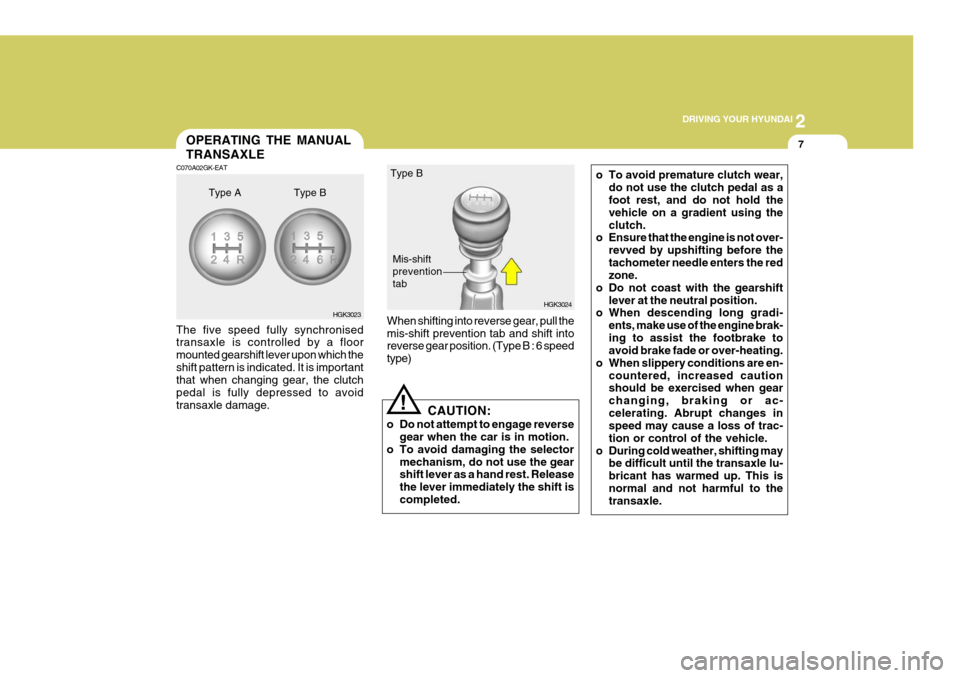
When shifting into reverse gear, pull the mis-shift prevention tab and shift into reverse gear position. (Type B : 6 speed type) HGK3024
Type B
Mis-shift preventiontab
OPERATING THE MANUAL TRANSAXLE
C070A02GK-EAT The five speed fully synchronised transaxle is controlled by a floor mounted gearshift lever upon which theshift pattern is indicated. It is important that when changing gear, the clutch pedal is fully depressed to avoidtransaxle damage. HGK3023
Type A Type B
CAUTION:
o Do not attempt to engage reverse gear when the car is in motion.
o To avoid damaging the selector mechanism, do not use the gear shift lever as a hand rest. Release the lever immediately the shift iscompleted. o To avoid premature clutch wear,
do not use the clutch pedal as a foot rest, and do not hold the vehicle on a gradient using theclutch.
o Ensure that the engine is not over-
revved by upshifting before thetachometer needle enters the red zone.
o Do not coast with the gearshift
lever at the neutral position.
o When descending long gradi-
ents, make use of the engine brak- ing to assist the footbrake to avoid brake fade or over-heating.
o When slippery conditions are en- countered, increased cautionshould be exercised when gear changing, braking or ac-celerating. Abrupt changes in speed may cause a loss of trac- tion or control of the vehicle.
o During cold weather, shifting may be difficult until the transaxle lu-bricant has warmed up. This isnormal and not harmful to the transaxle.
Page 382 of 487
2
DRIVING YOUR HYUNDAI
9
C090A03Y-EAT OPERATING THE AUTOMATIC TRANSAXLE
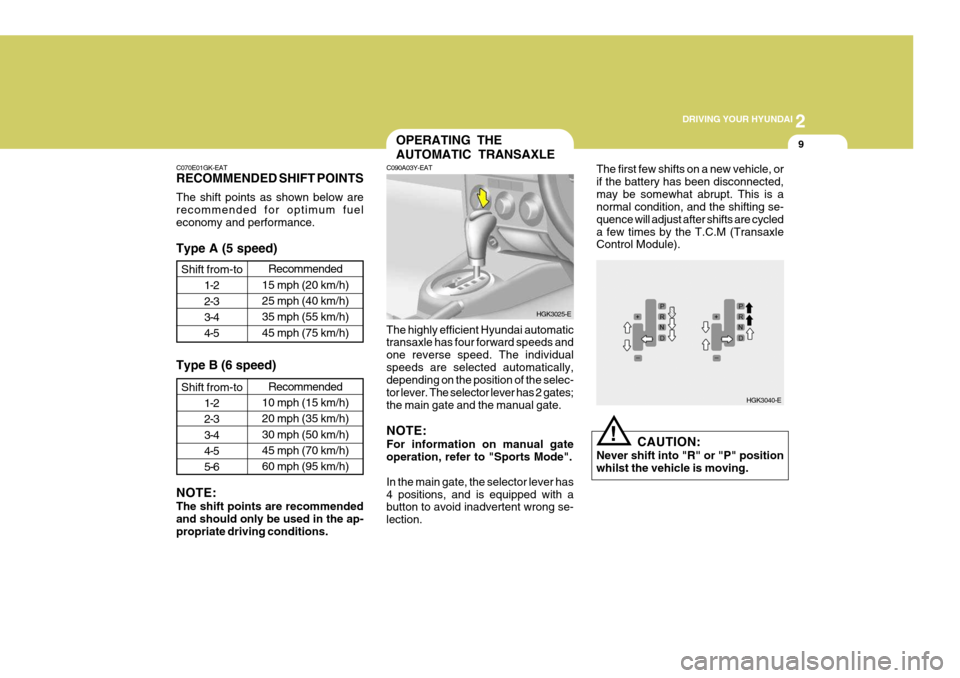
The highly efficient Hyundai automatic transaxle has four forward speeds and one reverse speed. The individualspeeds are selected automatically, depending on the position of the selec- tor lever. The selector lever has 2 gates;the main gate and the manual gate. NOTE: For information on manual gate operation, refer to "Sports Mode". In the main gate, the selector lever has 4 positions, and is equipped with a button to avoid inadvertent wrong se- lection. HGK3025-E
C070E01GK-EAT RECOMMENDED SHIFT POINTS The shift points as shown below are recommended for optimum fueleconomy and performance. Type A (5 speed)
Shift from-to 1-2 2-33-4 4-5 Recommended
15 mph (20 km/h)25 mph (40 km/h) 35 mph (55 km/h)45 mph (75 km/h)
Type B (6 speed)
Shift from-to 1-2 2-33-4 4-5 5-6 Recommended
10 mph (15 km/h)20 mph (35 km/h)30 mph (50 km/h) 45 mph (70 km/h) 60 mph (95 km/h)
NOTE: The shift points are recommended and should only be used in the ap- propriate driving conditions.
HGK3040-E
!
The first few shifts on a new vehicle, or if the battery has been disconnected,may be somewhat abrupt. This is a normal condition, and the shifting se- quence will adjust after shifts are cycleda few times by the T.C.M (Transaxle Control Module).
CAUTION:
Never shift into "R" or "P" positionwhilst the vehicle is moving.
Page 384 of 487
2
DRIVING YOUR HYUNDAI
11
!
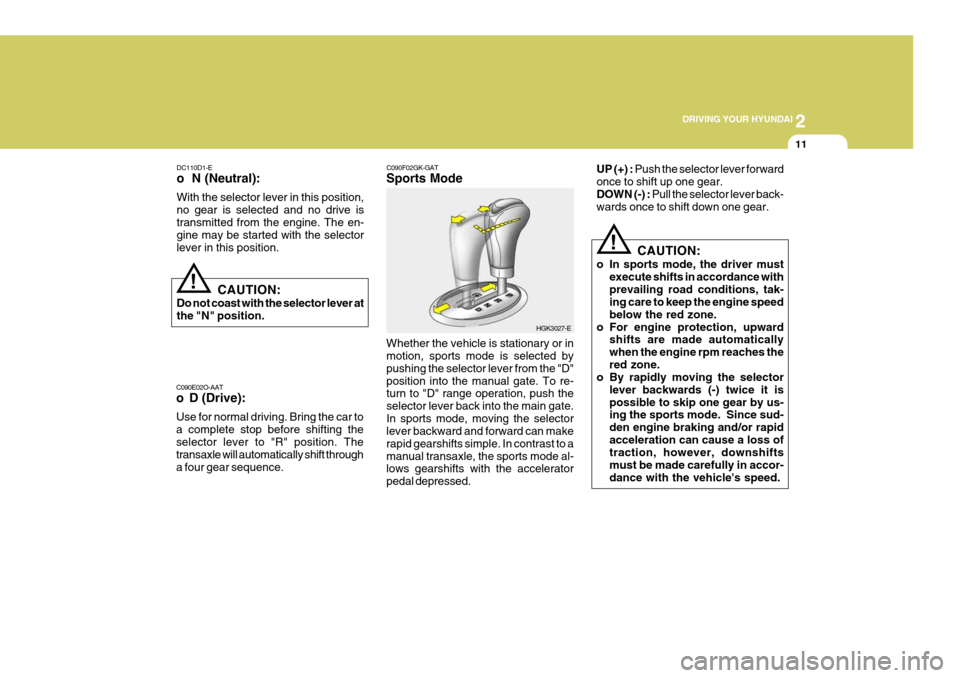
UP (+) :
Push the selector lever forward
once to shift up one gear. DOWN (-) : Pull the selector lever back-
wards once to shift down one gear.
CAUTION:
o In sports mode, the driver must execute shifts in accordance withprevailing road conditions, tak- ing care to keep the engine speed below the red zone.
o For engine protection, upward shifts are made automaticallywhen the engine rpm reaches thered zone.
o By rapidly moving the selector
lever backwards (-) twice it ispossible to skip one gear by us- ing the sports mode. Since sud- den engine braking and/or rapidacceleration can cause a loss of traction, however, downshifts must be made carefully in accor-dance with the vehicle's speed.
C090E02O-AAT
o D (Drive): Use for normal driving. Bring the car to a complete stop before shifting theselector lever to "R" position. The transaxle will automatically shift through a four gear sequence. C090F02GK-GAT Sports Mode Whether the vehicle is stationary or in motion, sports mode is selected by pushing the selector lever from the "D"position into the manual gate. To re- turn to "D" range operation, push the selector lever back into the main gate.In sports mode, moving the selector lever backward and forward can make rapid gearshifts simple. In contrast to amanual transaxle, the sports mode al- lows gearshifts with the accelerator pedal depressed.
HGK3027-E
DC110D1-E o N (Neutral): With the selector lever in this position, no gear is selected and no drive istransmitted from the engine. The en- gine may be started with the selector lever in this position.
CAUTION:
Do not coast with the selector lever atthe "N" position.
!
Page 390 of 487

2
DRIVING YOUR HYUNDAI
17
o Apply the parking brake only when the vehicle is at rest.
o Since the power assistance provided by the brake servo is derived from the engine, coasting with the engineturned off or towing of the vehicle with the engine turned off will result in greatly increased pedal pressuresbeing required to stop the vehicle.
o Do not hold the vehicle on an incline
with the accelerator pedal. This cancause the transmission to overheat. Always use the brake pedal or park- ing brake.
o Use caution when parking on a hill. Engage the parking brake and placethe gear selector lever in "P" (auto-matic transaxle) or in first or reverse gear (manual transaxle). If your car is facing downhill, turn the frontwheels into the curb to help keep the car from rolling. If your car is facing uphill, turn the front wheels awayfrom the curb to help keep the car from rolling. If there is no curb or if it is required by other conditions tokeep the car from rolling, block the wheels.DRIVING FOR ECONOMY
C140A02A-EAT You can save fuel and get more miles from your car if you follow these sug- gestions:
o Drive smoothly. Accelerate at a moderate rate. Don't make "jack- rabbit" starts or full-throttle shiftsand maintain a steady cruising speed. Don't race between stoplights. Try to adjust your speed to that of the othertraffic so you don't have to change speeds unnecessarily. Avoid heavy traffic whenever possible. Alwaysmaintain a safe distance from other vehicles so you can avoid unneces- sary braking. This also reduces brakewear.
o Drive at a moderate speed. The faster
you drive, the more fuel your caruses. Driving at a moderate speed, especially on the motorway, is one of the most effective ways to reducefuel consumption.
o Don't "ride" the brake or clutch pedal.
This can increase fuel consumptionand also increase wear on these components. In addition, driving with your foot resting on the brake pedalmay cause the brakes to overheat, which reduces their effectivenessand may lead to more serious conse-quences.
o Take care of your tyres. Keep them
inflated to the recommended pres-sure. Incorrect inflation, either too much or too little, results in unneces- sary tyre wear. Check the tyre pres-sures at least once a month.
o Be sure that the wheels are aligned
correctly. Improper alignment canresult from hitting curbs or driving too fast over irregular surfaces. Poor alignment causes faster tyre wearand may also result in other prob- lems as well as greater fuel con- sumption.
o Keep your car in good condition. For better fuel economy and reducedmaintenance costs, maintain yourcar in accordance with the mainte- nance schedule in Section 5. If you drive your car in severe conditions,more frequent maintenance is re- quired (see Section 5 for details).