engine Hyundai Coupe 2007 Manual Online
[x] Cancel search | Manufacturer: HYUNDAI, Model Year: 2007, Model line: Coupe, Model: Hyundai Coupe 2007Pages: 487, PDF Size: 12.96 MB
Page 224 of 487
6 DO-IT-YOURSELF MAINTENANCE
26
OGK076068N
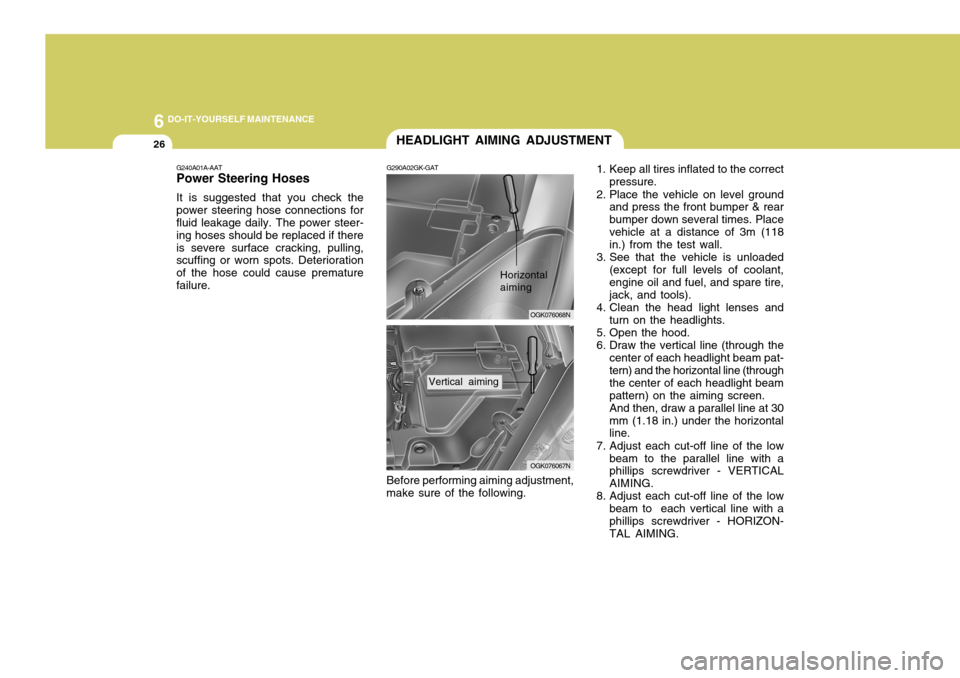
G240A01A-AAT Power Steering Hoses It is suggested that you check the power steering hose connections for fluid leakage daily. The power steer- ing hoses should be replaced if thereis severe surface cracking, pulling, scuffing or worn spots. Deterioration of the hose could cause prematurefailure. G290A02GK-GAT
HEADLIGHT AIMING ADJUSTMENT
1. Keep all tires inflated to the correctpressure.
2. Place the vehicle on level ground and press the front bumper & rearbumper down several times. Placevehicle at a distance of 3m (118 in.) from the test wall.
3. See that the vehicle is unloaded (except for full levels of coolant, engine oil and fuel, and spare tire,jack, and tools).
4. Clean the head light lenses and
turn on the headlights.
5. Open the hood.
6. Draw the vertical line (through the center of each headlight beam pat- tern) and the horizontal line (through the center of each headlight beampattern) on the aiming screen.And then, draw a parallel line at 30mm (1.18 in.) under the horizontal line.
7. Adjust each cut-off line of the low beam to the parallel line with aphillips screwdriver - VERTICAL AIMING.
8. Adjust each cut-off line of the low
beam to each vertical line with aphillips screwdriver - HORIZON- TAL AIMING.
Before performing aiming adjustment,
make sure of the following.
OGK076067N
Horizontal aiming
Vertical aiming
Page 226 of 487
6 DO-IT-YOURSELF MAINTENANCE
28
OGK076048
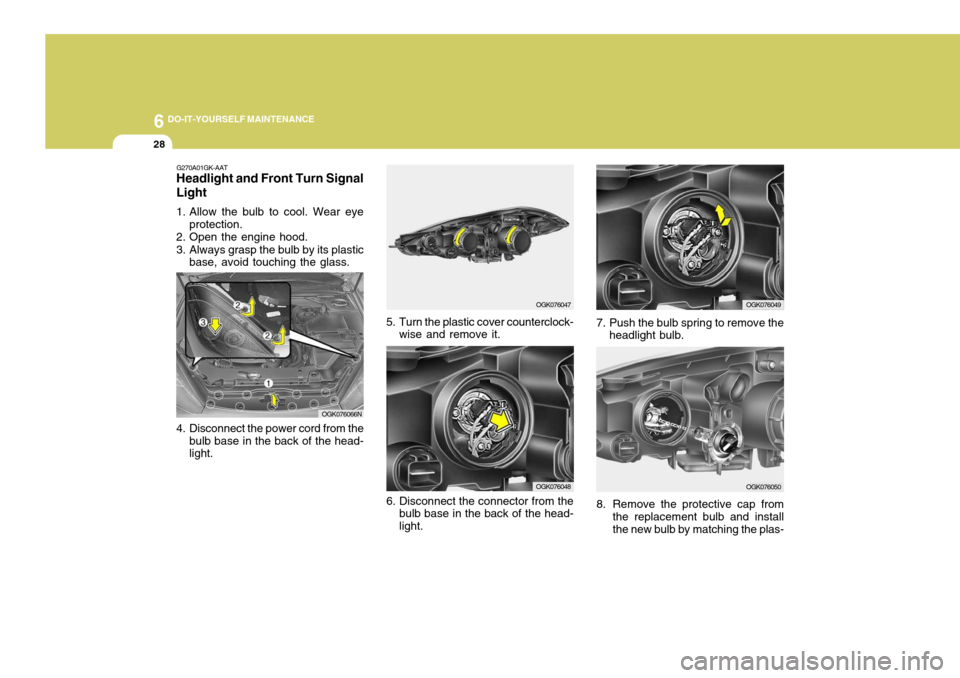
8. Remove the protective cap from
the replacement bulb and install the new bulb by matching the plas-
G270A01GK-AAT
Headlight and Front Turn Signal Light
1. Allow the bulb to cool. Wear eye
protection.
2. Open the engine hood.
3. Always grasp the bulb by its plastic base, avoid touching the glass.
OGK076047
5. Turn the plastic cover counterclock- wise and remove it.
4. Disconnect the power cord from the bulb base in the back of the head- light. OGK076066N
6. Disconnect the connector from thebulb base in the back of the head- light. 7. Push the bulb spring to remove the
headlight bulb.
OGK076050
OGK076049
Page 235 of 487
6
DO-IT-YOURSELF MAINTENANCE
37FUSE PANEL DESCRIPTION
G200C02GK-GAT
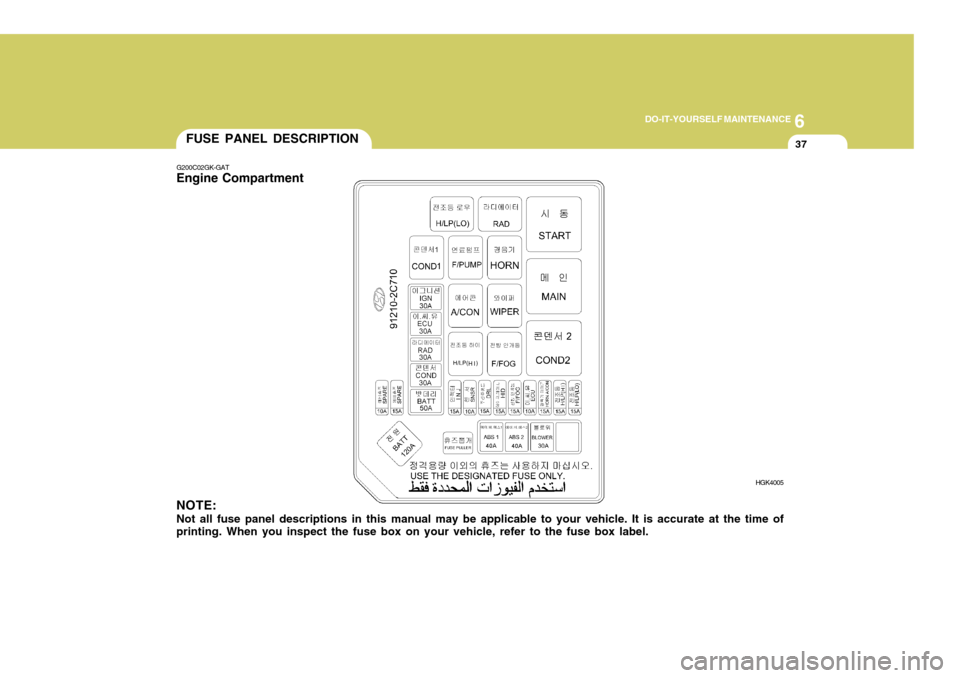
Engine Compartment NOTE: Not all fuse panel descriptions in this manual may be applicable to your vehicle. It is accurate at the time of printing. When you inspect the fuse box on your vehicle, refer to the fuse box label. HGK4005
Page 236 of 487

6 DO-IT-YOURSELF MAINTENANCE
38
PROTECTED COMPONENTS
Generator(1.6L/2.0L) BCM BOX(Tail lamp relay,Power connector,Fuse(2,7,12,13,19,20,24))Condenser fan relayRadiator fan relayEngine control relay, Fuel pump relay, A/T control relay, Generator,ECM(1.6L/2.7L),PCM(2.0L) Ignition switch,Start relayABS/ESP control module,ESP Air bleeding connectorABS/ESP control module,ESP Air bleeding connectorBlower relayInjector Oxygen sensor,Camshaft position sensor, Idle speed control actuator DRL control moduleFront fog lamp relayTCM(2.7L),ECM(2.7L/1.6L)Horn relay,A/C relay Head lamp relay(High) Head lamp relay(Low)
FUSERATING 120A50A 30A30A 30A 30A 40A40A30A 15A 10A15A15A10A15A 15A 15A
DESCRIPTION
BATTBATT
COND RAD ECU
IGN
ABS 1 ABS 2
BLOWER INJ
SNSR DRL
F/FOG ECU
HORN,A/CON H/LP (HI)
H/LP (LO)
Page 240 of 487
7EMISSION CONTROL SYSTEMS
2
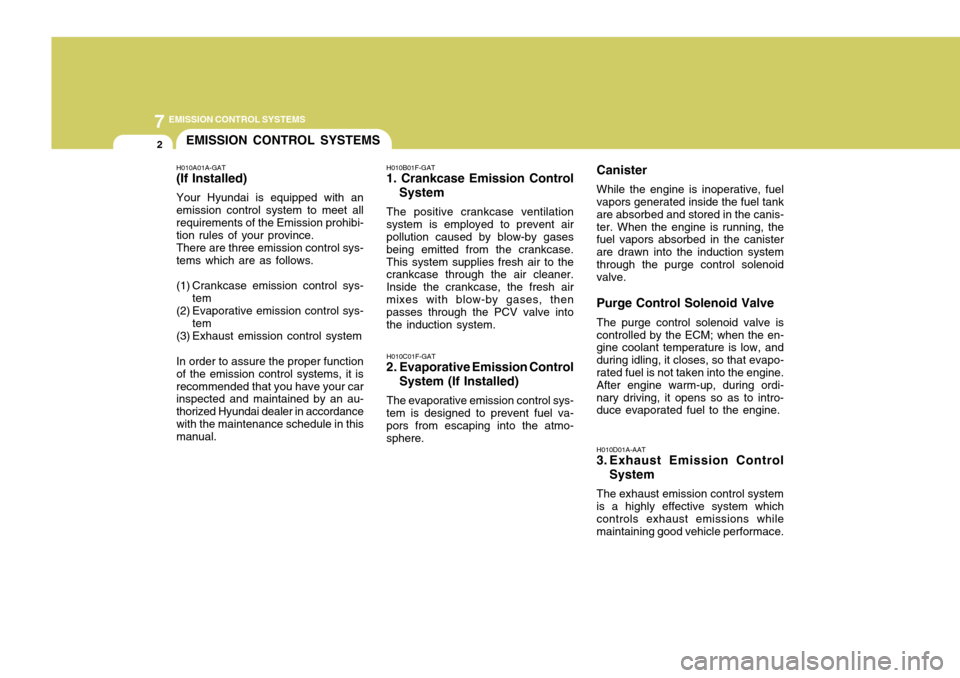
H010A01A-GAT (If Installed) Your Hyundai is equipped with an emission control system to meet all requirements of the Emission prohibi- tion rules of your province.There are three emission control sys-tems which are as follows.
(1) Crankcase emission control sys-
tem
(2) Evaporative emission control sys-
tem
(3) Exhaust emission control systemIn order to assure the proper function of the emission control systems, it isrecommended that you have your car inspected and maintained by an au- thorized Hyundai dealer in accordancewith the maintenance schedule in this manual. EMISSION CONTROL SYSTEMS
H010B01F-GAT 1. Crankcase Emission ControlSystem
The positive crankcase ventilation system is employed to prevent air pollution caused by blow-by gases being emitted from the crankcase.This system supplies fresh air to the crankcase through the air cleaner. Inside the crankcase, the fresh airmixes with blow-by gases, then passes through the PCV valve into the induction system.
H010C01F-GAT
2. Evaporative Emission Control
System (If Installed)
The evaporative emission control sys-
tem is designed to prevent fuel va-pors from escaping into the atmo-sphere. H010D01A-AAT
3. Exhaust Emission Control
System
The exhaust emission control system is a highly effective system which controls exhaust emissions while maintaining good vehicle performace.
Canister While the engine is inoperative, fuel vapors generated inside the fuel tank are absorbed and stored in the canis-ter. When the engine is running, the fuel vapors absorbed in the canister are drawn into the induction systemthrough the purge control solenoid valve. Purge Control Solenoid Valve The purge control solenoid valve is controlled by the ECM; when the en- gine coolant temperature is low, and during idling, it closes, so that evapo- rated fuel is not taken into the engine. After engine warm-up, during ordi-nary driving, it opens so as to intro- duce evaporated fuel to the engine.
Page 241 of 487
7
EMISSION CONTROL SYSTEMS
3
!
CATALYTIC CONVERTER
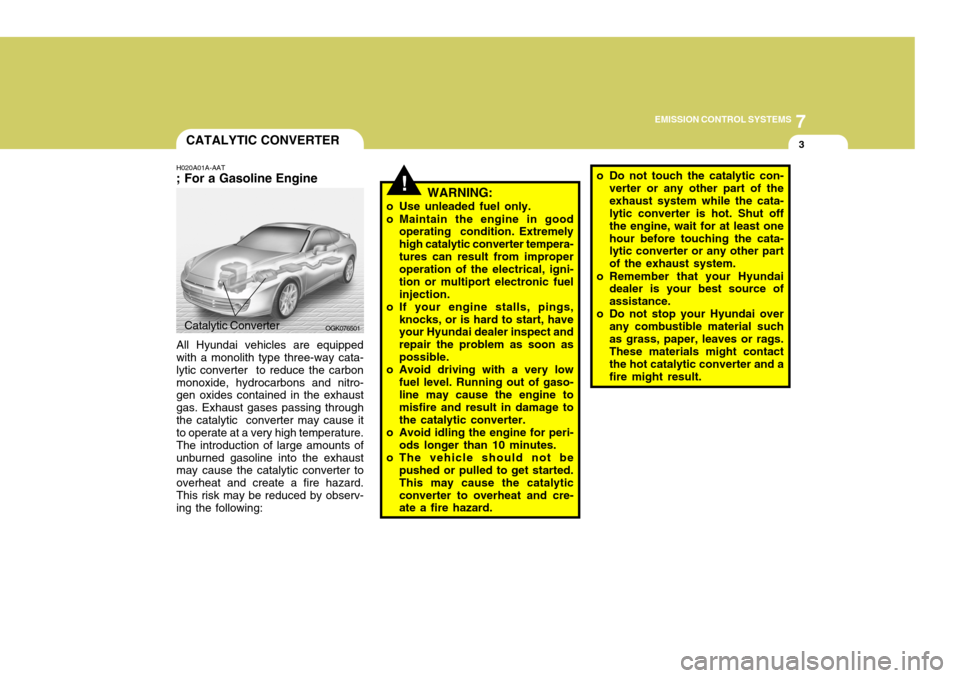
H020A01A-AAT ; For a Gasoline Engine All Hyundai vehicles are equipped with a monolith type three-way cata- lytic converter to reduce the carbonmonoxide, hydrocarbons and nitro- gen oxides contained in the exhaust gas. Exhaust gases passing throughthe catalytic converter may cause it to operate at a very high temperature. The introduction of large amounts ofunburned gasoline into the exhaust may cause the catalytic converter to overheat and create a fire hazard.This risk may be reduced by observ- ing the following: WARNING:
o Use unleaded fuel only.
o Maintain the engine in good operating condition. Extremely high catalytic converter tempera-tures can result from improper operation of the electrical, igni- tion or multiport electronic fuelinjection.
o If your engine stalls, pings, knocks, or is hard to start, have your Hyundai dealer inspect and repair the problem as soon aspossible.
o Avoid driving with a very low
fuel level. Running out of gaso-line may cause the engine to misfire and result in damage to the catalytic converter.
o Avoid idling the engine for peri-
ods longer than 10 minutes.
o The vehicle should not be pushed or pulled to get started.This may cause the catalyticconverter to overheat and cre- ate a fire hazard.
Catalytic Converter
OGK076501
o Do not touch the catalytic con-
verter or any other part of the exhaust system while the cata- lytic converter is hot. Shut off the engine, wait for at least onehour before touching the cata- lytic converter or any other part of the exhaust system.
o Remember that your Hyundai dealer is your best source ofassistance.
o Do not stop your Hyundai over any combustible material suchas grass, paper, leaves or rags. These materials might contact the hot catalytic converter and afire might result.
Page 242 of 487
Vehicle Identification Number (VIN) ............................ 8-2
Engine Number ............................................................ 8-2
Recommended Inflation Pressures ............................. 8-3
Snow Tires ................................................................... 8-4
Tire Chains ................................................................... 8-4
Tire Rotation ................................................................ 8-5
Tire Balancing .............................................................. 8-5
Tire Traction ................................................................. 8-5
When to Replace Tires ................................................ 8-6
Spare Tire and Tools ................................................... 8-6
8
CONSUMER INFORMATION
8
Page 243 of 487
8CONSUMER INFORMATION
2
F040A02TB-1
1.6LOGK086001
I010A01A-GAT
VEHICLE IDENTIFICATION NUMBER (VIN)
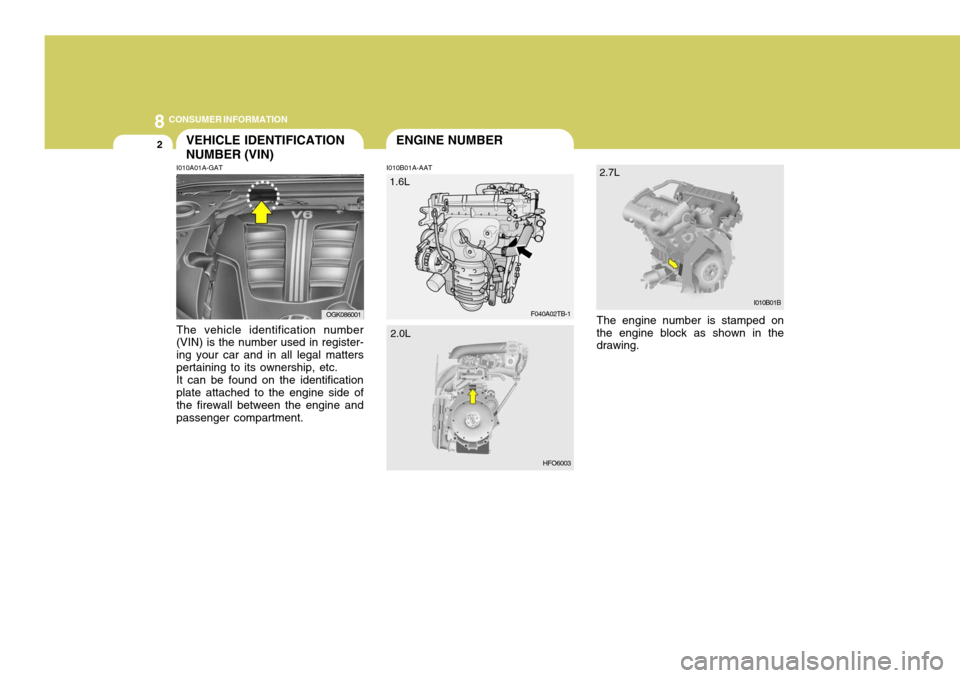
The vehicle identification number (VIN) is the number used in register- ing your car and in all legal matterspertaining to its ownership, etc.It can be found on the identificationplate attached to the engine side of the firewall between the engine and passenger compartment. I010B01A-AAT
ENGINE NUMBER
The engine number is stamped onthe engine block as shown in the drawing.I010B01B
2.7L
HFO6003
2.0L
Page 248 of 487
Measurement................................................................ 9-2
Engine ........................................................................... 9-3
Lubrication Chart .......................................................... 9-4
9
VEHICLE SPECIFICATIONS
9
Page 250 of 487

9
VEHICLE SPECIFICATIONS
3
SPECIFICATION 2.0 L
82 x 93.5 1,975
1 - 3 - 4 - 2
0.17 ~ 0.23 mm (0.0067 ~ 0.0091 in.) 0.25 ~ 0.31 mm (0.0098 ~ 0.0122 in.)
0.12 ~ 0.28 mm (0.0047 ~ 0.011 in.) 0.2 ~ 0.38 mm (0.0079 ~ 0.015 in.)
700 ± 100
BTDC 8° ± 5° 2.7 L
6-Cyl., V-type DOHC 86.7 x 75
2,656
1 - 2 - 3 - 4 - 5 - 6
AUTO LASH
750 ± 100
BTDC 12° ± 10°
4-Cyl., In-line DOHC
1.6 L
76.5 x 87 1,599
1 - 3 - 4 - 2
AUTO LASH
700 ± 100
BTDC 5° ± 5°
ITEMS
Engine TypeBore x Stroke (mm) Displacement (cc) Firing order Valve clearance (Cold Engine 20 ± 5°C) Idle speed (rpm) Ignition timing (Base)ENGINE
J070A05GK-GAT
For adjustingFor checking Intake ExhaustIntake Exhaust