light Hyundai Coupe 2008 Owners Manual
[x] Cancel search | Manufacturer: HYUNDAI, Model Year: 2008, Model line: Coupe, Model: Hyundai Coupe 2008Pages: 407, PDF Size: 11.03 MB
Page 310 of 407

2
DRIVING YOUR HYUNDAI
17
o Apply the parking brake only when the vehicle is at rest.
o Since the power assistance provided by the brake servo is derived from the engine, coasting with the engineturned off or towing of the vehicle with the engine turned off will result in greatly increased pedal pressuresbeing required to stop the vehicle.
o Do not hold the vehicle on an incline
with the accelerator pedal. This cancause the transmission to overheat. Always use the brake pedal or park- ing brake.
o Use caution when parking on a hill. Engage the parking brake and placethe gear selector lever in "P" (auto-matic transaxle) or in first or reverse gear (manual transaxle). If your car is facing downhill, turn the frontwheels into the curb to help keep the car from rolling. If your car is facing uphill, turn the front wheels awayfrom the curb to help keep the car from rolling. If there is no curb or if it is required by other conditions tokeep the car from rolling, block the wheels.DRIVING FOR ECONOMY
C140A02A-EAT You can save fuel and get more miles from your car if you follow these sug- gestions:
o Drive smoothly. Accelerate at a moderate rate. Don't make "jack- rabbit" starts or full-throttle shiftsand maintain a steady cruising speed. Don't race between stoplights. Try to adjust your speed to that of the othertraffic so you don't have to change speeds unnecessarily. Avoid heavy traffic whenever possible. Alwaysmaintain a safe distance from other vehicles so you can avoid unneces- sary braking. This also reduces brakewear.
o Drive at a moderate speed. The faster
you drive, the more fuel your caruses. Driving at a moderate speed, especially on the motorway, is one of the most effective ways to reducefuel consumption.
o Don't "ride" the brake or clutch pedal.
This can increase fuel consumptionand also increase wear on these components. In addition, driving with your foot resting on the brake pedalmay cause the brakes to overheat, which reduces their effectivenessand may lead to more serious conse-quences.
o Take care of your tyres. Keep them
inflated to the recommended pres-sure. Incorrect inflation, either too much or too little, results in unneces- sary tyre wear. Check the tyre pres-sures at least once a month.
o Be sure that the wheels are aligned
correctly. Improper alignment canresult from hitting curbs or driving too fast over irregular surfaces. Poor alignment causes faster tyre wearand may also result in other prob- lems as well as greater fuel con- sumption.
o Keep your car in good condition. For better fuel economy and reducedmaintenance costs, maintain yourcar in accordance with the mainte- nance schedule in Section 5. If you drive your car in severe conditions,more frequent maintenance is re- quired (see Section 5 for details).
Page 311 of 407

2DRIVING YOUR HYUNDAI
18
o Keep your car clean. For maximumservice, your Hyundai should be kept clean and free of corrosive materi- als. It is especially important that mud, dirt, ice, etc. not be allowed toaccumulate on the underside of the car. This extra weight can result in increased fuel consumption and alsocontribute to corrosion.
o Travel lightly. Don't carry unneces-
sary weight in your car. Weight re-duces fuel economy.
o Don't let the engine idle longer than
necessary. If you are waiting (andnot in traffic), turn off your engine and restart only when you're ready to go.
o Remember, your Hyundai does not require extended warm-up. After theengine has started, allow the engine to run for 10 to 20 seconds prior toplacing the vehicle in gear. In very cold weather, however, give your engine a slightly longer warm-up pe-riod. o Don't "labour" or "over-rev" the en-
gine. Labouring is driving too slowlyin too high a gear resulting in the vehicle kangarooing. If this happens, shift to a lower gear. Over-revving isracing the engine beyond its safe limit. This can be avoided by shifting at the recommended speeds.
o Use your air conditioning sparingly. The air conditioning system is oper-ated by engine power so your fueleconomy is reduced when you use it.SMOOTH CORNERING
C150A01A-EAT Avoid braking or gear changing in cor- ners, especially when roads are wet. Ideally, corners should always be taken under gentle acceleration. If you followthese suggestions, tyre wear will be held to a minimum.
Page 317 of 407

2DRIVING YOUR HYUNDAI
24
13. Avoid holding the brake pedal downtoo long or too frequently. This could cause the brakes to overheat, re- sulting in reduced braking efficiency.
14. When going down a hill, shift into a
lower gear and use the engine brak-ing effect. When climbing a long grade, down-shift the transaxle to a lower gear and reduce speed to reduce chances of engine overloading and/or over-heating.
15. If you have to stop whilst going
uphill, do not hold the vehicle inplace by pressing on the accelera- tor. This can cause the automatic transaxle to overheat. Use the park-ing brake or footbrake.
NOTE: When towing, check transaxle fluid more frequently.
8. When parking your car and trailer,
especially on a hill, be sure to followall the normal precautions. Turn your front wheels into the curb, set the parking brake firmly, and put thetransaxle in 1st or Reverse (manual) or Park (automatic). In addition we advise the use of wheel chocks ateach of the trailer's tyres.
9. If the trailer has electric brakes, start
your vehicle and trailer moving, andthen apply the trailer brake controller by hand to be sure the brakes are working. This lets you check yourelectrical connection at the same time.
10. During your trip, check occasionally to be sure that the load is secure,and that the lights and any trailer brakes are still working.
11. Avoid jerky starts, sudden accel- eration or sudden stops.
12. Avoid sharp turns and rapid lane changes.
YC200E3-E Trailer or Vehicle Towing Tips
1. Before towing, check towbar ball and
safety cable connections as well as proper operation of the trailer running lights, brake lights, and turn signals.
2. Always drive your vehicle at a mod-
erate speed (Less than 60 mph).
3. Trailer towing requires more fuel than
normal conditions.
4. To maintain engine braking effi- ciency, do not tow a trailer with the transaxle in fifth gear (manual transaxle) or overdrive (automatic transaxle).
5. Always secure items in the trailer to prevent load shift whilst driving.
6. Check the condition and air pressure of all tyres on the trailer and your car. Low tyre pressure can seriously af- fect the handling. Also check thespare tyre.
7. The vehicle/trailer combination is
more affected by crosswind and buf-feting. When being passed by a large vehicle, keep a constant speed and steer straight ahead. If there is toomuch wind buffeting, slow down to get out of the other vehicle's air turbulence.
Page 320 of 407
3 IN CASE OF EMERGENCY
2IF THE ENGINE WILL NOT START
!
SD020A1-E Seek assistance from the nearest Hyundai authorised repairer with regard to the method of ignition and fuel sys- tem diagnosis.
WARNING:
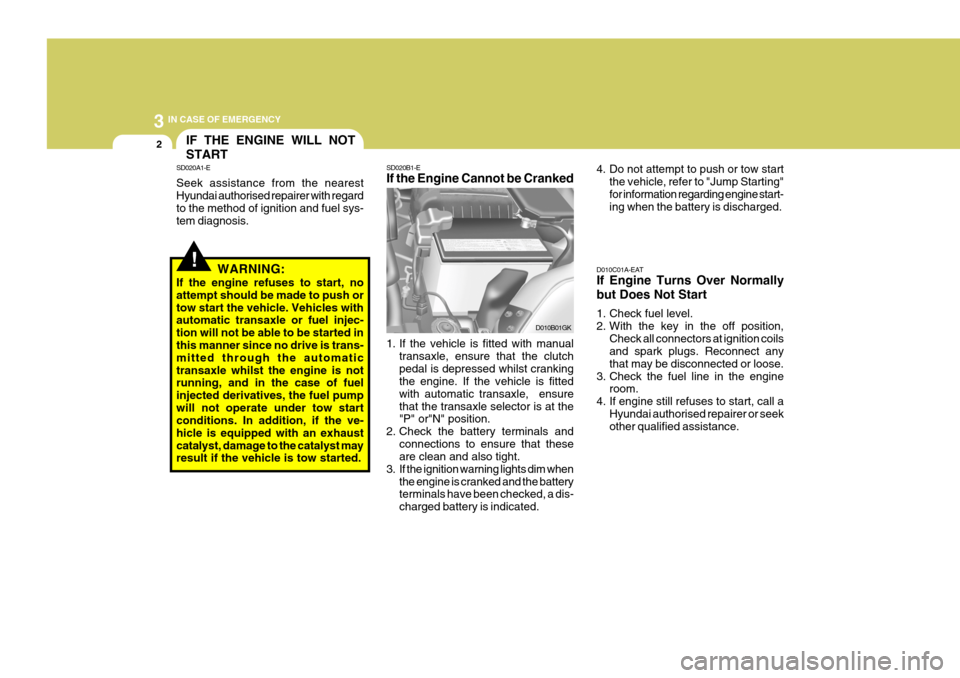
If the engine refuses to start, noattempt should be made to push ortow start the vehicle. Vehicles with automatic transaxle or fuel injec- tion will not be able to be started in this manner since no drive is trans- mitted through the automatictransaxle whilst the engine is not running, and in the case of fuel injected derivatives, the fuel pumpwill not operate under tow start conditions. In addition, if the ve- hicle is equipped with an exhaustcatalyst, damage to the catalyst may result if the vehicle is tow started. SD020B1-E If the Engine Cannot be Cranked
D010C01A-EATIf Engine Turns Over Normally but Does Not Start
1. Check fuel level.
2. With the key in the off position,Check all connectors at ignition coils and spark plugs. Reconnect any that may be disconnected or loose.
3. Check the fuel line in the engine room.
4. If engine still refuses to start, call a Hyundai authorised repairer or seek other qualified assistance.
1. If the vehicle is fitted with manual
transaxle, ensure that the clutch pedal is depressed whilst cranking the engine. If the vehicle is fitted with automatic transaxle, ensurethat the transaxle selector is at the "P" or"N" position.
2. Check the battery terminals and connections to ensure that theseare clean and also tight.
3. If the ignition warning lights dim when the engine is cranked and the batteryterminals have been checked, a dis- charged battery is indicated. D010B01GK
4. Do not attempt to push or tow start
the vehicle, refer to "Jump Starting"for information regarding engine start- ing when the battery is discharged.
Page 321 of 407
3
IN CASE OF EMERGENCY
3
!
!
D010D01A-EAT If Engine Stalls While Driving
1. Reduce your speed gradually, keep-
ing a straight line. Move cautiously off the road to a safe place.
2. Turn on your hazard lights.
3. Try to start the engine again. If your
vehicle will not start, contact a Hyundai authorised repairer or seek other qualified assistance. SD030A2-E
CAUTION:
Personal injury and damage to thevehicle may occur if jump startingis not performed correctly. If any doubt exists as to how this opera- tion should be performed, seek as-sistance from qualified personnel.
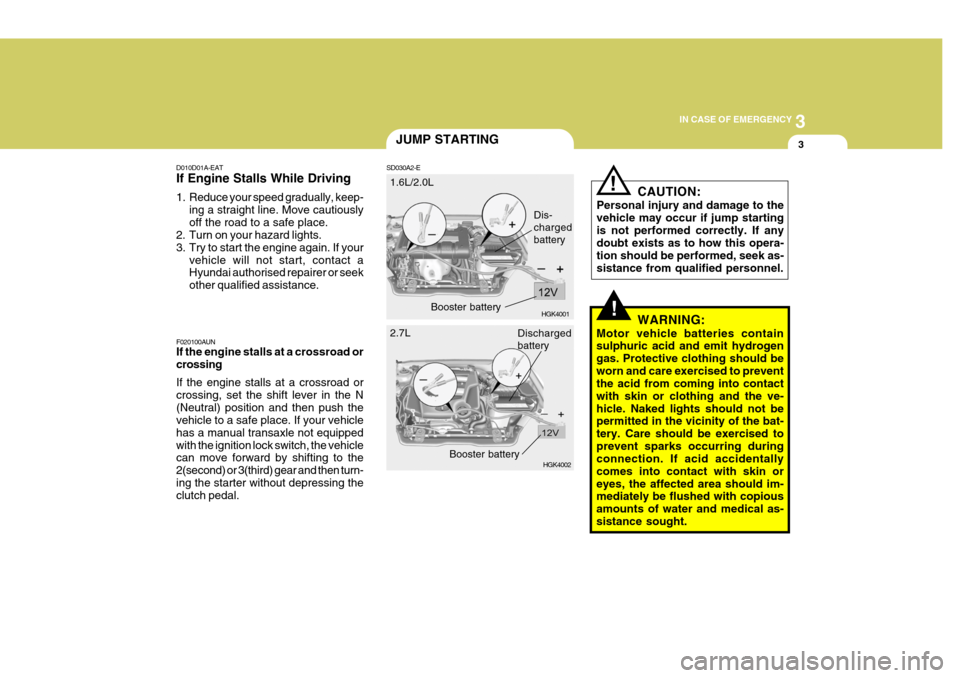
JUMP STARTING
WARNING:
Motor vehicle batteries contain sulphuric acid and emit hydrogen gas. Protective clothing should beworn and care exercised to prevent the acid from coming into contact with skin or clothing and the ve-hicle. Naked lights should not be permitted in the vicinity of the bat- tery. Care should be exercised toprevent sparks occurring during connection. If acid accidentally comes into contact with skin oreyes, the affected area should im- mediately be flushed with copious amounts of water and medical as-sistance sought.
1.6L/2.0L
HGK4001
HGK4002
Dis- chargedbattery
2.7L Booster battery
Discharged battery
Booster batteryF020100AUN If the engine stalls at a crossroad or crossing If the engine stalls at a crossroad or crossing, set the shift lever in the N(Neutral) position and then push the vehicle to a safe place. If your vehicle has a manual transaxle not equippedwith the ignition lock switch, the vehicle can move forward by shifting to the 2(second) or 3(third) gear and then turn-ing the starter without depressing the clutch pedal.
Page 326 of 407
3 IN CASE OF EMERGENCY
8
HGK4013OGK036401
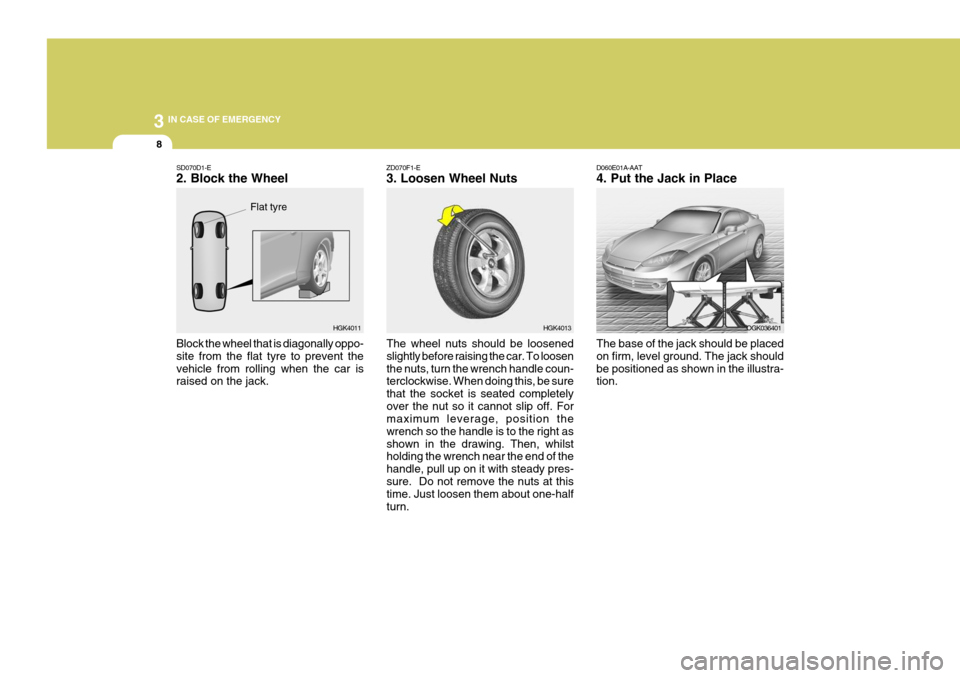
ZD070F1-E 3. Loosen Wheel Nuts
The wheel nuts should be loosened slightly before raising the car. To loosenthe nuts, turn the wrench handle coun- terclockwise. When doing this, be sure that the socket is seated completelyover the nut so it cannot slip off. For maximum leverage, position the wrench so the handle is to the right asshown in the drawing. Then, whilst holding the wrench near the end of the handle, pull up on it with steady pres-sure. Do not remove the nuts at this time. Just loosen them about one-half turn. D060E01A-AAT 4. Put the Jack in Place The base of the jack should be placed on firm, level ground. The jack shouldbe positioned as shown in the illustra- tion.
Flat tyre
SD070D1-E 2. Block the Wheel Block the wheel that is diagonally oppo- site from the flat tyre to prevent thevehicle from rolling when the car is raised on the jack. HGK4011
Page 327 of 407
3
IN CASE OF EMERGENCY
9
D060F01MC
Wheel nut wrench
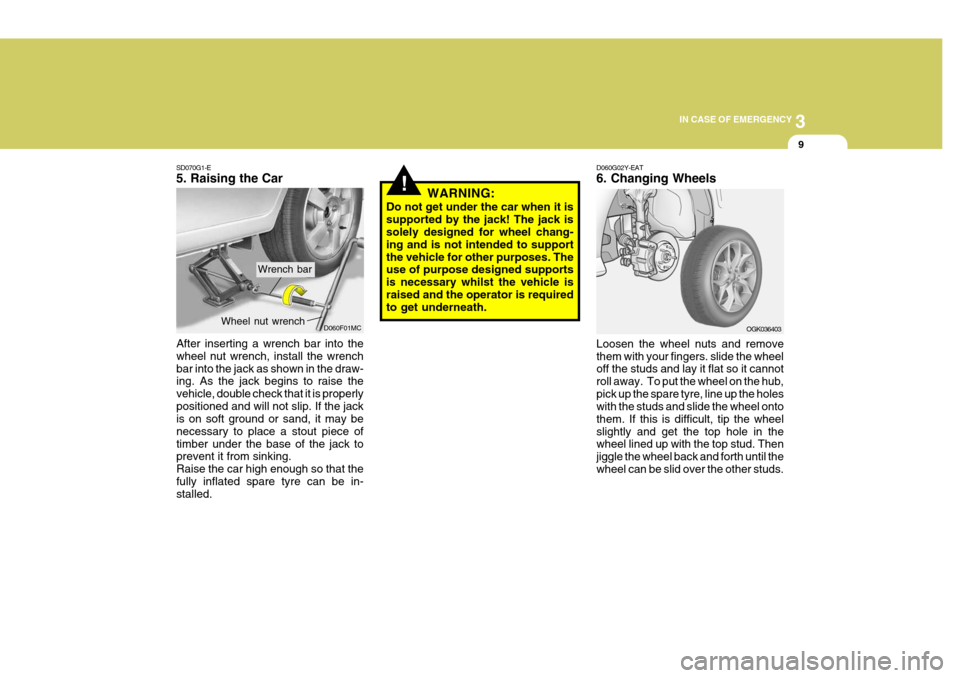
SD070G1-E 5. Raising the Car
After inserting a wrench bar into the wheel nut wrench, install the wrenchbar into the jack as shown in the draw- ing. As the jack begins to raise the vehicle, double check that it is properlypositioned and will not slip. If the jack is on soft ground or sand, it may be necessary to place a stout piece oftimber under the base of the jack to prevent it from sinking. Raise the car high enough so that thefully inflated spare tyre can be in- stalled.
Wrench bar
!WARNING:
Do not get under the car when it is supported by the jack! The jack is solely designed for wheel chang- ing and is not intended to supportthe vehicle for other purposes. The use of purpose designed supports is necessary whilst the vehicle israised and the operator is required to get underneath.
Loosen the wheel nuts and remove them with your fingers. slide the wheel off the studs and lay it flat so it cannot roll away. To put the wheel on the hub,pick up the spare tyre, line up the holes with the studs and slide the wheel onto them. If this is difficult, tip the wheelslightly and get the top hole in the wheel lined up with the top stud. Then jiggle the wheel back and forth until thewheel can be slid over the other studs.
OGK036403
D060G02Y-EAT 6. Changing Wheels
Page 335 of 407

4
CORROSION PREVENTION AND APPEARANCE CARE
3
4
APPEARANCE CARE
3VALETING
ZE020C1-E INTERIOR During the winter period, it is possible that the carpet within the passengercompartment may become wet. The carpet should not be allowed to remain in this condition for prolonged periodssince the carpet may begin to create musty smells and promote internal corrosion of the floorpan. GKE050A2-E Regular cleaning of the exterior paintwork serves two important func- tions. Firstly, the removal of abrasive dirt and contaminants will maintain thelustre of the paintwork and will prevent discolouration and dulling due to pro- longed contact.Secondly, the presence of damage through impact or abrasion will be ap- parent allowing early rectification to bemade thus preventing corrosion from becoming established and spreading beneath the paint film. To avoid "waterspotting" the vehicle should not be washed in direct sunlight particularly in the case of vehicles having dark bodycolours. The heat from the sun rays is absorbed by the paint film increasing the surface temperature. This actioncauses water used for washing to evaporate quickly leaving behind the deposits from the water and the sham-poo used.Use only a shampoo intended for thepurpose and ensure that the body workis thoroughly wet to soften the dirt film prior to removal. After removing the dirt film with a softsponge, the body work should be thor- oughly rinsed and then dried with a good quality chamois leather to pre-vent streaking or spotting of the paint work. Household detergents, solvents andabrasive cleaning materials should not be used in order to avoid damaging the paint film.High pressure car washes may cause water to enter your car. Plastic wheel covers should be cleanedusing a sponge and water. Cast alloy wheels should be cleaned using a mild soap or neutral detergent. Abrasivecompounds must not be used since in the event of these damaging the lac- quer coating, oxidisation of the alu-minium wheel will occur, spoiling the appearance. The use of a toothbrush will facilitatecleaning between the wheel "spokes".
Page 337 of 407

4
CORROSION PREVENTION AND APPEARANCE CARE
5
4
APPEARANCE CARE
5INTERIOR VALETING
JE090A1-E Accident Repairs In the event of the body work sustain- ing damage, the following points shouldbe noted prior to repairs being under- taken. If body panels are replaced or re-paired, anti corrosion treatment must be applied to the repair area. The product used must be compatible withthose used in manufacture. It is rec- ommended that repairs are entrusted to a Hyundai authorised repairer to en-sure that replacement parts used are of the same high quality as those used in manufacture of the vehicle and that thecorrect repair methods and materials will ensure adequate levels of corrosion protection and the continued validity ofthe Anti Perforation Warranty. JE100A1-E Seat Belts Seat belts should be cleaned only with a mild soap solution. Strong deter- gents, solvents or bleaches may dam- age the belt webbing and thereforereduce the effectiveness of the belt. Belts which display signs of fraying, wear or cuts should be replaced.
JE110A1-E The soft trim and carpets should be maintained with the regular use of a vacuum cleaner. Heavy soiling should be removed with a dry cleaning agentrecommended for this purpose follow- ing the instructions of the product manufacturer. Paint thinner, solventsor other such cleaning materials should not be used since damage to the up- holstery may result.
JE120A1-E Windows A proprietary glass cleaner should be used to clean the inside of the win-dows. However, the rear heated windscreen must only be cleaned us- ing a light horizontal cleaning action.Care should be exercised to avoid the use of abrasive cleaners or contact with items of jewellery which may dam-age the heating elements. YE010A1-E To Clean Leather Upholstery (Not all models) In the normal course of use, leather upholstered surfaces will, like any material, pick-up dust and dirt. This dust and dirt MUST be cleaned off or itmay work into the surface of the leather, causing damage.
Page 338 of 407

44APPEARANCE CARE
6
Fine leather needs care. This care, as with all fine things, need not be elabo-rate, but should include cleaning when necessary. Washing leather thoroughly with soap and water will keep yourleather lustrous, beautiful and ensure you have many years of wear. Take a piece of cheese cloth and usingany mild soap and lukewarm water, work up a good lather. Thoroughly wash the leather. Wipe clean with aslightly damp cloth and dry with soft cloth. Do this as often as the leather becomes soiled.During tanning operations, sufficient oils are incorporated through process- ing that none need be applied duringthe life of the leather. Oil applied to the finished surface will in no way help the leather and may do more harm thangood. Varnished and furniture polishes should NEVER be used under any conditions.