ECU Hyundai Coupe 2008 User Guide
[x] Cancel search | Manufacturer: HYUNDAI, Model Year: 2008, Model line: Coupe, Model: Hyundai Coupe 2008Pages: 407, PDF Size: 11.03 MB
Page 164 of 407
2
DRIVING YOUR HYUNDAI
21
!
C190A01A-GAT If you are considering towing with your car, you should first check with your Province Department of Motor Vehicles to determine their legal requirements.Since laws vary from province to prov- ince, the requirements for towing trail- ers, cars, other types of vehicles, orapparatus may differ. Ask your Hyundai dealer for further details before towing. TRAILER OR VEHICLE TOWING
CAUTION
Do not do any towing with your car during its first 2,000 km (1,200 miles)in order to allow the engine to prop- erly break in. Failure to heed this caution may result in serious en-gine or transaxle damage. C190B01S-AAT Trailer Hitches Select the proper hitch and ball combi- nation, making sure that it's location iscompatible with that of the trailer or vehicle being towed. Use a quality non-equalizing hitch whichdistributes the tongue load uniformly throughout the chassis. The hitch should be bolted securely to the car and installed by a qualified technician. DO NOT USE A HITCHDESIGNED FOR TEMPORARY IN- STALLATION AND NEVER USE ONE THAT ATTACHES ONLY TO THEBUMPER.
C190C03Y-GAT Trailer Brakes If your trailer is equipped with a braking system, make sure it conforms to fed-eral and/or local regulations and that it is properly installed and operating cor- rectly. NOTE: If you tow a trailer or vehicle, your car will require more frequent main-tenance due to the additional load. See "Maintenance Under Severe Usage Conditions" on page 5-7.
CAUTION:
o Never connect a trailer brake sys- tem directly to the vehicle brakesystem.
o When towing a trailer on steep grades (in excess of 6%) pay closeattention to the engine coolanttemperature gauge to ensure the engine does not overheat. If the needle of the coolant temperature
!
Page 167 of 407

2 DRIVING YOUR HYUNDAI
24
C190F01A-GAT Trailer or Vehicle Towing Tips
1. Before towing, check hitch andsafety chain connections as well as proper operation of the trailer run- ning lights, brake lights, and turn signals.
2. Always drive your vehicle at a mod- erate speed (Less than 100 km/H).
3. Trailer towing requires more fuel than normal conditions.
4. To maintain engine braking effi-
ciency and electrical chaarging per-formance, do not use fifth gear (manual transaxle) or overdrive (au- tomatic transaxle).
5. Always secure items in the trailer to prevent load shift while driving.
6. Check the condition and air pres- sure of all tires on the trailer and your car. Low tire pressure can seriously affect the handling. Alsocheck the spare tire. 7. The vehicle/trailer combination is
more affected by crosswind andbuffeting. When being passed by a large ve- hicle, keep a constant speed andsteer straight ahead. If there is too much wind buffeting, slow down to get out of the other vehicle's airturbulence.
8. When parking your car and trailer,
especially on a hill, be sure to followall the normal precautions. Turn your front wheel into the curb, set the parking brake firmly, and putthe transmission in 1st or Reverse (manual) or Park (automatic). In addition, place wheel chocks ateach of the trailer's tires.
9. If the trailer has electric brakes,
start your vehicle and trailer mov-ing, and then apply the trailer brake controller by hand to be sure the brakes are working. This lets youcheck your electrical connection at the same time.
10.During your trip, check occasion- ally to be sure that the load issecure, and that the lights and any trailer brakes are still working. 11. Avoid jerky starts, sudden accel-
eration or sudden stops.
12.Avoid sharp turns and rapid lane changes.
13.Avoid holding the brake pedal down too long or too frequently. This could cause the brakes to overheat, re- sulting in reduced braking efficiency.
14.When going down a hill, shift into a lower gear and use the engine brak-ing effect.When ascending a long grade, downshift the transmission to a lower gear and reduce speed toreduce chances of engine over- loading and/or overheating.
15.If you have to stop while going
uphill, do not hold the vehicle inplace by pressing on the accelera- tor. This can cause the automatictransmission to overheat. Use the parking brake or footbrake.
NOTE: When towing check transaxle fluid more frequently.
Page 170 of 407
3 WHAT TO DO IN AN EMERGENCY
2IF THE ENGINE WILL NOT START
!
D010A01A-AAT
WARNING:
If the engine will not start, do not push or pull the car to start it. This could result in a collision or cause other damage. In addition, push orpull starting may cause the cata- lytic converter to be overloaded and create a fire hazard.
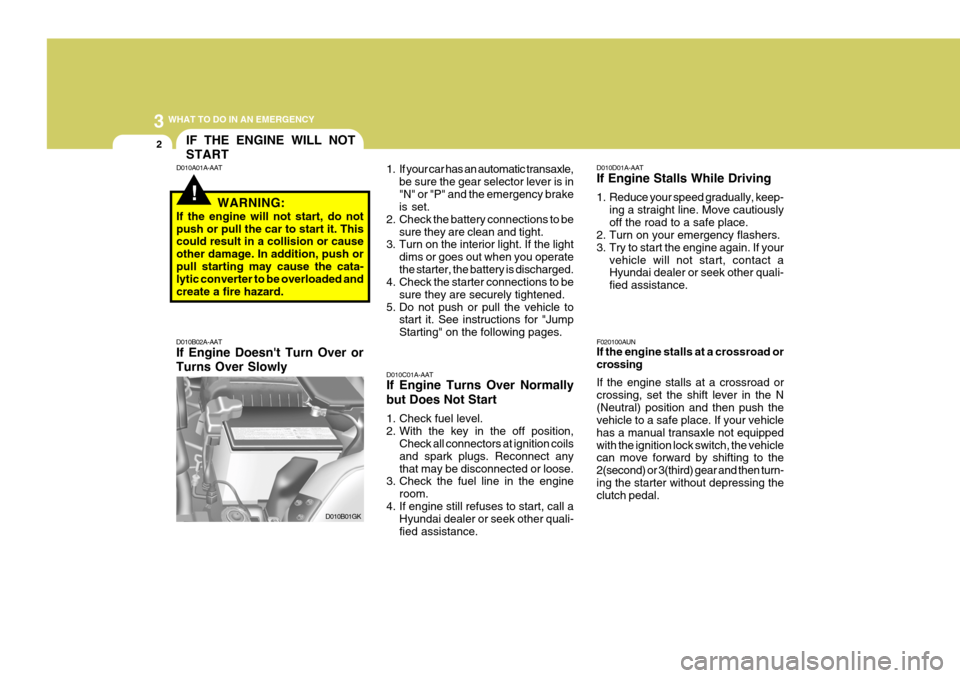
D010B02A-AAT If Engine Doesn't Turn Over or Turns Over Slowly D010C01A-AAT If Engine Turns Over Normally but Does Not Start
1. Check fuel level.
2. With the key in the off position,
Check all connectors at ignition coilsand spark plugs. Reconnect anythat may be disconnected or loose.
3. Check the fuel line in the engine
room.
4. If engine still refuses to start, call a Hyundai dealer or seek other quali-fied assistance. D010D01A-AAT If Engine Stalls While Driving
1. Reduce your speed gradually, keep-
ing a straight line. Move cautiously off the road to a safe place.
2. Turn on your emergency flashers.
3. Try to start the engine again. If your
vehicle will not start, contact a Hyundai dealer or seek other quali- fied assistance.
1. If your car has an automatic transaxle,
be sure the gear selector lever is in"N" or "P" and the emergency brake is set.
2. Check the battery connections to be sure they are clean and tight.
3. Turn on the interior light. If the light
dims or goes out when you operate the starter, the battery is discharged.
4. Check the starter connections to be
sure they are securely tightened.
5. Do not push or pull the vehicle to start it. See instructions for "JumpStarting" on the following pages.
D010B01GK F020100AUN If the engine stalls at a crossroad or crossing If the engine stalls at a crossroad or crossing, set the shift lever in the N(Neutral) position and then push the vehicle to a safe place. If your vehicle has a manual transaxle not equippedwith the ignition lock switch, the vehicle can move forward by shifting to the 2(second) or 3(third) gear and then turn-ing the starter without depressing the clutch pedal.
Page 179 of 407
3
WHAT TO DO IN AN EMERGENCY
11
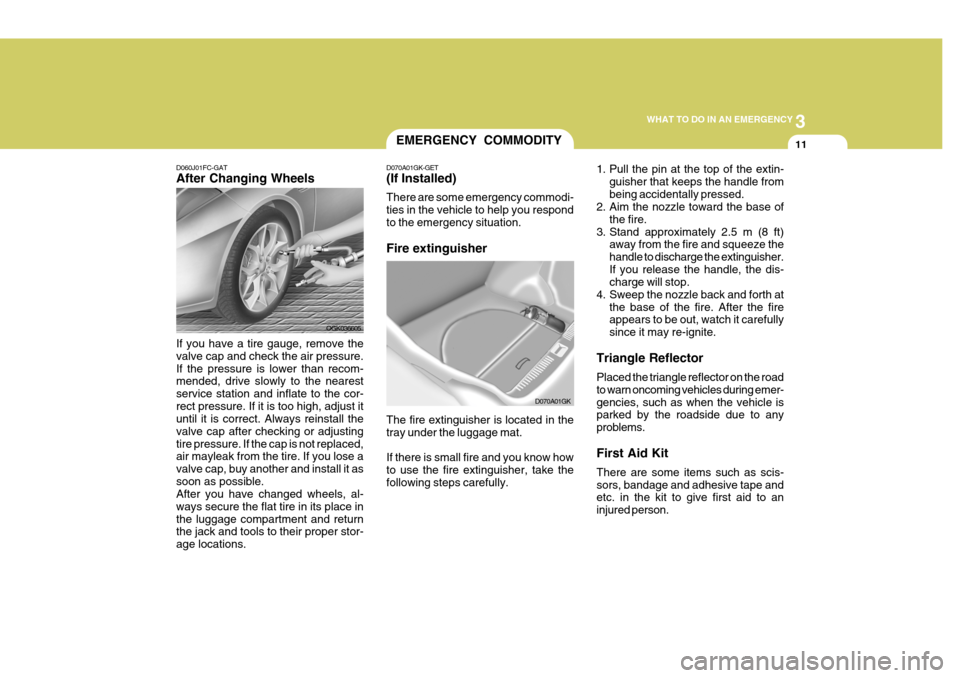
D060J01FC-GAT After Changing Wheels If you have a tire gauge, remove the valve cap and check the air pressure.If the pressure is lower than recom- mended, drive slowly to the nearest service station and inflate to the cor-rect pressure. If it is too high, adjust it until it is correct. Always reinstall the valve cap after checking or adjustingtire pressure. If the cap is not replaced, air mayleak from the tire. If you lose a valve cap, buy another and install it assoon as possible. After you have changed wheels, al- ways secure the flat tire in its place inthe luggage compartment and return the jack and tools to their proper stor- age locations. OGK036605
EMERGENCY COMMODITY
D070A01GK
D070A01GK-GET (If Installed) There are some emergency commodi- ties in the vehicle to help you respondto the emergency situation. Fire extinguisher The fire extinguisher is located in the tray under the luggage mat. If there is small fire and you know how to use the fire extinguisher, take the following steps carefully. 1. Pull the pin at the top of the extin-
guisher that keeps the handle from being accidentally pressed.
2. Aim the nozzle toward the base of
the fire.
3. Stand approximately 2.5 m (8 ft) away from the fire and squeeze thehandle to discharge the extinguisher.If you release the handle, the dis- charge will stop.
4. Sweep the nozzle back and forth at the base of the fire. After the fireappears to be out, watch it carefully since it may re-ignite.
Triangle Reflector Placed the triangle reflector on the road to warn oncoming vehicles during emer-gencies, such as when the vehicle is parked by the roadside due to any problems. First Aid Kit There are some items such as scis- sors, bandage and adhesive tape and etc. in the kit to give first aid to an injured person.
Page 199 of 407
5
VEHICLE MAINTENANCE REQUIREMENTS
9
F060F02A-AAT
o Crankcase Ventilation Hoses
Inspect the surface of hoses for evi- dence of heat and/or mechanical dam- age. Hard and brittle rubber, cracking, tears, cuts, abrasions, and excessiveswelling indicate deterioration. Particu- lar attention should be paid to examin- ing those hose surfaces nearest tohigh heat sources, such as the ex- haust manifold. Inspect the hose routing to assure that the hoses do not come in contact with any heat source, sharp edges or mov-ing component which might cause heat damage or mechanical wear. Inspect all hose connections, such as clampsand couplings, to make sure they are secure, and that no leaks are present. Hoses should be replaced immedi-ately if there is any evidence of dete- rioration or damage. F060H01A-AAT
o Air Cleaner Filter
A Genuine Hyundai air cleaner filter is
recommended when the filter is re-placed.
F060J01A-AAT
o Spark Plugs
Make sure to install new spark plugs
of the correct heat range.
F060N02E-AAT
o Valve Clearance
Inspect excessive valve noise and/or
engine vibration and adjust if neces- sary. A qualified technician should perform the operation. F070B01A-GAT o Cooling System Check the cooling system part, such as radiator, coolant reservoir, hoses and connections for leakage and dam- age. Replace any damaged parts. F070C01A-AAT o Coolant The coolant should be changed at the intervals specified in the mainte-nance schedule. F070D01A-AAT o Manual Transaxle Oil Inspect the manual transaxle oil ac- cording to the maintenance schedule. NOTE: If the oil level is low, check for possible leaks before adding oil. Do not overfill.
Page 211 of 407
6 DO-IT-YOURSELF MAINTENANCE
10
HGK4006
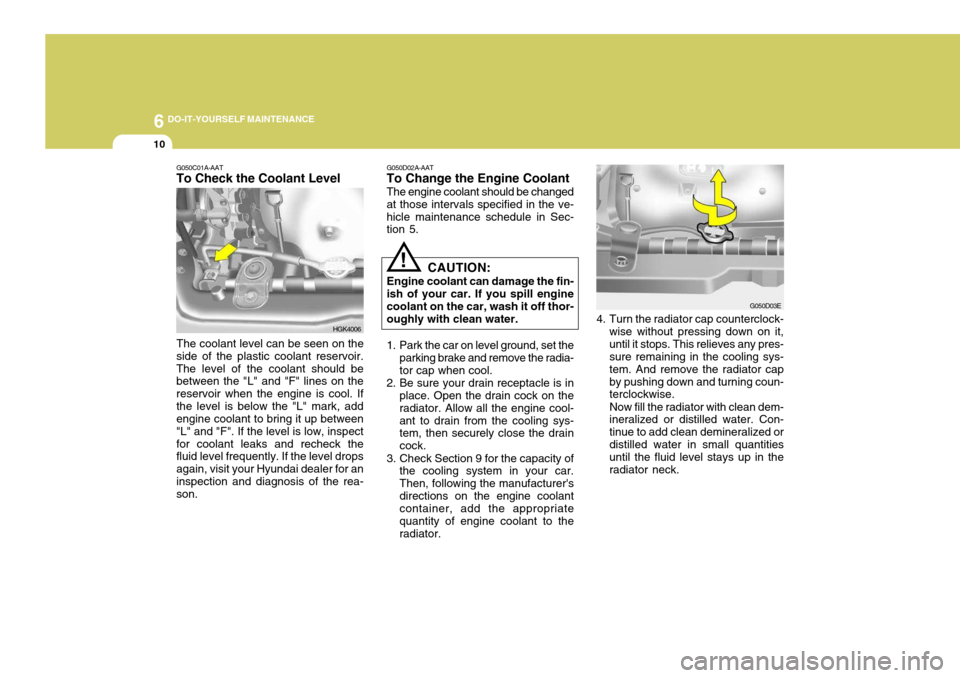
G050C01A-AAT To Check the Coolant Level
The coolant level can be seen on the
side of the plastic coolant reservoir. The level of the coolant should be between the "L" and "F" lines on the reservoir when the engine is cool. Ifthe level is below the "L" mark, add engine coolant to bring it up between "L" and "F". If the level is low, inspectfor coolant leaks and recheck the fluid level frequently. If the level drops again, visit your Hyundai dealer for aninspection and diagnosis of the rea- son. G050D02A-AAT To Change the Engine Coolant The engine coolant should be changed at those intervals specified in the ve-hicle maintenance schedule in Sec- tion 5.
CAUTION:
Engine coolant can damage the fin- ish of your car. If you spill engine coolant on the car, wash it off thor- oughly with clean water.
!
1. Park the car on level ground, set the parking brake and remove the radia- tor cap when cool.
2. Be sure your drain receptacle is in place. Open the drain cock on the radiator. Allow all the engine cool-ant to drain from the cooling sys- tem, then securely close the drain cock.
3. Check Section 9 for the capacity of the cooling system in your car.Then, following the manufacturer'sdirections on the engine coolant container, add the appropriate quantity of engine coolant to theradiator. 4. Turn the radiator cap counterclock-
wise without pressing down on it,until it stops. This relieves any pres- sure remaining in the cooling sys- tem. And remove the radiator capby pushing down and turning coun- terclockwise. Now fill the radiator with clean dem- ineralized or distilled water. Con- tinue to add clean demineralized ordistilled water in small quantities until the fluid level stays up in the radiator neck. G050D03E
Page 239 of 407
6 DO-IT-YOURSELF MAINTENANCE
38
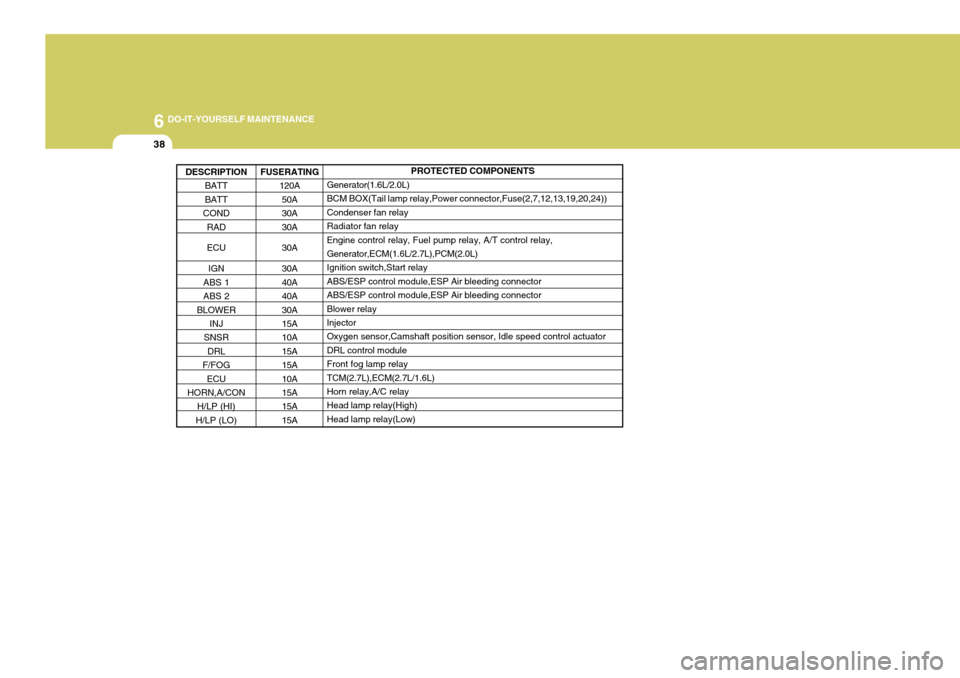
PROTECTED COMPONENTS
Generator(1.6L/2.0L) BCM BOX(Tail lamp relay,Power connector,Fuse(2,7,12,13,19,20,24))Condenser fan relayRadiator fan relayEngine control relay, Fuel pump relay, A/T control relay, Generator,ECM(1.6L/2.7L),PCM(2.0L) Ignition switch,Start relayABS/ESP control module,ESP Air bleeding connectorABS/ESP control module,ESP Air bleeding connectorBlower relayInjector Oxygen sensor,Camshaft position sensor, Idle speed control actuator DRL control moduleFront fog lamp relayTCM(2.7L),ECM(2.7L/1.6L)Horn relay,A/C relay Head lamp relay(High) Head lamp relay(Low)
FUSERATING 120A50A 30A30A 30A 30A 40A40A30A 15A 10A15A15A10A15A 15A 15A
DESCRIPTION
BATTBATT
COND RAD ECU
IGN
ABS 1 ABS 2
BLOWER INJ
SNSR DRL
F/FOG ECU
HORN,A/CON H/LP (HI)
H/LP (LO)
Page 241 of 407
6 DO-IT-YOURSELF MAINTENANCE
40
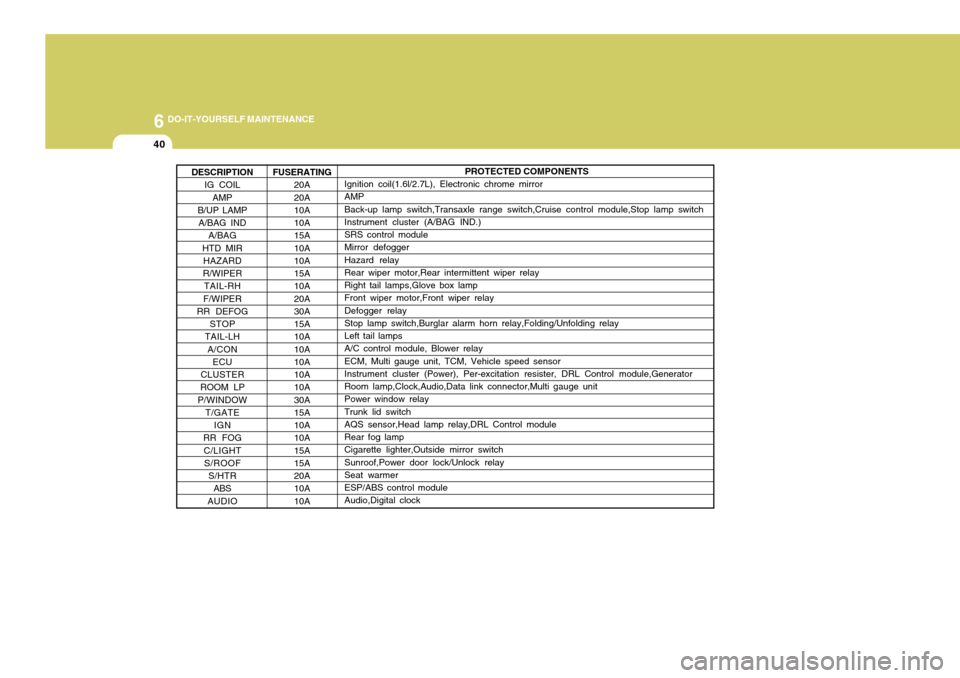
DESCRIPTIONIG COIL
AMP
B/UP LAMP
A/BAG IND A/BAG
HTD MIR HAZARD
R/WIPER TAIL-RH
F/WIPER
RR DEFOG
STOP
TAIL-LH
A/CON ECU
CLUSTER
ROOM LP
P/WINDOW T/GATE
IGN
RR FOG
C/LIGHT S/ROOF
S/HTR ABS
AUDIO
PROTECTED COMPONENTS
Ignition coil(1.6l/2.7L), Electronic chrome mirror AMP Back-up lamp switch,Transaxle range switch,Cruise control module,Stop lamp switch Instrument cluster (A/BAG IND.) SRS control module Mirror defogger Hazard relay Rear wiper motor,Rear intermittent wiper relay Right tail lamps,Glove box lamp Front wiper motor,Front wiper relay Defogger relay Stop lamp switch,Burglar alarm horn relay,Folding/Unfolding relay Left tail lamps A/C control module, Blower relay ECM, Multi gauge unit, TCM, Vehicle speed sensor Instrument cluster (Power), Per-excitation resister, DRL Control module,Generator Room lamp,Clock,Audio,Data link connector,Multi gauge unit Power window relay Trunk lid switch AQS sensor,Head lamp relay,DRL Control module Rear fog lamp Cigarette lighter,Outside mirror switch Sunroof,Power door lock/Unlock relay Seat warmer ESP/ABS control module Audio,Digital clock
FUSERATING
20A 20A 10A 10A 15A 10A 10A 15A 10A 20A 30A 15A 10A 10A 10A 10A 10A 30A 15A 10A 10A 15A 15A 20A 10A 10A
Page 304 of 407
2
DRIVING YOUR HYUNDAI
11
!
UP (+) :
Push the selector lever forward
once to shift up one gear. DOWN (-) : Pull the selector lever back-
wards once to shift down one gear.
CAUTION:
o In sports mode, the driver must execute shifts in accordance withprevailing road conditions, tak- ing care to keep the engine speed below the red zone.
o For engine protection, upward shifts are made automaticallywhen the engine rpm reaches thered zone.
o By rapidly moving the selector
lever backwards (-) twice it ispossible to skip one gear by us- ing the sports mode. Since sud- den engine braking and/or rapidacceleration can cause a loss of traction, however, downshifts must be made carefully in accor-dance with the vehicle's speed.
C090E02O-AAT
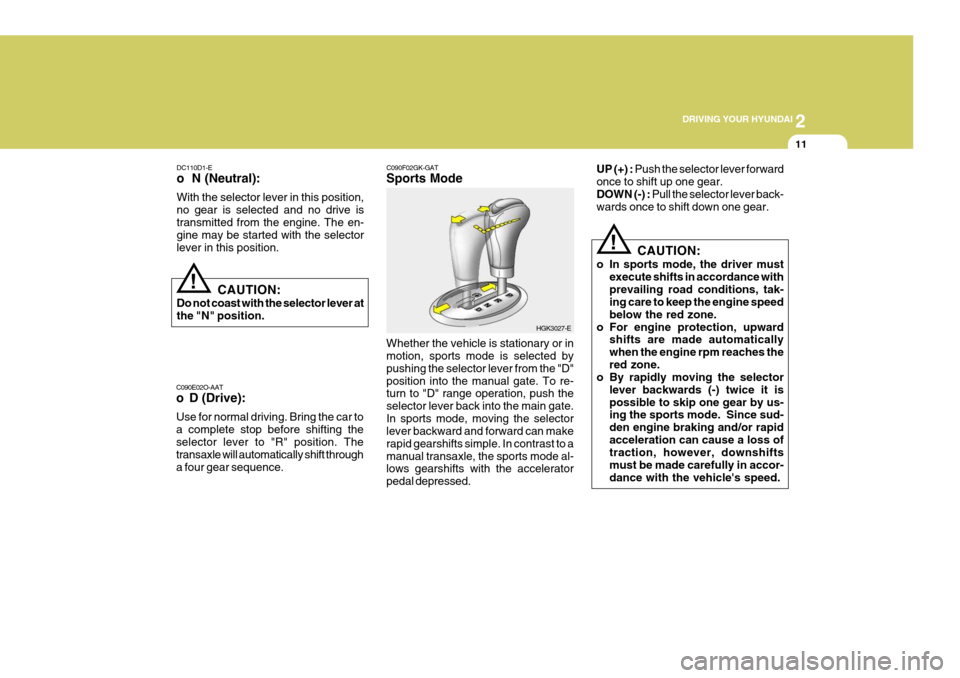
o D (Drive): Use for normal driving. Bring the car to a complete stop before shifting theselector lever to "R" position. The transaxle will automatically shift through a four gear sequence. C090F02GK-GAT Sports Mode Whether the vehicle is stationary or in motion, sports mode is selected by pushing the selector lever from the "D"position into the manual gate. To re- turn to "D" range operation, push the selector lever back into the main gate.In sports mode, moving the selector lever backward and forward can make rapid gearshifts simple. In contrast to amanual transaxle, the sports mode al- lows gearshifts with the accelerator pedal depressed.
HGK3027-E
DC110D1-E o N (Neutral): With the selector lever in this position, no gear is selected and no drive istransmitted from the engine. The en- gine may be started with the selector lever in this position.
CAUTION:
Do not coast with the selector lever atthe "N" position.
!
Page 305 of 407
2DRIVING YOUR HYUNDAI
12
C090H01L-EAT NOTE:
o For smooth and safe operation,depress the brake pedal when shifting from "Neutral" positionor "Park" position to a forward or reverse gear.
o The ignition key must be in the "ON" position and the brake pedalfully depressed in order to move the selector lever from the "P"(Park) position to any of the other positions.
o It is always possible to shift from "R", "N", "D" position to "P" po-sition. The vehicle must be fully stopped to avoid transaxle dam-age.
NOTE:
o In sports mode, only the four
forward gears can be selected. To reverse or park the vehicle,move the selector lever to the "R" or "P" position as required.
o In sports mode, downward shifts are made automatically when thevehicle slows down. When the vehicle stops, 1st gear is auto-matically selected.
o To maintain the required levels
of vehicle performance andsafety, the system may not ex- ecute certain gearshifts when the selector lever is operated.
o Before driving away from a stop on a slippery road, push the se-lector lever forward into the +(UP)position. This causes the transaxle to shift into 2nd gear which is better for smooth driv-ing away on a slippery road. Push the selector lever to the -(DOWN) side to shift back to 1st gear.
!
C090I04L-EAT
CAUTION:
o Shift into "R", "D" and "P" posi- tion only when the vehicle has completely stopped.
o Do not accelerate the engine in reverse or any of the forwardpositions with the brakes applied.
o Always apply the footbrake when shifting from "P" or "N", to "R","D"position.
o Do not use the "P" (Park) posi- tion in place of the parking brake.Always set the parking brake,shift the transaxle into "P" (Park) position and turn off the ignition when you leave the vehicle, evenmomentarily. Never leave the ve- hicle unattended whilst the en- gine is running.
o When accelerating from a stop on a steep hill, the vehicle may havea tendency to roll backwards. Shift-ing the shift lever into 2nd gear whilst in sport mode will help prevent the vehicle from rollingbackwards.