tow Hyundai Coupe 2008 User Guide
[x] Cancel search | Manufacturer: HYUNDAI, Model Year: 2008, Model line: Coupe, Model: Hyundai Coupe 2008Pages: 407, PDF Size: 11.03 MB
Page 69 of 407
1
FEATURES OF YOUR HYUNDAI
57
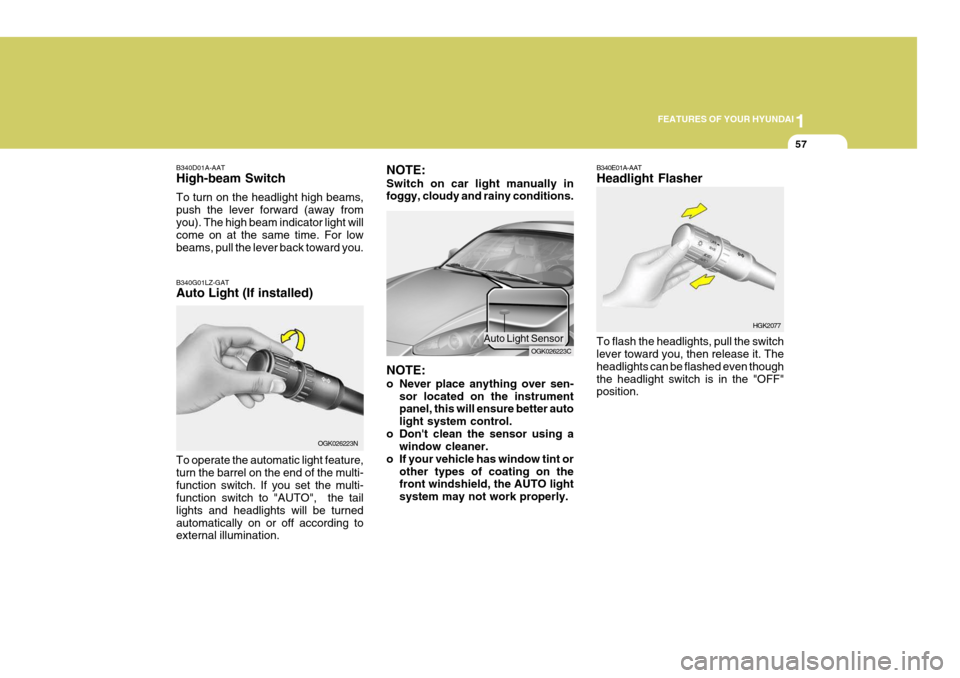
B340D01A-AAT High-beam Switch To turn on the headlight high beams, push the lever forward (away fromyou). The high beam indicator light will come on at the same time. For low beams, pull the lever back toward you. B340G01LZ-GAT Auto Light (If installed) To operate the automatic light feature, turn the barrel on the end of the multi-function switch. If you set the multi- function switch to "AUTO", the tail lights and headlights will be turnedautomatically on or off according to external illumination. OGK026223NNOTE: Switch on car light manually in foggy, cloudy and rainy conditions. NOTE:
o Never place anything over sen-
sor located on the instrument panel, this will ensure better auto light system control.
o Don't clean the sensor using a window cleaner.
o If your vehicle has window tint or other types of coating on the front windshield, the AUTO light system may not work properly. OGK026223C
Auto Light SensorB340E01A-AAT Headlight Flasher To flash the headlights, pull the switch lever toward you, then release it. The headlights can be flashed even thoughthe headlight switch is in the "OFF" position.
HGK2077
Page 71 of 407
1
FEATURES OF YOUR HYUNDAI
59
B350B01O-AAT Windshield Washer Operation
B350A01A-AATWindshield wiper and washer
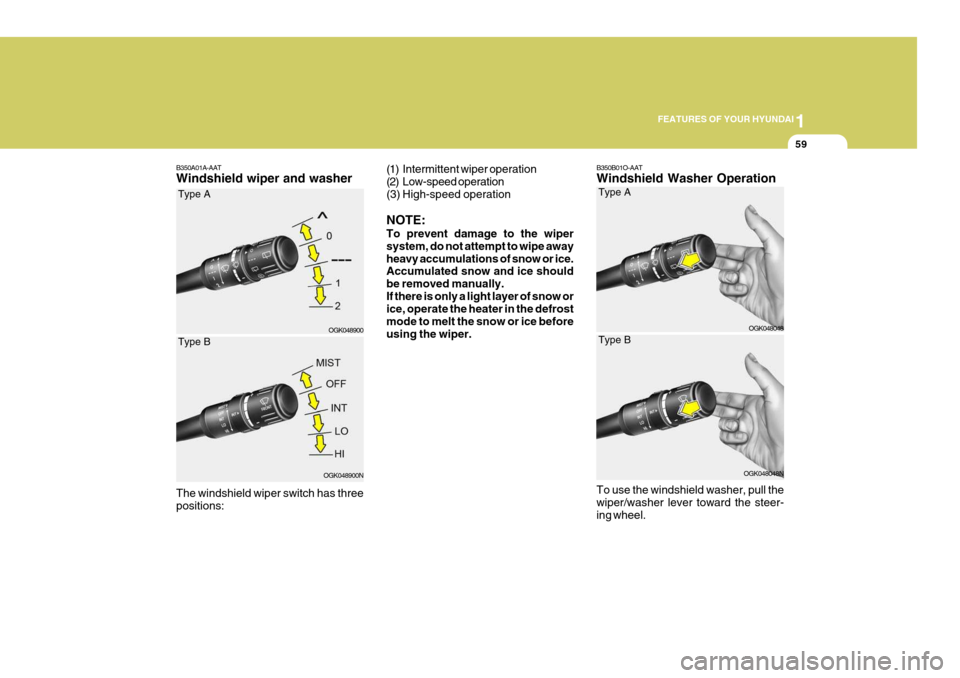
(1) Intermittent wiper operation
(2) Low-speed operation
(3) High-speed operation NOTE: To prevent damage to the wiper system, do not attempt to wipe awayheavy accumulations of snow or ice. Accumulated snow and ice should be removed manually.If there is only a light layer of snow or ice, operate the heater in the defrost mode to melt the snow or ice beforeusing the wiper.
OGK048900
OGK048900N
Type A Type B
The windshield wiper switch has three positions:
OGK048048
OGK048048N
Type A Type B
To use the windshield washer, pull the wiper/washer lever toward the steer-ing wheel.
Page 84 of 407
1FEATURES OF YOUR HYUNDAI
72
B510D01HP-GAT Outside Rearview Mirror Heater (If Installed)
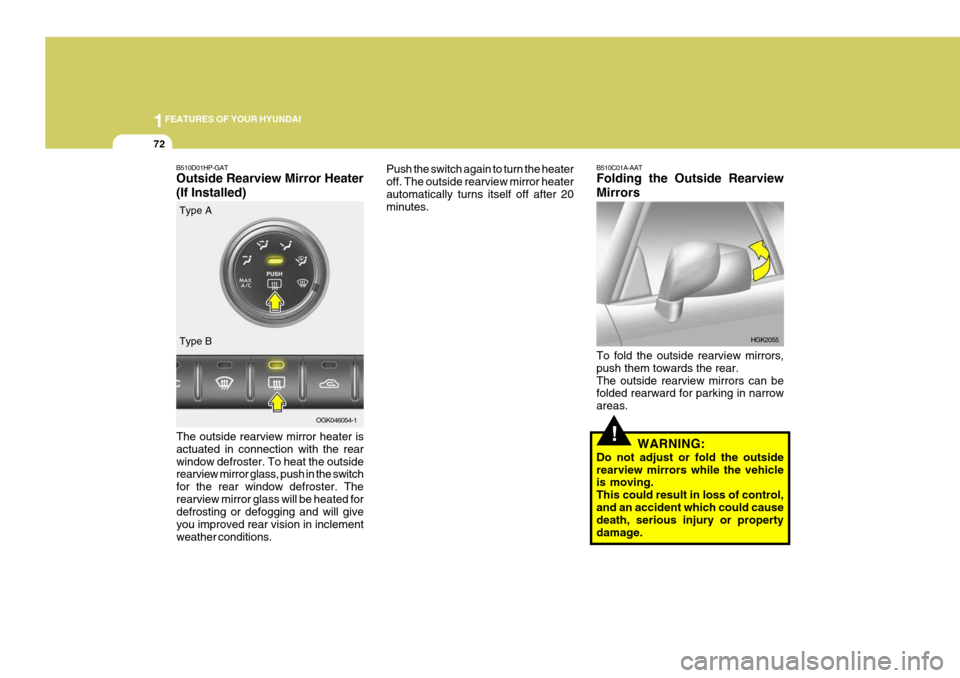
The outside rearview mirror heater is actuated in connection with the rearwindow defroster. To heat the outside rearview mirror glass, push in the switch for the rear window defroster. Therearview mirror glass will be heated for defrosting or defogging and will give you improved rear vision in inclementweather conditions.
OGK046054-1
!
B510C01A-AAT Folding the Outside Rearview Mirrors To fold the outside rearview mirrors, push them towards the rear.The outside rearview mirrors can be folded rearward for parking in narrow areas. WARNING:
Do not adjust or fold the outsiderearview mirrors while the vehicle is moving. This could result in loss of control,and an accident which could cause death, serious injury or property damage. HGK2055
Push the switch again to turn the heateroff. The outside rearview mirror heaterautomatically turns itself off after 20 minutes.
Type A Type B
Page 85 of 407
1
FEATURES OF YOUR HYUNDAI
73DAY/NIGHT INSIDE REARVIEW MIRROR
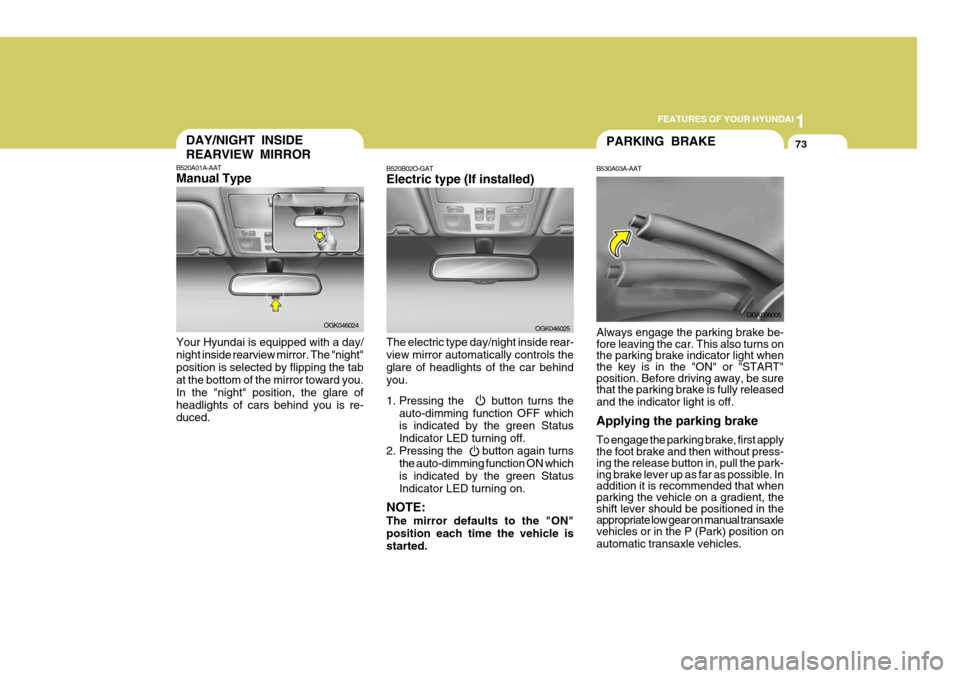
B520A01A-AAT Manual Type Your Hyundai is equipped with a day/ night inside rearview mirror. The "night"position is selected by flipping the tab at the bottom of the mirror toward you. In the "night" position, the glare ofheadlights of cars behind you is re- duced.
OGK046024
PARKING BRAKE
B530A03A-AAT Always engage the parking brake be- fore leaving the car. This also turns on the parking brake indicator light whenthe key is in the "ON" or "START" position. Before driving away, be sure that the parking brake is fully released and the indicator light is off. Applying the parking brake To engage the parking brake, first apply the foot brake and then without press- ing the release button in, pull the park- ing brake lever up as far as possible. Inaddition it is recommended that when parking the vehicle on a gradient, the shift lever should be positioned in theappropriate low gear on manual transaxle vehicles or in the P (Park) position on automatic transaxle vehicles. OGK056005
B520B02O-GATElectric type (If installed) The electric type day/night inside rear- view mirror automatically controls theglare of headlights of the car behind you.
1. Pressing the button turns the
auto-dimming function OFF which is indicated by the green Status Indicator LED turning off.
2. Pressing the button again turns the auto-dimming function ON whichis indicated by the green StatusIndicator LED turning on.
NOTE: The mirror defaults to the "ON" position each time the vehicle is started. OGK046025
Page 92 of 407
1FEATURES OF YOUR HYUNDAI
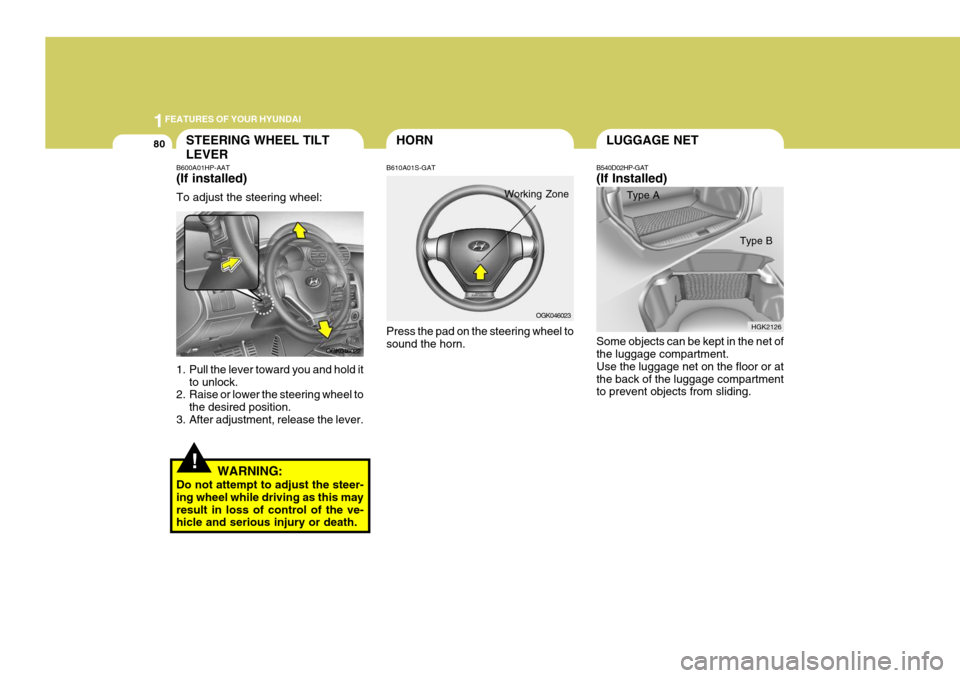
80LUGGAGE NET
B540D02HP-GAT (If Installed) Type A
Some objects can be kept in the net of the luggage compartment. Use the luggage net on the floor or atthe back of the luggage compartment to prevent objects from sliding. HGK2126
Type B
OGK046023
HORN
!
STEERING WHEEL TILT LEVER
B600A01HP-AAT (If installed) To adjust the steering wheel:
1. Pull the lever toward you and hold it
to unlock.
2. Raise or lower the steering wheel to
the desired position.
3. After adjustment, release the lever.
WARNING:
Do not attempt to adjust the steer- ing wheel while driving as this mayresult in loss of control of the ve- hicle and serious injury or death. B610A01S-GAT Press the pad on the steering wheel to sound the horn.
OGK046022
Working Zone
Page 106 of 407
1FEATURES OF YOUR HYUNDAI
94
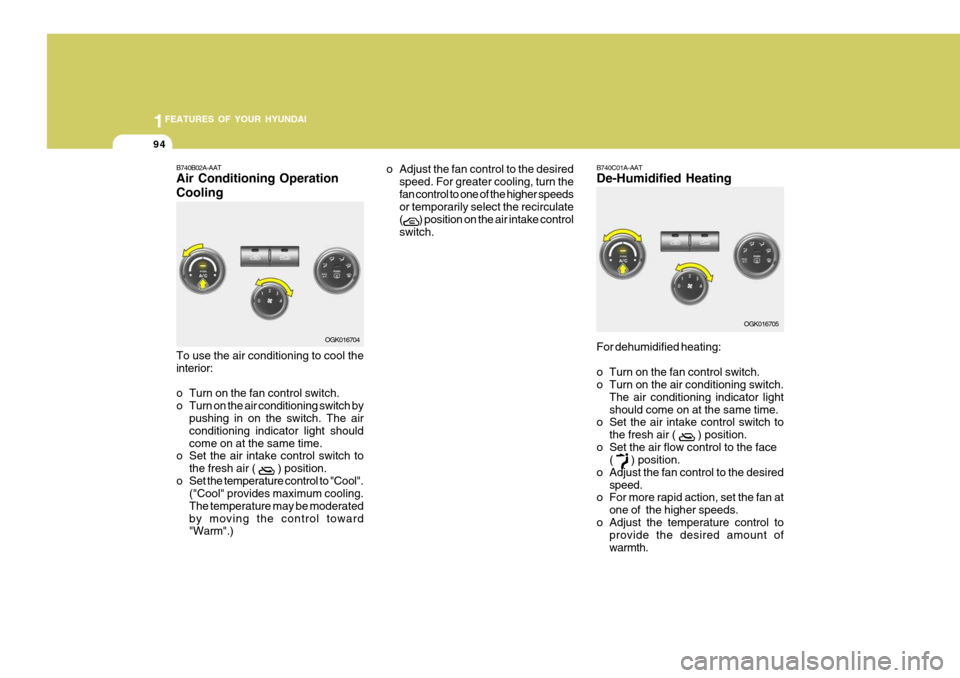
B740B02A-AAT Air Conditioning Operation Cooling To use the air conditioning to cool the interior:
o Turn on the fan control switch.
o Turn on the air conditioning switch by
pushing in on the switch. The airconditioning indicator light shouldcome on at the same time.
o Set the air intake control switch to
the fresh air (
) position.
o Set the temperature control to "Cool". ("Cool" provides maximum cooling. The temperature may be moderatedby moving the control toward "Warm".) o Adjust the fan control to the desired
speed. For greater cooling, turn the fan control to one of the higher speeds or temporarily select the recirculate (
) position on the air intake control
switch.
OGK016704
B740C01A-AAT De-Humidified Heating For dehumidified heating:
o Turn on the fan control switch.
o Turn on the air conditioning switch. The air conditioning indicator light should come on at the same time.
o Set the air intake control switch to
the fresh air (
) position.
o Set the air flow control to the face (
) position.
o Adjust the fan control to the desired
speed.
o For more rapid action, set the fan at
one of the higher speeds.
o Adjust the temperature control to provide the desired amount of warmth. OGK016705
Page 117 of 407
1
FEATURES OF YOUR HYUNDAI
105STEREO SOUND SYSTEM
AM reception
Ionosphere
FM reception
B750A01L
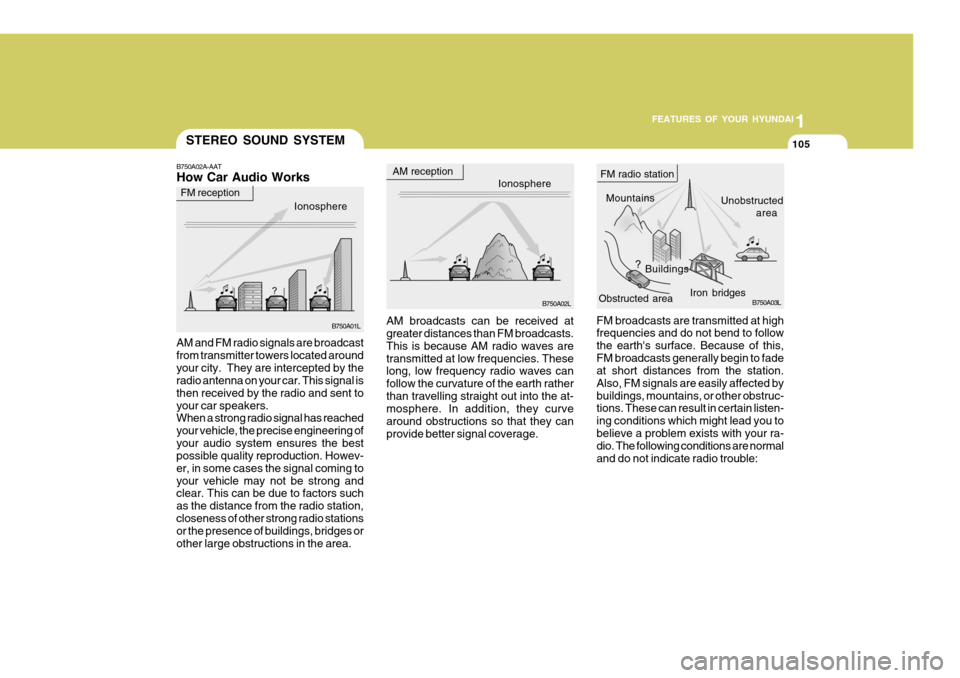
B750A02A-AAT How Car Audio Works
Ionosphere
B750A02L Mountains
Buildings Unobstructed
area
FM radio station
B750A03L
Obstructed area Iron bridges
FM broadcasts are transmitted at high frequencies and do not bend to follow the earth's surface. Because of this,FM broadcasts generally begin to fade at short distances from the station. Also, FM signals are easily affected bybuildings, mountains, or other obstruc- tions. These can result in certain listen- ing conditions which might lead you tobelieve a problem exists with your ra- dio. The following conditions are normal and do not indicate radio trouble:
AM broadcasts can be received at greater distances than FM broadcasts. This is because AM radio waves aretransmitted at low frequencies. These long, low frequency radio waves can follow the curvature of the earth ratherthan travelling straight out into the at- mosphere. In addition, they curve around obstructions so that they canprovide better signal coverage.
AM and FM radio signals are broadcastfrom transmitter towers located aroundyour city. They are intercepted by the radio antenna on your car. This signal is then received by the radio and sent toyour car speakers. When a strong radio signal has reached your vehicle, the precise engineering ofyour audio system ensures the best possible quality reproduction. Howev- er, in some cases the signal coming toyour vehicle may not be strong and clear. This can be due to factors such as the distance from the radio station,closeness of other strong radio stations or the presence of buildings, bridges or other large obstructions in the area.
Page 144 of 407
2
Engine Exhaust Can Be Dangerous! ............................ 2-2
Before Starting the Engine ............................................ 2-3
Key Positions ................................................................ 2-3Starting ......................................................................... 2-5
Operating the Manual Transaxle .................................. 2-5
Operating the Automatic Transaxle .............................. 2-8Anti-Lock Brake System (ABS) ................................... 2-12
Electronic Stabilty Program (ESP) ..............................2-13
Good Braking Practices .............................................. 2-15
Driving for Economy .................................................... 2-16
Smooth Cornering ........................................................ 2-17
Winter Driving .............................................................. 2-17
Trailer or Vehicle Towing ............................................. 2-21
DRIVING YOUR HYUNDAI
2
Page 163 of 407
2 DRIVING YOUR HYUNDAI
20HIGHER SPEED MOTORING
C160J01A-AAT Don't Let Ice and Snow Accumu- late Underneath Under some conditions, snow and ice can build up under the fenders andinterfere with the steering. When driv- ing in severe winter conditions where this may happen, you should periodi-cally check underneath the car to be sure the movement of the front wheels and the steering components is notobstructed. C160K01A-AAT Carry Emergency Equipment Depending on the severity of the weather where you drive your car, you should carry appropriate emergency equipment. Some of the items youmay want to carry include tire chains, tow straps or chains, flashlight, emer- gency flares, sand, a shovel, jumpercables, a window scraper, gloves, ground cloth, coveralls, a blanket, etc. C170A01A-AAT Pre-Trip Inspections 1. Tires: Adjust the tire inflation pressures to specification. Low tire inflation pres-sures will result in overheating and possible failure of the tires. Avoid using worn or damaged tireswhich may result in reduced traction or tire failure. NOTE: Never exceed the maximum tire in- flation pressure shown on the tires. 2. Fuel, engine coolant and en-
gine oil:
High speed travel consumes more fuel than urban motoring. Do not forget tocheck both engine coolant and engine oil. 3. Drive belt: A loose or damaged drive belt may result in overheating of the engine. C180A01A-AAT Check your lights regularly for correct operation and always keep them clean. When driving during the day in condi- tions of poor visibility, it is helpful todrive with headlights on low beam. This enables you to be seen as well as to see.
USE OF LIGHTS
Page 164 of 407
2
DRIVING YOUR HYUNDAI
21
!
C190A01A-GAT If you are considering towing with your car, you should first check with your Province Department of Motor Vehicles to determine their legal requirements.Since laws vary from province to prov- ince, the requirements for towing trail- ers, cars, other types of vehicles, orapparatus may differ. Ask your Hyundai dealer for further details before towing. TRAILER OR VEHICLE TOWING
CAUTION
Do not do any towing with your car during its first 2,000 km (1,200 miles)in order to allow the engine to prop- erly break in. Failure to heed this caution may result in serious en-gine or transaxle damage. C190B01S-AAT Trailer Hitches Select the proper hitch and ball combi- nation, making sure that it's location iscompatible with that of the trailer or vehicle being towed. Use a quality non-equalizing hitch whichdistributes the tongue load uniformly throughout the chassis. The hitch should be bolted securely to the car and installed by a qualified technician. DO NOT USE A HITCHDESIGNED FOR TEMPORARY IN- STALLATION AND NEVER USE ONE THAT ATTACHES ONLY TO THEBUMPER.
C190C03Y-GAT Trailer Brakes If your trailer is equipped with a braking system, make sure it conforms to fed-eral and/or local regulations and that it is properly installed and operating cor- rectly. NOTE: If you tow a trailer or vehicle, your car will require more frequent main-tenance due to the additional load. See "Maintenance Under Severe Usage Conditions" on page 5-7.
CAUTION:
o Never connect a trailer brake sys- tem directly to the vehicle brakesystem.
o When towing a trailer on steep grades (in excess of 6%) pay closeattention to the engine coolanttemperature gauge to ensure the engine does not overheat. If the needle of the coolant temperature
!