battery Hyundai Coupe 2008 Owner's Guide
[x] Cancel search | Manufacturer: HYUNDAI, Model Year: 2008, Model line: Coupe, Model: Hyundai Coupe 2008Pages: 407, PDF Size: 11.03 MB
Page 224 of 407
6
DO-IT-YOURSELF MAINTENANCE
23
!
CHECKING THE BATTERY
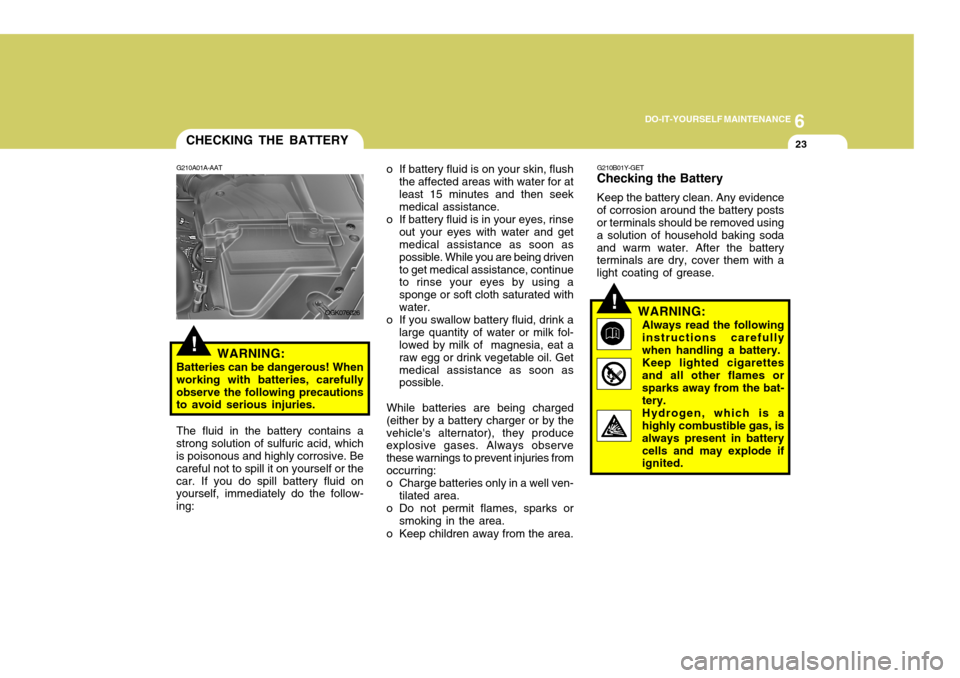
G210A01A-AAT
WARNING:
Batteries can be dangerous! When working with batteries, carefullyobserve the following precautions to avoid serious injuries. The fluid in the battery contains a
strong solution of sulfuric acid, which is poisonous and highly corrosive. Be careful not to spill it on yourself or thecar. If you do spill battery fluid on yourself, immediately do the follow- ing: o If battery fluid is on your skin, flush
the affected areas with water for atleast 15 minutes and then seek medical assistance.
o If battery fluid is in your eyes, rinse out your eyes with water and getmedical assistance as soon as possible. While you are being drivento get medical assistance, continue to rinse your eyes by using a sponge or soft cloth saturated withwater.
o If you swallow battery fluid, drink a large quantity of water or milk fol- lowed by milk of magnesia, eat a raw egg or drink vegetable oil. Getmedical assistance as soon as possible.
While batteries are being charged
(either by a battery charger or by the vehicle's alternator), they produce explosive gases. Always observe these warnings to prevent injuries fromoccurring:
o Charge batteries only in a well ven- tilated area.
o Do not permit flames, sparks or
smoking in the area.
o Keep children away from the area.
!
G210B01Y-GET
Checking the Battery
Keep the battery clean. Any evidence
of corrosion around the battery posts or terminals should be removed using a solution of household baking sodaand warm water. After the battery terminals are dry, cover them with a light coating of grease.
WARNING:Always read the followinginstructions carefullywhen handling a battery.Keep lighted cigarettesand all other flames orsparks away from the bat- tery. Hydrogen, which is a highly combustible gas, is always present in batterycells and may explode if ignited.
OGK076026
Page 225 of 407
6 DO-IT-YOURSELF MAINTENANCE
24
!
CHECKING ELECTRIC COOLING FANS
G220A01A-AAT
WARNING:
The cooling fan is controlled by engine coolant temperature and may sometimes operate even whenthe engine is not running. Use extreme caution when working near the blades of the coolant fan,so that you are not injured by a rotating fan blade. As the coolant temperature decreases the fan willautomatically shut off. This is a normal condition.
Keep batteries out of the reach of children because batteries contain highly corrosive SULFURIC ACID.Do not allow battery acid to contact your skin, eyes, clothing or paint finish.If any electrolyte gets intoyour eyes, flush your eyeswith clean water for at least 15 minutes and get imme- diate medical attention. Ifpossible, continue to ap- ply water with a sponge or cloth until medical atten-tion is received.If electrolyte gets on yourskin, thoroughly wash thecontacted area.If you feel a pain or a burn-ing sensation, get medi- cal attention immediately. Wear eye protection when charging or working near a battery. Always provide ventilation when working in an en- closed space.o When lifting a plastic-cased bat- tery, excessive pressure on the case may cause battery acid toleak, resulting in personal in- jury. Lift with a battery carrier or with your hands on oppositecorners.
o Never attempt to charge the bat- tery when the battery cables are connected.
o The electrical ignition system works with high voltage. Never touch these componentswith the engine running or the ignition switched on.
Page 256 of 407

10INDEX
2
A Air bag ........................................................................ 1-34
Air clean er filter .......................................................... 6-11
Air Conditioning
Care ......................................................................... 6-18
Operation ................................................................. 6-19
Switch ...................................................................... 1-87
Air Cond itioner filter .................................................... 1-93
Antenna .................................................................... 1-103
Ashtray ....................................................................... 1-65
Audio Remote Control ................................................. 1-85
Automatic Transaxle .................................................... 2-8
BBattery .............................................................. 2-18, 6-23
Brake
Anti-lock system ...................................................... 2-12
Checking the brakes ................................................ 6-17
Fluid ......................................................................... 6-17
Practices ................................................................. 2-15
Breaking-In your new Hyundai ..................................... 1-3
CCare of Cassette tapes ............................................ 1-130
Care of D iscs ........................................................... 1-129
Cassette Tape Player Operation (H280, H265, H465) .........................1-107, 1-116, 1-121
Catalytic Converter ...................................................... 7-3
Child Restraint system ............................................... 1-25Child Seat Restraint Suitability For Seat Position
Using the Seat Belt .................................................. 1-27
Cigarette Lighter ......................................................... 1-64
Clock .......................................................................... 1-63
Clutch Checking fluid .......................................................... 6-18
Combination Light
Daytime running lights ............................................. 1-56
Headlight flasher ...................................................... 1-57
Headlight swi tch ...................................................... 1-56
High-beam switch .................................................... 1-57
Lane change si gnal .................................................. 1-56
Turn signal operation ............................................... 1-55
Compact Disc Player Operation
(H280, H265, H465) .........................1-113, 1-119, 1-125
Cooling Fans ............................................................... 6-24
Corrosion Protection
Cleaning the interior .................................................. 4-6
Protecting your Hyundai from corrosion ................... 4-2
Washing and waxing ................................................. 4-4
Cruise Control ............................................................. 1-81
DDefrosting/Defogging ................................................... 1-92
Door
Central door lock ...................................................... 1-8
Door locks ................................................................ 1-7 Locking and unlocking front door with a key ............ 1-7
Drink Holder ................................................................ 1-65
Page 281 of 407
1
FEATURES OF YOUR HYUNDAI
93
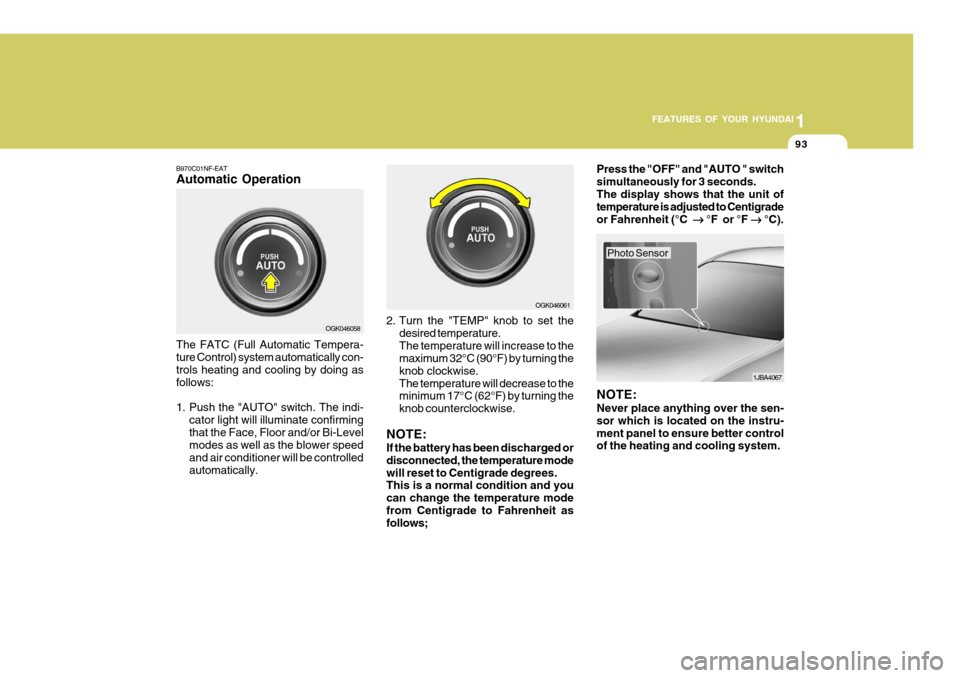
B970C01NF-EAT Automatic Operation The FATC (Full Automatic Tempera- ture Control) system automatically con- trols heating and cooling by doing as follows:
1. Push the "AUTO" switch. The indi-
cator light will illuminate confirming that the Face, Floor and/or Bi-Level modes as well as the blower speed and air conditioner will be controlledautomatically. 2. Turn the "TEMP" knob to set the
desired temperature.The temperature will increase to the maximum 32°C (90°F) by turning the knob clockwise.The temperature will decrease to the minimum 17°C (62°F) by turning the knob counterclockwise.
NOTE: If the battery has been discharged or disconnected, the temperature modewill reset to Centigrade degrees. This is a normal condition and you can change the temperature modefrom Centigrade to Fahrenheit as follows; Press the "OFF" and "AUTO " switch simultaneously for 3 seconds.The display shows that the unit of temperature is adjusted to Centigrade or Fahrenheit (°C
°F or °F
°C).
OGK046058 OGK046061
1JBA4067
NOTE: Never place anything over the sen- sor which is located on the instru-ment panel to ensure better control of the heating and cooling system.
Photo Sensor
Page 297 of 407
2DRIVING YOUR HYUNDAI
4KEY POSITIONS
!
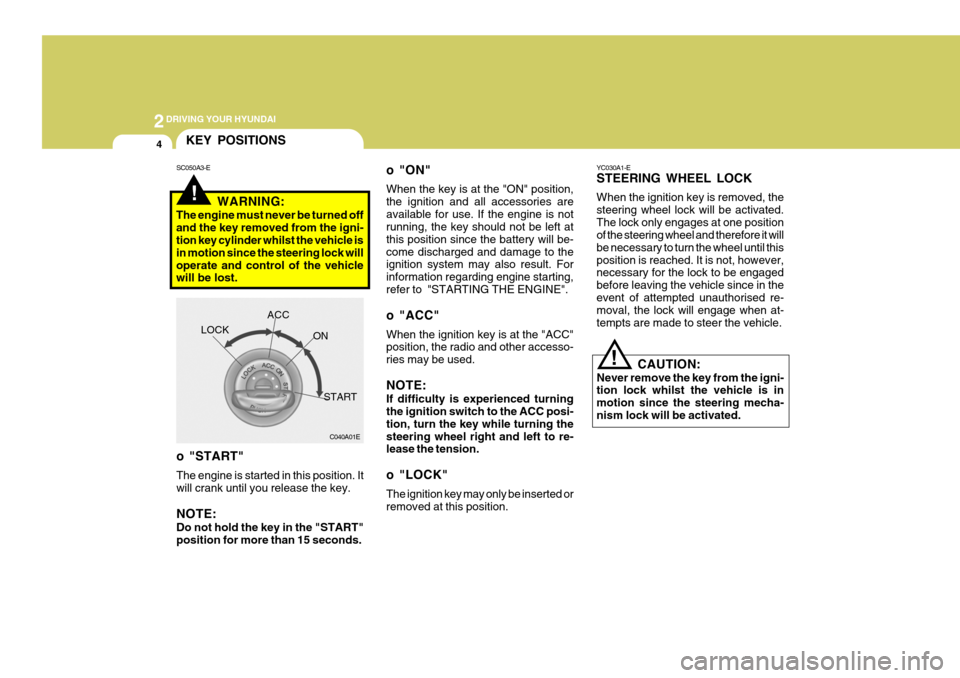
o "ON" When the key is at the "ON" position, the ignition and all accessories areavailable for use. If the engine is not running, the key should not be left at this position since the battery will be-come discharged and damage to the ignition system may also result. For information regarding engine starting,refer to "STARTING THE ENGINE".
o "ACC" When the ignition key is at the "ACC" position, the radio and other accesso- ries may be used. NOTE: If difficulty is experienced turning the ignition switch to the ACC posi- tion, turn the key while turning thesteering wheel right and left to re- lease the tension.
o "LOCK" The ignition key may only be inserted or removed at this position.
SC050A3-E
WARNING:
The engine must never be turned offand the key removed from the igni- tion key cylinder whilst the vehicle is in motion since the steering lock willoperate and control of the vehicle will be lost.
C040A01E
LOCK
ACC
ON
START
o "START" The engine is started in this position. It will crank until you release the key. NOTE: Do not hold the key in the "START" position for more than 15 seconds. YC030A1-E STEERING WHEEL LOCK When the ignition key is removed, the steering wheel lock will be activated.The lock only engages at one position of the steering wheel and therefore it will be necessary to turn the wheel until thisposition is reached. It is not, however, necessary for the lock to be engaged before leaving the vehicle since in theevent of attempted unauthorised re- moval, the lock will engage when at- tempts are made to steer the vehicle.
!
CAUTION:
Never remove the key from the igni- tion lock whilst the vehicle is in motion since the steering mecha-nism lock will be activated.
Page 302 of 407
2
DRIVING YOUR HYUNDAI
9
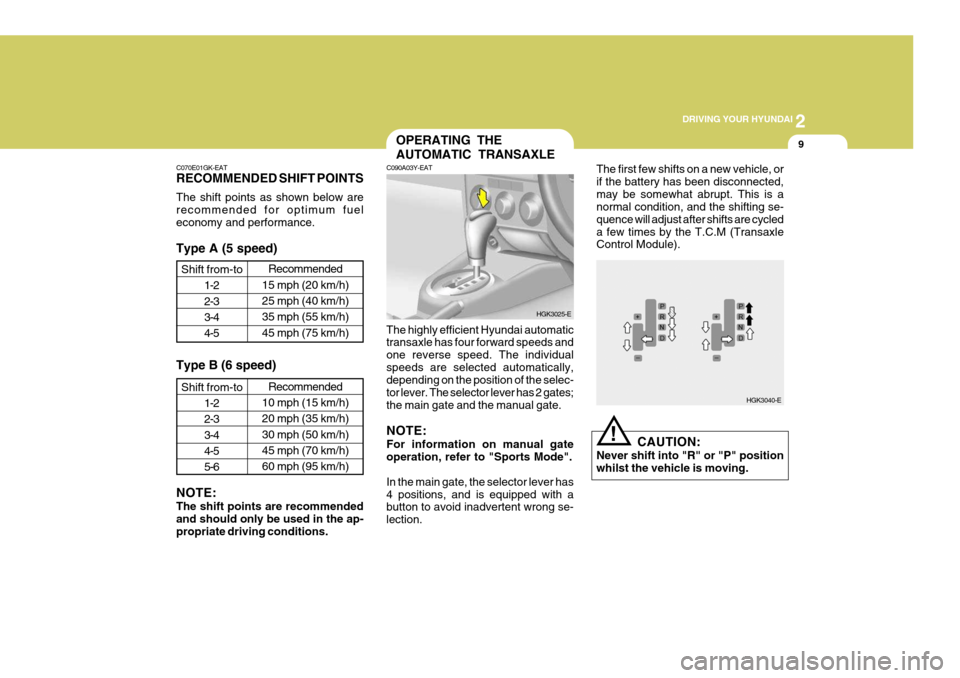
C090A03Y-EAT OPERATING THE AUTOMATIC TRANSAXLE
The highly efficient Hyundai automatic transaxle has four forward speeds and one reverse speed. The individualspeeds are selected automatically, depending on the position of the selec- tor lever. The selector lever has 2 gates;the main gate and the manual gate. NOTE: For information on manual gate operation, refer to "Sports Mode". In the main gate, the selector lever has 4 positions, and is equipped with a button to avoid inadvertent wrong se- lection. HGK3025-E
C070E01GK-EAT RECOMMENDED SHIFT POINTS The shift points as shown below are recommended for optimum fueleconomy and performance. Type A (5 speed)
Shift from-to 1-2 2-33-4 4-5 Recommended
15 mph (20 km/h)25 mph (40 km/h) 35 mph (55 km/h)45 mph (75 km/h)
Type B (6 speed)
Shift from-to 1-2 2-33-4 4-5 5-6 Recommended
10 mph (15 km/h)20 mph (35 km/h)30 mph (50 km/h) 45 mph (70 km/h) 60 mph (95 km/h)
NOTE: The shift points are recommended and should only be used in the ap- propriate driving conditions.
HGK3040-E
!
The first few shifts on a new vehicle, or if the battery has been disconnected,may be somewhat abrupt. This is a normal condition, and the shifting se- quence will adjust after shifts are cycleda few times by the T.C.M (Transaxle Control Module).
CAUTION:
Never shift into "R" or "P" positionwhilst the vehicle is moving.
Page 312 of 407
2
DRIVING YOUR HYUNDAI
19
ZC170C1-E Anti-freeze/Corrosion inhibitor The cooling system must always con- tain an Ethylene-Glycol based anti-freeze solution. The system is filled during manufacture with solution of the correct strength which should bechecked before the onset of winter and adjusted or changed as required. NOTE: The anti-freeze solution contains a corrosion inhibitor to prevent degra- dation of the aluminium castingscontained within the engine. There- fore, never, drain the system and refill with water only. In addition, anti-freeze solution must ALWAYS be used in vehicles fitted withair conditioning, to prevent the heater matrix from freezing and subsequently bursting with the refrigeration system inuse.WINTER MOTORING
DC170A1-E The onset of winter conditions subject motor vehicles to greater operating de- mands. Therefore, the following sug- gestions will assist in maintaining peakperformance and reliability during these periods: ZC170B1-E Electrical System Winter conditions impose severe de- mands upon vehicle electrical systems,particularly the charging circuit. The battery condition and performance along with the alternator performance anddrive belt condition should be checked prior to the onset of winter. ZC170D1-E Door Locks Should the door lock mechanism be- come frozen, a proprietary lock de-icershould be used. Alternatively, warming the door key may thaw the door lock. However, the key should be handledcarefully to avoid burning the fingers. Never attempt to thaw a frozen door lock using hot water, since the waterwill eventually freeze and compound the problem. NOTE: The proper temperature for using the immobiliser key is from -40°C to 80°C (-40°F to 176°F). If you heat theimmobiliser key over 80°C (176°F) to open the frozen lock, it may cause damage to the transponder in itshead.
Page 320 of 407
3 IN CASE OF EMERGENCY
2IF THE ENGINE WILL NOT START
!
SD020A1-E Seek assistance from the nearest Hyundai authorised repairer with regard to the method of ignition and fuel sys- tem diagnosis.
WARNING:
If the engine refuses to start, noattempt should be made to push ortow start the vehicle. Vehicles with automatic transaxle or fuel injec- tion will not be able to be started in this manner since no drive is trans- mitted through the automatictransaxle whilst the engine is not running, and in the case of fuel injected derivatives, the fuel pumpwill not operate under tow start conditions. In addition, if the ve- hicle is equipped with an exhaustcatalyst, damage to the catalyst may result if the vehicle is tow started. SD020B1-E If the Engine Cannot be Cranked
D010C01A-EATIf Engine Turns Over Normally but Does Not Start
1. Check fuel level.
2. With the key in the off position,Check all connectors at ignition coils and spark plugs. Reconnect any that may be disconnected or loose.
3. Check the fuel line in the engine room.
4. If engine still refuses to start, call a Hyundai authorised repairer or seek other qualified assistance.
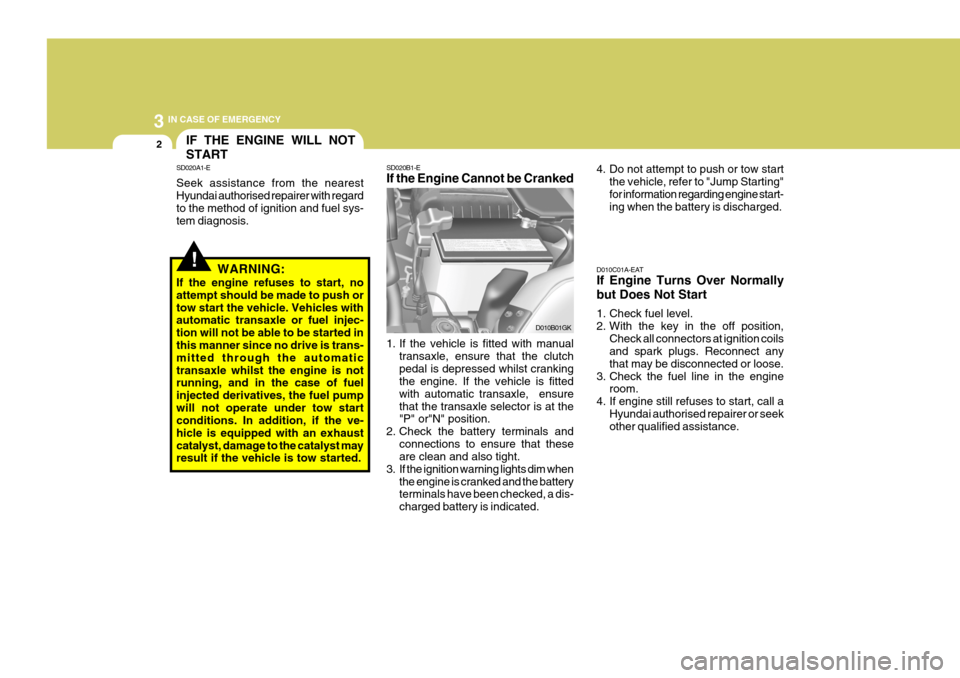
1. If the vehicle is fitted with manual
transaxle, ensure that the clutch pedal is depressed whilst cranking the engine. If the vehicle is fitted with automatic transaxle, ensurethat the transaxle selector is at the "P" or"N" position.
2. Check the battery terminals and connections to ensure that theseare clean and also tight.
3. If the ignition warning lights dim when the engine is cranked and the batteryterminals have been checked, a dis- charged battery is indicated. D010B01GK
4. Do not attempt to push or tow start
the vehicle, refer to "Jump Starting"for information regarding engine start- ing when the battery is discharged.
Page 321 of 407
3
IN CASE OF EMERGENCY
3
!
!
D010D01A-EAT If Engine Stalls While Driving
1. Reduce your speed gradually, keep-
ing a straight line. Move cautiously off the road to a safe place.
2. Turn on your hazard lights.
3. Try to start the engine again. If your
vehicle will not start, contact a Hyundai authorised repairer or seek other qualified assistance. SD030A2-E
CAUTION:
Personal injury and damage to thevehicle may occur if jump startingis not performed correctly. If any doubt exists as to how this opera- tion should be performed, seek as-sistance from qualified personnel.
JUMP STARTING
WARNING:
Motor vehicle batteries contain sulphuric acid and emit hydrogen gas. Protective clothing should beworn and care exercised to prevent the acid from coming into contact with skin or clothing and the ve-hicle. Naked lights should not be permitted in the vicinity of the bat- tery. Care should be exercised toprevent sparks occurring during connection. If acid accidentally comes into contact with skin oreyes, the affected area should im- mediately be flushed with copious amounts of water and medical as-sistance sought.
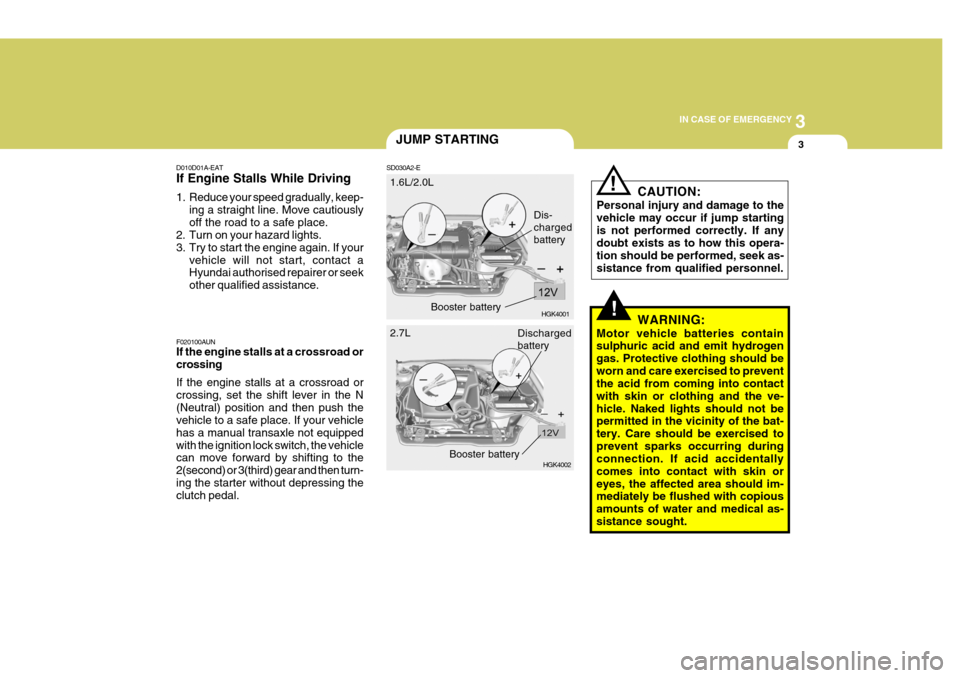
1.6L/2.0L
HGK4001
HGK4002
Dis- chargedbattery
2.7L Booster battery
Discharged battery
Booster batteryF020100AUN If the engine stalls at a crossroad or crossing If the engine stalls at a crossroad or crossing, set the shift lever in the N(Neutral) position and then push the vehicle to a safe place. If your vehicle has a manual transaxle not equippedwith the ignition lock switch, the vehicle can move forward by shifting to the 2(second) or 3(third) gear and then turn-ing the starter without depressing the clutch pedal.
Page 322 of 407
3 IN CASE OF EMERGENCY
4
7. Switch "ON" the main beam
headlamps before carefully remov- ing the jumper cables have been removed, switch "OFF" the main beam headlamps. SD040A2-E If the temperature gauge indicates overheating:
1. Pull off the road and stop as soon as
it is safe to do so.
2. Place the gear selector lever in "P"
(automatic), or neutral (manual transaxle) and set the parking brake. If the air conditioning is on, turn it off.
3. If coolant is running out under the car or steam is coming out fromunder the bonnet stop the engine. Do not open the bonnet until thecoolant has stopped running or the steaming has stopped. If there is no visible loss of coolant and no steam,leave the engine running and check to be sure the engine cooling fan is operating.If the fan is not running, turn the engine off.
4. Check to see if the water pump drive belt is broken. If it is not missing,check to see that it is tight. If the drive belt seems to be satisfactory,check for coolant leaking from the radiator, hoses or under the car. (If the air conditioning had been in use,it is normal for cold water to be draining from it).
IF THE ENGINE OVERHEATS
1. Ensure that the booster battery is 12 volt type. If the booster battery is installed in another vehicle, ensure that the two vehicles are not touch- ing.
2. Turn off all unnecessary electrical equipment in both vehicles.
3. Ensure that the engine of the ve- hicle providing the jump start is run- ning prior to connection of the jump cables.
4. Connect the red jump cable to the positive (+) terminal of the boosterbattery and the other end to thepositive (+) terminal of the dis- charged battery.
5. Attach the black jump cable to the negative (-) terminal of the boosterbattery, and the other end to a ground point within the engine compartmentof the vehicle with the flat battery. Do not connect to the negative battery terminal of the flat battery sincesparks may be generated with the subsequent risk of explosion.
6. Raise the booster vehicle engine speed to 2,000 r.p.m. and start theengine of the vehicle with the flat battery. CAUTION:
If the jump cables are incorrectlyinstalled, damage to the vehicle elec-trical system may occur, in particu- lar the electronic components such as the Fuel Injection system com- puter and the Automatic Transaxle computer. The battery must neverbe disconnected whilst the engine is running.
!