brake Hyundai Coupe 2008 Repair Manual
[x] Cancel search | Manufacturer: HYUNDAI, Model Year: 2008, Model line: Coupe, Model: Hyundai Coupe 2008Pages: 407, PDF Size: 11.03 MB
Page 308 of 407
2
DRIVING YOUR HYUNDAI
15
!WARNING:
ABS (ESP) will not prevent accidents due to improper or dangerous driv- ing manoeuvres. Even though ve- hicle control is improved duringemergency braking, always main- tain a safe distance between you and objects ahead. Vehicle speedsshould always be reduced during extreme road conditions. The braking distance for carsequipped with an anti-lock braking system (Electronic Stability Program) may be longer than for those without it, in the following road conditions. These roads should be driven atreduced speeds.
o Rough, gravel or snow-covered roads.
o With tyre chains installed.
o On roads where the road surface
is pitted or has different surface height.
The safety features of an ABS (ESP)equipped vehicle should not be tested by high speed driving or cornering.This could endanger the safety of yourself or others.
!
!
ELECTRONIC STABILITY PROGRAM (ESP)
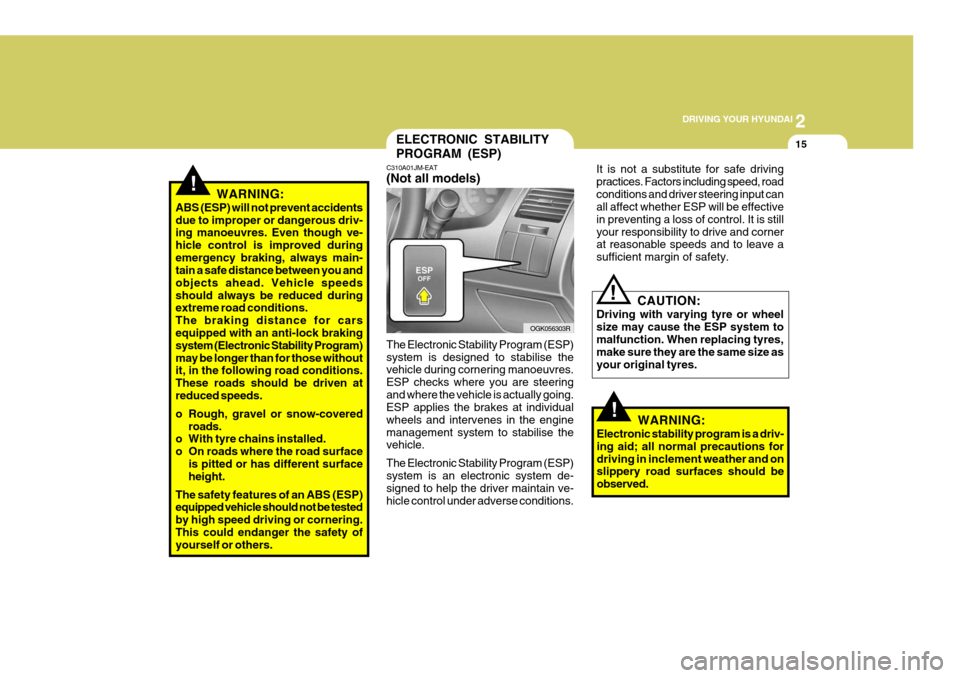
C310A01JM-EAT (Not all models) It is not a substitute for safe driving practices. Factors including speed, roadconditions and driver steering input can all affect whether ESP will be effective in preventing a loss of control. It is stillyour responsibility to drive and corner at reasonable speeds and to leave a sufficient margin of safety.
The Electronic Stability Program (ESP)system is designed to stabilise the vehicle during cornering manoeuvres. ESP checks where you are steeringand where the vehicle is actually going. ESP applies the brakes at individual wheels and intervenes in the enginemanagement system to stabilise the vehicle. The Electronic Stability Program (ESP) system is an electronic system de- signed to help the driver maintain ve-hicle control under adverse conditions.
OGK056303R CAUTION:
Driving with varying tyre or wheel size may cause the ESP system to malfunction. When replacing tyres, make sure they are the same size asyour original tyres.
WARNING:
Electronic stability program is a driv-ing aid; all normal precautions fordriving in inclement weather and on slippery road surfaces should be observed.
Page 309 of 407
2DRIVING YOUR HYUNDAI
16EFFECTIVE BRAKING
SC140A2-E Braking system performance and fric- tion material life are greatly affected by the driving style adopted. The following suggestions are made to assist inachieving the best results from the braking system.
o Anticipate the road and conditions ahead in order that heavy braking may be avoided.
o When descending long gradients, use the engine to assist in retarding thevehicle to minimise the possibility ofbrake fade occurring.
o When trailer towing, ensure that the
trailer brakes function correctly anduse engine braking to assist the vehicle braking system.
o Use only genuine Hyundai replace- ment brake pads and shoes to en-sure consistent friction characteris- tics and wear rates.
o After driving through deep water (e.g. fording), the brakes may becomewet and performance reduced. Al-ways check brake efficiency after emerging from the water and dry the brakes by lightly depressing the brakepedal several times whilst driving slowly.
C310B01JM-AAT ESP ON/OFF Mode When the ESP is operating, the ESP indicator in the instrument cluster willblink. If you turn the system off by pressing the ESP switch, the ESP-OFF indica-tor will come on and stay on. In the ESP-OFF mode, the stability control will be deactivated. Adjust your drivingaccordingly. To turn the system back on, press the switch again. The ESP- OFF indicator should go off. NOTE: The ESP mode will automatically be turned ON after the engine is turnedoff and restarted.
C310D02JM-EAT Indicators and Warning The indicators should illuminate when the ignition key is turned ON or STARTbut should go out after approximately 3 seconds. If the indicators do not illuminate, or theESP-OFF indicator does not go out after approximately 3 seconds, have the vehicle checked by a Hyundaiauthorised repairer. Should there be any unusual conditions in the device whilst driving, ESP-OFF indicator illuminates as a warning. If ESP-OFF indicator illuminates, pullyour car to a safe place and stop the engine. Then, start the engine again to check ifthe ESP-OFF indicator goes out. If the indicator remains lit even after the engine has been started, have your car checked by a Hyundai authorised re- pairer.
Page 310 of 407
2
DRIVING YOUR HYUNDAI
17
o Apply the parking brake only when the vehicle is at rest.
o Since the power assistance provided by the brake servo is derived from the engine, coasting with the engineturned off or towing of the vehicle with the engine turned off will result in greatly increased pedal pressuresbeing required to stop the vehicle.
o Do not hold the vehicle on an incline
with the accelerator pedal. This cancause the transmission to overheat. Always use the brake pedal or park- ing brake.
o Use caution when parking on a hill. Engage the parking brake and placethe gear selector lever in "P" (auto-matic transaxle) or in first or reverse gear (manual transaxle). If your car is facing downhill, turn the frontwheels into the curb to help keep the car from rolling. If your car is facing uphill, turn the front wheels awayfrom the curb to help keep the car from rolling. If there is no curb or if it is required by other conditions tokeep the car from rolling, block the wheels.DRIVING FOR ECONOMY
C140A02A-EAT You can save fuel and get more miles from your car if you follow these sug- gestions:
o Drive smoothly. Accelerate at a moderate rate. Don't make "jack- rabbit" starts or full-throttle shiftsand maintain a steady cruising speed. Don't race between stoplights. Try to adjust your speed to that of the othertraffic so you don't have to change speeds unnecessarily. Avoid heavy traffic whenever possible. Alwaysmaintain a safe distance from other vehicles so you can avoid unneces- sary braking. This also reduces brakewear.
o Drive at a moderate speed. The faster
you drive, the more fuel your caruses. Driving at a moderate speed, especially on the motorway, is one of the most effective ways to reducefuel consumption.
o Don't "ride" the brake or clutch pedal.
This can increase fuel consumptionand also increase wear on these components. In addition, driving with your foot resting on the brake pedalmay cause the brakes to overheat, which reduces their effectivenessand may lead to more serious conse-quences.
o Take care of your tyres. Keep them
inflated to the recommended pres-sure. Incorrect inflation, either too much or too little, results in unneces- sary tyre wear. Check the tyre pres-sures at least once a month.
o Be sure that the wheels are aligned
correctly. Improper alignment canresult from hitting curbs or driving too fast over irregular surfaces. Poor alignment causes faster tyre wearand may also result in other prob- lems as well as greater fuel con- sumption.
o Keep your car in good condition. For better fuel economy and reducedmaintenance costs, maintain yourcar in accordance with the mainte- nance schedule in Section 5. If you drive your car in severe conditions,more frequent maintenance is re- quired (see Section 5 for details).
Page 314 of 407

2
DRIVING YOUR HYUNDAI
21
YC200C4-E Trailer Brakes If your trailer is equipped with a braking system, make sure it conforms to localregulations and that it is properly in- stalled and operating correctly. NOTE: If you tow a trailer or vehicle, your car will require more frequent main- tenance due to the additional load.See Maintenance Under Severe Us- age Conditions" on page 5-7.
YC200B2-E Trailer Towbars Select the proper towbar and ball com- bination, making sure that its location is compatible with that of the trailer or vehicle being towed.Use a quality non-equalizing towbar which distributes the nose weight uni- formly throughout the chassis. The towbar should be bolted securely to the car and installed by a qualifiedtechnician.
CAUTION:
o Never connect a trailer brake sys- tem directly to the vehicle brakesystem.
o When towing a trailer on steep grades (in excess of 6%) pay closeattention to the engine coolanttemperature gauge to ensure the engine does not overheat. If the needle of the coolant temperaturegauge moves across the dial to- wards "H" (HOT), pull over and stop as soon as it is safe to do so,and allow the engine to idle until it cools down. You may proceed once the engine has cooled suffi-ciently.
!
Page 316 of 407
2
DRIVING YOUR HYUNDAI
23
3. The front or rear axle weight must
not exceed the Gross Axle Weight Rating (GAWR) shown on the ve- hicle identification plate (see page 8-2). It is possible that yourtowing package does not exceed the GVWR but exceeds the GAWR.Improper trailer loading and/or too much luggage in the luggage compartment can overload therear axle. Redistribute the load and check the axle weight again.
4. The maximum permissible static vertical load(nose weight) on thecoupling device is;
1.6L
2.0L/2.7L 110 (50) 132 (60)
CAUTION:
The following specifications are recommended when towing a trailer. The loaded trailer weight cannot safely exceed the values inthe chart.!
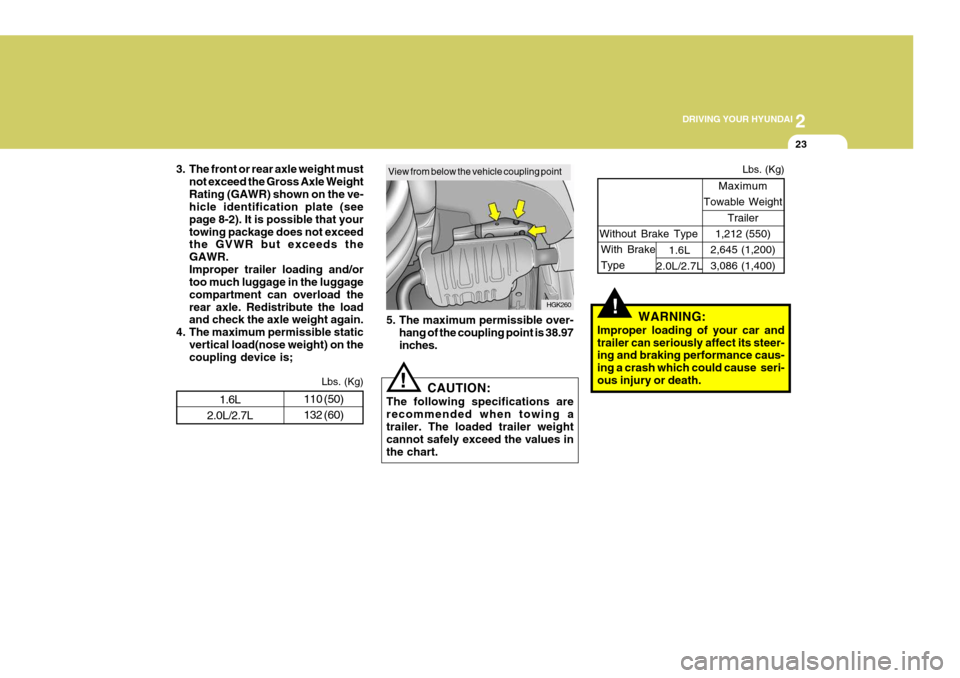
5. The maximum permissible over-
hang of the coupling point is 38.97 inches.
Lbs. (Kg) View from below the vehicle coupling point
HGK260!WARNING:
Improper loading of your car and trailer can seriously affect its steer- ing and braking performance caus- ing a crash which could cause seri-ous injury or death. Without Brake Type
Maximum
Towable Weight
Trailer
1,212 (550)
2,645 (1,200) 3,086 (1,400)
With Brake Type1.6L
2.0L/2.7L Lbs. (Kg)
Page 317 of 407

2DRIVING YOUR HYUNDAI
24
13. Avoid holding the brake pedal downtoo long or too frequently. This could cause the brakes to overheat, re- sulting in reduced braking efficiency.
14. When going down a hill, shift into a
lower gear and use the engine brak-ing effect. When climbing a long grade, down-shift the transaxle to a lower gear and reduce speed to reduce chances of engine overloading and/or over-heating.
15. If you have to stop whilst going
uphill, do not hold the vehicle inplace by pressing on the accelera- tor. This can cause the automatic transaxle to overheat. Use the park-ing brake or footbrake.
NOTE: When towing, check transaxle fluid more frequently.
8. When parking your car and trailer,
especially on a hill, be sure to followall the normal precautions. Turn your front wheels into the curb, set the parking brake firmly, and put thetransaxle in 1st or Reverse (manual) or Park (automatic). In addition we advise the use of wheel chocks ateach of the trailer's tyres.
9. If the trailer has electric brakes, start
your vehicle and trailer moving, andthen apply the trailer brake controller by hand to be sure the brakes are working. This lets you check yourelectrical connection at the same time.
10. During your trip, check occasionally to be sure that the load is secure,and that the lights and any trailer brakes are still working.
11. Avoid jerky starts, sudden accel- eration or sudden stops.
12. Avoid sharp turns and rapid lane changes.
YC200E3-E Trailer or Vehicle Towing Tips
1. Before towing, check towbar ball and
safety cable connections as well as proper operation of the trailer running lights, brake lights, and turn signals.
2. Always drive your vehicle at a mod-
erate speed (Less than 60 mph).
3. Trailer towing requires more fuel than
normal conditions.
4. To maintain engine braking effi- ciency, do not tow a trailer with the transaxle in fifth gear (manual transaxle) or overdrive (automatic transaxle).
5. Always secure items in the trailer to prevent load shift whilst driving.
6. Check the condition and air pressure of all tyres on the trailer and your car. Low tyre pressure can seriously af- fect the handling. Also check thespare tyre.
7. The vehicle/trailer combination is
more affected by crosswind and buf-feting. When being passed by a large vehicle, keep a constant speed and steer straight ahead. If there is toomuch wind buffeting, slow down to get out of the other vehicle's air turbulence.
Page 322 of 407
3 IN CASE OF EMERGENCY
4
7. Switch "ON" the main beam
headlamps before carefully remov- ing the jumper cables have been removed, switch "OFF" the main beam headlamps. SD040A2-E If the temperature gauge indicates overheating:
1. Pull off the road and stop as soon as
it is safe to do so.
2. Place the gear selector lever in "P"
(automatic), or neutral (manual transaxle) and set the parking brake. If the air conditioning is on, turn it off.
3. If coolant is running out under the car or steam is coming out fromunder the bonnet stop the engine. Do not open the bonnet until thecoolant has stopped running or the steaming has stopped. If there is no visible loss of coolant and no steam,leave the engine running and check to be sure the engine cooling fan is operating.If the fan is not running, turn the engine off.
4. Check to see if the water pump drive belt is broken. If it is not missing,check to see that it is tight. If the drive belt seems to be satisfactory,check for coolant leaking from the radiator, hoses or under the car. (If the air conditioning had been in use,it is normal for cold water to be draining from it).
IF THE ENGINE OVERHEATS
1. Ensure that the booster battery is 12 volt type. If the booster battery is installed in another vehicle, ensure that the two vehicles are not touch- ing.
2. Turn off all unnecessary electrical equipment in both vehicles.
3. Ensure that the engine of the ve- hicle providing the jump start is run- ning prior to connection of the jump cables.
4. Connect the red jump cable to the positive (+) terminal of the boosterbattery and the other end to thepositive (+) terminal of the dis- charged battery.
5. Attach the black jump cable to the negative (-) terminal of the boosterbattery, and the other end to a ground point within the engine compartmentof the vehicle with the flat battery. Do not connect to the negative battery terminal of the flat battery sincesparks may be generated with the subsequent risk of explosion.
6. Raise the booster vehicle engine speed to 2,000 r.p.m. and start theengine of the vehicle with the flat battery. CAUTION:
If the jump cables are incorrectlyinstalled, damage to the vehicle elec-trical system may occur, in particu- lar the electronic components such as the Fuel Injection system com- puter and the Automatic Transaxle computer. The battery must neverbe disconnected whilst the engine is running.
!
Page 325 of 407
3
IN CASE OF EMERGENCY
7
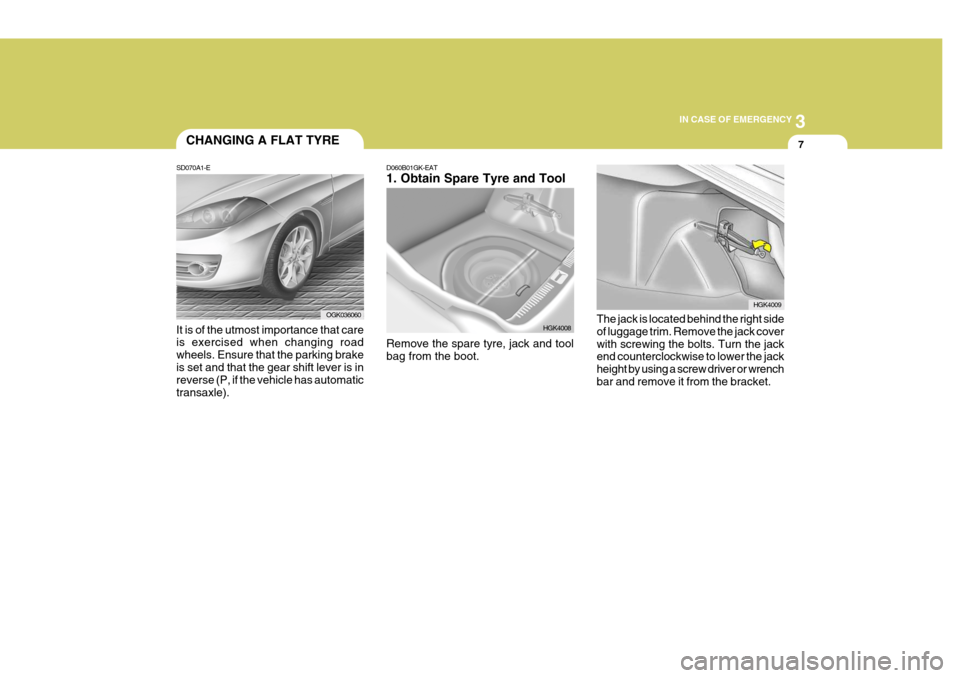
SD070A1-E CHANGING A FLAT TYRE
It is of the utmost importance that care is exercised when changing road wheels. Ensure that the parking brakeis set and that the gear shift lever is in reverse (P, if the vehicle has automatic transaxle).
OGK036060
D060B01GK-EAT 1. Obtain Spare Tyre and Tool Remove the spare tyre, jack and tool bag from the boot. HGK4008
HGK4009
The jack is located behind the right side of luggage trim. Remove the jack coverwith screwing the bolts. Turn the jack end counterclockwise to lower the jack height by using a screw driver or wrenchbar and remove it from the bracket.
Page 330 of 407
3 IN CASE OF EMERGENCY
12
!
!
1) If the vehicle is being towed with the
rear wheels on the ground, be sure the parking brake is released.
NOTE: Before towing, check the level of the automatic transaxle fluid. If it is below the "HOT" range on the dip-stick, add fluid. If you cannot add fluid, a towing dolly must be used.
2) If any of the loaded wheels or sus- pension components are damaged or the vehicle is being towed with the front wheels on the ground, use a towing dolly under the front wheels.
o Manual Transaxle: If you do not use a towing dolly,place the ignition key in the "ACC"position and put the transaxle in "N (Neutral)".
CAUTION:
Do not tow with the key removed or in the "LOCK" position when tow- ing from the rear without a towing dolly.
CAUTION:
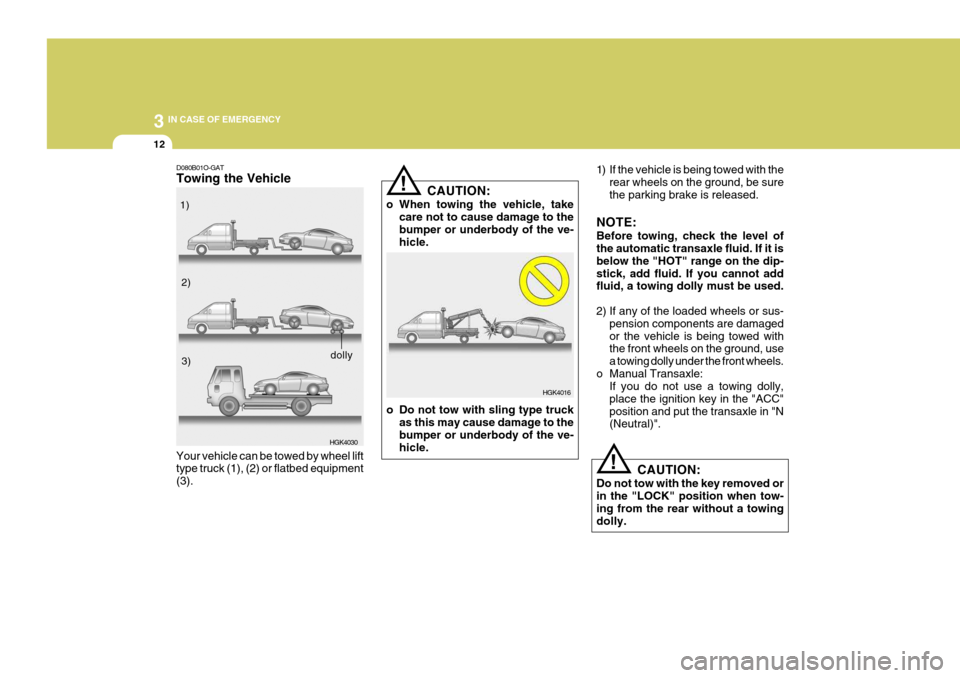
o When towing the vehicle, take care not to cause damage to the bumper or underbody of the ve- hicle.
o Do not tow with sling type truck as this may cause damage to thebumper or underbody of the ve-hicle. HGK4016
D080B01O-GAT Towing the Vehicle
HGK4030
Your vehicle can be towed by wheel lift type truck (1), (2) or flatbed equipment (3). 1)
2)
3)
dolly
Page 331 of 407
3
IN CASE OF EMERGENCY
13
HGK4017
!
o Automatic Transaxle:
Be sure to use a towing dolly under the front wheels.
CAUTION:
A vehicle with an automatic transaxleshould never be towed from the rear with the front wheels on the ground. This can cause serious damage tothe transaxle.
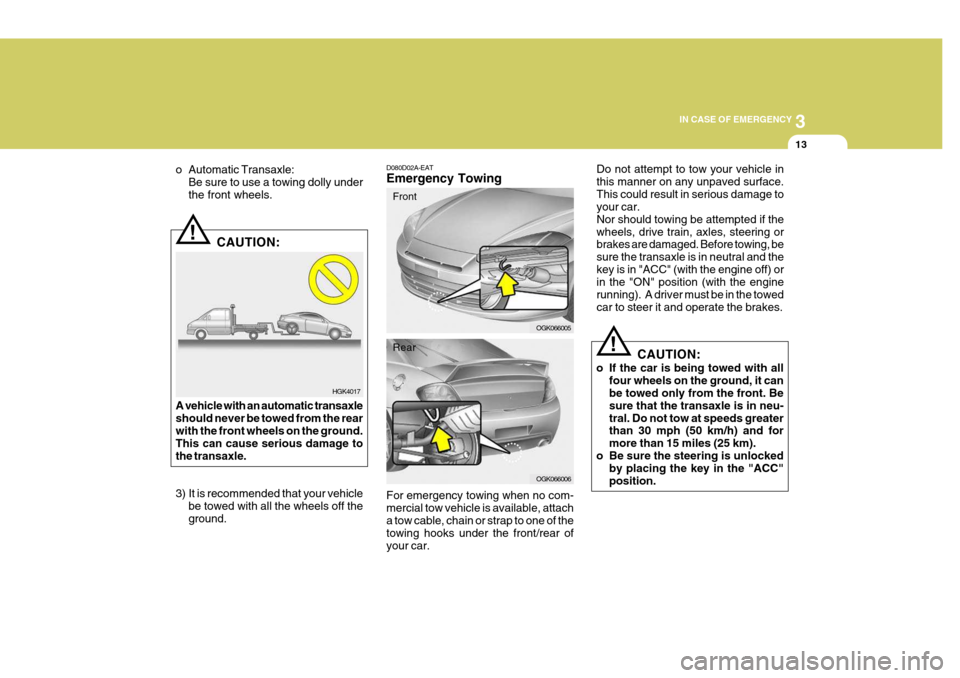
3) It is recommended that your vehicle be towed with all the wheels off the ground. D080D02A-EAT Emergency Towing For emergency towing when no com- mercial tow vehicle is available, attacha tow cable, chain or strap to one of the towing hooks under the front/rear of your car.
!
CAUTION:
o If the car is being towed with all four wheels on the ground, it can be towed only from the front. Be sure that the transaxle is in neu-tral. Do not tow at speeds greater than 30 mph (50 km/h) and for more than 15 miles (25 km).
o Be sure the steering is unlocked by placing the key in the "ACC"position.
OGK066005
Front
OGK066006
Rear Do not attempt to tow your vehicle in this manner on any unpaved surface.This could result in serious damage to your car. Nor should towing be attempted if thewheels, drive train, axles, steering or brakes are damaged. Before towing, be sure the transaxle is in neutral and thekey is in "ACC" (with the engine off) or in the "ON" position (with the engine running). A driver must be in the towedcar to steer it and operate the brakes.