brake Hyundai Coupe 2008 Workshop Manual
[x] Cancel search | Manufacturer: HYUNDAI, Model Year: 2008, Model line: Coupe, Model: Hyundai Coupe 2008Pages: 407, PDF Size: 11.03 MB
Page 268 of 407

F9
CAUTION:
When installing a container of liquid air freshener inside the vehicle, do not place it near the instrument cluster nor on the instrument panel surface. If there is any leakage from the air freshener onto these areas (Instrument cluster, instrument panel or air ventilator), it may damage these parts. If the liquid from the air freshener does leak onto these areas, wash themwith water immediately.
!
1. Passenger's Air Bag (Not all models)
2. Rear Fog Light Switch
3. Outside Temperature Switch
4. Hazard Warning Switch
5. Digital Clock
6. Front Fog Light Switch
7. Windscreen Wiper/Washer Switch
8. Horn and Driver's Airbag
9. Ignition Switch
10. Multi-Function Light Switch
11. Glove Box
12. Cigar Lighter
13. Front Seat Warmer (Not all models)
14. Shift Lever
15. Parking Brake Lever
16. Ashtray
17. Heating/Air Conditioning Control Panel
18. Steering Wheel Tilt Lever
19. Bonnet Release Lever
20. Fuse and Relay Box
Page 269 of 407

YOUR VEHICLE AT A GLANCE
F10B255A02GK-EAT INDICATOR SYMBOLS ON THE INSTRUMENT PANEL
* More detailed explanations of these items will be found beginning on page 1-42.
Turn Signal Indicator Lights Electronic Stability Program (ESP) Indicator Lights (Not all models)Malfunction Indicator Light (Not all models)
SRS (Airbag) Service Reminder Indicator (SRI)
Low Fuel Level Warning Light
High Beam Indicator Light Low Oil Pressure Warning Light
Charging System Warning Light
Seat Belt Warning Light
Immobiliser Warning Light
Hatchback Door Open Warning Light
Door Open (Ajar) Warning Light
ABS Service Reminder Indicator (Not all models)
Parking Brake/Low Brake Fluid Level Warning Light
CRUISE Indicator Light (Not all models)
CRUISE SET Indicator Light (Not all models)
Page 294 of 407
2
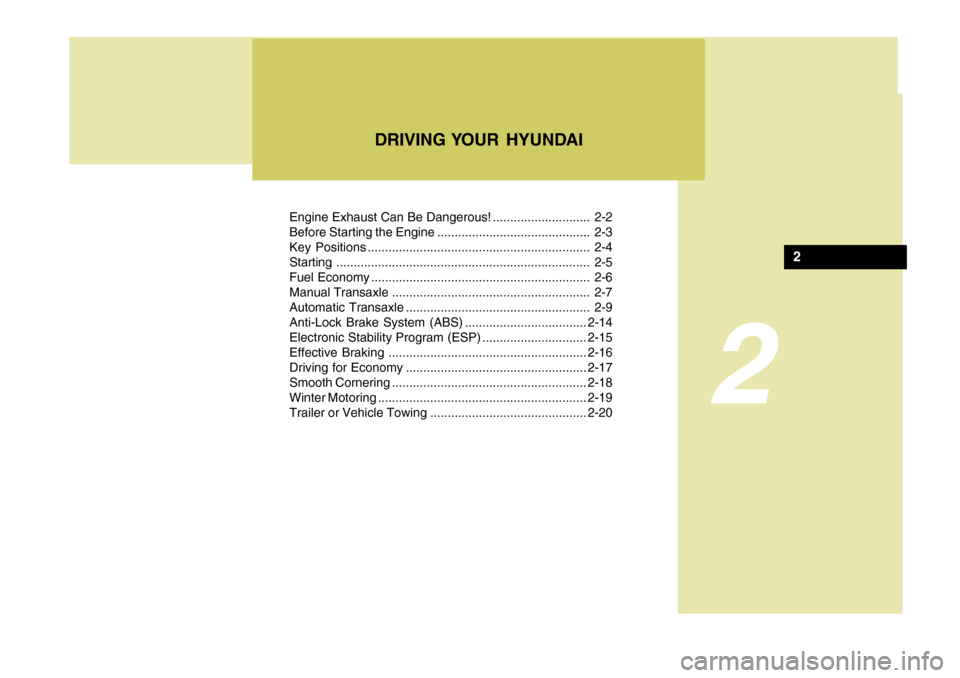
Engine Exhaust Can Be Dangerous! ............................ 2-2
Before Starting the Engine ............................................ 2-3
Key Positions ................................................................ 2-4Starting ......................................................................... 2-5
Fuel Economy ............................................................... 2-6
Manual Transaxle ......................................................... 2-7
Automatic Transaxle ..................................................... 2-9Anti-Lock Brake System (ABS) ................................... 2-14
Electronic Stability Program (ESP) ..............................2-15
Effective Braking ......................................................... 2-16
Driving for Economy .................................................... 2-17
Smooth Cornering ........................................................ 2-18
Winter Motoring ............................................................ 2-19
Trailer or Vehicle Towing ............................................. 2-20
DRIVING YOUR HYUNDAI
2
Page 296 of 407
2
DRIVING YOUR HYUNDAI
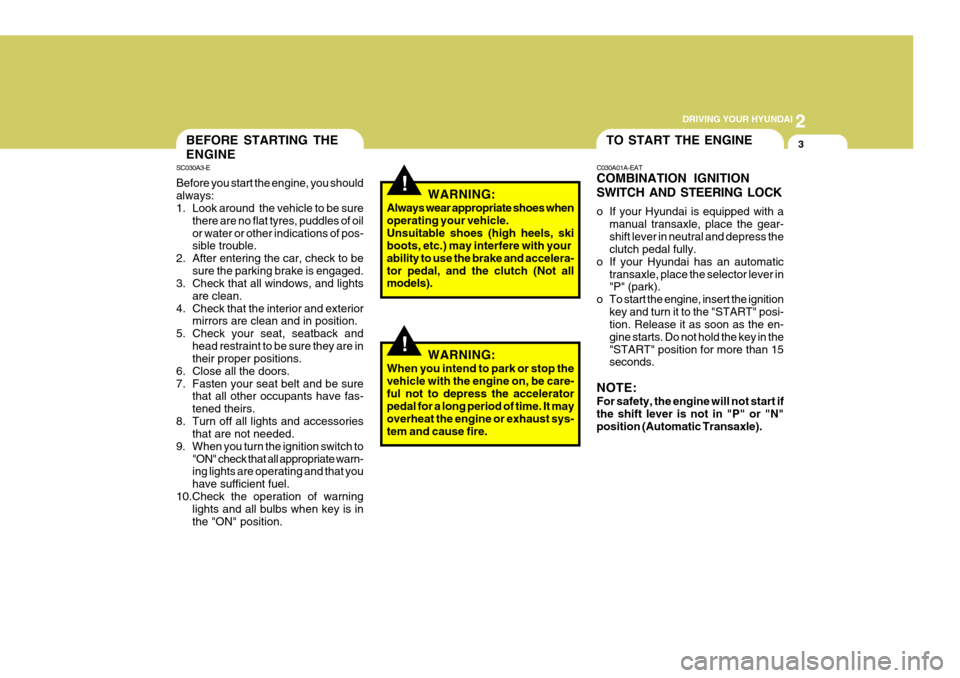
3TO START THE ENGINEBEFORE STARTING THE ENGINE
SC030A3-E Before you start the engine, you should always:
1. Look around the vehicle to be sure
there are no flat tyres, puddles of oil or water or other indications of pos- sible trouble.
2. After entering the car, check to be sure the parking brake is engaged.
3. Check that all windows, and lights
are clean.
4. Check that the interior and exterior mirrors are clean and in position.
5. Check your seat, seatback and head restraint to be sure they are intheir proper positions.
6. Close all the doors.
7. Fasten your seat belt and be sure that all other occupants have fas-tened theirs.
8. Turn off all lights and accessories that are not needed.
9. When you turn the ignition switch to "ON" check that all appropriate warn- ing lights are operating and that you have sufficient fuel.
10.Check the operation of warning lights and all bulbs when key is inthe "ON" position.
!WARNING:
Always wear appropriate shoes when operating your vehicle.Unsuitable shoes (high heels, ski boots, etc.) may interfere with your ability to use the brake and accelera-tor pedal, and the clutch (Not all models). C030A01A-EAT COMBINATION IGNITION SWITCH AND STEERING LOCK
o If your Hyundai is equipped with a
manual transaxle, place the gear- shift lever in neutral and depress the clutch pedal fully.
o If your Hyundai has an automatic
transaxle, place the selector lever in"P" (park).
o To start the engine, insert the ignition key and turn it to the "START" posi-tion. Release it as soon as the en- gine starts. Do not hold the key in the"START" position for more than 15 seconds.
NOTE: For safety, the engine will not start if the shift lever is not in "P" or "N" position (Automatic Transaxle).
!WARNING:
When you intend to park or stop the vehicle with the engine on, be care-ful not to depress the accelerator pedal for a long period of time. It may overheat the engine or exhaust sys-tem and cause fire.
Page 300 of 407
2
DRIVING YOUR HYUNDAI
7
!
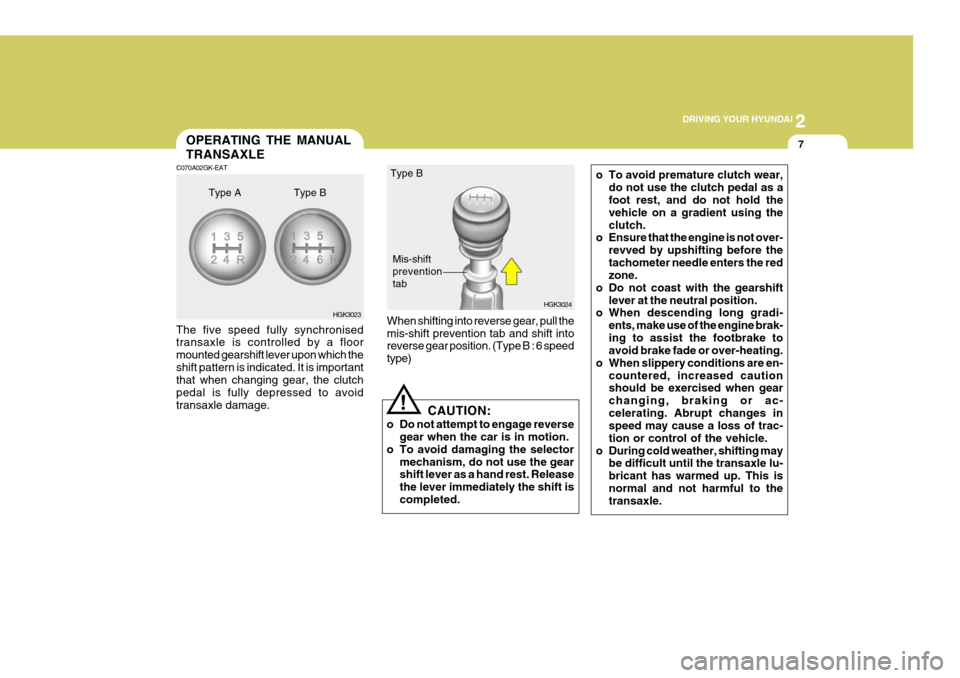
When shifting into reverse gear, pull the mis-shift prevention tab and shift into reverse gear position. (Type B : 6 speed type) HGK3024
Type B
Mis-shift preventiontab
OPERATING THE MANUAL TRANSAXLE
C070A02GK-EAT The five speed fully synchronised transaxle is controlled by a floor mounted gearshift lever upon which theshift pattern is indicated. It is important that when changing gear, the clutch pedal is fully depressed to avoidtransaxle damage. HGK3023
Type A Type B
CAUTION:
o Do not attempt to engage reverse gear when the car is in motion.
o To avoid damaging the selector mechanism, do not use the gear shift lever as a hand rest. Release the lever immediately the shift iscompleted. o To avoid premature clutch wear,
do not use the clutch pedal as a foot rest, and do not hold the vehicle on a gradient using theclutch.
o Ensure that the engine is not over-
revved by upshifting before thetachometer needle enters the red zone.
o Do not coast with the gearshift
lever at the neutral position.
o When descending long gradi-
ents, make use of the engine brak- ing to assist the footbrake to avoid brake fade or over-heating.
o When slippery conditions are en- countered, increased cautionshould be exercised when gear changing, braking or ac-celerating. Abrupt changes in speed may cause a loss of trac- tion or control of the vehicle.
o During cold weather, shifting may be difficult until the transaxle lu-bricant has warmed up. This isnormal and not harmful to the transaxle.
Page 301 of 407
2DRIVING YOUR HYUNDAI
8
o If you've come to a complete stopand it's hard to shift into 1st or R(Reverse), put the gearshift lever in N(Neutral) position and let upon the clutch. Press the clutch pedal back down, and then shift into 1st or R(Reverse) gear posi-tion.
o Do not use the gearshift lever as a
handrest during driving, as thiscan result in premature wear of the transaxle shift forks.
o Do not downshift more than 2 gears at once or when the engine isrunning at high speed (5,000 RPM or higher). Such downshifting maydamage the engine.
C070B01A-EAT Using the Clutch The clutch should be pressed all the way to the floor before shifting, thenreleased slowly. The clutch pedal should always be used after fully returning to the original position. Do not rest yourfoot on the clutch pedal whilst driving. This can cause unnecessary wear. Do not partially engage the clutch tohold the car on an incline. This causes unnecessary wear. Use the parking brake to hold the car onan incline. Do not operate the clutch pedal rapidly and repeatedly.
!WARNING:
o Avoid high cornering speeds.
o Do not make quick steering wheel movements, such as sharp lane changes or fast, sharp turns.
o Always wear your seat belts.
In a collision crash, an unbeltedperson is significantly more likely to die than a person wearing aseat belt.
o The risk of rollover is greatly in-
creased if you lose control of your vehicle at motorway speeds.
o Loss of control often occurs if two
or more wheels drop off the road-way and the driver oversteers to reenter the roadway.
o In the event your vehicle leaves the roadway, do not steer sharply.Instead, slow down before pullingback into the travel lanes.
o Never exceed posted speed limits.
!WARNING:
If your vehicle has a manual transaxle not equipped with a ignition lock switch, it may move and cause aserious accident when starting the engine without depressing the clutch pedal while the parking brake is re-leased and the shift never not in the N(Neutral) position.
Page 303 of 407
2DRIVING YOUR HYUNDAI
10
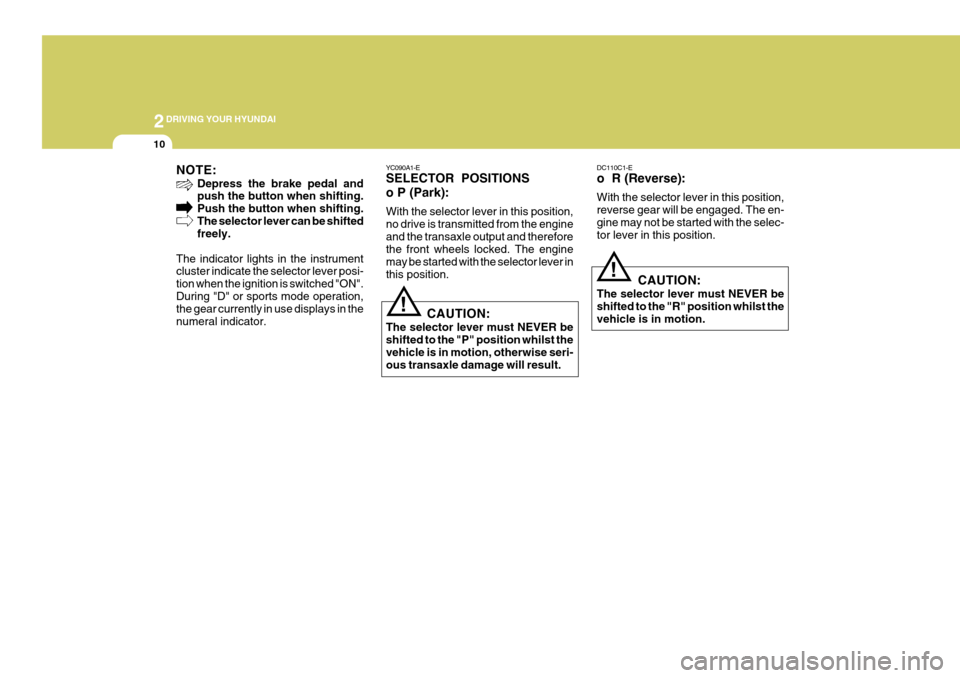
NOTE:Depress the brake pedal and push the button when shifting. Push the button when shifting.The selector lever can be shifted freely.
The indicator lights in the instrumentcluster indicate the selector lever posi- tion when the ignition is switched "ON".During "D" or sports mode operation, the gear currently in use displays in the numeral indicator.
YC090A1-E SELECTOR POSITIONS o P (Park): With the selector lever in this position, no drive is transmitted from the engineand the transaxle output and therefore the front wheels locked. The engine may be started with the selector lever inthis position.
CAUTION:
The selector lever must NEVER beshifted to the "P" position whilst thevehicle is in motion, otherwise seri- ous transaxle damage will result.
! DC110C1-E o R (Reverse): With the selector lever in this position, reverse gear will be engaged. The en-gine may not be started with the selec- tor lever in this position.
CAUTION:
The selector lever must NEVER be shifted to the "R" position whilst thevehicle is in motion.
!
Page 305 of 407

2DRIVING YOUR HYUNDAI
12
C090H01L-EAT NOTE:
o For smooth and safe operation,depress the brake pedal when shifting from "Neutral" positionor "Park" position to a forward or reverse gear.
o The ignition key must be in the "ON" position and the brake pedalfully depressed in order to move the selector lever from the "P"(Park) position to any of the other positions.
o It is always possible to shift from "R", "N", "D" position to "P" po-sition. The vehicle must be fully stopped to avoid transaxle dam-age.
NOTE:
o In sports mode, only the four
forward gears can be selected. To reverse or park the vehicle,move the selector lever to the "R" or "P" position as required.
o In sports mode, downward shifts are made automatically when thevehicle slows down. When the vehicle stops, 1st gear is auto-matically selected.
o To maintain the required levels
of vehicle performance andsafety, the system may not ex- ecute certain gearshifts when the selector lever is operated.
o Before driving away from a stop on a slippery road, push the se-lector lever forward into the +(UP)position. This causes the transaxle to shift into 2nd gear which is better for smooth driv-ing away on a slippery road. Push the selector lever to the -(DOWN) side to shift back to 1st gear.
!
C090I04L-EAT
CAUTION:
o Shift into "R", "D" and "P" posi- tion only when the vehicle has completely stopped.
o Do not accelerate the engine in reverse or any of the forwardpositions with the brakes applied.
o Always apply the footbrake when shifting from "P" or "N", to "R","D"position.
o Do not use the "P" (Park) posi- tion in place of the parking brake.Always set the parking brake,shift the transaxle into "P" (Park) position and turn off the ignition when you leave the vehicle, evenmomentarily. Never leave the ve- hicle unattended whilst the en- gine is running.
o When accelerating from a stop on a steep hill, the vehicle may havea tendency to roll backwards. Shift-ing the shift lever into 2nd gear whilst in sport mode will help prevent the vehicle from rollingbackwards.
Page 306 of 407

2
DRIVING YOUR HYUNDAI
13
o Check the automatic transaxle fluid level regularly, and add fluid as necessary.
o See the maintenance schedule for
the proper fluid recommendation.
C090N05O-EAT General Operating Instructions
o The engine may only be started when
the selector lever is at position "P".
o Ensure that the footbrake is firmly applied when shifting from "P" or "N", to "R" or "D" and vice versa.
o Always engage the parking brake when the vehicle is unattended, neveruse the "P" or "R" position in place ofthe parking brake.
o Under normal circumstances, the
selector lever should be placed in the"D" position and the transaxle al- lowed to select the most ideal ratio for the circumstances. In this posi-tion maximum fuel economy will be achieved.
o When descending steep gradients where engine braking is required, theselector lever should be shifted into 1st gear whilst in sport mode de-pending upon the vehicle speed.
o When climbing steep gradients and
using large throttle openings, thetransaxle may repeatedly change between two adjacent ratios. This is a normal characteristic and may beprevented by shifting into 1st gear whilst in sport mode depending upon the vehicle speed. o Never move the selector lever to or
from the "P" or "N" position with theaccelerator depressed.
o If rapid acceleration is required, fully
depress the accelerator pedal. Inthis condition, the kickdown mecha- nism will be operated and the transaxle will automatically down-shift according to the vehicle speed.
o Do not depress the accelerator pedal
with the brakes applied and the se-lector at the "R" or "D" position.
o The automatic transaxle may be used
to great effect if the vehicle becomesstuck in snow or mud by allowing the vehicle to be rocked to and fro. The engine speed should be held at ap-proximately 1,000rpm by means of the accelerator pedal and the selec- tor lever moved between the "D" and"R" positions to induce a rocking motion.
o Optimum vehicle performance and economy is obtained by smoothlydepressing and releasing the accel- erator pedal.
Page 307 of 407
2DRIVING YOUR HYUNDAI
14
!o If your vehicle becomes stuck in
snow, mud, sand, etc., then you may attempt to rock the vehicle free by moving it forward and back-ward. Do not attempt this proce- dure if people or objects are any- where near the vehicle. During therocking operation the vehicle may suddenly move forward of back- ward as it becomes unstuck, caus-ing injury or damage to nearby people or objects.
WARNING:
o Avoid high cornering speeds.
o Do not make quick steering wheel movements, such as sharp lane changes or fast, sharp turns.
o Always wear your seat belts. In a collision crash, an unbeltedperson is significantly more likely to die than a person wearing aseatbelt.
o The risk of rollover is greatly in-
creased if you lose control of yourvehicle at motorway speeds.
o Loss of control often occurs if two
or more wheels drop off the road-way and the driver oversteers to reenter the roadway.
o In the event your vehicle leaves
the roadway, do not steer sharply.Instead, slow down before pulling back into the travel lanes.
o Never exceed posted speed limits.
ANTI-LOCK BRAKE SYSTEM (ABS)
C120A01FC-EAT (Not all models) The Anti-Lock Brake System (ABS) is designed to prevent wheel lock-up dur-ing sudden braking or on hazardous road surfaces. The ABS control module monitors the wheel speed and controlsthe pressure applied to each brake. Thus, in emergency situations or on slick roads, ABS will increase vehiclecontrol during braking. NOTE:
o A click sound may be heard in the
engine compartment when the ve- hicle begins to move after the en- gine is started. These conditionsare normal and indicate that the anti-lock brake system (Electronic Stability Program) is functioningproperly.
o During ABS (ESP) operation, a
slight pulsation may be felt in thebrake pedal when the brakes are applied. Also, a noise may be heard in the engine compartment whilstbraking. These conditions are nor- mal and indicate that the anti-lock brake system (Electronic StabilityProgram) is functioning properly.