brake light HYUNDAI COUPE 2012 Owner's Guide
[x] Cancel search | Manufacturer: HYUNDAI, Model Year: 2012, Model line: COUPE, Model: HYUNDAI COUPE 2012Pages: 391, PDF Size: 6.88 MB
Page 282 of 391
63
What to do in an emergency
2. When the car is stopped, turn on youremergency hazard flashers, set the
parking brake and put the transmission
in P (automatic transmission) or
reverse (manual transmission).
3. Have all passengers get out of the car. Be sure they all get out on the side of
the car that is away from traffic.
4. When changing a flat tire, follow the instruction provided later in this sec-
tion.
F020300AEN
If engine stalls while driving
1. Reduce your speed gradually, keeping a straight line. Move cautiously off the
road to a safe place.
2. Turn on your emergency flashers.
3. Try to start the engine again. If your vehicle will not start, contact an
authorized HYUNDAI dealer or seek
other qualified assistance.
F030100ABK
If engine doesn't turn over or
turns over slowly
1. If your vehicle has an automatic trans-mission, be sure the gear selector
lever is in N(Neutral) or P(Park) and
the emergency brake is set.
2. Check the battery connections to be sure they are clean and tight.
3. Turn on the interior light. If the light dims or goes out when you operate the
starter, the battery is discharged.
4. Check the starter connections to be sure they are securely tightened.
5. Do not push or pull the vehicle to start it. See instructions for "Jump starting".
F030200ABH
If the engine turns over normally
but does not start
1. Check fuel level.
2. With the ignition switch in the LOCKposition, check all connectors at the
ignition coils and spark plugs.
Reconnect any that may be discon-
nected or loose.
3. If the engine still does not start, call an authorized HYUNDAI dealer or seek
other qualified assistance.
IF THE ENGINE WILL NOT START
WARNING
If the engine will not start, do not
push or pull the car to start it. This
could result in a collision or cause
other damage.
procarmanuals.com
Page 290 of 391
611
What to do in an emergency
Allow the tire to cool before measur-
ing the inflation pressure. Always be
sure the tire is cold before inflating to
the recommended pressure.
A cold tire means the vehicle has
been sitting for 3 hours and driven for
less than 1 mile (1.6 km) in that 3
hour period.This device complies with Part 15
of the FCC rules.
Operation is subject to the following
two conditions:
1. This device may not cause harm-
ful interference, and
2. This device must accept any inter- ference received, including inter-
ference that may cause undesired
operation.
CAUTION
Do not use any tire sealant ifyour vehicle is equipped with aTire Pressure MonitoringSystem. The liquid sealant candamage the tire pressure sen-sors.
WARNING - Protecting TPMS
Tampering with, modifying, or
disabling the Tire Pressure
Monitoring System (TPMS)
components may interfere with
the system's ability to warn the
driver of low tire pressure con-
ditions and/or TPMS malfunc-
tions. Tampering with, modify-
ing, or disabling the Tire
Pressure Monitoring System
(TPMS) components may void
the warranty for that portion of
the vehicle.
WARNING- TPMS
The TPMS cannot alert you to severe and sudden tire dam-
age caused by external fac-
tors such as nails or road
debris.
If you feel any vehicle instabil- ity, immediately take your foot
off the accelerator, apply the
brakes gradually and with
light force, and slowly move to
a safe position off the road.
WARNING
Changes or modifications not
expressly approved by the party
responsible for compliance
could void the user's authority
to operate the equipment.
procarmanuals.com
Page 303 of 391
7
Engine compartment / 7-2
Maintenance services / 7-4
Owner maintenance / 7-5
Scheduled maintenance service / 7-7
Explanation of scheduled maintenance items / 7-13
Engine oil / 7-16
Engine coolant / 7-17
Brake and clutch fluid / 7-20
Power steering fluid / 7-21
Automatic transmission fluid / 7-22
Manual transmission fluid / 7-22
Washer fluid / 7-22
Parking brake / 7-23
Air cleaner / 7-24
Climate control air filter / 7-25
Wiper blades / 7-27
Battery / 7-30
Tires and wheels / 7-33
Fuses / 7-47
Light bulbs / 7-56
Appearance care / 7-61
Emission control system / 7-67
Califonia perchlorate notice / 7-70
Maintenance
procarmanuals.com
Page 308 of 391
Maintenance
67
G030102ABH
While operating your vehicle:
Note any changes in the sound of theexhaust or any smell of exhaust fumes
in the vehicle.
Check for vibrations in the steering wheel. Notice any increased steering
effort or looseness in the steering
wheel, or change in its straight-ahead
position.
Notice if your vehicle constantly turns slightly or “pulls” to one side when trav-
eling on smooth, level road.
When stopping, listen and check for unusual sounds, pulling to one side,
increased brake pedal travel or “hard-
to-push” brake pedal.
If any slipping or changes in the oper- ation of your transmission occurs,
check the transmission fluid level.
Check automatic transmission P (Park) function.
Check parking brake.
Check for fluid leaks under your vehicle (water dripping from the air condition-
ing system during or after use is nor-
mal).
G030103AUN
At least monthly:
Check the coolant level in the enginecoolant reservoir.
Check the operation of all exterior lights, including the stoplights, turn sig-
nals and hazard warning flashers.
Check the inflation pressures of all tires including the spare.
G030104AHM
At least twice a year (i.e., every Spring and Fall):
Check the radiator, heater and air con- ditioning hoses for leaks or damage.
Check the windshield washer spray and wiper operation. Clean the wiper
blades with clean cloth dampened with
washer fluid.
Check the headlight alignment.
Check the muffler, exhaust pipes, shields and clamps.
Check the lap/shoulder belts for wear and function.
Check for worn tires and loose wheel lug nuts.
procarmanuals.com
Page 340 of 391
Maintenance
38
7
G200601AUN
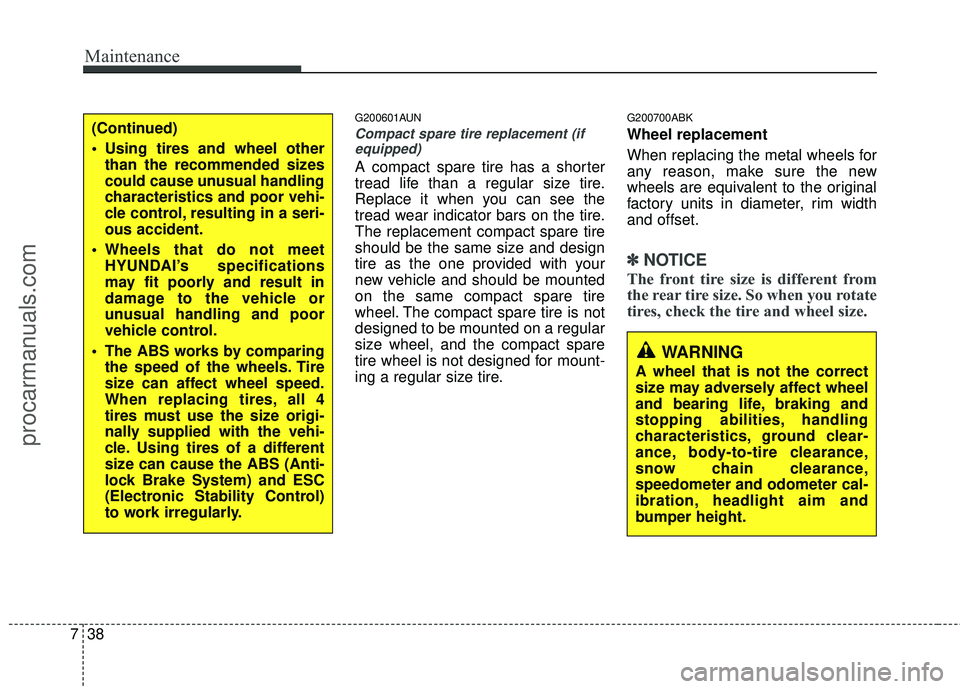
Compact spare tire replacement (if
equipped)
A compact spare tire has a shorter
tread life than a regular size tire.
Replace it when you can see the
tread wear indicator bars on the tire.
The replacement compact spare tire
should be the same size and design
tire as the one provided with your
new vehicle and should be mounted
on the same compact spare tire
wheel. The compact spare tire is not
designed to be mounted on a regular
size wheel, and the compact spare
tire wheel is not designed for mount-
ing a regular size tire.
G200700ABK
Wheel replacement
When replacing the metal wheels for
any reason, make sure the new
wheels are equivalent to the original
factory units in diameter, rim width
and offset.
✽ ✽ NOTICE
The front tire size is different from
the rear tire size. So when you rotate
tires, check the tire and wheel size.
(Continued)
Using tires and wheel other
than the recommended sizes
could cause unusual handling
characteristics and poor vehi-
cle control, resulting in a seri-
ous accident.
Wheels that do not meet HYUNDAI’s specifications
may fit poorly and result in
damage to the vehicle or
unusual handling and poor
vehicle control.
The ABS works by comparing the speed of the wheels. Tire
size can affect wheel speed.
When replacing tires, all 4
tires must use the size origi-
nally supplied with the vehi-
cle. Using tires of a different
size can cause the ABS (Anti-
lock Brake System) and ESC
(Electronic Stability Control)
to work irregularly.
WARNING
A wheel that is not the correct
size may adversely affect wheel
and bearing life, braking and
stopping abilities, handling
characteristics, ground clear-
ance, body-to-tire clearance,
snow chain clearance,
speedometer and odometer cal-
ibration, headlight aim and
bumper height.
procarmanuals.com
Page 358 of 391
Maintenance
56
7
LIGHT BULBS
G220000AEN
Use only the bulbs of the specified
wattage.
✽
✽ NOTICE
After heavy, driving rain or washing,
headlight and taillight lenses could
appear frosty. This condition is caused by
the temperature difference between the
lamp inside and outside. This is similar
to the condensation on your windows
inside your vehicle during the rain and
doesn’t indicate a problem with your
vehicle. If the water leaks into the lamp
bulb circuitry, have the vehicle checked
by an authorized HYUNDAI dealer.
G220100ABH
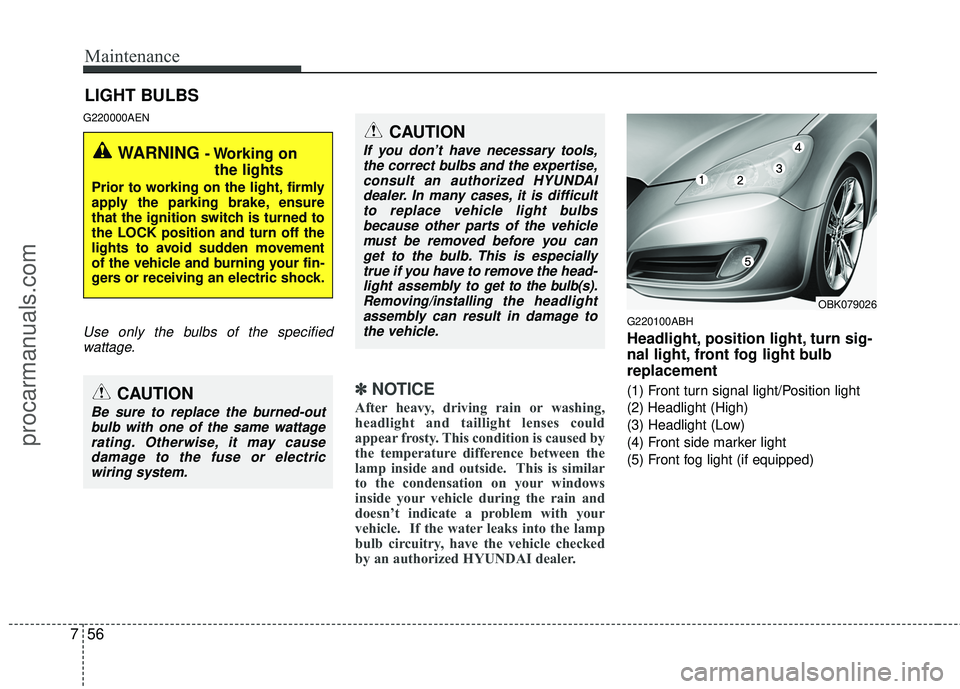
Headlight, position light, turn sig-
nal light, front fog light bulb
replacement
(1) Front turn signal light/Position light
(2) Headlight (High)
(3) Headlight (Low)
(4) Front side marker light
(5) Front fog light (if equipped)
WARNING - Working on
the lights
Prior to working on the light, firmly
apply the parking brake, ensure
that the ignition switch is turned to
the LOCK position and turn off the
lights to avoid sudden movement
of the vehicle and burning your fin-
gers or receiving an electric shock.
CAUTION
Be sure to replace the burned-out
bulb with one of the same wattagerating. Otherwise, it may cause damage to the fuse or electricwiring system.
CAUTION
If you don’t have necessary tools,the correct bulbs and the expertise,consult an authorized HYUNDAIdealer. In many cases, it is difficultto replace vehicle light bulbs because other parts of the vehiclemust be removed before you canget to the bulb. This is especiallytrue if you have to remove the head-light assembly to
get to the bulb(s).
Removing/installingthe headlight
assembly can result in damage to the vehicle.OBK079026
procarmanuals.com
Page 363 of 391
761
Maintenance
Exterior care
G230101AUN
Exterior general caution
It is very important to follow the label
directions when using any chemical
cleaner or polish. Read all warning and
caution statements that appear on the
label.
G230102ABH
Finish maintenance
Washing
To help protect your vehicle’s finish from
rust and deterioration, wash it thoroughly
and frequently at least once a month with
lukewarm or cold water.
If you use your vehicle for off-road driv-
ing, you should wash it after each off-
road trip. Pay special attention to the
removal of any accumulation of salt, dirt,
mud, and other foreign materials. Make
sure the drain holes in the lower edges of
the doors and rocker panels are kept
clear and clean.
Insects, tar, tree sap, bird droppings,
industrial pollution and similar deposits
can damage your vehicle’s finish if not
removed immediately.
Even prompt washing with plain water
may not completely remove all these
deposits. A mild soap, safe for use on
painted surfaces, may be used.After washing, rinse the vehicle thor-
oughly with lukewarm or cold water. Do
not allow soap to dry on the finish.
APPEARANCE CARE
CAUTION
Do not use strong soap, chemical
detergents or hot water, and donot wash the vehicle in directsunlight or when the body of thevehicle is warm.
Do not wash the side windows too close with high pressurewater. Water may leak through the windows and wet the interior.
To prevent damage to the plastic parts and lamps, do not cleanwith chemical solvents or strong detergents.
WARNING - Wet brakes
After washing the vehicle, test the
brakes while driving slowly to see if
they have been affected by water. If
braking performance is impaired,
dry the brakes by applying them
lightly while maintaining a slow for-
ward speed.
CAUTION
Water washing in the engine com- partment including high pressurewater washing may cause the fail-ure of electrical circuits or engineand related part located in the engine compartment.
Never allow water or other liquids to come in contact with electri-cal/electronic components inside the vehicle as this may damagethem.
OJB037800
procarmanuals.com
Page 365 of 391
763
Maintenance
G230105AUN
Underbody maintenance
Corrosive materials used for ice and
snow removal and dust control may col-
lect on the underbody. If these materials
are not removed, accelerated rusting can
occur on underbody parts such as the
fuel lines, frame, floor pan and exhaust
system, even though they have been
treated with rust protection.
Thoroughly flush the vehicle underbody
and wheel openings with lukewarm or
cold water once a month, after off-road
driving and at the end of each winter. Pay
special attention to these areas because
it is difficult to see all the mud and dirt. It
will do more harm than good to wet down
the road grime without removing it. The
lower edges of doors, rocker panels, and
frame members have drain holes that
should not be allowed to clog with dirt;
trapped water in these areas can cause
rusting.
G230106AUN
Aluminum or chrome wheel mainte-nance
The aluminum or chrome wheels are
coated with a clear protective finish.
Do not use any abrasive cleaner, pol- ishing compound, solvent, or wire
brushes on aluminum or chrome
wheels. They may scratch or damage
the finish.
Clean the wheel when it has cooled.
Use only a mild soap or neutral deter- gent, and rinse thoroughly with water.
Also, be sure to clean the wheels after
driving on salted roads. This helps pre-
vent corrosion.
Avoid washing the wheels with high- speed car wash brushes.
Do not use any alkaline or acid deter- gent. It may damage and corrode the
aluminum or chrome wheels coated
with a clear protective finish.
WARNING
After washing the vehicle, testthe brakes while driving slowly to
see if they have been affected by
water. If braking performance is
impaired, dry the brakes by
applying them lightly while main-
taining a slow forward speed.
If the underbody of you vehicle is sprayed with coating substances,
the high-speed drive system
parts such as the drive shaft or
propeller shaft will be out of bal-
ance and make noise or vibrate.
Moreover, the high-speed drive
system parts may be damaged.
procarmanuals.com
Page 383 of 391

Index
2I
Air bags··················\
··················\
··················\
··················\
··3-33Air bag warning label··················\
··················\
············3-58
Air bag warning light ··················\
··················\
············3-36
Curtain air bag··················\
··················\
··················\
·····3-50
Driver's and passenger's front air bag··················\
··········3-44 Occupant detection system··················\
··················\
····3-39
Side impact air bag··················\
··················\
················3-48
Air cleaner ··················\
··················\
··················\
···············7-24
Antenna ··················\
··················\
··················\
··················\
··4-99
Anti-lock brake system (ABS) ··················\
··················\
··5-25
Appearance care··················\
··················\
··················\
·······7-61 Exterior care ··················\
··················\
··················\
········7-61
Interior care ··················\
··················\
··················\
·········7-66
Audio system ··················\
··················\
··················\
···········4-99 Glass antenna ··················\
··················\
··················\
······4-99
Steering wheel audio control··················\
··················\
·4-99
Auto lock mode (Passenger seat belt) ··················\
·········3-27
Automatic climate control system ··················\
···············4-79 Air conditioning ··················\
··················\
··················\
··4-84
Automatic heating and air conditioning··················\
··4-80
Manual heating and air conditioning ··················\
······4-81
Automatic transaxle ··················\
··················\
··················\
·5-16 Ignition key interlock system ··················\
··················\
5-20
Shift lock system ··················\
··················\
··················\
·5-19
Sports mode··················\
··················\
··················\
·········5-18 Battery··················\
··················\
··················\
··················\
····7-30
Battery saver function··················\
··················\
················4-61
Before driving ··················\
··················\
··················\
············5-3
Binding arbitration (U.S.A only) ··················\
··················\
·8-9
Brake system··················\
··················\
··················\
············5-22
Anti-lock brake system (ABS) ··················\
················5-25
Electronic stability control (ESC) ··················\
···········5-27
Parking brake ··················\
··················\
··················\
······5-23
Power brakes ··················\
··················\
··················\
·······5-22
Brake/clutch fluid ··················\
··················\
··················\
····7-20
Bulb replacement Front fog light bulb replacement ··················\
············7-56
Headlight bulb replacement ··················\
··················\
··7-56
High mounted stop light replacement ··················\
·····7-59
Interior light bulb replacement··················\
················7-60
License plate light bulb replacement ··················\
······7-59
Position light bulb replacement ··················\
··············7-56
Rear combination light bulb replacement ·················7-58\
Side repeater light bulb replacement·········\
················7-58
Turn signal light bulb replacement ··················\
·········7-56
Bulb wattage ··················\
··················\
··················\
··············8-2
California Perchlorate Notice ··················\
··················\
····7-70
Capacities (Lubricants) ··················\
··················\
················8-4
AB
C
procarmanuals.com
Page 385 of 391

Index
4I
Door locks··················\
··················\
··················\
················4-15Central door lock switch ··················\
··················\
·······4-17
Driver's air bag··············\
··················\
··················\
·············3-44
Driving at night··················\
··················\
··················\
········5-39
Driving in flooded areas ··················\
··················\
············5-40
Driving in the rain ··················\
··················\
··················\
···5-40
Economical operation ··················\
··················\
················5-56
Electric chromic mirror (ECM) ··················\
··················\
·4-33
Electronic stability control (ESC) ··················\
···············5-27
Emergency starting ··················\
··················\
··················\
····6-4 Jump starting ··················\
··················\
··················\
·········6-4
Push starting ··················\
··················\
··················\
··········6-5
Emergency trunk safety release ··················\
··················\
·4-19
Emergency towing ··················\
··················\
··················\
···6-22
Emergency while driving··················\
··················\
·············6-2
Emission control system ··················\
··················\
············7-67 Crankcase emission control system ··················\
········7-67
Evaporative emission control (including ORVR) System ··················\
··················\
··················\
··············7-67
Exhaust emission control system ··················\
············7-68
Engine compartment ··················\
··················\
············2-4, 7-2
Engine coolant ··················\
··················\
··················\
·········7-17
Engine number ··················\
··················\
··················\
···········8-7
Engine oil ··················\
··················\
··················\
·················7-16\
Engine overheats··················\
··················\
··················\
········6-6 Engine start/stop button ··················\
··················\
···············5-7
Engine temperature gauge ··················\
··················\
·········4-44
Engine will not start··················\
··················\
··················\
···6-3
Evaporative emission control (including ORVR)
System ··················\
··················\
··················\
·················7-67\
Exhaust emission control system··················\
·················7-68\
Explanation of scheduled maintenance items ···············7-13
Exterior care··················\
··················\
··················\
·············7-61
Flat tire ··················\
··················\
··················\
··················\
···6-12 Changing tires ··················\
··················\
··················\
·····6-13
Compact spare tire ··················\
··················\
················6-18
Jack and tools ··················\
··················\
··················\
······6-12
Removing and storing the spare tire ··················\
·······6-13
Floor mat anchor(s) ··················\
··················\
··················\
·4-97
Fluid Brake/clutch fluid ··················\
··················\
··················\
7-20
Power steering fluid ··················\
··················\
··············7-21
Washer fluid ··················\
··················\
··················\
········7-22
Folding the rear seat ··················\
··················\
··················\
3-11
Front fog light bulb replacement ··················\
·················7-56\
Front seat adjustment - manual ··················\
··················\
···3-4
Front seat adjustment - power ··················\
··················\
·····3-9
Fuel filler door ··················\
··················\
··················\
·········4-25
Fuel gauge··················\
··················\
··················\
················4-45
Fuel requirements ··················\
··················\
··················\
······1-3
E
F
procarmanuals.com