air filter HYUNDAI COUPE 2014 User Guide
[x] Cancel search | Manufacturer: HYUNDAI, Model Year: 2014, Model line: COUPE, Model: HYUNDAI COUPE 2014Pages: 546, PDF Size: 14.38 MB
Page 455 of 546
7-19
7
Maintenance
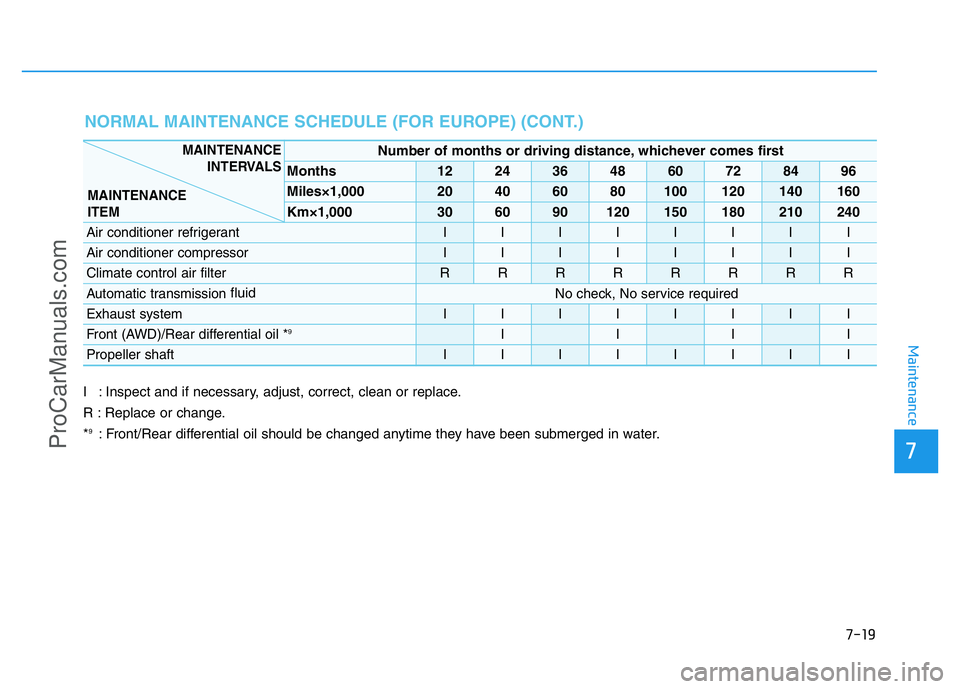
NORMAL MAINTENANCE SCHEDULE (FOR EUROPE) (CONT.)
I : Inspect and if necessary, adjust, correct, clean or replace.
R : Replace or change.
*
9: Front/Rear differential oil should be changed anytime they have been submerged in water.
Number of months or driving distance, whichever comes first
Months1224364860728496
Miles×1,00020406080100120140160
Km×1,000306090120150180210240
Air conditioner refrigerantIIIIIIII
Air conditioner compressorIIIIIIII
Climate control air filter RRRRRRRR
Automatic transmission fluidNo check, No service required
Exhaust systemIIIIIIII
Front (AWD)/Rear differential oil *9IIII
Propeller shaftIIIIIIII
MAINTENANCE
INTERVALS
MAINTENANCE
ITEM
ProCarManuals.com
Page 456 of 546
7-20
Maintenance
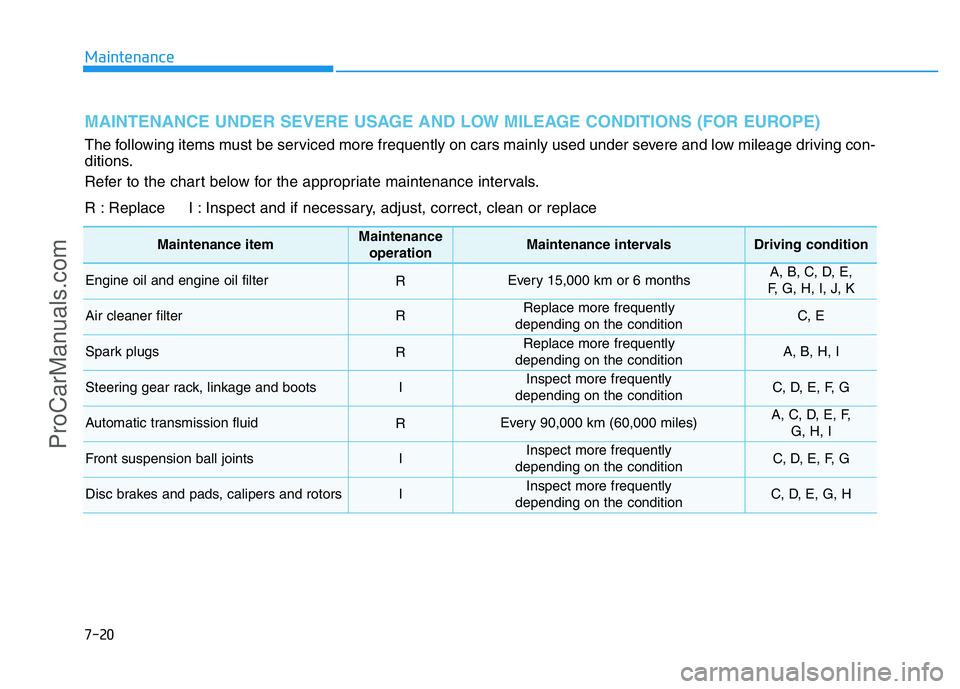
MAINTENANCE UNDER SEVERE USAGE AND LOW MILEAGE CONDITIONS (FOR EUROPE)
The following items must be serviced more frequently on cars mainly used under severe and low mileage driving con-
ditions.
Refer to the chart below for the appropriate maintenance intervals.
R : Replace I : Inspect and if necessary, adjust, correct, clean or replace
Maintenance itemMaintenance
operationMaintenance intervalsDriving condition
Engine oil and engine oil filterREvery 15,000 km or 6 monthsA, B, C, D, E,
F, G, H, I, J, K
Air cleaner filterRReplace more frequently
depending on the conditionC, E
Spark plugs RReplace more frequently
depending on the conditionA, B, H, I
Steering gear rack, linkage and bootsIInspect more frequently
depending on the conditionC, D, E, F, G
Automatic transmission fluidREvery 90,000 km (60,000 miles)A, C, D, E, F,
G, H, I
Front suspension ball jointsIInspect more frequently
depending on the conditionC, D, E, F, G
Disc brakes and pads, calipers and rotorsIInspect more frequently
depending on the conditionC, D, E, G, H
ProCarManuals.com
Page 457 of 546
7-21
7
Maintenance
21
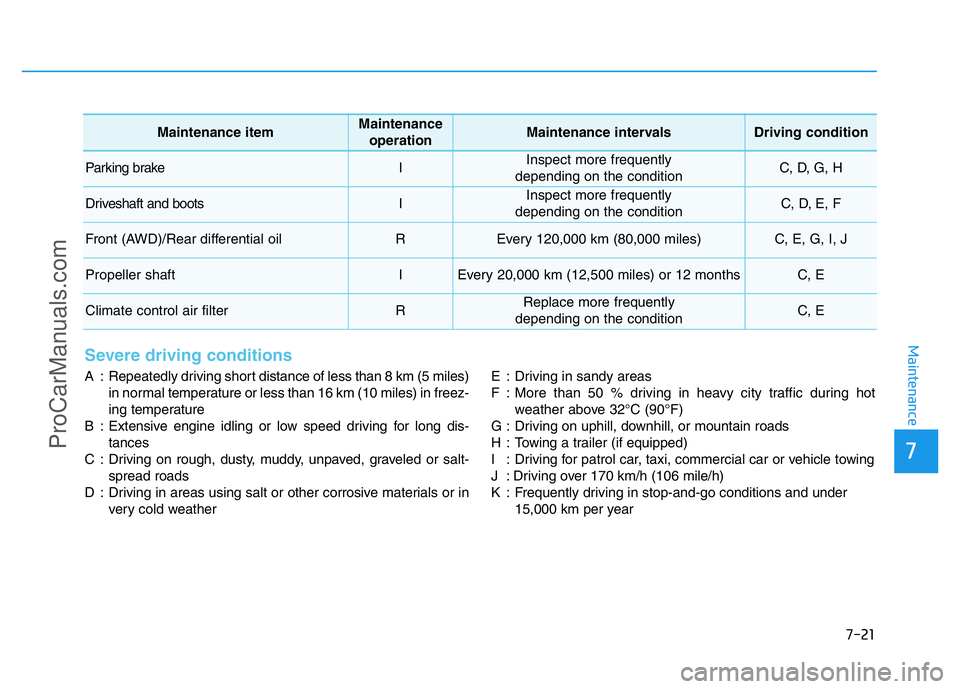
Severe driving conditions
A : Repeatedly driving short distance of less than 8 km (5 miles)
in normal temperature or less than 16 km (10 miles) in freez-
ing temperature
B : Extensive engine idling or low speed driving for long dis-
tances
C : Driving on rough, dusty, muddy, unpaved, graveled or salt-
spread roads
D : Driving in areas using salt or other corrosive materials or in
very cold weatherE : Driving in sandy areas
F : More than 50 % driving in heavy city traffic during hot
weather above 32°C (90°F)
G : Driving on uphill, downhill, or mountain roads
H : Towing a trailer (if equipped)
I : Driving for patrol car, taxi, commercial car or vehicle towing
J : Driving over 170 km/h (106 mile/h)
K : Frequently driving in stop-and-go conditions and under
15,000 km per year
Maintenance itemMaintenance
operationMaintenance intervalsDriving condition
Parking brakeIInspect more frequently
depending on the conditionC, D, G, H
Driveshaft and bootsIInspect more frequently
depending on the conditionC, D, E, F
Front (AWD)/Rear differential oilREvery 120,000 km (80,000 miles)C, E, G, I, J
Propeller shaftIEvery 20,000 km (12,500 miles) or 12 monthsC, E
Climate control air filter RReplace more frequently
depending on the conditionC, E
ProCarManuals.com
Page 459 of 546
7-23
7
Maintenance
Vacuum crankcase ventilation
hoses (if equipped)
Inspect the surface of hoses for evi-
dence of heat and/or mechanical
damage. Hard and brittle rubber,
cracking, tears, cuts, abrasions, and
excessive swelling indicate deterio-
ration. Particular attention should be
paid to examine those hose surfaces
nearest to high heat sources, such
as the exhaust manifold.
Inspect the hose routing to assure
that the hoses do not come in con-
tact with any heat source, sharp
edges or moving component which
might cause heat damage or
mechanical wear. Inspect all hose
connections, such as clamps and
couplings, to make sure they are
secure, and that no leaks are pres-
ent. Hoses should be replaced
immediately if there is any evidence
of deterioration or damage.
Air cleaner filter
We recommend that the air cleaner
filter be replaced by an authorized
HYUNDAI dealer.
Spark plugs
Make sure to install new spark plugs
of the correct heat range.
Valve clearance
(3.0L / 3.3L / 3.8L)
Inspect excessive valve noise and/or
engine vibration and adjust if neces-
sary. We recommend that the system
be serviced by an authorized
HYUNDAI dealer.
Cooling system
Check the cooling system parts,
such as radiator, coolant reservoir,
hoses and connections for leakage
and damage. Replace any damaged
parts.
Coolant
The coolant should be changed at
the intervals specified in the mainte-
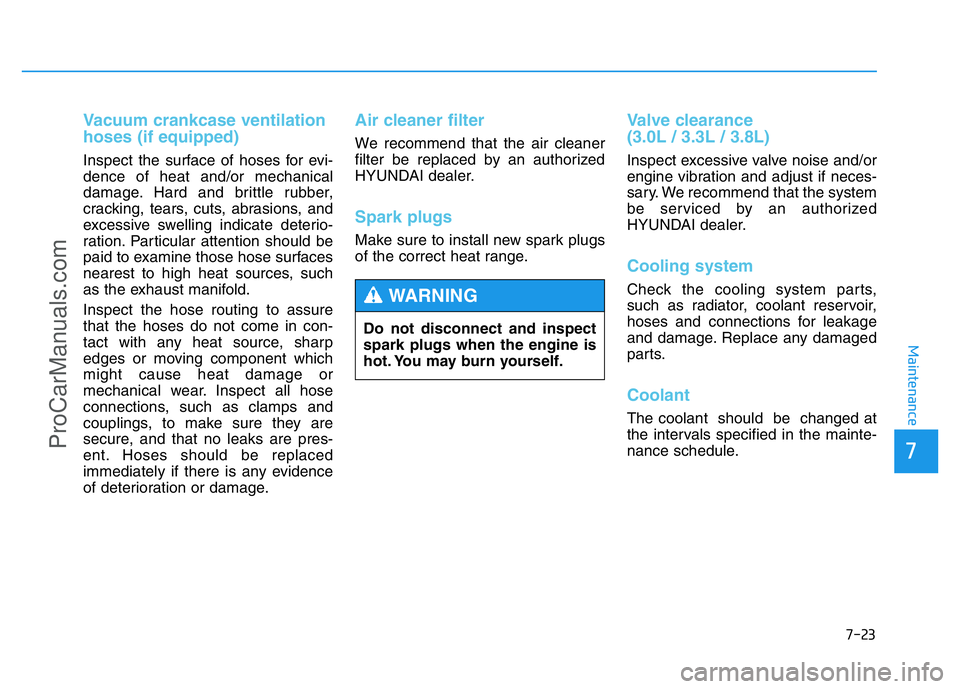
nance schedule. Do not disconnect and inspect
spark plugs when the engine is
hot. You may burn yourself.
WARNING
ProCarManuals.com
Page 470 of 546
7-34
Maintenance
AIR CLEANER
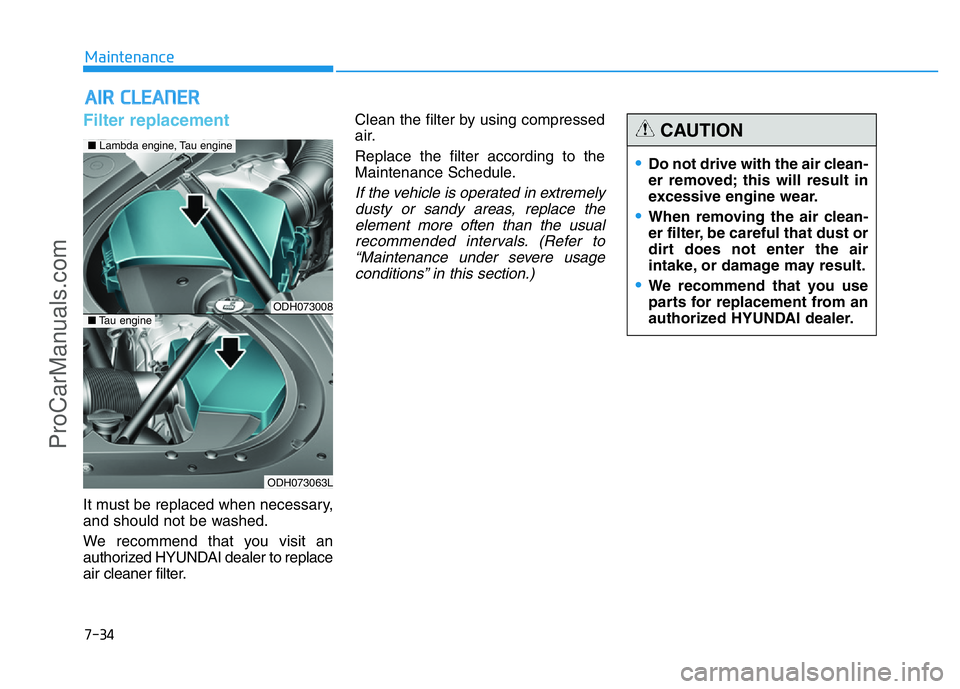
Filter replacement
It must be replaced when necessary,
and should not be washed.
We recommend that you visit an
authorized HYUNDAI dealer to replace
air cleaner filter.Clean the filter by using compressed
air.
Replace the filter according to the
Maintenance Schedule.
If the vehicle is operated in extremely
dusty or sandy areas, replace the
element more often than the usual
recommended intervals. (Refer to
“Maintenance under severe usage
conditions” in this section.)
•Do not drive with the air clean-
er removed; this will result in
excessive engine wear.
•When removing the air clean-
er filter, be careful that dust or
dirt does not enter the air
intake, or damage may result.
•We recommend that you use
parts for replacement from an
authorized HYUNDAI dealer.
CAUTION
ODH073008
ODH073063L
■Lambda engine, Tau engine
■Tau engine
ProCarManuals.com
Page 471 of 546
7-35
7
Maintenance
CLIMATE CONTROL AIR FILTER
Filter inspection
If the vehicle is operated in the
severely air-polluted cities or on dusty
rough roads for a long period, it
should be inspected more frequently
and replaced earlier. When you, the
owner, replace the climate control air
filter, replace it performing the follow-
ing procedure, and be careful to
avoid damaging other components.
Replace the filter according to the
Maintenance Schedule.
✽NOTICE
Install a new climate control air fil-
ter in the correct direction with the
arrow symbol (
↓) facing downwards.
Otherwise, the climate control effects
may decrease, possibly with a noise.
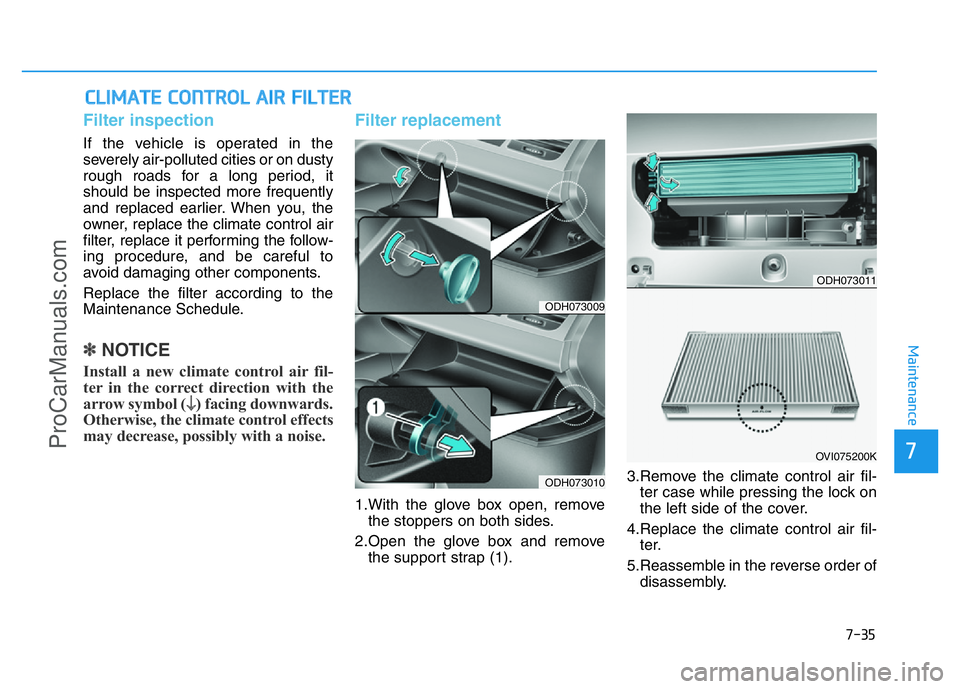
Filter replacement
1.With the glove box open, remove
the stoppers on both sides.
2.Open the glove box and remove
the support strap (1).3.Remove the climate control air fil-
ter case while pressing the lock on
the left side of the cover.
4.Replace the climate control air fil-
ter.
5.Reassemble in the reverse order of
disassembly.
ODH073009
ODH073010
ODH073011
OVI075200K
ProCarManuals.com
Page 533 of 546
7-97
7
Maintenance
EMISSION CONTROL SYSTEM
The emission control system of your
vehicle is covered by a written limited
warranty. Please see the warranty
information contained in the Service
Passport in your vehicle.
Your vehicle is equipped with an
emission control system to meet all
emission regulations.
There are three emission control
systems which are as follows.
(1) Crankcase emission control sys-
tem
(2) Evaporative emission control sys-
tem
(3) Exhaust emission control system
In order to assure the proper function
of the emission control systems, it is
recommended that you have your
car inspected and maintained by an
authorized HYUNDAI dealer in
accordance with the maintenance
schedule in this manual.Caution for the Inspection and
Maintenance Test (With Electronic
Stability Control (ESC) system)
• To prevent the vehicle from mis-
firing during dynamometer test-
ing, turn the Electronic Stability
Control (ESC) system off by
pressing the ESC switch.
• After dynamometer testing is
completed, turn the ESC system
back on by pressing the ESC
switch again.
1. Crankcase emission control
system
The positive crankcase ventilation
system is employed to prevent air
pollution caused by blow-by gases
being emitted from the crankcase.
This system supplies fresh filtered air
to the crankcase through the air
intake hose. Inside the crankcase,
the fresh air mixes with blow-by
gases, which then pass through the
PCV valve into the induction system.
2. Evaporative emission con-
trol system
The Evaporative Emission Control
System is designed to prevent fuel
vapors from escaping into the atmos-
phere.
Canister
Fuel vapors generated inside the fuel
tank are absorbed and stored in the
onboard canister. When the engine is
running, the fuel vapors absorbed in
the canister are drawn into the surge
tank through the purge control sole-
noid valve.
Purge Control Solenoid Valve
(PCSV)
The purge control solenoid valve is
controlled by the Engine Control
Module (ECM); when the engine
coolant temperature is low during
idling, the PCSV closes so that evap-
orated fuel is not taken into the
engine. After the engine warms-up
during ordinary driving, the PCSV
opens to introduce evaporated fuel to
the engine.
ProCarManuals.com