ESP HYUNDAI COUPE 2014 Owners Manual
[x] Cancel search | Manufacturer: HYUNDAI, Model Year: 2014, Model line: COUPE, Model: HYUNDAI COUPE 2014Pages: 546, PDF Size: 14.38 MB
Page 20 of 546
2-2
You will find many safety precautions
and recommendations throughout
this section, and throughout this man-
ual. The safety precautions in this sec-
tion are among the most important.
Always wear your seat belt
A seat belt is your best protection in
all types of accidents. Air bags are
designed to supplement seat belts,
not replace them. So even though
your vehicle is equipped with air bags,
ALWAYS make sure you and your
passengers wear your seat belts, and
wear them properly.
Restrain all children
All children under age 13 should ride
in your vehicle properly restrained in
a rear seat, not the front seat. Infants
and small children should be
restrained in an appropriate child
restraint. Larger children should use
a booster seat with the lap/shoulder
belt until they can use the seat belt
properly without a booster seat.
Air bag hazards
While air bags can save lives, they
can also cause serious or fatal
injuries to occupants who sit too
close to them, or who are not prop-
erly restrained. Infants, young chil-
dren, and short adults are at the
greatest risk of being injured by an
inflating air bag. Follow all instruc-
tions and warnings in this manual.
Driver distraction
Driver distraction presents a serious
and potentially deadly danger, espe-
cially for inexperienced drivers. Safety
should be the first concern when
behind the wheel and drivers need to
be aware of the wide array of potential
distractions, such as drowsiness,
reaching for objects, eating, personal
grooming, other passengers, and
using cellular phones.
Drivers can become distracted when
they take their eyes and attention off
the road or their hands off the wheel
to focus on activities other than driv-
ing. To reduce your risk of distraction
and an accident:
• ALWAYS set up your mobile devices
(i.e., MP3 players, phones, naviga-
tion units, etc.) when your vehicle is
parked or safely stopped.
• ONLY use your mobile device when
allowed by laws and conditions per-
mit safe use. NEVER text or email
while driving. Most countries have
laws prohibiting drivers from texting.
Some countries and cities also pro-
hibit drivers from using handheld
phones.
IMPORTANT SAFETY PRECAUTIONS
Safety system of your vehicle
ProCarManuals.com
Page 21 of 546
2-3
Safety system of your vehicle
• NEVER let the use of a mobile
device distract you from driving. You
have a responsibility to your passen-
gers and others on the road to
always drive safely, with your hands
on the wheel as well as your eyes
and attention on the road.
Control your speed
Excessive speed is a major factor in
crash injuries and deaths. Generally,
the higher the speed, the greater the
risk, but serious injuries can also occur
at lower speeds. Never drive faster
than is safe for current conditions,
regardless of the maximum speed
posted.
Keep your vehicle in safe condi-
tion
Having a tire blowout or a mechanical
failure can be extremely hazardous. To
reduce the possibility of such prob-
lems, check your tire pressures and
condition frequently, and perform all
regularly scheduled maintenance.
2
ProCarManuals.com
Page 24 of 546
2-6
Safety system of your vehicle
Seat belts
Always fasten your seat belt before
starting any trip.
At all times, passengers should sit
upright and be properly restrained.
Infants and small children must be
restrained in appropriate child restraint
systems. Children who have outgrown
a booster seat and adults must be
restrained using the seat belts.
Front seats
The front seat can be adjusted by
using the control switches located on
the outside of the seat cushion. Before
driving, adjust the seat to the proper
position so that you can easily control
the steering wheel, foot pedals and
controls on the instrument panel.
Take the following precautions
when adjusting your seat belt:
•NEVER use one seat belt for
more than one occupant.
•Always position the seatback
upright with the lap portion of
the seat belt snug and low
across the hips.
•NEVER allow children or small
infants to ride in a passenger’s
lap.
(Continued)
(Continued)
•Do not route the seat belt
across your neck, across sharp
edges, or reroute the shoulder
strap away from your body.
•Do not allow the seat belt to
become caught or jammed.
WARNING Take the following precautions
when adjusting your seat:
•NEVER attempt to adjust the
seat while the vehicle is mov-
ing. The seat could respond
with unexpected movement
and may cause loss of vehicle
control resulting in an acci-
dent.
•Do not place anything under
the front seats. Loose objects
in the driver’s foot area could
interfere with the operation of
the foot pedals, causing an
accident.
(Continued)
WARNING
ProCarManuals.com
Page 34 of 546
2-16
Headrest
The vehicle’s front and rear seats
have adjustable headrests. The head-
rests provide comfort for passengers,
but more importantly they are
designed to help protect passengers
from whiplash and other neck and
spinal injuries during an accident,
especially in a rear impact collision.
Safety system of your vehicle
To reduce the risk of serious
injury or death in an accident,
take the following precautions
when adjusting your headrests:
•Always properly adjust the
headrests for all passengers
BEFORE starting the vehicle.
•NEVER let anyone ride in a seat
with the headrest removed.
•Adjust the headrests so the
middle of the headrests is at
the same height as the height
of the top of the eyes.
(Continued)
WARNING
(Continued)
•NEVER adjust the headrest
position of the driver’s seat
when the vehicle is in motion.
•Adjust the headrest as close
to the passenger’s head as
possible. Do not use a seat
cushion that holds the body
away from the seatback.
•Make sure the headrest locks
into position after adjusting it.
To prevent damage, NEVER hit
or pull on the headrests.
CAUTION
When there is no occupant in
the rear seats, adjust the height
of the headrest to the lowest
position. The rear seat headrest
can reduce the visibility of the
rear area.
CAUTION
Cargo
Cargo should always be
secured to prevent it from being
thrown about the vehicle in a
collision and causing injury to
the vehicle occupants. Do not
place objects in the rear seats,
since they cannot be properly
secured and may hit the front
seat occupants in a collision.
WARNING
Cargo loading
Make sure the engine is off, the
automatic transmission is in P
(Park) and the parking brake is
securely applied whenever load-
ing or unloading cargo.
Failure to take these steps may
allow the vehicle to move if the
shift lever is inadvertently moved
to another position.
WARNING
ProCarManuals.com
Page 38 of 546
2-20
Safety system of your vehicle
Seat warmers and coolers
Seat warmers (if equipped)
Seat warmers are provided to warm
the seats during cold weather.
The seat warmers can cause a
SERIOUS BURN, even at low
temperatures and especially if
used for long periods of time.
Passengers must be able to feel
if the seat is becoming too warm
so they can turn it off, if needed.
People who cannot detect tem-
perature change or pain to the
skin should use extreme cau-
tion, especially the following
types of passengers:
•Infants, children, elderly or
disabled persons, or hospital
outpatients.
•People with sensitive skin or
who burn easily.
(Continued)
(Continued)
•Fatigued individuals.
•Intoxicated individuals.
•People taking medication that
can cause drowsiness or
sleepiness.
WARNING
NEVER place anything on the
seat that insulates against heat
when the seat warmer is in oper-
ation, such as a blanket or seat
cushion. This may cause the
seat warmer to overheat, caus-
ing a burn or damage to the seat.
WARNING
To prevent damage to the seat
warmers and seats:
•Never use a solvent such as
paint thinner, benzene, alco-
hol or gasoline to clean the
seats.
•Do not place heavy or sharp
objects on seats equipped
with seat warmers.
•Do not change the seat cover.
It may damage the seat
warmer or air ventilation sys-
tem.
CAUTION
ProCarManuals.com
Page 43 of 546
2-25
Safety system of your vehicle
2
Seat belt warning light
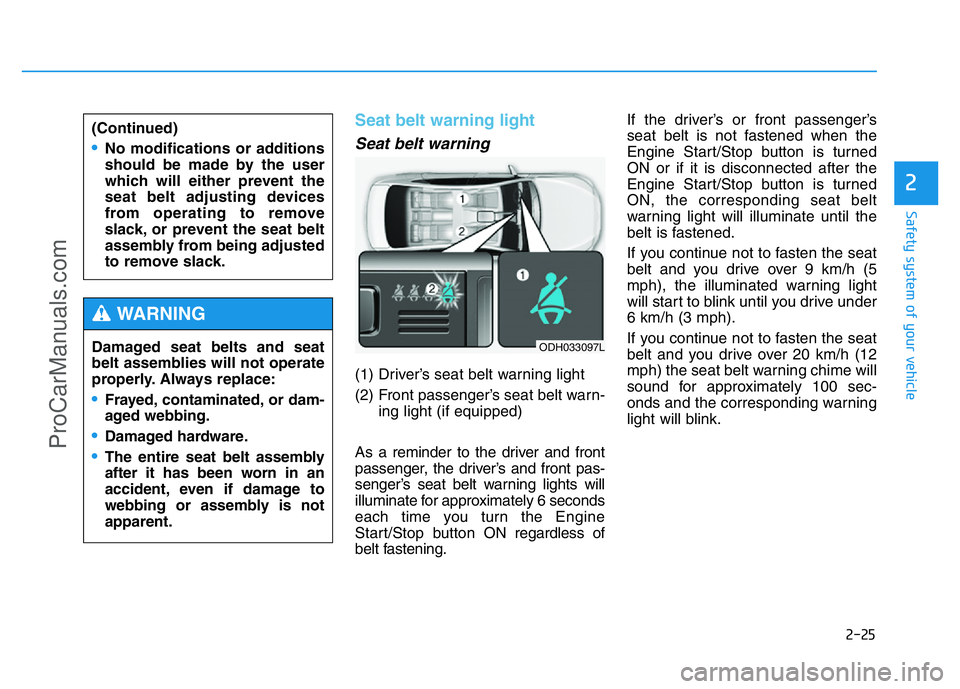
Seat belt warning
(1) Driver’s seat belt warning light
(2) Front passenger’s seat belt warn-
ing light (if equipped)
As a reminder to the driver and front
passenger, the driver’s and front pas-
senger’s seat belt warning lights will
illuminate for approximately 6 seconds
each time you turn the Engine
Start/Stop button ON regardless of
belt fastening.If the driver’s or front passenger’s
seat belt is not fastened when the
Engine Start/Stop button is turned
ON or if it is disconnected after the
Engine Start/Stop button is turned
ON, the corresponding seat belt
warning light will illuminate until the
belt is fastened.
If you continue not to fasten the seat
belt and you drive over 9 km/h (5
mph), the illuminated warning light
will start to blink until you drive under
6 km/h (3 mph).
If you continue not to fasten the seat
belt and you drive over 20 km/h (12
mph) the seat belt warning chime will
sound for approximately 100 sec-
onds and the corresponding warning
light will blink. Damaged seat belts and seat
belt assemblies will not operate
properly. Always replace:
•Frayed, contaminated, or dam-
aged webbing.
•Damaged hardware.
•The entire seat belt assembly
after it has been worn in an
accident, even if damage to
webbing or assembly is not
apparent.
WARNING
(Continued)
•No modifications or additions
should be made by the user
which will either prevent the
seat belt adjusting devices
from operating to remove
slack, or prevent the seat belt
assembly from being adjusted
to remove slack.
ODH033097L
ProCarManuals.com
Page 44 of 546
2-26
Safety system of your vehicle
✽NOTICE
• You can find the front passenger’s
seat belt warning light on the cen-
ter fascia panel.
• Although the front passenger seat
is not occupied, the seat belt warn-
ing light will illuminate for 6 sec-
onds.
• The front passenger's seat belt
warning may operate when lug-
gage is placed on the front passen-
ger seat.
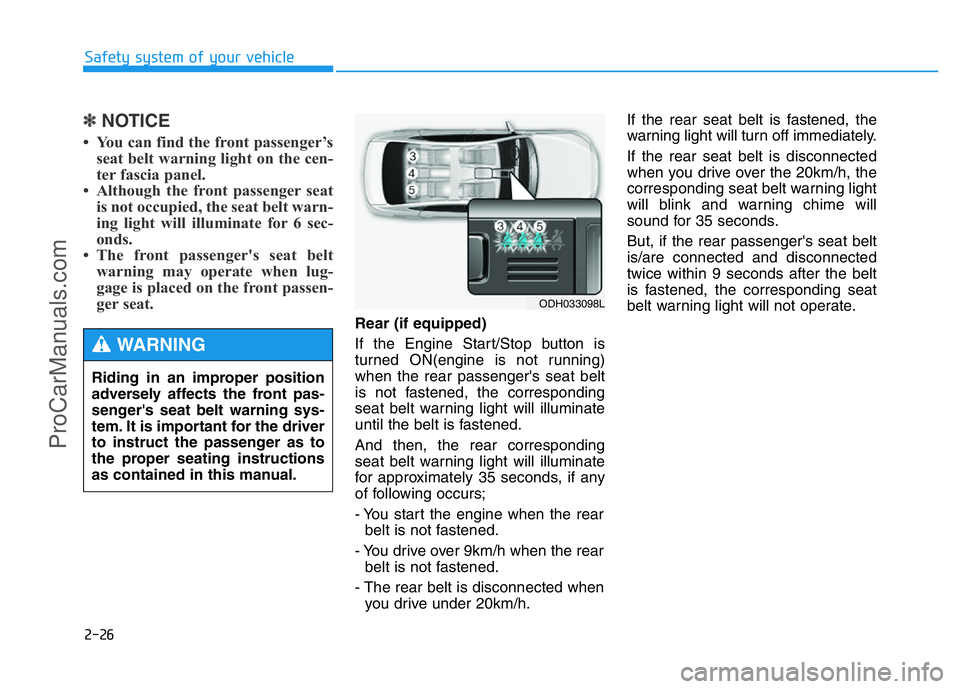
Rear (if equipped)
If the Engine Start/Stop button is
turned ON(engine is not running)
when the rear passenger's seat belt
is not fastened, the corresponding
seat belt warning light will illuminate
until the belt is fastened.
And then, the rear corresponding
seat belt warning light will illuminate
for approximately 35 seconds, if any
of following occurs;
- You start the engine when the rear
belt is not fastened.
- You drive over 9km/h when the rear
belt is not fastened.
- The rear belt is disconnected when
you drive under 20km/h.If the rear seat belt is fastened, the
warning light will turn off immediately.
If the rear seat belt is disconnected
when you drive over the 20km/h, the
corresponding seat belt warning light
will blink and warning chime will
sound for 35 seconds.
But, if the rear passenger's seat belt
is/are connected and disconnected
twice within 9 seconds after the belt
is fastened, the corresponding seat
belt warning light will not operate.
Riding in an improper position
adversely affects the front pas-
senger's seat belt warning sys-
tem. It is important for the driver
to instruct the passenger as to
the proper seating instructions
as contained in this manual.
WARNING
ODH033098L
ProCarManuals.com
Page 58 of 546
2-40
Safety system of your vehicle
Booster seats
A booster seat is a restraint designed
to improve the fit of the vehicle’s seat
belt system. A booster seat positions
the seat belt so that it fits properly
over the stronger parts of your child’s
body. Keep your children in booster
seats until they are big enough to fit in
a seat belt properly.
For a seat belt to fit properly, the lap
belt must lie snugly across the upper
thighs, not the stomach. The shoulder
belt should lie snug across the shoul-
der and chest and not across the neck
or face. Children under age 13 must
always ride in the rear seats and must
always be properly restrained to mini-
mize the risk of injury in an accident,
sudden stop or sudden maneuver.
Installing a Child Restraint
System (CRS)After selecting a proper child
restraint and checking that the child
restraint fits properly in the rear of
this vehicle, you are ready to install
the child restraint according to the
manufacturer’s instruction. There are
three general steps in installing the
seat properly:
•Properly secure the child restraint
to the vehicle.All child restraints
must be secured to the vehicle with
the lap belt or lap part of a lap/shoul-
der belt or with the ISOFIX top-teth-
er anchorage and/or ISOFIX lower
anchorage (if equipped).
•Make sure the child restraint is
firmly secured.After installing a
child restraint to the vehicle, push
and pull the seat forward and from
side-to-side to verify that it is
securely attached to the seat. A
child restraint secured with a seat
belt should be installed as firmly as
possible. However, some side-to-
side movement can be expected. Before installing your child
restraint always:
•Read and follow the instruc-
tions provided by the manu-
facturer of the child restraint.
•Read and follow the instruc-
tions regarding child restraint
systems in this manual.
Failure to follow all warnings
and instructions could increase
the risk of the SERIOUS INJURY
or DEATH if an accident occurs.
WARNING
If the vehicle headrest prevents
proper installation of a child
seat (as described in the child
seat system manual), the head-
rest of the respective seating
position shall be readjusted or
entirely removed.
WARNING
ProCarManuals.com
Page 61 of 546
2-43
Safety system of your vehicle
2
Both rear outboard seats are
equipped with a pair of ISOFIX lower
anchorages as well as a correspon-
ding top-tether anchorage on the
back side of the rear seats.
(CRS with universal approval to ECE-
R44 need to be fixed additionally with
a top-tether strap connected to the
corresponding top-tether anchorage
point on the back side of the rear
seats.)
ISOFIX lower anchorages are locat-
ed between the seatback and the
seat cushion of the rear seat left and
right outboard seating positions.Securing a child restraint with
the “ISOFIX Anchorages System”
To install a ISOFIX-compatible child
restraint in either of the rear outboard
seating positions:
1. Move the seat belt buckle away
from the ISOFIX lower anchorages.
2. Move any other objects away from
the anchors that could prevent a
secure connection between the
child restraint and the ISOFIX lower
anchorages.
3. Place the child restraint on the vehi-
cle seat, then attach the seat to the
ISOFIX lower anchorages accord-
ing to the instructions provided by
the child restraint manufacturer.
4. Follow the child restraint instruc-
tions for properly adjusting and
tightening the lower attachments on
the child restraint to the ISOFIX
lower anchorages.Take the following precautions
when using the ISOFIX system:
•Read and follow all installation
instructions provided with
your child restraint system.
•To prevent the child from
reaching and taking hold of
unretracted seat belts, buckle
all unused rear seat belts and
retract the seat belt webbing
behind the child. Children can
be strangled if a shoulder belt
becomes wrapped around
their neck and the seat belt
tightens.
•NEVER attach more than one
child restraint to a single
anchorage. This could cause
the anchor or attachment to
come loose or break.
•Always have the ISOFIX sys-
tem inspected by your dealer
after an accident. An accident
can damage the ISOFIX sys-
tem and may not properly
secure the child restraint.
WARNING
ProCarManuals.com
Page 75 of 546
2-57
Safety system of your vehicle
2
During a moderate to severe frontal
collision, sensors will detect the vehi-
cle’s rapid deceleration. If the rate of
deceleration is high enough, the con-
trol unit will inflate the front air bags, at
the time and with the force needed.
The front air bags help protect the
driver and front passenger by
responding to frontal impacts in
which seat belts alone cannot provide
adequate restraint. When needed,
the side air bags help provide protec-
tion in the event of a side impact or
rollover by supporting the side upper
body area.
• Air bags are activated (able to
inflate if necessary) only when the
Engine Start/Stop button is in the
ON position.
• Air bags inflate in the event of a
severe frontal or side collision to
help protect the occupants from
serious physical injury.
• There is no single speed at which
the air bags will inflate. Generally,
air bags are designed to inflate
based upon the severity of a colli-
sion and its direction. These two
factors determine whether the sen-
sors produce an electronic deploy-
ment/inflation signal.• Air bag deployment depends on a
number of factors including vehicle
speed, angles of impact and the
density and stiffness of the vehicles
or objects which your vehicle
impacts during a collision. The
determining factors are not limited
to those mentioned above.
• The front air bags will completely
inflate and deflate in an instant. It is
virtually impossible for you to see
the air bags inflate during an acci-
dent. It is much more likely that you
will simply see the deflated air bags
hanging out of their storage com-
partments after the collision.
• In addition to inflating in serious
side collisions, vehicles equipped
with a rollover sensor, side and/or
curtain air bags will inflate if the
sensing system detects a rollover.
When a rollover is detected, curtain
air bags will remain inflated longer
to help provide protection from
ejection, especially when used in
conjunction with the seat belts. (if
equipped with a rollover sensor)• To help provide protection, the air
bags must inflate rapidly. The
speed of air bag inflation is a con-
sequence of extremely short time
in which to inflate the air bag
between the occupant and the
vehicle structures before the occu-
pant impacts those structures. This
speed of inflation reduces the risk
of serious or life-threatening
injuries and is thus a necessary
part of air bag design.
However, the rapid air bag inflation
can also cause injuries which can
include facial abrasions, bruises
and broken bones because the
inflation speed also causes the air
bags to expand with a great deal of
force.
• There are even circumstances
under which contact with the air
bag can cause fatal injuries, espe-
cially if the occupant is positioned
excessively close to the air bag.
ProCarManuals.com