engine HYUNDAI COUPE 2016 Owners Manual
[x] Cancel search | Manufacturer: HYUNDAI, Model Year: 2016, Model line: COUPE, Model: HYUNDAI COUPE 2016Pages: 475, PDF Size: 14.78 MB
Page 393 of 475
Maintenance
24
7
Changing the engine oil and
filter
Have engine oil and filter changed by
an authorized HYUNDAI dealer
according to the Maintenance
Schedule at the beginning of this
section.
CALIFORNIA PROPO-
SITION 65 WARNING
Engine oil contains chemicals
known to the State of California
to cause cancer, birth defects
and reproductive harm. Used
engine oil may cause irritation
or cancer of the skin if left in
contact with the skin for pro-
longed periods of time. Always
protect your skin by washing
your hands thoroughly with
soap and warm water as soon
as possible after handling used
oil.
procarmanuals.com
Page 394 of 475
725
Maintenance
The high-pressure cooling system
has a reservoir filled with year-round
antifreeze coolant. The reservoir is
filled at the factory.
Check the antifreeze protection and
coolant level at least once a year, at
the beginning of the winter season,
and before traveling to a colder cli-
mate.Checking the coolant level
ENGINE COOLANT
(Continued)
Even if the engine is not oper-ating, do not remove the radi-
ator cap or the drain plug
while the engine and radiator
are hot. Hot coolant and
steam may still blow out
under pressure, causing seri-
ous injury.
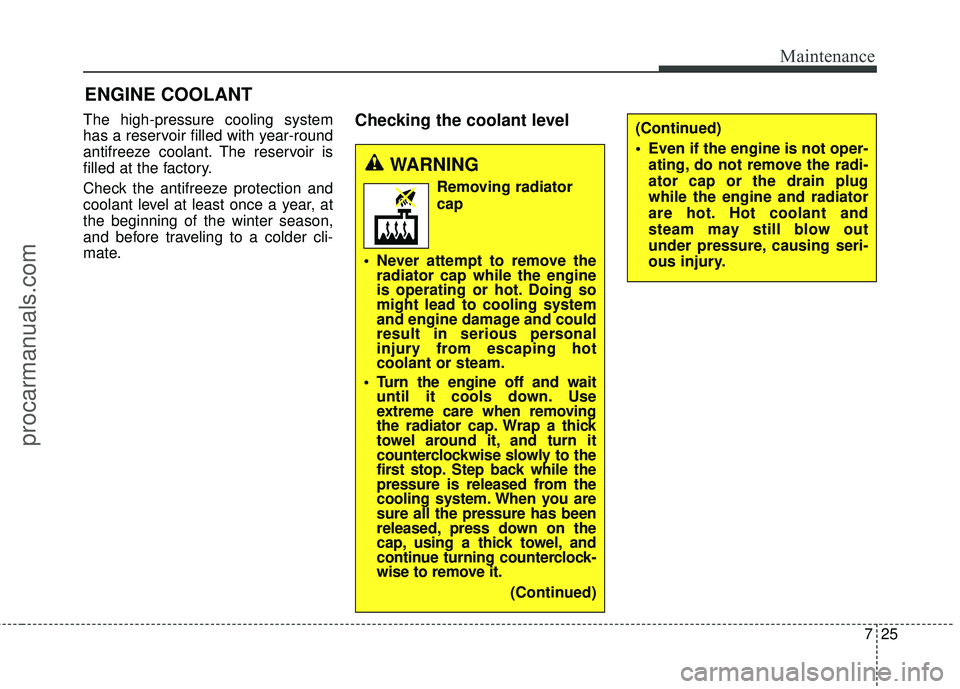
WARNING
Removing radiator
cap
Never attempt to remove the radiator cap while the engine
is operating or hot. Doing so
might lead to cooling system
and engine damage and could
result in serious personal
injury from escaping hot
coolant or steam.
Turn the engine off and wait until it cools down. Use
extreme care when removing
the radiator cap. Wrap a thick
towel around it, and turn it
counterclockwise slowly to the
first stop. Step back while the
pressure is released from the
cooling system. When you are
sure all the pressure has been
released, press down on the
cap, using a thick towel, and
continue turning counterclock-
wise to remove it.
(Continued)
procarmanuals.com
Page 395 of 475
Maintenance
26
7
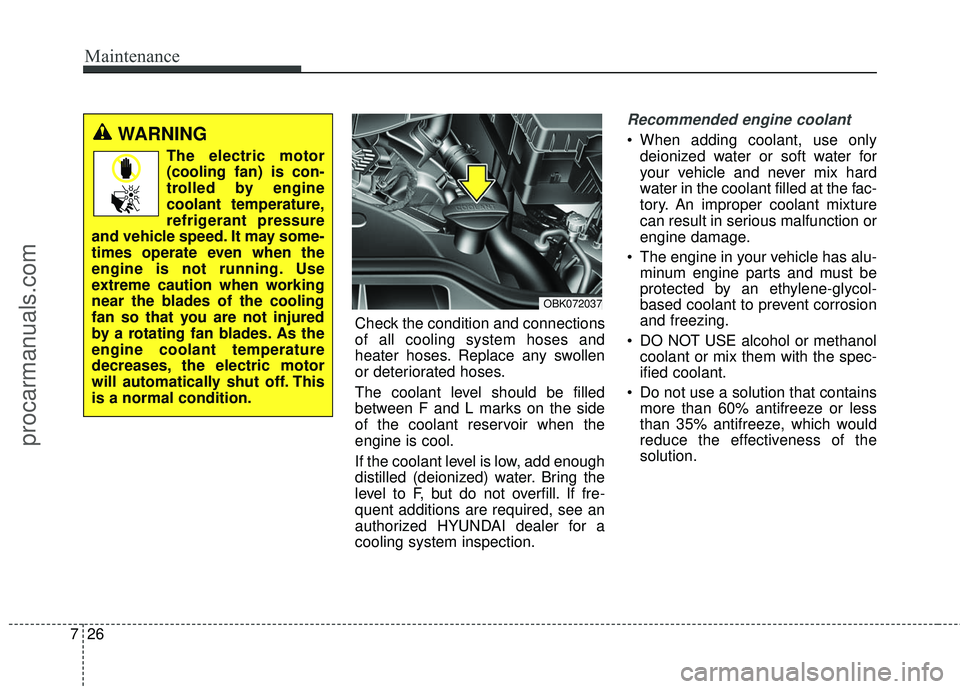
Check the condition and connections
of all cooling system hoses and
heater hoses. Replace any swollen
or deteriorated hoses.
The coolant level should be filled
between F and L marks on the side
of the coolant reservoir when the
engine is cool.
If the coolant level is low, add enough
distilled (deionized) water. Bring the
level to F, but do not overfill. If fre-
quent additions are required, see an
authorized HYUNDAI dealer for a
cooling system inspection.
Recommended engine coolant
When adding coolant, use only
deionized water or soft water for
your vehicle and never mix hard
water in the coolant filled at the fac-
tory. An improper coolant mixture
can result in serious malfunction or
engine damage.
The engine in your vehicle has alu- minum engine parts and must be
protected by an ethylene-glycol-
based coolant to prevent corrosion
and freezing.
DO NOT USE alcohol or methanol coolant or mix them with the spec-
ified coolant.
Do not use a solution that contains more than 60% antifreeze or less
than 35% antifreeze, which would
reduce the effectiveness of the
solution.WARNING
The electric motor
(cooling fan) is con-
trolled by engine
coolant temperature,
refrigerant pressure
and vehicle speed. It may some-
times operate even when the
engine is not running. Use
extreme caution when working
near the blades of the cooling
fan so that you are not injured
by a rotating fan blades. As the
engine coolant temperature
decreases, the electric motor
will automatically shut off. This
is a normal condition.
OBK072037
procarmanuals.com
Page 396 of 475
727
Maintenance
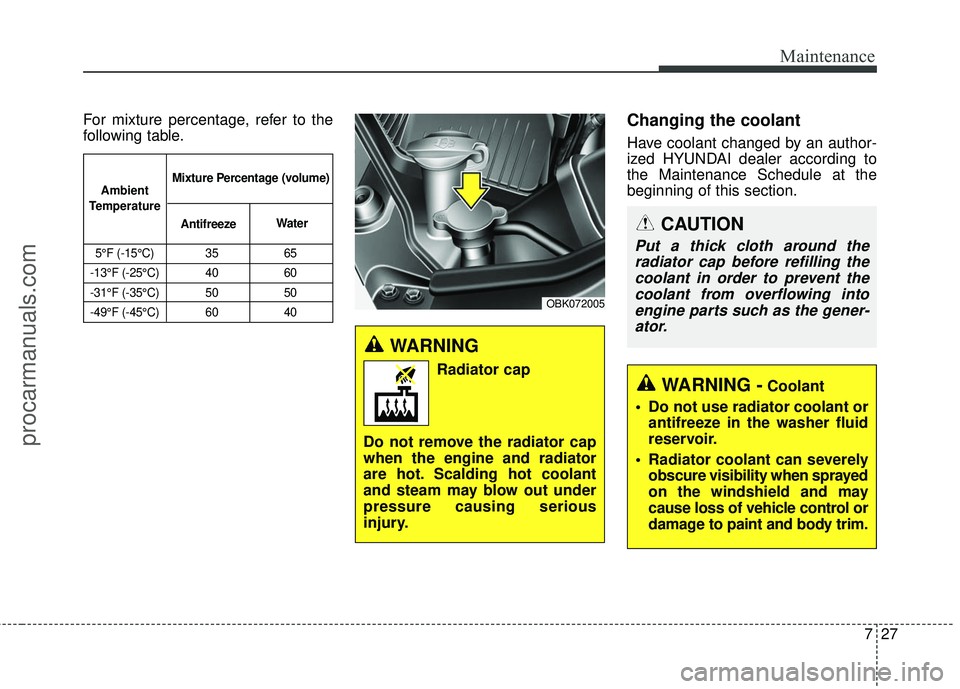
For mixture percentage, refer to the
following table.Changing the coolant
Have coolant changed by an author-
ized HYUNDAI dealer according to
the Maintenance Schedule at the
beginning of this section.
WARNING
Radiator cap
Do not remove the radiator cap
when the engine and radiator
are hot. Scalding hot coolant
and steam may blow out under
pressure causing serious
injury.
CAUTION
Put a thick cloth around the radiator cap before refilling thecoolant in order to prevent thecoolant from overflowing intoengine parts such as the gener-ator.
WARNING -Coolant
Do not use radiator coolant or antifreeze in the washer fluid
reservoir.
Radiator coolant can severely obscure visibility when sprayed
on the windshield and may
cause loss of vehicle control or
damage to paint and body trim.
5°F (-15°C) 35 65
-13°F (-25°C) 40 60
-31°F (-35°C) 50 50
-49°F (-45°C) 60 40
Ambient
Temperature Mixture Percentage (volume)
Antifreeze Water
OBK072005
procarmanuals.com
Page 397 of 475
Maintenance
28
7
BRAKE AND CLUTCH (IF EQUIPPED) FLUID
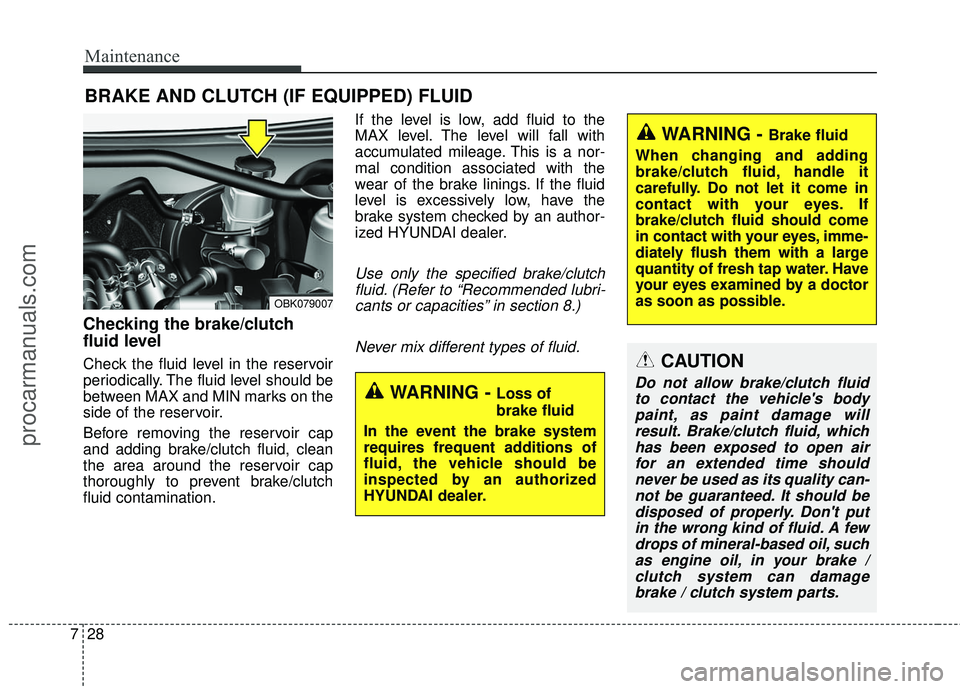
Checking the brake/clutch
fluid level
Check the fluid level in the reservoir
periodically. The fluid level should be
between MAX and MIN marks on the
side of the reservoir.
Before removing the reservoir cap
and adding brake/clutch fluid, clean
the area around the reservoir cap
thoroughly to prevent brake/clutch
fluid contamination. If the level is low, add fluid to the
MAX level. The level will fall with
accumulated mileage. This is a nor-
mal condition associated with the
wear of the brake linings. If the fluid
level is excessively low, have the
brake system checked by an author-
ized HYUNDAI dealer.
Use only the specified brake/clutch
fluid. (Refer to “Recommended lubri-cants or capacities” in section 8.)
Never mix different types of fluid.
WARNING - Brake fluid
When changing and adding
brake/clutch fluid, handle it
carefully. Do not let it come in
contact with your eyes. If
brake/clutch fluid should come
in contact with your eyes, imme-
diately flush them with a large
quantity of fresh tap water. Have
your eyes examined by a doctor
as soon as possible.
WARNING - Loss of
brake fluid
In the event the brake system
requires frequent additions of
fluid, the vehicle should be
inspected by an authorized
HYUNDAI dealer.
OBK079007
CAUTION
Do not allow brake/clutch fluid to contact the vehicle's bodypaint, as paint damage willresult. Brake/clutch fluid, whichhas been exposed to open airfor an extended time shouldnever be used as its quality can-not be guaranteed. It should bedisposed of properly. Don't putin the wrong kind of fluid. A fewdrops of mineral-based oil, suchas engine oil, in your brake /clutch system can damagebrake / clutch system parts.
procarmanuals.com
Page 398 of 475
729
Maintenance
POWER STEERING FLUID
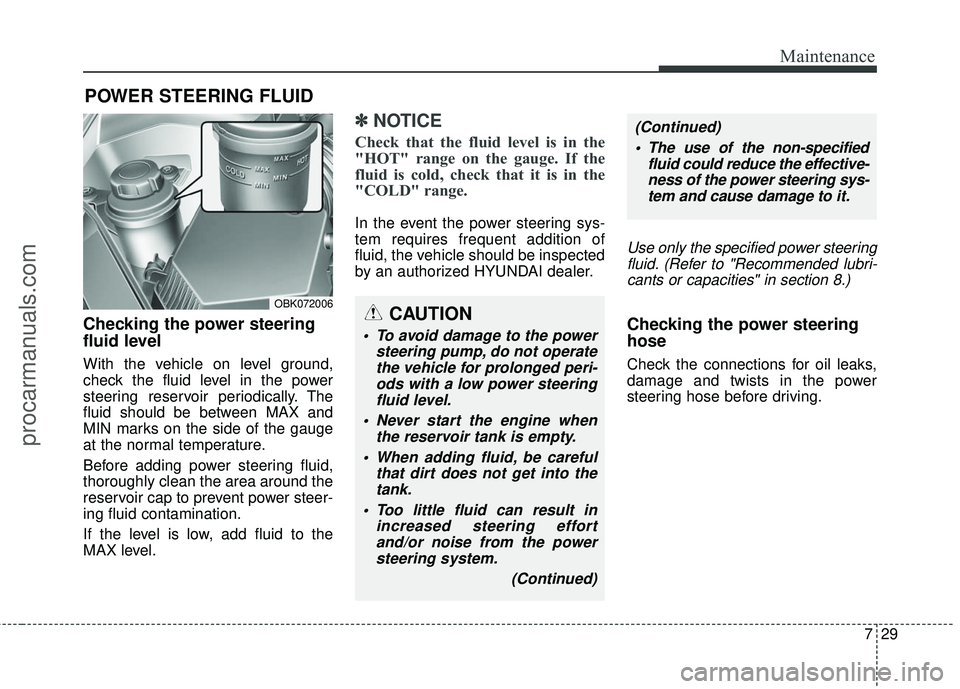
Checking the power steering
fluid level
With the vehicle on level ground,
check the fluid level in the power
steering reservoir periodically. The
fluid should be between MAX and
MIN marks on the side of the gauge
at the normal temperature.
Before adding power steering fluid,
thoroughly clean the area around the
reservoir cap to prevent power steer-
ing fluid contamination.
If the level is low, add fluid to the
MAX level.
✽ ✽NOTICE
Check that the fluid level is in the
"HOT" range on the gauge. If the
fluid is cold, check that it is in the
"COLD" range.
In the event the power steering sys-
tem requires frequent addition of
fluid, the vehicle should be inspected
by an authorized HYUNDAI dealer.
Use only the specified power steering
fluid. (Refer to "Recommended lubri-cants or capacities" in section 8.)
Checking the power steering
hose
Check the connections for oil leaks,
damage and twists in the power
steering hose before driving.
CAUTION
To avoid damage to the power steering pump, do not operatethe vehicle for prolonged peri-ods with a low power steeringfluid level.
Never start the engine when the reservoir tank is empty.
When adding fluid, be careful that dirt does not get into thetank.
Too little fluid can result in increased steering effortand/or noise from the powersteering system.
(Continued)
(Continued) The use of the non-specified fluid could reduce the effective-ness of the power steering sys-tem and cause damage to it.
OBK072006
procarmanuals.com
Page 402 of 475
733
Maintenance
Filter inspection
The climate control air filter should
be replaced according to the
Maintenance Schedule. If the vehicle
is operated in severely air-polluted
cities or on dusty rough roads for a
long period, it should be inspected
more frequently and replaced earlier.
When you replace the climate control
air filter, replace it performing the fol-
lowing procedure, and be careful to
avoid damaging other components.
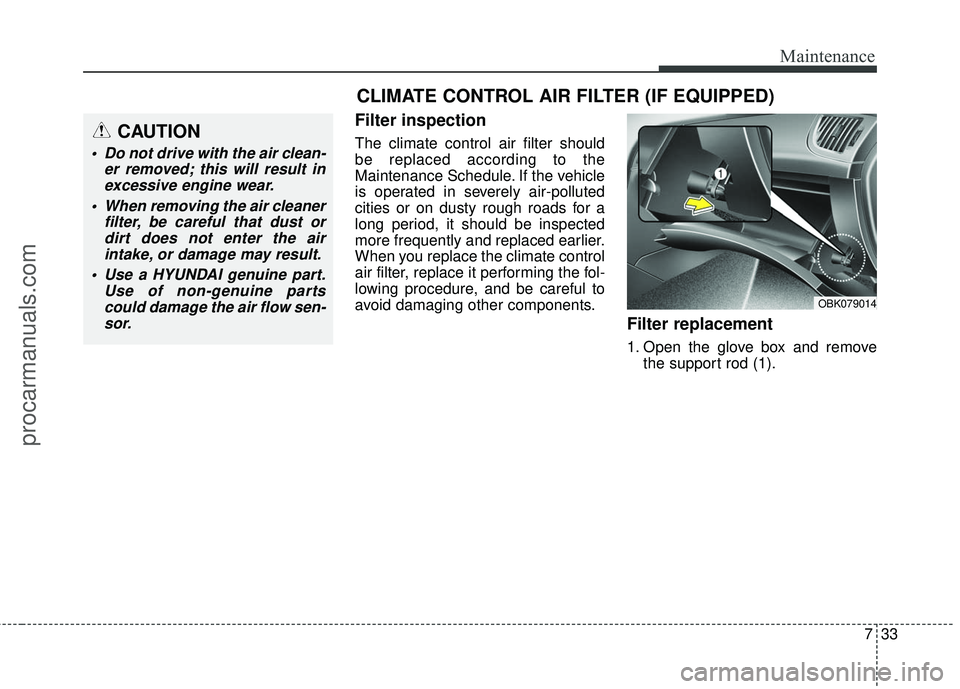
Filter replacement
1. Open the glove box and removethe support rod (1).
CAUTION
Do not drive with the air clean-er removed; this will result inexcessive engine wear.
When removing the air cleaner filter, be careful that dust ordirt does not enter the airintake, or damage may result.
Use a HYUNDAI genuine part. Use of non-genuine partscould damage the air flow sen-sor.
CLIMATE CONTROL AIR FILTER (IF EQUIPPED)
OBK079014
procarmanuals.com
Page 408 of 475
739
Maintenance
Battery recharging
Your vehicle has a maintenance-free,
calcium-based battery.
If the battery becomes discharged
try jump starting the battery from
another vehicle's battery according
to the instructions of section 6-4. Be
sure to run vehicle for at least 15
minutes to charge the battery
enough to be able to restart the vehi-
cle after it is shut off.(Continued)
When lifting a plastic-casedbattery, excessive pressure
on the case may cause battery
acid to leak, resulting in per-
sonal injury. Lift with a battery
carrier or with your hands on
opposite corners.
Never attempt to recharge the battery when the battery
cables are connected.
The electrical ignition system works with high voltage.
Never touch these compo-
nents with the engine running
or the ignition switched on.
Failure to follow the above
warnings can result in serious
bodily injury or death.
CAUTION
When you don’t use the vehi- cle for a long time in low tem-perature weather, separate thebattery and keep it indoors.
Always charge the battery fully to prevent battery case damagein low temperature weather.
If you connect unauthorized electronic devices to the bat-tery, the battery may be dis-charged. Never use unautho-rized devices.
CALIFORNIA PROPOSI-
TION 65 WARNING
Battery posts, terminals, and
related accessories contain
lead and lead compounds,
chemicals known to the State of
California to cause cancer, birth
defects and reproductive harm.
Batteries also contain other
chemicals known to the State of
California to cause cancer.
Wash hands after handling.
WARNING- Recharging
battery
When recharging the battery,
observe the following precau-
tions:
The battery must be removed from the vehicle and placed in
an area with good ventilation.
Do not allow cigarettes, sparks, or flame near the battery.
(Continued)
procarmanuals.com
Page 409 of 475
Maintenance
40
7
Reset items
Items should be reset after the bat-
tery has been discharged or the bat-
tery has been disconnected.
Sunroof (See section 4)
Trip computer (See section 4)
Climate control system
(See section 4)
Clock (See section 4)
Audio (See section 4)
Auto up/down window (See section 4)WARNING
Before performing mainte-nance or recharging the bat-
tery, turn off all accessories
and stop the engine.
The negative battery cable must be removed first and
installed last when the battery
is disconnected.
Operation related to the bat- tery should be done in an
authorized HYUNDAI dealer.
CAUTION
Keep the battery away from water or any liquid.
Use genuine HYUNDAI batter- ies, available at HYUNDAIdealers, when you replace thebattery.
(Continued)
Watch the battery during charg- ing, and stop or reduce the
charging rate if the battery cells
begin gassing (boiling) violent-
ly or if the temperature of the
electrolyte of any cell exceeds
120°F (49°C).
Wear eye protection when checking the battery during
charging.
Disconnect the battery charger in the following order.
1. Turn off the battery charger main switch.
2. Unhook the negative clamp from the negative battery ter-
minal.
3. Unhook the positive clamp from the positive battery ter-
minal.
procarmanuals.com
Page 424 of 475
755
Maintenance
FUSES
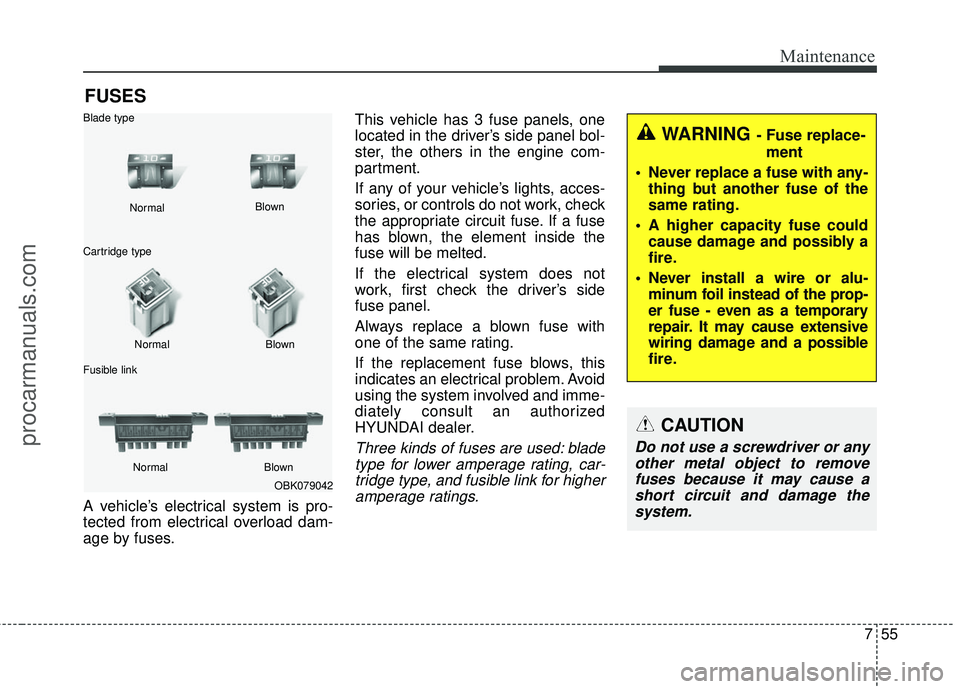
A vehicle’s electrical system is pro-
tected from electrical overload dam-
age by fuses.This vehicle has 3 fuse panels, one
located in the driver’s side panel bol-
ster, the others in the engine com-
partment.
If any of your vehicle’s lights, acces-
sories, or controls do not work, check
the appropriate circuit fuse. If a fuse
has blown, the element inside the
fuse will be melted.
If the electrical system does not
work, first check the driver’s side
fuse panel.
Always replace a blown fuse with
one of the same rating.
If the replacement fuse blows, this
indicates an electrical problem. Avoid
using the system involved and imme-
diately consult an authorized
HYUNDAI dealer.
Three kinds of fuses are used: blade
type for lower amperage rating, car-tridge type, and fusible link for higheramperage ratings.
OBK079042
Normal
Normal
Blade type
Cartridge type
Fusible link Blown
Blown
Normal Blown
WARNING - Fuse replace-
ment
Never replace a fuse with any- thing but another fuse of the
same rating.
A higher capacity fuse could cause damage and possibly a
fire.
Never install a wire or alu- minum foil instead of the prop-
er fuse - even as a temporary
repair. It may cause extensive
wiring damage and a possible
fire.
CAUTION
Do not use a screwdriver or anyother metal object to removefuses because it may cause ashort circuit and damage thesystem.
procarmanuals.com