Fuel tank Hyundai Creta 2016 User Guide
[x] Cancel search | Manufacturer: HYUNDAI, Model Year: 2016, Model line: Creta, Model: Hyundai Creta 2016Pages: 512, PDF Size: 11.54 MB
Page 368 of 512
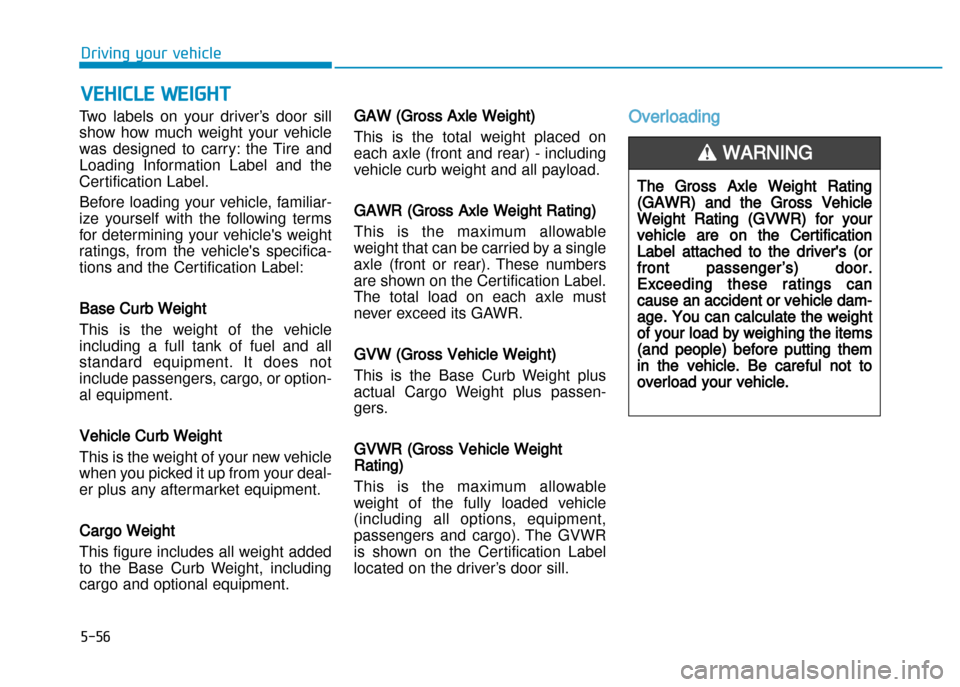
Two labels on your driver’s door sill
show how much weight your vehicle
was designed to carry: the Tire and
Loading Information Label and the
Certification Label.
Before loading your vehicle, familiar
ize yourself with the following terms
for determining your vehicle's weight
ratings, from the vehicle's specifica
tions and the Certification Label:
Base Curb Weight
This is the weight of the vehicle
including a full tank of fuel and all
standard equipment. It does not
include passengers, cargo, or option
al equipment.
Vehicle Curb Weight
This is the weight of your new vehicle
when you picked it up from your deal
er plus any aftermarket equipment.
Cargo Weight
This figure includes all weight added
to the Base Curb Weight, including
cargo and optional equipment.
GAW (Gross Axle Weight)
This is the total weight placed on
each axle (front and rear) including
vehicle curb weight and all payload.
GAWR (Gross Axle Weight Rating)
This is the maximum allowable
weight that can be carried by a single
axle (front or rear). These numbers
are shown on the Certification Label.
The total load on each axle must
never exceed its GAWR.
GVW (Gross Vehicle Weight)
This is the Base Curb Weight plus
actual Cargo Weight plus passen
gers.
GVWR (Gross Vehicle Weight
Rating)
This is the maximum allowable
weight of the fully loaded vehicle
(including all options, equipment,
passengers and cargo). The GVWR
is shown on the Certification Label
located on the driver’s door sill.
Overloading
VEHICLE WEIGHT
The Gross Axle Weight Rating
(GAWR) and the Gross Vehicle
Weight Rating (GVWR) for your
vehicle are on the Certification
Label attached to the driver's (or
front passenger’s) door.
Exceeding these ratings can
cause an accident or vehicle dam
age. You can calculate the weight
of your load by weighing the items
(and people) before putting them
in the vehicle. Be careful not to
overload your vehicle.
WARNING
Driving your vehicle
5-56
Page 417 of 512
7-23
7
Maintenance
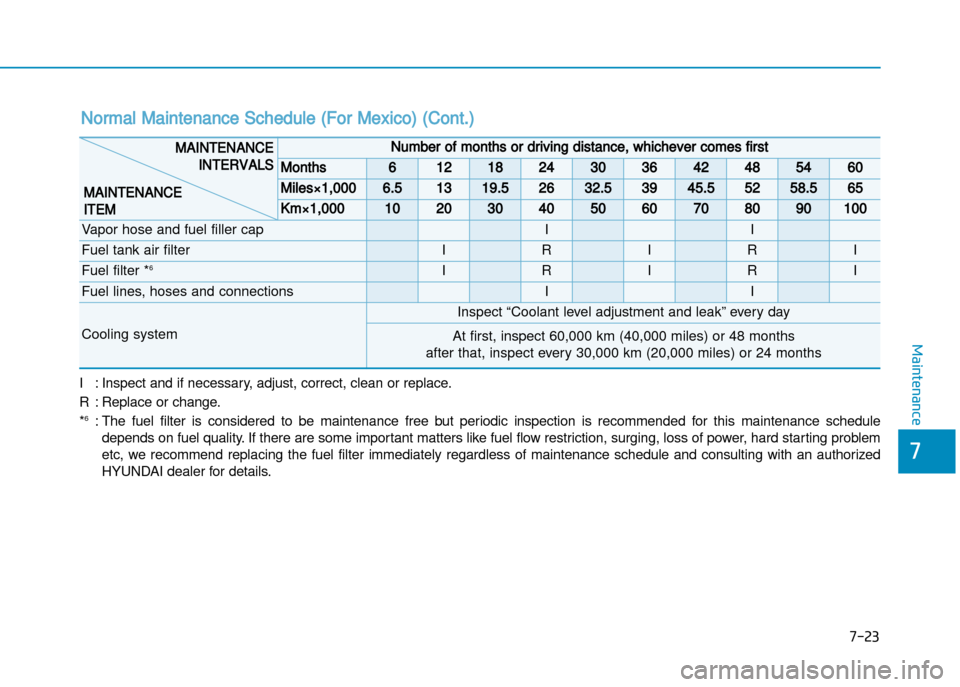
Normal Maintenance Schedule (For Mexico) (Cont.)
I : Inspect and if necessary, adjust, correct, clean or replace.
R : Replace or change. * 6
: The fuel filter is considered to be maintenance f ree but periodic inspection is recommended for this maintenance schedule
depends on fuel quality. If there are some importan t matters like fuel flow restriction, surging, loss of power, hard starting problem
etc, we recommend replacing the fuel filter immedia tely regardless of maintenance schedule and consult ing with an authorized
HYUNDAI dealer for details.
Number of months or driving distance, whichever comes first
Months6121824303642485460
Miles1,0006.51319.52632.53945.55258.565
Km1,000102030405060708090100
Vapor hose and fuel filler capII
Fuel tank air filter IRIRI
Fuel filter * 6IRIRI
Fuel lines, hoses and connectionsII
Cooling system
Inspect “Coolant level adjustment and leak” every day
At first, inspect 60,000 km (40,000 miles) or 48 months
after that, inspect every 30,000 km (20,000 miles) or 24 months
MAINTENANCE
INTERVALS
MAINTENANCE
ITEM
Page 422 of 512
7-28
Maintenance
EXPlANATION OF SChEdulEd MAINTENANCE ITEMS
Engine oil and filter
The engine oil and filter should be
changed at the intervals specified in
the maintenance schedule. If the car
is being driven in severe conditions,
more frequent oil and filter changes
are required.
Drive belts
Inspect all drive belts for evidence of
cuts, cracks, excessive wear or oil
saturation and replace if necessary.
Drive belts should be checked peri
odically for proper tension and
adjusted as necessary.
When you are inspecting the belt,
place the ignition switch in the
LOCK/OFF or ACC position.
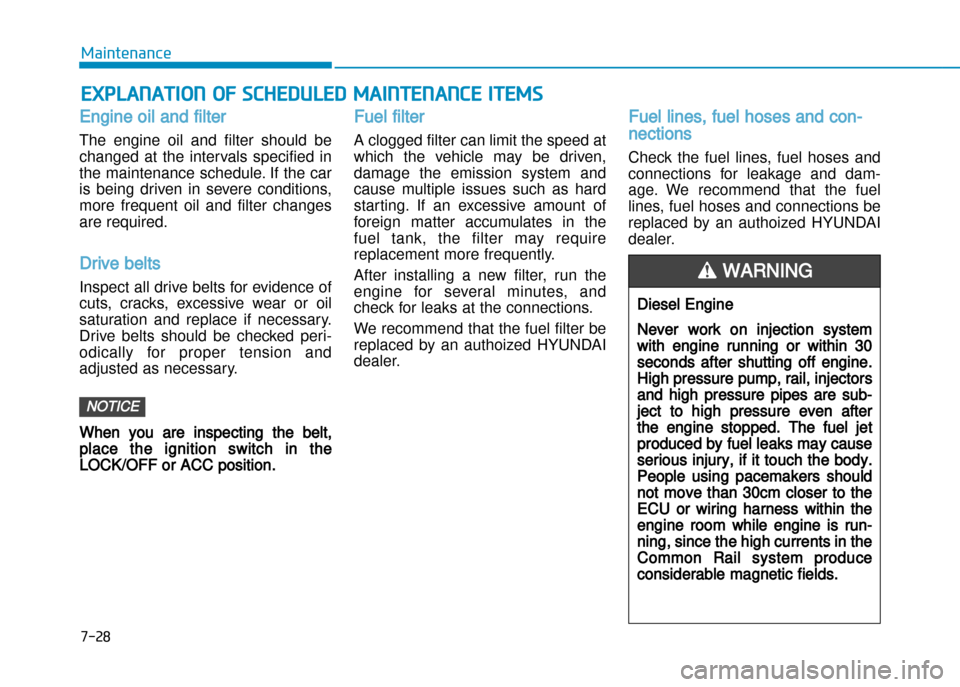
Fuel filter
A clogged filter can limit the speed at
which the vehicle may be driven,
damage the emission system and
cause multiple issues such as hard
starting. If an excessive amount of
foreign matter accumulates in the
fuel tank, the filter may require
replacement more frequently.
After installing a new filter, run the
engine for several minutes, and
check for leaks at the connections.
We recommend that the fuel filter be
replaced by an authoized HYUNDAI
dealer.
Fuel lines, fuel hoses and con
nections
Check the fuel lines, fuel hoses and
connections for leakage and dam
age. We recommend that the fuel
lines, fuel hoses and connections be
replaced by an authoized HYUNDAI
dealer.
NOTICE
Diesel Engine
Never work on injection system
with engine running or within 30
seconds after shutting off engine.
High pressure pump, rail, injectors
and high pressure pipes are sub
ject to high pressure even after
the engine stopped. The fuel jet
produced by fuel leaks may cause
serious injury, if it touch the body.
People using pacemakers should
not move than 30cm closer to the
ECU or wiring harness within the
engine room while engine is run
ning, since the high currents in the
Common Rail system produce
considerable magnetic fields.
WARNING
Page 490 of 512
7-96
Maintenance
EMISSION CONTROl SYSTEM
The emission control system of your
vehicle is covered by a written limited
warranty. Please see the warranty
information contained in the Service
Passport in your vehicle.
Your vehicle is equipped with an
emission control system to meet all
emission regulations.
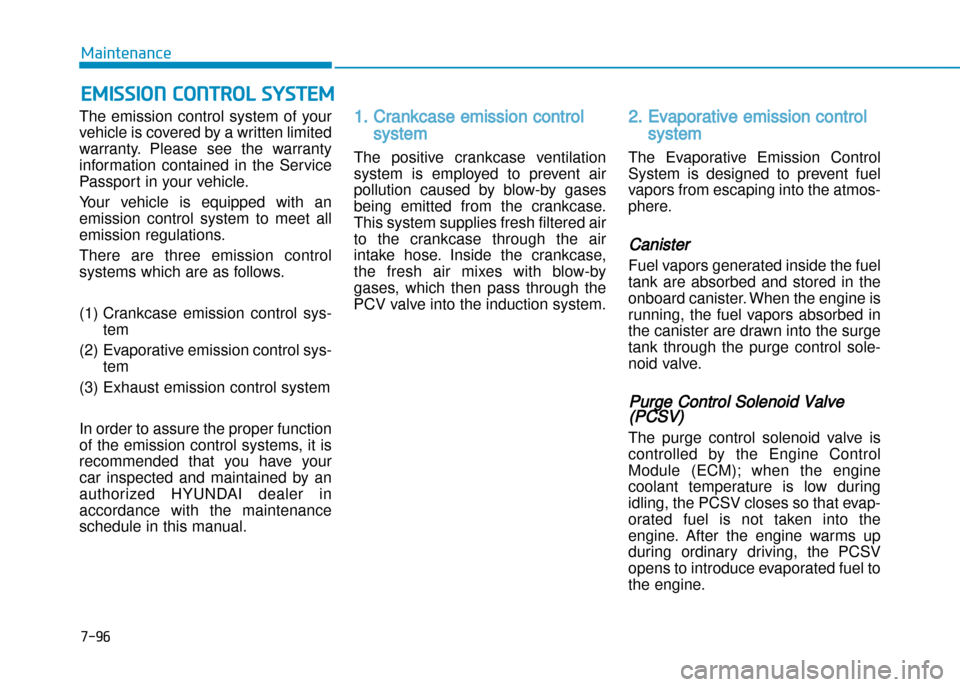
There are three emission control
systems which are as follows.
(1) Crankcase emission control system
(2) Evaporative emission control sys tem
(3) Exhaust emission control system
In order to assure the proper function
of the emission control systems, it is
recommended that you have your
car inspected and maintained by an
authorized HYUNDAI dealer in
accordance with the maintenance
schedule in this manual.1. Crankcase emission control
system
The positive crankcase ventilation
system is employed to prevent air
pollution caused by blowby gases
being emitted from the crankcase.
This system supplies fresh filtered air
to the crankcase through the air
intake hose. Inside the crankcase,
the fresh air mixes with blowby
gases, which then pass through the
PCV valve into the induction system.
2. Evaporative emission control
system
The Evaporative Emission Control
System is designed to prevent fuel
vapors from escaping into the atmos
phere.
Canister
Fuel vapors generated inside the fuel
tank are absorbed and stored in the
onboard canister. When the engine is
running, the fuel vapors absorbed in
the canister are drawn into the surge
tank through the purge control sole
noid valve.
Purge Control Solenoid Valve(PCSV)
The purge control solenoid valve is
controlled by the Engine Control
Module (ECM); when the engine
coolant temperature is low during
idling, the PCSV closes so that evap
orated fuel is not taken into the
engine. After the engine warms up
during ordinary driving, the PCSV
opens to introduce evaporated fuel to
the engine.