VIN Hyundai Creta 2016 User Guide
[x] Cancel search | Manufacturer: HYUNDAI, Model Year: 2016, Model line: Creta, Model: Hyundai Creta 2016Pages: 512, PDF Size: 11.54 MB
Page 45 of 512
2-15
Safety system of your vehicle
2
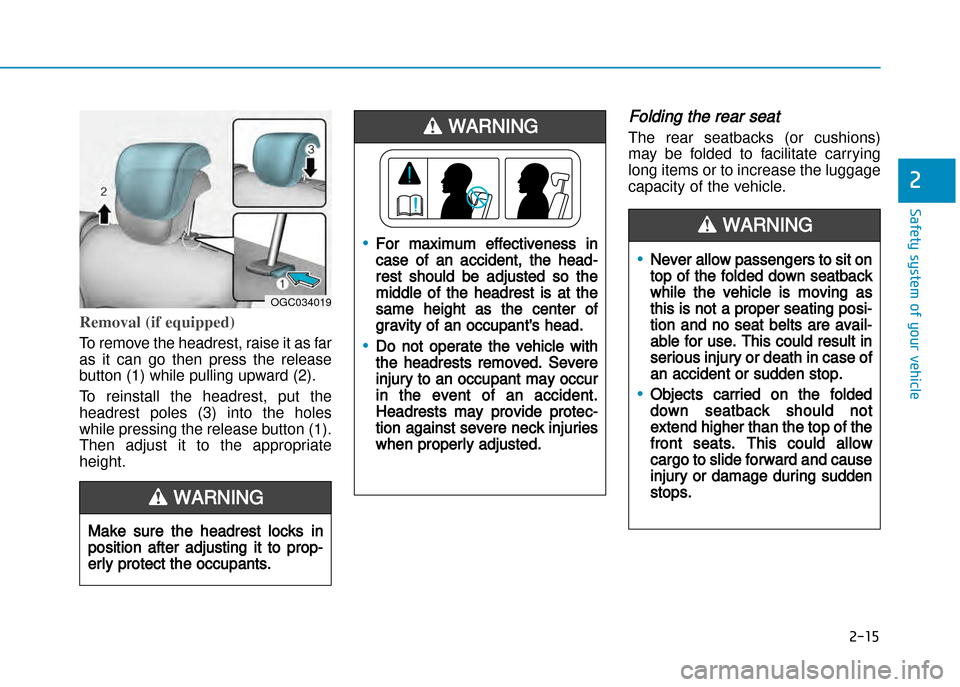
Removal (if equipped)
To remove the headrest, raise it as far
as it can go then press the release
button (1) while pulling upward (2).
To reinstall the headrest, put the
headrest poles (3) into the holes
while pressing the release button (1).
Then adjust it to the appropriateheight.
Folding the rear seat
The rear seatbacks (or cushions)
may be folded to facilitate carrying
long items or to increase the luggage
capacity of the vehicle.
•Never allow passengers to sit on
top of the folded down seatback
while the vehicle is moving as
this is not a proper seating posi
tion and no seat belts are avail
able for use. This could result in
serious injury or death in case of
an accident or sudden stop.
•Objects carried on the folded
down seatback should not
extend higher than the top of the
front seats. This could allow
cargo to slide forward and cause
injury or damage during sudden
stops.
WARNING
Make sure the headrest locks in
position after adjusting it to prop
erly protect the occupants.
WARNING
OGC034019
•For maximum effectiveness in
case of an accident, the head
rest should be adjusted so the
middle of the headrest is at the
same height as the center of
gravity of an occupant's head.
•Do not operate the vehicle with
the headrests removed. Severe
injury to an occupant may occur
in the event of an accident.
Headrests may provide protec
tion against severe neck injuries
when properly adjusted.
WARNING
Page 49 of 512
2-19
Safety system of your vehicle
2
SEAT BELTS
•For maximum restraint system
protection, the seat belts must
always be used whenever the
car is moving.
•Seat belts are most effective
when seatbacks are in the
upright position.
•Children age 12 and under must
always be properly restrained in
the rear seat. Never allow chil
dren to ride in the front passen
ger seat. If a child over 12 must
be seated in the front seat,
he/she must be properly belted
and the seat should be moved
as far back as possible.
(Continued)
WARNING (Continued)
•Never wear the shoulder belt
under your arm or behind your
back. An improperly positioned
shoulder belt can cause serious
injuries in a crash. The shoulder
belt should be positioned mid
way over your shoulder across
your collarbone.
•Never wear a seat belt over
fragile objects. If there is a sud
den stop or impact, the seat belt
can damage it.
•Avoid wearing twisted seat
belts. A twisted belt can't do its
job as well. In a collision, it could
even cut into you. Be sure the
belt webbing is straight and not
twisted.
•Be careful not to damage the
belt webbing or hardware. If the
belt webbing or hardware is
damaged, replace it.
Seat belts are designed to bear
upon the bony structure of the
body, and should be worn low
across the front of the pelvis or the
pelvis, chest and shoulders, as
applicable; wearing the lap section
of the belt across the abdominal
area must be avoided.
Seat belts should be adjusted as
firmly as possible, consistent with
comfort, to provide the protection for
which they have been designed.
A slack belt will greatly reduce the
protection afforded to the wearer.
Care should be taken to avoid con
tamination of the webbing with pol
ishes, oils and chemicals, and par
ticularly battery acid. Cleaning may
safely be carried out using mild
soap and water. The belt should be
replaced if webbing becomes
frayed, contaminated or damaged.
(Continued)
WARNING
Page 50 of 512
2-20
Safety system of your vehicle
(Continued)
It is essential to replace the entire
assembly after it has been worn in
a severe impact even if damage to
the assembly is not obvious. Belts
should not be worn with straps
twisted. Each belt assembly must
only be used by one occupant; it is
dangerous to put a belt around a
child being carried on the occu
pant's lap.
•No modifications or additions
should be made by the user
which will either prevent the seat
belt adjusting devices from oper
ating to remove slack, or prevent
the seat belt assembly from being
adjusted to remove slack.
•When you fasten the seat belt, be
careful not to latch the seat belt in
buckles of other seat. It's very dan
gerous and you may not be pro
tected by the seat belt properly.
•Do not unfasten the seat belt and
do not fasten and unfasten the
seat belt repeatedly while driving.
This could result in loss of control,
and an accident causing death,
serious injury, or property dam
age.
(Continued)
WARNING (Continued)
•When fastening the seat belt,
make sure that the seat belt does
not pass over objects that are
hard or can break easily.
•Make sure there is nothing in the
buckle. The seat belt may not be
fastened securely.
Page 58 of 512
2-28
Safety system of your vehicle
Small children are best prot ected from
injury in an accident when prop erly
restrained in the rear seat by a Child
Restraint System that meets the
requirements of t he Safety Standards
of your country. Before buying any Child
Restraint System, make sure that it has
a label certifying that it meets Safety
Standard of your country. The restraint
must be appropriate for your child's
height and weight. Check the label on
the Child Restraint System for this
information. Refer to “Child Restraint
Systems” in this chapter.
Larger children
Children under age 13 and who are
too large for a booster seat must
always occupy the rear seat and use
the available lap/shoulder belts. A
seat belt should lie across the upper
thighs and be snug across the shoul
der and chest to restrain the child
safely. Check belt fit periodically. A
child's squirming could put the belt
out of position. Children are afforded
the most safety in the event of an
accident when they are restrained by
a proper restraint system and/or seat
belts in the rear seat.
If a larger child over age 13 must be
seated in the front seat, the child
must be securely restrained by the
available lap/shoulder belt and the
seat should be placed in the rear
most position.
If the shoulder belt portion slightly
touches the child’s neck or face, try
placing the child closer to the center
of the vehicle. If the shoulder belt still
touches their face or neck, they need
to be returned to an appropriate booster seat in the rear seat.
ALWAYS properly restrain infants
and small children in a Child Restraint
System appropriate for the child’s
height and weight.
To reduce the risk of serious injury or
death to a child and other passen
gers, NEVER hold a child in your lapor arms when the vehicle is moving.
The violent forces created during an
accident will tear the child from your
arms and throw the child against the
interior of the vehicle.
WARNING
•Always make sure larger chil
dren’s seat belts are worn and
properly adjusted.
•NEVER allow the shoulder belt
to contact the child’s neck or
face.
•Do not allow more than one
child to use a single seat belt.
WARNING
Page 59 of 512
2-29
Safety system of your vehicle
2
Seat belt use and injured people
A seat belt should be used when an
injured person is being transported.
Consult a physician for specific rec
ommendations.
One person per belt
Two people (including children) should
never attempt to use a single seat belt.
This could increase the severity of
injuries in case of an accident.
Do not lie down
Sitting in a reclined position when
the vehicle is in motion can be dan
gerous. Even when buckled up, the
protections of your restraint system
(seat belts and/or air bags) is greatly
reduced by reclining your seatback.
Seat belts must be snug against your hips and chest to work properly. Duringan accident, you could be thrown into the seat belt, causing neck or other
injuries.
The more the seatback is reclined,
the greater chance the passenger’s
hips will slide under the lap belt or
the passenger’s neck will strike the
shoulder belt.
Care of seat belts
Seat belt systems should never be
disassembled or modified. In addi
tion, care should be taken to assure
that seat belts and belt hardware are
not damaged by seat hinges, doors
or other abuse.
•NEVER ride with a reclined seat
back when the vehicle is moving.
•Riding with a reclined seatback
increases your chance of serious
or fatal injuries in the event of a
collision or sudden stop.
•Driver and passengers should
always sit well back in their seats,
properly belted, and with the seat
backs upright.
WARNING
When you return the rear seat
back to its upright position after
the rear seatback has been folded
down, be careful not to damage
the seat belt webbing or buckle.
Be sure that the webbing or buck
le does not get caught or pinched
in the rear seat. A seat belt with
damaged webbing or buckle could
possibly fail during a collision or
sudden stop, resulting in serious
injury. If the webbing or buckles
are damaged, get them replaced
immediately.
WARNING
Page 62 of 512
2-32
Safety system of your vehicle
To reduce the chance of serious or
fatal injuries:
•Children of all ages are safer
when restrained in the rear seat.
A child riding in the front passen
ger seat can be forcefully struck
by an inflating air bag resulting in
serious or fatal injuries.
•Always follow the instructions for
installation and use of the child
restraint maker.
•Always make sure the child seat
is secured properly in the car and
your child is securely restrained
in the child seat.
•Never hold a child in your arms or
lap when riding in a vehicle. The
violent forces created during a
crash will tear the child from your
arms and throw the child against
the car’s interior.
(Continued)
WARNING (Continued)
•Never put a seat belt over yourself
and a child. During a crash, the
belt could press deep into the
child causing serious internal
injuries.
•Never leave children unattended
in a vehicle – not even for a short
time. The car can heat up very
quickly, resulting in serious
injuries to children inside. Even
very young children may inadver
tently cause the vehicle to move,
entangle themselves in the win
dows, or lock themselves or oth
ers inside the vehicle.
•Never allow two children, or any
two persons, to use the same seat
belt.
•Children often squirm and reposi
tion themselves improperly.
Never let a child ride with the
shoulder belt under their arm or
behind their back. Always proper
ly position and secure children in
rear seat.
(Continued)
(Continued)
•Never allow a child to standup or
kneel on the seat or floorboard of
a moving vehicle. During a colli
sion or sudden stop, the child can
be violently thrown against the
vehicles interior, resulting in seri
ous injury.
•Never use an infant carrier or a
child safety seat that "hooks"
over a seatback, it may not pro
vide adequate security in an acci
dent.
•Seat belts can become very hot,
especially when the car is parked
in direct sunlight. Always check
seat belt buckles before fasten
ing them over a child.
•After an accident, we recom
mend that the system be
checked by an authorized
HYUNDAI dealer.
•If there is not enough space to
place the child restraint system
because of the driver's seat,
install the child restraint system
in the rear right seat.
Page 64 of 512
2-34
Safety system of your vehicle
ISOFIX anchorage and toptether
anchorage (ISOFIX anchorages
system) for children
The ISOFIX system holds a Child
Restraint System during driving and
in an accident. This system is
designed to make installation of the
Child Restraint System easier and
reduce the possibility of improperly
installing your Child Restraint
System. The ISOFIX system uses
anchors in the vehicle and attach
ments on the Child Restraint System.
The ISOFIX system eliminates the
need to use seat belts to secure the
Child Restraint System to the rear
seats.
ISOFIX anchorages are metal bars
built into the vehicle. There are twolower anchors for each ISOFIX seat
ing position that will accommodate a
Child Restraint System with lower
attachments. To use the ISOFIX system in your
vehicle, you must have a Child
Restraint System with ISOFIX attach
ments. (An ISOFIX Child Restraint
System may only be installed if it has
vehiclespecific or universal approval
in accordance with the requirements
of ECER44 or ECER129.)
The Child Restraint System manu
facturer will provide you with instruc
tions on how to use the Child
Restraint System with its attach
ments for the ISOFIX anchorages.
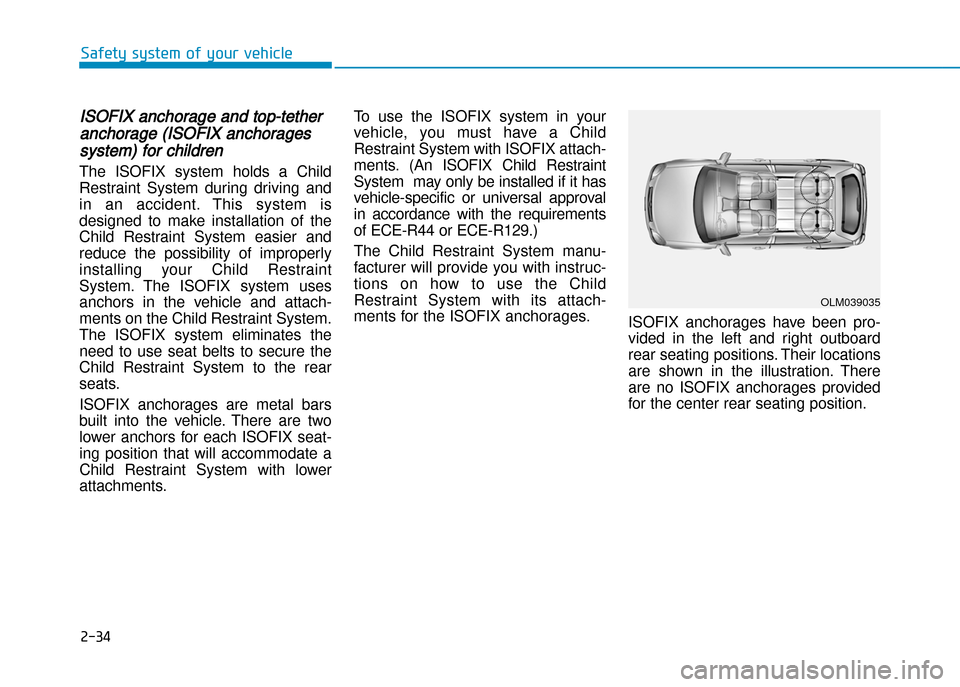
ISOFIX anchorages have been pro
vided in the left and right outboard
rear seating positions. Their locations
are shown in the illustration. There
are no ISOFIX anchorages provided
for the center rear seating position.
OLM039035
Page 74 of 512
2-44
Safety system of your vehicle
How does the air bag system
operate
•Air bags are activated (able to
inflate if necessary) only when the
ignition switch is placed to the ON
or START position.
• Air bags inflate instantly in the event of serious frontal or side col
lision in order to help protect the
occupants from serious physical
injury.
• There is no single speed at which the air bags will inflate.
Generally, air bags are designed to
inflate based upon the severity of a
collision and its direction. These
two factors determine whether the
sensors produce an electronic
deployment/ inflation signal.
• Air bag deployment depends on a number of factors including vehicle
speed, angles of impact and the
density and stiffness of the vehi
cles or objects which your vehicle
hits in the collision. The determin
ing, factors are not limited to those
mentioned above. • The front air bags will completely
inflate and deflate in an instant.
It is virtually impossible for you to
see the air bags inflate during an
accident.
It is much more likely that you will
simply see the deflated air bags
hanging out of their storage com
partments after the collision.
• In order to help provide protection in a severe collision, the air bags
must inflate rapidly. The speed of
air bag inflation is a consequence
of extremely short time in which a
collision occurs and the need to
get the air bag between the occu
pant and the vehicle structures
before the occupant impacts those
structures. This speed of inflation
reduces the risk of serious or life
threatening injuries in a severe col
lision and is thus a necessary part
of air bag design.
However, air bag inflation can also
cause injuries which can include
facial abrasions, bruises and bro
ken bones because the inflation
speed also causes the air bags to
expand with a great deal of force.•Even in vehicles with air bags,
you and your passengers must
always wear the safety belts pro
vided in order to minimize the riskand severity of injury in the event
of a collision or rollover.
•SRS and pretensioners contain
explosive chemicals.
If scraping a vehicle without
removing SRS and pretensioners
from a vehicle, it may cause fire.
Before scraping a vehicle, we
recommend that you contact anauthorized HYUNDAI dealer.
•Keep the SRS parts and wirings
away from water or any liquid. If
the SRS components are inoper
ative due to exposure to water or
liquids, it may cause fire or severeinjury.
WARNING
Page 92 of 512
2-62
Safety system of your vehicle
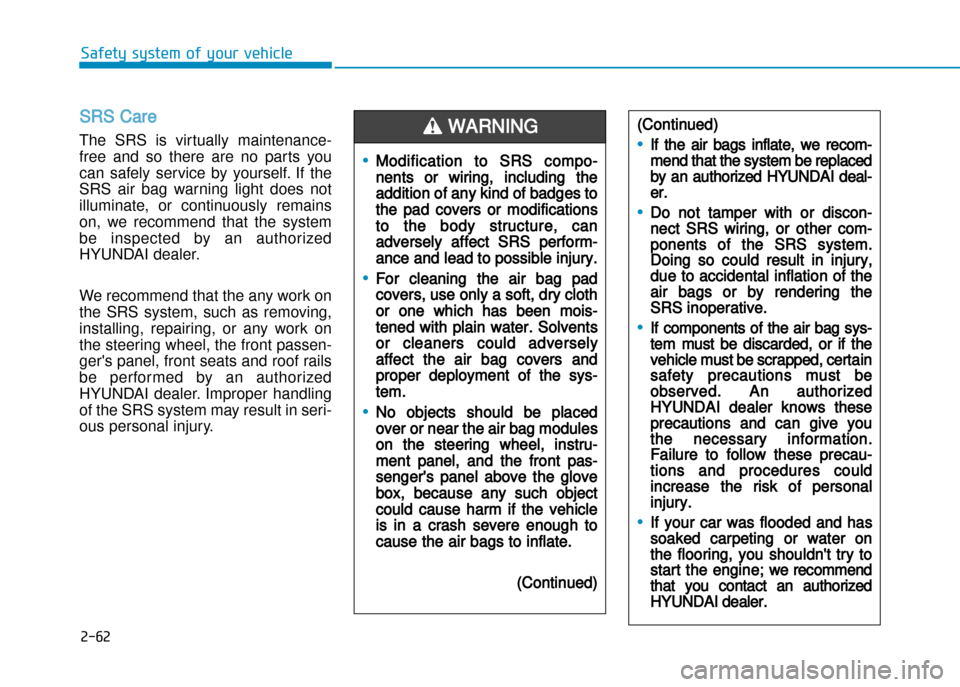
SRS Care
The SRS is virtually maintenance
free and so there are no parts you
can safely service by yourself. If the
SRS air bag warning light does not
illuminate, or continuously remains
on, we recommend that the system
be inspected by an authorized
HYUNDAI dealer.
We recommend that the any work on
the SRS system, such as removing,
installing, repairing, or any work on
the steering wheel, the front passen
ger's panel, front seats and roof rails
be performed by an authorized
HYUNDAI dealer. Improper handling
of the SRS system may result in seri
ous personal injury.
(Continued)
•If the air bags inflate, we recom
mend that the system be replaced
by an authorized HYUNDAI deal
er.
•Do not tamper with or discon
nect SRS wiring, or other com
ponents of the SRS system.Doing so could result in injury,
due to accidental inflation of the
air bags or by rendering the
SRS inoperative.
•If components of the air bag sys
tem must be discarded, or if the
vehicle must be scrapped, certainsafety precautions must be
observed. An authorized
HYUNDAI dealer knows these
precautions and can give you
the necessary information.Failure to follow these precau
tions and procedures could
increase the risk of personal
injury.
•If your car was flooded and has
soaked carpeting or water on
the flooring, you shouldn't try tostart the engine; we recommend
that you contact an authorized
HYUNDAI dealer.
•Modification to SRS compo
nents or wiring, including the
addition of any kind of badges to
the pad covers or modifications
to the body structure, can
adversely affect SRS perform
ance and lead to possible injury.
•For cleaning the air bag pad
covers, use only a soft, dry cloth
or one which has been mois
tened with plain water. Solvents
or cleaners could adversely
affect the air bag covers and
proper deployment of the sys
tem.
•No objects should be placed
over or near the air bag modules
on the steering wheel, instru
ment panel, and the front pas
senger's panel above the glove
box, because any such object
could cause harm if the vehicle
is in a crash severe enough to
cause the air bags to inflate.
(Continued)
WARNING
Page 93 of 512
2-63
Safety system of your vehicle
2
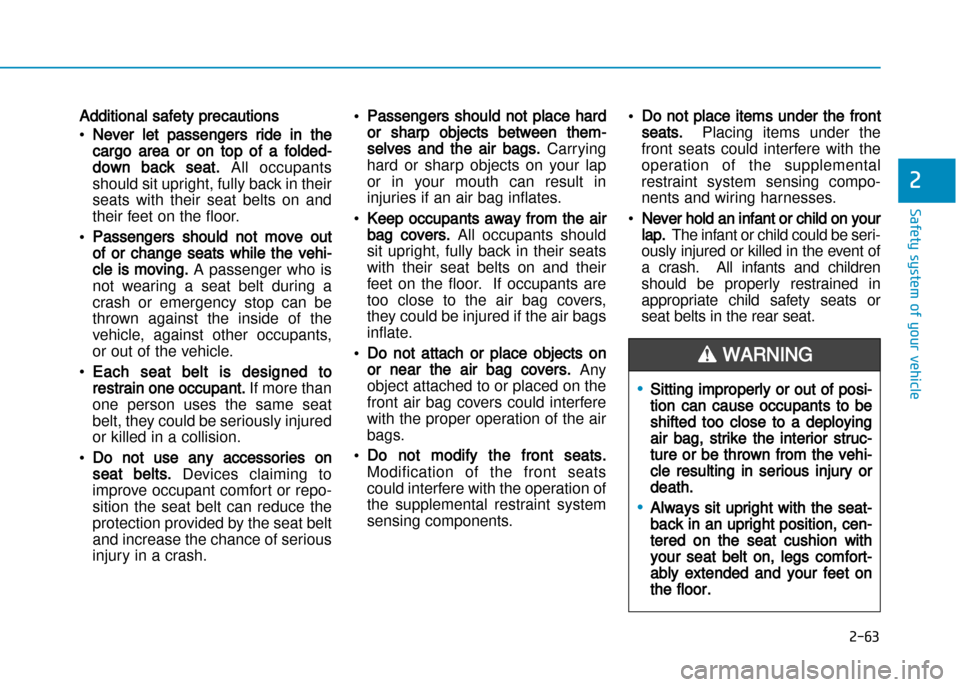
Additional safety precautions
•
Never let passengers ride in the
cargo area or on top of a folded
down back seat. All o ccupants
should sit upright, fully back in their
seats with their seat belts on and
their feet on the floor.
•
Passengers should not move out
of or change seats while the vehi
cle is moving. A passenger who is
not wearing a seat belt during a
crash or emergency stop can be
thrown against the inside of the
vehicle, against other occupants,
or out of the vehicle.
•
Each seat belt is designed to
restrain one occupant. If more than
one person uses the same seat
belt, they could be seriously injured
or killed in a collision.
•
Do not use any accessories on
seat belts. Devices claiming to
improve occupant comfort or repo
sition the seat belt can reduce the
protection provided by the seat belt
and increase the chance of serious
injury in a crash. •
Passengers should not place hard
or sharp objects between them
selves and the air bags.
Carrying
hard or sharp objects on your lap
or in your mouth can result in
injuries if an air bag inflates.
•
Keep occupants away from the air
bag covers. All occupants should
sit upright, fully back in their seats
with their seat belts on and their
feet on the floor. If occupants are
too close to the air bag covers,
they could be injured if the air bags
inflate.
•
Do not attach or place objects on
or near the air bag covers. Any
object attached to or placed on the
front air bag covers could interfere
with the proper operation of the air
bags.
•
Do not modify the front seats.
Modification of the front seats
could interfere with the operation of
the supplemental restraint system
sensing components. •
Do not place items under the front
seats.
Placing items under the
front seats could interfere with the
operation of the supplemental
restraint system sensing compo
nents and wiring harnesses.
•
Never hold an infant or child on your
lap. The infant or child could be seri
ously injured or killed in the event of
a crash. All infants and children
should be properly restrained in
appropriate child safety seats or
seat belts in the rear seat.
•Sitting improperly or out of posi
tion can cause occupants to be
shifted too close to a deploying
air bag, strike the interior struc
ture or be thrown from the vehi
cle resulting in serious injury or
death.
•Always sit upright with the seat
back in an upright position, cen
tered on the seat cushion with
your seat belt on, legs comfort
ably extended and your feet on
the floor.
WARNING