flat tire Hyundai Creta 2016 Owner's Guide
[x] Cancel search | Manufacturer: HYUNDAI, Model Year: 2016, Model line: Creta, Model: Hyundai Creta 2016Pages: 512, PDF Size: 11.54 MB
Page 446 of 512
7-52
Maintenance
•Underinflation also results in
excessive wear, poor handling and
reduced fuel economy. Wheel
deformation also is possible. Keep
your tire pressures at the proper
levels. If a tire frequently needs
refilling, we recommend that the
system be checked by an author
ized HYUNDAI dealer.
•Overinflation produces a harsh
ride, excessive wear at the center
of the tire tread, and a greater pos
sibility of damage from road haz
ards.
•Warm tires normally exceed rec
ommended cold tire pressures by
28 to 41 kPa (4 to 6 psi). Do not
release air from warm tires to
adjust the pressure or the tires will
be underinflated.
•Be sure to reinstall the tire inflation
valve caps. Without the valve cap,
dirt or moisture could get into the
valve core and cause air leakage.
If a valve cap is missing, install a
new one as soon as possible.
Tire pressure
Always observe the following:
•Check tire pressure when the tires
are cold. (After vehicle has been
parked for at least three hours or
hasn't been driven more than 1.6
km (one mile) since startup.)
•Check the pressure of your spare
tire each time you check the pres
sure of other tires.
•Never overload your vehicle. Be
careful not to overload a vehicle
luggage rack if your vehicle is
equipped with one.
•Worn, old tires can cause acci
dents. If your tread is badly worn,
or if your tires have been dam
aged, replace them.
NOTICENOTICENOTICE
Tire Inflation
Overinflation or underinflation can
reduce tire life, adversely affect
vehicle handling, and lead to sud
den tire failure. This could result in
loss of vehicle control and poten
tial injury.
WARNING
Page 447 of 512
7-53
7
Maintenance
Checking tire inflation pressure
Check your tires once a month or
more.
Also, check the tire pressure of the
spare tire.
How to check
Use a good quality gage to check tire
pressure. You can not tell if your tires
are properly inflated simply by look
ing at them. Radial tires may look
properly inflated even when they're
underinflated.
Check the tire's inflation pressure
when the tires are cold. "Cold"
means your vehicle has been sitting
for at least three hours or driven no
more than 1.6 km (1 mile).Remove the valve cap from the tire
valve stem. Press the tire gage firm
ly onto the valve to get a pressure
measurement. If the cold tire inflation
pressure matches the recommended
pressure on the tire and loading
information label, no further adjust
ment is necessary. If the pressure is
low, add air until you reach the rec
ommended amount.
If you overfill the tire, release air by
pushing on the metal stem in the
center of the tire valve. Recheck the
tire pressure with the tire gage. Be
sure to put the valve caps back on
the valve stems. They help prevent
leaks by keeping out dirt and mois
ture.
•Inspect your tires frequently for
proper inflation as well as wear
and damage. Always use a tire
pressure gauge.
•Tires with too much or too little
pressure wear unevenly causing
poor handling, loss of vehicle
control, and sudden tire failure
leading to accidents, injuries,
and even death. The recom
mended cold tire pressure for
your vehicle can be found in this
manual and on the tire label
located on the driver's side cen
ter pillar.
•Worn tires can cause accidents.
Replace tires that are worn,
show uneven wear, or are dam
aged.
•Remember to check the pres
sure of your spare tire.
HYUNDAI recommends that you
check the spare every time you
check the pressure of the other
tires on your vehicle.
WARNING
Page 451 of 512
7-57
7
Maintenance
Tire traction
Tire traction can be reduced if you
drive on worn tires, tires that are
improperly inflated or on slippery
road surfaces. Tires should be
replaced when tread wear indicators
appear. Slow down whenever there
is rain, snow or ice on the road, to
reduce the possibility of losing con
trol of the vehicle.
Tire maintenance
In addition to proper inflation, correct
wheel alignment helps decrease tire
wear. If you find a tire worn unevenly,
have your dealer check the wheelalignment.
When you have new tires installed,
make sure they are balanced. This
will increase vehicle ride comfort and
tire life. Additionally, a tire should
always be rebalanced if it is removed
from the wheel.
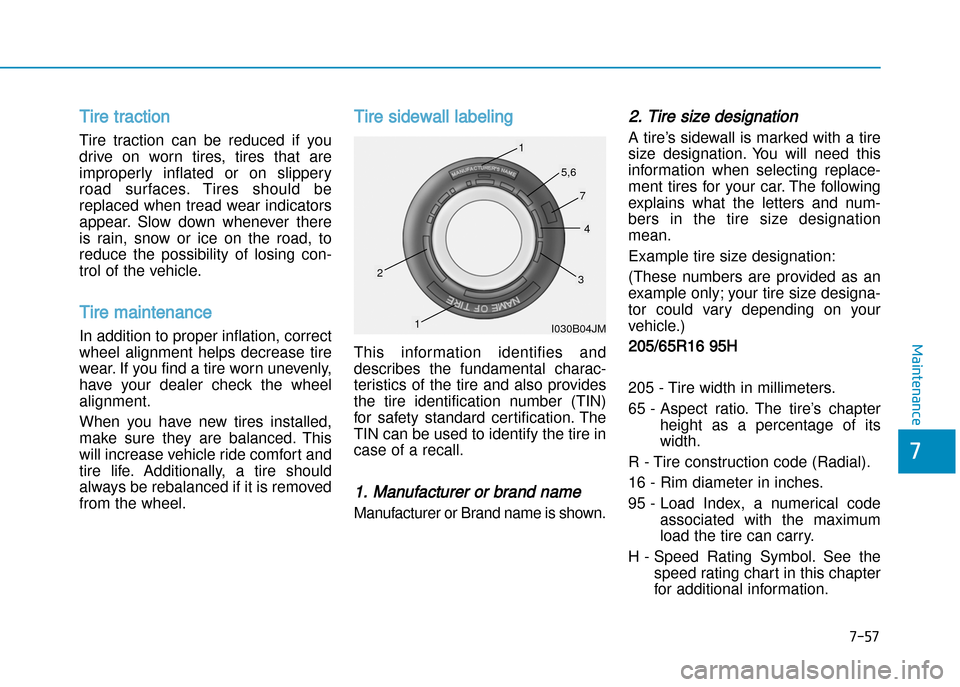
Tire sidewall labeling
This information identifies and
describes the fundamental charac
teristics of the tire and also provides
the tire identification number (TIN)
for safety standard certification. The
TIN can be used to identify the tire in
case of a recall.
1. Manufacturer or brand name
Manufacturer or Brand name is shown.
2. Tire size designation
A tire’s sidewall is marked with a tire
size designation. You will need this
information when selecting replace
ment tires for your car. The following
explains what the letters and num
bers in the tire size designationmean.
Example tire size designation:
(These numbers are provided as an
example only; your tire size designa
tor could vary depending on your
vehicle.)
205/65R16 95H
205 Tire width in millimeters.
65 Aspect ratio. The tire’s chapter height as a percentage of its width.
R Tire construction code (Radial).
16 Rim diameter in inches.
95 Load Index, a numerical code associated with the maximum
load the tire can carry.
H Speed Rating Symbol. See the speed rating chart in this chapter
for additional information.
I030B04JM
1
1
23
4
5,6
7
Page 453 of 512
7-59
7
Maintenance
4. Tire ply composition and materi
al
The number of layers or plies of rub
bercoated fabric in the tire. Tire
manufacturers also must indicate the
materials in the tire, which include
steel, nylon, polyester, and others.
The letter "R" means radial ply con
struction; the letter "D" means diago
nal or bias ply construction; and the
letter "B" means beltedbias ply con
struction.
5. Maximum permissible inflation
pressure
This number is the greatest amount
of air pressure that should be put in
the tire. Do not exceed the maximum
permissible inflation pressure. Refer
to the Tire and Loading Information
label for recommended inflation
pressure.
6. Maximum load rating
This number indicates the maximum
load in kilograms and pounds that
can be carried by the tire. When
replacing the tires on the vehicle,
always use a tire that has the same
load rating as the factory installed
tire.
7. Uniform tire quality grading
Quality grades can be found where
applicable on the tire sidewall
between tread shoulder and maxi
mum chapter width.
For example:
TREAD wear 200
TRACTION AA
TEMPERATURE A
Tire age
Tires degrade over time, even
when they are not being used.
Regardless of the remaining
tread, it is recommended that tires
generally be replaced after six (6)
years of normal service. Heat
caused by hot climates or frequent
high loading conditions can accel
erate the aging process. Failure
to follow this warning could cause
sudden tire failure, which could
lead to a loss of control and an
accident involving serious injury or
death.
WARNING
Page 455 of 512
7-61
7
Maintenance
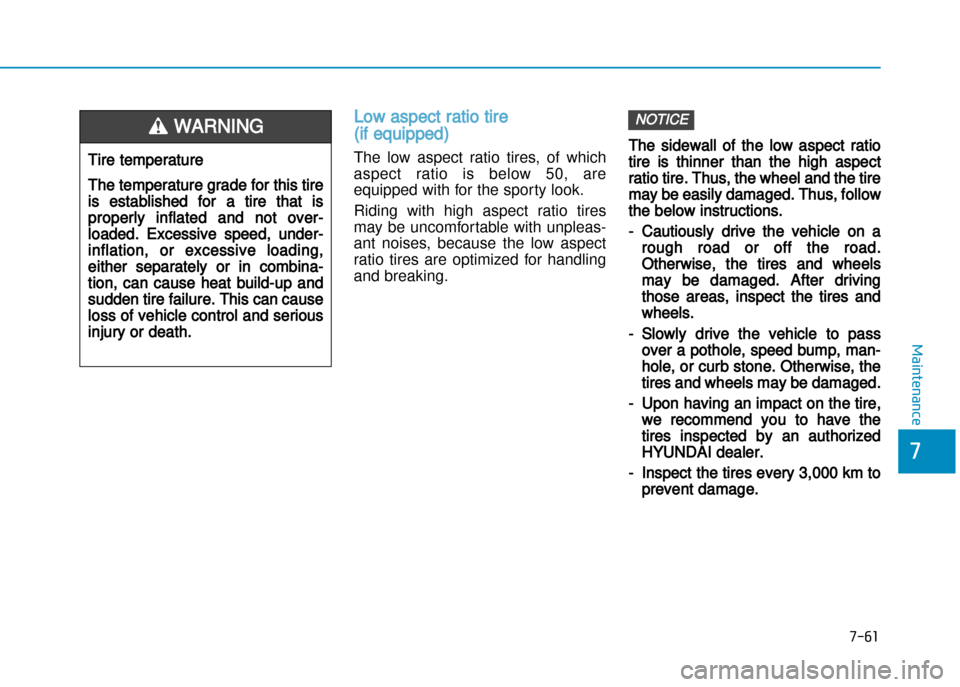
Low aspect ratio tire
(if equipped)
The low aspect ratio tires, of which
aspect ratio is below 50, are
equipped with for the sporty look.
Riding with high aspect ratio tires
may be uncomfortable with unpleas
ant noises, because the low aspect
ratio tires are optimized for handling
and breaking.The sidewall of the low aspect ratio
tire is thinner than the high aspect
ratio tire. Thus, the wheel and the tire
may be easily damaged. Thus, follow
the below instructions.
Cautiously drive the vehicle on a
rough road or off the road.
Otherwise, the tires and wheels
may be damaged. After driving
those areas, inspect the tires and
wheels.
Slowly drive the vehicle to pass
over a pothole, speed bump, man
hole, or curb stone. Otherwise, the
tires and wheels may be damaged.
Upon having an impact on the tire,
we recommend you to have the
tires inspected by an authorized
HYUNDAI dealer.
Inspect the tires every 3,000 km to
prevent damage.
NOTICE
Tire temperature
The temperature grade for this tire
is established for a tire that is
properly inflated and not over
loaded. Excessive speed, under
inflation, or excessive loading,
either separately or in combina
tion, can cause heat buildup and
sudden tire failure. This can cause
loss of vehicle control and serious
injury or death.
WARNING
Page 496 of 512
8-4
Specifications & Consumer information
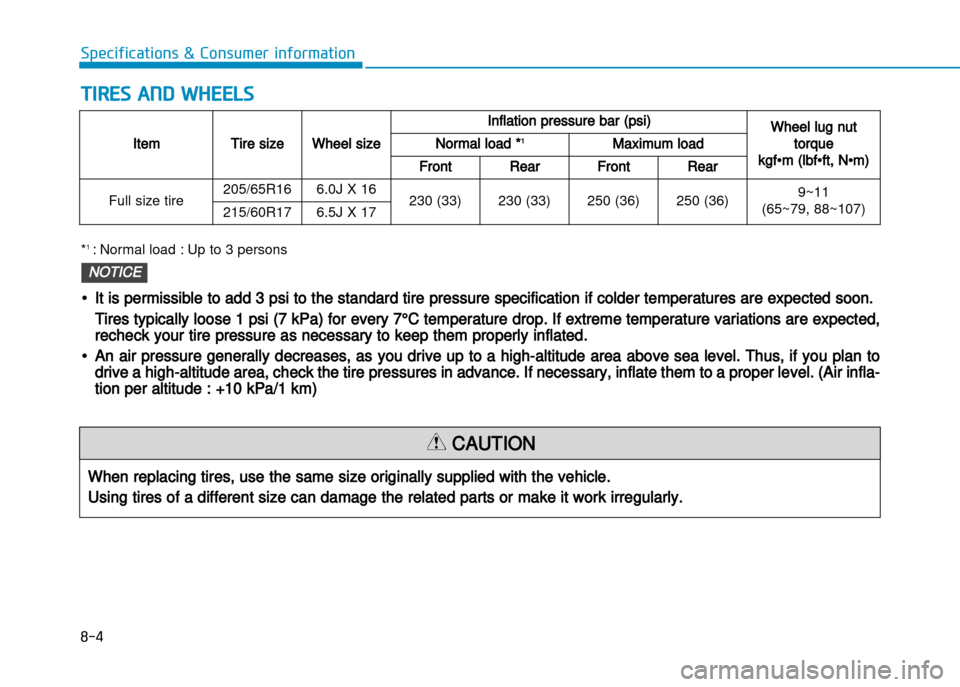
tIrES aND whEElS
When replacing tires, use the same size originally supplied with the vehicle.
Using tires of a different size can damage the related parts or make it work irregularly.
CAUTION
*1
: Normal load : Up to 3 persons
ItemTire sizeWheel size
Inflation pressure bar (psi)Wheel lug nut
torque
kgf•m (lbf•ft, N•m)
Normal load *1Maximum load
FrontRearFront Rear
Full size tire 205/65R16 6.0J X 16
230 (33) 230 (33) 250 (36) 250 (36) 9~11
(65~79, 88~107)
215/60R17 6.5J X 17
•It is permissible to add 3 psi to the standard tire pressure specification if colder temperatures are expected soon.
Tires typically loose 1 psi (7 kPa) for every 7°C temperature drop. If extreme temperature variations are expected,
recheck your tire pressure as necessary to keep them properly inflated.
•An air pressure generally decreases, as you drive up to a highaltitude area above sea level. Thus, if you plan to
drive a highaltitude area, check the tire pressures in advance. If necessary, inflate them to a proper level. (Air infla
tion per altitude : +10 kPa/1 km)
NOTICE