Ignition Hyundai Creta 2016 Repair Manual
[x] Cancel search | Manufacturer: HYUNDAI, Model Year: 2016, Model line: Creta, Model: Hyundai Creta 2016Pages: 512, PDF Size: 11.54 MB
Page 350 of 512
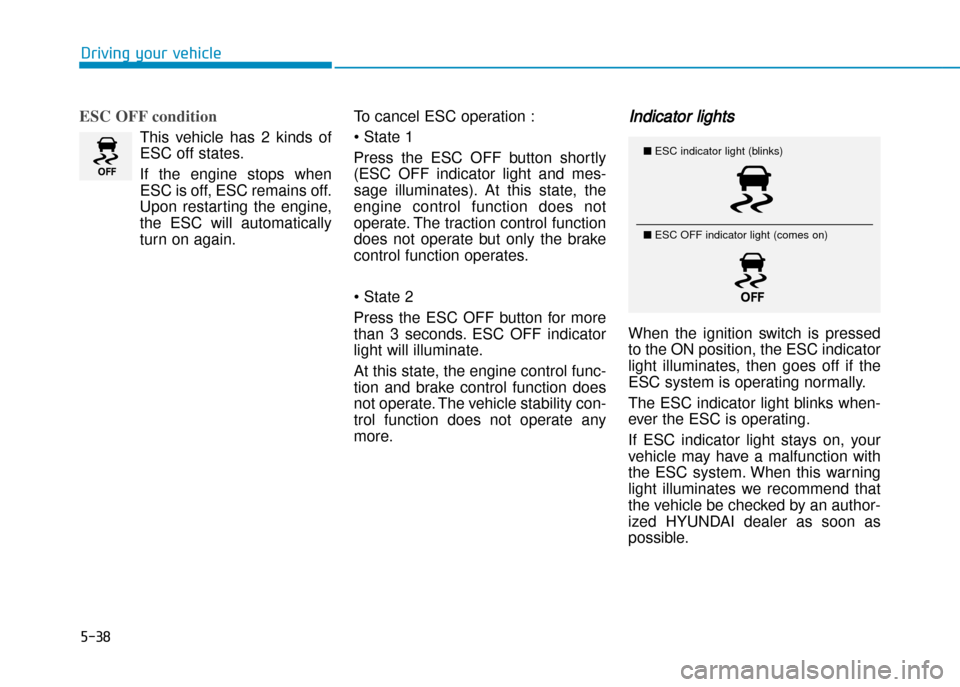
ESC OFF condition
This vehicle has 2 kinds of
ESC off states.
If the engine stops when
ESC is off, ESC remains off.
Upon restarting the engine,
the ESC will automatically
turn on again. To cancel ESC operation :
• State 1
Press the ESC OFF button shortly
(ESC OFF indicator light and mes
sage illuminates). At this state, the
engine control function does not
operate. The traction control function
does not operate but only the brake
control function operates.
• State 2
Press the ESC OFF button for more
than 3 seconds. ESC OFF indicator
light will illuminate.
At this state, the engine control func
tion and brake control function does
not operate. The vehicle stability con
trol function does not operate any
more.
Indicator lights
When the ignition switch is pressed
to the ON position, the ESC indicator
light illuminates, then goes off if the
ESC system is operating normally.
The ESC indicator light blinks when
ever the ESC is operating.
If ESC indicator light stays on, your
vehicle may have a malfunction with
the ESC system. When this warning
light illuminates we recommend that
the vehicle be checked by an author
ized HYUNDAI dealer as soon as
possible.
5-38
Driving your vehicle
■ ESC indicator light (blinks)
■ ESC OFF indicator light (comes on)
Page 354 of 512
Good braking practices Wet brakes can be dangerous! The
brakes may get wet if the vehicle is
driven through standing water or if it
is washed. Your vehicle will not stop
as quickly if the brakes are wet. Wet
brakes may cause the vehicle to pull
to one side.
To dry the brakes, apply the brakes
lightly until the braking action returns
to normal, taking care to keep the
vehicle under control at all times. If
the braking action does not return to
normal, stop as soon as it is safe to
do so and we recommend that you
call an authorized HYUNDAI dealer
for assistance.
DO NOT drive with your foot resting
on the brake pedal. Even light, but
constant pedal pressure can result in
the brakes overheating, brake wear,
and possibly even brake failure. If a tire goes flat while you are driv
ing, apply the brakes gently and
keep the vehicle pointed straight
ahead while you slow down. When
you are moving slowly enough for it
to be safe to do so, pull off the road
and stop in a safe location.
Keep your foot firmly on the brake
pedal when the vehicle is stopped to
prevent the vehicle from rolling for
ward.
5-42
Driving your vehicle
Whenever leaving the vehicle or
parking, always come to a com
plete stop and continue to depress
the brake pedal. Move the shift
lever into the 1st gear (for manual
transaxle vehicle) or P (Park, for
automatic transaxle vehicle) posi
tion, then apply the parking brake,
and place the ignition switch in the
LOCK/OFF position.
Vehicles parked with the parking
brake not applied or not fully
engaged may roll inadvertently
and may cause injury to the driver
and others. ALWAYS apply the
parking brake before exiting the
vehicle.
WARNING
Page 366 of 512
When using tire chains:
•Wrong size chains or improperly
installed chains can damage your
vehicle's brake lines, suspension,
body and wheels.
•Use SAE “S” class or wire chains.
•If you hear noise caused by chains
contacting the body, retighten the
chain to prevent contact with the
vehicle body.
•To prevent body damage, retighten
the chains after driving 0.5~1.0 km
(0.3~0.6 miles).
•Do not use tire chains on vehicles
equipped with aluminum wheels. If
unavoidable, use a wire type
chain.
•Use wire chains less than 15 mm
(0.59 in) wide to prevent damage
to the chain’s connection.
Winter precautions
Use high quality ethylene glycol
coolant
Your vehicle is delivered with high
quality ethylene glycol coolant in the
cooling system. It is the only type of
coolant that should be used because
it helps prevent corrosion in the cool
ing system, lubricates the water
pump and prevents freezing. Be sure
to replace or replenish your coolant
in accordance with the maintenance
schedule in chapter 7. Before winter,
have your coolant tested to assure
that its freezing point is sufficient for
the temperatures anticipated during
the winter.
Check battery and cables
Winter puts additional burdens on
the battery system. Visually inspect
the battery and cables as described
in chapter 7. The level of charge in
your battery can be checked by an
authorized HYUNDAI dealer or a
service station.
Change to "winter weight" oil if
necessary
In some climates it is recommended
that a lower viscosity "winter weight"
oil be used during cold weather. See
chapter 8 for recommendations. If
you aren't sure what weight oil you
should use, we recommend that you
consult with an authorized HYUNDAI
dealer.
Check spark plugs and ignition
system
Inspect your spark plugs as
described in chapter 7 and replace
them if necessary. Also check all
ignition wiring and components to be
sure they are not cracked, worn or
damaged in any way.
NOTICE
Driving your vehicle
5-54
Page 370 of 512
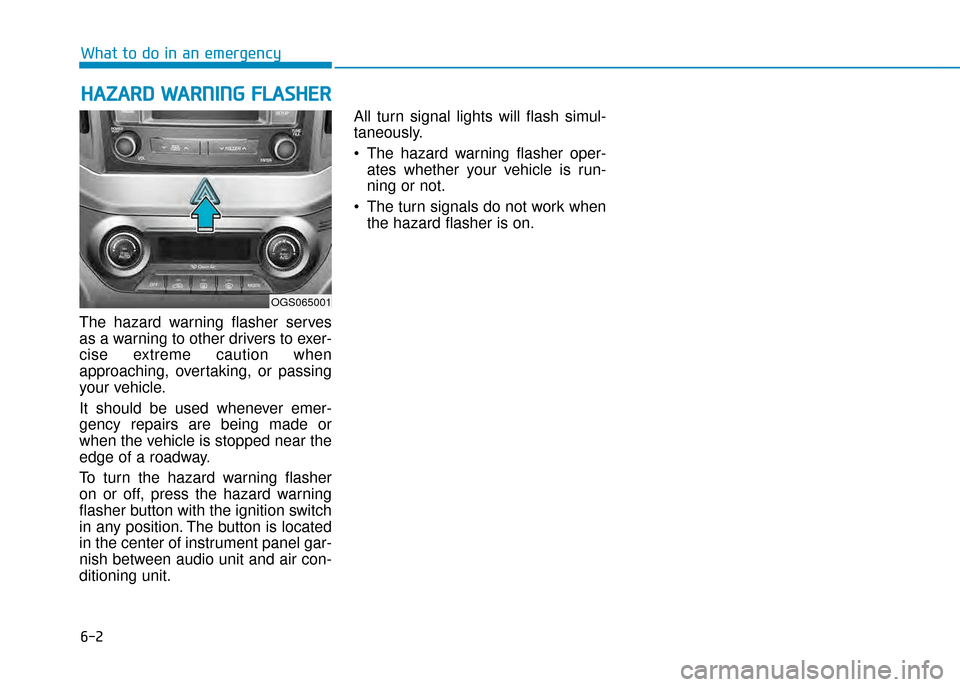
The hazard warning flasher serves
as a warning to other drivers to exer
cise extreme caution when
approaching, overtaking, or passing
your vehicle.
It should be used whenever emer
gency repairs are being made or
when the vehicle is stopped near the
edge of a roadway.
To turn the hazard warning flasher
on or off, press the hazard warning
flasher button with the ignition switch
in any position. The button is located
in the center of instrument panel gar
nish between audio unit and air con
ditioning unit. All turn signal lights will flash simul
taneously.
• The hazard warning flasher oper
ates whether your vehicle is run
ning or not.
• The turn signals do not work when the hazard flasher is on.
HAZARD WARNING FLASHER
6-2
What to do in an emergency
OGS065001
Page 371 of 512
If the engine stalls while driving
• Reduce your speed gradually,keeping a straight line. Move cau
tiously off the road to a safe place.
• Turn on your hazard warning flash er.
• Try to start the engine again. If your vehicle will not start, we recom
mend that you contact an author
ized HYUNDAI dealer.
If the engine stalls at a cross
road or crossing
If the engine stalls at a crossroad or
crossing, if safe to do so, move the
shift lever to the N (Neutral) position
and then push the vehicle to a safelocation.
• If your vehicle has a manualtransaxle not equipped with a igni
tion lock switch, the vehicle can
move forward by shifting to the
2(second) or 3(third) gear and then
turning the starter without depress
ing the clutch pedal.
If you have a flat tire while driv
ing
If a tire goes flat while you are driv ing:
• Take your foot off the accelerator pedal and let the vehicle slow
down while driving straight ahead.
Do not apply the brakes immedi
ately or attempt to pull off the road
as this may cause loss of vehicle
control resulting in an accident.
When the vehicle has slowed to
such a speed that it is safe to do
so, brake carefully and pull off the
road. Drive off the road as far as
possible and park on firm, level
ground. If you are on a divided
highway, do not park in the median
area between the two traffic lanes.
• When the vehicle is stopped, press the hazard warning flasher button,
move the shift lever into P (Park,
for automatic transaxle vehicle) or
neutral (for manual transaxle vehi
cle), apply the parking brake, and
place the ignition switch in theLOCK/OFF position. • Have all passengers get out of the
vehicle. Be sure they all get out on
the side of the vehicle that is away
from traffic.
• When changing a flat tire, follow the instructions provided later in
this chapter.
IN CASE OF AN EMERGENCY WHILE DRIVING
6-3
What to do in an emergency
6
Page 374 of 512
To prevent damage to your vehicle:
•Only use a 12volt power supply
(battery or jumper system) to jump
start your vehicle.
•Do not attempt to jump start your
vehicle by pushstarting.
Information
An inappropriately disposed battery can be harmful to the
environment and human
health. Dispose the battery
according to your local law(s)
or regulation.
Jump starting procedure
1. Position the vehicles close enough that the jumper cables will reach,
but do not allow the vehicles totouch.
2. Avoid fans or any moving parts in the engine compartment at all
times, even when the vehicles are
turned off.
3. Turn off all electrical devices such as radios, lights, air conditioning,
etc. Put the vehicles in P (Park, for
automatic transaxle vehicle) or
neutral (for manual transaxle vehi
cle), and set the parking brakes.
Turn both vehicles OFF.
i
NOTICE
6-6
What to do in an emergency
Pb
(Continued)
•NEVER attempt to recharge the
battery when the vehicle’s bat
tery cables are connected to the
battery.
•The electrical ignition system
works with high voltage. NEVER
touch these components with
the engine running or when the
ignition switch is in the ON posi
tion.
•Do not allow the (+) and ()
jumper cables to touch. It may
cause sparks.
•The battery may rupture or
explode when you jump start
with a low or frozen battery.
•Never attempt jump start if you
observe cracks, leaks or other
damage on Battery.
Page 379 of 512
6-11
What to do in an emergency
6
Information
If the TPMS indicator does not illumi
nate for 3 seconds when the ignition
switch is turned to the ON position or
engine is running, or if it comes on
after blinking for approximately one
minute, we recommend that you con
tact an authorized HYUNDAI dealer.Low tire pressure tell
tale
When the tire pressure monitoring
system warning indicator is illuminat
ed, one or more of your tires is sig
nificantly underinflated.
If the telltale illuminates, immediately
reduce your speed, avoid hard cor
nering and anticipate increased stop
ping distances. You should stop and
check your tires as soon as possible.
Inflate the tires to the proper pres
sure as indicated on the vehicle’s
placard or tire inflation pressure label
located on the driver’s side center pil
lar outer panel. If you cannot reach a
service station or if the tire cannot
hold the newly added air, replace the
low pressure tire with the spare tire.
Then the Low Tire Pressure telltale
may flash for approximately one minute and then remain continuously
illuminated after restarting and about
20 minutes of continuous drivingbefore you have the low pressure tire
repaired and replaced on the vehicle.
i
In winter or cold weather, the low
tire pressure telltale may be illumi
nated if the tire pressure was
adjusted to the recommended tire
inflation pressure in warm weath
er. It does not mean your TPMS is
malfunctioning because the
decreased temperature leads to a
proportional lowering of tire pres
sure.
When you drive your vehicle from
a warm area to a cold area or from
a cold area to a warm area, or the
outside temperature is greatly
higher or lower, you should check
the tire inflation pressure and
adjust the tires to the recommend
ed tire inflation pressure.
CAUTION
Page 385 of 512
6-17
What to do in an emergency
6
Changing tires Follow these steps to change your
vehicle’s tire:
1. Park on a level, firm surface.
2. Move the shift lever into P (Park,for automatic transaxle vehicle) or
neutral (for manual transaxle
vehicle), apply the parking brake,
and place the ignition switch in the
LOCK/OFF position.
3. Press the hazard warning flasher button.
4. Remove the wheel lug nut wrench, jack, jack handle, and spare tire
from the vehicle.
5. Block both the front and rear of the tire diagonally opposite of the tire
you are changing.
A vehicle can slip or roll off of a
jack causing serious injury or
death to you or those nearby.
Take the following safety precau
tions:
•Do not get under a vehicle that
is supported by a jack.
•NEVER attempt to change a tire
in the lane of traffic. ALWAYS
move the vehicle completely off
the road on level, firm ground
away from traffic before trying to
change a tire. If you cannot find
a level, firm place off the road,
call a towing service for assis
tance.
•Be sure to use the jack provided
with the vehicle.
(Continued)
(Continued)
•ALWAYS place the jack on the
designated jacking positions on
the vehicle and NEVER on the
bumpers or any other part of the
vehicle for jacking support.
•Do not start or run the engine
while the vehicle is on the jack.
•Do not allow anyone to remain
in the vehicle while it is on the
jack.
•Keep children away from the
road and the vehicle.
WARNING
Page 391 of 512
6-23
What to do in an emergency
6
When towing your vehicle in an
emergency without wheel dollies:
1. Place the ignition switch in the ACC position.
2. Place the shift lever in N (Neutral).
3. Release the parking brake.
Failure to place the shift lever in N
(Neutral) when being towed with the
front wheels on the ground can
cause internal damage to the
transaxle.
Removable towing hook
NOTICE
OGC064010OGC064015
OGC064011
n Frontn Rear
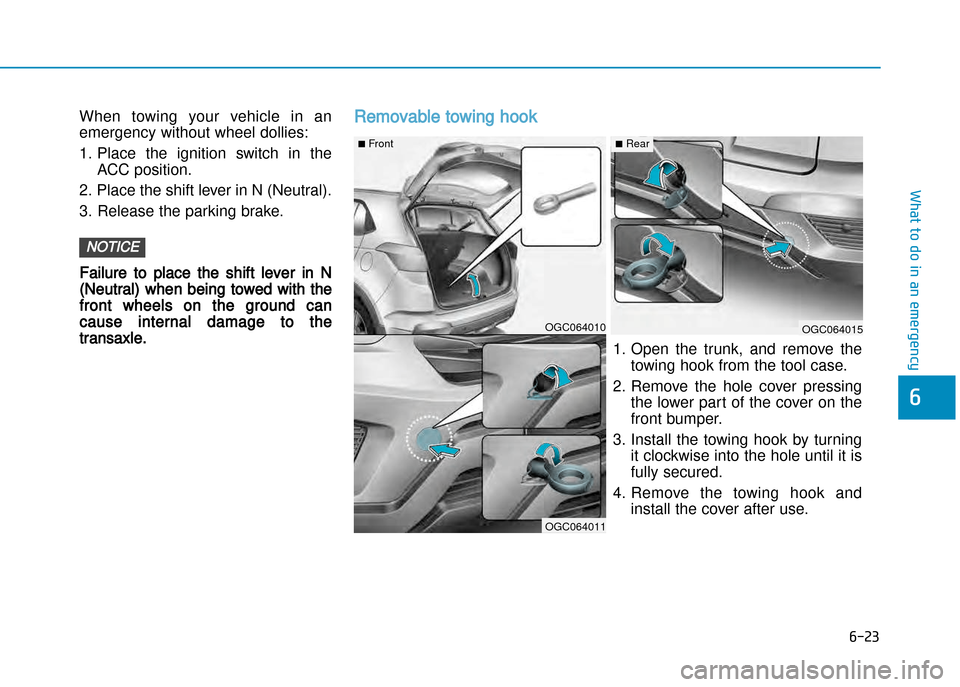
1. Open the trunk, and remove the
towing hook from the tool case.
2. Remove the hole cover pressing the lower part of the cover on the
front bumper.
3. Install the towing hook by turning it clockwise into the hole until it is
fully secured.
4. Remove the towing hook and install the cover after use.
Page 392 of 512
6-24
What to do in an emergency
Emergency towing
If towing is necessary, we recom
mend you have it done by an author
ized HYUNDAI dealer or a commer
cial tow truck service. If towing service is not available in an
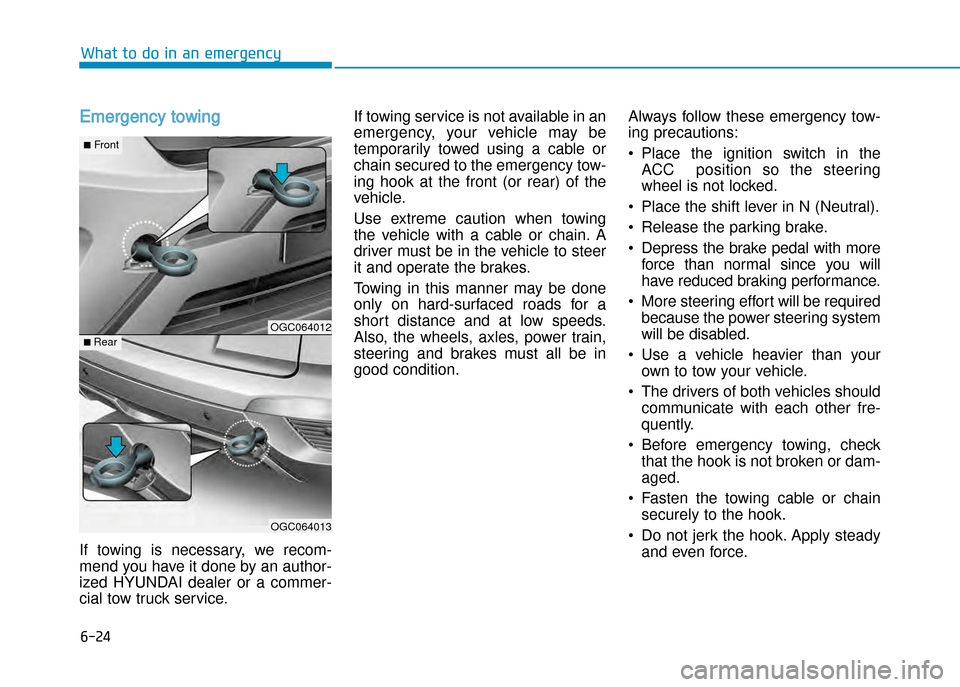
emergency, your vehicle may be
temporarily towed using a cable or
chain secured to the emergency tow
ing hook at the front (or rear) of the
vehicle.
Use extreme caution when towing
the vehicle with a cable or chain. A
driver must be in the vehicle to steer
it and operate the brakes.
Towing in this manner may be done
only on hardsurfaced roads for a
short distance and at low speeds.
Also, the wheels, axles, power train,
steering and brakes must all be in
good condition.
Always follow these emergency tow
ing precautions:
• Place the ignition switch in the
ACC position so the steering
wheel is not locked.
• Place the shift lever in N (Neutral).
• Release the parking brake.
• Depress the brake pedal with more force than normal since you will
have reduced braking performance.
• More steering effort will be required because the power steering system
will be disabled.
• Use a vehicle heavier than your own to tow your vehicle.
• The drivers of both vehicles should communicate with each other fre
quently.
• Before emergency towing, check that the hook is not broken or damaged.
• Fasten the towing cable or chain securely to the hook.
• Do not jerk the hook. Apply steady and even force.
OGC064012
OGC064013
nFront
n Rear