ECU Hyundai Creta 2018 User Guide
[x] Cancel search | Manufacturer: HYUNDAI, Model Year: 2018, Model line: Creta, Model: Hyundai Creta 2018Pages: 472, PDF Size: 11.87 MB
Page 54 of 472
2-34
Safety system of your vehicle
ISOFIX anchorage and top-teth-
er anchorage (ISOFIX anchor-
ages system) for children
The ISOFIX system holds a Child
Restraint System during driving and
in an accident. This system is
designed to make installation of the
Child Restraint System easier and
reduce the possibility of improperly
installing your Child Restraint
System. The ISOFIX system uses
anchors in the vehicle and attach-
ments on the Child Restraint System.
The ISOFIX system eliminates the
need to use seat belts to secure the
Child Restraint System to the rear
seats.
ISOFIX anchorages are metal bars
built into the vehicle. There are two
lower anchors for each ISOFIX seat-
ing position that will accommodate a
Child Restraint System with lower
attachments.To use the ISOFIX system in your
vehicle, you must have a Child
Restraint System with ISOFIX attach-
ments.(An ISOFIX Child Restraint
System may only be installed if it has
vehicle-specific or universal approval
in accordance with the requirements
of ECE-R44 or ECE-R129.)
The Child Restraint System manu-
facturer will provide you with instruc-
tions on how to use the Child
Restraint System with its attach-
ments for the ISOFIX anchorages.
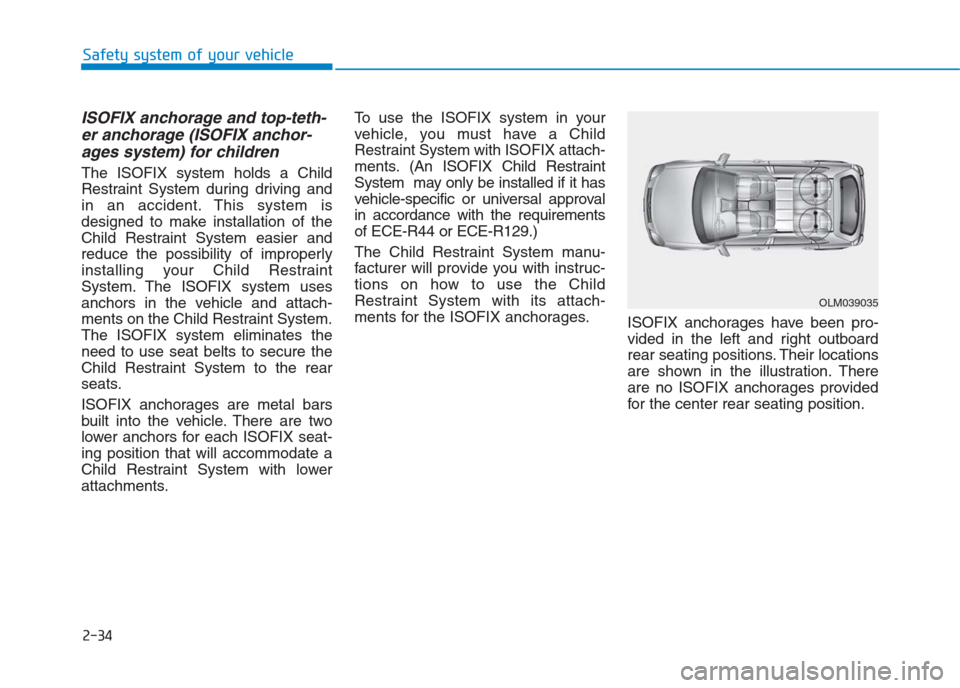
ISOFIX anchorages have been pro-
vided in the left and right outboard
rear seating positions. Their locations
are shown in the illustration. There
are no ISOFIX anchorages provided
for the center rear seating position.
OLM039035
Page 56 of 472
Securing a Child Restraint
System with the “ISOFIX
Anchorage System”
To install a ISOFIX-compatible Child
Restraint System in either of the rear
outboard seating positions:
1. Move the seat belt buckle away
from the ISOFIX anchorages.
2. Move any other objects away from
the anchors that could prevent a
secure connection between the
Child Restraint System and the
ISOFIX anchorages.
3. Place the Child Restraint System
on the vehicle seat, then attach the
seat to the ISOFIX anchorages
according to the instructions provid-
ed by the Child Restraint System
manufacturer.
4. Follow the instructions of the Child
Restraint System's manufacturer
for proper installation and connec-
tion of the ISOFIX attachments on
the Child Restraint System to the
ISOFIX anchorages.
2-36
Safety system of your vehicle
Take the following precautions
when using the ISOFIX system:
Read and follow all installation
instructions provided with
your Child Restraint System.
To prevent the child from reach-
ing and taking hold of unre-
tracted seat belts, buckle all
unused rear seat belts and
retract the seat belt webbing
behind the child. Children can
be strangled if a shoulder belt
becomes wrapped around their
neck and the seat belt tightens.
NEVER attach more than one
Child Restraint System to a
single anchorage. This could
cause the anchor or attach-
ment to come loose or break.
(Continued)
(Continued)
Always have the ISOFIX sys-
tem inspected by your dealer
after an accident. An accident
can damage the ISOFIX system
and may not properly secure
the Child Restraint System.
WARNING
Page 57 of 472
Securing a Child Restraint
System seat with “Top-tether
Anchorage” system
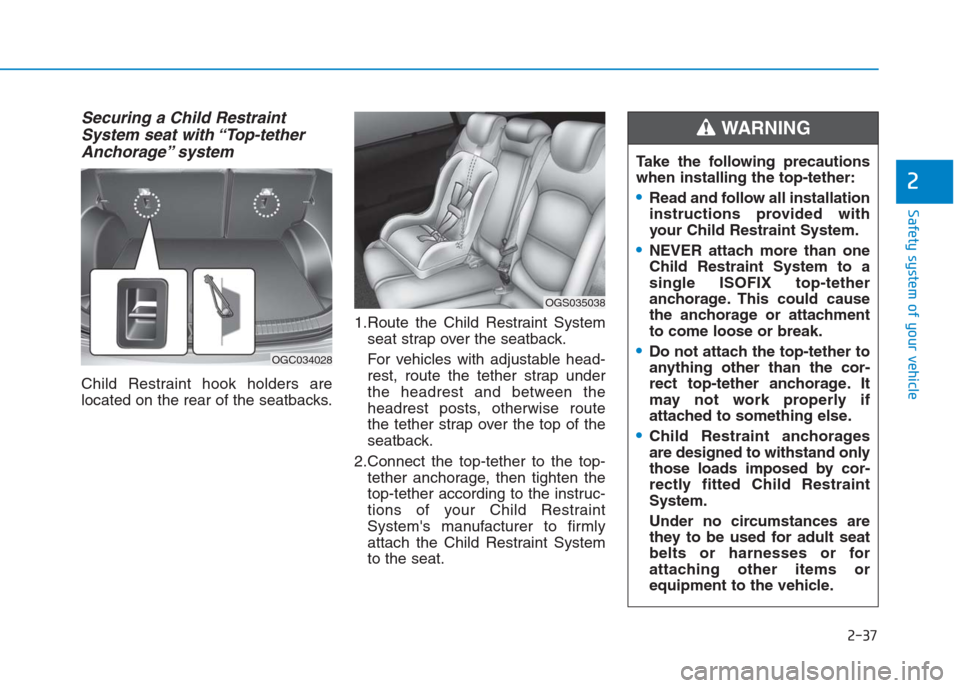
Child Restraint hook holders are
located on the rear of the seatbacks.1.Route the Child Restraint System
seat strap over the seatback.
For vehicles with adjustable head-
rest, route the tether strap under
the headrest and between the
headrest posts, otherwise route
the tether strap over the top of the
seatback.
2.Connect the top-tether to the top-
tether anchorage, then tighten the
top-tether according to the instruc-
tions of your Child Restraint
System's manufacturer to firmly
attach the Child Restraint System
to the seat.
2-37
Safety system of your vehicle
2
OGC034028
OGS035038
Take the following precautions
when installing the top-tether:
Read and follow all installation
instructions provided with
your Child Restraint System.
NEVER attach more than one
Child Restraint System to a
single ISOFIX top-tether
anchorage. This could cause
the anchorage or attachment
to come loose or break.
Do not attach the top-tether to
anything other than the cor-
rect top-tether anchorage. It
may not work properly if
attached to something else.
Child Restraint anchorages
are designed to withstand only
those loads imposed by cor-
rectly fitted Child Restraint
System.
Under no circumstances are
they to be used for adult seat
belts or harnesses or for
attaching other items or
equipment to the vehicle.
WARNING
Page 59 of 472
Securing a Child Restraint
System with a lap/shoulder belt
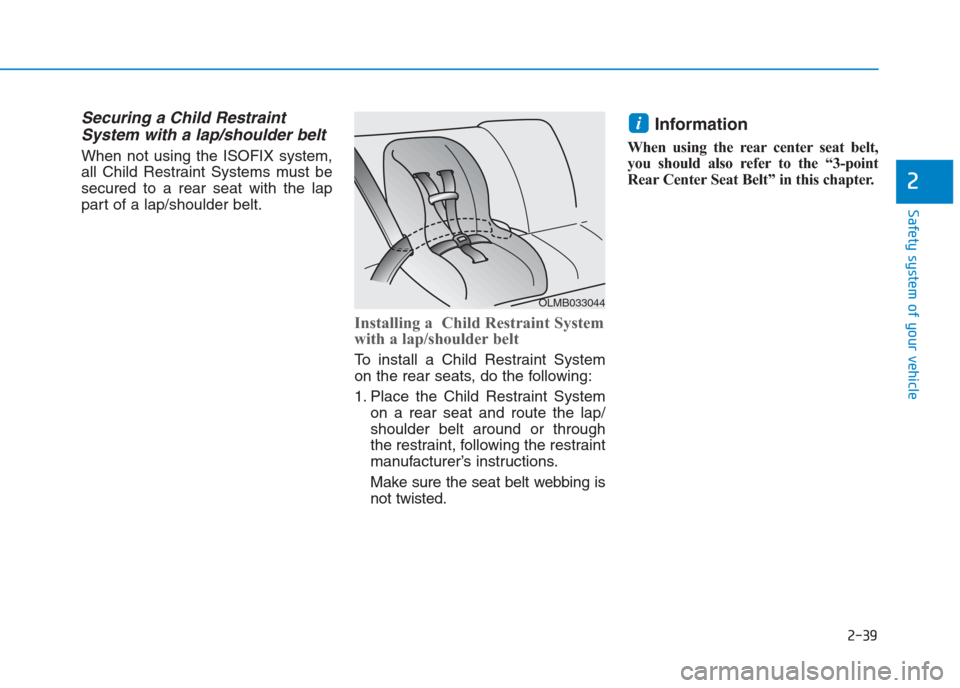
When not using the ISOFIX system,
all Child Restraint Systems must be
secured to a rear seat with the lap
part of a lap/shoulder belt.
Installing a Child Restraint System
with a lap/shoulder belt
To install a Child Restraint System
on the rear seats, do the following:
1. Place the Child Restraint System
on a rear seat and route the lap/
shoulder belt around or through
the restraint, following the restraint
manufacturer’s instructions.
Make sure the seat belt webbing is
not twisted.
Information
When using the rear center seat belt,
you should also refer to the “3-point
Rear Center Seat Belt” in this chapter.
i
2-39
Safety system of your vehicle
2
OLMB033044
Page 67 of 472
2-47
Safety system of your vehicle
2
Do not install a child restraint
on the front passenger's seat.
(if equipped)
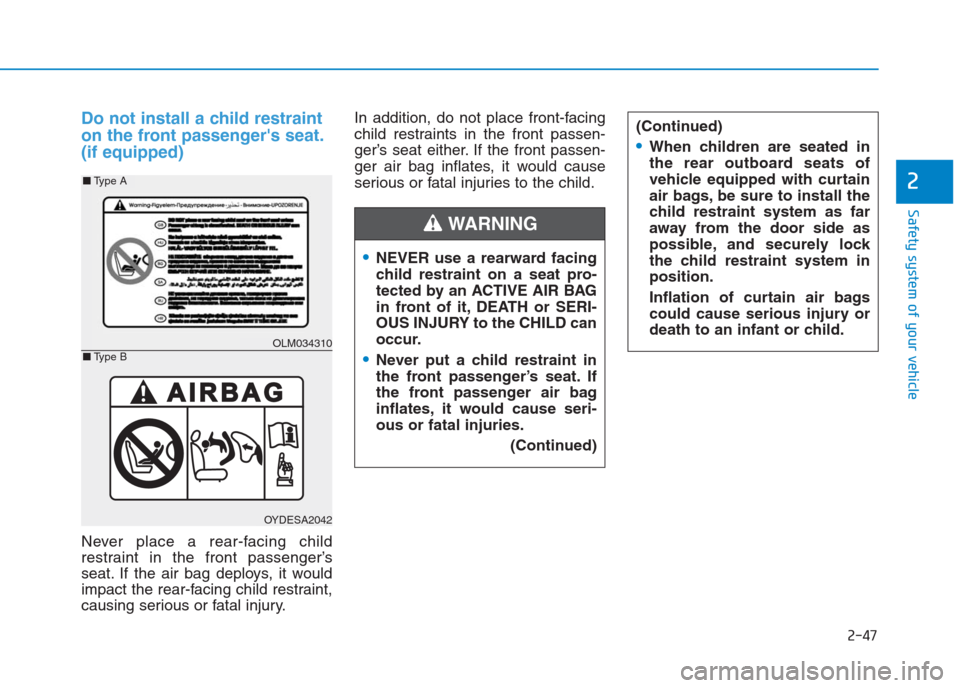
Never place a rear-facing child
restraint in the front passenger’s
seat. If the air bag deploys, it would
impact the rear-facing child restraint,
causing serious or fatal injury.In addition, do not place front-facing
child restraints in the front passen-
ger’s seat either. If the front passen-
ger air bag inflates, it would cause
serious or fatal injuries to the child.
OLM034310
OYDESA2042
■Type A
■Type B
NEVER use a rearward facing
child restraint on a seat pro-
tected by an ACTIVE AIR BAG
in front of it, DEATH or SERI-
OUS INJURY to the CHILD can
occur.
Never put a child restraint in
the front passenger’s seat. If
the front passenger air bag
inflates, it would cause seri-
ous or fatal injuries.
(Continued)
WARNING
(Continued)
When children are seated in
the rear outboard seats of
vehicle equipped with curtain
air bags, be sure to install the
child restraint system as far
away from the door side as
possible, and securely lock
the child restraint system in
position.
Inflation of curtain air bags
could cause serious injury or
death to an infant or child.
Page 77 of 472
2-57
Safety system of your vehicle
2
They are designed to help protect
the heads of the front seat occupants
and the rear outboard seat occu-
pants in certain side impact colli-
sions.
The curtain air bags are designed to
deploy only during certain side
impact collisions, depending on the
crash severity, angle, speed and
impact. The curtain air bags are not
designed to deploy in all side impact
situations, collisions from the front or
rear of the vehicle or in most rollover
situations.
In order for side impact and
curtain air bags to provide the
best protection, both front
seat occupants and both out-
board rear occupants should
sit in an upright position with
the seat belts properly fas-
tened.
Importantly, children should
sit in a proper child restraint
system in the rear seat.
When children are seated in
the rear outboard seats, they
must be seated in the proper
child restraint system. Make
sure to put the child restraint
system as far away from the
door side as possible, and
secure the child restraint sys-
tem in a locked position.
Do not place any objects over
the air bag. Also, do not attach
any objects around the area
the air bag inflates such as the
door, side door glass, front
and rear pillar, roof side rail.
(Continued)
WARNING (Continued)
Do not hang hard or breakable
objects on the clothes hanger.
Do not allow the passengers
to lean their heads or bodies
onto doors, put their arms on
the doors, stretch their arms
out of the window, or place
objects between the doors
and passengers when they
are seated on seats equipped
with side and/or curtain air
bags.
Never try to open or repair any
components of the side cur-
tain air bag system. We rec-
ommend that the system be
serviced by an authorized
HYUNDAI dealer.
Failure to follow the above men-
tioned instructions can result in
injury or death to the vehicle
occupants in an accident.
Page 98 of 472
3-13
Convenient features of your vehicle
3
Operating door locks from
outside the vehicle
Mechanical key
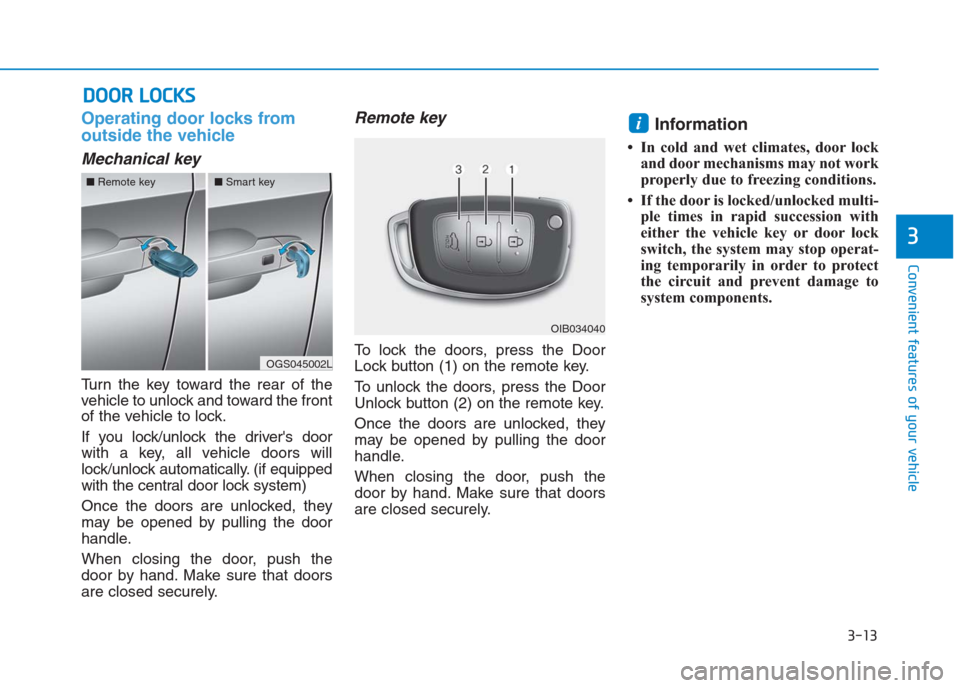
Turn the key toward the rear of the
vehicle to unlock and toward the front
of the vehicle to lock.
If you lock/unlock the driver's door
with a key, all vehicle doors will
lock/unlock automatically. (if equipped
with the central door lock system)
Once the doors are unlocked, they
may be opened by pulling the door
handle.
When closing the door, push the
door by hand. Make sure that doors
are closed securely.
Remote key
To lock the doors, press the Door
Lock button (1) on the remote key.
To unlock the doors, press the Door
Unlock button (2) on the remote key.
Once the doors are unlocked, they
may be opened by pulling the door
handle.
When closing the door, push the
door by hand. Make sure that doors
are closed securely.
Information
• In cold and wet climates, door lock
and door mechanisms may not work
properly due to freezing conditions.
• If the door is locked/unlocked multi-
ple times in rapid succession with
either the vehicle key or door lock
switch, the system may stop operat-
ing temporarily in order to protect
the circuit and prevent damage to
system components.
i
D DO
OO
OR
R
L
LO
OC
CK
KS
S
OIB034040
OGS045002L ■Remote key■Smart key
Page 99 of 472
3-14
Convenient features of your vehicle
Smart key
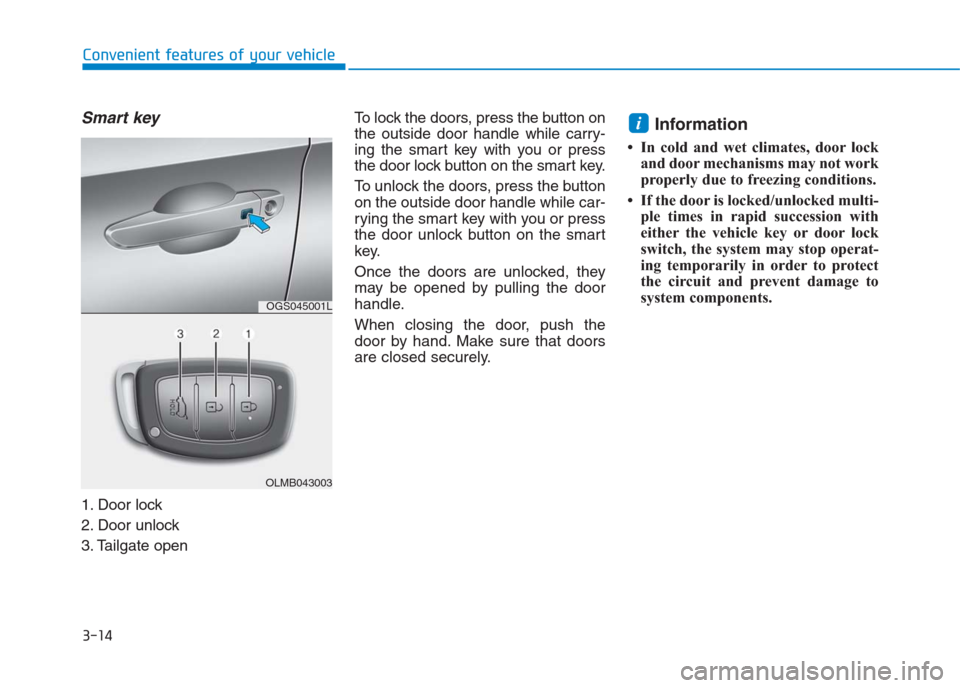
1. Door lock
2. Door unlock
3. Tailgate openTo lock the doors, press the button on
the outside door handle while carry-
ing the smart key with you or press
the door lock button on the smart key.
To unlock the doors, press the button
on the outside door handle while car-
rying the smart key with you or press
the door unlock button on the smart
key.
Once the doors are unlocked, they
may be opened by pulling the door
handle.
When closing the door, push the
door by hand. Make sure that doors
are closed securely.
Information
• In cold and wet climates, door lock
and door mechanisms may not work
properly due to freezing conditions.
• If the door is locked/unlocked multi-
ple times in rapid succession with
either the vehicle key or door lock
switch, the system may stop operat-
ing temporarily in order to protect
the circuit and prevent damage to
system components.
i
OGS045001L
OLMB043003
Page 101 of 472

3-16
Convenient features of your vehicle
To unlock the doors, press the door
unlock switch ( ). All vehicle doors
will unlock.
The doors should always be
fully closed and locked while
the vehicle is in motion. If the
doors are unlocked, the risk of
being thrown from the vehicle in
a crash is increased.
WARNING
Do not leave children or animals
unattended in your vehicle. An
enclosed vehicle can become
extremely hot, causing death or
serious injury to unattended
children or animals who cannot
escape the vehicle. Children
might operate features of the
vehicle that could injure them,
or they could encounter other
harm, possibly from someone
gaining entry to the vehicle.
WARNING
Always secure your vehicle
Leaving your vehicle unlocked
increases the potential risk to
you or others from someone
hiding in your vehicle.
To secure your vehicle, while
depressing the brake, move the
shift lever to the P (Park) position
(for automatic transaxle) or first
gear or R (Reverse, for manual
transaxle), engage the parking
brake, and place the ignition
switch in the LOCK/OFF position,
close all windows, lock all doors,
and always take the key with you.
WARNING
Opening a door when something
is approaching may cause dam-
age or injury. Be careful when
opening doors and watch for
vehicles, motorcycles, bicycles
or pedestrians approaching the
vehicle in the path of the door.
WARNING
OGS045004L
Page 103 of 472
3-18
Convenient features of your vehicle
This system helps to protect your
vehicle and valuables. The horn will
sound and the hazard warning lights
will blink continuously if any of the
following occurs:
- A door is opened without using the
remote key or smart key.
- The tailgate is opened without
using the remote key or smart key.
- The engine hood is opened.
The alarm continues for 30 seconds,
then the system resets. To turn off
the alarm, unlock the doors with the
remote key or smart key.
The Theft Alarm System automatical-
ly sets 30 seconds after you lock the
doors and the tailgate. For the system
to activate, you must lock the doors
and the tailgate from outside the vehi-
cle with the remote key or smart key
or by pressing the button on the out-
side of the door handles with the
smart key in your possession.
The hazard warning lights will blink
and the chime will sound once to
indicate the system is armed.Once the security system is set, open-
ing any door, the tailgate, or the hood
without using the remote key or smart
key will cause the alarm to activate.
The Theft Alarm System will not set if
the hood, the tailgate, or any door is
not fully closed. If the system will not
set, check the hood, the tailgate, or
the doors are fully closed.
Do not attempt to alter this system or
add other devices to it.
Information
• Do not lock the doors until all pas-
sengers have left the vehicle. If the
remaining passenger leaves the
vehicle when the system is armed,
the alarm will be activated.
• If the vehicle is not disarmed with
the remote key or smart key, open
the doors by using the mechanical
key and place the ignition switch in
the ON position (for remote key) or
start the engine (for smart key) and
wait for 30 seconds.
• When the system is disarmed but a
door or tailgate is not opened within
30 seconds, the system will be
rearmed.
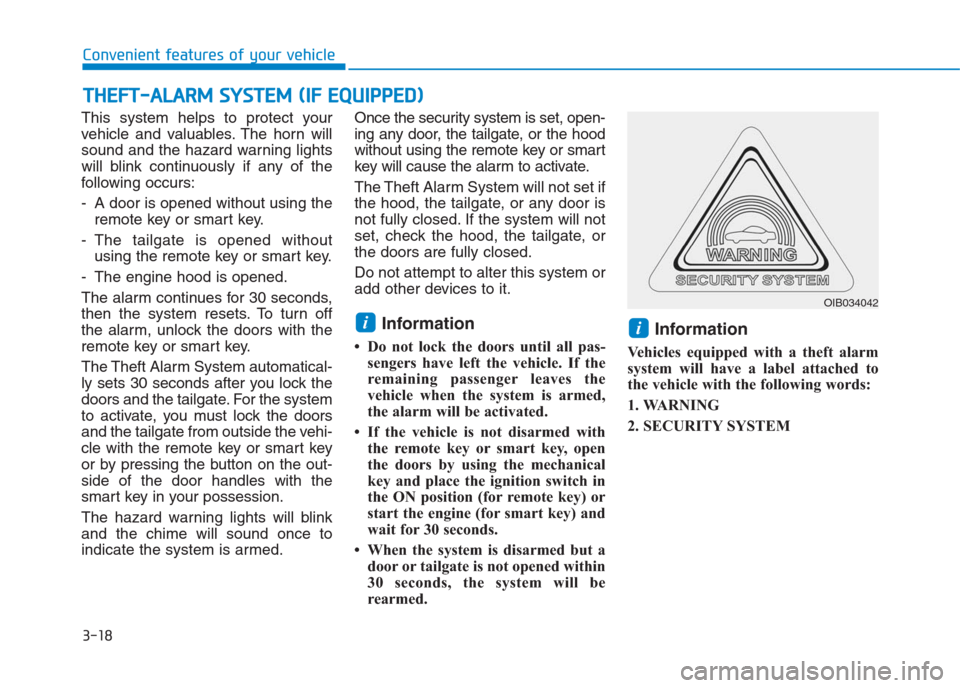
Information
Vehicles equipped with a theft alarm
system will have a label attached to
the vehicle with the following words:
1. WARNING
2. SECURITY SYSTEM
ii
T TH
HE
EF
FT
T-
-A
AL
LA
AR
RM
M
S
SY
YS
ST
TE
EM
M
(
(I
IF
F
E
EQ
QU
UI
IP
PP
PE
ED
D)
)
OIB034042