height Hyundai Creta 2018 User Guide
[x] Cancel search | Manufacturer: HYUNDAI, Model Year: 2018, Model line: Creta, Model: Hyundai Creta 2018Pages: 472, PDF Size: 11.87 MB
Page 48 of 472
2-28
Safety system of your vehicle
Seat belt use and children
Infant and small children
Most countries have Child Restraint
System laws which require children to
travel in approved Child Restraint
System devices, including booster
seats. The age at which seat belts can
be used instead of Child Restraint
System differs among countries, so
you should be aware of the specific
requirements in your country, and
where you are travelling. Infant and
Child Restraint System must be prop-
erly placed and installed in a rear seat.
For more information refer to the “Child
Restraint Systems” in this chapter.
Small children are best protected from
injury in an accident when properly
restrained in the rear seat by a Child
Restraint System that meets the
requirements of the Safety Standards
of your country. Before buying any Child
Restraint System, make sure that it has
a label certifying that it meets Safety
Standard of your country. The restraint
must be appropriate for your child's
height and weight. Check the label on
the Child Restraint System for this
information. Refer to “Child Restraint
Systems” in this chapter.
Larger children
Children under age 13 and who are
too large for a booster seat must
always occupy the rear seat and use
the available lap/shoulder belts. A
seat belt should lie across the upper
thighs and be snug across the shoul-
der and chest to restrain the child
safely. Check belt fit periodically. A
child's squirming could put the belt
out of position. Children are afforded
the most safety in the event of an
accident when they are restrained by
a proper restraint system and/or seat
belts in the rear seat.
If a larger child over age 13 must be
seated in the front seat, the child
must be securely restrained by the
available lap/shoulder belt and the
seat should be placed in the rear-
most position.
If the shoulder belt portion slightly
touches the child’s neck or face, try
placing the child closer to the center
of the vehicle. If the shoulder belt still
touches their face or neck, they need
to be returned to an appropriate
booster seat in the rear seat. ALWAYS properly restrain infants
and small children in a Child
Restraint System appropriate for
the child’s height and weight.
To reduce the risk of serious
injury or death to a child and other
passengers, NEVER hold a child
in your lap or arms when the vehi-
cle is moving. The violent forces
created during an accident will
tear the child from your arms and
throw the child against the interior
of the vehicle.WARNING
Page 51 of 472
2-31
Safety system of your vehicle
2
Children always in the rear
Children under age 13 must always
ride in the rear seats and must
always be properly restrained to min-
imize the risk of injury in an accident,
sudden stop or sudden maneuver.
According to accident statistics, chil-
dren are safer when properly
restrained in the rear seats than in
the front seat. Children too large for a
Child Restraint System must use the
seat belts provided.Most countries have Child Restraint
Systems which require children to
travel in approved Child Restraint
Systems. The laws governing the
age or height/weight restrictions at
which seat belts can be used instead
of Child Restraint System differs
among countries, so you should be
aware of the specific requirements in
your country, and where you are trav-
elling.
Child Restraint Systems must be
properly placed and installed in the
rear seat. You must use a commer-
cially available Child Restraint System
that meets the requirements of the
Safety Standards of your country.
Child Restraint Systems are general-
ly designed to be secured in a vehi-
cle seat by lap belt or the lap belt
portion of a lap/shoulder belt, or by a
top-tether and/or ISOFIX anchorage
in the rear seats of the vehicle.
Child Restraint System (CRS)
always in the rear
Infants and younger children must be
restrained in an appropriate rearward-
facing or forward-facing CRS that has
first been properly secured to the rear
seat of the vehicle. Read and comply
with the instructions for installation
and use provided by the manufacturer
of the Child Restraint System.
C CH
HI
IL
LD
D
R
RE
ES
ST
TR
RA
AI
IN
NT
T
S
SY
YS
ST
TE
EM
M
Always follow the Child Restraint
System manufacturer’s instruc-
tions for installation and use.
Always properly restrain your
child in the Child Restraint
System.
Do not use an infant carrier or a
child safety seat that “hooks”
over a seatback, it may not pro-
vide adequate protection in an
accident.
After an accident, we recom-
mend a HYUNDAI dealer check
the Child Restraint System, seat
belts, ISOFIX anchorages and
top-tether anchorages.
WARNING
Always properly restrain chil-
dren in the rear seats of the
vehicle, unless the air bag on
the front passenger seat is
deactivated.
Children of all ages are safer
when restrained in the rear seat.
A child riding in the front pas-
senger seat can be forcefully
struck by an inflating air bag
resulting in SERIOUS INJURY
or DEATH.
WARNING
Page 58 of 472
2-38
Safety system of your vehicle
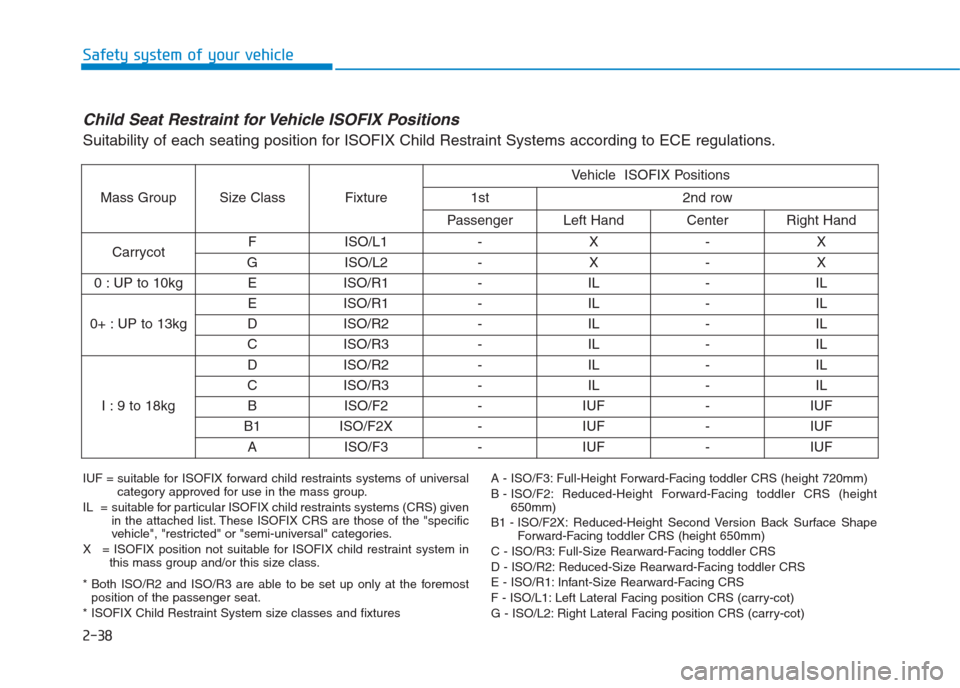
Child Seat Restraint for Vehicle ISOFIX Positions
Suitability of each seating position for ISOFIX Child Restraint Systems according to ECE regulations.
IUF = suitable for ISOFIX forward child restraints systems of universal
category approved for use in the mass group.
IL = suitable for particular ISOFIX child restraints systems (CRS) given
in the attached list. These ISOFIX CRS are those of the "specific
vehicle", "restricted" or "semi-universal" categories.
X = ISOFIX position not suitable for ISOFIX child restraint system in
this mass group and/or this size class.
* Both ISO/R2 and ISO/R3 are able to be set up only at the foremost
position of the passenger seat.
* ISOFIX Child Restraint System size classes and fixturesA - ISO/F3: Full-Height Forward-Facing toddler CRS (height 720mm)
B - ISO/F2: Reduced-Height Forward-Facing toddler CRS (height
650mm)
B1 - ISO/F2X: Reduced-Height Second Version Back Surface Shape
Forward-Facing toddler CRS (height 650mm)
C - ISO/R3: Full-Size Rearward-Facing toddler CRS
D - ISO/R2: Reduced-Size Rearward-Facing toddler CRS
E - ISO/R1: Infant-Size Rearward-Facing CRS
F - ISO/L1: Left Lateral Facing position CRS (carry-cot)
G - ISO/L2: Right Lateral Facing position CRS (carry-cot)
Mass Group Size Class FixtureVehicle ISOFIX Positions
1st 2nd row
Passenger Left Hand Center Right Hand
CarrycotF ISO/L1 - X - X
G ISO/L2 - X - X
0 : UP to 10kg E ISO/R1 - IL - IL
0+ : UP to 13kgE ISO/R1 - IL - IL
D ISO/R2 - IL - IL
C ISO/R3 - IL - IL
I : 9 to 18kgD ISO/R2 - IL - IL
C ISO/R3 - IL - IL
B ISO/F2 - IUF - IUF
B1 ISO/F2X - IUF - IUF
A ISO/F3 - IUF - IUF
Page 61 of 472
2-41
Safety system of your vehicle
2
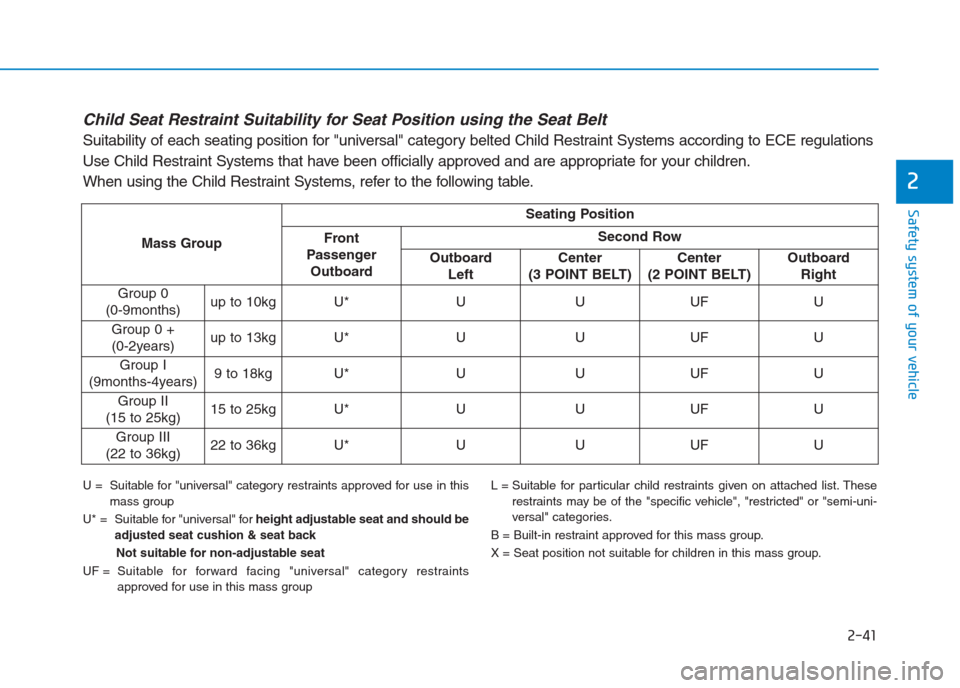
Child Seat Restraint Suitability for Seat Position using the Seat Belt
Suitability of each seating position for "universal" category belted Child Restraint Systems according to ECE regulations
Use Child Restraint Systems that have been officially approved and are appropriate for your children.
When using the Child Restraint Systems, refer to the following table.
U = Suitable for "universal" category restraints approved for use in this
mass group
U* = Suitable for "universal" forheight adjustable seat and should be
adjusted seat cushion & seat back
Not suitable for non-adjustable seat
UF = Suitable for forward facing "universal" category restraints
approved for use in this mass groupL = Suitable for particular child restraints given on attached list. These
restraints may be of the "specific vehicle", "restricted" or "semi-uni-
versal" categories.
B = Built-in restraint approved for this mass group.
X = Seat position not suitable for children in this mass group.
Mass Group
Seating Position
Front
Passenger
OutboardSecond Row
Outboard
LeftCenter
(3 POINT BELT)Center
(2 POINT BELT)Outboard
Right
Group 0
(0-9months)up to 10kgU*UUUFU
Group 0 +
(0-2years)up to 13kgU*UUUFU
Group I
(9months-4years)9 to 18kgU*UUUFU
Group II
(15 to 25kg)15 to 25kgU*UUUFU
Group III
(22 to 36kg)22 to 36kgU*UUUFU
Page 85 of 472
2-65
Safety system of your vehicle
2
Adding equipment to or modify-
ing your air bag-equipped vehi-
cle
If you modify your vehicle by chang-
ing your vehicle's frame, bumper sys-
tem, front end or side sheet metal or
ride height, this may affect the opera-
tion of your vehicle's air bag system.
Air bag warning label
(if equipped)
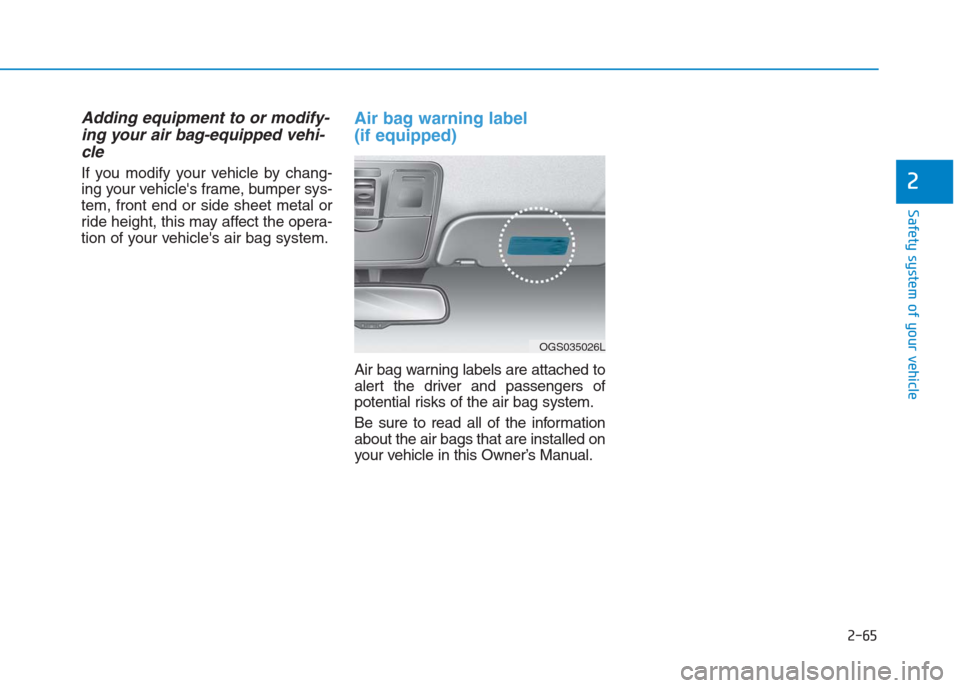
Air bag warning labels are attached to
alert the driver and passengers of
potential risks of the air bag system.
Be sure to read all of the information
about the air bags that are installed on
your vehicle in this Owner’s Manual.
OGS035026L
Page 178 of 472
3-93
Convenient features of your vehicle
3
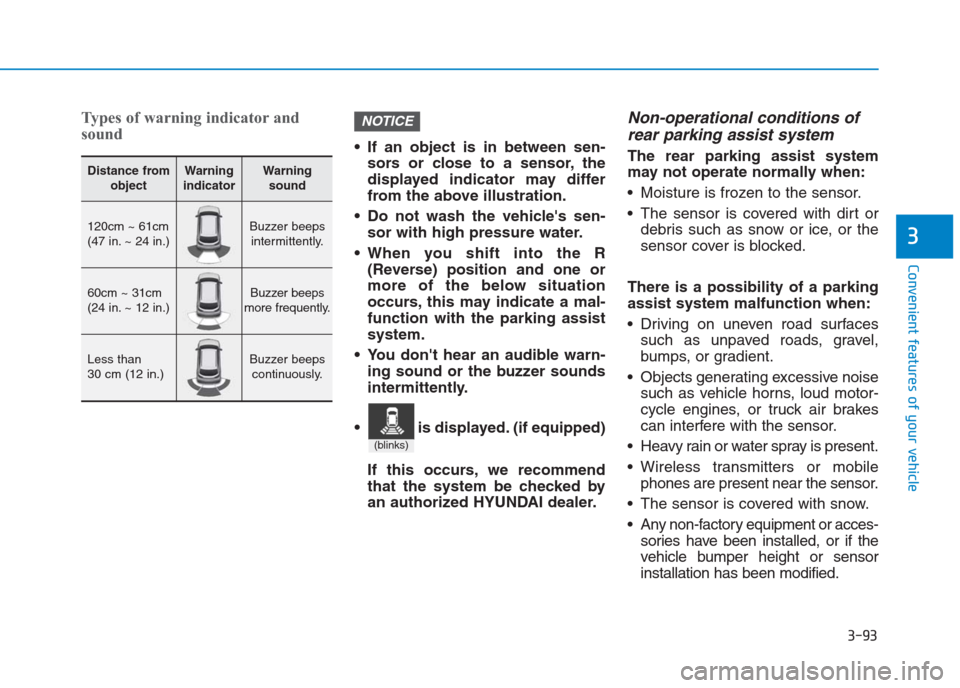
Types of warning indicator and
sound
If an object is in between sen-
sors or close to a sensor, the
displayed indicator may differ
from the above illustration.
Do not wash the vehicle's sen-
sor with high pressure water.
When you shift into the R
(Reverse) position and one or
more of the below situation
occurs, this may indicate a mal-
function with the parking assist
system.
You don't hear an audible warn-
ing sound or the buzzer sounds
intermittently.
If this occurs, we recommend
that the system be checked by
an authorized HYUNDAI dealer.
Non-operational conditions of
rear parking assist system
The rear parking assist system
may not operate normally when:
Moisture is frozen to the sensor.
The sensor is covered with dirt or
debris such as snow or ice, or the
sensor cover is blocked.
There is a possibility of a parking
assist system malfunction when:
Driving on uneven road surfaces
such as unpaved roads, gravel,
bumps, or gradient.
Objects generating excessive noise
such as vehicle horns, loud motor-
cycle engines, or truck air brakes
can interfere with the sensor.
Heavy rain or water spray is present.
Wireless transmitters or mobile
phones are present near the sensor.
The sensor is covered with snow.
Any non-factory equipment or acces-
sories have been installed, or if the
vehicle bumper height or sensor
installation has been modified.
NOTICE
Distance from
objectWarning
indicatorWarning
sound
120cm ~ 61cm
(47 in. ~ 24 in.)Buzzer beeps
intermittently.
60cm ~ 31cm
(24 in. ~ 12 in.)Buzzer beeps
more frequently.
Less than
30 cm (12 in.)Buzzer beeps
continuously.
(blinks)
is displayed. (if equipped)
Page 217 of 472
4-3
Multimedia System
4
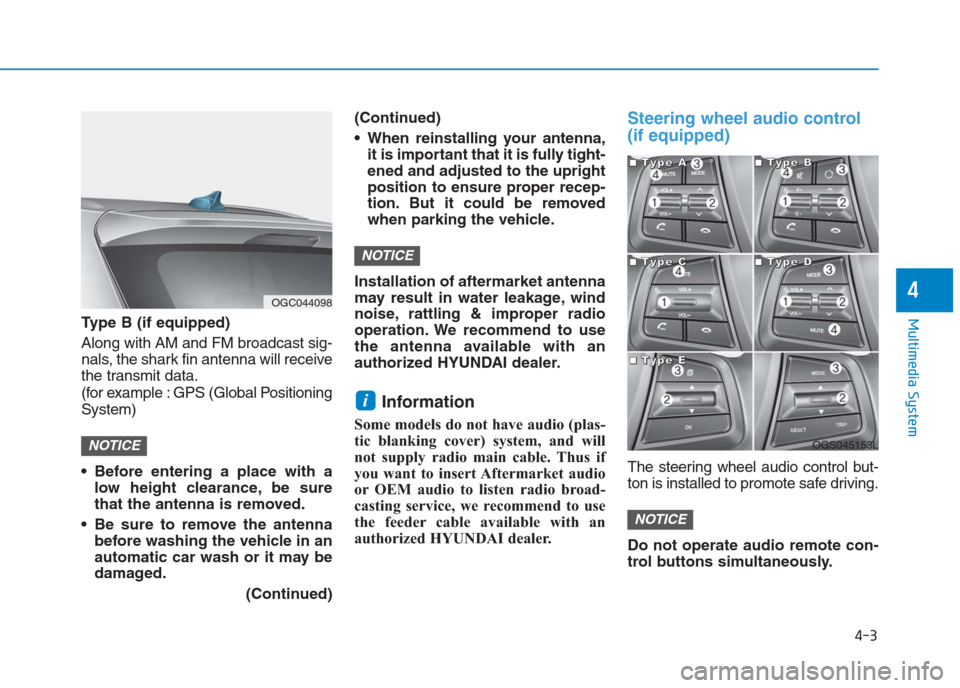
Type B (if equipped)
Along with AM and FM broadcast sig-
nals, the shark fin antenna will receive
the transmit data.
(for example : GPS (Global Positioning
System)
Before entering a place with a
low height clearance, be sure
that the antenna is removed.
Be sure to remove the antenna
before washing the vehicle in an
automatic car wash or it may be
damaged.
(Continued)(Continued)
When reinstalling your antenna,
it is important that it is fully tight-
ened and adjusted to the upright
position to ensure proper recep-
tion. But it could be removed
when parking the vehicle.
Installation of aftermarket antenna
may result in water leakage, wind
noise, rattling & improper radio
operation. We recommend to use
the antenna available with an
authorized HYUNDAI dealer.
Information
Some models do not have audio (plas-
tic blanking cover) system, and will
not supply radio main cable. Thus if
you want to insert Aftermarket audio
or OEM audio to listen radio broad-
casting service, we recommend to use
the feeder cable available with an
authorized HYUNDAI dealer.
Steering wheel audio control
(if equipped)
The steering wheel audio control but-
ton is installed to promote safe driving.
Do not operate audio remote con-
trol buttons simultaneously.
NOTICE
i
NOTICE
NOTICE
OGC044098
OGS045153L
■ ■ ■ ■T
T T T
y y y y
p p p p
e e e e
A A A A■
■ ■ ■T
T T T
y y y y
p p p p
e e e e
B B B B
■
■ ■ ■T
T T T
y y y y
p p p p
e e e e
C C C C■
■ ■ ■T
T T T
y y y y
p p p p
e e e e
D D D D
■
■ ■ ■T
T T T
y y y y
p p p p
e e e e
E E E E
Page 309 of 472
5-34
Driving your vehicle
If the Parking Brake Warning Light
remains on after the parking brake is
released while engine is running,
there may be a malfunction in the
brake system. Immediate attention is
necessary.
If at all possible, cease driving the
vehicle immediately. If that is not pos-
sible, use extreme caution while
operating the vehicle and only con-
tinue to drive the vehicle until you
can reach a safe location.
Anti-lock Brake System (ABS)
(if equipped )
ABS is an electronic braking system
that helps prevent a braking skid.
ABS allows the driver to steer and
brake at the same time.(Continued)
Drive your vehicle at reduced
speeds during the following
conditions:
Rough, gravel or snow-cov-
ered roads.
On roads where the road sur-
face is pitted or has different
surface height.
Tire chains are installed on
your vehicle.
The safety features of an ABS
equipped vehicle should not be
tested by high speed driving or
cornering. This could endanger
the safety of yourself or others.
An Anti-Lock Braking System
(ABS) will not prevent accidents
due to improper or dangerous
driving maneuvers. Even
though vehicle control is
improved during emergency
braking, always maintain a safe
distance between you and
objects ahead of you. Vehicle
speeds should always be
reduced during extreme road
conditions. The braking dis-
tance for cars equipped with
ABS may be longer than for
those without these systems in
the following road conditions.
(Continued)
WARNING
Page 413 of 472
7-56
Maintenance
Wheel replacement
When replacing the metal wheels for
any reason, make sure the new
wheels are equivalent to the original
factory units in diameter, rim width
and offset. Replacing tires
To reduce the chance or serious
or fatal injuries from an acci-
dent caused by tire failure or
loss of vehicle control:
Replace tires that are worn,
show uneven wear, or are
damaged. Worn tires can
cause loss of braking effec-
tiveness, steering control, and
traction.
Do not drive your vehicle with
too little or too much pressure
in your tires. This can lead to
uneven wear and tire failure.
When replacing tires, never
mix radial and bias-ply tires
on the same car. You must
replace all tires (including the
spare) if moving from radial to
bias-ply tires.
(Continued)
WARNING (Continued)
Using tires and wheel other
than the recommended sizes
could cause unusual handling
characteristics and poor vehi-
cle control, resulting in a seri-
ous accident.
When replacing tires (or
wheels), it is recommended to
replace the two front or two
rear tires (or wheels) as a pair.
Replacing just one tire can
seriously affect your vehicle’s
handling.
The ABS works by comparing
the speed of the wheels. Tire
size can affect wheel speed.
When replacing tires, all 4
tires must use the same size
originally supplied with the
vehicle. Using tires of a differ-
ent size can cause the ABS
(Anti-lock Brake System) and
ESC (Electronic Stability
Control) to work irregularly. (if
equipped)
A wheel that is not the correct
size may adversely affect wheel
and bearing life, braking and
stopping abilities, handling
characteristics, ground clear-
ance, body-to-tire clearance,
snow chain clearance,
speedometer and odometer cal-
ibration, headlight aim and
bumper height.
WARNING
Page 414 of 472
7-57
7
Maintenance
Tire traction
Tire traction can be reduced if you
drive on worn tires, tires that are
improperly inflated or on slippery
road surfaces. Tires should be
replaced when tread wear indicators
appear. Slow down whenever there
is rain, snow or ice on the road, to
reduce the possibility of losing con-
trol of the vehicle.
Tire maintenance
In addition to proper inflation, correct
wheel alignment helps decrease tire
wear. If you find a tire worn unevenly,
have your dealer check the wheel
alignment.
When you have new tires installed,
make sure they are balanced. This
will increase vehicle ride comfort and
tire life. Additionally, a tire should
always be rebalanced if it is removed
from the wheel.
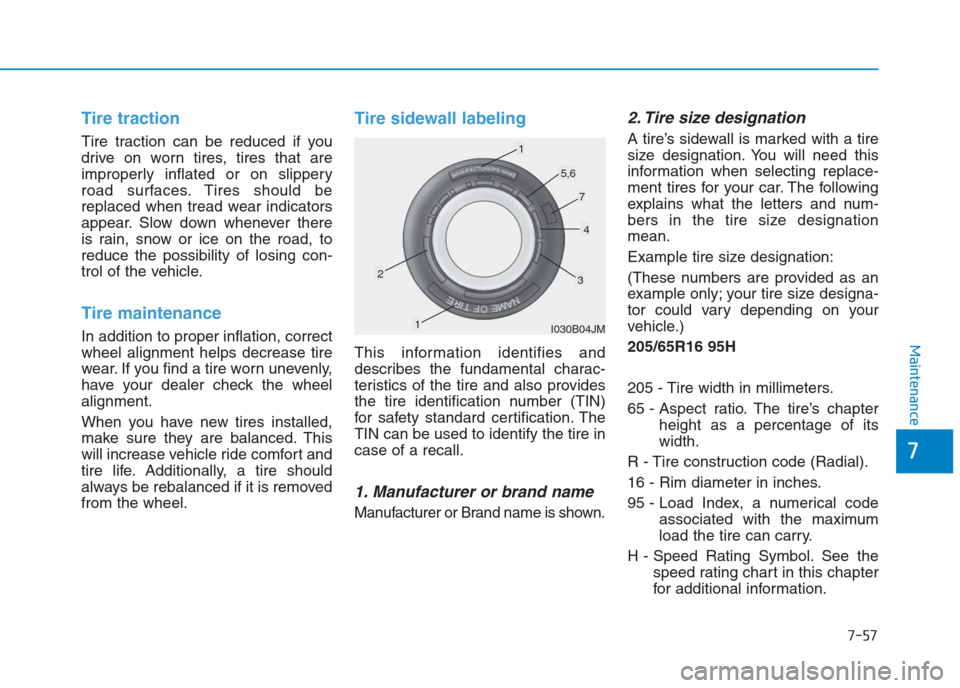
Tire sidewall labeling
This information identifies and
describes the fundamental charac-
teristics of the tire and also provides
the tire identification number (TIN)
for safety standard certification. The
TIN can be used to identify the tire in
case of a recall.
1. Manufacturer or brand name
Manufacturer or Brand name is shown.
2. Tire size designation
A tire’s sidewall is marked with a tire
size designation. You will need this
information when selecting replace-
ment tires for your car. The following
explains what the letters and num-
bers in the tire size designation
mean.
Example tire size designation:
(These numbers are provided as an
example only; your tire size designa-
tor could vary depending on your
vehicle.)
205/65R16 95H
205 - Tire width in millimeters.
65 - Aspect ratio. The tire’s chapter
height as a percentage of its
width.
R - Tire construction code (Radial).
16 - Rim diameter in inches.
95 - Load Index, a numerical code
associated with the maximum
load the tire can carry.
H - Speed Rating Symbol. See the
speed rating chart in this chapter
for additional information.
I030B04JM
1
1
23
4
5,6
7