seats Hyundai Creta 2018 User Guide
[x] Cancel search | Manufacturer: HYUNDAI, Model Year: 2018, Model line: Creta, Model: Hyundai Creta 2018Pages: 472, PDF Size: 11.87 MB
Page 34 of 472
2-14
Safety system of your vehicle
Rear seats
Headrest
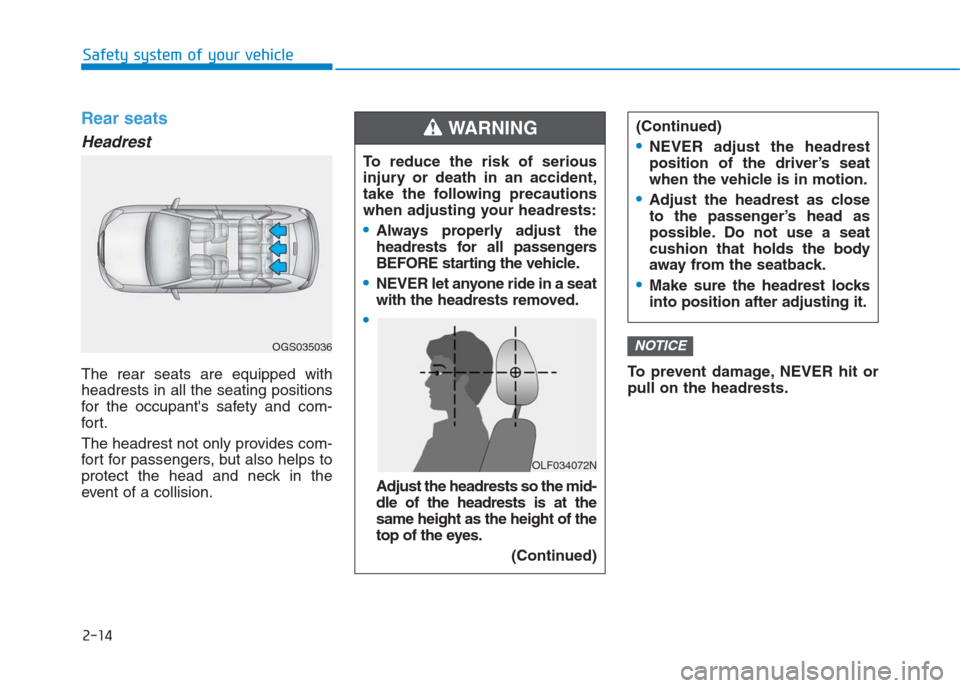
The rear seats are equipped with
headrests in all the seating positions
for the occupant's safety and com-
for t.
The headrest not only provides com-
fort for passengers, but also helps to
protect the head and neck in the
event of a collision.To prevent damage, NEVER hit or
pull on the headrests.
NOTICE
(Continued)
NEVER adjust the headrest
position of the driver’s seat
when the vehicle is in motion.
Adjust the headrest as close
to the passenger’s head as
possible. Do not use a seat
cushion that holds the body
away from the seatback.
Make sure the headrest locks
into position after adjusting it.
To reduce the risk of serious
injury or death in an accident,
take the following precautions
when adjusting your headrests:
Always properly adjust the
headrests for all passengers
BEFORE starting the vehicle.
NEVER let anyone ride in a seat
with the headrests removed.
Adjust the headrests so the mid-
dle of the headrests is at the
same height as the height of the
top of the eyes.
(Continued)
WARNING
OLF034072N
OGS035036
Page 36 of 472
2-16
Safety system of your vehicle
Folding the rear seat
The rear seatbacks (or cushions)
may be folded to facilitate carrying
long items or to increase the luggage
capacity of the vehicle.
Type A
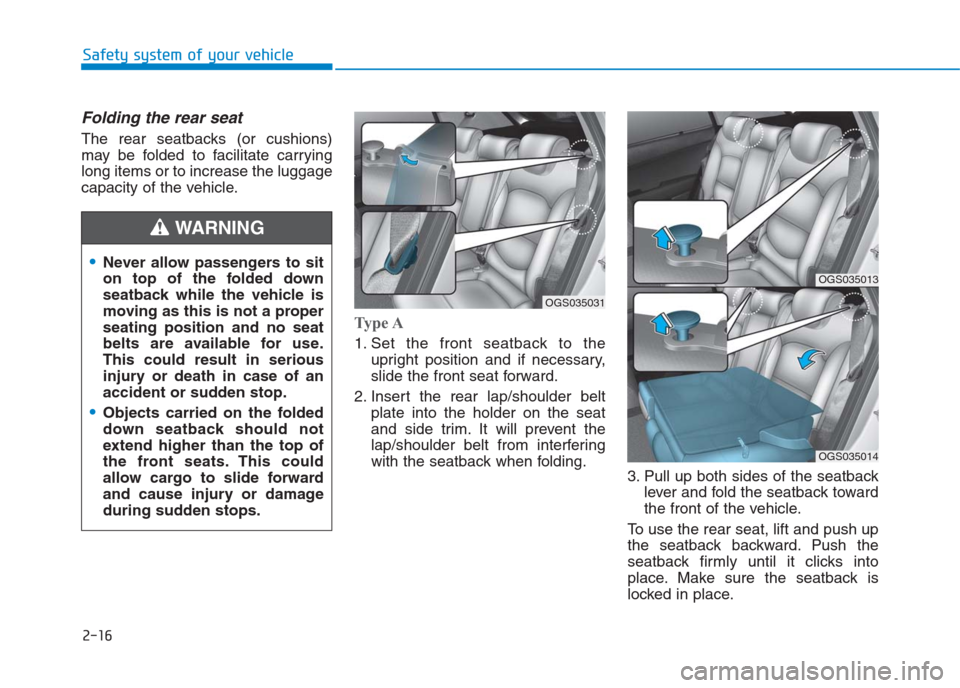
1. Set the front seatback to the
upright position and if necessary,
slide the front seat forward.
2. Insert the rear lap/shoulder belt
plate into the holder on the seat
and side trim. It will prevent the
lap/shoulder belt from interfering
with the seatback when folding.
3. Pull up both sides of the seatback
lever and fold the seatback toward
the front of the vehicle.
To use the rear seat, lift and push up
the seatback backward. Push the
seatback firmly until it clicks into
place. Make sure the seatback is
locked in place.
OGS035031
OGS035013
OGS035014
Never allow passengers to sit
on top of the folded down
seatback while the vehicle is
moving as this is not a proper
seating position and no seat
belts are available for use.
This could result in serious
injury or death in case of an
accident or sudden stop.
Objects carried on the folded
down seatback should not
extend higher than the top of
the front seats. This could
allow cargo to slide forward
and cause injury or damage
during sudden stops.
WARNING
Page 38 of 472
2-18
Safety system of your vehicle
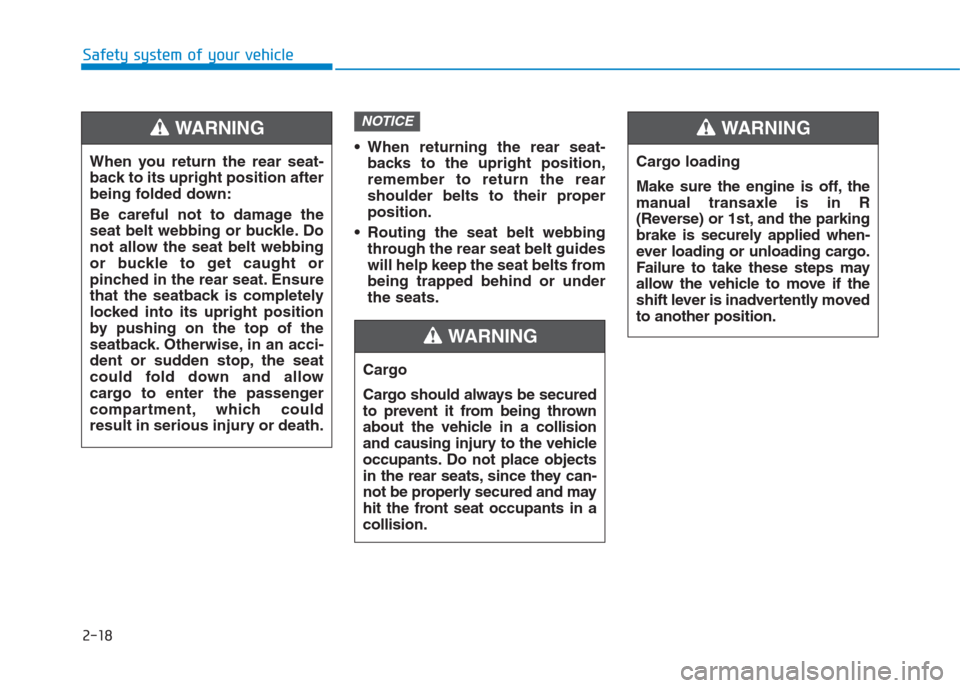
When returning the rear seat-
backs to the upright position,
remember to return the rear
shoulder belts to their proper
position.
Routing the seat belt webbing
through the rear seat belt guides
will help keep the seat belts from
being trapped behind or under
the seats.
NOTICE
Cargo
Cargo should always be secured
to prevent it from being thrown
about the vehicle in a collision
and causing injury to the vehicle
occupants. Do not place objects
in the rear seats, since they can-
not be properly secured and may
hit the front seat occupants in a
collision.
WARNING
When you return the rear seat-
back to its upright position after
being folded down:
Be careful not to damage the
seat belt webbing or buckle. Do
not allow the seat belt webbing
or buckle to get caught or
pinched in the rear seat. Ensure
that the seatback is completely
locked into its upright position
by pushing on the top of the
seatback. Otherwise, in an acci-
dent or sudden stop, the seat
could fold down and allow
cargo to enter the passenger
compartment, which could
result in serious injury or death.
WARNING
Cargo loading
Make sure the engine is off, the
manual transaxle is in R
(Reverse) or 1st, and the parking
brake is securely applied when-
ever loading or unloading cargo.
Failure to take these steps may
allow the vehicle to move if the
shift lever is inadvertently moved
to another position.
WARNING
Page 48 of 472
2-28
Safety system of your vehicle
Seat belt use and children
Infant and small children
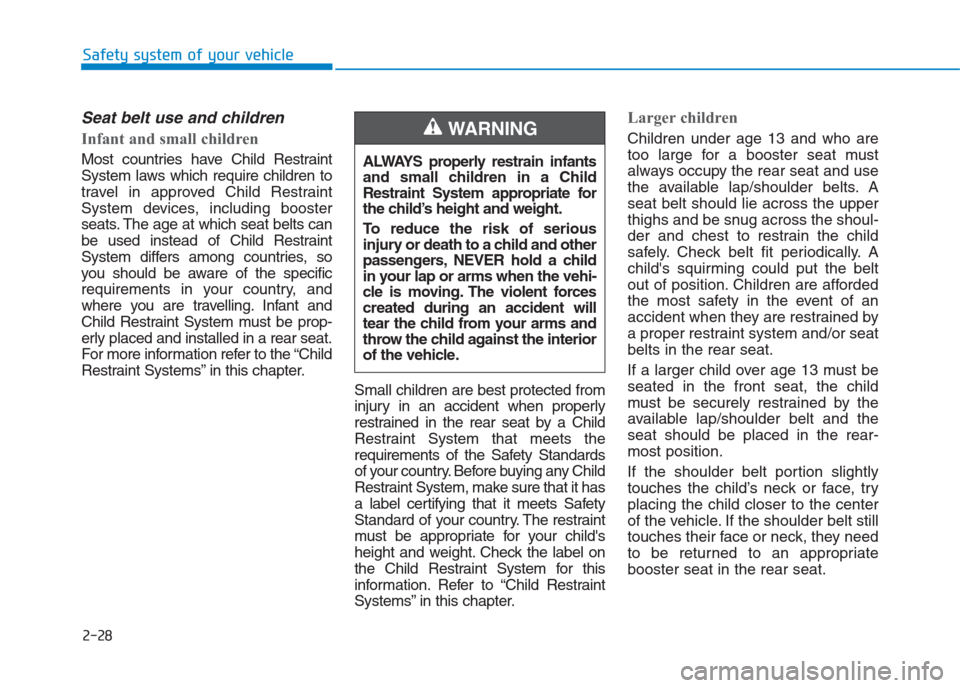
Most countries have Child Restraint
System laws which require children to
travel in approved Child Restraint
System devices, including booster
seats. The age at which seat belts can
be used instead of Child Restraint
System differs among countries, so
you should be aware of the specific
requirements in your country, and
where you are travelling. Infant and
Child Restraint System must be prop-
erly placed and installed in a rear seat.
For more information refer to the “Child
Restraint Systems” in this chapter.
Small children are best protected from
injury in an accident when properly
restrained in the rear seat by a Child
Restraint System that meets the
requirements of the Safety Standards
of your country. Before buying any Child
Restraint System, make sure that it has
a label certifying that it meets Safety
Standard of your country. The restraint
must be appropriate for your child's
height and weight. Check the label on
the Child Restraint System for this
information. Refer to “Child Restraint
Systems” in this chapter.
Larger children
Children under age 13 and who are
too large for a booster seat must
always occupy the rear seat and use
the available lap/shoulder belts. A
seat belt should lie across the upper
thighs and be snug across the shoul-
der and chest to restrain the child
safely. Check belt fit periodically. A
child's squirming could put the belt
out of position. Children are afforded
the most safety in the event of an
accident when they are restrained by
a proper restraint system and/or seat
belts in the rear seat.
If a larger child over age 13 must be
seated in the front seat, the child
must be securely restrained by the
available lap/shoulder belt and the
seat should be placed in the rear-
most position.
If the shoulder belt portion slightly
touches the child’s neck or face, try
placing the child closer to the center
of the vehicle. If the shoulder belt still
touches their face or neck, they need
to be returned to an appropriate
booster seat in the rear seat. ALWAYS properly restrain infants
and small children in a Child
Restraint System appropriate for
the child’s height and weight.
To reduce the risk of serious
injury or death to a child and other
passengers, NEVER hold a child
in your lap or arms when the vehi-
cle is moving. The violent forces
created during an accident will
tear the child from your arms and
throw the child against the interior
of the vehicle.WARNING
Page 49 of 472
2-29
Safety system of your vehicle
2
Seat belt use and injured people
A seat belt should be used when an
injured person is being transported.
Consult a physician for specific rec-
ommendations.
One person per belt
Two people (including children) should
never attempt to use a single seat belt.
This could increase the severity of
injuries in case of an accident.
Do not lie down
Sitting in a reclined position when
the vehicle is in motion can be dan-
gerous. Even when buckled up, the
protections of your restraint system
(seat belts and/or air bags) is greatly
reduced by reclining your seatback.
Seat belts must be snug against your
hips and chest to work properly. During
an accident, you could be thrown into
the seat belt, causing neck or other
injuries.
The more the seatback is reclined,
the greater chance the passenger’s
hips will slide under the lap belt or
the passenger’s neck will strike the
shoulder belt.
NEVER ride with a reclined
seatback when the vehicle is
moving.
Riding with a reclined seatback
increases your chance of seri-
ous or fatal injuries in the event
of a collision or sudden stop.
Driver and passengers should
always sit well back in their
seats, properly belted, and with
the seatbacks upright.
WARNING
Always make sure larger chil-
dren’s seat belts are worn and
properly adjusted.
NEVER allow the shoulder
belt to contact the child’s
neck or face.
Do not allow more than one
child to use a single seat belt.
WARNING
Page 51 of 472
2-31
Safety system of your vehicle
2
Children always in the rear
Children under age 13 must always
ride in the rear seats and must
always be properly restrained to min-
imize the risk of injury in an accident,
sudden stop or sudden maneuver.
According to accident statistics, chil-
dren are safer when properly
restrained in the rear seats than in
the front seat. Children too large for a
Child Restraint System must use the
seat belts provided.Most countries have Child Restraint
Systems which require children to
travel in approved Child Restraint
Systems. The laws governing the
age or height/weight restrictions at
which seat belts can be used instead
of Child Restraint System differs
among countries, so you should be
aware of the specific requirements in
your country, and where you are trav-
elling.
Child Restraint Systems must be
properly placed and installed in the
rear seat. You must use a commer-
cially available Child Restraint System
that meets the requirements of the
Safety Standards of your country.
Child Restraint Systems are general-
ly designed to be secured in a vehi-
cle seat by lap belt or the lap belt
portion of a lap/shoulder belt, or by a
top-tether and/or ISOFIX anchorage
in the rear seats of the vehicle.
Child Restraint System (CRS)
always in the rear
Infants and younger children must be
restrained in an appropriate rearward-
facing or forward-facing CRS that has
first been properly secured to the rear
seat of the vehicle. Read and comply
with the instructions for installation
and use provided by the manufacturer
of the Child Restraint System.
C CH
HI
IL
LD
D
R
RE
ES
ST
TR
RA
AI
IN
NT
T
S
SY
YS
ST
TE
EM
M
Always follow the Child Restraint
System manufacturer’s instruc-
tions for installation and use.
Always properly restrain your
child in the Child Restraint
System.
Do not use an infant carrier or a
child safety seat that “hooks”
over a seatback, it may not pro-
vide adequate protection in an
accident.
After an accident, we recom-
mend a HYUNDAI dealer check
the Child Restraint System, seat
belts, ISOFIX anchorages and
top-tether anchorages.
WARNING
Always properly restrain chil-
dren in the rear seats of the
vehicle, unless the air bag on
the front passenger seat is
deactivated.
Children of all ages are safer
when restrained in the rear seat.
A child riding in the front pas-
senger seat can be forcefully
struck by an inflating air bag
resulting in SERIOUS INJURY
or DEATH.
WARNING
Page 54 of 472
2-34
Safety system of your vehicle
ISOFIX anchorage and top-teth-
er anchorage (ISOFIX anchor-
ages system) for children
The ISOFIX system holds a Child
Restraint System during driving and
in an accident. This system is
designed to make installation of the
Child Restraint System easier and
reduce the possibility of improperly
installing your Child Restraint
System. The ISOFIX system uses
anchors in the vehicle and attach-
ments on the Child Restraint System.
The ISOFIX system eliminates the
need to use seat belts to secure the
Child Restraint System to the rear
seats.
ISOFIX anchorages are metal bars
built into the vehicle. There are two
lower anchors for each ISOFIX seat-
ing position that will accommodate a
Child Restraint System with lower
attachments.To use the ISOFIX system in your
vehicle, you must have a Child
Restraint System with ISOFIX attach-
ments.(An ISOFIX Child Restraint
System may only be installed if it has
vehicle-specific or universal approval
in accordance with the requirements
of ECE-R44 or ECE-R129.)
The Child Restraint System manu-
facturer will provide you with instruc-
tions on how to use the Child
Restraint System with its attach-
ments for the ISOFIX anchorages.
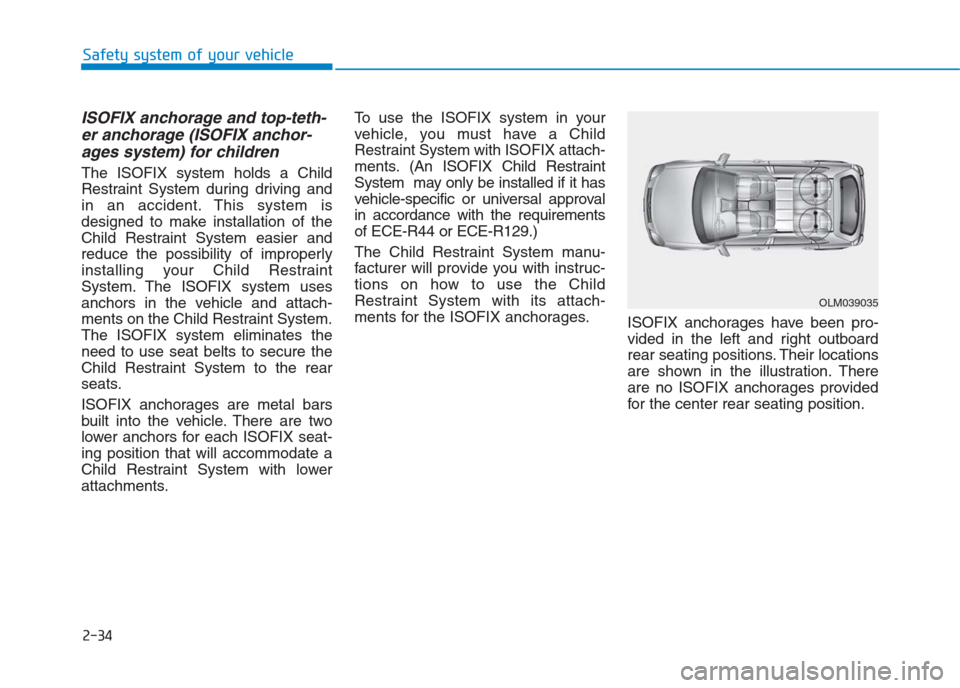
ISOFIX anchorages have been pro-
vided in the left and right outboard
rear seating positions. Their locations
are shown in the illustration. There
are no ISOFIX anchorages provided
for the center rear seating position.
OLM039035
Page 55 of 472
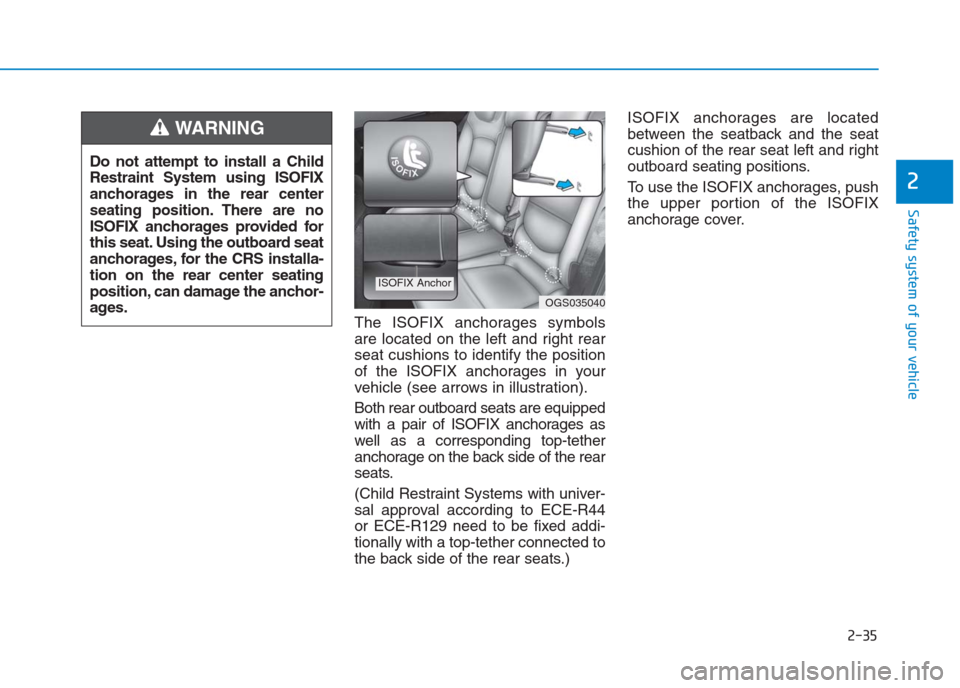
The ISOFIX anchorages symbols
are located on the left and right rear
seat cushions to identify the position
of the ISOFIX anchorages in your
vehicle (see arrows in illustration).
Both rear outboard seats are equipped
with a pair of ISOFIX anchorages as
well as a corresponding top-tether
anchorage on the back side of the rear
seats.
(Child Restraint Systems with univer-
sal approval according to ECE-R44
or ECE-R129 need to be fixed addi-
tionally with a top-tether connected to
the back side of the rear seats.)ISOFIX anchorages are located
between the seatback and the seat
cushion of the rear seat left and right
outboard seating positions.
To use the ISOFIX anchorages, push
the upper portion of the ISOFIX
anchorage cover.
2-35
Safety system of your vehicle
2
Do not attempt to install a Child
Restraint System using ISOFIX
anchorages in the rear center
seating position. There are no
ISOFIX anchorages provided for
this seat. Using the outboard seat
anchorages, for the CRS installa-
tion on the rear center seating
position, can damage the anchor-
ages.
WARNING
OGS035040
ISOFIX Anchor
Page 59 of 472
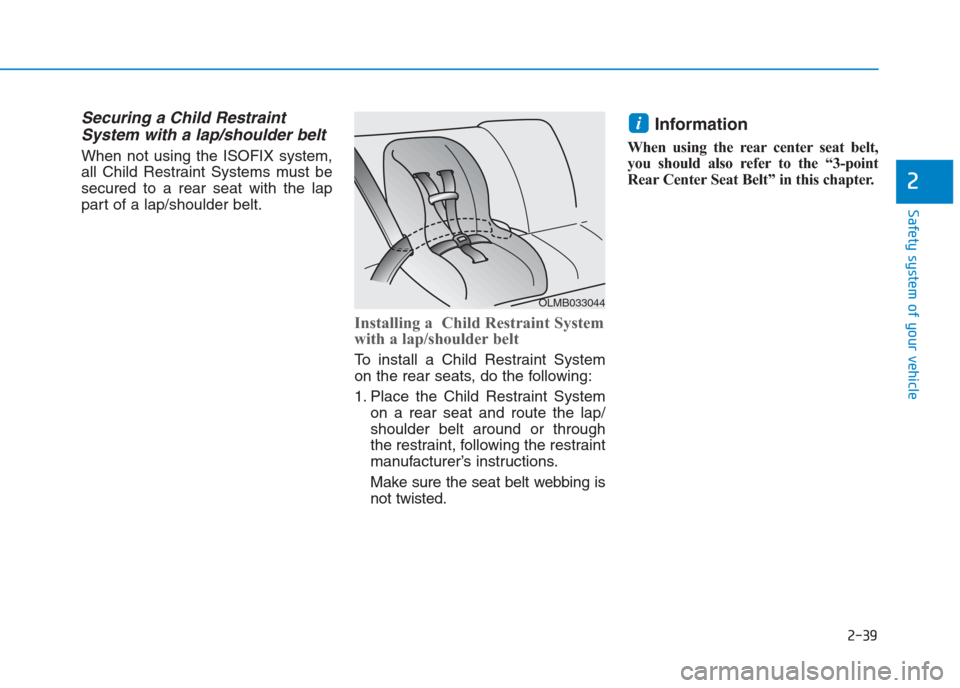
Securing a Child Restraint
System with a lap/shoulder belt
When not using the ISOFIX system,
all Child Restraint Systems must be
secured to a rear seat with the lap
part of a lap/shoulder belt.
Installing a Child Restraint System
with a lap/shoulder belt
To install a Child Restraint System
on the rear seats, do the following:
1. Place the Child Restraint System
on a rear seat and route the lap/
shoulder belt around or through
the restraint, following the restraint
manufacturer’s instructions.
Make sure the seat belt webbing is
not twisted.
Information
When using the rear center seat belt,
you should also refer to the “3-point
Rear Center Seat Belt” in this chapter.
i
2-39
Safety system of your vehicle
2
OLMB033044
Page 67 of 472
2-47
Safety system of your vehicle
2
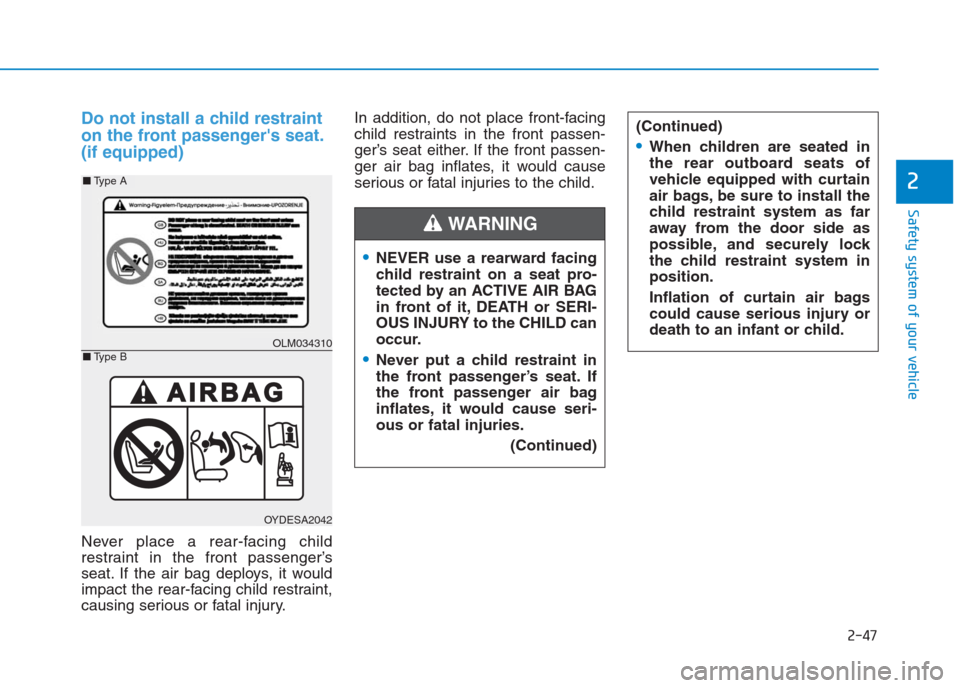
Do not install a child restraint
on the front passenger's seat.
(if equipped)
Never place a rear-facing child
restraint in the front passenger’s
seat. If the air bag deploys, it would
impact the rear-facing child restraint,
causing serious or fatal injury.In addition, do not place front-facing
child restraints in the front passen-
ger’s seat either. If the front passen-
ger air bag inflates, it would cause
serious or fatal injuries to the child.
OLM034310
OYDESA2042
■Type A
■Type B
NEVER use a rearward facing
child restraint on a seat pro-
tected by an ACTIVE AIR BAG
in front of it, DEATH or SERI-
OUS INJURY to the CHILD can
occur.
Never put a child restraint in
the front passenger’s seat. If
the front passenger air bag
inflates, it would cause seri-
ous or fatal injuries.
(Continued)
WARNING
(Continued)
When children are seated in
the rear outboard seats of
vehicle equipped with curtain
air bags, be sure to install the
child restraint system as far
away from the door side as
possible, and securely lock
the child restraint system in
position.
Inflation of curtain air bags
could cause serious injury or
death to an infant or child.