seats Hyundai Creta 2018 Owner's Guide
[x] Cancel search | Manufacturer: HYUNDAI, Model Year: 2018, Model line: Creta, Model: Hyundai Creta 2018Pages: 472, PDF Size: 11.87 MB
Page 73 of 472
2-53
Safety system of your vehicle
2
(Continued)
Front and side impact air bags
can injure occupants improp-
erly positioned in the front
seats.
Move your seat as far back as
practical from the front air
bags, while still maintaining
control of the vehicle.
You and your passengers
should never sit or lean
unnecessarily close to the air
bags. Improperly positioned
drivers and passengers can
be severely injured by inflat-
ing air bags.
Never lean against the door or
center console – always sit in
an upright position.
(Continued)
(Continued)
No objects (such as crash pad
cover, cellular phone holder,
cup holder, perfume or stick-
ers) should be placed over or
near the air bag modules on
the steering wheel, instrument
panel, windshield glass, and
the front passenger's panel
above the glove box. Such
objects could cause harm if
the vehicle is in a crash severe
enough to cause the air bags
to deploy.
Do not tamper with or discon-
nect SRS wiring or other com-
ponents of the SRS system.
Doing so could result in injury,
due to accidental deployment
of the air bags or by rendering
the SRS inoperative.
If the SRS air bag warning
light remains illuminated
while the vehicle is being driv-
en, we recommend that the
system be inspected by an
authorized HYUNDAI dealer.
(Continued)
(Continued)
Air bags can only be used
once – we recommend that
the system be replaced by an
authorized HYUNDAI dealer.
The SRS is designed to deploy
the front air bags only when an
impact is sufficiently severe
and when the impact angle is
less than 30° from the forward
longitudinal axis of the vehi-
cle. Additionally, the air bags
will only deploy once. Seat
belts must be worn at all times.
Front air bags are not intend-
ed to deploy in side-impact,
rear-impact or rollover crash-
es. In addition, front air bags
will not deploy in frontal
crashes below the deploy-
ment threshold.
A child restraint system must
never be placed in the front
seat. The infant or child could
be severely injured or killed
by an air bag deployment in
case of an accident.
(Continued)
Page 75 of 472
2-55
Safety system of your vehicle
2
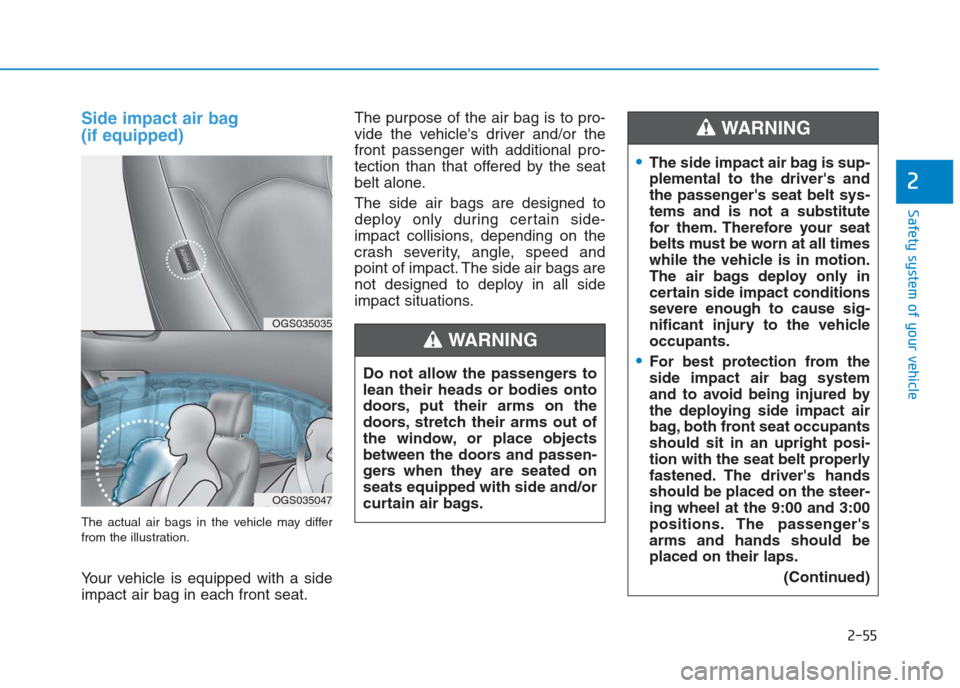
Side impact air bag
(if equipped)
The actual air bags in the vehicle may differ
from the illustration.
Your vehicle is equipped with a side
impact air bag in each front seat.The purpose of the air bag is to pro-
vide the vehicle's driver and/or the
front passenger with additional pro-
tection than that offered by the seat
belt alone.
The side air bags are designed to
deploy only during certain side-
impact collisions, depending on the
crash severity, angle, speed and
point of impact. The side air bags are
not designed to deploy in all side
impact situations.
OGS035035
OGS035047
Do not allow the passengers to
lean their heads or bodies onto
doors, put their arms on the
doors, stretch their arms out of
the window, or place objects
between the doors and passen-
gers when they are seated on
seats equipped with side and/or
curtain air bags.
WARNING
The side impact air bag is sup-
plemental to the driver's and
the passenger's seat belt sys-
tems and is not a substitute
for them. Therefore your seat
belts must be worn at all times
while the vehicle is in motion.
The air bags deploy only in
certain side impact conditions
severe enough to cause sig-
nificant injury to the vehicle
occupants.
For best protection from the
side impact air bag system
and to avoid being injured by
the deploying side impact air
bag, both front seat occupants
should sit in an upright posi-
tion with the seat belt properly
fastened. The driver's hands
should be placed on the steer-
ing wheel at the 9:00 and 3:00
positions. The passenger's
arms and hands should be
placed on their laps.
(Continued)
WARNING
Page 77 of 472
2-57
Safety system of your vehicle
2
They are designed to help protect
the heads of the front seat occupants
and the rear outboard seat occu-
pants in certain side impact colli-
sions.
The curtain air bags are designed to
deploy only during certain side
impact collisions, depending on the
crash severity, angle, speed and
impact. The curtain air bags are not
designed to deploy in all side impact
situations, collisions from the front or
rear of the vehicle or in most rollover
situations.
In order for side impact and
curtain air bags to provide the
best protection, both front
seat occupants and both out-
board rear occupants should
sit in an upright position with
the seat belts properly fas-
tened.
Importantly, children should
sit in a proper child restraint
system in the rear seat.
When children are seated in
the rear outboard seats, they
must be seated in the proper
child restraint system. Make
sure to put the child restraint
system as far away from the
door side as possible, and
secure the child restraint sys-
tem in a locked position.
Do not place any objects over
the air bag. Also, do not attach
any objects around the area
the air bag inflates such as the
door, side door glass, front
and rear pillar, roof side rail.
(Continued)
WARNING (Continued)
Do not hang hard or breakable
objects on the clothes hanger.
Do not allow the passengers
to lean their heads or bodies
onto doors, put their arms on
the doors, stretch their arms
out of the window, or place
objects between the doors
and passengers when they
are seated on seats equipped
with side and/or curtain air
bags.
Never try to open or repair any
components of the side cur-
tain air bag system. We rec-
ommend that the system be
serviced by an authorized
HYUNDAI dealer.
Failure to follow the above men-
tioned instructions can result in
injury or death to the vehicle
occupants in an accident.
Page 83 of 472
2-63
Safety system of your vehicle
2
SRS Care
The SRS is virtually maintenance-
free and so there are no parts you
can safely service by yourself. If the
SRS air bag warning light does not
illuminate, or continuously remains
on, we recommend that the system
be inspected by an authorized
HYUNDAI dealer.
We recommend that the any work on
the SRS system, such as removing,
installing, repairing, or any work on
the steering wheel, the front passen-
ger's panel, front seats and roof rails
be performed by an authorized
HYUNDAI dealer. Improper handling
of the SRS system may result in seri-
ous personal injury.(Continued)If the air bags inflate, we rec-
ommend that the system be
replaced by an authorized
HYUNDAI dealer.
Do not tamper with or discon-
nect SRS wiring, or other
components of the SRS sys-
tem. Doing so could result in
injury, due to accidental infla-
tion of the air bags or by ren-
dering the SRS inoperative.
If components of the air bag
system must be discarded, or if
the vehicle must be scrapped,
certain safety precautions
must be observed. An author-
ized HYUNDAI dealer knows
these precautions and can
give you the necessary infor-
mation. Failure to follow these
precautions and procedures
could increase the risk of per-
sonal injury.
If your car was flooded and
has soaked carpeting or water
on the flooring, you shouldn't
try to start the engine; we rec-
ommend that you contact an
authorized HYUNDAI dealer.
Modification to SRS compo-
nents or wiring, including the
addition of any kind of badges
to the pad covers or modifica-
tions to the body structure,
can adversely affect SRS per-
formance and lead to possible
injury.
For cleaning the air bag pad
covers, use only a soft, dry
cloth or one which has been
moistened with plain water.
Solvents or cleaners could
adversely affect the air bag
covers and proper deploy-
ment of the system.
No objects should be placed
over or near the air bag mod-
ules on the steering wheel,
instrument panel, and the
front passenger's panel above
the glove box, because any
such object could cause harm
if the vehicle is in a crash
severe enough to cause the
air bags to inflate.
(Continued)
WARNING
Page 84 of 472
2-64
Safety system of your vehicle
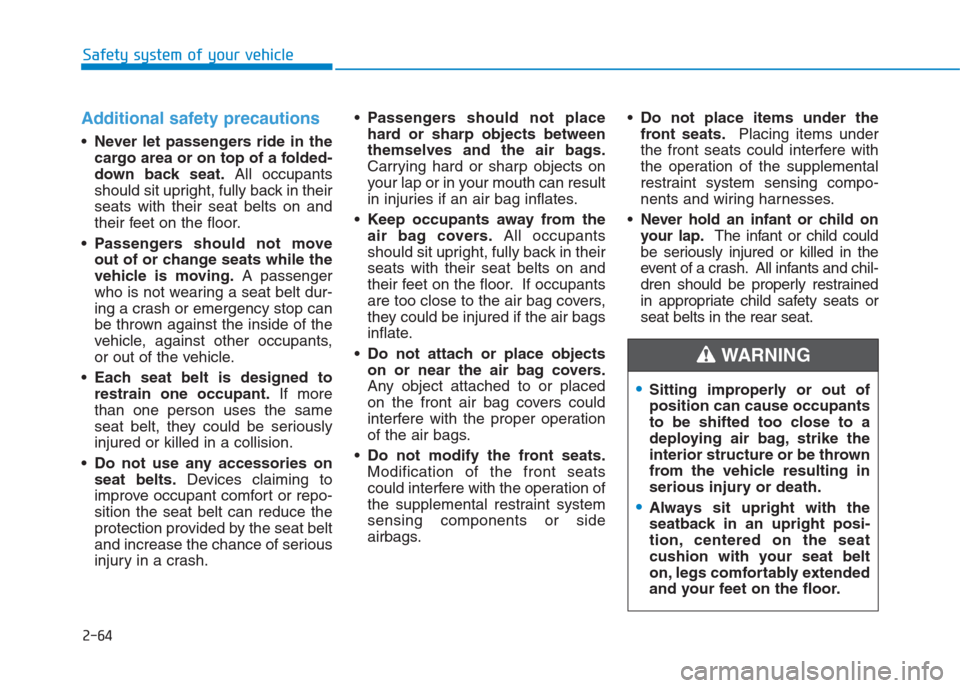
Additional safety precautions
Never let passengers ride in the
cargo area or on top of a folded-
down back seat.All occupants
should sit upright, fully back in their
seats with their seat belts on and
their feet on the floor.
Passengers should not move
out of or change seats while the
vehicle is moving.A passenger
who is not wearing a seat belt dur-
ing a crash or emergency stop can
be thrown against the inside of the
vehicle, against other occupants,
or out of the vehicle.
Each seat belt is designed to
restrain one occupant.If more
than one person uses the same
seat belt, they could be seriously
injured or killed in a collision.
Do not use any accessories on
seat belts.Devices claiming to
improve occupant comfort or repo-
sition the seat belt can reduce the
protection provided by the seat belt
and increase the chance of serious
injury in a crash.Passengers should not place
hard or sharp objects between
themselves and the air bags.
Carrying hard or sharp objects on
your lap or in your mouth can result
in injuries if an air bag inflates.
Keep occupants away from the
air bag covers.All occupants
should sit upright, fully back in their
seats with their seat belts on and
their feet on the floor. If occupants
are too close to the air bag covers,
they could be injured if the air bags
inflate.
Do not attach or place objects
on or near the air bag covers.
Any object attached to or placed
on the front air bag covers could
interfere with the proper operation
of the air bags.
Do not modify the front seats.
Modification of the front seats
could interfere with the operation of
the supplemental restraint system
sensing components or side
airbags.Do not place items under the
front seats.Placing items under
the front seats could interfere with
the operation of the supplemental
restraint system sensing compo-
nents and wiring harnesses.
Never hold an infant or child on
your lap.The infant or child could
be seriously injured or killed in the
event of a crash. All infants and chil-
dren should be properly restrained
in appropriate child safety seats or
seat belts in the rear seat.
Sitting improperly or out of
position can cause occupants
to be shifted too close to a
deploying air bag, strike the
interior structure or be thrown
from the vehicle resulting in
serious injury or death.
Always sit upright with the
seatback in an upright posi-
tion, centered on the seat
cushion with your seat belt
on, legs comfortably extended
and your feet on the floor.
WARNING
Page 450 of 472
7-93
7
Maintenance
Keep your garage dry
Don't park your vehicle in a damp,
poorly ventilated garage. This cre-
ates a favorable environment for cor-
rosion. This is particularly true if you
wash your vehicle in the garage or
drive it into the garage when it is still
wet or covered with snow, ice or
mud. Even a heated garage can con-
tribute to corrosion unless it is well
ventilated so moisture is dispersed.
Keep paint and trim in good con-
dition
Scratches or chips in the finish
should be covered with "touch-up"
paint as soon as possible to reduce
the possibility of corrosion. If bare
metal is showing through, the atten-
tion of a qualified body and paint
shop is recommended.
Bird droppings : Bird droppings are
highly corrosive and may damage
painted surfaces in just a few hours.
Always remove bird droppings as
soon as possible.Don't neglect the interior
Moisture can collect under the floor
mats and carpeting and cause corro-
sion. Check under the mats periodi-
cally to be sure the carpeting is dry.
Use particular care if you carry fertil-
izers, cleaning materials or chemi-
cals in the vehicle.
These should be carried only in
proper containers and any spills or
leaks should be cleaned up, flushed
with clean water and thoroughly
dried.Interior care
Interior general precautions
Prevent chemicals such as perfume,
cosmetic oil, sun cream, hand clean-
er, and air freshener from contacting
the interior parts because they may
cause damage or discoloration. If
they do contact the interior parts,
wipe them off immediately. See the
instructions that follow for the proper
way to clean vinyl.
Never allow water or other liquids
to come in contact with electrical/
electronic components inside the
vehicle as this may damage them.
When cleaning leather products
(steering wheel, seats etc.), use
neutral detergents or low alcohol
content solutions. If you use high
alcohol content solutions or
acid/alkaline detergents, the color
of the leather may fade or the sur-
face may get stripped off.
NOTICE
NOTICE
Page 471 of 472
I-7
Scheduled maintenance service ....................................7-10
Seat belts .......................................................................2-19
Additional seat belt safety precautions .....................2-27
Care of seat belts .......................................................2-30
Pre-tensioner seat belt ...............................................2-25
Seats ...............................................................................2-2
Front seats ..................................................................2-7
Rear seats ..................................................................2-14
Special driving conditions ............................................5-48
Driving at night..........................................................5-49
Driving in flooded areas ............................................5-50
Driving in the rain .....................................................5-50
Hazardous driving conditions ....................................5-48
Highway driving ........................................................5-51
Rocking the vehicle ...................................................5-48
Smooth cornering.......................................................5-49
Steering wheel ..............................................................3-36
Electric power steering (EPS) ...................................3-36
Horn ...........................................................................3-37
Tilt steering ................................................................3-37Storage compartment ..................................................3-120
Center console storage .............................................3-120
Glove box.................................................................3-121
Sunglass holder ........................................................3-121
Sunroof .........................................................................3-24
Resetting the sunroof .................................................3-26
Sunroof open warning ...............................................3-27
Sunroof opening and closing .....................................3-25
Sunshade ....................................................................3-26
Tilting the sunroof .....................................................3-25
Tailgate .........................................................................3-33
Closing the tailgate ....................................................3-33
Emergency tailgate safety release..............................3-34
Opening the tailgate ...................................................3-33
Theft-alarm system .......................................................3-18
Tire Pressure Monitoring System (TPMS)...................6-10
Changing a tire with TPMS .......................................6-13
Low tire pressure telltale ...........................................6-11
TPMS (Tire Pressure Monitoring System)
malfunction indicator...............................................6-12
I
Index
S
T