led Hyundai Creta 2019 Owner's Manual
[x] Cancel search | Manufacturer: HYUNDAI, Model Year: 2019, Model line: Creta, Model: Hyundai Creta 2019Pages: 472, PDF Size: 13.39 MB
Page 384 of 472
7-27
7
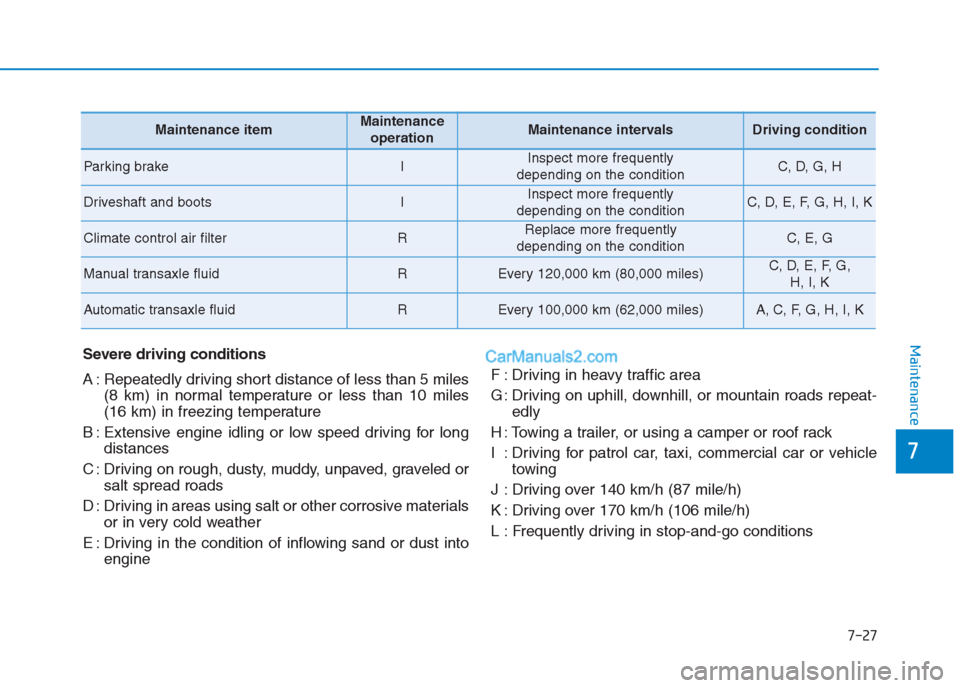
MaintenanceSevere driving conditions
A : Repeatedly driving short distance of less than 5 miles
(8 km) in normal temperature or less than 10 miles
(16 km) in freezing temperature
B : Extensive engine idling or low speed driving for long
distances
C : Driving on rough, dusty, muddy, unpaved, graveled or
salt spread roads
D : Driving in areas using salt or other corrosive materials
or in very cold weather
E : Driving in the condition of inflowing sand or dust into
engineF : Driving in heavy traffic area
G : Driving on uphill, downhill, or mountain roads repeat-
edly
H : Towing a trailer, or using a camper or roof rack
I : Driving for patrol car, taxi, commercial car or vehicle
towing
J : Driving over 140 km/h (87 mile/h)
K : Driving over 170 km/h (106 mile/h)
L : Frequently driving in stop-and-go conditions
Maintenance itemMaintenance
operationMaintenance intervalsDriving condition
Parking brakeIInspect more frequently
depending on the conditionC, D, G, H
Driveshaft and bootsIInspect more frequently
depending on the conditionC, D, E, F, G, H, I, K
Climate control air filter RReplace more frequently
depending on the conditionC, E, G
Manual transaxle fluidREvery 120,000 km (80,000 miles)C, D, E, F, G,
H, I, K
Automatic transaxle fluidREvery 100,000 km (62,000 miles)A, C, F, G, H, I, K
Page 390 of 472
7-33
7
Maintenance
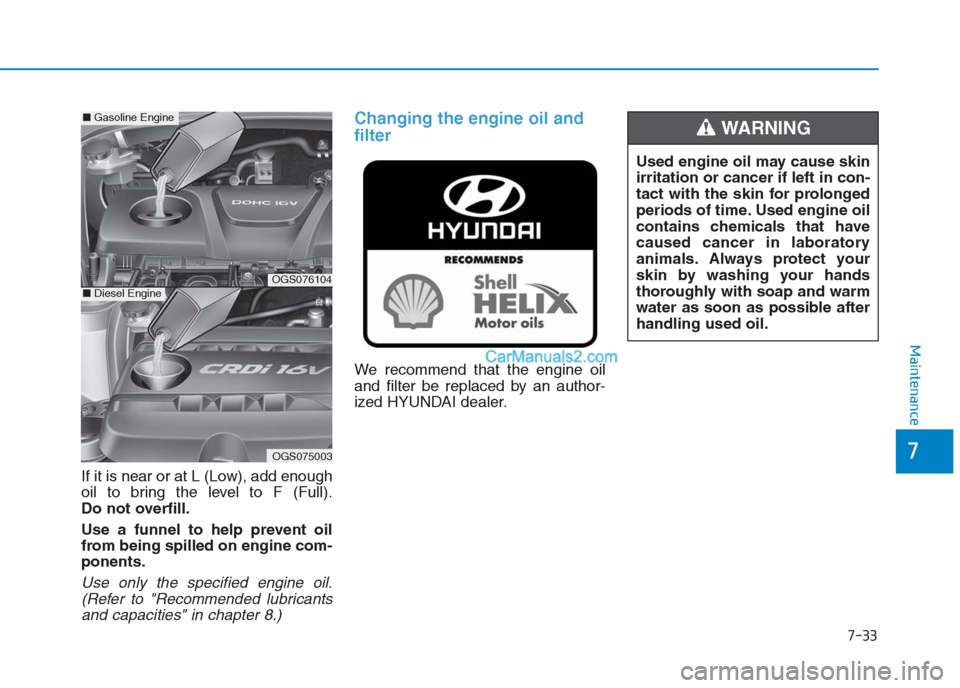
If it is near or at L (Low), add enough
oil to bring the level to F (Full).
Do not overfill.
Use a funnel to help prevent oil
from being spilled on engine com-
ponents.
Use only the specified engine oil.
(Refer to "Recommended lubricants
and capacities" in chapter 8.)
Changing the engine oil and
filter
We recommend that the engine oil
and filter be replaced by an author-
ized HYUNDAI dealer.
Used engine oil may cause skin
irritation or cancer if left in con-
tact with the skin for prolonged
periods of time. Used engine oil
contains chemicals that have
caused cancer in laboratory
animals. Always protect your
skin by washing your hands
thoroughly with soap and warm
water as soon as possible after
handling used oil.
WARNING
OGS076104
OGS075003
■Gasoline Engine
■Diesel Engine
Page 391 of 472
7-34
Maintenance
E EN
NG
GI
IN
NE
E
C
CO
OO
OL
LA
AN
NT
T
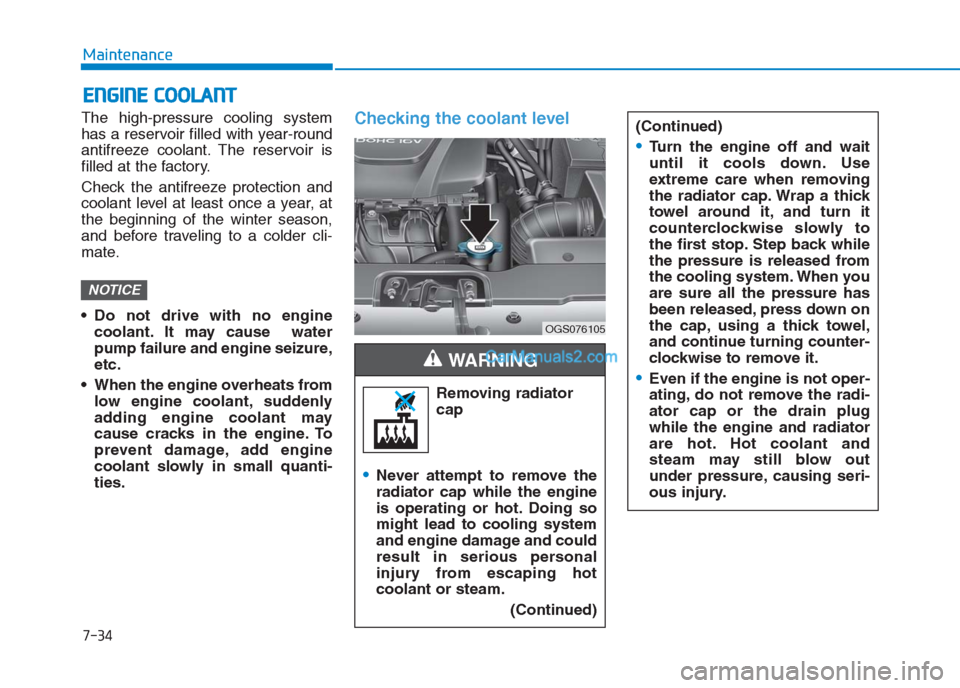
The high-pressure cooling system
has a reservoir filled with year-round
antifreeze coolant. The reservoir is
filled at the factory.
Check the antifreeze protection and
coolant level at least once a year, at
the beginning of the winter season,
and before traveling to a colder cli-
mate.
Do not drive with no engine
coolant. It may cause water
pump failure and engine seizure,
etc.
When the engine overheats from
low engine coolant, suddenly
adding engine coolant may
cause cracks in the engine. To
prevent damage, add engine
coolant slowly in small quanti-
ties.Checking the coolant level
NOTICE
Removing radiator
cap
Never attempt to remove the
radiator cap while the engine
is operating or hot. Doing so
might lead to cooling system
and engine damage and could
result in serious personal
injury from escaping hot
coolant or steam.
(Continued)
WARNING
(Continued)
Turn the engine off and wait
until it cools down. Use
extreme care when removing
the radiator cap. Wrap a thick
towel around it, and turn it
counterclockwise slowly to
the first stop. Step back while
the pressure is released from
the cooling system. When you
are sure all the pressure has
been released, press down on
the cap, using a thick towel,
and continue turning counter-
clockwise to remove it.
Even if the engine is not oper-
ating, do not remove the radi-
ator cap or the drain plug
while the engine and radiator
are hot. Hot coolant and
steam may still blow out
under pressure, causing seri-
ous injury.
OGS076105
Page 392 of 472
7-35
7
Maintenance
Check the condition and connections
of all cooling system hoses and
heater hoses. Replace any swollen
or deteriorated hoses.
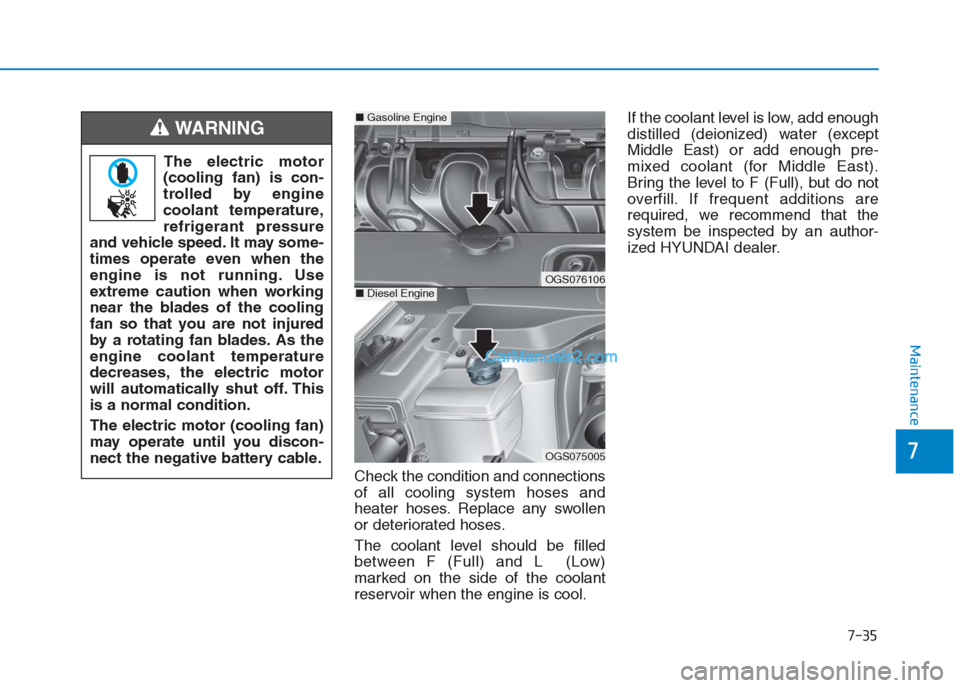
The coolant level should be filled
between F (Full) and L (Low)
marked on the side of the coolant
reservoir when the engine is cool.If the coolant level is low, add enough
distilled (deionized) water (except
Middle East) or add enough pre-
mixed coolant (for Middle East).
Bring the level to F (Full), but do not
overfill. If frequent additions are
required, we recommend that the
system be inspected by an author-
ized HYUNDAI dealer. The electric motor
(cooling fan) is con-
trolled by engine
coolant temperature,
refrigerant pressure
and vehicle speed. It may some-
times operate even when the
engine is not running. Use
extreme caution when working
near the blades of the cooling
fan so that you are not injured
by a rotating fan blades. As the
engine coolant temperature
decreases, the electric motor
will automatically shut off. This
is a normal condition.
The electric motor (cooling fan)
may operate until you discon-
nect the negative battery cable.
WARNING
OGS076106
OGS075005
■Gasoline Engine
■Diesel Engine
Page 393 of 472
7-36
Maintenance
Recommended engine coolant
Use only soft (distilled) water in the
coolant mixture.
The engine in your vehicle has alu-
minum engine parts and must be
protected by a phosphate-based
ethylene glycol coolant for alu-
minum radiator based coolant to
prevent corrosion and freezing.
DO NOT USE alcohol or methanol
coolant or mix them with the spec-
ified coolant.
Do not use a solution that contains
more than 60% antifreeze or less
than 35% antifreeze, which would
reduce the effectiveness of the
solution.
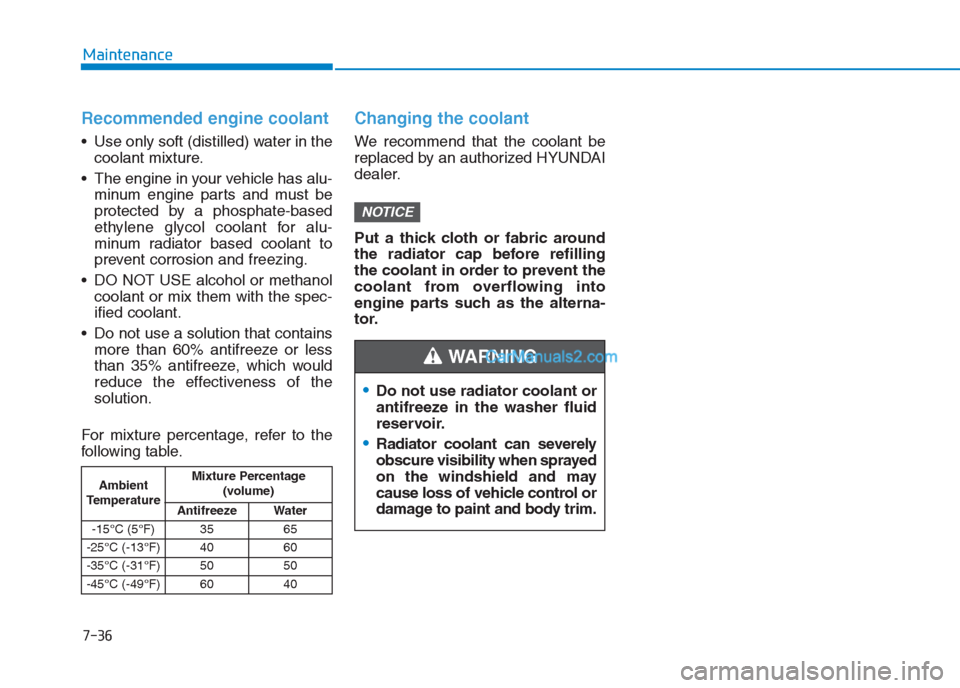
For mixture percentage, refer to the
following table.
Changing the coolant
We recommend that the coolant be
replaced by an authorized HYUNDAI
dealer.
Put a thick cloth or fabric around
the radiator cap before refilling
the coolant in order to prevent the
coolant from overflowing into
engine parts such as the alterna-
tor.
NOTICE
Ambient
TemperatureMixture Percentage
(volume)
Antifreeze Water
-15°C (5°F) 35 65
-25°C (-13°F) 40 60
-35°C (-31°F) 50 50
-45°C (-49°F) 60 40
Do not use radiator coolant or
antifreeze in the washer fluid
reservoir.
Radiator coolant can severely
obscure visibility when sprayed
on the windshield and may
cause loss of vehicle control or
damage to paint and body trim.
WARNING
Page 394 of 472
7-37
7
Maintenance
B BR
RA
AK
KE
E/
/C
CL
LU
UT
TC
CH
H
F
FL
LU
UI
ID
D
(
(I
IF
F
E
EQ
QU
UI
IP
PP
PE
ED
D)
)
Checking the brake/clutch
fluid level
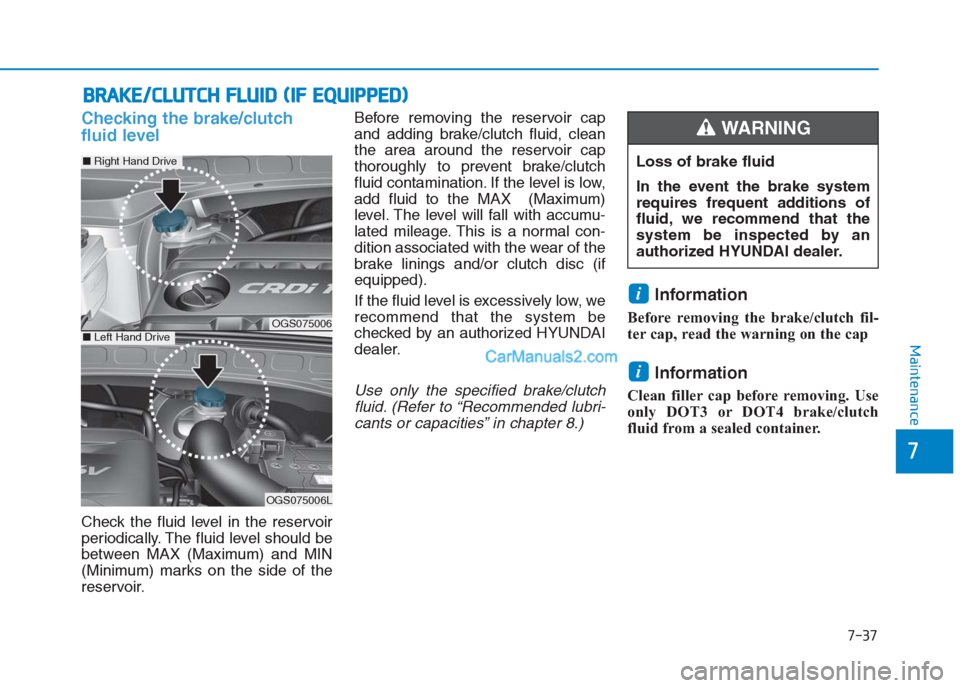
Check the fluid level in the reservoir
periodically. The fluid level should be
between MAX (Maximum) and MIN
(Minimum) marks on the side of the
reservoir.Before removing the reservoir cap
and adding brake/clutch fluid, clean
the area around the reservoir cap
thoroughly to prevent brake/clutch
fluid contamination. If the level is low,
add fluid to the MAX (Maximum)
level. The level will fall with accumu-
lated mileage. This is a normal con-
dition associated with the wear of the
brake linings and/or clutch disc (if
equipped).
If the fluid level is excessively low, we
recommend that the system be
checked by an authorized HYUNDAI
dealer.
Use only the specified brake/clutch
fluid. (Refer to “Recommended lubri-
cants or capacities” in chapter 8.)
Information
Before removing the brake/clutch fil-
ter cap, read the warning on the cap
Information
Clean filler cap before removing. Use
only DOT3 or DOT4 brake/clutch
fluid from a sealed container.
i
i
Loss of brake fluid
In the event the brake system
requires frequent additions of
fluid, we recommend that the
system be inspected by an
authorized HYUNDAI dealer.
WARNING
OGS075006
OGS075006L
■Right Hand Drive
■Left Hand Drive
Page 403 of 472
7-46
Maintenance
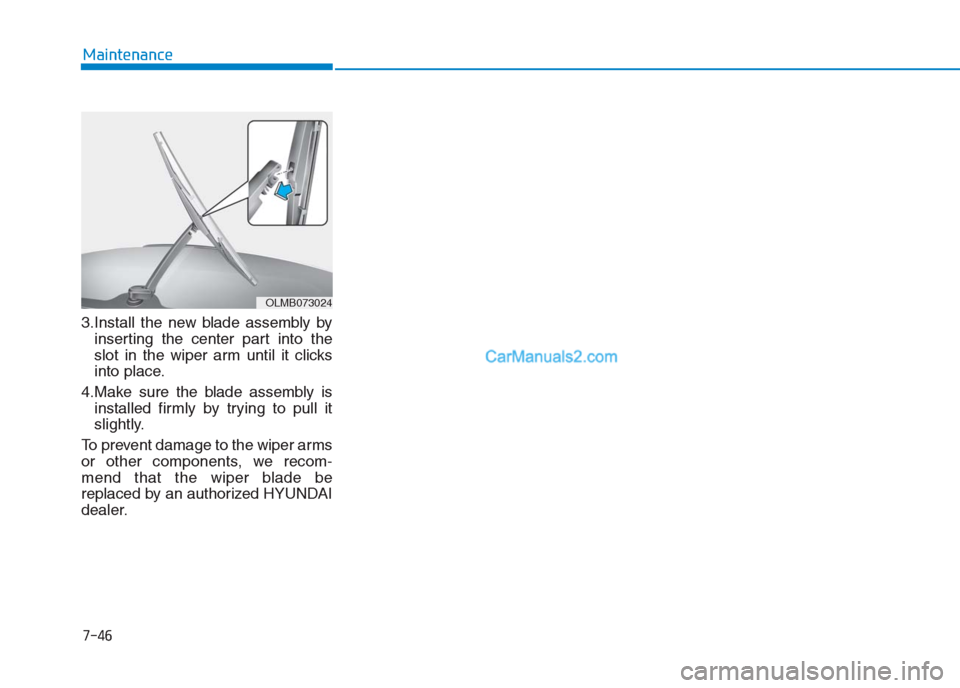
3.Install the new blade assembly by
inserting the center part into the
slot in the wiper arm until it clicks
into place.
4.Make sure the blade assembly is
installed firmly by trying to pull it
slightly.
To prevent damage to the wiper arms
or other components, we recom-
mend that the wiper blade be
replaced by an authorized HYUNDAI
dealer.
OLMB073024
Page 404 of 472
7-47
7
Maintenance
B BA
AT
TT
TE
ER
RY
Y
For best battery service
Keep the battery securely mounted.
Keep the battery top clean and dry.
Keep the terminals and connec-
tions clean, tight, and coated with
gasolineeum jelly or terminal
grease.
Rinse any spilled electrolyte from
the battery immediately with a
solution of water and baking soda.
If the vehicle is not going to be
used for an extended time, discon-
nect the cable from Negative termi-
nal (-ve) of the Battery to prevent
Discharge.
Information
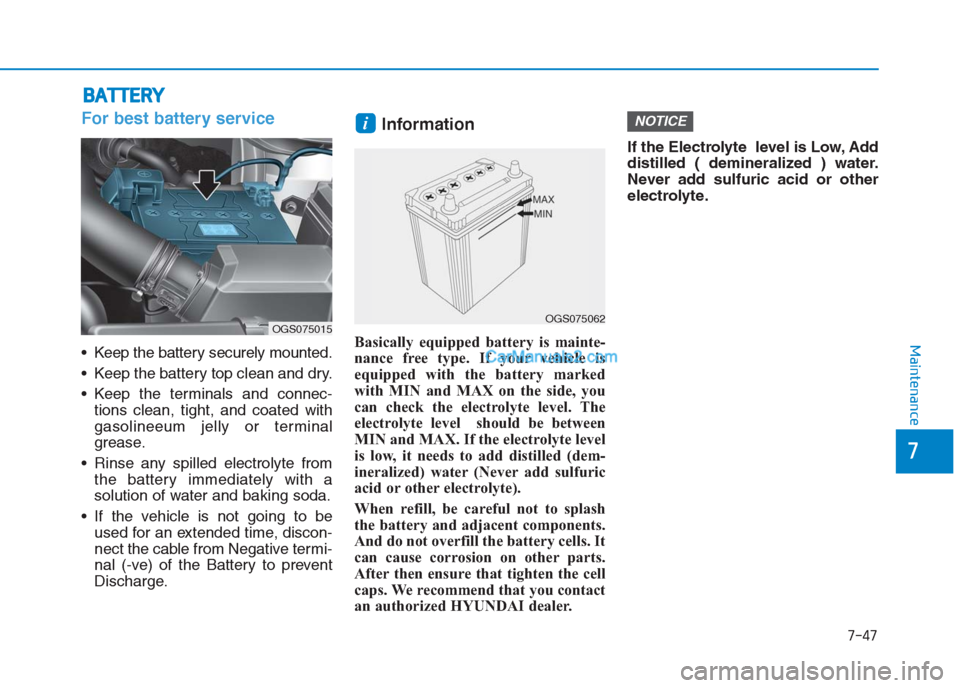
Basically equipped battery is mainte-
nance free type. If your vehicle is
equipped with the battery marked
with MIN and MAX on the side, you
can check the electrolyte level. The
electrolyte level should be between
MIN and MAX. If the electrolyte level
is low, it needs to add distilled (dem-
ineralized) water (Never add sulfuric
acid or other electrolyte).
When refill, be careful not to splash
the battery and adjacent components.
And do not overfill the battery cells. It
can cause corrosion on other parts.
After then ensure that tighten the cell
caps. We recommend that you contact
an authorized HYUNDAI dealer.If the Electrolyte level is Low, Add
distilled ( demineralized ) water.
Never add sulfuric acid or other
electrolyte.
NOTICEi
OGS075062OGS075015
Page 405 of 472
7-48
Maintenance
(Continued)
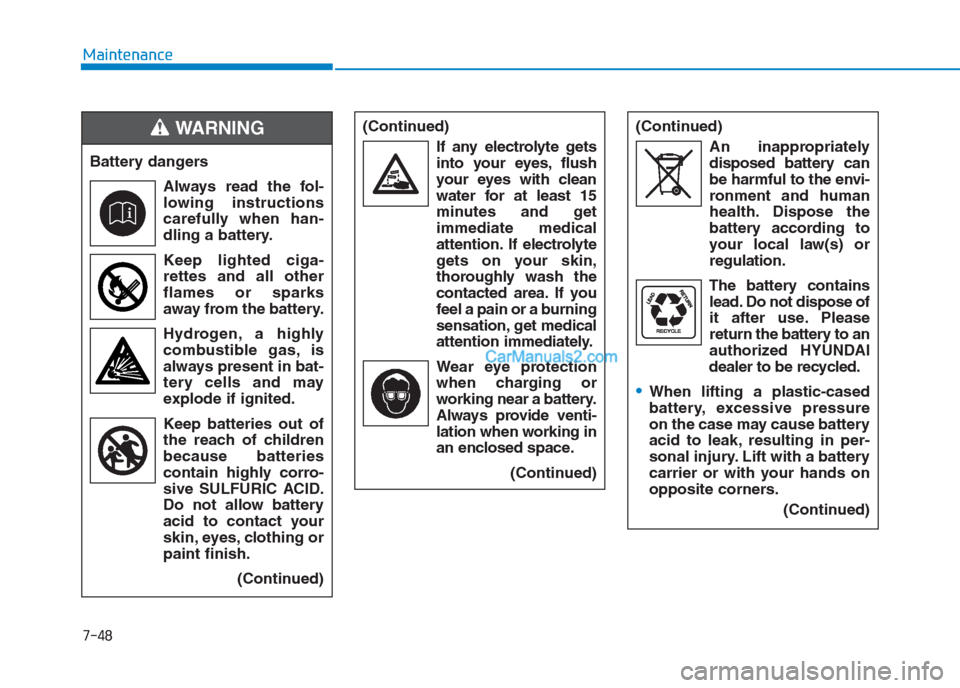
If any electrolyte gets
into your eyes, flush
your eyes with clean
water for at least 15
minutes and get
immediate medical
attention. If electrolyte
gets on your skin,
thoroughly wash the
contacted area. If you
feel a pain or a burning
sensation, get medical
attention immediately.
Wear eye protection
when charging or
working near a battery.
Always provide venti-
lation when working in
an enclosed space.
(Continued)
(Continued)
An inappropriately
disposed battery can
be harmful to the envi-
ronment and human
health. Dispose the
battery according to
your local law(s) or
regulation.
The battery contains
lead. Do not dispose of
it after use. Please
return the battery to an
authorized HYUNDAI
dealer to be recycled.
When lifting a plastic-cased
battery, excessive pressure
on the case may cause battery
acid to leak, resulting in per-
sonal injury. Lift with a battery
carrier or with your hands on
opposite corners.
(Continued)
Battery dangers
Always read the fol-
lowing instructions
carefully when han-
dling a battery.
Keep lighted ciga-
rettes and all other
flames or sparks
away from the battery.
Hydrogen, a highly
combustible gas, is
always present in bat-
tery cells and may
explode if ignited.
Keep batteries out of
the reach of children
because batteries
contain highly corro-
sive SULFURIC ACID.
Do not allow battery
acid to contact your
skin, eyes, clothing or
paint finish.
(Continued)
WARNING
Page 407 of 472
7-50
Maintenance
Reset items
Items should be reset after the bat-
tery has been discharged or the bat-
tery has been disconnected.
Auto up/down window
(See chapter 3)
Climate control system
(See chapter 3)
Audio (See chapter 3)
Clock (See chapter3)
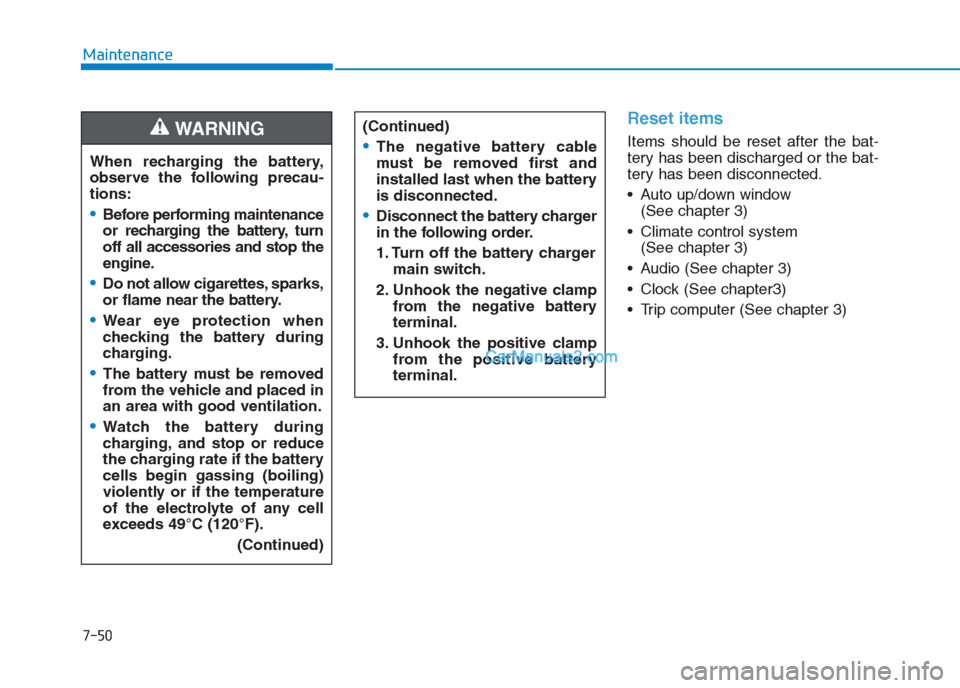
Trip computer (See chapter 3) When recharging the battery,
observe the following precau-
tions:
Before performing maintenance
or recharging the battery, turn
off all accessories and stop the
engine.
Do not allow cigarettes, sparks,
or flame near the battery.
Wear eye protection when
checking the battery during
charging.
The battery must be removed
from the vehicle and placed in
an area with good ventilation.
Watch the battery during
charging, and stop or reduce
the charging rate if the battery
cells begin gassing (boiling)
violently or if the temperature
of the electrolyte of any cell
exceeds 49°C (120°F).
(Continued)
WARNING (Continued)
The negative battery cable
must be removed first and
installed last when the battery
is disconnected.
Disconnect the battery charger
in the following order.
1. Turn off the battery charger
main switch.
2. Unhook the negative clamp
from the negative battery
terminal.
3. Unhook the positive clamp
from the positive battery
terminal.