led Hyundai Creta 2019 Owners Manual
[x] Cancel search | Manufacturer: HYUNDAI, Model Year: 2019, Model line: Creta, Model: Hyundai Creta 2019Pages: 472, PDF Size: 13.39 MB
Page 351 of 472
6-20
What to do in an emergency
If you have a tire gauge, check the
tire pressure (see “Tires and Wheels”
in chapter 8 for tire pressure instruc-
tions.). If the pressure is lower or
higher than recommended, drive
slowly to the nearest service station
and adjust it to the recommended
pressure. Always reinstall the valve
cap after checking or adjusting tire
pressure. If the cap is not replaced,
air may leak from the tire. If you lose
a valve cap, buy another and install it
as soon as possible. After changing
tires, secure the flat tire and return
the jack and tools to their proper stor-
age locations.
Information
Check the tire pressure as soon as pos-
sible after installing a spare tire.
Adjust it to the recommended pres-
sure.Your vehicle has metric threads
on the studs and lug nuts. Make
certain during tire changing that
the same nuts that were removed
are reinstalled. If you have to
replace your lug nuts make sure
they have metric threads to avoid
damaging the studs and ensure
the wheel is properly secured to
the hub. We recommend that you
consult an authorized HYUNDAI
dealer for assistance.
If any of the equipment such as the
jack, lug nuts, studs, or other equip-
ment is damaged or in poor condi-
tion, do not attempt to change the
tire and call for assistance.
NOTICE
i
Page 352 of 472
6-21
What to do in an emergency
6
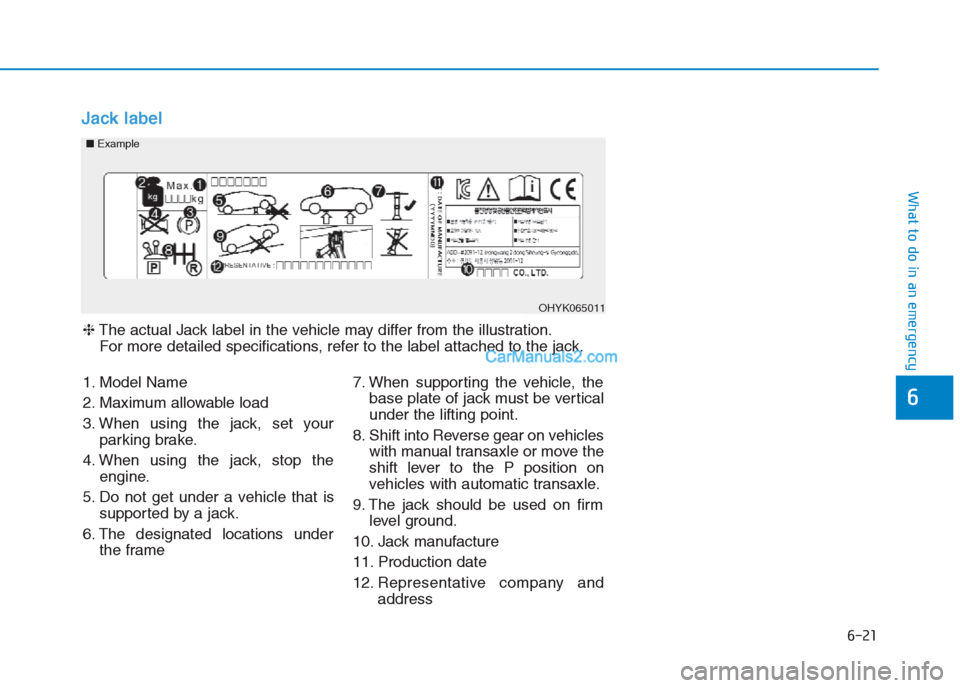
Jack label
OHYK065011
■Example
❈The actual Jack label in the vehicle may differ from the illustration.
For more detailed specifications, refer to the label attached to the jack.
1. Model Name
2. Maximum allowable load
3. When using the jack, set your
parking brake.
4. When using the jack, stop the
engine.
5. Do not get under a vehicle that is
supported by a jack.
6. The designated locations under
the frame7. When supporting the vehicle, the
base plate of jack must be vertical
under the lifting point.
8. Shift into Reverse gear on vehicles
with manual transaxle or move the
shift lever to the P position on
vehicles with automatic transaxle.
9. The jack should be used on firm
level ground.
10. Jack manufacture
11. Production date
12. Representative company and
address
Page 355 of 472
6-24
What to do in an emergency
Emergency towing
If towing is necessary, we recom-
mend you have it done by an author-
ized HYUNDAI dealer or a commer-
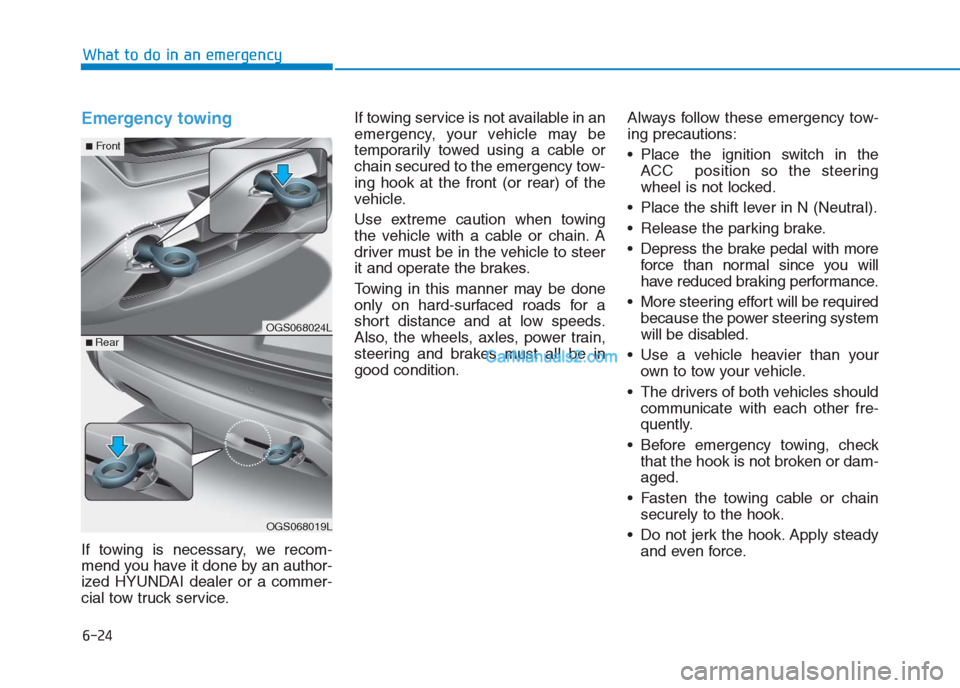
cial tow truck service.If towing service is not available in an
emergency, your vehicle may be
temporarily towed using a cable or
chain secured to the emergency tow-
ing hook at the front (or rear) of the
vehicle.
Use extreme caution when towing
the vehicle with a cable or chain. A
driver must be in the vehicle to steer
it and operate the brakes.
Towing in this manner may be done
only on hard-surfaced roads for a
short distance and at low speeds.
Also, the wheels, axles, power train,
steering and brakes must all be in
good condition.Always follow these emergency tow-
ing precautions:
Place the ignition switch in the
ACC position so the steering
wheel is not locked.
Place the shift lever in N (Neutral).
Release the parking brake.
Depress the brake pedal with more
force than normal since you will
have reduced braking performance.
More steering effort will be required
because the power steering system
will be disabled.
Use a vehicle heavier than your
own to tow your vehicle.
The drivers of both vehicles should
communicate with each other fre-
quently.
Before emergency towing, check
that the hook is not broken or dam-
aged.
Fasten the towing cable or chain
securely to the hook.
Do not jerk the hook. Apply steady
and even force.
OGS068024L
OGS068019L
■Front
■ Rear
Page 358 of 472
7
Maintenance
7
Maintenance
Engine compartment .............................................7-3
Maintenance services ...........................................7-5
Owner's responsibility ......................................................7-5
Owner maintenance precautions ................................7-5
Owner maintenance ...............................................7-8
Owner maintenance schedule ......................................7-8
Scheduled maintenance service ........................7-10
Explanation of scheduled maintenance items..7-28
Engine oil ..............................................................7-32
Checking the engine oil level ....................................7-32
Changing the engine oil and filter ..............................7-33
Engine coolant......................................................7-34
Checking the coolant level ...........................................7-34
Recommended engine coolant.....................................7-36
Changing the coolant .....................................................7-36
Brake/clutch fluid ................................................7-37
Checking the brake/clutch fluid level ........................7-37
Washer fluid .........................................................7-39
Checking the washer fluid level ..................................7-39
Parking brake .......................................................7-39
Checking the parking brake .........................................7-39
Fuel filter (For Diesel) ........................................7-40
Draining water from fuel filter ....................................7-40
Extracting air from the fuel filter ..............................7-40
Air cleaner ............................................................7-41
Filter replacement ........................................................7-41
Climate control air filter .....................................7-42
Filter inspection ...............................................................7-42
Filter replacement ...........................................................7-42
Wiper blades .........................................................7-44
Blade inspection ..............................................................7-44
Blade replacement ..........................................................7-44
Battery...................................................................7-47
For best battery service................................................7-47
Battery capacity label ....................................................7-49
Battery recharging .........................................................7-49
Reset items .......................................................................7-50
Tires and wheels ..................................................7-51
Tire care ............................................................................7-51
Recommended cold tire inflation pressures.............7-51
Checking tire inflation pressure ..................................7-53
Tire rotation .....................................................................7-54
Wheel alignment and tire balance ..............................7-55
Tire replacement .............................................................7-55
Wheel replacement ........................................................7-56
Tire traction ......................................................................7-57
Tire maintenance ...........................................................7-57
Tire sidewall labeling ......................................................7-57
Low aspect ratio tire ......................................................7-61
7
Page 362 of 472
7-5
7
Maintenance
M
MA
AI
IN
N T
TE
EN
N A
AN
N C
CE
E
S
S E
E R
R V
V I
IC
C E
E S
S
You should exercise the utmost care
to prevent damage to your vehicle
and injury to yourself whenever per-
forming any maintenance or inspec-
tion procedures. Inadequate, incom-
plete or insufficient servicing may
result in operational problems with
your vehicle that could lead to vehi-
cle damage, an accident, or person-
al injury.Owner's responsibility
Information
Maintenance Service and Record
Retention are the owner's responsibility.
We recommend in general that you
have your vehicle serviced by an
authorized HYUNDAI dealer.
You should retain documents that
show proper maintenance has been
performed on your vehicle in accor-
dance with the scheduled mainte-
nance service charts shown on the
following pages. You need this infor-
mation to establish your compliance
with the servicing and maintenance
requirements of your vehicle war-
ranties.
Detailed warranty information is pro-
vided in your Service Passport.
Repairs and adjustments required as
a result of improper maintenance or
a lack of required maintenance are
not covered when your vehicle is
covered by warranty.
Owner maintenance precau-
tions
Improper or incomplete service may
result in problems. This chapter gives
instructions only for the maintenance
items that are easy to perform.
Information
Improper owner maintenance during
the warranty period may affect war-
ranty coverage. For details, read the
separate Service Passport provided
with the vehicle. If you're unsure
about any servicing or maintenance
procedure, we recommend that the
system be serviced by an authorized
HYUNDAI dealer.
i
i
Page 363 of 472
7-6
Maintenance
• Do not put heavy objects or
apply excessive force on top of
the engine cover (if equipped) or
fuel related parts.
When you inspect the fuel sys-
tem (fuel lines and fuel injection
devices), we recommend that
you contact an authorized
HYUNDAI dealer.
Do not drive long time with
the engine cover (if equipped)
removed.
When checking the engine
room, do not go near fire. Fuel,
washer fluid, etc. are flammable
oils that may cause fire.
Before touching the battery,
ignition cables and electrical
wiring, you should disconnect
the battery "-" terminal. You may
get an electric shock from the
electric current.
(Continued)
NOTICE
Maintenance work
Performing maintenance work
on a vehicle can be danger-
ous. You can be seriously
injured while performing some
maintenance procedures. If
you lack sufficient knowledge
and experience or the proper
tools and equipment to do the
work, we recommend that the
system be serviced by an
authorized HYUNDAI dealer.
Working under the hood with
the engine running is danger-
ous. It becomes even more
dangerous when you wear
jewelry or loose clothing.
These can become entangled
in moving parts and result in
injury.
(Continued)
WARNING (Continued)
Therefore, if you must run the
engine while working under the
hood, make certain that you
remove all jewelry (especially
rings, bracelets, watches, and
necklaces) and all neckties,
scarves, and similar loose
clothing before getting near the
engine or cooling fans.
Do not leave gloves, rags or any
other combustible material in
the engine compartment. Doing
so may cause a heat-induced
fire.
WARNING
Page 367 of 472
7-10
Maintenance
S SC
CH
HE
ED
DU
UL
LE
ED
D
M
MA
AI
IN
NT
TE
EN
NA
AN
NC
CE
E
S
SE
ER
RV
VI
IC
CE
E
Follow the Normal Maintenance
Schedule if the vehicle is usually
operated where none of the following
conditions apply. If any of the follow-
ing conditions apply, follow
Maintenance Under Severe Usage
Conditions.
Repeated driving short distance of
less than 8 km (5 miles) in normal
temperature or less than 16 km(10
miles) in freezing temperature
Extensive engine idling or low
speed driving for long distances
Driving on rough, dusty, muddy,
unpaved, graveled or salt-spread
roads
Driving in areas using salt or other
corrosive materials or in very cold
weather
Driving in the condition of inflowing
sand or dust into engine
Driving in heavy traffic area
Driving on uphill, downhill, or
mountain road repeatedly
Towing a trailer or using a camper,
or roof rack Driving as a patrol car, taxi, other
commercial use of vehicle towing
Driving over 170 km/h (106 mile/h)
Frequently driving in stop-and-go
condition
If your vehicle is operated under the
above conditions, you should
inspect, replace or refill more fre-
quently than the following Normal
Maintenance Schedule. After the
periods or distance shown in the
chart, continue to follow the pre-
scribed maintenance intervals.
Page 370 of 472
7-13
7
Maintenance
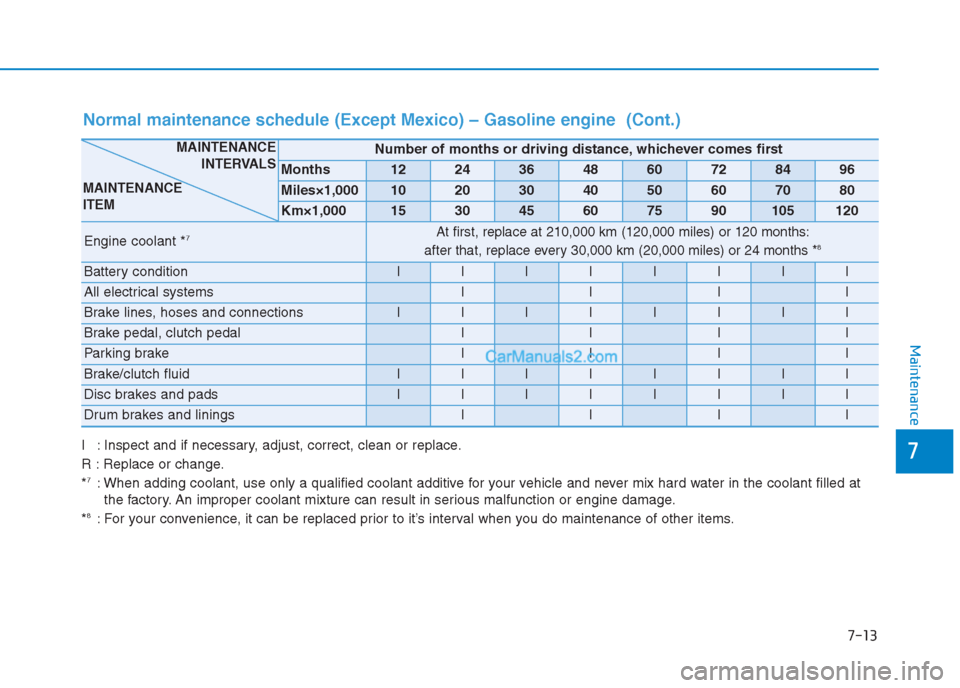
Normal maintenance schedule (Except Mexico) – Gasoline engine (Cont.)
I : Inspect and if necessary, adjust, correct, clean or replace.
R : Replace or change.
*
7: When adding coolant, use only a qualified coolant additive for your vehicle and never mix hard water in the coolant filled at
the factory. An improper coolant mixture can result in serious malfunction or engine damage.
*
8: For your convenience, it can be replaced prior to it’s interval when you do maintenance of other items.
Number of months or driving distance, whichever comes first
Months1224364860728496
Miles×1,0001020304050607080
Km×1,000153045607590105120
Engine coolant *7At first, replace at 210,000 km (120,000 miles) or 120 months:
after that, replace every 30,000 km (20,000 miles) or 24 months *8
Battery conditionIIIIIIII
All electrical systemsIIII
Brake lines, hoses and connectionsIIIIIIII
Brake pedal, clutch pedalIIII
Parking brakeIIII
Brake/clutch fluidIIIIIIII
Disc brakes and padsIIIIIIII
Drum brakes and liningsIIII
MAINTENANCE
INTERVALS
MAINTENANCE
ITEM
Page 375 of 472
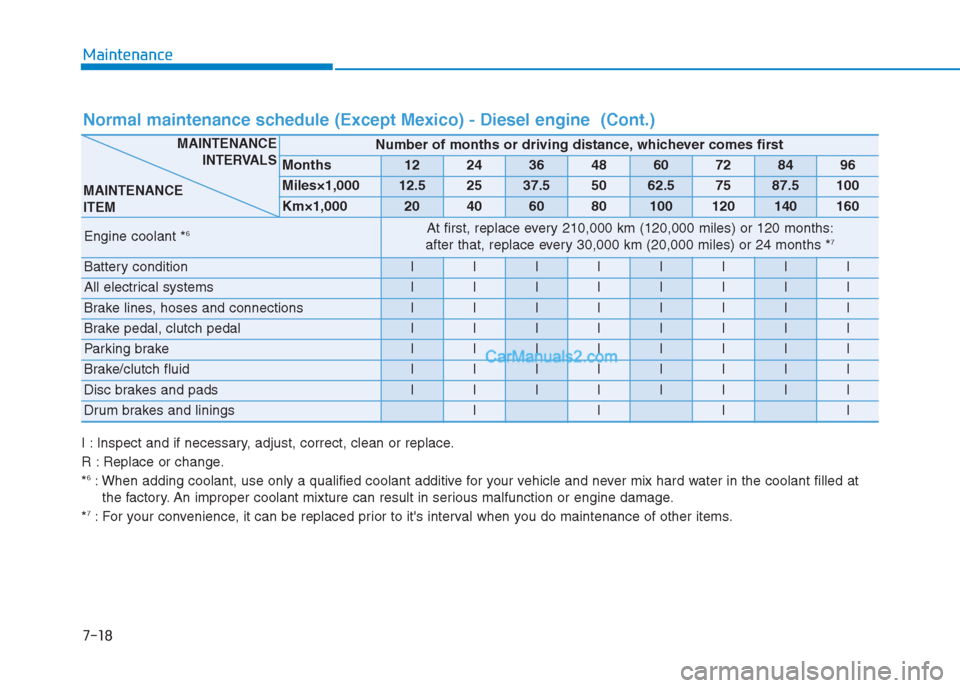
7-18
Maintenance
I : Inspect and if necessary, adjust, correct, clean or replace.
R : Replace or change.
*
6: When adding coolant, use only a qualified coolant additive for your vehicle and never mix hard water in the coolant filled at
the factory. An improper coolant mixture can result in serious malfunction or engine damage.
*
7: For your convenience, it can be replaced prior to it's interval when you do maintenance of other items.
Normal maintenance schedule (Except Mexico) - Diesel engine (Cont.)
Number of months or driving distance, whichever comes first
Months1224364860728496
Miles×1,00012.52537.55062.57587.5100
Km×1,00020406080100120140160
Engine coolant *6At first, replace every 210,000 km (120,000 miles) or 120 months:
after that, replace every 30,000 km (20,000 miles) or 24 months *7
Battery conditionIIIIIIII
All electrical systemsIIIIIIII
Brake lines, hoses and connectionsIIIIIIII
Brake pedal, clutch pedal IIIIIIII
Parking brakeIIIIIIII
Brake/clutch fluidIIIIIIII
Disc brakes and padsIIIIIIII
Drum brakes and linings IIII
MAINTENANCE
INTERVALS
MAINTENANCE
ITEM
Page 381 of 472
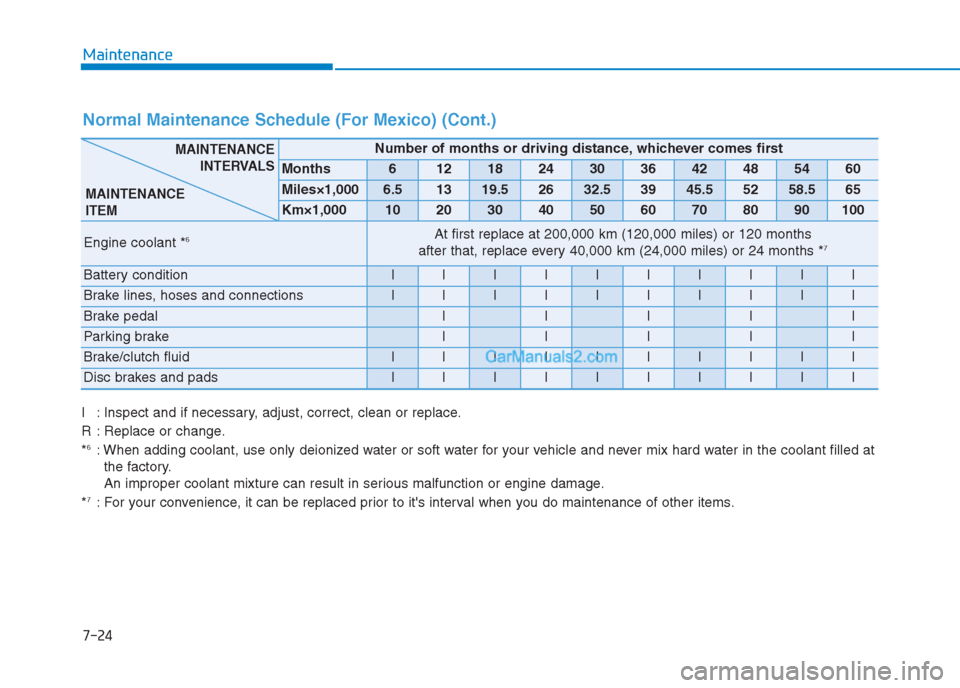
7-24
Maintenance
Normal Maintenance Schedule (For Mexico) (Cont.)
I : Inspect and if necessary, adjust, correct, clean or replace.
R : Replace or change.
*
6: When adding coolant, use only deionized water or soft water for your vehicle and never mix hard water in the coolant filled at
the factory.
An improper coolant mixture can result in serious malfunction or engine damage.
*
7: For your convenience, it can be replaced prior to it's interval when you do maintenance of other items.
Number of months or driving distance, whichever comes first
Months6121824303642485460
Miles×1,0006.51319.52632.53945.55258.565
Km×1,000102030405060708090100
Engine coolant *6At first replace at 200,000 km (120,000 miles) or 120 months
after that, replace every 40,000 km (24,000 miles) or 24 months *7
Battery conditionIIIIIIIIII
Brake lines, hoses and connectionsIIIIIIIIII
Brake pedalIIIII
Parking brakeIIIII
Brake/clutch fluidIIIIIIIIII
Disc brakes and padsIIIIIIIIII
MAINTENANCE
INTERVALS
MAINTENANCE
ITEM