light Hyundai Creta 2019 Owner's Manual
[x] Cancel search | Manufacturer: HYUNDAI, Model Year: 2019, Model line: Creta, Model: Hyundai Creta 2019Pages: 472, PDF Size: 13.39 MB
Page 337 of 472
To prevent damage to your vehi-
cle:
Only use a 12-volt power supply
(battery or jumper system) to
jump start your vehicle.
Do not attempt to jump start
your vehicle by push-starting.
Information
An inappropriately disposed
battery can be harmful to the
environment and human
health. Dispose the battery
according to your local law(s)
or regulation.
Jump starting procedure
1. Position the vehicles close enough
that the jumper cables will reach,
but do not allow the vehicles to
touch.
2. Avoid fans or any moving parts in
the engine compartment at all
times, even when the vehicles are
turned off.
3. Turn off all electrical devices such
as radios, lights, air conditioning,
etc. Put the vehicles in P (Park, for
automatic transaxle vehicle) or
neutral (for manual transaxle vehi-
cle), and set the parking brakes.
Turn both vehicles OFF.
i
NOTICE
6-6
What to do in an emergency
Pb
(Continued)
NEVER attempt to recharge
the battery when the vehicle’s
battery cables are connected
to the battery.
The electrical ignition system
works with high voltage.
NEVER touch these compo-
nents with the engine running
or when the ignition switch is
in the ON position.
Do not allow the (+) and (-)
jumper cables to touch. It may
cause sparks.
The battery may rupture or
explode when you jump start
with a low or frozen battery.
Never attempt jump start if
you observe cracks, leaks or
other damage on Battery.
Page 345 of 472
What to do in an emergency
6-14
You may not be able to identify a low
tire by simply looking at it. Always
use a good quality tire pressure
gauge to measure the tire's inflation
pressure. Please note that a tire that
is hot (from being driven) will have a
higher pressure measurement than a
tire that is cold.
A cold tire means the vehicle has
been sitting for 3 hours and driven for
less than 1 mile (1.6 km) in that 3
hour period.
Allow the tire to cool before measur-
ing the inflation pressure. Always be
sure the tire is cold before inflating to
the recommended pressure.TPMS
The TPMS cannot alert you to
severe and sudden tire dam-
age caused by external fac-
tors such as nails or road
debris.
If you feel any vehicle instabil-
ity, immediately take your foot
off the accelerator, apply the
brakes gradually and with
light force, and slowly move to
a safe position off the road.
WARNING
Protecting TPMS
Tampering with, modifying, or
disabling the Tire Pressure
Monitoring System (TPMS)
components may interfere with
the system's ability to warn the
driver of low tire pressure con-
ditions and/or TPMS malfunc-
tions. Tampering with, modify-
ing, or disabling the Tire
Pressure Monitoring System
(TPMS) components may void
the warranty for that portion of
the vehicle.
WARNING
We recommend that you use the
tire sealant approved by
HYUNDAI if your vehicle is
equipped with a Tire Pressure
Monitoring System. The liquid
sealant can damage the tire
pressure sensors.
CAUTION
Page 359 of 472
7
Fuses ......................................................................7-63
Instrument panel fuse replacement ...........................7-64
Engine compartment panel fuse replacement.........7-66
Fuse/Relay panel description ......................................7-68
Light bulbs.............................................................7-77
Headlight, position light, turn signal light,
and front fog light bulb replacement ....................7-78
Side repeater light bulb replacement.........................7-83
Rear combination light bulb replacement .................7-83
High mounted stop light ................................................7-85
License plate light bulb replacement ........................7-86
Interior light bulb replacement ....................................7-86
Appearance care ..................................................7-88
Exterior care ....................................................................7-88
Interior care......................................................................7-93
Emission control system .....................................7-95
Crankcase emission control system ...........................7-95
Evaporative emission control system.........................7-95
Exhaust emission control system ...............................7-96
Page 365 of 472
7-8
Maintenance
O OW
WN
NE
ER
R
M
MA
AI
IN
NT
TE
EN
NA
AN
NC
CE
E
The following lists are vehicle checks
and inspections that should be per-
formed at the frequencies indicated
to help ensure safe, dependable
operation of your vehicle.
Any adverse conditions should be
brought to the attention of your deal-
er as soon as possible.
These Owner Maintenance Checks
are generally not covered by war-
ranties and you may be charged for
labor, parts and lubricants used.Owner maintenance schedule
When you stop for fuel:
• Check the engine oil level.
Check the coolant level in coolant
reservoir.
Check the windshield washer fluid
level.
Look for low or under-inflated tires.
Check the radiator and condenser.
Check if the front of the radiator
and condenser are clean and not
blocked with leaves, dirt or insects
etc.
If any of the above parts are
extremely dirty or you are not sure
of their condition, we recommend
that you contact an authorized
HYUNDAI dealer.
While operating your vehicle:
Note any changes in the sound of
the exhaust or any smell of
exhaust fumes in the vehicle.
Check for vibrations in the steering
wheel. Notice any increased steer-
ing effort or looseness in the steer-
ing wheel, or change in its straight-
ahead position.
Notice if your vehicle constantly
turns slightly or "pulls" to one side
when traveling on smooth, level
road.
When stopping, listen and check
for unusual sounds, pulling to one
side, increased brake pedal travel
or "hard-to-push" brake pedal.
If any slipping or changes in the
operation of your transaxle occurs,
check the transaxle fluid level.
Check automatic transaxle P
(Park) function.
Check the parking brake.
Check for fluid leaks under your
vehicle (water dripping from the air
conditioning system during or after
use is normal). Be careful when checking your
engine coolant level when the
engine is hot. Scalding hot
coolant and steam may blow
out under pressure. This could
cause burns or other serious
injury.
WARNING
Page 366 of 472
7-9
7
Maintenance
At least monthly:
Check the coolant level in the
engine coolant reservoir.
Check the operation of all exterior
lights, including the stoplights, turn
signals and hazard warning flash-
ers.
Check the inflation pressures of all
tires including the spare.
At least twice a year
(i.e., every Spring and Fall):
Check the radiator, heater and air
conditioning hoses for leaks or
damage.
Check the windshield washer
spray and wiper operation. Clean
wiper blades with clean cloth
dampened with washer fluid.
Check the headlight alignment.
Check the muffler, exhaust pipes,
shields and clamps.
Check the lap/shoulder belts for
wear and function.
Check for worn tires and loose
wheel lug nuts.
At least once a year:
Clean the body and door drain
holes.
Lubricate the door hinges and
checks, and hood hinges.
Lubricate the door and hood locks
and latches.
Lubricate the door rubber weather-
strips.
Check the air conditioning system.
Inspect and lubricate automatic
transaxle linkage and controls.
Clean the battery and terminals.
Check the brake/clutch fluid level.
Page 397 of 472
7-40
Maintenance
F FU
UE
EL
L
F
FI
IL
LT
TE
ER
R
(
(F
FO
OR
R
D
DI
IE
ES
SE
EL
L)
)
Draining water from fuel filter
The fuel filter for diesel engine plays
an important role of separating water
from fuel and accumulating the water
in its bottom.
If water accumulates in the fuel filter,
the warning light comes on when the
ignition switch is in the ON position.
If this warning light turned
on, we recommend that the
system be serviced by an
authorized HYUNDAI dealer.
If the water accumulated in the
fuel filter is not drained at proper
times, damages to the major parts
such as the fuel system can be
caused by water permeation in the
fuel filter.
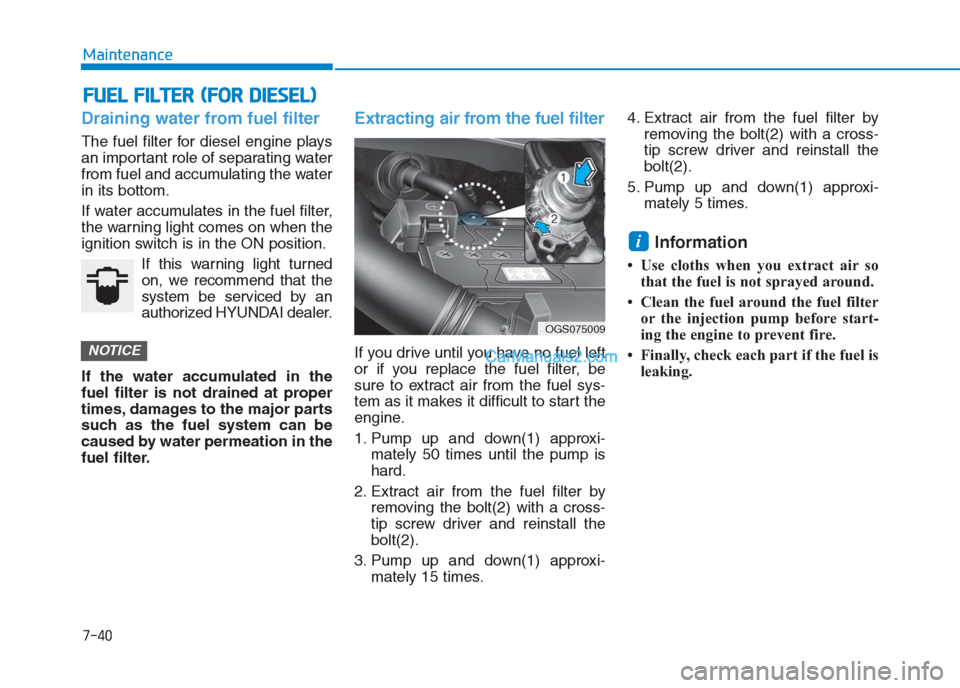
Extracting air from the fuel filter
If you drive until you have no fuel left
or if you replace the fuel filter, be
sure to extract air from the fuel sys-
tem as it makes it difficult to start the
engine.
1. Pump up and down(1) approxi-
mately 50 times until the pump is
hard.
2. Extract air from the fuel filter by
removing the bolt(2) with a cross-
tip screw driver and reinstall the
bolt(2).
3. Pump up and down(1) approxi-
mately 15 times.4. Extract air from the fuel filter by
removing the bolt(2) with a cross-
tip screw driver and reinstall the
bolt(2).
5. Pump up and down(1) approxi-
mately 5 times.
Information
• Use cloths when you extract air so
that the fuel is not sprayed around.
• Clean the fuel around the fuel filter
or the injection pump before start-
ing the engine to prevent fire.
• Finally, check each part if the fuel is
leaking.
i
NOTICE
OGS075009
Page 403 of 472
7-46
Maintenance
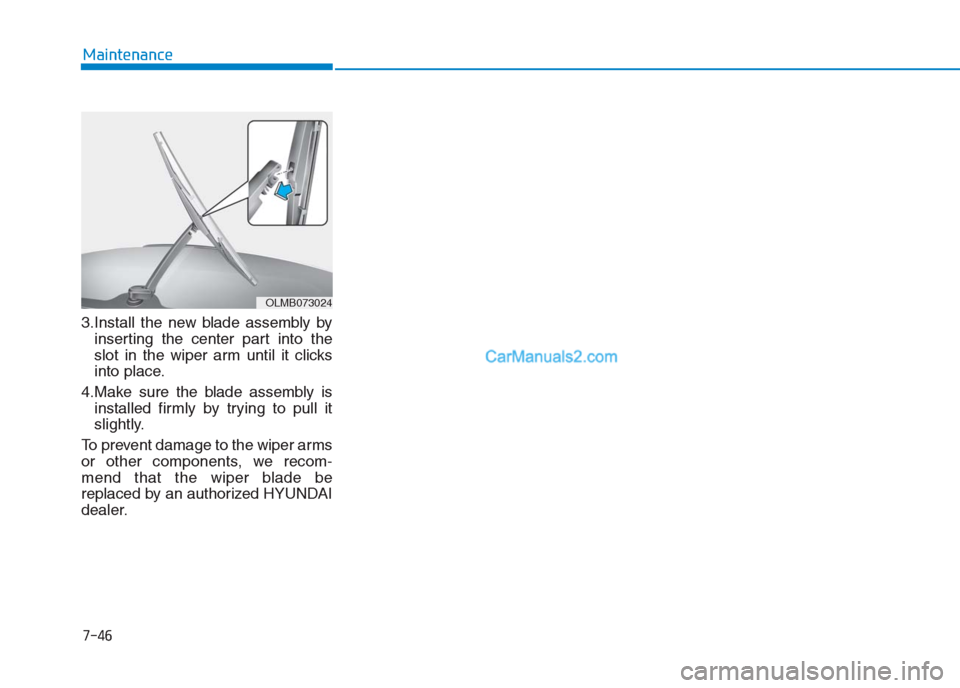
3.Install the new blade assembly by
inserting the center part into the
slot in the wiper arm until it clicks
into place.
4.Make sure the blade assembly is
installed firmly by trying to pull it
slightly.
To prevent damage to the wiper arms
or other components, we recom-
mend that the wiper blade be
replaced by an authorized HYUNDAI
dealer.
OLMB073024
Page 405 of 472
7-48
Maintenance
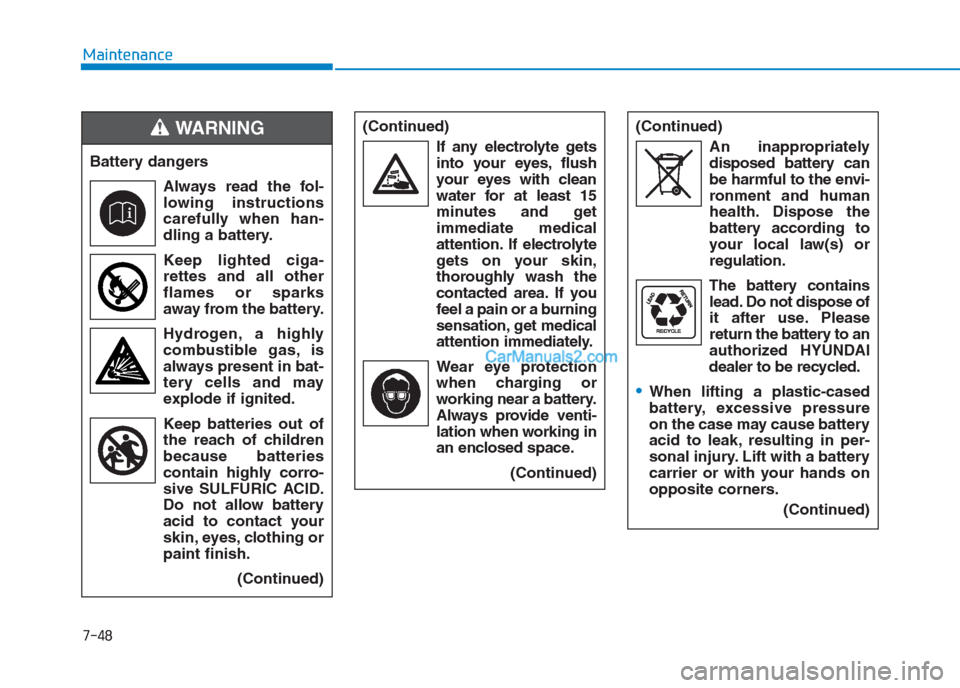
(Continued)
If any electrolyte gets
into your eyes, flush
your eyes with clean
water for at least 15
minutes and get
immediate medical
attention. If electrolyte
gets on your skin,
thoroughly wash the
contacted area. If you
feel a pain or a burning
sensation, get medical
attention immediately.
Wear eye protection
when charging or
working near a battery.
Always provide venti-
lation when working in
an enclosed space.
(Continued)
(Continued)
An inappropriately
disposed battery can
be harmful to the envi-
ronment and human
health. Dispose the
battery according to
your local law(s) or
regulation.
The battery contains
lead. Do not dispose of
it after use. Please
return the battery to an
authorized HYUNDAI
dealer to be recycled.
When lifting a plastic-cased
battery, excessive pressure
on the case may cause battery
acid to leak, resulting in per-
sonal injury. Lift with a battery
carrier or with your hands on
opposite corners.
(Continued)
Battery dangers
Always read the fol-
lowing instructions
carefully when han-
dling a battery.
Keep lighted ciga-
rettes and all other
flames or sparks
away from the battery.
Hydrogen, a highly
combustible gas, is
always present in bat-
tery cells and may
explode if ignited.
Keep batteries out of
the reach of children
because batteries
contain highly corro-
sive SULFURIC ACID.
Do not allow battery
acid to contact your
skin, eyes, clothing or
paint finish.
(Continued)
WARNING
Page 406 of 472
7-49
7
Maintenance
If you connect unauthorized elec-
tronic devices to the battery, the
battery may be discharged. Never
use unauthorized devices.
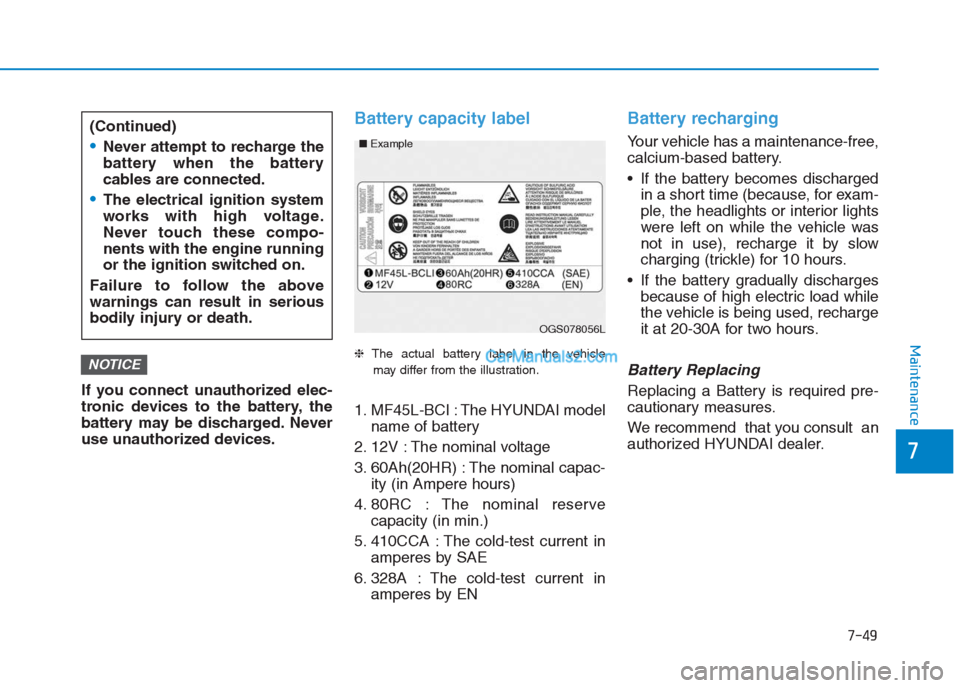
Battery capacity label
❈The actual battery label in the vehicle
may differ from the illustration.
1. MF45L-BCI : The HYUNDAI model
name of battery
2. 12V : The nominal voltage
3. 60Ah(20HR) : The nominal capac-
ity (in Ampere hours)
4. 80RC : The nominal reserve
capacity (in min.)
5. 410CCA : The cold-test current in
amperes by SAE
6. 328A : The cold-test current in
amperes by EN
Battery recharging
Your vehicle has a maintenance-free,
calcium-based battery.
If the battery becomes discharged
in a short time (because, for exam-
ple, the headlights or interior lights
were left on while the vehicle was
not in use), recharge it by slow
charging (trickle) for 10 hours.
If the battery gradually discharges
because of high electric load while
the vehicle is being used, recharge
it at 20-30A for two hours.
Battery Replacing
Replacing a Battery is required pre-
cautionary measures.
We recommend that you consult an
authorized HYUNDAI dealer.
NOTICE
(Continued)
Never attempt to recharge the
battery when the battery
cables are connected.
The electrical ignition system
works with high voltage.
Never touch these compo-
nents with the engine running
or the ignition switched on.
Failure to follow the above
warnings can result in serious
bodily injury or death.
OGS078056L ■Example
Page 413 of 472
7-56
Maintenance
Wheel replacement
When replacing the metal wheels for
any reason, make sure the new
wheels are equivalent to the original
factory units in diameter, rim width
and offset. Replacing tires
To reduce the chance or serious
or fatal injuries from an acci-
dent caused by tire failure or
loss of vehicle control:
Replace tires that are worn,
show uneven wear, or are
damaged. Worn tires can
cause loss of braking effec-
tiveness, steering control, and
traction.
Do not drive your vehicle with
too little or too much pressure
in your tires. This can lead to
uneven wear and tire failure.
When replacing tires, never
mix radial and bias-ply tires
on the same car. You must
replace all tires (including the
spare) if moving from radial to
bias-ply tires.
(Continued)
WARNING (Continued)
Using tires and wheel other
than the recommended sizes
could cause unusual handling
characteristics and poor vehi-
cle control, resulting in a seri-
ous accident.
When replacing tires (or
wheels), it is recommended to
replace the two front or two
rear tires (or wheels) as a pair.
Replacing just one tire can
seriously affect your vehicle’s
handling.
The ABS works by comparing
the speed of the wheels. Tire
size can affect wheel speed.
When replacing tires, all 4
tires must use the same size
originally supplied with the
vehicle. Using tires of a differ-
ent size can cause the ABS
(Anti-lock Brake System) and
ESC (Electronic Stability
Control) to work irregularly. (if
equipped)
A wheel that is not the correct
size may adversely affect wheel
and bearing life, braking and
stopping abilities, handling
characteristics, ground clear-
ance, body-to-tire clearance,
snow chain clearance,
speedometer and odometer cal-
ibration, headlight aim and
bumper height.
WARNING