belt Hyundai Creta 2019 Workshop Manual
[x] Cancel search | Manufacturer: HYUNDAI, Model Year: 2019, Model line: Creta, Model: Hyundai Creta 2019Pages: 472, PDF Size: 13.39 MB
Page 368 of 472
7-11
7
Maintenance
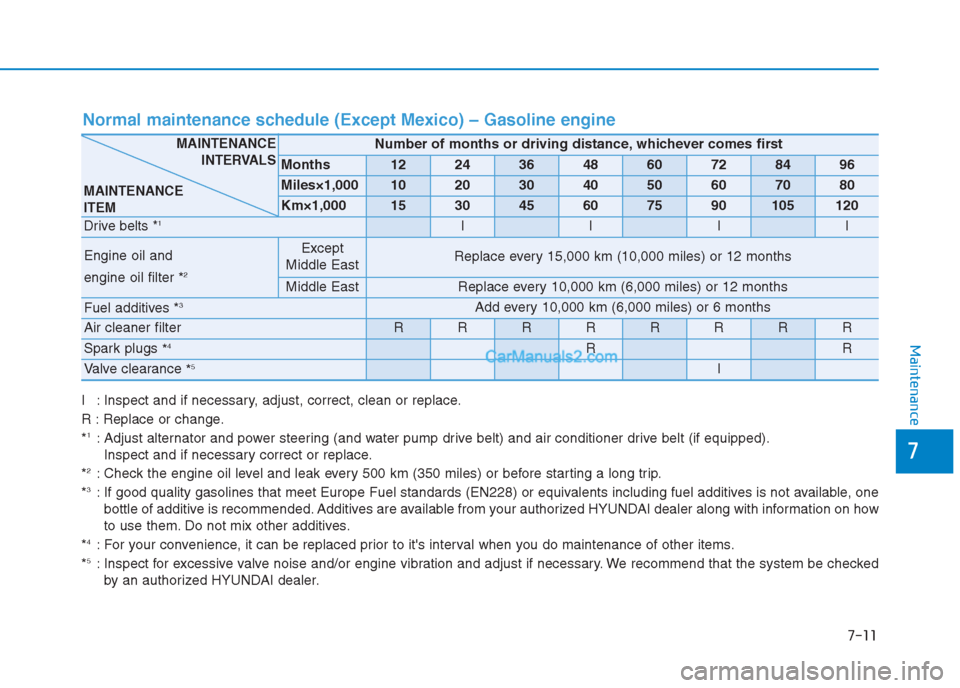
I : Inspect and if necessary, adjust, correct, clean or replace.
R : Replace or change.
*
1: Adjust alternator and power steering (and water pump drive belt) and air conditioner drive belt (if equipped).
Inspect and if necessary correct or replace.
*
2: Check the engine oil level and leak every 500 km (350 miles) or before starting a long trip.
*3: If good quality gasolines that meet Europe Fuel standards (EN228) or equivalents including fuel additives is not available, one
bottle of additive is recommended. Additives are available from your authorized HYUNDAI dealer along with information on how
to use them. Do not mix other additives.
*
4: For your convenience, it can be replaced prior to it's interval when you do maintenance of other items.
*5: Inspect for excessive valve noise and/or engine vibration and adjust if necessary. We recommend that the system be checked
by an authorized HYUNDAI dealer.
Normal maintenance schedule (Except Mexico) – Gasoline engine
Number of months or driving distance, whichever comes first
Months1224364860728496
Miles×1,0001020304050607080
Km×1,000153045607590105120
Drive belts *1IIII
Engine oil and
engine oil filter *
2
Except
Middle EastReplace every 15,000 km (10,000 miles) or 12 months
Middle EastReplace every 10,000 km (6,000 miles) or 12 months
Fuel additives *3Add every 10,000 km (6,000 miles) or 6 months
Air cleaner filterRRRRRRRR
Spark plugs
*4RR
Valve clearance
*5I
MAINTENANCE
INTERVALS
MAINTENANCE
ITEM
Page 369 of 472
7-12
Maintenance
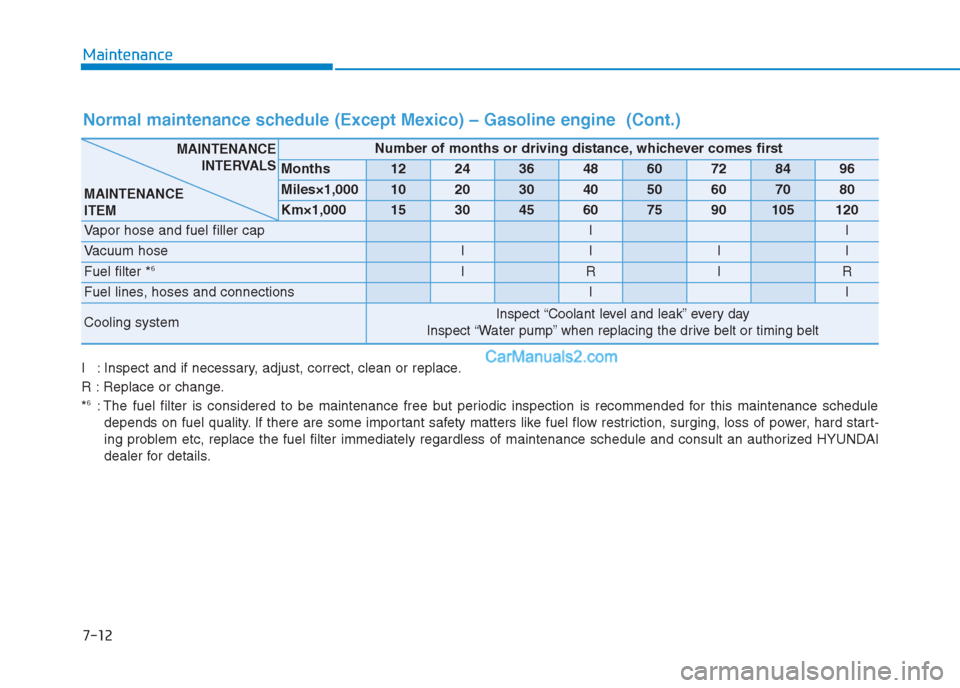
Normal maintenance schedule (Except Mexico) – Gasoline engine (Cont.)
I : Inspect and if necessary, adjust, correct, clean or replace.
R : Replace or change.
*
6: The fuel filter is considered to be maintenance free but periodic inspection is recommended for this maintenance schedule
depends on fuel quality. If there are some important safety matters like fuel flow restriction, surging, loss of power, hard start-
ing problem etc, replace the fuel filter immediately regardless of maintenance schedule and consult an authorized HYUNDAI
dealer for details.
Number of months or driving distance, whichever comes first
Months1224364860728496
Miles×1,0001020304050607080
Km×1,000153045607590105120
Vapor hose and fuel filler capII
Vacuum hoseIIII
Fuel filter *6IRIR
Fuel lines, hoses and connectionsII
Cooling systemInspect “Coolant level and leak” every day
Inspect “Water pump” when replacing the drive belt or timing belt
MAINTENANCE
INTERVALS
MAINTENANCE
ITEM
Page 374 of 472
7-17
7
Maintenance
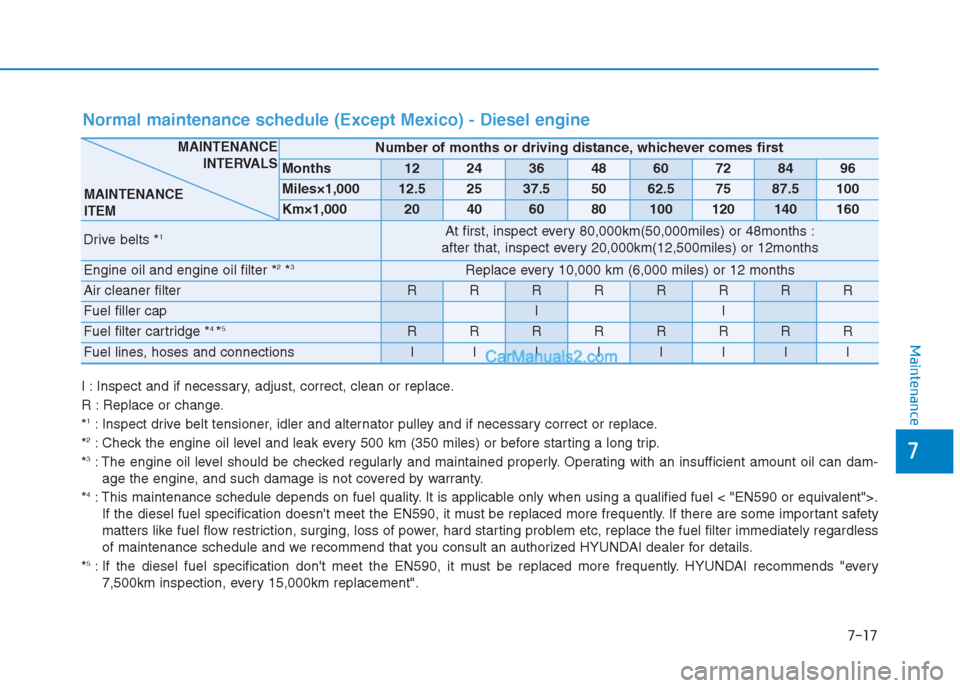
Normal maintenance schedule (Except Mexico) - Diesel engine
I : Inspect and if necessary, adjust, correct, clean or replace.
R : Replace or change.
*
1: Inspect drive belt tensioner, idler and alternator pulley and if necessary correct or replace.
*2: Check the engine oil level and leak every 500 km (350 miles) or before starting a long trip.
*3: The engine oil level should be checked regularly and maintained properly. Operating with an insufficient amount oil can dam-
age the engine, and such damage is not covered by warranty.
*
4: This maintenance schedule depends on fuel quality. It is applicable only when using a qualified fuel < "EN590 or equivalent">.
If the diesel fuel specification doesn't meet the EN590, it must be replaced more frequently. If there are some important safety
matters like fuel flow restriction, surging, loss of power, hard starting problem etc, replace the fuel filter immediately regardless
of maintenance schedule and we recommend that you consult an authorized HYUNDAI dealer for details.
*
5: If the diesel fuel specification don't meet the EN590, it must be replaced more frequently. HYUNDAI recommends "every
7,500km inspection, every 15,000km replacement".
Number of months or driving distance, whichever comes first
Months1224364860728496
Miles×1,00012.52537.55062.57587.5100
Km×1,00020406080100120140160
Drive belts *1At first, inspect every 80,000km(50,000miles) or 48months :
after that, inspect every 20,000km(12,500miles) or 12months
Engine oil and engine oil filter *2*3Replace every 10,000 km (6,000 miles) or 12 months
Air cleaner filter RRRRRRRR
Fuel filler capII
Fuel filter cartridge *4 *5RRRRRRRR
Fuel lines, hoses and connectionsIIIIIIII
MAINTENANCE
INTERVALS
MAINTENANCE
ITEM
Page 379 of 472
7-22
Maintenance
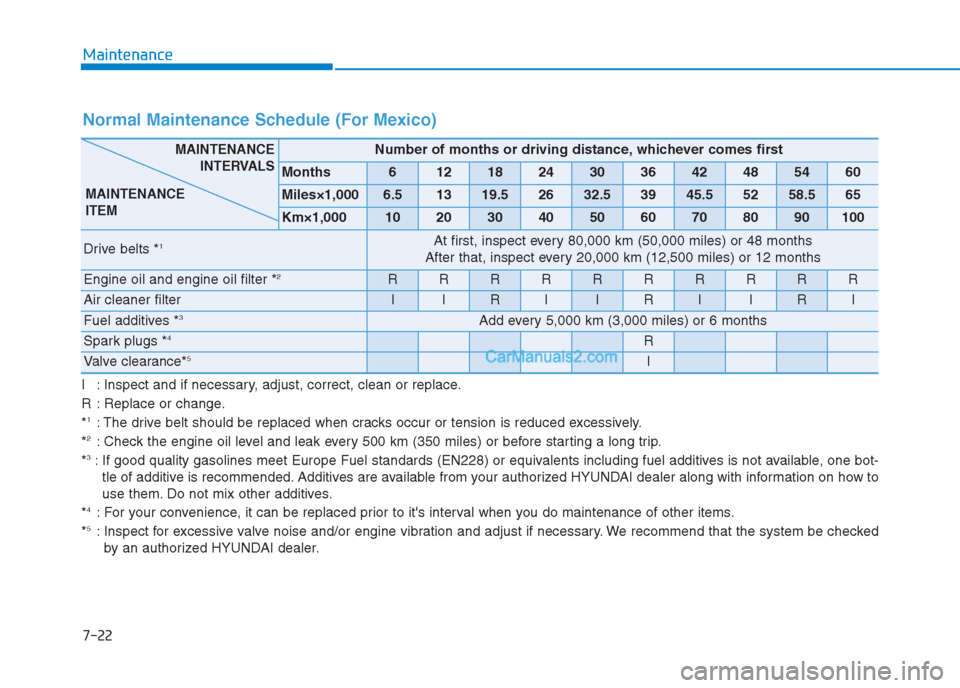
I : Inspect and if necessary, adjust, correct, clean or replace.
R : Replace or change.
*
1: The drive belt should be replaced when cracks occur or tension is reduced excessively.
*2: Check the engine oil level and leak every 500 km (350 miles) or before starting a long trip.
*3: If good quality gasolines meet Europe Fuel standards (EN228) or equivalents including fuel additives is not available, one bot-
tle of additive is recommended. Additives are available from your authorized HYUNDAI dealer along with information on how to
use them. Do not mix other additives.
*
4: For your convenience, it can be replaced prior to it's interval when you do maintenance of other items.
*5: Inspect for excessive valve noise and/or engine vibration and adjust if necessary. We recommend that the system be checked
by an authorized HYUNDAI dealer.
Normal Maintenance Schedule (For Mexico)
Number of months or driving distance, whichever comes first
Months6121824303642485460
Miles×1,0006.51319.52632.53945.55258.565
Km×1,000102030405060708090100
Drive belts *1At first, inspect every 80,000 km (50,000 miles) or 48 months
After that, inspect every 20,000 km (12,500 miles) or 12 months
Engine oil and engine oil filter *2RRRRRRRRRR
Air cleaner filterIIRIIRIIRI
Fuel additives *3Add every 5,000 km (3,000 miles) or 6 months
Spark plugs *4R
Valve clearance*5I
MAINTENANCE
INTERVALS
MAINTENANCE
ITEM
Page 380 of 472
7-23
7
Maintenance
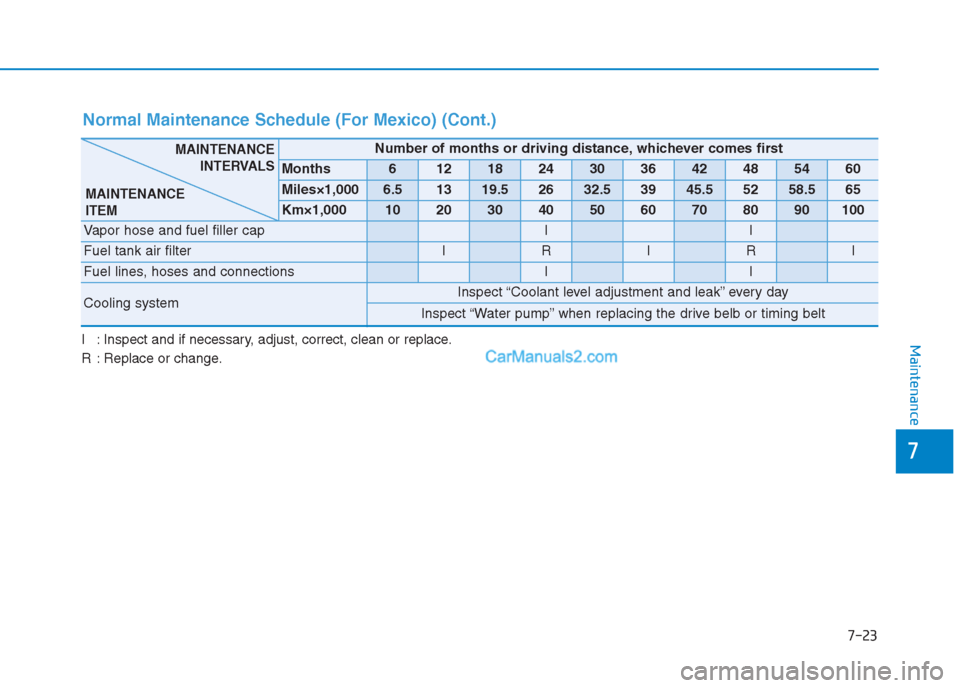
Normal Maintenance Schedule (For Mexico) (Cont.)
I : Inspect and if necessary, adjust, correct, clean or replace.
R : Replace or change.
Number of months or driving distance, whichever comes first
Months6121824303642485460
Miles×1,0006.51319.52632.53945.55258.565
Km×1,000102030405060708090100
Vapor hose and fuel filler capII
Fuel tank air filter IRIRI
Fuel lines, hoses and connectionsII
Cooling systemInspect “Coolant level adjustment and leak” every day
Inspect “Water pump” when replacing the drive belb or timing belt
MAINTENANCE
INTERVALS
MAINTENANCE
ITEM
Page 385 of 472
7-28
Maintenance
E EX
XP
PL
LA
AN
NA
AT
TI
IO
ON
N
O
OF
F
S
SC
CH
HE
ED
DU
UL
LE
ED
D
M
MA
AI
IN
NT
TE
EN
NA
AN
NC
CE
E
I
IT
TE
EM
MS
S
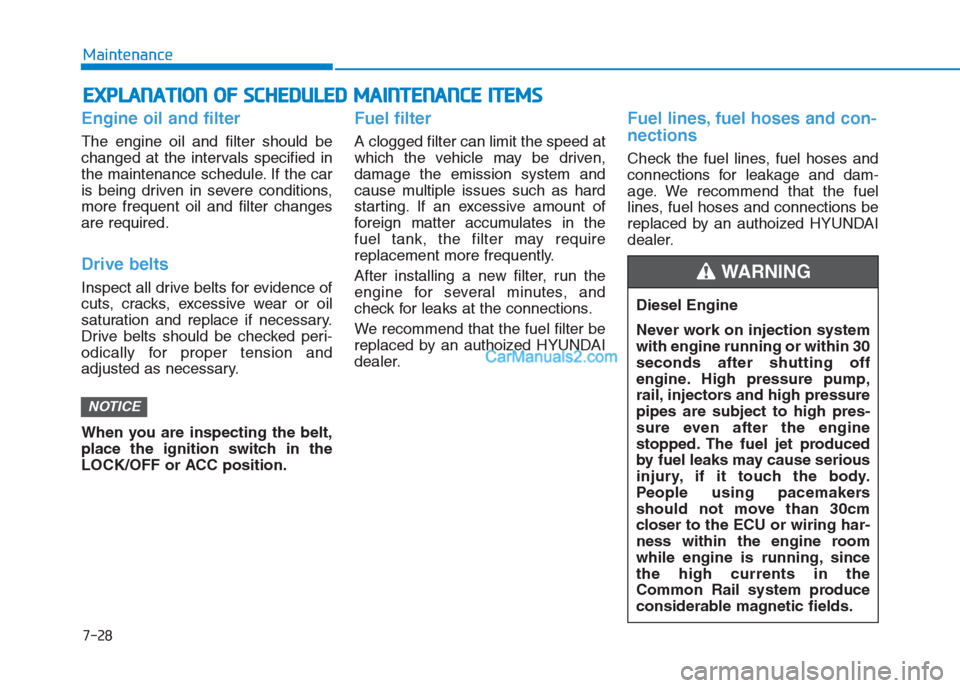
Engine oil and filter
The engine oil and filter should be
changed at the intervals specified in
the maintenance schedule. If the car
is being driven in severe conditions,
more frequent oil and filter changes
are required.
Drive belts
Inspect all drive belts for evidence of
cuts, cracks, excessive wear or oil
saturation and replace if necessary.
Drive belts should be checked peri-
odically for proper tension and
adjusted as necessary.
When you are inspecting the belt,
place the ignition switch in the
LOCK/OFF or ACC position.
Fuel filter
A clogged filter can limit the speed at
which the vehicle may be driven,
damage the emission system and
cause multiple issues such as hard
starting. If an excessive amount of
foreign matter accumulates in the
fuel tank, the filter may require
replacement more frequently.
After installing a new filter, run the
engine for several minutes, and
check for leaks at the connections.
We recommend that the fuel filter be
replaced by an authoized HYUNDAI
dealer.
Fuel lines, fuel hoses and con-
nections
Check the fuel lines, fuel hoses and
connections for leakage and dam-
age. We recommend that the fuel
lines, fuel hoses and connections be
replaced by an authoized HYUNDAI
dealer.
NOTICE
Diesel Engine
Never work on injection system
with engine running or within 30
seconds after shutting off
engine. High pressure pump,
rail, injectors and high pressure
pipes are subject to high pres-
sure even after the engine
stopped. The fuel jet produced
by fuel leaks may cause serious
injury, if it touch the body.
People using pacemakers
should not move than 30cm
closer to the ECU or wiring har-
ness within the engine room
while engine is running, since
the high currents in the
Common Rail system produce
considerable magnetic fields.
WARNING
Page 416 of 472
7-59
7
Maintenance
4. Tire ply composition and
material
The number of layers or plies of rub-
ber-coated fabric in the tire. Tire
manufacturers also must indicate the
materials in the tire, which include
steel, nylon, polyester, and others.
The letter "R" means radial ply con-
struction; the letter "D" means diago-
nal or bias ply construction; and the
letter "B" means belted-bias ply con-
struction.
5. Maximum permissible infla-
tion pressure
This number is the greatest amount
of air pressure that should be put in
the tire. Do not exceed the maximum
permissible inflation pressure. Refer
to the Tire and Loading Information
label for recommended inflation
pressure.
6. Maximum load rating
This number indicates the maximum
load in kilograms and pounds that
can be carried by the tire. When
replacing the tires on the vehicle,
always use a tire that has the same
load rating as the factory installed
tire.
7. Uniform tire quality grading
Quality grades can be found where
applicable on the tire sidewall
between tread shoulder and maxi-
mum chapter width.
For example:
TREAD wear 200
TRACTION AA
TEMPERATURE A Tire age
Tires degrade over time, even
when they are not being used.
Regardless of the remaining
tread, it is recommended that
tires generally be replaced after
six (6) years of normal service.
Heat caused by hot climates or
frequent high loading condi-
tions can accelerate the aging
process. Failure to follow this
warning could cause sudden
tire failure, which could lead to
a loss of control and an acci-
dent involving serious injury or
death.
WARNING
Page 451 of 472
7-94
Maintenance
Cleaning the upholstery and
interior trim
Vinyl
Remove dust and loose dirt from
vinyl with a whisk broom or vacuum
cleaner. Clean vinyl surfaces with a
vinyl cleaner.
Fabric
Remove dust and loose dirt from fab-
ric with a whisk broom or vacuum
cleaner. Clean with a mild soap solu-
tion recommended for upholstery or
carpets. Remove fresh spots imme-
diately with a fabric spot cleaner. If
fresh spots do not receive immediate
attention, the fabric can be stained
and its color can be affected. Also, its
fire-resistant properties can be
reduced if the material is not proper-
ly maintained.
Using anything but recommended
cleaners and procedures may
affect the fabric’s appearance and
fire-resistant properties.
Cleaning the lap/shoulder belt
webbing
Clean the belt webbing with any mild
soap solution recommended for
cleaning upholstery or carpet. Follow
the instructions provided with the
soap. Do not bleach or re-dye the
webbing because this may weaken it.
Cleaning the interior window
glass
If the interior glass surfaces of the
vehicle become fogged (that is, cov-
ered with an oily, greasy or waxy
film), they should be cleaned with
glass cleaner. Follow the directions
on the glass cleaner container.
Do not scrape or scratch the
inside of the rear window. This
may result in damage to the rear
window defroster grid.
NOTICE
NOTICE
Page 471 of 472
I-7
Scheduled maintenance service ....................................7-10
Seat belts .......................................................................2-19
Additional seat belt safety precautions .....................2-27
Care of seat belts .......................................................2-30
Pre-tensioner seat belt ...............................................2-25
Seats ...............................................................................2-2
Front seats ..................................................................2-7
Rear seats ..................................................................2-14
Special driving conditions ............................................5-48
Driving at night..........................................................5-49
Driving in flooded areas ............................................5-50
Driving in the rain .....................................................5-50
Hazardous driving conditions ....................................5-48
Highway driving ........................................................5-51
Rocking the vehicle ...................................................5-48
Smooth cornering.......................................................5-49
Steering wheel ..............................................................3-36
Electric power steering (EPS) ...................................3-36
Horn ...........................................................................3-37
Tilt steering ................................................................3-37Storage compartment ..................................................3-120
Center console storage .............................................3-120
Glove box.................................................................3-121
Sunglass holder ........................................................3-121
Sunroof .........................................................................3-24
Resetting the sunroof .................................................3-26
Sunroof open warning ...............................................3-27
Sunroof opening and closing .....................................3-25
Sunshade ....................................................................3-26
Tilting the sunroof .....................................................3-25
Tailgate .........................................................................3-33
Closing the tailgate ....................................................3-33
Emergency tailgate safety release..............................3-34
Opening the tailgate ...................................................3-33
Theft-alarm system .......................................................3-18
Tire Pressure Monitoring System (TPMS)...................6-10
Changing a tire with TPMS .......................................6-13
Low tire pressure telltale ...........................................6-11
TPMS (Tire Pressure Monitoring System)
malfunction indicator...............................................6-12
I
Index
S
T