Capacity Hyundai Elantra 2003 User Guide
[x] Cancel search | Manufacturer: HYUNDAI, Model Year: 2003, Model line: Elantra, Model: Hyundai Elantra 2003Pages: 172, PDF Size: 2.82 MB
Page 152 of 172
DO-IT-YOURSELF MAINTENANCE DO-IT-YOURSELF MAINTENANCEDO-IT-YOURSELF MAINTENANCE DO-IT-YOURSELF MAINTENANCE
DO-IT-YOURSELF MAINTENANCE
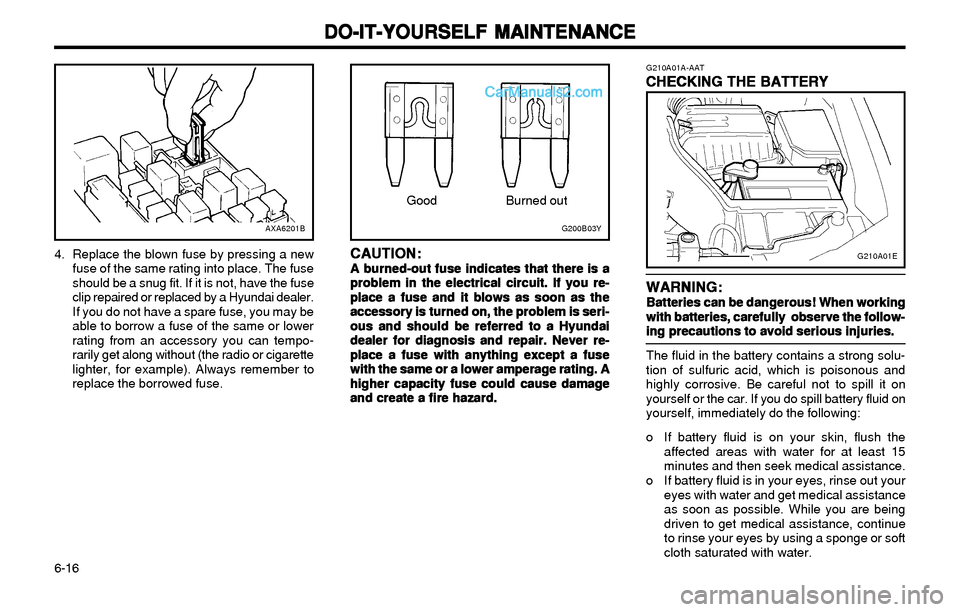
6-16 4. Replace the blown fuse by pressing a new
fuse of the same rating into place. The fuse
should be a snug fit. If it is not, have the fuse
clip repaired or replaced by a Hyundai dealer.
If you do not have a spare fuse, you may be
able to borrow a fuse of the same or lower
rating from an accessory you can tempo-
rarily get along without (the radio or cigarette
lighter, for example). Always remember to
replace the borrowed fuse.
CAUTION: CAUTION:CAUTION: CAUTION:
CAUTION:A burned-out fuse indicates that there is a A burned-out fuse indicates that there is aA burned-out fuse indicates that there is a A burned-out fuse indicates that there is a
A burned-out fuse indicates that there is a
problem in the electrical circuit. If you re- problem in the electrical circuit. If you re-problem in the electrical circuit. If you re- problem in the electrical circuit. If you re-
problem in the electrical circuit. If you re-
place a fuse and it blows as soon as the place a fuse and it blows as soon as theplace a fuse and it blows as soon as the place a fuse and it blows as soon as the
place a fuse and it blows as soon as the
accessory is turned on, the problem is seri- accessory is turned on, the problem is seri-accessory is turned on, the problem is seri- accessory is turned on, the problem is seri-
accessory is turned on, the problem is seri-
ous and should be referred to a Hyundai ous and should be referred to a Hyundaious and should be referred to a Hyundai ous and should be referred to a Hyundai
ous and should be referred to a Hyundai
dealer for diagnosis and repair. Never re- dealer for diagnosis and repair. Never re-dealer for diagnosis and repair. Never re- dealer for diagnosis and repair. Never re-
dealer for diagnosis and repair. Never re-
place a fuse with anything except a fuse place a fuse with anything except a fuseplace a fuse with anything except a fuse place a fuse with anything except a fuse
place a fuse with anything except a fuse
with the same or a lower amperage rating. A with the same or a lower amperage rating. Awith the same or a lower amperage rating. A with the same or a lower amperage rating. A
with the same or a lower amperage rating. A
higher capacity fuse could cause damage higher capacity fuse could cause damagehigher capacity fuse could cause damage higher capacity fuse could cause damage
higher capacity fuse could cause damage
and create a fire hazard. and create a fire hazard.and create a fire hazard. and create a fire hazard.
and create a fire hazard.
AXA6201B
Burned out
G200B03Y
Good
WARNING: WARNING:WARNING: WARNING:
WARNING:Batteries can be dangerous! When working Batteries can be dangerous! When workingBatteries can be dangerous! When working Batteries can be dangerous! When working
Batteries can be dangerous! When working
with batteries, carefully observe the follow- with batteries, carefully observe the follow-with batteries, carefully observe the follow- with batteries, carefully observe the follow-
with batteries, carefully observe the follow-
ing precautions to avoid serious injuries. ing precautions to avoid serious injuries.ing precautions to avoid serious injuries. ing precautions to avoid serious injuries.
ing precautions to avoid serious injuries.
The fluid in the battery contains a strong solu-
tion of sulfuric acid, which is poisonous and
highly corrosive. Be careful not to spill it on
yourself or the car. If you do spill battery fluid on
yourself, immediately do the following:
o If battery fluid is on your skin, flush the
affected areas with water for at least 15
minutes and then seek medical assistance.
o If battery fluid is in your eyes, rinse out your
eyes with water and get medical assistance
as soon as possible. While you are being
driven to get medical assistance, continue
to rinse your eyes by using a sponge or soft
cloth saturated with water.
G210A01A-AAT
CHECKING THE BATTERY CHECKING THE BATTERYCHECKING THE BATTERY CHECKING THE BATTERY
CHECKING THE BATTERY
G210A01E
Page 160 of 172
CONSUMER INFORMATION & REPORTING SAFETY DEFECTS CONSUMER INFORMATION & REPORTING SAFETY DEFECTSCONSUMER INFORMATION & REPORTING SAFETY DEFECTS CONSUMER INFORMATION & REPORTING SAFETY DEFECTS
CONSUMER INFORMATION & REPORTING SAFETY DEFECTS
8-2 o Lower-than-recommended tire pressures
cause uneven tread wear and poor han-
dling.
o Higher-than-recommended tire pressures
increase the chance of damage from im-
pacts and cause uneven tread wear.
CAUTION: CAUTION:CAUTION: CAUTION:
CAUTION:Always observe the following: Always observe the following:Always observe the following: Always observe the following:
Always observe the following:
o oo o
o
Check pressures when the tires are cold. That Check pressures when the tires are cold. ThatCheck pressures when the tires are cold. That Check pressures when the tires are cold. That
Check pressures when the tires are cold. That
is, after the car has been parked for at least is, after the car has been parked for at leastis, after the car has been parked for at least is, after the car has been parked for at least
is, after the car has been parked for at least
three hours and hasn't been driven more than three hours and hasn't been driven more thanthree hours and hasn't been driven more than three hours and hasn't been driven more than
three hours and hasn't been driven more than
one mile or 1.6 km since starting up. one mile or 1.6 km since starting up.one mile or 1.6 km since starting up. one mile or 1.6 km since starting up.
one mile or 1.6 km since starting up.
o oo o
o
Check the pressure of your spare tire each Check the pressure of your spare tire eachCheck the pressure of your spare tire each Check the pressure of your spare tire each
Check the pressure of your spare tire each
time you check the pressure of other tires. time you check the pressure of other tires.time you check the pressure of other tires. time you check the pressure of other tires.
time you check the pressure of other tires.
o oo o
o
Never overload your car. Be especially Never overload your car. Be especiallyNever overload your car. Be especially Never overload your car. Be especially
Never overload your car. Be especially
careful about overloading if you equip your careful about overloading if you equip yourcareful about overloading if you equip your careful about overloading if you equip your
careful about overloading if you equip your
car with a luggage rack or car top carrier. car with a luggage rack or car top carrier.car with a luggage rack or car top carrier. car with a luggage rack or car top carrier.
car with a luggage rack or car top carrier.
I040A01S-AAT
SNOW TIRES SNOW TIRESSNOW TIRES SNOW TIRES
SNOW TIRESIf you equip your car with snow tires, they
should be the same size and have the same
load capacity as the original tires. Snow tires
should be installed on all four wheels; other-
wise, poor handling may result.
Snow tires should carry 4 psi (28 kPa) more air
pressure than the pressure recommended for
the standard tires on the tire label on the driver
side center pillar outer panel, or up to the
maximum pressure shown on the tire sidewall
whichever is less.
Do not drive faster than 75 mph (120 km/h)
when your car is equipped with snow tires.
I050A01S-AAT
TIRE CHAINS TIRE CHAINSTIRE CHAINS TIRE CHAINS
TIRE CHAINSTire chains, if necessary, should be installed on
the front wheels. Be sure that the chains are the
proper size and that they are installed in accor-
dance with the manufacturer's instructions.
To minimize tire and chain wear, do not con-
tinue to use tire chains when they are no longer
needed.
WARNING: WARNING:WARNING: WARNING:
WARNING:When driving on roads covered with snow When driving on roads covered with snowWhen driving on roads covered with snow When driving on roads covered with snow
When driving on roads covered with snow
or ice, drive at less than 20 mph (30 km/h). or ice, drive at less than 20 mph (30 km/h).or ice, drive at less than 20 mph (30 km/h). or ice, drive at less than 20 mph (30 km/h).
or ice, drive at less than 20 mph (30 km/h).
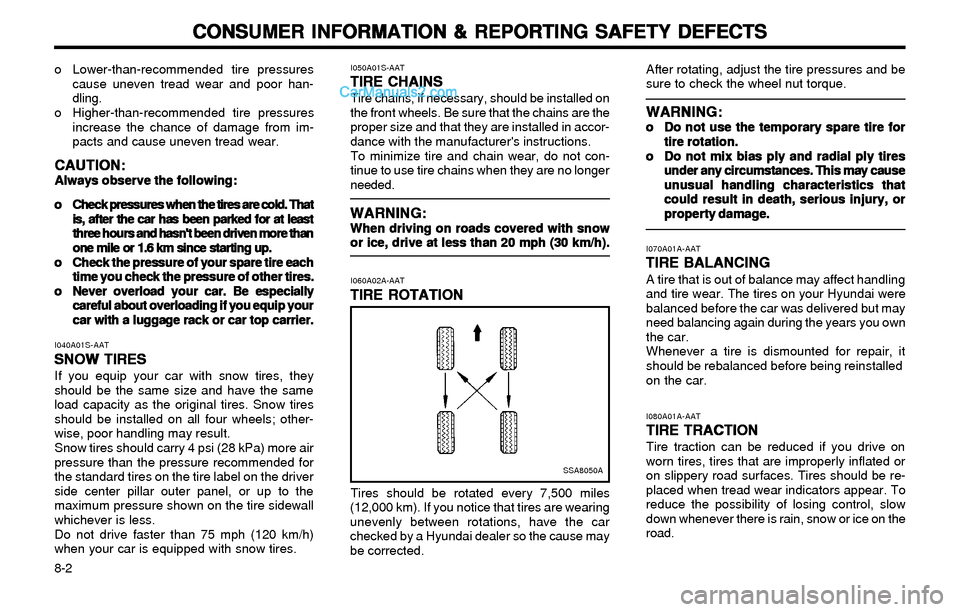
I060A02A-AAT
TIRE ROTATION TIRE ROTATIONTIRE ROTATION TIRE ROTATION
TIRE ROTATION
Tires should be rotated every 7,500 miles
(12,000 km). If you notice that tires are wearing
unevenly between rotations, have the car
checked by a Hyundai dealer so the cause may
be corrected.
SSA8050A
After rotating, adjust the tire pressures and be
sure to check the wheel nut torque.
WARNING: WARNING:WARNING: WARNING:
WARNING:o oo o
o
Do not use the temporary spare tire for Do not use the temporary spare tire forDo not use the temporary spare tire for Do not use the temporary spare tire for
Do not use the temporary spare tire for
tire rotation. tire rotation.tire rotation. tire rotation.
tire rotation.
o oo o
o
Do not mix bias ply and radial ply tires Do not mix bias ply and radial ply tiresDo not mix bias ply and radial ply tires Do not mix bias ply and radial ply tires
Do not mix bias ply and radial ply tires
under any circumstances. This may cause under any circumstances. This may causeunder any circumstances. This may cause under any circumstances. This may cause
under any circumstances. This may cause
unusual handling characteristics that unusual handling characteristics thatunusual handling characteristics that unusual handling characteristics that
unusual handling characteristics that
could result in death, serious injury, or could result in death, serious injury, orcould result in death, serious injury, or could result in death, serious injury, or
could result in death, serious injury, or
property damage. property damage.property damage. property damage.
property damage.
I070A01A-AAT
TIRE BALANCING TIRE BALANCINGTIRE BALANCING TIRE BALANCING
TIRE BALANCINGA tire that is out of balance may affect handling
and tire wear. The tires on your Hyundai were
balanced before the car was delivered but may
need balancing again during the years you own
the car.
Whenever a tire is dismounted for repair, it
should be rebalanced before being reinstalled
on the car.
I080A01A-AAT
TIRE TRACTION TIRE TRACTIONTIRE TRACTION TIRE TRACTION
TIRE TRACTIONTire traction can be reduced if you drive on
worn tires, tires that are improperly inflated or
on slippery road surfaces. Tires should be re-
placed when tread wear indicators appear. To
reduce the possibility of losing control, slow
down whenever there is rain, snow or ice on the
road.
Page 165 of 172
VEHICLE SPECIFICATIONS VEHICLE SPECIFICATIONSVEHICLE SPECIFICATIONS VEHICLE SPECIFICATIONS
VEHICLE SPECIFICATIONS
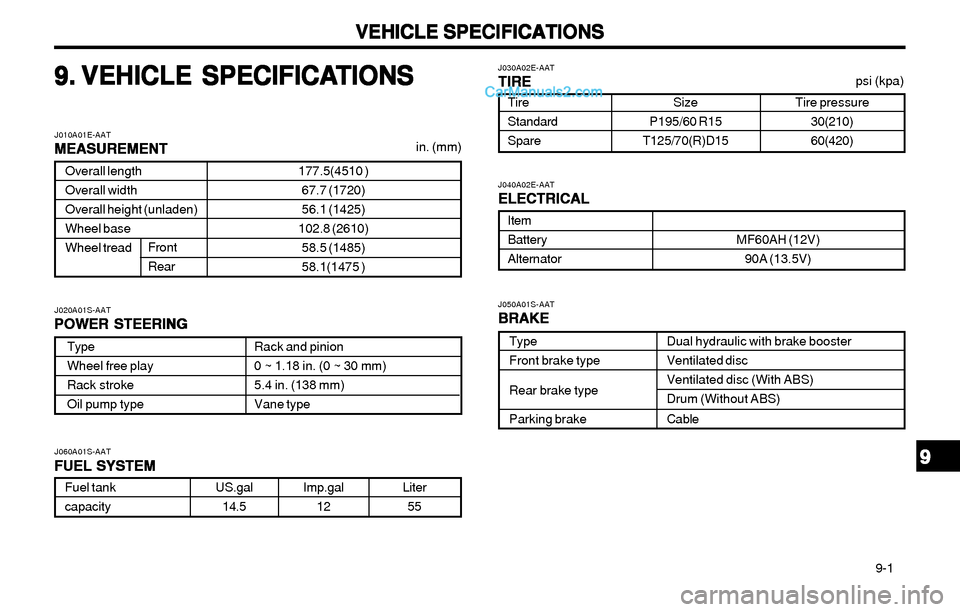
9-1 Liter
55
Item
Battery
Alternator
9. 9.9. 9.
9.
VEHICLE SPECIFICA VEHICLE SPECIFICAVEHICLE SPECIFICA VEHICLE SPECIFICA
VEHICLE SPECIFICA
TIONS TIONSTIONS TIONS
TIONS
Rack and pinion
0 ~ 1.18 in. (0 ~ 30 mm)
5.4 in. (138 mm)
Vane type
in. (mm)
9 99 9
9
Overall length
Overall width
Overall height (unladen)
Wheel base
Wheel tread
J010A01E-AAT
MEASUREMENT MEASUREMENTMEASUREMENT MEASUREMENT
MEASUREMENT
177.5(4510 )
67.7 (1720)
56.1 (1425)
102.8 (2610)
58.5 (1485)
58.1(1475 ) Front
Rear
J020A01S-AAT
POWER STEERING POWER STEERINGPOWER STEERING POWER STEERING
POWER STEERING
Type
Wheel free play
Rack stroke
Oil pump type
J060A01S-AAT
FUEL SYSTEM FUEL SYSTEMFUEL SYSTEM FUEL SYSTEM
FUEL SYSTEM
Fuel tank
capacityUS.gal
14.5Imp.gal
12
J040A02E-AAT
ELECTRICAL ELECTRICALELECTRICAL ELECTRICAL
ELECTRICAL
MF60AH (12V)
90A (13.5V)
J050A01S-AAT
BRAKE BRAKEBRAKE BRAKE
BRAKE
Type
Front brake type
Rear brake type
Parking brakeDual hydraulic with brake booster
Ventilated disc
Ventilated disc (With ABS)
Drum (Without ABS)
Cable Tire
Standard
Spare
Size
P195/60 R15
T125/70(R)D15
J030A02E-AAT
TIRE TIRETIRE TIRE
TIRE
Tire pressure
30(210)
60(420)
psi (kpa)
Page 169 of 172
INDEX INDEXINDEX INDEX
INDEX
10-2Driving
Economical driving ............................................................... 2-9 ~ 2-10
Smooth cornering ..........................................................................2-10
Winter driving ................................................................................2-10
E EE E
E
Emissions Control Systems ................................................................ 7-1
Engine
Before starting the engine ............................................................... 2-2
Compartment.......................................................................... 6-1 ~ 6-2
Coolant............................................................................................ 6-5
Coolant temperature gauge ...........................................................1-33
If the engine overheats ................................................................... 3-2
Number............................................................................................ 8-1
Oil .................................................................................................... 6-3
Starting ............................................................................................ 2-3
Engine Exhaust Can Be Dangerous ................................................... 2-1
F FF F
F
Floor Mat Anchor ..............................................................................1-49
Front Fog Light Switch ......................................................................1-36
Front Seats
Adjustable front seats ..................................................................... 1-7
Adjustable headrests ....................................................................... 1-8
Adjusting seatback angle ................................................................ 1-7
Adjusting seat forward and rearward .............................................. 1-7
Lumbar support control ................................................................... 1-8
Seat cushion height adjustment ...................................................... 1-8
Fuel
Capacity .......................................................................................... 9-1
Gauge............................................................................................1-32
Recommendations........................................................................... 1-1
Fuel Filler Lid
Remote release .............................................................................1-49Fuses ................................................................................................6-15
G GG G
G
General Everyday Checks .................................................................. 6-3
Glove box ..........................................................................................1-44
H HH H
H
Hazard Warning System ...................................................................1-39
Headlight Aiming Adjustment ................................................. 6-18 ~ 6-19
Headlight Bulb ...................................................................................6-18
Heating and Ventilation
Air flow control ..............................................................................1-55
Air intake control ...........................................................................1-55
Bi-level heating ..............................................................................1-56
Fan speed control .........................................................................1-54
Heating controls ............................................................................1-56
Temperature control ......................................................................1-56
High-mounted Rear Stoplight ............................................................1-47
Hood Release ...................................................................................1-48
Horn ..................................................................................................1-52
I II I
I
Ignition Switch ..................................................................................... 2-2
Illuminated Ignition Switch ................................................................... 1-2
Instrument Cluster and Indicator ............................................ 1-28 ~ 1-29
Instrument Panel Light Control .........................................................1-40
Instruments and Controls ..................................................................1-27
Interior Light
Interior light ...................................................................................1-44
Map light ........................................................................................1-43
Intermittent Wiper ..............................................................................1-38
J JJ J
J
Jump Starting ...................................................................................... 3-1
Page 172 of 172
Seoul Korea
Printing: JAN. 24, 2003
Publication No.: A2DO-EU31P
Printed in Korea
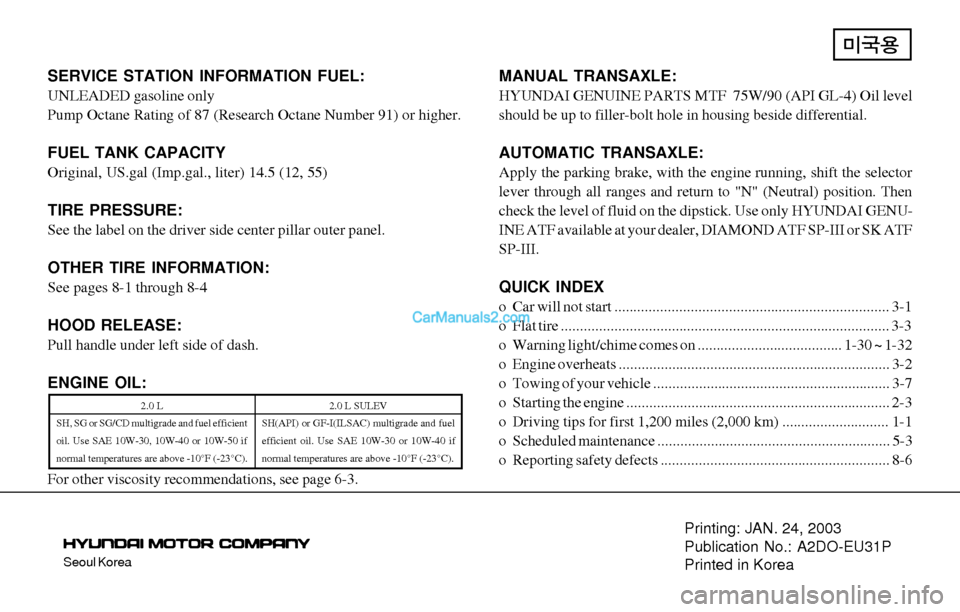
SERVICE STATION INFORMATION FUEL:
UNLEADED gasoline only
Pump Octane Rating of 87 (Research Octane Number 91) or higher.
FUEL TANK CAPACITY
Original, US.gal (Imp.gal., liter) 14.5 (12, 55)
TIRE PRESSURE:
See the label on the driver side center pillar outer panel.
OTHER TIRE INFORMATION:
See pages 8-1 through 8-4
HOOD RELEASE:
Pull handle under left side of dash.
ENGINE OIL:
For other viscosity recommendations, see page 6-3.
MANUAL TRANSAXLE:
HYUNDAI GENUINE PARTS MTF 75W/90 (API GL-4) Oil level
should be up to filler-bolt hole in housing beside differential.
AUTOMATIC TRANSAXLE:
Apply the parking brake, with the engine running, shift the selector
lever through all ranges and return to "N" (Neutral) position. Then
check the level of fluid on the dipstick. Use only HYUNDAI GENU-
INE ATF available at your dealer, DIAMOND ATF SP-III or SK ATF
SP-III.
QUICK INDEX
o Car will not start ........................................................................ 3-1
o Flat tire ...................................................................................... 3-3
o Warning light/chime comes on ...................................... 1-30 ~ 1-32
o Engine overheats ....................................................................... 3-2
o Towing of your vehicle .............................................................. 3-7
o Starting the engine ..................................................................... 2-3
o Driving tips for first 1,200 miles (2,000 km) ............................ 1-1
o Scheduled maintenance ............................................................. 5-3
o Reporting safety defects ............................................................ 8-6
2.0 L
SH, SG or SG/CD multigrade and fuel efficient
oil. Use SAE 10W-30, 10W-40 or 10W-50 if
normal temperatures are above -10°F (-23°C).2.0 L SULEV
SH(API) or GF-I(ILSAC) multigrade and fuel
efficient oil. Use SAE 10W-30 or 10W-40 if
normal temperatures are above -10°F (-23°C).