lights Hyundai Elantra 2003 User Guide
[x] Cancel search | Manufacturer: HYUNDAI, Model Year: 2003, Model line: Elantra, Model: Hyundai Elantra 2003Pages: 172, PDF Size: 2.82 MB
Page 104 of 172
DRIVING YOUR HYUNDAI DRIVING YOUR HYUNDAIDRIVING YOUR HYUNDAI DRIVING YOUR HYUNDAI
DRIVING YOUR HYUNDAI
2- 3
C070C01E-1
o oo o
o
"LOCK" "LOCK""LOCK" "LOCK"
"LOCK"The key can be removed or inserted in this
position. To protect against theft, the steering
wheel locks by removing the key.
NOTE: NOTE:NOTE: NOTE:
NOTE:To unlock the steering wheel, insert the key, To unlock the steering wheel, insert the key,To unlock the steering wheel, insert the key, To unlock the steering wheel, insert the key,
To unlock the steering wheel, insert the key,
and then turn the steering wheel and key and then turn the steering wheel and keyand then turn the steering wheel and key and then turn the steering wheel and key
and then turn the steering wheel and key
simultaneously. simultaneously.simultaneously. simultaneously.
simultaneously.
C070C01A-AAT
To Remove the Ignition Key To Remove the Ignition KeyTo Remove the Ignition Key To Remove the Ignition Key
To Remove the Ignition Key
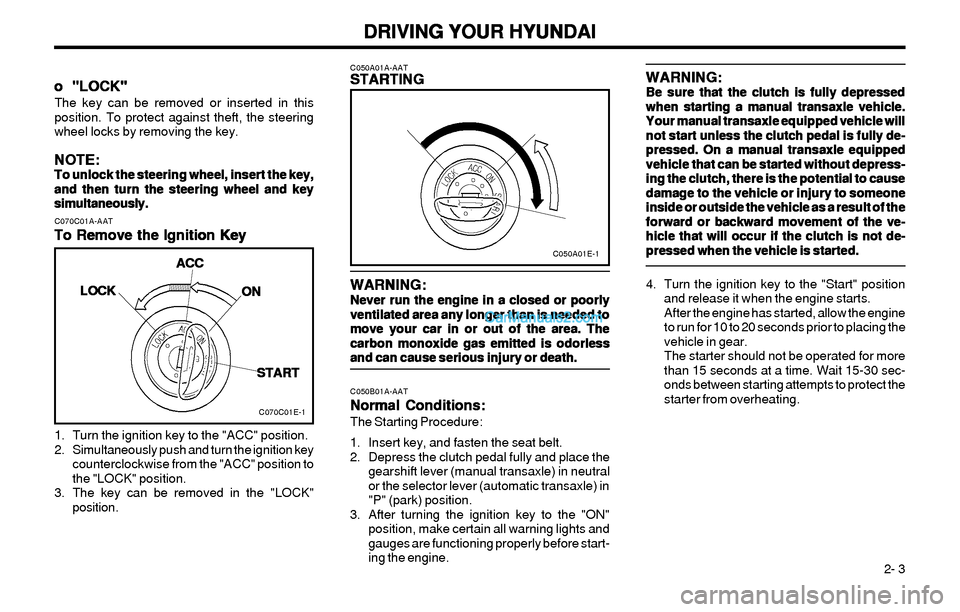
1. Turn the ignition key to the "ACC" position.
2. Simultaneously push and turn the ignition key
counterclockwise from the "ACC" position to
the "LOCK" position.
3. The key can be removed in the "LOCK"
position.
C050A01A-AATSTARTING STARTINGSTARTING STARTING
STARTING
WARNING: WARNING:WARNING: WARNING:
WARNING:
Never run the engine in a closed or poorly Never run the engine in a closed or poorlyNever run the engine in a closed or poorly Never run the engine in a closed or poorly
Never run the engine in a closed or poorly
ventilated area any longer than is needed to ventilated area any longer than is needed toventilated area any longer than is needed to ventilated area any longer than is needed to
ventilated area any longer than is needed to
move your car in or out of the area. The move your car in or out of the area. Themove your car in or out of the area. The move your car in or out of the area. The
move your car in or out of the area. The
carbon monoxide gas emitted is odorless carbon monoxide gas emitted is odorlesscarbon monoxide gas emitted is odorless carbon monoxide gas emitted is odorless
carbon monoxide gas emitted is odorless
and can cause serious injury or death. and can cause serious injury or death.and can cause serious injury or death. and can cause serious injury or death.
and can cause serious injury or death.
WARNING: WARNING:WARNING: WARNING:
WARNING:Be sure that the clutch is fully depressed Be sure that the clutch is fully depressedBe sure that the clutch is fully depressed Be sure that the clutch is fully depressed
Be sure that the clutch is fully depressed
when starting a manual transaxle vehicle. when starting a manual transaxle vehicle.when starting a manual transaxle vehicle. when starting a manual transaxle vehicle.
when starting a manual transaxle vehicle.
Your manual transaxle equipped vehicle will Your manual transaxle equipped vehicle willYour manual transaxle equipped vehicle will Your manual transaxle equipped vehicle will
Your manual transaxle equipped vehicle will
not start unless the clutch pedal is fully de- not start unless the clutch pedal is fully de-not start unless the clutch pedal is fully de- not start unless the clutch pedal is fully de-
not start unless the clutch pedal is fully de-
pressed. On a manual transaxle equipped pressed. On a manual transaxle equippedpressed. On a manual transaxle equipped pressed. On a manual transaxle equipped
pressed. On a manual transaxle equipped
vehicle that can be started without depress- vehicle that can be started without depress-vehicle that can be started without depress- vehicle that can be started without depress-
vehicle that can be started without depress-
ing the clutch, there is the potential to cause ing the clutch, there is the potential to causeing the clutch, there is the potential to cause ing the clutch, there is the potential to cause
ing the clutch, there is the potential to cause
damage to the vehicle or injury to someone damage to the vehicle or injury to someonedamage to the vehicle or injury to someone damage to the vehicle or injury to someone
damage to the vehicle or injury to someone
inside or outside the vehicle as a result of the inside or outside the vehicle as a result of theinside or outside the vehicle as a result of the inside or outside the vehicle as a result of the
inside or outside the vehicle as a result of the
forward or backward movement of the ve- forward or backward movement of the ve-forward or backward movement of the ve- forward or backward movement of the ve-
forward or backward movement of the ve-
hicle that will occur if the clutch is not de- hicle that will occur if the clutch is not de-hicle that will occur if the clutch is not de- hicle that will occur if the clutch is not de-
hicle that will occur if the clutch is not de-
pressed when the vehicle is started. pressed when the vehicle is started.pressed when the vehicle is started. pressed when the vehicle is started.
pressed when the vehicle is started.
4. Turn the ignition key to the "Start" position
and release it when the engine starts.
After the engine has started, allow the engine
to run for 10 to 20 seconds prior to placing the
vehicle in gear.
The starter should not be operated for more
than 15 seconds at a time. Wait 15-30 sec-
onds between starting attempts to protect the
starter from overheating.
C050A01E-1
C050B01A-AAT
Normal Conditions: Normal Conditions:Normal Conditions: Normal Conditions:
Normal Conditions:The Starting Procedure:
1. Insert key, and fasten the seat belt.
2. Depress the clutch pedal fully and place the
gearshift lever (manual transaxle) in neutral
or the selector lever (automatic transaxle) in
"P" (park) position.
3. After turning the ignition key to the "ON"
position, make certain all warning lights and
gauges are functioning properly before start-
ing the engine.
LOCK LOCKLOCK LOCK
LOCKACC ACCACC ACC
ACC
ON ONON ON
ON
START STARTSTART START
START
Page 110 of 172
DRIVING YOUR HYUNDAI DRIVING YOUR HYUNDAIDRIVING YOUR HYUNDAI DRIVING YOUR HYUNDAI
DRIVING YOUR HYUNDAI
2- 9
C300B01E-GAT
TCS ON/OFF Mode TCS ON/OFF ModeTCS ON/OFF Mode TCS ON/OFF Mode
TCS ON/OFF ModeIn the TCS ON mode, the indicator in the instru-
ment cluster will not be illuminated.
To switch the TCS OFF mode, press the TCS
switch . And the SLIP control will be deactivated
and the TCS indicator in the instrument cluster
will be illuminated.
SLIP Control SLIP ControlSLIP Control SLIP Control
SLIP ControlLimits the drive wheels from spinning exces-
sively during starting or while making accelerat-
ed turns on slippery roads to avoid losing the
driving force of the front wheels.
Driving hints Driving hintsDriving hints Driving hints
Driving hintsTCS does not actively apply brakes. Be sure to
decelerate the car sufficiently before entering
curves.
CAUTION: CAUTION:CAUTION: CAUTION:
CAUTION:When the TCS indicator blinks, SLIP control When the TCS indicator blinks, SLIP controlWhen the TCS indicator blinks, SLIP control When the TCS indicator blinks, SLIP control
When the TCS indicator blinks, SLIP control
has been activated. It also means that the has been activated. It also means that thehas been activated. It also means that the has been activated. It also means that the
has been activated. It also means that the
road is slippery or your car is accelerating road is slippery or your car is acceleratingroad is slippery or your car is accelerating road is slippery or your car is accelerating
road is slippery or your car is accelerating
excessively. In this situation, release foot excessively. In this situation, release footexcessively. In this situation, release foot excessively. In this situation, release foot
excessively. In this situation, release foot
pressure from the accelerator pedal and main- pressure from the accelerator pedal and main-pressure from the accelerator pedal and main- pressure from the accelerator pedal and main-
pressure from the accelerator pedal and main-
tain moderate speed. tain moderate speed.tain moderate speed. tain moderate speed.
tain moderate speed.
WARNING: WARNING:WARNING: WARNING:
WARNING:Traction control is only a driving aid; all Traction control is only a driving aid; allTraction control is only a driving aid; all Traction control is only a driving aid; all
Traction control is only a driving aid; all
normal precautions for driving in inclement normal precautions for driving in inclementnormal precautions for driving in inclement normal precautions for driving in inclement
normal precautions for driving in inclement
weather and on slippery driving surfaces weather and on slippery driving surfacesweather and on slippery driving surfaces weather and on slippery driving surfaces
weather and on slippery driving surfaces
should be observed. should be observed.should be observed. should be observed.
should be observed.
C300D02L-GAT
Indicator and Warning Indicator and WarningIndicator and Warning Indicator and Warning
Indicator and WarningThe indicator should illuminate when the ignition
key is turned to "ON" or "START", but should go
out after three seconds.
If the indicator does not illuminate, have it checked
by an authorized Hyundai dealer.
Should there be any unusual conditions in the
device, TCS illuminates as a warning.
If TCS illuminates, pull your car to a safe place
and stop the engine.
Then, start the engine again to check if the TCS
indicator goes out.
If the indicator remains lit even after the engine
has been started, have your car checked by an
authorized Hyundai dealer.
NOTE: NOTE:NOTE: NOTE:
NOTE:1) 1)1) 1)
1)
Turn off the engine. Then restart the en- Turn off the engine. Then restart the en-Turn off the engine. Then restart the en- Turn off the engine. Then restart the en-
Turn off the engine. Then restart the en-
gine, and the TCS mode will automatically gine, and the TCS mode will automaticallygine, and the TCS mode will automatically gine, and the TCS mode will automatically
gine, and the TCS mode will automatically
turn "ON". turn "ON".turn "ON". turn "ON".
turn "ON".
2) 2)2) 2)
2)
When the traction control is operating When the traction control is operatingWhen the traction control is operating When the traction control is operating
When the traction control is operating
properly, you can feel a slight pulsation in properly, you can feel a slight pulsation inproperly, you can feel a slight pulsation in properly, you can feel a slight pulsation in
properly, you can feel a slight pulsation in
the vehicle. This is only the effect of brake the vehicle. This is only the effect of brakethe vehicle. This is only the effect of brake the vehicle. This is only the effect of brake
the vehicle. This is only the effect of brake
control and indicates nothing unusual. control and indicates nothing unusual.control and indicates nothing unusual. control and indicates nothing unusual.
control and indicates nothing unusual.
3) 3)3) 3)
3)
When the engine starts, a click is heard When the engine starts, a click is heardWhen the engine starts, a click is heard When the engine starts, a click is heard
When the engine starts, a click is heard
from the engine compartment; however, from the engine compartment; however,from the engine compartment; however, from the engine compartment; however,
from the engine compartment; however,
this is only the sound of traction control this is only the sound of traction controlthis is only the sound of traction control this is only the sound of traction control
this is only the sound of traction control
being checked. being checked.being checked. being checked.
being checked.
4) 4)4) 4)
4)
When moving out of the mud or fresh When moving out of the mud or freshWhen moving out of the mud or fresh When moving out of the mud or fresh
When moving out of the mud or fresh
snow, pressing the accelerator pedal may snow, pressing the accelerator pedal maysnow, pressing the accelerator pedal may snow, pressing the accelerator pedal may
snow, pressing the accelerator pedal may
not cause the engine speed to increase. not cause the engine speed to increase.not cause the engine speed to increase. not cause the engine speed to increase.
not cause the engine speed to increase.NOTE: NOTE:NOTE: NOTE:
NOTE:1) 1)1) 1)
1)
When TCS illuminates, traction control is When TCS illuminates, traction control isWhen TCS illuminates, traction control is When TCS illuminates, traction control is
When TCS illuminates, traction control is
automatically deactivated for safety. automatically deactivated for safety.automatically deactivated for safety. automatically deactivated for safety.
automatically deactivated for safety.
2) 2)2) 2)
2)
This warning function is not provided when This warning function is not provided whenThis warning function is not provided when This warning function is not provided when
This warning function is not provided when
the driver selects the TCS-OFF mode. the driver selects the TCS-OFF mode.the driver selects the TCS-OFF mode. the driver selects the TCS-OFF mode.
the driver selects the TCS-OFF mode.
C140A01A-AAT
DRIVING FOR ECONOMY DRIVING FOR ECONOMYDRIVING FOR ECONOMY DRIVING FOR ECONOMY
DRIVING FOR ECONOMYYou can save fuel and get more miles from your
car if you follow these suggestions:
o Drive smoothly. Accelerate at a moderate
rate. Don't make "jack-rabbit" starts or full-
throttle shifts and maintain a steady cruising
speed. Don't race between stoplights. Try to
adjust your speed to that of the other traffic so
you don't have to change speeds unneces-
sarily. Avoid heavy traffic whenever possible.
Always maintain a safe distance from other
vehicles so you can avoid unnecessary brak-
ing. This also reduces brake wear.
o Drive at a moderate speed. The faster you
drive, the more fuel your car uses. Driving at
a moderate speed, especially on the high-
way, is one of the most effective ways to
reduce fuel consumption.
o Don't "ride" the brake or clutch pedal. This
can increase fuel consumption and also in-
crease wear on these components. In addi-
tion, driving with your foot resting on the brake
pedal may cause the brakes to overheat,
which reduces their effectiveness and may
lead to more serious consequences.
Page 113 of 172
DRIVING YOUR HYUNDAI DRIVING YOUR HYUNDAIDRIVING YOUR HYUNDAI DRIVING YOUR HYUNDAI
DRIVING YOUR HYUNDAI
2- 12
CAUTION: CAUTION:CAUTION: CAUTION:
CAUTION:Do not do any towing with your car during its Do not do any towing with your car during itsDo not do any towing with your car during its Do not do any towing with your car during its
Do not do any towing with your car during its
first 1,200 miles (2,000 km) in order to allow first 1,200 miles (2,000 km) in order to allowfirst 1,200 miles (2,000 km) in order to allow first 1,200 miles (2,000 km) in order to allow
first 1,200 miles (2,000 km) in order to allow
the engine to properly break in. Failure to the engine to properly break in. Failure tothe engine to properly break in. Failure to the engine to properly break in. Failure to
the engine to properly break in. Failure to
heed this caution may result in serious en- heed this caution may result in serious en-heed this caution may result in serious en- heed this caution may result in serious en-
heed this caution may result in serious en-
gine or transaxle damage. gine or transaxle damage.gine or transaxle damage. gine or transaxle damage.
gine or transaxle damage.
C190B01S-AAT
Trailer Hitches Trailer HitchesTrailer Hitches Trailer Hitches
Trailer HitchesSelect the proper hitch and ball combination,
making sure that it's location is compatible with
that of the trailer or vehicle being towed.
Use a quality non-equalizing hitch which distrib-
utes the tongue load uniformly throughout the
chassis.
The hitch should be bolted securely to the car
and installed by a qualified technician. DO NOT
USE A HITCH DESIGNED FOR TEMPORARY
INSTALLATION AND NEVER USE ONE THAT
ATTACHES ONLY TO THE BUMPER.
C190C03S-AAT
Trailer Brakes Trailer BrakesTrailer Brakes Trailer Brakes
Trailer BrakesIf your trailer is equipped with a braking system,
make sure it conforms to federal and/or local
regulations and that it is properly installed and
operating correctly.
NOTE: NOTE:NOTE: NOTE:
NOTE:If you tow a trailer or vehicle, your car will If you tow a trailer or vehicle, your car willIf you tow a trailer or vehicle, your car will If you tow a trailer or vehicle, your car will
If you tow a trailer or vehicle, your car will
require more frequent maintenance due to require more frequent maintenance due torequire more frequent maintenance due to require more frequent maintenance due to
require more frequent maintenance due to
the additional load. See "Maintenance Under the additional load. See "Maintenance Underthe additional load. See "Maintenance Under the additional load. See "Maintenance Under
the additional load. See "Maintenance Under
Severe Usage Conditions" on page 5-5. Severe Usage Conditions" on page 5-5.Severe Usage Conditions" on page 5-5. Severe Usage Conditions" on page 5-5.
Severe Usage Conditions" on page 5-5.
CAUTION: CAUTION:CAUTION: CAUTION:
CAUTION:o oo o
o
Never connect a trailer brake system di- Never connect a trailer brake system di-Never connect a trailer brake system di- Never connect a trailer brake system di-
Never connect a trailer brake system di-
rectly to the vehicle brake system. rectly to the vehicle brake system.rectly to the vehicle brake system. rectly to the vehicle brake system.
rectly to the vehicle brake system.
o oo o
o
When towing a trailer on steep grades (in When towing a trailer on steep grades (inWhen towing a trailer on steep grades (in When towing a trailer on steep grades (in
When towing a trailer on steep grades (in
excess of 12%) pay close attention to the excess of 12%) pay close attention to theexcess of 12%) pay close attention to the excess of 12%) pay close attention to the
excess of 12%) pay close attention to the
engine coolant temperature gauge to en- engine coolant temperature gauge to en-engine coolant temperature gauge to en- engine coolant temperature gauge to en-
engine coolant temperature gauge to en-
sure the engine does not overheat. If the sure the engine does not overheat. If thesure the engine does not overheat. If the sure the engine does not overheat. If the
sure the engine does not overheat. If the
needle of the coolant temperature gauge needle of the coolant temperature gaugeneedle of the coolant temperature gauge needle of the coolant temperature gauge
needle of the coolant temperature gauge
moves across the dial towards "H" (HOT), moves across the dial towards "H" (HOT),moves across the dial towards "H" (HOT), moves across the dial towards "H" (HOT),
moves across the dial towards "H" (HOT),
pull over and stop as soon as it is safe to pull over and stop as soon as it is safe topull over and stop as soon as it is safe to pull over and stop as soon as it is safe to
pull over and stop as soon as it is safe to
do so, and allow the engine to idle until it do so, and allow the engine to idle until itdo so, and allow the engine to idle until it do so, and allow the engine to idle until it
do so, and allow the engine to idle until it
cools down. You may proceed once the cools down. You may proceed once thecools down. You may proceed once the cools down. You may proceed once the
cools down. You may proceed once the
engine has cooled sufficiently. engine has cooled sufficiently.engine has cooled sufficiently. engine has cooled sufficiently.
engine has cooled sufficiently.
C190D01S-AAT
Safety Chains Safety ChainsSafety Chains Safety Chains
Safety ChainsShould the hitch connection between your car
and the trailer or vehicle you are towing fail, the
trailer or vehicle could wander dangerously across
other lanes of traffic and ultimately leave the
roadway. To eliminate this potentially dangerous
situation, safety chains, attached between your
car and the trailer or towed vehicle, are required
in most states.
NOTE: NOTE:NOTE: NOTE:
NOTE:Never exceed the maximum tire inflation pres- Never exceed the maximum tire inflation pres-Never exceed the maximum tire inflation pres- Never exceed the maximum tire inflation pres-
Never exceed the maximum tire inflation pres-
sure shown on the tires. sure shown on the tires.sure shown on the tires. sure shown on the tires.
sure shown on the tires.
2. Fuel, engine coolant and engine oil:
High speed travel consumes 1.5 times more fuel
than urban motoring. Do not forget to check both
engine coolant and engine oil.
3. Drive belt:
A loose or damaged drive belt may result in
overheating of the engine.
C180A01A-AAT
USE OF LIGHTS USE OF LIGHTSUSE OF LIGHTS USE OF LIGHTS
USE OF LIGHTSCheck your lights regularly for correct operation
and always keep them clean. When driving dur-
ing the day in conditions of poor visibility, it is
helpful to drive with headlights on low beam. This
enables you to be seen as well as to see.
C190A02S-AAT
TRAILER OR VEHICLE TOWING TRAILER OR VEHICLE TOWINGTRAILER OR VEHICLE TOWING TRAILER OR VEHICLE TOWING
TRAILER OR VEHICLE TOWINGIf you are considering towing with your car, you
should first check with your State's Department
of Motor Vehicles to determine their legal re-
quirements.
Since laws vary from State to State, the require-
ments for towing trailers, cars, other types of
vehicles, or apparatus may differ. Ask your
Hyundai dealer for further details before towing.
Page 114 of 172

DRIVING YOUR HYUNDAI DRIVING YOUR HYUNDAIDRIVING YOUR HYUNDAI DRIVING YOUR HYUNDAI
DRIVING YOUR HYUNDAI
2- 13 Tongue
187.4 (85)
100 (45.3)
C190E01E-AAT
Trailer Weight Limit Trailer Weight LimitTrailer Weight Limit Trailer Weight Limit
Trailer Weight Limit
Tongue load Total trailer weightSSA2200B
o Keep the tongue load 10% of the total trailer
load.
Tongue load
Total trailer weight
o Tongue loads can be increased or decreased
by redistributing the load in the trailer.
This can be verified by checking the total
weight of the loaded trailer and then checking
the load on the tongue.
NOTE: NOTE:NOTE: NOTE:
NOTE:1. 1.1. 1.
1.
Never load the trailer with more weight in Never load the trailer with more weight inNever load the trailer with more weight in Never load the trailer with more weight in
Never load the trailer with more weight in
the back than in the front. About 60% of the back than in the front. About 60% ofthe back than in the front. About 60% of the back than in the front. About 60% of
the back than in the front. About 60% of
the trailer load should be in the front half the trailer load should be in the front halfthe trailer load should be in the front half the trailer load should be in the front half
the trailer load should be in the front half
on the trailer and the remaining 40% in the on the trailer and the remaining 40% in theon the trailer and the remaining 40% in the on the trailer and the remaining 40% in the
on the trailer and the remaining 40% in the
rear. rear.rear. rear.
rear.
2. 2.2. 2.
2.
The total gross vehicle weight with trailer The total gross vehicle weight with trailerThe total gross vehicle weight with trailer The total gross vehicle weight with trailer
The total gross vehicle weight with trailer
must not exceed the Gross Vehicle Weight must not exceed the Gross Vehicle Weightmust not exceed the Gross Vehicle Weight must not exceed the Gross Vehicle Weight
must not exceed the Gross Vehicle Weight
Rating (GVWR) shown on the vehicle iden- Rating (GVWR) shown on the vehicle iden-Rating (GVWR) shown on the vehicle iden- Rating (GVWR) shown on the vehicle iden-
Rating (GVWR) shown on the vehicle iden-tification plate (see page 8-1). The total tification plate (see page 8-1). The totaltification plate (see page 8-1). The total tification plate (see page 8-1). The total
tification plate (see page 8-1). The total
gross vehicle weight is the combined gross vehicle weight is the combinedgross vehicle weight is the combined gross vehicle weight is the combined
gross vehicle weight is the combined
weight of the vehicle, driver, all passen- weight of the vehicle, driver, all passen-weight of the vehicle, driver, all passen- weight of the vehicle, driver, all passen-
weight of the vehicle, driver, all passen-
gers and their luggage, cargo, hitch, trailer gers and their luggage, cargo, hitch, trailergers and their luggage, cargo, hitch, trailer gers and their luggage, cargo, hitch, trailer
gers and their luggage, cargo, hitch, trailer
tongue load and other optional equip- tongue load and other optional equip-tongue load and other optional equip- tongue load and other optional equip-
tongue load and other optional equip-
ment. ment.ment. ment.
ment.
3. 3.3. 3.
3.
The front or rear axle weight must not The front or rear axle weight must notThe front or rear axle weight must not The front or rear axle weight must not
The front or rear axle weight must not
exceed the Gross Axle Weight Rating exceed the Gross Axle Weight Ratingexceed the Gross Axle Weight Rating exceed the Gross Axle Weight Rating
exceed the Gross Axle Weight Rating
(GAWR) shown on the vehicle identifica- (GAWR) shown on the vehicle identifica-(GAWR) shown on the vehicle identifica- (GAWR) shown on the vehicle identifica-
(GAWR) shown on the vehicle identifica-
tion plate (see page 8-1). It is possible that tion plate (see page 8-1). It is possible thattion plate (see page 8-1). It is possible that tion plate (see page 8-1). It is possible that
tion plate (see page 8-1). It is possible that
your towing package does not exceed the your towing package does not exceed theyour towing package does not exceed the your towing package does not exceed the
your towing package does not exceed the
GVWR but exceeds the GAWR. GVWR but exceeds the GAWR.GVWR but exceeds the GAWR. GVWR but exceeds the GAWR.
GVWR but exceeds the GAWR.
Improper trailer loading and/or too much Improper trailer loading and/or too muchImproper trailer loading and/or too much Improper trailer loading and/or too much
Improper trailer loading and/or too much
luggage in the trunk can overload the rear luggage in the trunk can overload the rearluggage in the trunk can overload the rear luggage in the trunk can overload the rear
luggage in the trunk can overload the rear
axle. Redistribute the load and check the axle. Redistribute the load and check theaxle. Redistribute the load and check the axle. Redistribute the load and check the
axle. Redistribute the load and check the
axle weight again. axle weight again.axle weight again. axle weight again.
axle weight again.Gross axle weight Gross vehicle weightSSA2200D
CAUTION: CAUTION:CAUTION: CAUTION:
CAUTION:The following specifications are recommend- The following specifications are recommend-The following specifications are recommend- The following specifications are recommend-
The following specifications are recommend-
ed when towing a trailer. The loaded trailer ed when towing a trailer. The loaded trailered when towing a trailer. The loaded trailer ed when towing a trailer. The loaded trailer
ed when towing a trailer. The loaded trailer
weight cannot safely exceed the values in the weight cannot safely exceed the values in theweight cannot safely exceed the values in the weight cannot safely exceed the values in the
weight cannot safely exceed the values in the
following chart. following chart.following chart. following chart.
following chart.Lbs. (kg)
Maximum Towable Weight
Trailer
1874(850)
1000(453)
WARNING: WARNING:WARNING: WARNING:
WARNING:Improperly loading your car and trailer can Improperly loading your car and trailer canImproperly loading your car and trailer can Improperly loading your car and trailer can
Improperly loading your car and trailer can
seriously affect its steering and braking per- seriously affect its steering and braking per-seriously affect its steering and braking per- seriously affect its steering and braking per-
seriously affect its steering and braking per-
formance causing a crash which could cause formance causing a crash which could causeformance causing a crash which could cause formance causing a crash which could cause
formance causing a crash which could cause
serious injury or death. serious injury or death.serious injury or death. serious injury or death.
serious injury or death.
o x 100 = 10% (MAX)
C190F01S-AAT
Trailer or Vehicle Towing Tips Trailer or Vehicle Towing TipsTrailer or Vehicle Towing Tips Trailer or Vehicle Towing Tips
Trailer or Vehicle Towing Tips1. Before towing, check hitch and safety chain
connections as well as proper operation of
the trailer running lights, brake lights, and turn
signals.
2. Always drive your vehicle at a moderate
speed. (Less than 60 mph)
3. Trailer towing requires more fuel than normal
conditions.
4. To maintain engine braking efficiency and
electrical charging performance, do not use
fifth gear (manual transaxle) or overdrive
(automatic transaxle).
5. Always secure items in the trailer to prevent
load shift while driving.
6. Check the condition and air pressure of all
tires on the trailer and your car. Low tire
pressure can seriously affect the handling.
Also check the spare tire.
With Brake
Without Brake
Page 115 of 172
DRIVING YOUR HYUNDAI DRIVING YOUR HYUNDAIDRIVING YOUR HYUNDAI DRIVING YOUR HYUNDAI
DRIVING YOUR HYUNDAI
2- 1415. If you have to stop while going uphill, do not
hold the vehicle in place by pressing on the
accelerator. This can cause the automatic
transaxle to overheat. Use the parking brake
or footbrake.
NOTE: NOTE:NOTE: NOTE:
NOTE:When towing check transaxle fluid more fre- When towing check transaxle fluid more fre-When towing check transaxle fluid more fre- When towing check transaxle fluid more fre-
When towing check transaxle fluid more fre-
quently. quently.quently. quently.
quently.
CAUTION: CAUTION:CAUTION: CAUTION:
CAUTION:If overheating should occur when towing, If overheating should occur when towing,If overheating should occur when towing, If overheating should occur when towing,
If overheating should occur when towing,
(the temperature gauge reads near red zone), (the temperature gauge reads near red zone),(the temperature gauge reads near red zone), (the temperature gauge reads near red zone),
(the temperature gauge reads near red zone),
taking the following action may reduce or taking the following action may reduce ortaking the following action may reduce or taking the following action may reduce or
taking the following action may reduce or
eliminate the problem. eliminate the problem.eliminate the problem. eliminate the problem.
eliminate the problem.
1. 1.1. 1.
1.
Turn off the air conditioner. Turn off the air conditioner.Turn off the air conditioner. Turn off the air conditioner.
Turn off the air conditioner.
2. 2.2. 2.
2.
Reduce highway speed. Reduce highway speed.Reduce highway speed. Reduce highway speed.
Reduce highway speed.
3. 3.3. 3.
3.
Select a lower gear when going uphill. Select a lower gear when going uphill.Select a lower gear when going uphill. Select a lower gear when going uphill.
Select a lower gear when going uphill.
4. 4.4. 4.
4.
While in stop and go traffic, place the gear While in stop and go traffic, place the gearWhile in stop and go traffic, place the gear While in stop and go traffic, place the gear
While in stop and go traffic, place the gear
selector in park or neutral and idle the selector in park or neutral and idle theselector in park or neutral and idle the selector in park or neutral and idle the
selector in park or neutral and idle the
engine at a higher speed. engine at a higher speed.engine at a higher speed. engine at a higher speed.
engine at a higher speed. 7. The vehicle/trailer combination is more af-
fected by crosswind and buffeting.
When being passed by a large vehicle, keep
a constant speed and steer straight ahead. If
there is too much wind buffeting slow down to
get out of the other vehicle's air turbulence.
8. When parking your car and trailer, especially
on a hill, be sure to follow all the normal
precautions. Turn your front wheel into the
curb, set the parking brake firmly, and put the
transaxle in 1st or Reverse (manual) or Park
(automatic). In addition, place wheel chocks
at each of the trailer's tires.
9. If the trailer has electric brakes, start your
vehicle and trailer moving, and then apply the
trailer brake controller by hand to be sure the
brakes are working. This lets you check your
electrical connection at the same time.
10. During your trip, occasionally check to be
sure that the load is secure, and that the
lights and any trailer brakes are still working.
11. Avoid jerky starts, sudden acceleration or
sudden stops.
12. Avoid sharp turns and rapid lane changes.
13. Avoid holding the brake pedal down too long
or too frequently. This could cause the brakes
to overheat, resulting in reduced braking effi-
ciency.
14. When going down a hill, shift into a lower gear
and use the engine braking effect.
When ascending a long grade, downshift the
transaxle to a lower gear and reduce speed to
reduce chances of engine overloading and/or
overheating.
Page 117 of 172

WHAT TO DO IN AN EMERGENCY WHAT TO DO IN AN EMERGENCYWHAT TO DO IN AN EMERGENCY WHAT TO DO IN AN EMERGENCY
WHAT TO DO IN AN EMERGENCY
3-2
WARNING: WARNING:WARNING: WARNING:
WARNING:The gas produced by the battery during the The gas produced by the battery during theThe gas produced by the battery during the The gas produced by the battery during the
The gas produced by the battery during the
jump-start operation is highly explosive. If jump-start operation is highly explosive. Ifjump-start operation is highly explosive. If jump-start operation is highly explosive. If
jump-start operation is highly explosive. If
these instructions are not followed exactly, these instructions are not followed exactly,these instructions are not followed exactly, these instructions are not followed exactly,
these instructions are not followed exactly,
serious personal injury and damage to the serious personal injury and damage to theserious personal injury and damage to the serious personal injury and damage to the
serious personal injury and damage to the
vehicle may occur! If you are not sure how to vehicle may occur! If you are not sure how tovehicle may occur! If you are not sure how to vehicle may occur! If you are not sure how to
vehicle may occur! If you are not sure how to
follow this procedure, seek qualified assis- follow this procedure, seek qualified assis-follow this procedure, seek qualified assis- follow this procedure, seek qualified assis-
follow this procedure, seek qualified assis-
tance. Automobile batteries contain sulfuric tance. Automobile batteries contain sulfurictance. Automobile batteries contain sulfuric tance. Automobile batteries contain sulfuric
tance. Automobile batteries contain sulfuric
acid. This is poisonous and highly corrosive. acid. This is poisonous and highly corrosive.acid. This is poisonous and highly corrosive. acid. This is poisonous and highly corrosive.
acid. This is poisonous and highly corrosive.
When jump starting, wear protective glasses When jump starting, wear protective glassesWhen jump starting, wear protective glasses When jump starting, wear protective glasses
When jump starting, wear protective glasses
and be careful not to get acid on yourself, and be careful not to get acid on yourself,and be careful not to get acid on yourself, and be careful not to get acid on yourself,
and be careful not to get acid on yourself,
your clothing or on the car. your clothing or on the car.your clothing or on the car. your clothing or on the car.
your clothing or on the car.
o If you should accidentally get acid on your
skin or in your eyes, immediately remove any
contaminated clothing and flush the area with
clear water for at least 15 minutes. Then
promptly obtain medical attention. If you must
be transported to an emergency facility, con-
tinue to apply water to the affected area with
a sponge or cloth.
o The gas produced by the battery during the
jump-start operation is highly explosive. Do
not smoke or allow a spark or an open flame
in the vicinity.
o The battery being used to provide the jump
start must be 12-volt. If you cannot determine
that it is a 12-volt battery, do not attempt to
use it for the jump start.
o To jump start a car with a discharged battery,
follow this procedure exactly:1. If the booster battery is installed in another
vehicle, be sure the two vehicles are not
touching.
2. Turn off all unnecessary lights and acces-
sories in both vehicles.
3. Attach the clamps of the jumper cable in the
exact location shown in the illustration. First,
attach one clamp of the jumper cable to the
positive (+) post or cable of the discharged
battery. Then attach the other end of the
same cable to the positive (+) post or cable
of the booster battery. Next, using the other
cable, attach one clamp to the negative (-)
post or cable of the booster battery. Then
attach the other end of that cable to a solid
metal part of the engine away from the
battery. Do not connect the cable to any
moving part.
4. Start the engine in the car with the booster
battery and let it run for a few minutes. This
will help to assure that the booster battery is
fully charged. During the jumping operation,
run the engine in this vehicle at about 2,000
rpm.
5. Start the engine in the car with the discharged
battery using the normal starting procedure.
After the engine starts, leave the jumper
cables connected and let the engine run at
fast idle or about 2,000 rpm for several min-
utes.
6. Carefully remove the jumper cables in the
reverse order of attachment.
If you do not know why your battery became
discharged (because the lights were left on,
D030A01A-AAT
IF THE ENGINE OVERHEATS IF THE ENGINE OVERHEATSIF THE ENGINE OVERHEATS IF THE ENGINE OVERHEATS
IF THE ENGINE OVERHEATSIf your temperature gauge indicates overheating,
you experience a loss of power, or hear loud
pinging or knocking and the engine is probably
too hot. If this happens and, you should:
1. Pull off the road and stop as soon as it is safe
to do so.
2. Place the gear selector lever in "P" (auto-
matic), or neutral (manual transaxle) and set
the parking brake. If the air conditioning is on,
turn it off.
3. If engine coolant is running out under the car
or steam is coming out from the hood, stop
the engine. Do not open the hood until the
engine coolant has stopped running or the
steaming has stopped. If there is no visible
loss of engine coolant and no steam, leave
the engine running and check to be sure the
engine cooling fan is operating. If the fan is
not running, turn the engine off.
4. Check to see if the water pump drive belt is
missing. If it is not missing, check to see that
it is tight. If the drive belt seems to be satis-
factory, check for engine coolant leaking from
the radiator, hoses or under the car. (If the air
conditioning had been in use, it is normal for
cold water to be draining from it when you
stop).
etc.), have the charging system checked by your
Hyundai dealer.
Page 139 of 172
DO-IT-YOURSELF MAINTENANCE DO-IT-YOURSELF MAINTENANCEDO-IT-YOURSELF MAINTENANCE DO-IT-YOURSELF MAINTENANCE
DO-IT-YOURSELF MAINTENANCE
6-3
G020B01A-AAT
Vehicle Exterior Vehicle ExteriorVehicle Exterior Vehicle Exterior
Vehicle ExteriorThe following should be checked monthly:
o Overall appearance and condition
o Wheel condition and wheel nut torque
o Exhaust system condition
o Light condition and operation
o Windshield glass condition
o Wiper blade condition
o Paint condition and body corrosion
o Fluid leaks
o Door and hood lock condition
o Tire pressure and condition (including spare
tire)
G020C01A-AAT
Vehicle Interior Vehicle InteriorVehicle Interior Vehicle Interior
Vehicle InteriorThe following should be checked each time
when the vehicle is driven:
o Lights operation
o Windshield wiper operation
o Horn operation
o Defroster, heating system operation (and air
conditioning, if installed)
o Steering operation and condition
o Mirror condition and operation
o Turn signal operation
o Accelerator pedal operation
o Brake operation, including parking brake
o Manual transaxle operation, including clutch
operation
o Automatic transaxle operation, including
"Park" mechanism operation
o Seat control condition and operation
o Seat belt condition and operation
o Sunvisor operation
If you notice anything that does not operate
correctly or appears to be functioning incorrect-
ly, inspect it carefully and seek assistance from
your Hyundai dealer if service is needed.
G030A01A-AAT
CHECKING THE ENGINE OIL CHECKING THE ENGINE OILCHECKING THE ENGINE OIL CHECKING THE ENGINE OIL
CHECKING THE ENGINE OILEngine oil is essential to the performance and
service of the engine. It is suggested that you
check the oil level at least once a week in
normal use and more often if you are on a trip
or driving in severe conditions.
G030B02A-AAT
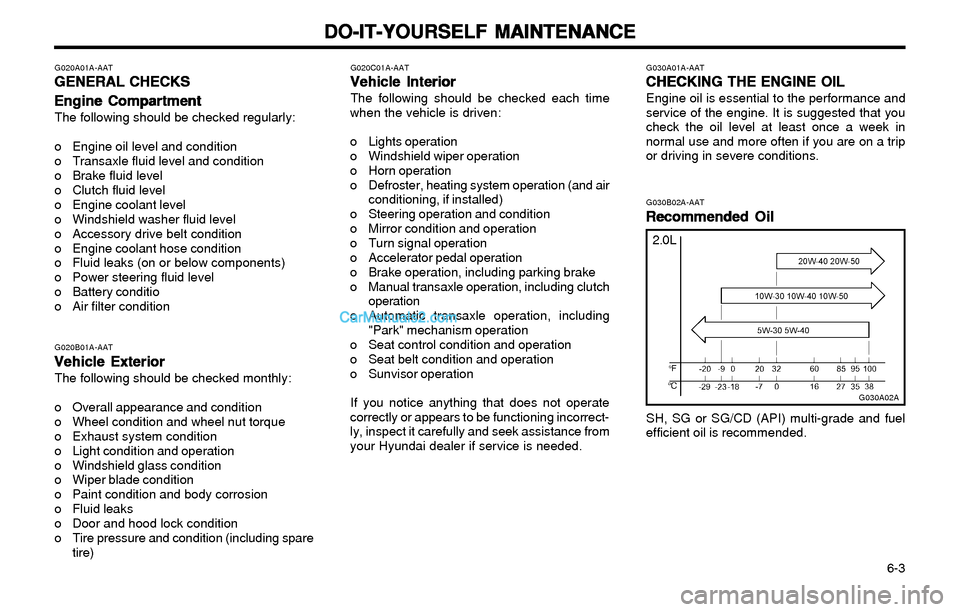
Recommended Oil Recommended OilRecommended Oil Recommended Oil
Recommended Oil
G030A02A
2.0L
SH, SG or SG/CD (API) multi-grade and fuel
efficient oil is recommended.
G020A01A-AAT
GENERAL CHECKS GENERAL CHECKSGENERAL CHECKS GENERAL CHECKS
GENERAL CHECKS
Engine Compartment Engine CompartmentEngine Compartment Engine Compartment
Engine Compartment
The following should be checked regularly:
o Engine oil level and condition
o Transaxle fluid level and condition
o Brake fluid level
o Clutch fluid level
o Engine coolant level
o Windshield washer fluid level
o Accessory drive belt condition
o Engine coolant hose condition
o Fluid leaks (on or below components)
o Power steering fluid level
o Battery conditio
o Air filter condition
Page 151 of 172
DO-IT-YOURSELF MAINTENANCE DO-IT-YOURSELF MAINTENANCEDO-IT-YOURSELF MAINTENANCE DO-IT-YOURSELF MAINTENANCE
DO-IT-YOURSELF MAINTENANCE
6-15
G200B01E-AAT
Replacing Accessory Fuse Replacing Accessory FuseReplacing Accessory Fuse Replacing Accessory Fuse
Replacing Accessory Fuse
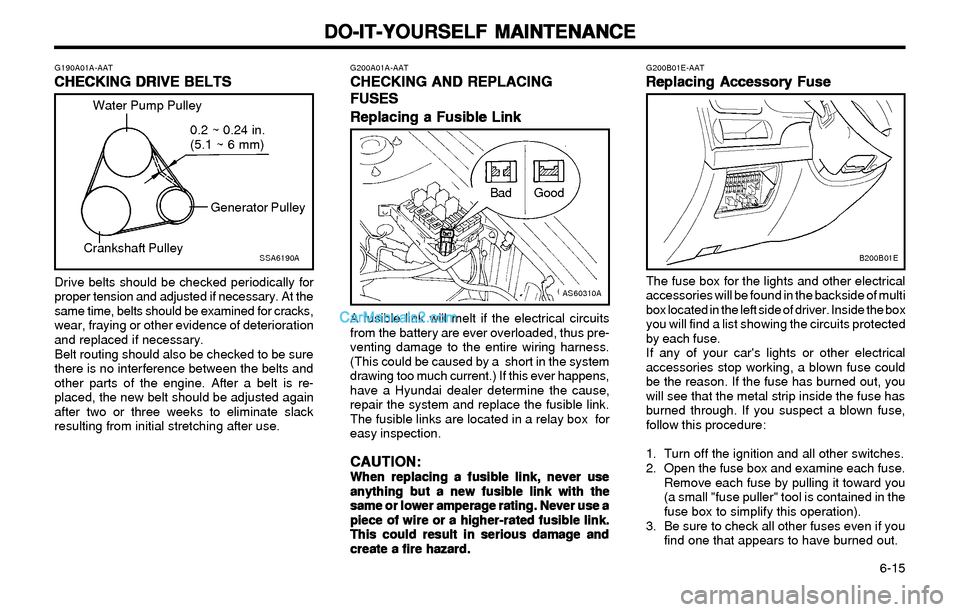
The fuse box for the lights and other electrical
accessories will be found in the backside of multi
box located in the left side of driver. Inside the box
you will find a list showing the circuits protected
by each fuse.
If any of your car's lights or other electrical
accessories stop working, a blown fuse could
be the reason. If the fuse has burned out, you
will see that the metal strip inside the fuse has
burned through. If you suspect a blown fuse,
follow this procedure:
1. Turn off the ignition and all other switches.
2. Open the fuse box and examine each fuse.
Remove each fuse by pulling it toward you
(a small "fuse puller" tool is contained in the
fuse box to simplify this operation).
3. Be sure to check all other fuses even if you
find one that appears to have burned out.
B200B01E
G190A01A-AAT
CHECKING DRIVE BELTS CHECKING DRIVE BELTSCHECKING DRIVE BELTS CHECKING DRIVE BELTS
CHECKING DRIVE BELTS
G200A01A-AAT
CHECKING AND REPLACING CHECKING AND REPLACINGCHECKING AND REPLACING CHECKING AND REPLACING
CHECKING AND REPLACING
FUSES FUSESFUSES FUSES
FUSES
Replacing a Fusible Link Replacing a Fusible LinkReplacing a Fusible Link Replacing a Fusible Link
Replacing a Fusible Link
Drive belts should be checked periodically for
proper tension and adjusted if necessary. At the
same time, belts should be examined for cracks,
wear, fraying or other evidence of deterioration
and replaced if necessary.
Belt routing should also be checked to be sure
there is no interference between the belts and
other parts of the engine. After a belt is re-
placed, the new belt should be adjusted again
after two or three weeks to eliminate slack
resulting from initial stretching after use.A fusible link will melt if the electrical circuits
from the battery are ever overloaded, thus pre-
venting damage to the entire wiring harness.
(This could be caused by a short in the system
drawing too much current.) If this ever happens,
have a Hyundai dealer determine the cause,
repair the system and replace the fusible link.
The fusible links are located in a relay box for
easy inspection.
CAUTION: CAUTION:CAUTION: CAUTION:
CAUTION:When replacing a fusible link, never use When replacing a fusible link, never useWhen replacing a fusible link, never use When replacing a fusible link, never use
When replacing a fusible link, never use
anything but a new fusible link with the anything but a new fusible link with theanything but a new fusible link with the anything but a new fusible link with the
anything but a new fusible link with the
same or lower amperage rating. Never use a same or lower amperage rating. Never use asame or lower amperage rating. Never use a same or lower amperage rating. Never use a
same or lower amperage rating. Never use a
piece of wire or a higher-rated fusible link. piece of wire or a higher-rated fusible link.piece of wire or a higher-rated fusible link. piece of wire or a higher-rated fusible link.
piece of wire or a higher-rated fusible link.
This could result in serious damage and This could result in serious damage andThis could result in serious damage and This could result in serious damage and
This could result in serious damage and
create a fire hazard. create a fire hazard.create a fire hazard. create a fire hazard.
create a fire hazard.
SSA6190A
Water Pump Pulley
Generator Pulley
Crankshaft Pulley0.2 ~ 0.24 in.
(5.1 ~ 6 mm)
GoodBad
AS60310A
Page 155 of 172
DO-IT-YOURSELF MAINTENANCE DO-IT-YOURSELF MAINTENANCEDO-IT-YOURSELF MAINTENANCE DO-IT-YOURSELF MAINTENANCE
DO-IT-YOURSELF MAINTENANCE
6-19
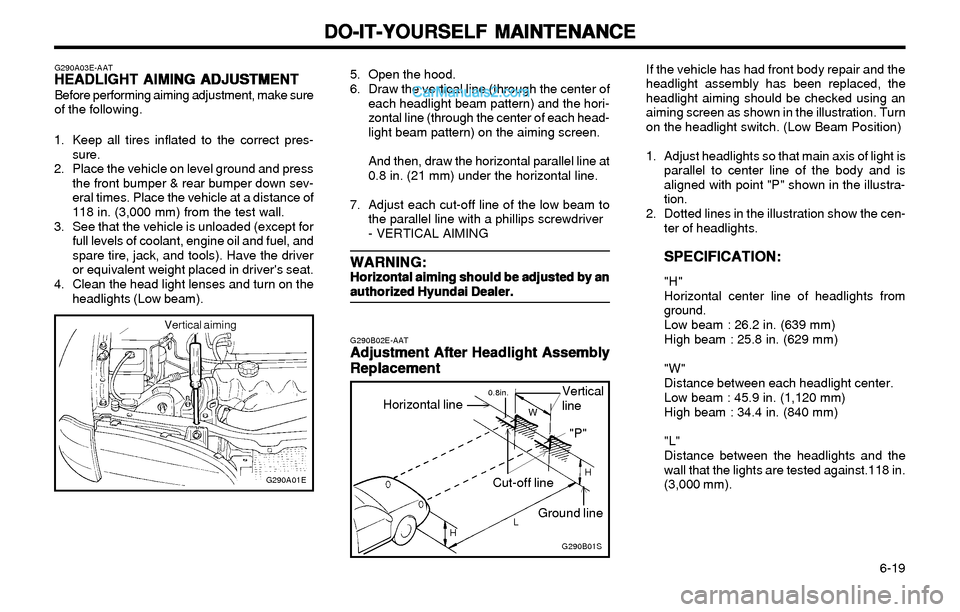
If the vehicle has had front body repair and the
headlight assembly has been replaced, the
headlight aiming should be checked using an
aiming screen as shown in the illustration. Turn
on the headlight switch. (Low Beam Position)
1. Adjust headlights so that main axis of light is
parallel to center line of the body and is
aligned with point "P" shown in the illustra-
tion.
2. Dotted lines in the illustration show the cen-
ter of headlights.
SPECIFICATION: SPECIFICATION:SPECIFICATION: SPECIFICATION:
SPECIFICATION:
"H"
Horizontal center line of headlights from
ground.
Low beam : 26.2 in. (639 mm)
High beam : 25.8 in. (629 mm)
"W"
Distance between each headlight center.
Low beam : 45.9 in. (1,120 mm)
High beam : 34.4 in. (840 mm)
"L"
Distance between the headlights and the
wall that the lights are tested against.118 in.
(3,000 mm).
G290B02E-AATAdjustment After Headlight Assembly Adjustment After Headlight AssemblyAdjustment After Headlight Assembly Adjustment After Headlight Assembly
Adjustment After Headlight Assembly
Replacement ReplacementReplacement Replacement
Replacement
G290A03E-AATHEADLI HEADLIHEADLI HEADLI
HEADLI
GHT AIMING ADJUSTMENT GHT AIMING ADJUSTMENTGHT AIMING ADJUSTMENT GHT AIMING ADJUSTMENT
GHT AIMING ADJUSTMENTBefore performing aiming adjustment, make sure
of the following.
1. Keep all tires inflated to the correct pres-
sure.
2. Place the vehicle on level ground and press
the front bumper & rear bumper down sev-
eral times. Place the vehicle at a distance of
118 in. (3,000 mm) from the test wall.
3. See that the vehicle is unloaded (except for
full levels of coolant, engine oil and fuel, and
spare tire, jack, and tools). Have the driver
or equivalent weight placed in driver's seat.
4. Clean the head light lenses and turn on the
headlights (Low beam).
G290A01E
G290B01S
Vertical
line
Cut-off line
Ground line Horizontal line
LW
H
H
"P"
0.8in.
Vertical aiming
5. Open the hood.
6. Draw the vertical line (through the center of
each headlight beam pattern) and the hori-
zontal line (through the center of each head-
light beam pattern) on the aiming screen.
And then, draw the horizontal parallel line at
0.8 in. (21 mm) under the horizontal line.
7. Adjust each cut-off line of the low beam to
the parallel line with a phillips screwdriver
- VERTICAL AIMING
WARNING: WARNING:WARNING: WARNING:
WARNING:Horizontal aiming should be adjusted by an Horizontal aiming should be adjusted by anHorizontal aiming should be adjusted by an Horizontal aiming should be adjusted by an
Horizontal aiming should be adjusted by an
authorized Hyundai Dealer. authorized Hyundai Dealer.authorized Hyundai Dealer. authorized Hyundai Dealer.
authorized Hyundai Dealer.
Page 171 of 172
INDEX INDEXINDEX INDEX
INDEX
10-4Snow tires ....................................................................................... 8-2
Spare tire ......................................................................................... 3-3
Traction ........................................................................................... 8-2
Towing
A trailer (or vehicle) ......................................................................2-12
Emergency ...................................................................................... 3-8
If your car must be towed ............................................................... 3-7
Traction Control System(TCS) ................................................... 2-8 ~ 2-9
Transaxle
Automatic ........................................................................................ 2-5
Automatic transaxle fluid checking .................................... 6-10 ~ 6-11
Manual............................................................................................. 2-4
Manual transaxle oil checking .......................................................6-10
Trip Computer ........................................................................ 1-35 ~ 1-36
Trip Odometer ...................................................................................1-34
Trunk Lid ...........................................................................................1-50
V VV V
V
Vehicle Identification Number (VIN) .................................................... 8-1
Vehicle Specification ........................................................................... 9-1
Ventilation
Center ventilator ............................................................................1-56
Side ventilator ...............................................................................1-58
W WW W
W
Warning Lights ....................................................................... 1-30 ~ 1-32
Windows
Manual............................................................................................. 1-6
Power ..................................................................................... 1-6 ~ 1-7
Windshield Wiper and Washer Switch ..............................................1-38
Windshield Wiper Blades .................................................................... 6-9