steering Hyundai Elantra 2003 User Guide
[x] Cancel search | Manufacturer: HYUNDAI, Model Year: 2003, Model line: Elantra, Model: Hyundai Elantra 2003Pages: 172, PDF Size: 2.82 MB
Page 104 of 172
DRIVING YOUR HYUNDAI DRIVING YOUR HYUNDAIDRIVING YOUR HYUNDAI DRIVING YOUR HYUNDAI
DRIVING YOUR HYUNDAI
2- 3
C070C01E-1
o oo o
o
"LOCK" "LOCK""LOCK" "LOCK"
"LOCK"The key can be removed or inserted in this
position. To protect against theft, the steering
wheel locks by removing the key.
NOTE: NOTE:NOTE: NOTE:
NOTE:To unlock the steering wheel, insert the key, To unlock the steering wheel, insert the key,To unlock the steering wheel, insert the key, To unlock the steering wheel, insert the key,
To unlock the steering wheel, insert the key,
and then turn the steering wheel and key and then turn the steering wheel and keyand then turn the steering wheel and key and then turn the steering wheel and key
and then turn the steering wheel and key
simultaneously. simultaneously.simultaneously. simultaneously.
simultaneously.
C070C01A-AAT
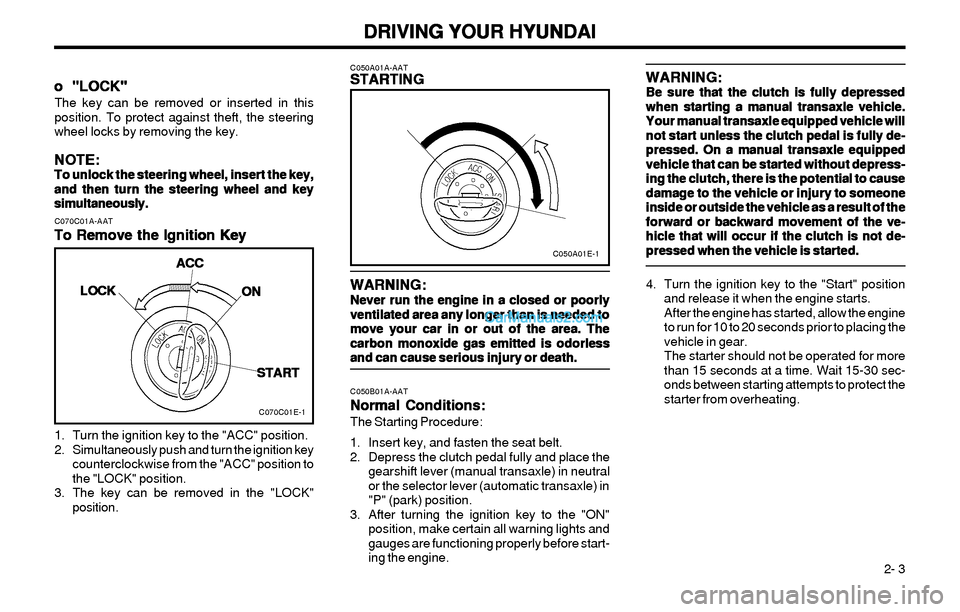
To Remove the Ignition Key To Remove the Ignition KeyTo Remove the Ignition Key To Remove the Ignition Key
To Remove the Ignition Key
1. Turn the ignition key to the "ACC" position.
2. Simultaneously push and turn the ignition key
counterclockwise from the "ACC" position to
the "LOCK" position.
3. The key can be removed in the "LOCK"
position.
C050A01A-AATSTARTING STARTINGSTARTING STARTING
STARTING
WARNING: WARNING:WARNING: WARNING:
WARNING:
Never run the engine in a closed or poorly Never run the engine in a closed or poorlyNever run the engine in a closed or poorly Never run the engine in a closed or poorly
Never run the engine in a closed or poorly
ventilated area any longer than is needed to ventilated area any longer than is needed toventilated area any longer than is needed to ventilated area any longer than is needed to
ventilated area any longer than is needed to
move your car in or out of the area. The move your car in or out of the area. Themove your car in or out of the area. The move your car in or out of the area. The
move your car in or out of the area. The
carbon monoxide gas emitted is odorless carbon monoxide gas emitted is odorlesscarbon monoxide gas emitted is odorless carbon monoxide gas emitted is odorless
carbon monoxide gas emitted is odorless
and can cause serious injury or death. and can cause serious injury or death.and can cause serious injury or death. and can cause serious injury or death.
and can cause serious injury or death.
WARNING: WARNING:WARNING: WARNING:
WARNING:Be sure that the clutch is fully depressed Be sure that the clutch is fully depressedBe sure that the clutch is fully depressed Be sure that the clutch is fully depressed
Be sure that the clutch is fully depressed
when starting a manual transaxle vehicle. when starting a manual transaxle vehicle.when starting a manual transaxle vehicle. when starting a manual transaxle vehicle.
when starting a manual transaxle vehicle.
Your manual transaxle equipped vehicle will Your manual transaxle equipped vehicle willYour manual transaxle equipped vehicle will Your manual transaxle equipped vehicle will
Your manual transaxle equipped vehicle will
not start unless the clutch pedal is fully de- not start unless the clutch pedal is fully de-not start unless the clutch pedal is fully de- not start unless the clutch pedal is fully de-
not start unless the clutch pedal is fully de-
pressed. On a manual transaxle equipped pressed. On a manual transaxle equippedpressed. On a manual transaxle equipped pressed. On a manual transaxle equipped
pressed. On a manual transaxle equipped
vehicle that can be started without depress- vehicle that can be started without depress-vehicle that can be started without depress- vehicle that can be started without depress-
vehicle that can be started without depress-
ing the clutch, there is the potential to cause ing the clutch, there is the potential to causeing the clutch, there is the potential to cause ing the clutch, there is the potential to cause
ing the clutch, there is the potential to cause
damage to the vehicle or injury to someone damage to the vehicle or injury to someonedamage to the vehicle or injury to someone damage to the vehicle or injury to someone
damage to the vehicle or injury to someone
inside or outside the vehicle as a result of the inside or outside the vehicle as a result of theinside or outside the vehicle as a result of the inside or outside the vehicle as a result of the
inside or outside the vehicle as a result of the
forward or backward movement of the ve- forward or backward movement of the ve-forward or backward movement of the ve- forward or backward movement of the ve-
forward or backward movement of the ve-
hicle that will occur if the clutch is not de- hicle that will occur if the clutch is not de-hicle that will occur if the clutch is not de- hicle that will occur if the clutch is not de-
hicle that will occur if the clutch is not de-
pressed when the vehicle is started. pressed when the vehicle is started.pressed when the vehicle is started. pressed when the vehicle is started.
pressed when the vehicle is started.
4. Turn the ignition key to the "Start" position
and release it when the engine starts.
After the engine has started, allow the engine
to run for 10 to 20 seconds prior to placing the
vehicle in gear.
The starter should not be operated for more
than 15 seconds at a time. Wait 15-30 sec-
onds between starting attempts to protect the
starter from overheating.
C050A01E-1
C050B01A-AAT
Normal Conditions: Normal Conditions:Normal Conditions: Normal Conditions:
Normal Conditions:The Starting Procedure:
1. Insert key, and fasten the seat belt.
2. Depress the clutch pedal fully and place the
gearshift lever (manual transaxle) in neutral
or the selector lever (automatic transaxle) in
"P" (park) position.
3. After turning the ignition key to the "ON"
position, make certain all warning lights and
gauges are functioning properly before start-
ing the engine.
LOCK LOCKLOCK LOCK
LOCKACC ACCACC ACC
ACC
ON ONON ON
ON
START STARTSTART START
START
Page 109 of 172

DRIVING YOUR HYUNDAI DRIVING YOUR HYUNDAIDRIVING YOUR HYUNDAI DRIVING YOUR HYUNDAI
DRIVING YOUR HYUNDAI
2- 8
C120A02A-AATANTI-LOCK BRAKE SYSTEM ANTI-LOCK BRAKE SYSTEMANTI-LOCK BRAKE SYSTEM ANTI-LOCK BRAKE SYSTEM
ANTI-LOCK BRAKE SYSTEM
(If Installed) (If Installed)(If Installed) (If Installed)
(If Installed)
The Anti-Lock Brake System (ABS) is designed
to prevent wheel lock-up during sudden braking
or on hazardous road surfaces. The ABS control
module monitors the wheel speed and controls
the pressure applied to each brake. Thus, in
emergency situations or on slick roads, ABS will
increase vehicle control during braking.
NOTE: NOTE:NOTE: NOTE:
NOTE:During ABS operation, a slight pulsation may During ABS operation, a slight pulsation mayDuring ABS operation, a slight pulsation may During ABS operation, a slight pulsation may
During ABS operation, a slight pulsation may
be felt in the brake pedal when the brakes are be felt in the brake pedal when the brakes arebe felt in the brake pedal when the brakes are be felt in the brake pedal when the brakes are
be felt in the brake pedal when the brakes are
applied. Also, a noise may be heard in the applied. Also, a noise may be heard in theapplied. Also, a noise may be heard in the applied. Also, a noise may be heard in the
applied. Also, a noise may be heard in the
engine compartment while braking. These engine compartment while braking. Theseengine compartment while braking. These engine compartment while braking. These
engine compartment while braking. These
conditions are normal and indicate that the conditions are normal and indicate that theconditions are normal and indicate that the conditions are normal and indicate that the
conditions are normal and indicate that the
anti-lock brake system is functioning prop- anti-lock brake system is functioning prop-anti-lock brake system is functioning prop- anti-lock brake system is functioning prop-
anti-lock brake system is functioning prop-
erly. erly.erly. erly.
erly.
WARNING: WARNING:WARNING: WARNING:
WARNING:ABS will not prevent accidents due to im- ABS will not prevent accidents due to im-ABS will not prevent accidents due to im- ABS will not prevent accidents due to im-
ABS will not prevent accidents due to im-
proper or dangerous driving maneuvers. Even proper or dangerous driving maneuvers. Evenproper or dangerous driving maneuvers. Even proper or dangerous driving maneuvers. Even
proper or dangerous driving maneuvers. Even
though vehicle control is improved during though vehicle control is improved duringthough vehicle control is improved during though vehicle control is improved during
though vehicle control is improved during
emergency braking, always maintain a safe emergency braking, always maintain a safeemergency braking, always maintain a safe emergency braking, always maintain a safe
emergency braking, always maintain a safe
distance between you and objects ahead. distance between you and objects ahead.distance between you and objects ahead. distance between you and objects ahead.
distance between you and objects ahead.
Vehicle speeds should always be reduced Vehicle speeds should always be reducedVehicle speeds should always be reduced Vehicle speeds should always be reduced
Vehicle speeds should always be reduced
during extreme road conditions. during extreme road conditions.during extreme road conditions. during extreme road conditions.
during extreme road conditions.
The braking distance for cars equipped with The braking distance for cars equipped withThe braking distance for cars equipped with The braking distance for cars equipped with
The braking distance for cars equipped with
an anti-lock braking system may be longer an anti-lock braking system may be longeran anti-lock braking system may be longer an anti-lock braking system may be longer
an anti-lock braking system may be longer
than for those without it in the following road than for those without it in the following roadthan for those without it in the following road than for those without it in the following road
than for those without it in the following road
conditions. conditions.conditions. conditions.
conditions.o oo o
o
Driving on rough, gravel or snow-covered Driving on rough, gravel or snow-coveredDriving on rough, gravel or snow-covered Driving on rough, gravel or snow-covered
Driving on rough, gravel or snow-covered
roads. roads.roads. roads.
roads.
o oo o
o
Driving with tire chains installed. Driving with tire chains installed.Driving with tire chains installed. Driving with tire chains installed.
Driving with tire chains installed.
o oo o
o
Driving on roads where the road surface is Driving on roads where the road surface isDriving on roads where the road surface is Driving on roads where the road surface is
Driving on roads where the road surface is
pitted or has different surface height. pitted or has different surface height.pitted or has different surface height. pitted or has different surface height.
pitted or has different surface height.
During these conditions the vehicle should During these conditions the vehicle shouldDuring these conditions the vehicle should During these conditions the vehicle should
During these conditions the vehicle should
be driven at reduced speeds. The safety fea- be driven at reduced speeds. The safety fea-be driven at reduced speeds. The safety fea- be driven at reduced speeds. The safety fea-
be driven at reduced speeds. The safety fea-
tures of an ABS equipped vehicle should not tures of an ABS equipped vehicle should nottures of an ABS equipped vehicle should not tures of an ABS equipped vehicle should not
tures of an ABS equipped vehicle should not
be tested by high speed driving or cornering. be tested by high speed driving or cornering.be tested by high speed driving or cornering. be tested by high speed driving or cornering.
be tested by high speed driving or cornering.
This could endanger the safety of yourself or This could endanger the safety of yourself orThis could endanger the safety of yourself or This could endanger the safety of yourself or
This could endanger the safety of yourself or
others. others.others. others.
others.
C300A02Y-GATTRACTION CONTROL SYSTEM (TCS) TRACTION CONTROL SYSTEM (TCS)TRACTION CONTROL SYSTEM (TCS) TRACTION CONTROL SYSTEM (TCS)
TRACTION CONTROL SYSTEM (TCS)
(If Installed) (If Installed)(If Installed) (If Installed)
(If Installed)
C370A01E-2
On slippery road surfaces, the traction control
system (TCS) limits the drive wheels from spin-
ning excessively, thus helping the car to acceler-
ate. It also provides sufficient driving force and
steering performance as the car turns at acceler-
ated speeds. o Use caution when parking on a hill. Engage
the parking brake and place the gear selector
lever in "P" (automatic transaxle) or in first or
reverse gear (manual transaxle). If your car is
facing downhill, turn the front wheels into the
curb to help keep the car from rolling. If your
car is facing uphill, turn the front wheels away
from the curb to help keep the car from rolling.
If there is no curb or if it is required by other
conditions to keep the car from rolling, block
the wheels.
o Under some conditions your parking brake
can freeze in the engaged position. This is
most likely to happen when there is an accu-
mulation of snow or ice around or near the
rear brakes or if the brakes are wet. If there is
a risk that the parking brake may freeze,
apply it only temporarily while you put the
gear selector lever in "P" (automatic) or in first
or reverse gear (manual transaxle) and block
the rear wheels so the car cannot roll. Then
release the parking brake.
o Do not hold the vehicle on the upgrade with
the accelerator pedal. This can cause the
transmission to overheat. Always use the
brake pedal or parking brake.
Page 112 of 172

DRIVING YOUR HYUNDAI DRIVING YOUR HYUNDAIDRIVING YOUR HYUNDAI DRIVING YOUR HYUNDAI
DRIVING YOUR HYUNDAI
2- 11 accordance with the maintenance schedule in
Section 5. Before winter, have your coolant test-
ed to assure that its freezing point is sufficient for
the temperatures anticipated during the winter.
C160D01A-AAT
Check Battery and Cables Check Battery and CablesCheck Battery and Cables Check Battery and Cables
Check Battery and CablesWinter puts additional burdens on the battery
system. Visually inspect the battery and cables
as described in Section 6. The level of charge in
your battery can be checked by your Hyundai
dealer or a service station.
C160E01A-AATChange to "Winter Weight" Oil if Change to "Winter Weight" Oil ifChange to "Winter Weight" Oil if Change to "Winter Weight" Oil if
Change to "Winter Weight" Oil if
Necessary NecessaryNecessary Necessary
Necessary
In some climates it is recommended that a lower
viscosity "winter weight" oil be used during cold
weather. See Section 9 for recommendations. If
you aren't sure what weight oil you should use,
consult your Hyundai dealer.
C160F01A-AATCheck Spark Plugs and Ignition Check Spark Plugs and IgnitionCheck Spark Plugs and Ignition Check Spark Plugs and Ignition
Check Spark Plugs and Ignition
System SystemSystem System
System
Inspect your spark plugs as described in Section
6 and replace them if necessary. Also check all
ignition wiring and components to be sure they
are not cracked, worn or damaged in any way.
C160G01A-AAT
To Keep Locks from Freezing To Keep Locks from FreezingTo Keep Locks from Freezing To Keep Locks from Freezing
To Keep Locks from FreezingTo keep the locks from freezing, squirt an ap-
proved de-icer fluid or glycerine into the key
opening. If a lock is covered with ice, squirt it with
an approved de-icing fluid to remove the ice. If
the lock is frozen internally, you may be able to
thaw it out by using a heated key. Handle the
heated key with care to avoid burning the fingers.
C160H01A-AATUse Approved Anti-Freeze in Window Use Approved Anti-Freeze in WindowUse Approved Anti-Freeze in Window Use Approved Anti-Freeze in Window
Use Approved Anti-Freeze in Window
Washer System Washer SystemWasher System Washer System
Washer System
To keep the water in the window washer system
from freezing, add an approved anti-freeze solu-
tion in accordance with instructions on the con-
tainer. Window washer anti-freeze is available
from Hyundai dealers and most auto parts out-
lets. Do not use engine coolant or other types of
anti-freeze as these may damage the finish.
C160I01A-AAT
Don't Let Your Parking Brake Freeze Don't Let Your Parking Brake FreezeDon't Let Your Parking Brake Freeze Don't Let Your Parking Brake Freeze
Don't Let Your Parking Brake FreezeUnder some conditions your parking brake can
freeze in the engaged position. This is most likely
to happen when there is an accumulation of snow
or ice around or near the rear brakes or if the
brakes are wet. If there is a risk the parking brake
may freeze, apply it only temporarily while you
put the gear selector lever in "P" (automatic) or in
first or reverse gear (manual transaxle) and
block the rear wheels so the car cannot roll. Then
release the parking brake.
C160K01A-AAT
Carry Emergency Equipment Carry Emergency EquipmentCarry Emergency Equipment Carry Emergency Equipment
Carry Emergency EquipmentDepending on the severity of the weather where
you drive your car, you should carry appropriate
emergency equipment. Some of the items you
may want to carry include tire chains, tow straps
or chains, flashlight, emergency flares, sand, a
shovel, jumper cables, a window scraper, gloves,
ground cloth, coveralls, a blanket, etc.
C160J01A-AAT
Don't Let Ice and Snow Accumulate Don't Let Ice and Snow AccumulateDon't Let Ice and Snow Accumulate Don't Let Ice and Snow Accumulate
Don't Let Ice and Snow Accumulate
Underneath UnderneathUnderneath Underneath
Underneath
Under some conditions, snow and ice can build
up under the fenders and interfere with the steer-
ing. When driving in severe winter conditions
where this may happen, you should periodically
check underneath the car to be sure the move-
ment of the front wheels and the steering compo-
nents is not obstructed.
C170A01A-AAT
HIGHER SPEED MOTORING HIGHER SPEED MOTORINGHIGHER SPEED MOTORING HIGHER SPEED MOTORING
HIGHER SPEED MOTORING
Pre-Trip Inspections Pre-Trip InspectionsPre-Trip Inspections Pre-Trip Inspections
Pre-Trip Inspections
1. Tires:
Adjust the tire inflation pressures to specifica-
tion. Low tire inflation pressures will result in
overheating and possible failure of the tires.
Avoid using worn or damaged tires which may
result in reduced traction or tire failure.
Page 114 of 172

DRIVING YOUR HYUNDAI DRIVING YOUR HYUNDAIDRIVING YOUR HYUNDAI DRIVING YOUR HYUNDAI
DRIVING YOUR HYUNDAI
2- 13 Tongue
187.4 (85)
100 (45.3)
C190E01E-AAT
Trailer Weight Limit Trailer Weight LimitTrailer Weight Limit Trailer Weight Limit
Trailer Weight Limit
Tongue load Total trailer weightSSA2200B
o Keep the tongue load 10% of the total trailer
load.
Tongue load
Total trailer weight
o Tongue loads can be increased or decreased
by redistributing the load in the trailer.
This can be verified by checking the total
weight of the loaded trailer and then checking
the load on the tongue.
NOTE: NOTE:NOTE: NOTE:
NOTE:1. 1.1. 1.
1.
Never load the trailer with more weight in Never load the trailer with more weight inNever load the trailer with more weight in Never load the trailer with more weight in
Never load the trailer with more weight in
the back than in the front. About 60% of the back than in the front. About 60% ofthe back than in the front. About 60% of the back than in the front. About 60% of
the back than in the front. About 60% of
the trailer load should be in the front half the trailer load should be in the front halfthe trailer load should be in the front half the trailer load should be in the front half
the trailer load should be in the front half
on the trailer and the remaining 40% in the on the trailer and the remaining 40% in theon the trailer and the remaining 40% in the on the trailer and the remaining 40% in the
on the trailer and the remaining 40% in the
rear. rear.rear. rear.
rear.
2. 2.2. 2.
2.
The total gross vehicle weight with trailer The total gross vehicle weight with trailerThe total gross vehicle weight with trailer The total gross vehicle weight with trailer
The total gross vehicle weight with trailer
must not exceed the Gross Vehicle Weight must not exceed the Gross Vehicle Weightmust not exceed the Gross Vehicle Weight must not exceed the Gross Vehicle Weight
must not exceed the Gross Vehicle Weight
Rating (GVWR) shown on the vehicle iden- Rating (GVWR) shown on the vehicle iden-Rating (GVWR) shown on the vehicle iden- Rating (GVWR) shown on the vehicle iden-
Rating (GVWR) shown on the vehicle iden-tification plate (see page 8-1). The total tification plate (see page 8-1). The totaltification plate (see page 8-1). The total tification plate (see page 8-1). The total
tification plate (see page 8-1). The total
gross vehicle weight is the combined gross vehicle weight is the combinedgross vehicle weight is the combined gross vehicle weight is the combined
gross vehicle weight is the combined
weight of the vehicle, driver, all passen- weight of the vehicle, driver, all passen-weight of the vehicle, driver, all passen- weight of the vehicle, driver, all passen-
weight of the vehicle, driver, all passen-
gers and their luggage, cargo, hitch, trailer gers and their luggage, cargo, hitch, trailergers and their luggage, cargo, hitch, trailer gers and their luggage, cargo, hitch, trailer
gers and their luggage, cargo, hitch, trailer
tongue load and other optional equip- tongue load and other optional equip-tongue load and other optional equip- tongue load and other optional equip-
tongue load and other optional equip-
ment. ment.ment. ment.
ment.
3. 3.3. 3.
3.
The front or rear axle weight must not The front or rear axle weight must notThe front or rear axle weight must not The front or rear axle weight must not
The front or rear axle weight must not
exceed the Gross Axle Weight Rating exceed the Gross Axle Weight Ratingexceed the Gross Axle Weight Rating exceed the Gross Axle Weight Rating
exceed the Gross Axle Weight Rating
(GAWR) shown on the vehicle identifica- (GAWR) shown on the vehicle identifica-(GAWR) shown on the vehicle identifica- (GAWR) shown on the vehicle identifica-
(GAWR) shown on the vehicle identifica-
tion plate (see page 8-1). It is possible that tion plate (see page 8-1). It is possible thattion plate (see page 8-1). It is possible that tion plate (see page 8-1). It is possible that
tion plate (see page 8-1). It is possible that
your towing package does not exceed the your towing package does not exceed theyour towing package does not exceed the your towing package does not exceed the
your towing package does not exceed the
GVWR but exceeds the GAWR. GVWR but exceeds the GAWR.GVWR but exceeds the GAWR. GVWR but exceeds the GAWR.
GVWR but exceeds the GAWR.
Improper trailer loading and/or too much Improper trailer loading and/or too muchImproper trailer loading and/or too much Improper trailer loading and/or too much
Improper trailer loading and/or too much
luggage in the trunk can overload the rear luggage in the trunk can overload the rearluggage in the trunk can overload the rear luggage in the trunk can overload the rear
luggage in the trunk can overload the rear
axle. Redistribute the load and check the axle. Redistribute the load and check theaxle. Redistribute the load and check the axle. Redistribute the load and check the
axle. Redistribute the load and check the
axle weight again. axle weight again.axle weight again. axle weight again.
axle weight again.Gross axle weight Gross vehicle weightSSA2200D
CAUTION: CAUTION:CAUTION: CAUTION:
CAUTION:The following specifications are recommend- The following specifications are recommend-The following specifications are recommend- The following specifications are recommend-
The following specifications are recommend-
ed when towing a trailer. The loaded trailer ed when towing a trailer. The loaded trailered when towing a trailer. The loaded trailer ed when towing a trailer. The loaded trailer
ed when towing a trailer. The loaded trailer
weight cannot safely exceed the values in the weight cannot safely exceed the values in theweight cannot safely exceed the values in the weight cannot safely exceed the values in the
weight cannot safely exceed the values in the
following chart. following chart.following chart. following chart.
following chart.Lbs. (kg)
Maximum Towable Weight
Trailer
1874(850)
1000(453)
WARNING: WARNING:WARNING: WARNING:
WARNING:Improperly loading your car and trailer can Improperly loading your car and trailer canImproperly loading your car and trailer can Improperly loading your car and trailer can
Improperly loading your car and trailer can
seriously affect its steering and braking per- seriously affect its steering and braking per-seriously affect its steering and braking per- seriously affect its steering and braking per-
seriously affect its steering and braking per-
formance causing a crash which could cause formance causing a crash which could causeformance causing a crash which could cause formance causing a crash which could cause
formance causing a crash which could cause
serious injury or death. serious injury or death.serious injury or death. serious injury or death.
serious injury or death.
o x 100 = 10% (MAX)
C190F01S-AAT
Trailer or Vehicle Towing Tips Trailer or Vehicle Towing TipsTrailer or Vehicle Towing Tips Trailer or Vehicle Towing Tips
Trailer or Vehicle Towing Tips1. Before towing, check hitch and safety chain
connections as well as proper operation of
the trailer running lights, brake lights, and turn
signals.
2. Always drive your vehicle at a moderate
speed. (Less than 60 mph)
3. Trailer towing requires more fuel than normal
conditions.
4. To maintain engine braking efficiency and
electrical charging performance, do not use
fifth gear (manual transaxle) or overdrive
(automatic transaxle).
5. Always secure items in the trailer to prevent
load shift while driving.
6. Check the condition and air pressure of all
tires on the trailer and your car. Low tire
pressure can seriously affect the handling.
Also check the spare tire.
With Brake
Without Brake
Page 122 of 172
WHAT TO DO IN AN EMERGENCY WHAT TO DO IN AN EMERGENCYWHAT TO DO IN AN EMERGENCY WHAT TO DO IN AN EMERGENCY
WHAT TO DO IN AN EMERGENCY
3-7
D060J01E-AAT
After Changing Wheels After Changing WheelsAfter Changing Wheels After Changing Wheels
After Changing Wheels
If you have a tire gauge, remove the valve cap
and check the air pressure. If the pressure is
lower than recommended, drive slowly to the
nearest service station and inflate to the correct
pressure. If it is too high, adjust it until it is correct.
Always reinstall the valve cap after checking or
adjusting tire pressure. If the cap is not replaced,
air may leak from the tire. If you lose a valve cap,
buy another and install it as soon as possible.
After you have changed wheels, always secure
the flat tire in its place in the trunk and return the
jack and tools to their proper storage locations.
D080A01A-AAT
IF YOUR CAR MUST BE TOWED IF YOUR CAR MUST BE TOWEDIF YOUR CAR MUST BE TOWED IF YOUR CAR MUST BE TOWED
IF YOUR CAR MUST BE TOWED
CAUTION: CAUTION:CAUTION: CAUTION:
CAUTION:
Your car can be damaged if towed incor- Your car can be damaged if towed incor-Your car can be damaged if towed incor- Your car can be damaged if towed incor-
Your car can be damaged if towed incor-
rectly! rectly!rectly! rectly!
rectly!
If your car has to be towed, it should be done by
your Hyundai dealer or a commercial tow truck
service. This will help assure that your car is not
damaged in towing. Also, professionals are gen-
erally aware of state and local laws governing
towing. In any case, rather than risk damage to
your car, it is suggested that you show this
information to the tow truck operator. Be sure that
a safety chain system is used and that all state
and local laws are observed.
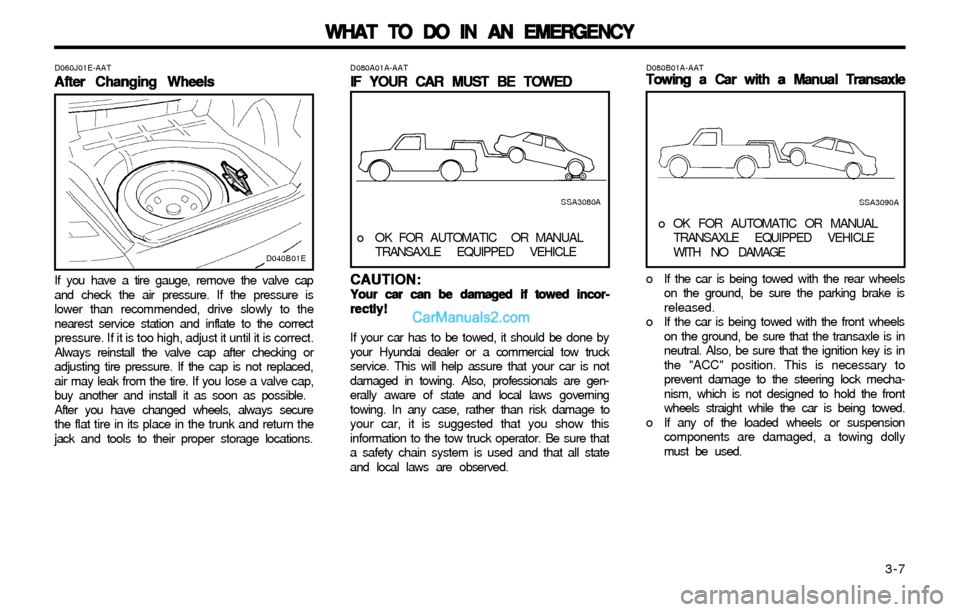
D080B01A-AATTowing a Car with a Manual Transaxle Towing a Car with a Manual TransaxleTowing a Car with a Manual Transaxle Towing a Car with a Manual Transaxle
Towing a Car with a Manual Transaxle
o If the car is being towed with the rear wheels
on the ground, be sure the parking brake is
released.
o If the car is being towed with the front wheels
on the ground, be sure that the transaxle is in
neutral. Also, be sure that the ignition key is in
the "ACC" position. This is necessary to
prevent damage to the steering lock mecha-
nism, which is not designed to hold the front
wheels straight while the car is being towed.
o If any of the loaded wheels or suspension
components are damaged, a towing dolly
must be used.
o OK FOR AUTOMATIC OR MANUAL
TRANSAXLE EQUIPPED VEHICLE
SSA3080A
o OK FOR AUTOMATIC OR MANUAL
TRANSAXLE EQUIPPED VEHICLE
WITH NO DAMAGE
SSA3090A
D040B01E
Page 123 of 172

WHAT TO DO IN AN EMERGENCY WHAT TO DO IN AN EMERGENCYWHAT TO DO IN AN EMERGENCY WHAT TO DO IN AN EMERGENCY
WHAT TO DO IN AN EMERGENCY
3-8
D080C02A-AATTowing a Car with an Automatic Towing a Car with an AutomaticTowing a Car with an Automatic Towing a Car with an Automatic
Towing a Car with an Automatic
Transaxle TransaxleTransaxle Transaxle
Transaxle
CAUTION: CAUTION:CAUTION: CAUTION:
CAUTION:
A car with an automatic transaxle should A car with an automatic transaxle shouldA car with an automatic transaxle should A car with an automatic transaxle should
A car with an automatic transaxle should
never be towed from the rear with the front never be towed from the rear with the frontnever be towed from the rear with the front never be towed from the rear with the front
never be towed from the rear with the front
wheels on the ground. This can cause seri- wheels on the ground. This can cause seri-wheels on the ground. This can cause seri- wheels on the ground. This can cause seri-
wheels on the ground. This can cause seri-
ous damage to the transaxle. If the car must ous damage to the transaxle. If the car mustous damage to the transaxle. If the car must ous damage to the transaxle. If the car must
ous damage to the transaxle. If the car must
be towed from the rear, a towing dolly must be towed from the rear, a towing dolly mustbe towed from the rear, a towing dolly must be towed from the rear, a towing dolly must
be towed from the rear, a towing dolly must
be used under the front wheels. be used under the front wheels.be used under the front wheels. be used under the front wheels.
be used under the front wheels.
If the car is being towed with the rear wheels on
the ground, be sure the parking brake is re-
leased.
o NOT OK FOR AUTOMATIC TRANSAXLE
EQUIPPED VEHICLE
o OK FOR MANUAL TRANSAXLE
SSA3100A o OK FOR AUTOMATIC OR MANUAL
TRANSAXLE EQUIPPED VEHICLE
SSA3101AD080D02A-AAT
Emergency Towing Emergency TowingEmergency Towing Emergency Towing
Emergency Towing
For emergency towing when no commercial tow
vehicle is available, attach a tow cable, chain or
strap to one of the tie-down hooks under the front
of your car. Do not attempt to tow your vehicle in
this manner on any unpaved surface. This could
result in serious damage to your car.
Nor should towing be attempted if the wheels,
drive train, axles, steering or brakes are dam-
aged. Before towing, be sure the transaxle is in
neutral and the key is in "ACC" (with the engine
off) or in the "ON" position (with the engine
running). A driver must be in the towed car to
steer it and operate the brakes.
D080D01ENOTE: NOTE:NOTE: NOTE:
NOTE:Before towing, check the level of the tran- Before towing, check the level of the tran-Before towing, check the level of the tran- Before towing, check the level of the tran-
Before towing, check the level of the tran-
saxle fluid. If it is below the "HOT" mark on saxle fluid. If it is below the "HOT" mark onsaxle fluid. If it is below the "HOT" mark on saxle fluid. If it is below the "HOT" mark on
saxle fluid. If it is below the "HOT" mark on
the dipstick, add fluid. If you cannot add fluid, the dipstick, add fluid. If you cannot add fluid,the dipstick, add fluid. If you cannot add fluid, the dipstick, add fluid. If you cannot add fluid,
the dipstick, add fluid. If you cannot add fluid,
a towing dolly must be used as described a towing dolly must be used as describeda towing dolly must be used as described a towing dolly must be used as described
a towing dolly must be used as described
above. above.above. above.
above.
Page 124 of 172

WHAT TO DO IN AN EMERGENCY WHAT TO DO IN AN EMERGENCYWHAT TO DO IN AN EMERGENCY WHAT TO DO IN AN EMERGENCY
WHAT TO DO IN AN EMERGENCY
3-9
D120A01A-AAT
IF YOU LOSE YOUR KEYS IF YOU LOSE YOUR KEYSIF YOU LOSE YOUR KEYS IF YOU LOSE YOUR KEYS
IF YOU LOSE YOUR KEYSIf you lose your keys, many Hyundai dealers can
make you a new key if you have your key
number.
If you lock the keys inside your car and you
cannot obtain a new key, many Hyundai dealers
can use special tools to open the door for you.
CAUTION: CAUTION:CAUTION: CAUTION:
CAUTION:If the car is being towed with all four wheels If the car is being towed with all four wheelsIf the car is being towed with all four wheels If the car is being towed with all four wheels
If the car is being towed with all four wheels
on the ground, it can be towed only from the on the ground, it can be towed only from theon the ground, it can be towed only from the on the ground, it can be towed only from the
on the ground, it can be towed only from the
front. Be sure that the transaxle is in neutral. front. Be sure that the transaxle is in neutral.front. Be sure that the transaxle is in neutral. front. Be sure that the transaxle is in neutral.
front. Be sure that the transaxle is in neutral.
Do not tow at speeds greater than 30 mph (50 Do not tow at speeds greater than 30 mph (50Do not tow at speeds greater than 30 mph (50 Do not tow at speeds greater than 30 mph (50
Do not tow at speeds greater than 30 mph (50
km/h) and for more than 15 miles (25 km). Be km/h) and for more than 15 miles (25 km). Bekm/h) and for more than 15 miles (25 km). Be km/h) and for more than 15 miles (25 km). Be
km/h) and for more than 15 miles (25 km). Be
sure the steering is unlocked by placing the sure the steering is unlocked by placing thesure the steering is unlocked by placing the sure the steering is unlocked by placing the
sure the steering is unlocked by placing the
key in the "ACC" position. A driver must be in key in the "ACC" position. A driver must be inkey in the "ACC" position. A driver must be in key in the "ACC" position. A driver must be in
key in the "ACC" position. A driver must be in
the towed vehicle to operate the steering and the towed vehicle to operate the steering andthe towed vehicle to operate the steering and the towed vehicle to operate the steering and
the towed vehicle to operate the steering and
brakes. brakes.brakes. brakes.
brakes.
Page 132 of 172
VEHICLE MAINTENANCE REQUIREMENTS VEHICLE MAINTENANCE REQUIREMENTSVEHICLE MAINTENANCE REQUIREMENTS VEHICLE MAINTENANCE REQUIREMENTS
VEHICLE MAINTENANCE REQUIREMENTS
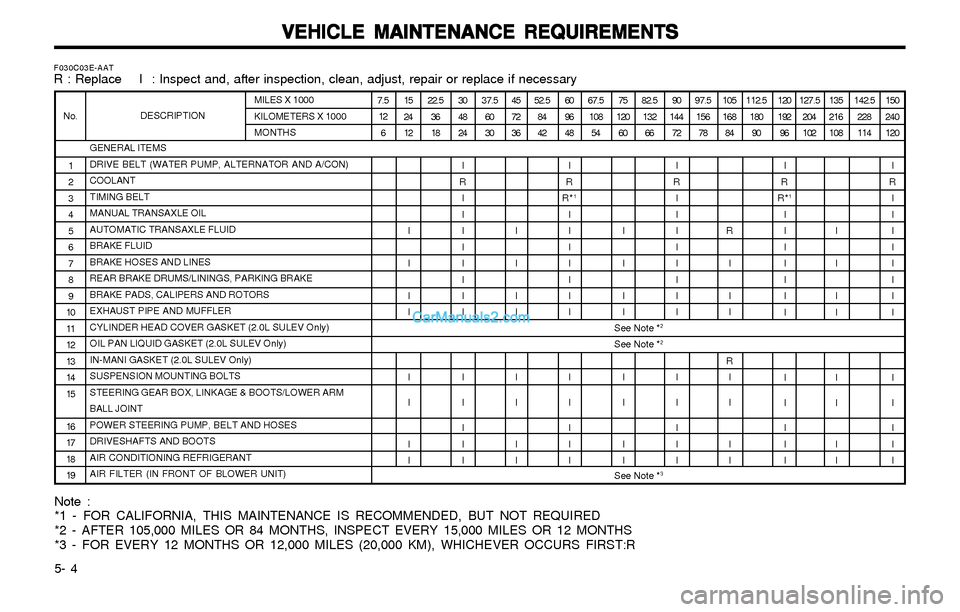
5- 4 Note :
*1 - FOR CALIFORNIA, THIS MAINTENANCE IS RECOMMENDED, BUT NOT REQUIRED
*2 - AFTER 105,000 MILES OR 84 MONTHS, INSPECT EVERY 15,000 MILES OR 12 MONTHS
*3 - FOR EVERY 12 MONTHS OR 12,000 MILES (20,000 KM), WHICHEVER OCCURS FIRST:R
See Note *3
F030C03E-AATR : Replace I : Inspect and, after inspection, clean, adjust, repair or replace if necessary
GENERAL ITEMS
DRIVE BELT (WATER PUMP, ALTERNATOR AND A/CON)
COOLANT
TIMING BELT
MANUAL TRANSAXLE OIL
AUTOMATIC TRANSAXLE FLUID
BRAKE FLUID
BRAKE HOSES AND LINES
REAR BRAKE DRUMS/LININGS, PARKING BRAKE
BRAKE PADS, CALIPERS AND ROTORS
EXHAUST PIPE AND MUFFLER
CYLINDER HEAD COVER GASKET (2.0L SULEV Only)
OIL PAN LIQUID GASKET (2.0L SULEV Only)
IN-MANI GASKET (2.0L SULEV Only)
SUSPENSION MOUNTING BOLTS
STEERING GEAR BOX, LINKAGE & BOOTS/LOWER ARM
BALL JOINT
POWER STEERING PUMP, BELT AND HOSES
DRIVESHAFTS AND BOOTS
AIR CONDITIONING REFRIGERANT
AIR FILTER (IN FRONT OF BLOWER UNIT) 1
2
3
4
5
6
7
8
9
10
11
12
13
14
15
16
17
18
19 No.DESCRIPTIONMILES X 1000
KILOMETERS X 1000
MONTHS7.5
12
615
24
12
I
I
I
I
I
I
I
I22.5
36
1830
48
24
I
R
I
I
I
I
I
I
I
I
I
I
I
I
I37.5
60
3045
72
36
I
I
I
I
I
I
I
I52.5
84
4260
96
48
I
R
R*
1
I
I
I
I
I
I
I
I
I
I
I
I67.5
108
5475
120
60
I
I
I
I
I
I
I
I82.5
132
6690
144
72
I
R
I
I
I
I
I
I
I
I
I
I
I
I
I97.5
156
78105
168
84
R
I
I
I
R
I
I
I
I112.5
180
90120
192
96
I
R
R*
1
I
I
I
I
I
I
I
I
I
I
I
I127.5
204
102135
216
108
I
I
I
I
I
I
I
I142.5
228
114150
240
120
I
R
I
I
I
I
I
I
I
I
I
I
I
I
I
See Note *2
See Note *2
Page 133 of 172
VEHICLE MAINTENANCE REQUIREMENTS VEHICLE MAINTENANCE REQUIREMENTSVEHICLE MAINTENANCE REQUIREMENTS VEHICLE MAINTENANCE REQUIREMENTS
VEHICLE MAINTENANCE REQUIREMENTS
5-5
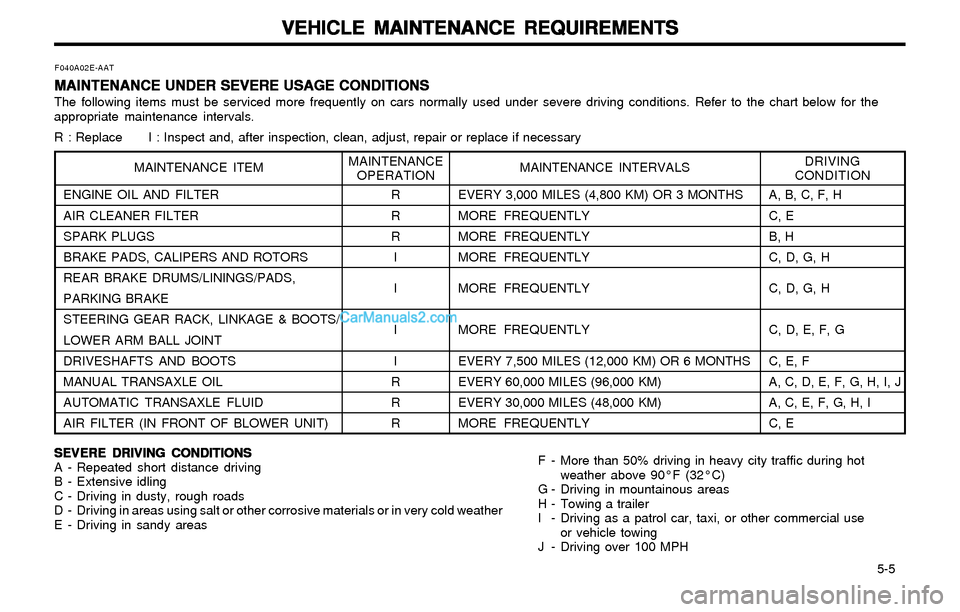
MAINTENANCE UNDER SEVERE USAGE CONDITIONS MAINTENANCE UNDER SEVERE USAGE CONDITIONSMAINTENANCE UNDER SEVERE USAGE CONDITIONS MAINTENANCE UNDER SEVERE USAGE CONDITIONS
MAINTENANCE UNDER SEVERE USAGE CONDITIONSThe following items must be serviced more frequently on cars normally used under severe driving conditions. Refer to the chart below for the
appropriate maintenance intervals.
R : Replace I : Inspect and, after inspection, clean, adjust, repair or replace if necessary
F040A02E-AAT
MAINTENANCE ITEM
F - More than 50% driving in heavy city traffic during hot
weather above 90°F (32°C)
G - Driving in mountainous areas
H - Towing a trailer
I - Driving as a patrol car, taxi, or other commercial use
or vehicle towing
J - Driving over 100 MPH SEVERE DRIVING CONDITIONS SEVERE DRIVING CONDITIONSSEVERE DRIVING CONDITIONS SEVERE DRIVING CONDITIONS
SEVERE DRIVING CONDITIONS
A - Repeated short distance driving
B - Extensive idling
C - Driving in dusty, rough roads
D - Driving in areas using salt or other corrosive materials or in very cold weather
E - Driving in sandy areasMAINTENANCE INTERVALS
ENGINE OIL AND FILTER
AIR CLEANER FILTER
SPARK PLUGS
BRAKE PADS, CALIPERS AND ROTORS
REAR BRAKE DRUMS/LININGS/PADS,
PARKING BRAKE
STEERING GEAR RACK, LINKAGE & BOOTS/
LOWER ARM BALL JOINT
DRIVESHAFTS AND BOOTS
MANUAL TRANSAXLE OIL
AUTOMATIC TRANSAXLE FLUID
AIR FILTER (IN FRONT OF BLOWER UNIT)R
R
R
I
I
I
I
R
R
REVERY 3,000 MILES (4,800 KM) OR 3 MONTHS
MORE FREQUENTLY
MORE FREQUENTLY
MORE FREQUENTLY
MORE FREQUENTLY
MORE FREQUENTLY
EVERY 7,500 MILES (12,000 KM) OR 6 MONTHS
EVERY 60,000 MILES (96,000 KM)
EVERY 30,000 MILES (48,000 KM)
MORE FREQUENTLY MAINTENANCE
OPERATION
A, B, C, F, H
C, E
B, H
C, D, G, H
C, D, G, H
C, D, E, F, G
C, E, F
A, C, D, E, F, G, H, I, J
A, C, E, F, G, H, I
C, EDRIVING
CONDITION
Page 135 of 172
VEHICLE MAINTENANCE REQUIREMENTS VEHICLE MAINTENANCE REQUIREMENTSVEHICLE MAINTENANCE REQUIREMENTS VEHICLE MAINTENANCE REQUIREMENTS
VEHICLE MAINTENANCE REQUIREMENTS
5-7
F070E05A-AAT
o Automatic Transaxle Fluid o Automatic Transaxle Fluido Automatic Transaxle Fluid o Automatic Transaxle Fluid
o Automatic Transaxle FluidThe fluid level should be in the "HOT" range
of the dipstick, after the engine and transaxle
are at normal operating temperature. Check
the automatic transaxle fluid level with the
engine running and the transaxle in neutral,
with the parking brake properly applied. Use
HYUNDAI GENUINE ATF, DIAMOND ATF
SP-III or SK ATF SP-III when adding or
changing fluid.
F070F01A-AAT
o oo o
o
Brake Hoses and Lines Brake Hoses and LinesBrake Hoses and Lines Brake Hoses and Lines
Brake Hoses and LinesVisually check for proper installation, chafing,
cracks, deterioration and any leakage. Re-
place any deteriorated or damaged parts
immediately.
F070G02A-AAT
o Brake Fluid o Brake Fluido Brake Fluid o Brake Fluid
o Brake FluidCheck brake fluid level in the brake fluid
reservoir. The level should be between "MIN"
and "MAX" marks on the side of the reservoir.
Use only hydraulic brake fluid conforming to
DOT 3 or DOT 4.
F070D01A-AAT
o Manual transaxle oil o Manual transaxle oilo Manual transaxle oil o Manual transaxle oil
o Manual transaxle oilInspect the manual transaxle oil according to
the maintenance schedule.
NOTE: NOTE:NOTE: NOTE:
NOTE:If the oil level is low, check for possible If the oil level is low, check for possibleIf the oil level is low, check for possible If the oil level is low, check for possible
If the oil level is low, check for possible
leaks before adding oil. Do not overfill. leaks before adding oil. Do not overfill.leaks before adding oil. Do not overfill. leaks before adding oil. Do not overfill.
leaks before adding oil. Do not overfill.
F070H01A-AATo oo o
o
Rear Brake Drums/Linings, Rear Brake Drums/Linings,Rear Brake Drums/Linings, Rear Brake Drums/Linings,
Rear Brake Drums/Linings,
Parking Brake Parking BrakeParking Brake Parking Brake
Parking Brake
Check the rear brake drums and linings for
scoring, burning, leaking fluid, broken parts,
and excessive wear. Inspect the parking
brake system including the parking brake
lever and cables. For detailed service proce-
dures, refer to the Shop Manual.
F070J01A-AAT
o Brake Pads, Calipers and Rotors o Brake Pads, Calipers and Rotorso Brake Pads, Calipers and Rotors o Brake Pads, Calipers and Rotors
o Brake Pads, Calipers and RotorsCheck the pads for excessive wear, discs for
run out and wear, and calipers for fluid leak-
age.
F070K01A-AAT
o Exhaust Pipe and Muffler o Exhaust Pipe and Mufflero Exhaust Pipe and Muffler o Exhaust Pipe and Muffler
o Exhaust Pipe and MufflerVisually inspect the exhaust pipes, muffler
and hangers for cracks, deterioration, or dam-
age. Start the engine and listen carefully for
any exhaust gas leakage. Tighten connec-
tions or replace parts as necessary.
F070L01A-AAT
o Suspension Mounting Bolts o Suspension Mounting Boltso Suspension Mounting Bolts o Suspension Mounting Bolts
o Suspension Mounting BoltsCheck the suspension connections for loose-
ness or damage. Retighten to the specified
torque.
F070N01A-AATo oo o
o
Power Steering Pump, Belt and Hoses Power Steering Pump, Belt and HosesPower Steering Pump, Belt and Hoses Power Steering Pump, Belt and Hoses
Power Steering Pump, Belt and HosesCheck the power steering pump and hoses
for leakage and damage. Replace any dam-
aged or leaking parts immediately. Inspect the
power steering belt for evidence of cuts,
cracks, excessive wear, oiliness and proper
tension. Replace or adjust it if necessary.
F070P01A-AAT
o Driveshafts and Boots o Driveshafts and Bootso Driveshafts and Boots o Driveshafts and Boots
o Driveshafts and BootsCheck the drive shafts, boots and clamps for
cracks, deterioration, or damage. Replace
any damaged parts and, if necessary, repack
the grease.
F070Q01A-AAT
o oo o
o
Air Conditioning Refrigerant Air Conditioning RefrigerantAir Conditioning Refrigerant Air Conditioning Refrigerant
Air Conditioning RefrigerantCheck the air conditioning lines and connec-
tions for leakage and damage. Check air
conditioning performance according to the
relevant shop manual if necessary.
F070M01A-AATo oo o
o
Steering Gear Box, Linkage & Boots/ Steering Gear Box, Linkage & Boots/Steering Gear Box, Linkage & Boots/ Steering Gear Box, Linkage & Boots/
Steering Gear Box, Linkage & Boots/
Lower arm Ball Joint Lower arm Ball JointLower arm Ball Joint Lower arm Ball Joint
Lower arm Ball Joint
With the vehicle stopped and engine off, check
for excessive free-play in the steering wheel.
Check the linkage for bends or damage.
Check the dust boots and ball joints for dete-
rioration, cracks, or damage. Replace any
damaged parts.