wheel Hyundai Elantra 2003 Owner's Guide
[x] Cancel search | Manufacturer: HYUNDAI, Model Year: 2003, Model line: Elantra, Model: Hyundai Elantra 2003Pages: 172, PDF Size: 2.82 MB
Page 119 of 172
WHAT TO DO IN AN EMERGENCY WHAT TO DO IN AN EMERGENCYWHAT TO DO IN AN EMERGENCY WHAT TO DO IN AN EMERGENCY
WHAT TO DO IN AN EMERGENCY
3-4cause a loss of control. When the car has
slowed to such a speed that it is safe to do so,
brake carefully and pull off the road. Drive off
the road as far as possible and park on firm,
level ground. If you are on a divided highway,
do not park in the median area between the
two traffic lanes.
2. When the car is stopped, turn on your emer-
gency hazard flashers, set the parking brake
and put the transaxle in "P" (automatic) or
reverse (manual transaxle).
3. Have all passengers get out of the car. Be
sure they all get out on the side of the car that
is away from traffic.
4. Change the tire following the instructions pro-
vided on the following pages.
D060A01A-AAT
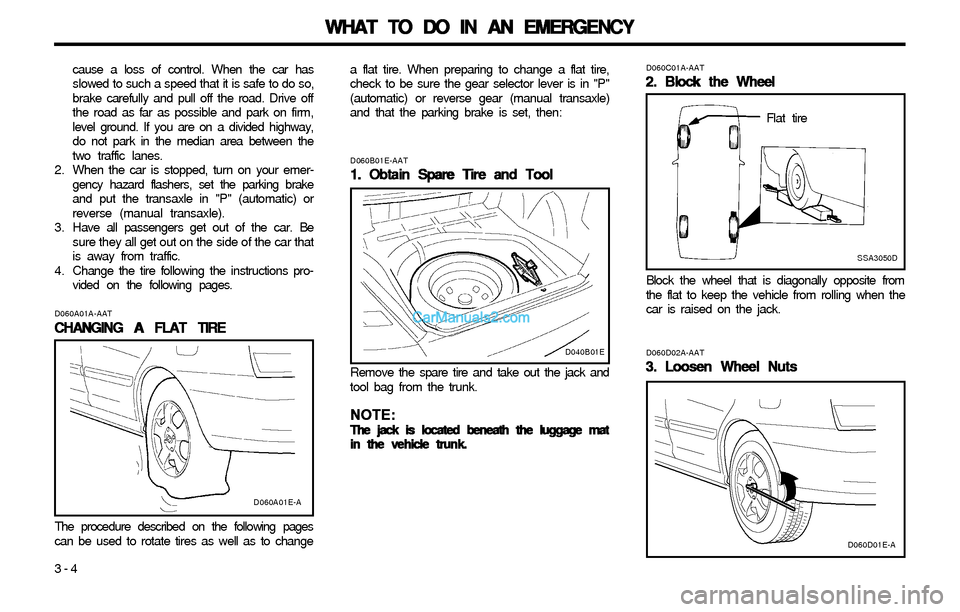
CHANGING A FLAT TIRE CHANGING A FLAT TIRECHANGING A FLAT TIRE CHANGING A FLAT TIRE
CHANGING A FLAT TIRE
The procedure described on the following pages
can be used to rotate tires as well as to changea flat tire. When preparing to change a flat tire,
check to be sure the gear selector lever is in "P"
(automatic) or reverse gear (manual transaxle)
and that the parking brake is set, then:
Remove the spare tire and take out the jack and
tool bag from the trunk.
NOTE: NOTE:NOTE: NOTE:
NOTE:The jack is located beneath the luggage mat The jack is located beneath the luggage matThe jack is located beneath the luggage mat The jack is located beneath the luggage mat
The jack is located beneath the luggage mat
in the vehicle trunk. in the vehicle trunk.in the vehicle trunk. in the vehicle trunk.
in the vehicle trunk.
D060B01E-AAT
1. Obtain Spare Tire and Tool 1. Obtain Spare Tire and Tool1. Obtain Spare Tire and Tool 1. Obtain Spare Tire and Tool
1. Obtain Spare Tire and Tool
D060C01A-AAT
2. Block the Wheel 2. Block the Wheel2. Block the Wheel 2. Block the Wheel
2. Block the Wheel
Block the wheel that is diagonally opposite from
the flat to keep the vehicle from rolling when the
car is raised on the jack.
Flat tire
SSA3050D
D060D02A-AAT
3. Loosen Wheel Nuts 3. Loosen Wheel Nuts3. Loosen Wheel Nuts 3. Loosen Wheel Nuts
3. Loosen Wheel Nuts
D060D01E-A
D060A01E-A
D040B01E
Page 120 of 172
WHAT TO DO IN AN EMERGENCY WHAT TO DO IN AN EMERGENCYWHAT TO DO IN AN EMERGENCY WHAT TO DO IN AN EMERGENCY
WHAT TO DO IN AN EMERGENCY
3-5 The wheel nuts should be loosened slightly be-
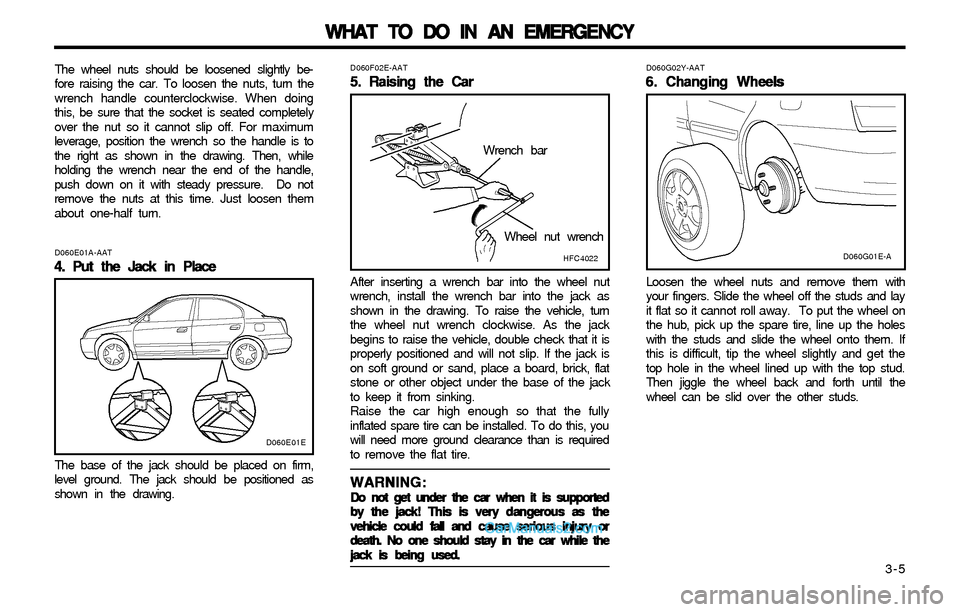
fore raising the car. To loosen the nuts, turn the
wrench handle counterclockwise. When doing
this, be sure that the socket is seated completely
over the nut so it cannot slip off. For maximum
leverage, position the wrench so the handle is to
the right as shown in the drawing. Then, while
holding the wrench near the end of the handle,
push down on it with steady pressure. Do not
remove the nuts at this time. Just loosen them
about one-half turn.
D060E01A-AAT
4. Put the Jack in Place 4. Put the Jack in Place4. Put the Jack in Place 4. Put the Jack in Place
4. Put the Jack in Place
The base of the jack should be placed on firm,
level ground. The jack should be positioned as
shown in the drawing.
D060F02E-AAT
5. Raising the Car 5. Raising the Car5. Raising the Car 5. Raising the Car
5. Raising the Car
After inserting a wrench bar into the wheel nut
wrench, install the wrench bar into the jack as
shown in the drawing. To raise the vehicle, turn
the wheel nut wrench clockwise. As the jack
begins to raise the vehicle, double check that it is
properly positioned and will not slip. If the jack is
on soft ground or sand, place a board, brick, flat
stone or other object under the base of the jack
to keep it from sinking.
Raise the car high enough so that the fully
inflated spare tire can be installed. To do this, you
will need more ground clearance than is required
to remove the flat tire.
WARNING: WARNING:WARNING: WARNING:
WARNING:Do not get under the car when it is supported Do not get under the car when it is supportedDo not get under the car when it is supported Do not get under the car when it is supported
Do not get under the car when it is supported
by the jack! This is very dangerous as the by the jack! This is very dangerous as theby the jack! This is very dangerous as the by the jack! This is very dangerous as the
by the jack! This is very dangerous as the
vehicle could fall and cause serious injury or vehicle could fall and cause serious injury orvehicle could fall and cause serious injury or vehicle could fall and cause serious injury or
vehicle could fall and cause serious injury or
death. No one should stay in the car while the death. No one should stay in the car while thedeath. No one should stay in the car while the death. No one should stay in the car while the
death. No one should stay in the car while the
jack is being used. jack is being used.jack is being used. jack is being used.
jack is being used.
D060G02Y-AAT
6. Changing Wheels 6. Changing Wheels6. Changing Wheels 6. Changing Wheels
6. Changing Wheels
Loosen the wheel nuts and remove them with
your fingers. Slide the wheel off the studs and lay
it flat so it cannot roll away. To put the wheel on
the hub, pick up the spare tire, line up the holes
with the studs and slide the wheel onto them. If
this is difficult, tip the wheel slightly and get the
top hole in the wheel lined up with the top stud.
Then jiggle the wheel back and forth until the
wheel can be slid over the other studs.
D060E01E
D060G01E-AHFC4022
Wrench bar
Wheel nut wrench
Page 121 of 172
WHAT TO DO IN AN EMERGENCY WHAT TO DO IN AN EMERGENCYWHAT TO DO IN AN EMERGENCY WHAT TO DO IN AN EMERGENCY
WHAT TO DO IN AN EMERGENCY
3-6
STA3071H
WARNING: WARNING:WARNING: WARNING:
WARNING:Wheel and wheel covers may have sharp Wheel and wheel covers may have sharpWheel and wheel covers may have sharp Wheel and wheel covers may have sharp
Wheel and wheel covers may have sharp
edges. Handle them carefully to avoid pos- edges. Handle them carefully to avoid pos-edges. Handle them carefully to avoid pos- edges. Handle them carefully to avoid pos-
edges. Handle them carefully to avoid pos-
sible severe injury. sible severe injury.sible severe injury. sible severe injury.
sible severe injury.
Before putting the wheel into place, be sure Before putting the wheel into place, be sureBefore putting the wheel into place, be sure Before putting the wheel into place, be sure
Before putting the wheel into place, be sure
that there is nothing on the hub or wheel that there is nothing on the hub or wheelthat there is nothing on the hub or wheel that there is nothing on the hub or wheel
that there is nothing on the hub or wheel
(such as mud, tar, gravel, etc.) that interferes (such as mud, tar, gravel, etc.) that interferes(such as mud, tar, gravel, etc.) that interferes (such as mud, tar, gravel, etc.) that interferes
(such as mud, tar, gravel, etc.) that interferes
with the wheel from fitting solidly against the with the wheel from fitting solidly against thewith the wheel from fitting solidly against the with the wheel from fitting solidly against the
with the wheel from fitting solidly against the
hub. If there is, remove it. If there is not good hub. If there is, remove it. If there is not goodhub. If there is, remove it. If there is not good hub. If there is, remove it. If there is not good
hub. If there is, remove it. If there is not good
contact on the mounting surface between the contact on the mounting surface between thecontact on the mounting surface between the contact on the mounting surface between the
contact on the mounting surface between the
wheel and hub, the wheel nuts could loosen wheel and hub, the wheel nuts could loosenwheel and hub, the wheel nuts could loosen wheel and hub, the wheel nuts could loosen
wheel and hub, the wheel nuts could loosen
and cause the loss of a wheel. Loss of a wheel and cause the loss of a wheel. Loss of a wheeland cause the loss of a wheel. Loss of a wheel and cause the loss of a wheel. Loss of a wheel
and cause the loss of a wheel. Loss of a wheel
may result in loss of control of the vehicle. may result in loss of control of the vehicle.may result in loss of control of the vehicle. may result in loss of control of the vehicle.
may result in loss of control of the vehicle.
This may cause serious injury or death. This may cause serious injury or death.This may cause serious injury or death. This may cause serious injury or death.
This may cause serious injury or death.
D060H02A-AAT
7. Re-install Wheel Nuts 7. Re-install Wheel Nuts7. Re-install Wheel Nuts 7. Re-install Wheel Nuts
7. Re-install Wheel Nuts
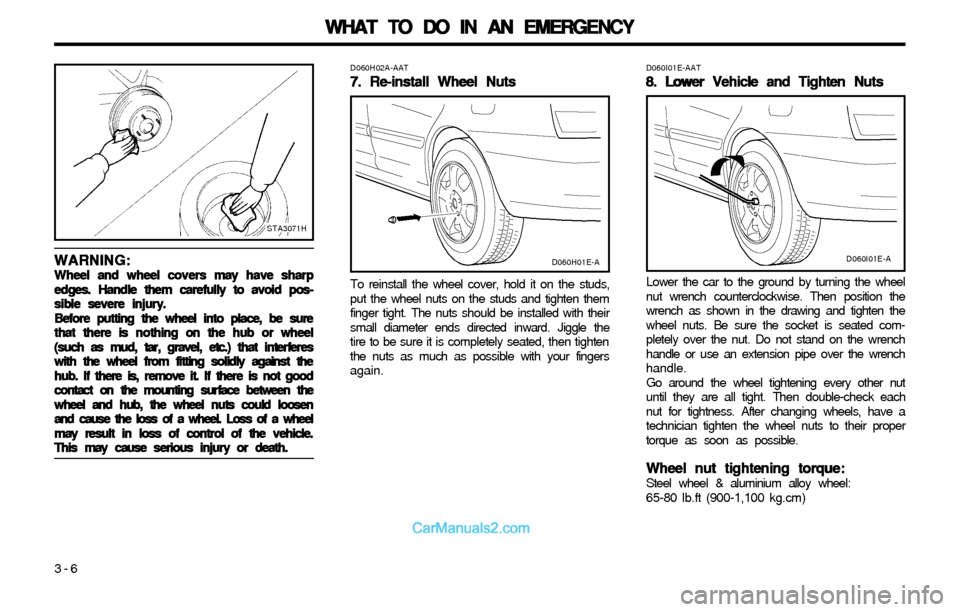
To reinstall the wheel cover, hold it on the studs,
put the wheel nuts on the studs and tighten them
finger tight. The nuts should be installed with their
small diameter ends directed inward. Jiggle the
tire to be sure it is completely seated, then tighten
the nuts as much as possible with your fingers
again.Lower the car to the ground by turning the wheel
nut wrench counterclockwise. Then position the
wrench as shown in the drawing and tighten the
wheel nuts. Be sure the socket is seated com-
pletely over the nut. Do not stand on the wrench
handle or use an extension pipe over the wrench
handle.
Go around the wheel tightening every other nut
until they are all tight. Then double-check each
nut for tightness. After changing wheels, have a
technician tighten the wheel nuts to their proper
torque as soon as possible.
Wheel nut tightening torque: Wheel nut tightening torque:Wheel nut tightening torque: Wheel nut tightening torque:
Wheel nut tightening torque:Steel wheel & aluminium alloy wheel:
65-80 lb.ft (900-1,100 kg.cm)
D060I01E-AAT
8. Lower Vehicle and Tighten Nuts 8. Lower Vehicle and Tighten Nuts8. Lower Vehicle and Tighten Nuts 8. Lower Vehicle and Tighten Nuts
8. Lower Vehicle and Tighten Nuts
D060H01E-AD060I01E-A
Page 122 of 172
WHAT TO DO IN AN EMERGENCY WHAT TO DO IN AN EMERGENCYWHAT TO DO IN AN EMERGENCY WHAT TO DO IN AN EMERGENCY
WHAT TO DO IN AN EMERGENCY
3-7
D060J01E-AAT
After Changing Wheels After Changing WheelsAfter Changing Wheels After Changing Wheels
After Changing Wheels
If you have a tire gauge, remove the valve cap
and check the air pressure. If the pressure is
lower than recommended, drive slowly to the
nearest service station and inflate to the correct
pressure. If it is too high, adjust it until it is correct.
Always reinstall the valve cap after checking or
adjusting tire pressure. If the cap is not replaced,
air may leak from the tire. If you lose a valve cap,
buy another and install it as soon as possible.
After you have changed wheels, always secure
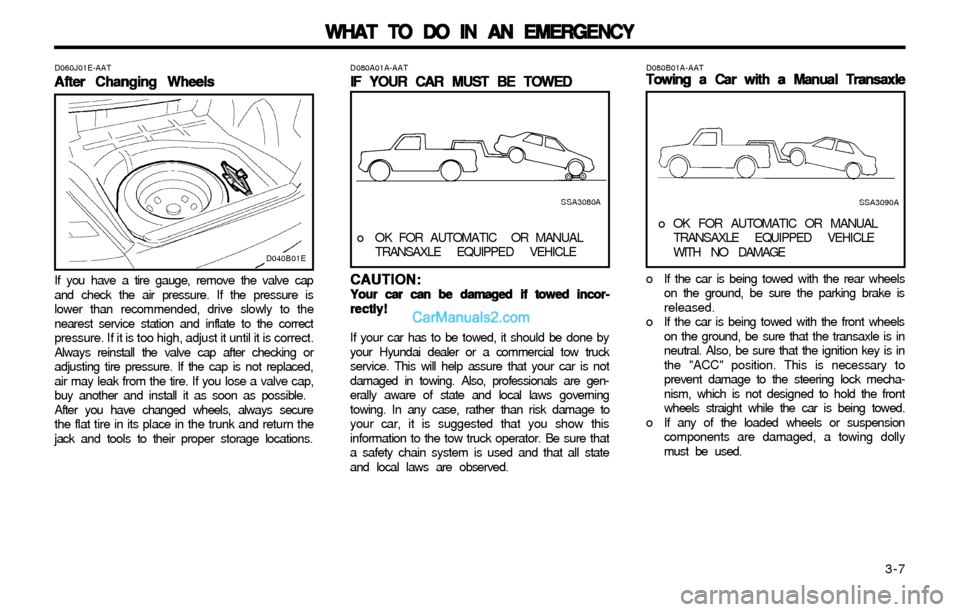
the flat tire in its place in the trunk and return the
jack and tools to their proper storage locations.
D080A01A-AAT
IF YOUR CAR MUST BE TOWED IF YOUR CAR MUST BE TOWEDIF YOUR CAR MUST BE TOWED IF YOUR CAR MUST BE TOWED
IF YOUR CAR MUST BE TOWED
CAUTION: CAUTION:CAUTION: CAUTION:
CAUTION:
Your car can be damaged if towed incor- Your car can be damaged if towed incor-Your car can be damaged if towed incor- Your car can be damaged if towed incor-
Your car can be damaged if towed incor-
rectly! rectly!rectly! rectly!
rectly!
If your car has to be towed, it should be done by
your Hyundai dealer or a commercial tow truck
service. This will help assure that your car is not
damaged in towing. Also, professionals are gen-
erally aware of state and local laws governing
towing. In any case, rather than risk damage to
your car, it is suggested that you show this
information to the tow truck operator. Be sure that
a safety chain system is used and that all state
and local laws are observed.
D080B01A-AATTowing a Car with a Manual Transaxle Towing a Car with a Manual TransaxleTowing a Car with a Manual Transaxle Towing a Car with a Manual Transaxle
Towing a Car with a Manual Transaxle
o If the car is being towed with the rear wheels
on the ground, be sure the parking brake is
released.
o If the car is being towed with the front wheels
on the ground, be sure that the transaxle is in
neutral. Also, be sure that the ignition key is in
the "ACC" position. This is necessary to
prevent damage to the steering lock mecha-
nism, which is not designed to hold the front
wheels straight while the car is being towed.
o If any of the loaded wheels or suspension
components are damaged, a towing dolly
must be used.
o OK FOR AUTOMATIC OR MANUAL
TRANSAXLE EQUIPPED VEHICLE
SSA3080A
o OK FOR AUTOMATIC OR MANUAL
TRANSAXLE EQUIPPED VEHICLE
WITH NO DAMAGE
SSA3090A
D040B01E
Page 123 of 172

WHAT TO DO IN AN EMERGENCY WHAT TO DO IN AN EMERGENCYWHAT TO DO IN AN EMERGENCY WHAT TO DO IN AN EMERGENCY
WHAT TO DO IN AN EMERGENCY
3-8
D080C02A-AATTowing a Car with an Automatic Towing a Car with an AutomaticTowing a Car with an Automatic Towing a Car with an Automatic
Towing a Car with an Automatic
Transaxle TransaxleTransaxle Transaxle
Transaxle
CAUTION: CAUTION:CAUTION: CAUTION:
CAUTION:
A car with an automatic transaxle should A car with an automatic transaxle shouldA car with an automatic transaxle should A car with an automatic transaxle should
A car with an automatic transaxle should
never be towed from the rear with the front never be towed from the rear with the frontnever be towed from the rear with the front never be towed from the rear with the front
never be towed from the rear with the front
wheels on the ground. This can cause seri- wheels on the ground. This can cause seri-wheels on the ground. This can cause seri- wheels on the ground. This can cause seri-
wheels on the ground. This can cause seri-
ous damage to the transaxle. If the car must ous damage to the transaxle. If the car mustous damage to the transaxle. If the car must ous damage to the transaxle. If the car must
ous damage to the transaxle. If the car must
be towed from the rear, a towing dolly must be towed from the rear, a towing dolly mustbe towed from the rear, a towing dolly must be towed from the rear, a towing dolly must
be towed from the rear, a towing dolly must
be used under the front wheels. be used under the front wheels.be used under the front wheels. be used under the front wheels.
be used under the front wheels.
If the car is being towed with the rear wheels on
the ground, be sure the parking brake is re-
leased.
o NOT OK FOR AUTOMATIC TRANSAXLE
EQUIPPED VEHICLE
o OK FOR MANUAL TRANSAXLE
SSA3100A o OK FOR AUTOMATIC OR MANUAL
TRANSAXLE EQUIPPED VEHICLE
SSA3101AD080D02A-AAT
Emergency Towing Emergency TowingEmergency Towing Emergency Towing
Emergency Towing
For emergency towing when no commercial tow
vehicle is available, attach a tow cable, chain or
strap to one of the tie-down hooks under the front
of your car. Do not attempt to tow your vehicle in
this manner on any unpaved surface. This could
result in serious damage to your car.
Nor should towing be attempted if the wheels,
drive train, axles, steering or brakes are dam-
aged. Before towing, be sure the transaxle is in
neutral and the key is in "ACC" (with the engine
off) or in the "ON" position (with the engine
running). A driver must be in the towed car to
steer it and operate the brakes.
D080D01ENOTE: NOTE:NOTE: NOTE:
NOTE:Before towing, check the level of the tran- Before towing, check the level of the tran-Before towing, check the level of the tran- Before towing, check the level of the tran-
Before towing, check the level of the tran-
saxle fluid. If it is below the "HOT" mark on saxle fluid. If it is below the "HOT" mark onsaxle fluid. If it is below the "HOT" mark on saxle fluid. If it is below the "HOT" mark on
saxle fluid. If it is below the "HOT" mark on
the dipstick, add fluid. If you cannot add fluid, the dipstick, add fluid. If you cannot add fluid,the dipstick, add fluid. If you cannot add fluid, the dipstick, add fluid. If you cannot add fluid,
the dipstick, add fluid. If you cannot add fluid,
a towing dolly must be used as described a towing dolly must be used as describeda towing dolly must be used as described a towing dolly must be used as described
a towing dolly must be used as described
above. above.above. above.
above.
Page 124 of 172

WHAT TO DO IN AN EMERGENCY WHAT TO DO IN AN EMERGENCYWHAT TO DO IN AN EMERGENCY WHAT TO DO IN AN EMERGENCY
WHAT TO DO IN AN EMERGENCY
3-9
D120A01A-AAT
IF YOU LOSE YOUR KEYS IF YOU LOSE YOUR KEYSIF YOU LOSE YOUR KEYS IF YOU LOSE YOUR KEYS
IF YOU LOSE YOUR KEYSIf you lose your keys, many Hyundai dealers can
make you a new key if you have your key
number.
If you lock the keys inside your car and you
cannot obtain a new key, many Hyundai dealers
can use special tools to open the door for you.
CAUTION: CAUTION:CAUTION: CAUTION:
CAUTION:If the car is being towed with all four wheels If the car is being towed with all four wheelsIf the car is being towed with all four wheels If the car is being towed with all four wheels
If the car is being towed with all four wheels
on the ground, it can be towed only from the on the ground, it can be towed only from theon the ground, it can be towed only from the on the ground, it can be towed only from the
on the ground, it can be towed only from the
front. Be sure that the transaxle is in neutral. front. Be sure that the transaxle is in neutral.front. Be sure that the transaxle is in neutral. front. Be sure that the transaxle is in neutral.
front. Be sure that the transaxle is in neutral.
Do not tow at speeds greater than 30 mph (50 Do not tow at speeds greater than 30 mph (50Do not tow at speeds greater than 30 mph (50 Do not tow at speeds greater than 30 mph (50
Do not tow at speeds greater than 30 mph (50
km/h) and for more than 15 miles (25 km). Be km/h) and for more than 15 miles (25 km). Bekm/h) and for more than 15 miles (25 km). Be km/h) and for more than 15 miles (25 km). Be
km/h) and for more than 15 miles (25 km). Be
sure the steering is unlocked by placing the sure the steering is unlocked by placing thesure the steering is unlocked by placing the sure the steering is unlocked by placing the
sure the steering is unlocked by placing the
key in the "ACC" position. A driver must be in key in the "ACC" position. A driver must be inkey in the "ACC" position. A driver must be in key in the "ACC" position. A driver must be in
key in the "ACC" position. A driver must be in
the towed vehicle to operate the steering and the towed vehicle to operate the steering andthe towed vehicle to operate the steering and the towed vehicle to operate the steering and
the towed vehicle to operate the steering and
brakes. brakes.brakes. brakes.
brakes.
Page 126 of 172
CORROSION PREVENTION AND APPEARANCE CARE CORROSION PREVENTION AND APPEARANCE CARECORROSION PREVENTION AND APPEARANCE CARE CORROSION PREVENTION AND APPEARANCE CARE
CORROSION PREVENTION AND APPEARANCE CARE
4-2
E020C01A-AAT
Keep Your Garage Dry Keep Your Garage DryKeep Your Garage Dry Keep Your Garage Dry
Keep Your Garage DryDon't park your car in a damp, poorly ventilated
garage. This creates a favorable environment for
corrosion. This is particularly true if you wash
your car in the garage or drive it into the garage
when it is still wet or covered with snow, ice or
mud. Even a heated garage can contribute to
corrosion unless it is well ventilated so moisture
is dispersed.
E020D01A-AATKeep Paint and Trim in Good Condition Keep Paint and Trim in Good ConditionKeep Paint and Trim in Good Condition Keep Paint and Trim in Good Condition
Keep Paint and Trim in Good ConditionScratches or chips in the finish should be cov-
ered with "touch-up" paint as soon as possible to
reduce the possibility of corrosion. If bare metal
is showing through, the attention of a qualified
body and paint shop is recommended.
E020E01A-AAT
Don't Neglect the Interior Don't Neglect the InteriorDon't Neglect the Interior Don't Neglect the Interior
Don't Neglect the InteriorMoisture can collect under the floor mats and
carpeting to cause corrosion. Check under the
mats periodically to be sure the carpeting is dry.
Use particular care if you carry fertilizers, clean-
ing materials or chemicals in the car.
These should be carried only in proper contain-
ers and any spills or leaks should be cleaned up,
flushed with clear water and thoroughly dried.
E030A01A-AAT
WASHING AND WAXING WASHING AND WAXINGWASHING AND WAXING WASHING AND WAXING
WASHING AND WAXING
Washing Your Hyundai Washing Your HyundaiWashing Your Hyundai Washing Your Hyundai
Washing Your Hyundai
Never wash your car when the surface is hot
from being in the sun. Always wash your car in
the shade.
Wash your car frequently. Dirt is abrasive and
can scratch the paint if it is not removed. Air
pollution or acid rain may damage the paint and
trim through chemical action if pollutants are
allowed to remain in contact with the surface. If
you live near the ocean or in an area where road
salts or dust control chemicals are used, you
should pay particular attention to the underside
of the car. Start by rinsing the car to remove dust
and loose dirt. In winter, or if you have driven
through mud or muddy water, be sure to thor-
oughly clean the underside as well. Use a hard
direct stream of water to remove accumulations
of mud or corrosive materials. Use a good quality
car-washing solution and follow the
manufacturer's directions on the package. These
are available at your Hyundai dealer or auto parts
outlet. Don't use strong household detergents,
gasoline, strong solvents or abrasive cleaning
powders as these may damage the finish.
Use a clean sponge or cloth, rinse it frequently
and don't damage the finish by rubbing too hard.
For stubborn spots, dampen them frequently and
remove them a little at a time.To clean whitewall tires, use a stiff brush or
soapy steel-wool scouring pad.
To clean plastic wheel covers, use a clean sponge
or soft cloth and water.
To clean cast aluminum alloy wheels, use a mild
soap or neutral detergent. Do not use abrasive
cleaners. Protect the bare-metal surfaces by
cleaning, polishing and waxing. Because alumi-
num is subject to corrosion, be sure to give
aluminum alloy wheels special attention in win-
ter. If you drive on salted roads, clean the wheels
thoroughly afterwards.
After washing, be sure to rinse thoroughly. If
soapy water dries on the finish, streaking will
result.
When the weather is warm and the humidity low,
you may find it necessary to rinse each section
immediately after washing to avoid streaking.
After rinsing, dry the car using a damp chamois
or soft, absorbent cloth. The reason for drying the
car is to remove water from the car so it will dry
without water spots. Don't rub, this can damage
the finish.
If you find any nicks or scratches in the paint, use
touch-up paint to cover them to prevent corro-
sion. To protect the paintwork of the car against
corrosion, you must clean your Hyundai (at least
once a month). Give special attention to the
removal of salt, mud and other substances on the
underside of the splashboards of the car. Make
sure that the outlets and the underside of the
Page 135 of 172
VEHICLE MAINTENANCE REQUIREMENTS VEHICLE MAINTENANCE REQUIREMENTSVEHICLE MAINTENANCE REQUIREMENTS VEHICLE MAINTENANCE REQUIREMENTS
VEHICLE MAINTENANCE REQUIREMENTS
5-7
F070E05A-AAT
o Automatic Transaxle Fluid o Automatic Transaxle Fluido Automatic Transaxle Fluid o Automatic Transaxle Fluid
o Automatic Transaxle FluidThe fluid level should be in the "HOT" range
of the dipstick, after the engine and transaxle
are at normal operating temperature. Check
the automatic transaxle fluid level with the
engine running and the transaxle in neutral,
with the parking brake properly applied. Use
HYUNDAI GENUINE ATF, DIAMOND ATF
SP-III or SK ATF SP-III when adding or
changing fluid.
F070F01A-AAT
o oo o
o
Brake Hoses and Lines Brake Hoses and LinesBrake Hoses and Lines Brake Hoses and Lines
Brake Hoses and LinesVisually check for proper installation, chafing,
cracks, deterioration and any leakage. Re-
place any deteriorated or damaged parts
immediately.
F070G02A-AAT
o Brake Fluid o Brake Fluido Brake Fluid o Brake Fluid
o Brake FluidCheck brake fluid level in the brake fluid
reservoir. The level should be between "MIN"
and "MAX" marks on the side of the reservoir.
Use only hydraulic brake fluid conforming to
DOT 3 or DOT 4.
F070D01A-AAT
o Manual transaxle oil o Manual transaxle oilo Manual transaxle oil o Manual transaxle oil
o Manual transaxle oilInspect the manual transaxle oil according to
the maintenance schedule.
NOTE: NOTE:NOTE: NOTE:
NOTE:If the oil level is low, check for possible If the oil level is low, check for possibleIf the oil level is low, check for possible If the oil level is low, check for possible
If the oil level is low, check for possible
leaks before adding oil. Do not overfill. leaks before adding oil. Do not overfill.leaks before adding oil. Do not overfill. leaks before adding oil. Do not overfill.
leaks before adding oil. Do not overfill.
F070H01A-AATo oo o
o
Rear Brake Drums/Linings, Rear Brake Drums/Linings,Rear Brake Drums/Linings, Rear Brake Drums/Linings,
Rear Brake Drums/Linings,
Parking Brake Parking BrakeParking Brake Parking Brake
Parking Brake
Check the rear brake drums and linings for
scoring, burning, leaking fluid, broken parts,
and excessive wear. Inspect the parking
brake system including the parking brake
lever and cables. For detailed service proce-
dures, refer to the Shop Manual.
F070J01A-AAT
o Brake Pads, Calipers and Rotors o Brake Pads, Calipers and Rotorso Brake Pads, Calipers and Rotors o Brake Pads, Calipers and Rotors
o Brake Pads, Calipers and RotorsCheck the pads for excessive wear, discs for
run out and wear, and calipers for fluid leak-
age.
F070K01A-AAT
o Exhaust Pipe and Muffler o Exhaust Pipe and Mufflero Exhaust Pipe and Muffler o Exhaust Pipe and Muffler
o Exhaust Pipe and MufflerVisually inspect the exhaust pipes, muffler
and hangers for cracks, deterioration, or dam-
age. Start the engine and listen carefully for
any exhaust gas leakage. Tighten connec-
tions or replace parts as necessary.
F070L01A-AAT
o Suspension Mounting Bolts o Suspension Mounting Boltso Suspension Mounting Bolts o Suspension Mounting Bolts
o Suspension Mounting BoltsCheck the suspension connections for loose-
ness or damage. Retighten to the specified
torque.
F070N01A-AATo oo o
o
Power Steering Pump, Belt and Hoses Power Steering Pump, Belt and HosesPower Steering Pump, Belt and Hoses Power Steering Pump, Belt and Hoses
Power Steering Pump, Belt and HosesCheck the power steering pump and hoses
for leakage and damage. Replace any dam-
aged or leaking parts immediately. Inspect the
power steering belt for evidence of cuts,
cracks, excessive wear, oiliness and proper
tension. Replace or adjust it if necessary.
F070P01A-AAT
o Driveshafts and Boots o Driveshafts and Bootso Driveshafts and Boots o Driveshafts and Boots
o Driveshafts and BootsCheck the drive shafts, boots and clamps for
cracks, deterioration, or damage. Replace
any damaged parts and, if necessary, repack
the grease.
F070Q01A-AAT
o oo o
o
Air Conditioning Refrigerant Air Conditioning RefrigerantAir Conditioning Refrigerant Air Conditioning Refrigerant
Air Conditioning RefrigerantCheck the air conditioning lines and connec-
tions for leakage and damage. Check air
conditioning performance according to the
relevant shop manual if necessary.
F070M01A-AATo oo o
o
Steering Gear Box, Linkage & Boots/ Steering Gear Box, Linkage & Boots/Steering Gear Box, Linkage & Boots/ Steering Gear Box, Linkage & Boots/
Steering Gear Box, Linkage & Boots/
Lower arm Ball Joint Lower arm Ball JointLower arm Ball Joint Lower arm Ball Joint
Lower arm Ball Joint
With the vehicle stopped and engine off, check
for excessive free-play in the steering wheel.
Check the linkage for bends or damage.
Check the dust boots and ball joints for dete-
rioration, cracks, or damage. Replace any
damaged parts.
Page 139 of 172
DO-IT-YOURSELF MAINTENANCE DO-IT-YOURSELF MAINTENANCEDO-IT-YOURSELF MAINTENANCE DO-IT-YOURSELF MAINTENANCE
DO-IT-YOURSELF MAINTENANCE
6-3
G020B01A-AAT
Vehicle Exterior Vehicle ExteriorVehicle Exterior Vehicle Exterior
Vehicle ExteriorThe following should be checked monthly:
o Overall appearance and condition
o Wheel condition and wheel nut torque
o Exhaust system condition
o Light condition and operation
o Windshield glass condition
o Wiper blade condition
o Paint condition and body corrosion
o Fluid leaks
o Door and hood lock condition
o Tire pressure and condition (including spare
tire)
G020C01A-AAT
Vehicle Interior Vehicle InteriorVehicle Interior Vehicle Interior
Vehicle InteriorThe following should be checked each time
when the vehicle is driven:
o Lights operation
o Windshield wiper operation
o Horn operation
o Defroster, heating system operation (and air
conditioning, if installed)
o Steering operation and condition
o Mirror condition and operation
o Turn signal operation
o Accelerator pedal operation
o Brake operation, including parking brake
o Manual transaxle operation, including clutch
operation
o Automatic transaxle operation, including
"Park" mechanism operation
o Seat control condition and operation
o Seat belt condition and operation
o Sunvisor operation
If you notice anything that does not operate
correctly or appears to be functioning incorrect-
ly, inspect it carefully and seek assistance from
your Hyundai dealer if service is needed.
G030A01A-AAT
CHECKING THE ENGINE OIL CHECKING THE ENGINE OILCHECKING THE ENGINE OIL CHECKING THE ENGINE OIL
CHECKING THE ENGINE OILEngine oil is essential to the performance and
service of the engine. It is suggested that you
check the oil level at least once a week in
normal use and more often if you are on a trip
or driving in severe conditions.
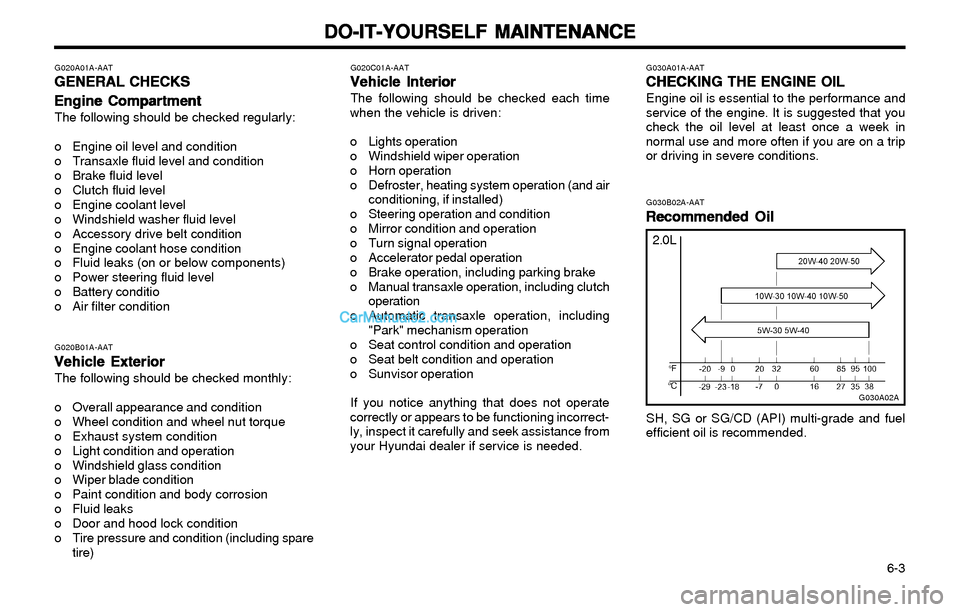
G030B02A-AAT
Recommended Oil Recommended OilRecommended Oil Recommended Oil
Recommended Oil
G030A02A
2.0L
SH, SG or SG/CD (API) multi-grade and fuel
efficient oil is recommended.
G020A01A-AAT
GENERAL CHECKS GENERAL CHECKSGENERAL CHECKS GENERAL CHECKS
GENERAL CHECKS
Engine Compartment Engine CompartmentEngine Compartment Engine Compartment
Engine Compartment
The following should be checked regularly:
o Engine oil level and condition
o Transaxle fluid level and condition
o Brake fluid level
o Clutch fluid level
o Engine coolant level
o Windshield washer fluid level
o Accessory drive belt condition
o Engine coolant hose condition
o Fluid leaks (on or below components)
o Power steering fluid level
o Battery conditio
o Air filter condition
Page 149 of 172
DO-IT-YOURSELF MAINTENANCE DO-IT-YOURSELF MAINTENANCEDO-IT-YOURSELF MAINTENANCE DO-IT-YOURSELF MAINTENANCE
DO-IT-YOURSELF MAINTENANCE
6-13
G150A01A-AAT
CHECKING STEERING WHEEL CHECKING STEERING WHEELCHECKING STEERING WHEEL CHECKING STEERING WHEEL
CHECKING STEERING WHEEL
FREE-PLAY FREE-PLAYFREE-PLAY FREE-PLAY
FREE-PLAY
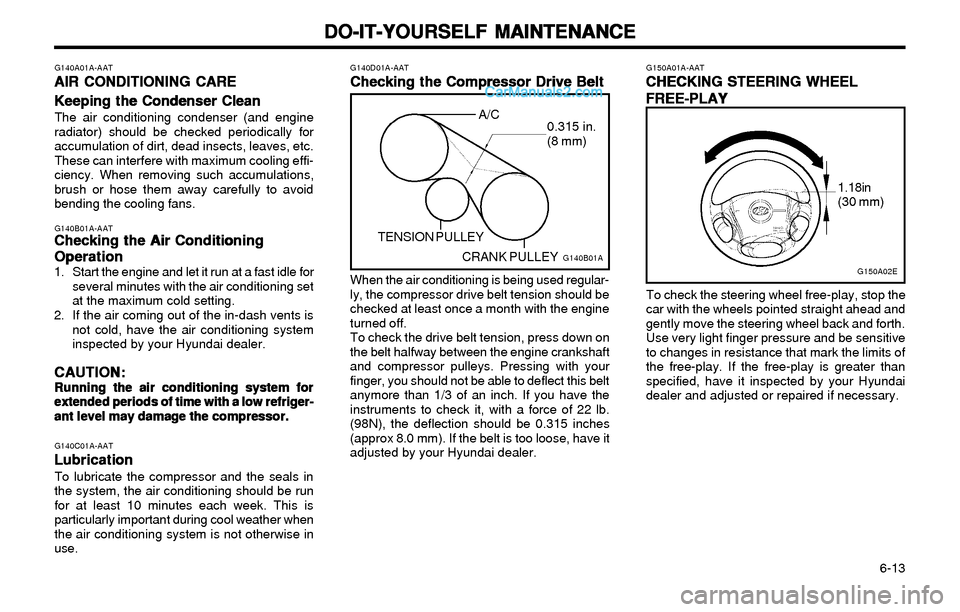
To check the steering wheel free-play, stop the
car with the wheels pointed straight ahead and
gently move the steering wheel back and forth.
Use very light finger pressure and be sensitive
to changes in resistance that mark the limits of
the free-play. If the free-play is greater than
specified, have it inspected by your Hyundai
dealer and adjusted or repaired if necessary.1.18in
(30 mm)
G150A02E
G140B01A-AATChecking the Air Conditioning Checking the Air ConditioningChecking the Air Conditioning Checking the Air Conditioning
Checking the Air Conditioning
Operation OperationOperation Operation
Operation
1. Start the engine and let it run at a fast idle for
several minutes with the air conditioning set
at the maximum cold setting.
2. If the air coming out of the in-dash vents is
not cold, have the air conditioning system
inspected by your Hyundai dealer.
CAUTION: CAUTION:CAUTION: CAUTION:
CAUTION:Running the air conditioning system for Running the air conditioning system forRunning the air conditioning system for Running the air conditioning system for
Running the air conditioning system for
extended periods of time with a low refriger- extended periods of time with a low refriger-extended periods of time with a low refriger- extended periods of time with a low refriger-
extended periods of time with a low refriger-
ant level may damage the compressor. ant level may damage the compressor.ant level may damage the compressor. ant level may damage the compressor.
ant level may damage the compressor.
G140C01A-AAT
Lubrication LubricationLubrication Lubrication
LubricationTo lubricate the compressor and the seals in
the system, the air conditioning should be run
for at least 10 minutes each week. This is
particularly important during cool weather when
the air conditioning system is not otherwise in
use.
G140A01A-AAT
AIR CONDITIONING CARE AIR CONDITIONING CAREAIR CONDITIONING CARE AIR CONDITIONING CARE
AIR CONDITIONING CARE
Keeping the Condenser Clean Keeping the Condenser CleanKeeping the Condenser Clean Keeping the Condenser Clean
Keeping the Condenser Clean
The air conditioning condenser (and engine
radiator) should be checked periodically for
accumulation of dirt, dead insects, leaves, etc.
These can interfere with maximum cooling effi-
ciency. When removing such accumulations,
brush or hose them away carefully to avoid
bending the cooling fans.
G140D01A-AAT
Checking the Compressor Drive Belt Checking the Compressor Drive BeltChecking the Compressor Drive Belt Checking the Compressor Drive Belt
Checking the Compressor Drive Belt
When the air conditioning is being used regular-
ly, the compressor drive belt tension should be
checked at least once a month with the engine
turned off.
To check the drive belt tension, press down on
the belt halfway between the engine crankshaft
and compressor pulleys. Pressing with your
finger, you should not be able to deflect this belt
anymore than 1/3 of an inch. If you have the
instruments to check it, with a force of 22 lb.
(98N), the deflection should be 0.315 inches
(approx 8.0 mm). If the belt is too loose, have it
adjusted by your Hyundai dealer.
G140B01A
A/C0.315 in.
(8 mm)
CRANK PULLEY TENSION PULLEY