Brake system Hyundai Elantra 2003 Owner's Manual
[x] Cancel search | Manufacturer: HYUNDAI, Model Year: 2003, Model line: Elantra, Model: Hyundai Elantra 2003Pages: 172, PDF Size: 2.82 MB
Page 37 of 172
FEATURES OF YOUR HYUNDAI FEATURES OF YOUR HYUNDAIFEATURES OF YOUR HYUNDAI FEATURES OF YOUR HYUNDAI
FEATURES OF YOUR HYUNDAI
1- 28
B260A01E
24 6578 13
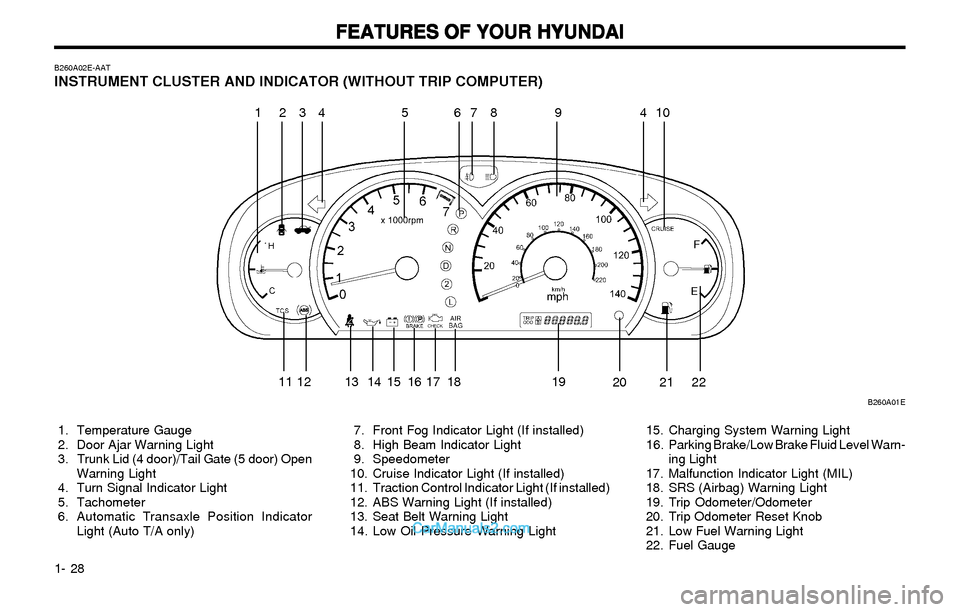
B260A02E-AATINSTRUMENT CLUSTER AND INDICATOR (WITHOUT TRIP COMPUTER)
10
12 13 14 15 16 17 18 19
21 20 22
1. Temperature Gauge
2. Door Ajar Warning Light
3. Trunk Lid (4 door)/Tail Gate (5 door) Open
Warning Light
4. Turn Signal Indicator Light
5. Tachometer
6. Automatic Transaxle Position Indicator
Light (Auto T/A only) 7. Front Fog Indicator Light (If installed)
8. High Beam Indicator Light
9. Speedometer
10. Cruise Indicator Light (If installed)
11. Traction Control Indicator Light (If installed)
12. ABS Warning Light (If installed)
13. Seat Belt Warning Light
14. Low Oil Pressure Warning Light9
114
15. Charging System Warning Light
16. Parking Brake/Low Brake Fluid Level Warn-
ing Light
17. Malfunction Indicator Light (MIL)
18. SRS (Airbag) Warning Light
19. Trip Odometer/Odometer
20. Trip Odometer Reset Knob
21. Low Fuel Warning Light
22. Fuel Gauge
Page 38 of 172
FEATURES OF YOUR HYUNDAI FEATURES OF YOUR HYUNDAIFEATURES OF YOUR HYUNDAI FEATURES OF YOUR HYUNDAI
FEATURES OF YOUR HYUNDAI
1- 29
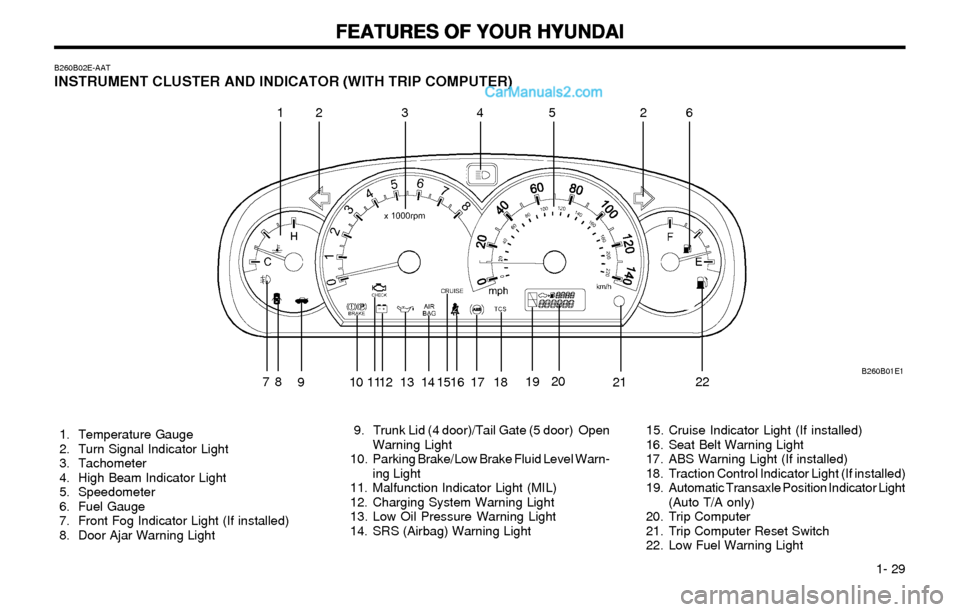
B260B02E-AATINSTRUMENT CLUSTER AND INDICATOR (WITH TRIP COMPUTER)
24 65
7813
10 12 13 14 1516
171819 2220
9112
1. Temperature Gauge
2. Turn Signal Indicator Light
3. Tachometer
4. High Beam Indicator Light
5. Speedometer
6. Fuel Gauge
7. Front Fog Indicator Light (If installed)
8. Door Ajar Warning Light 9. Trunk Lid (4 door)/Tail Gate (5 door) Open
Warning Light
10. Parking Brake/Low Brake Fluid Level Warn-
ing Light
11. Malfunction Indicator Light (MIL)
12. Charging System Warning Light
13. Low Oil Pressure Warning Light
14. SRS (Airbag) Warning Light15. Cruise Indicator Light (If installed)
16. Seat Belt Warning Light
17. ABS Warning Light (If installed)
18. Traction Control Indicator Light (If installed)
19. Automatic Transaxle Position Indicator Light
(Auto T/A only)
20. Trip Computer
21. Trip Computer Reset Switch
22. Low Fuel Warning Light
B260B01E121
Page 39 of 172
FEATURES OF YOUR HYUNDAI FEATURES OF YOUR HYUNDAIFEATURES OF YOUR HYUNDAI FEATURES OF YOUR HYUNDAI
FEATURES OF YOUR HYUNDAI
1- 30
B260D01A-AAT
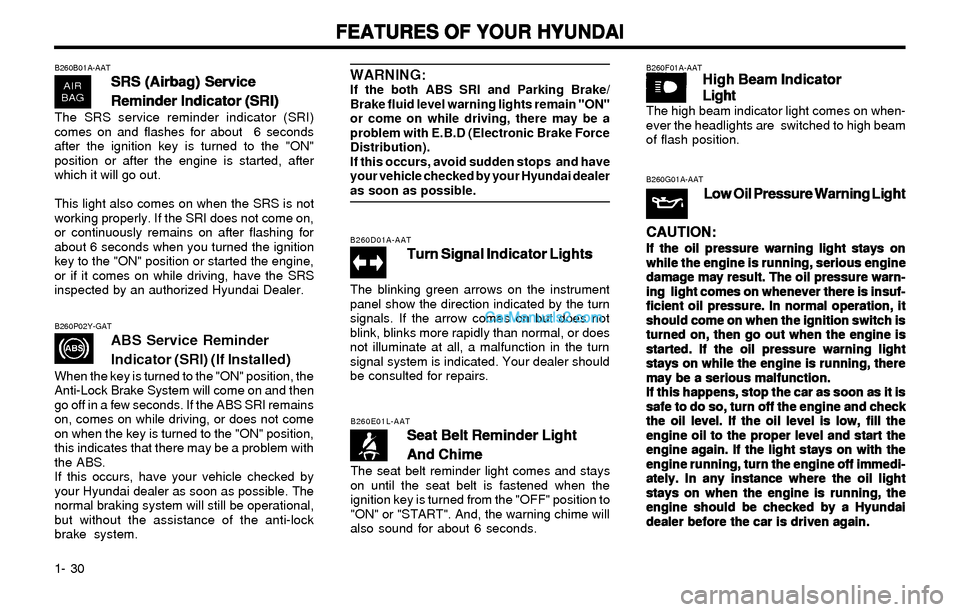
Turn Signal Indicator Lights Turn Signal Indicator LightsTurn Signal Indicator Lights Turn Signal Indicator Lights
Turn Signal Indicator Lights
The blinking green arrows on the instrument
panel show the direction indicated by the turn
signals. If the arrow comes on but does not
blink, blinks more rapidly than normal, or does
not illuminate at all, a malfunction in the turn
signal system is indicated. Your dealer should
be consulted for repairs.
B260E01L-AAT
Seat Belt Reminder Light Seat Belt Reminder LightSeat Belt Reminder Light Seat Belt Reminder Light
Seat Belt Reminder Light
And Chime And ChimeAnd Chime And Chime
And Chime
The seat belt reminder light comes and stays
on until the seat belt is fastened when the
ignition key is turned from the "OFF" position to
"ON" or "START". And, the warning chime will
also sound for about 6 seconds.
B260F01A-AATHigh Beam Indicator High Beam IndicatorHigh Beam Indicator High Beam Indicator
High Beam Indicator
Light LightLight Light
Light
The high beam indicator light comes on when-
ever the headlights are switched to high beam
of flash position.
B260G01A-AAT
Low Oil Pressure Warning Light Low Oil Pressure Warning LightLow Oil Pressure Warning Light Low Oil Pressure Warning Light
Low Oil Pressure Warning Light
CAUTION: CAUTION:CAUTION: CAUTION:
CAUTION:
If the oil pressure warning light stays on If the oil pressure warning light stays onIf the oil pressure warning light stays on If the oil pressure warning light stays on
If the oil pressure warning light stays on
while the engine is running, serious engine while the engine is running, serious enginewhile the engine is running, serious engine while the engine is running, serious engine
while the engine is running, serious engine
damage may result. The oil pressure warn- damage may result. The oil pressure warn-damage may result. The oil pressure warn- damage may result. The oil pressure warn-
damage may result. The oil pressure warn-
ing light comes on whenever there is insuf- ing light comes on whenever there is insuf-ing light comes on whenever there is insuf- ing light comes on whenever there is insuf-
ing light comes on whenever there is insuf-
ficient oil pressure. In normal operation, it ficient oil pressure. In normal operation, itficient oil pressure. In normal operation, it ficient oil pressure. In normal operation, it
ficient oil pressure. In normal operation, it
should come on when the ignition switch is should come on when the ignition switch isshould come on when the ignition switch is should come on when the ignition switch is
should come on when the ignition switch is
turned on, then go out when the engine is turned on, then go out when the engine isturned on, then go out when the engine is turned on, then go out when the engine is
turned on, then go out when the engine is
started. If the oil pressure warning light started. If the oil pressure warning lightstarted. If the oil pressure warning light started. If the oil pressure warning light
started. If the oil pressure warning light
stays on while the engine is running, there stays on while the engine is running, therestays on while the engine is running, there stays on while the engine is running, there
stays on while the engine is running, there
may be a serious malfunction. may be a serious malfunction.may be a serious malfunction. may be a serious malfunction.
may be a serious malfunction.
If this happens, stop the car as soon as it is If this happens, stop the car as soon as it isIf this happens, stop the car as soon as it is If this happens, stop the car as soon as it is
If this happens, stop the car as soon as it is
safe to do so, turn off the engine and check safe to do so, turn off the engine and checksafe to do so, turn off the engine and check safe to do so, turn off the engine and check
safe to do so, turn off the engine and check
the oil level. If the oil level is low, fill the the oil level. If the oil level is low, fill thethe oil level. If the oil level is low, fill the the oil level. If the oil level is low, fill the
the oil level. If the oil level is low, fill the
engine oil to the proper level and start the engine oil to the proper level and start theengine oil to the proper level and start the engine oil to the proper level and start the
engine oil to the proper level and start the
engine again. If the light stays on with the engine again. If the light stays on with theengine again. If the light stays on with the engine again. If the light stays on with the
engine again. If the light stays on with the
engine running, turn the engine off immedi- engine running, turn the engine off immedi-engine running, turn the engine off immedi- engine running, turn the engine off immedi-
engine running, turn the engine off immedi-
ately. In any instance where the oil light ately. In any instance where the oil lightately. In any instance where the oil light ately. In any instance where the oil light
ately. In any instance where the oil light
stays on when the engine is running, the stays on when the engine is running, thestays on when the engine is running, the stays on when the engine is running, the
stays on when the engine is running, the
engine should be checked by a Hyundai engine should be checked by a Hyundaiengine should be checked by a Hyundai engine should be checked by a Hyundai
engine should be checked by a Hyundai
dealer before the car is driven again. dealer before the car is driven again.dealer before the car is driven again. dealer before the car is driven again.
dealer before the car is driven again.
B260B01A-AAT
SRS (Airbag) Service SRS (Airbag) ServiceSRS (Airbag) Service SRS (Airbag) Service
SRS (Airbag) Service
Reminder Indicator (SRI) Reminder Indicator (SRI)Reminder Indicator (SRI) Reminder Indicator (SRI)
Reminder Indicator (SRI)
The SRS service reminder indicator (SRI)
comes on and flashes for about 6 seconds
after the ignition key is turned to the "ON"
position or after the engine is started, after
which it will go out.
This light also comes on when the SRS is not
working properly. If the SRI does not come on,
or continuously remains on after flashing for
about 6 seconds when you turned the ignition
key to the "ON" position or started the engine,
or if it comes on while driving, have the SRS
inspected by an authorized Hyundai Dealer.
B260P02Y-GATABS Service Reminder
Indicator (SRI) (If Installed)
When the key is turned to the "ON" position, the
Anti-Lock Brake System will come on and then
go off in a few seconds. If the ABS SRI remains
on, comes on while driving, or does not come
on when the key is turned to the "ON" position,
this indicates that there may be a problem with
the ABS.
If this occurs, have your vehicle checked by
your Hyundai dealer as soon as possible. The
normal braking system will still be operational,
but without the assistance of the anti-lock
brake system.
WARNING:If the both ABS SRI and Parking Brake/
Brake fluid level warning lights remain "ON"
or come on while driving, there may be a
problem with E.B.D (Electronic Brake Force
Distribution).
If this occurs, avoid sudden stops and have
your vehicle checked by your Hyundai dealer
as soon as possible.
Page 40 of 172
FEATURES OF YOUR HYUNDAI FEATURES OF YOUR HYUNDAIFEATURES OF YOUR HYUNDAI FEATURES OF YOUR HYUNDAI
FEATURES OF YOUR HYUNDAI
1- 31
B260H03A-AAT
Parking Brake/ Parking Brake/Parking Brake/ Parking Brake/
Parking Brake/
Low Brake Fluid Level Low Brake Fluid LevelLow Brake Fluid Level Low Brake Fluid Level
Low Brake Fluid Level
Level Warning Light Level Warning LightLevel Warning Light Level Warning Light
Level Warning Light
WARNING: WARNING:WARNING: WARNING:
WARNING:
If you suspect brake trouble, have your If you suspect brake trouble, have yourIf you suspect brake trouble, have your If you suspect brake trouble, have your
If you suspect brake trouble, have your
brakes checked by a Hyundai dealer as brakes checked by a Hyundai dealer asbrakes checked by a Hyundai dealer as brakes checked by a Hyundai dealer as
brakes checked by a Hyundai dealer as
soon as possible. Driving your car with a soon as possible. Driving your car with asoon as possible. Driving your car with a soon as possible. Driving your car with a
soon as possible. Driving your car with a
problem in either the brake electrical sys- problem in either the brake electrical sys-problem in either the brake electrical sys- problem in either the brake electrical sys-
problem in either the brake electrical sys-
tem or brake hydraulic system is danger- tem or brake hydraulic system is danger-tem or brake hydraulic system is danger- tem or brake hydraulic system is danger-
tem or brake hydraulic system is danger-
ous, and could result in a serious injury or ous, and could result in a serious injury orous, and could result in a serious injury or ous, and could result in a serious injury or
ous, and could result in a serious injury or
death. death.death. death.
death.
Warning Light Operation Warning Light OperationWarning Light Operation Warning Light Operation
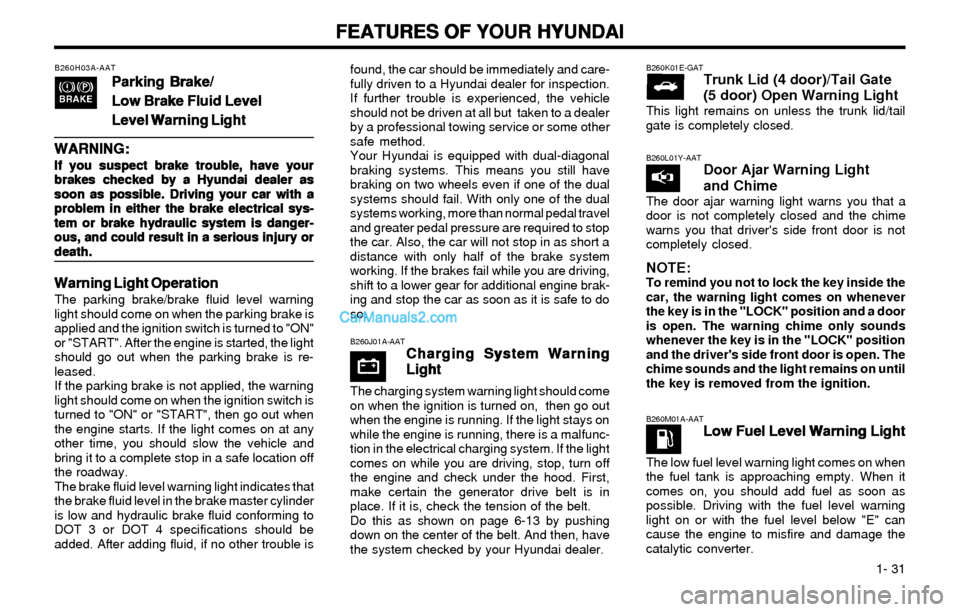
Warning Light OperationThe parking brake/brake fluid level warning
light should come on when the parking brake is
applied and the ignition switch is turned to "ON"
or "START". After the engine is started, the light
should go out when the parking brake is re-
leased.
If the parking brake is not applied, the warning
light should come on when the ignition switch is
turned to "ON" or "START", then go out when
the engine starts. If the light comes on at any
other time, you should slow the vehicle and
bring it to a complete stop in a safe location off
the roadway.
The brake fluid level warning light indicates that
the brake fluid level in the brake master cylinder
is low and hydraulic brake fluid conforming to
DOT 3 or DOT 4 specifications should be
added. After adding fluid, if no other trouble isfound, the car should be immediately and care-
fully driven to a Hyundai dealer for inspection.
If further trouble is experienced, the vehicle
should not be driven at all but taken to a dealer
by a professional towing service or some other
safe method.
Your Hyundai is equipped with dual-diagonal
braking systems. This means you still have
braking on two wheels even if one of the dual
systems should fail. With only one of the dual
systems working, more than normal pedal travel
and greater pedal pressure are required to stop
the car. Also, the car will not stop in as short a
distance with only half of the brake system
working. If the brakes fail while you are driving,
shift to a lower gear for additional engine brak-
ing and stop the car as soon as it is safe to do
so.
B260J01A-AATCharging System Warning Charging System WarningCharging System Warning Charging System Warning
Charging System Warning
Light LightLight Light
Light
The charging system warning light should come
on when the ignition is turned on, then go out
when the engine is running. If the light stays on
while the engine is running, there is a malfunc-
tion in the electrical charging system. If the light
comes on while you are driving, stop, turn off
the engine and check under the hood. First,
make certain the generator drive belt is in
place. If it is, check the tension of the belt.
Do this as shown on page 6-13 by pushing
down on the center of the belt. And then, have
the system checked by your Hyundai dealer.
B260M01A-AATLow Fuel Level Warning Light Low Fuel Level Warning LightLow Fuel Level Warning Light Low Fuel Level Warning Light
Low Fuel Level Warning Light
The low fuel level warning light comes on when
the fuel tank is approaching empty. When it
comes on, you should add fuel as soon as
possible. Driving with the fuel level warning
light on or with the fuel level below "E" can
cause the engine to misfire and damage the
catalytic converter.
B260L01Y-AATDoor Ajar Warning Light
and Chime
The door ajar warning light warns you that a
door is not completely closed and the chime
warns you that driver's side front door is not
completely closed.
NOTE:To remind you not to lock the key inside the
car, the warning light comes on whenever
the key is in the "LOCK" position and a door
is open. The warning chime only sounds
whenever the key is in the "LOCK" position
and the driver's side front door is open. The
chime sounds and the light remains on until
the key is removed from the ignition.
B260K01E-GATTrunk Lid (4 door)/Tail Gate
(5 door) Open Warning Light
This light remains on unless the trunk lid/tail
gate is completely closed.
Page 41 of 172
FEATURES OF YOUR HYUNDAI FEATURES OF YOUR HYUNDAIFEATURES OF YOUR HYUNDAI FEATURES OF YOUR HYUNDAI
FEATURES OF YOUR HYUNDAI
1- 32
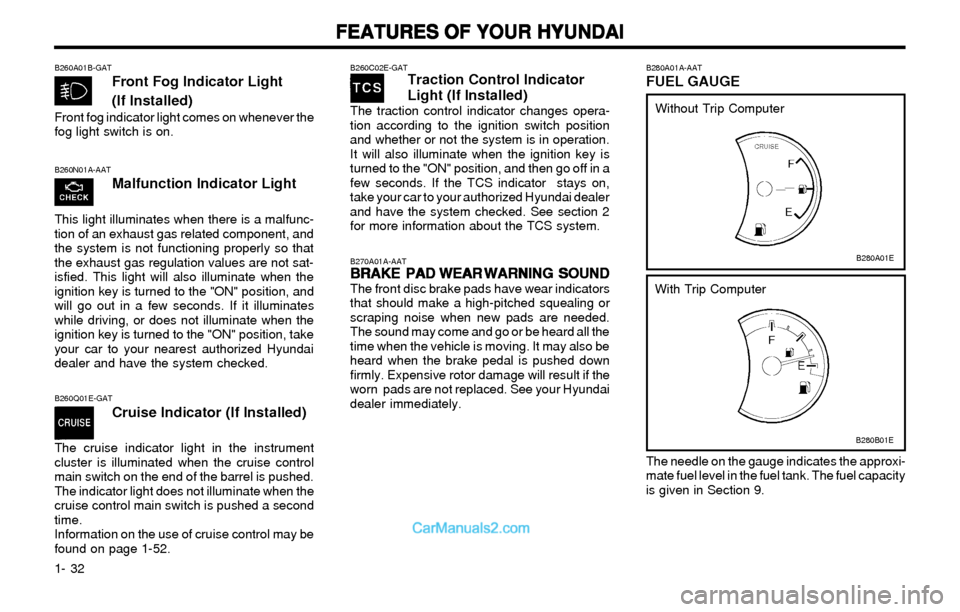
B260N01A-AATMalfunction Indicator Light
This light illuminates when there is a malfunc-
tion of an exhaust gas related component, and
the system is not functioning properly so that
the exhaust gas regulation values are not sat-
isfied. This light will also illuminate when the
ignition key is turned to the "ON" position, and
will go out in a few seconds. If it illuminates
while driving, or does not illuminate when the
ignition key is turned to the "ON" position, take
your car to your nearest authorized Hyundai
dealer and have the system checked.
B270A01A-AATBRAKE PAD WEAR WARNING SOUND BRAKE PAD WEAR WARNING SOUNDBRAKE PAD WEAR WARNING SOUND BRAKE PAD WEAR WARNING SOUND
BRAKE PAD WEAR WARNING SOUNDThe front disc brake pads have wear indicators
that should make a high-pitched squealing or
scraping noise when new pads are needed.
The sound may come and go or be heard all the
time when the vehicle is moving. It may also be
heard when the brake pedal is pushed down
firmly. Expensive rotor damage will result if the
worn pads are not replaced. See your Hyundai
dealer immediately.
B260Q01E-GATCruise Indicator (If Installed)
The cruise indicator light in the instrument
cluster is illuminated when the cruise control
main switch on the end of the barrel is pushed.
The indicator light does not illuminate when the
cruise control main switch is pushed a second
time.
Information on the use of cruise control may be
found on page 1-52.
B260A01B-GATFront Fog Indicator Light
(If Installed)
Front fog indicator light comes on whenever the
fog light switch is on.
B280B01E
B280A01E
Without Trip Computer
With Trip Computer
CRUISE
B280A01A-AATFUEL GAUGE
The needle on the gauge indicates the approxi-
mate fuel level in the fuel tank. The fuel capacity
is given in Section 9.
B260C02E-GATTraction Control Indicator
Light (If Installed)
The traction control indicator changes opera-
tion according to the ignition switch position
and whether or not the system is in operation.
It will also illuminate when the ignition key is
turned to the "ON" position, and then go off in a
few seconds. If the TCS indicator stays on,
take your car to your authorized Hyundai dealer
and have the system checked. See section 2
for more information about the TCS system.
Page 62 of 172
FEATURES OF YOUR HYUNDAI FEATURES OF YOUR HYUNDAIFEATURES OF YOUR HYUNDAI FEATURES OF YOUR HYUNDAI
FEATURES OF YOUR HYUNDAI
1- 53
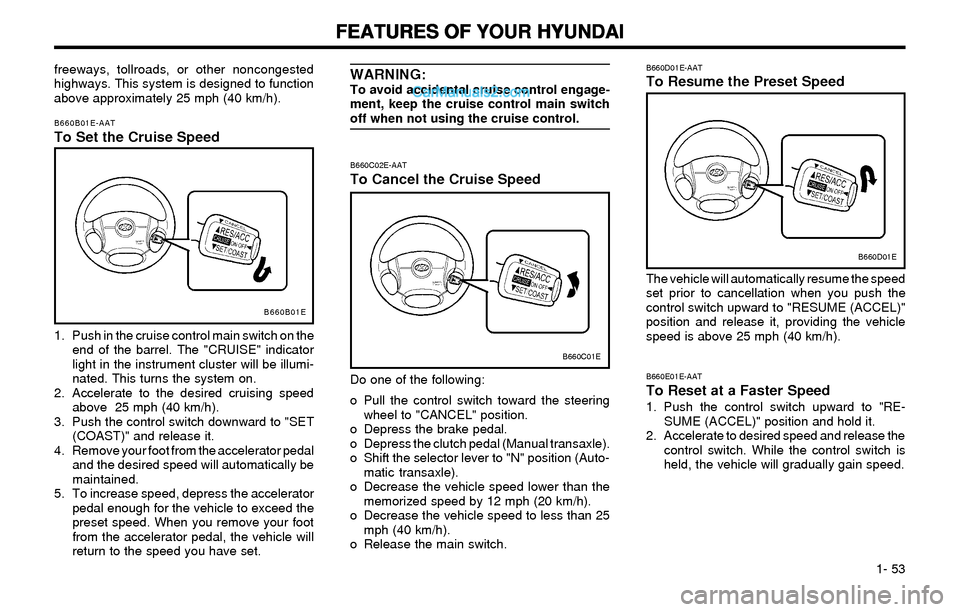
B660D01E-AATTo Resume the Preset Speed
B660D01E
The vehicle will automatically resume the speed
set prior to cancellation when you push the
control switch upward to "RESUME (ACCEL)"
position and release it, providing the vehicle
speed is above 25 mph (40 km/h).
B660E01E-AAT
To Reset at a Faster Speed1. Push the control switch upward to "RE-
SUME (ACCEL)" position and hold it.
2. Accelerate to desired speed and release the
control switch. While the control switch is
held, the vehicle will gradually gain speed.
B660C02E-AAT
To Cancel the Cruise Speed
Do one of the following:
o Pull the control switch toward the steering
wheel to "CANCEL" position.
o Depress the brake pedal.
o Depress the clutch pedal (Manual transaxle).
o Shift the selector lever to "N" position (Auto-
matic transaxle).
o Decrease the vehicle speed lower than the
memorized speed by 12 mph (20 km/h).
o Decrease the vehicle speed to less than 25
mph (40 km/h).
o Release the main switch.
B660C01E
WARNING:To avoid accidental cruise control engage-
ment, keep the cruise control main switch
off when not using the cruise control.
B660B01E
B660B01E-AATTo Set the Cruise Speed
1. Push in the cruise control main switch on the
end of the barrel. The "CRUISE" indicator
light in the instrument cluster will be illumi-
nated. This turns the system on.
2. Accelerate to the desired cruising speed
above 25 mph (40 km/h).
3. Push the control switch downward to "SET
(COAST)" and release it.
4. Remove your foot from the accelerator pedal
and the desired speed will automatically be
maintained.
5. To increase speed, depress the accelerator
pedal enough for the vehicle to exceed the
preset speed. When you remove your foot
from the accelerator pedal, the vehicle will
return to the speed you have set. freeways, tollroads, or other noncongested
highways. This system is designed to function
above approximately 25 mph (40 km/h).
Page 63 of 172
FEATURES OF YOUR HYUNDAI FEATURES OF YOUR HYUNDAIFEATURES OF YOUR HYUNDAI FEATURES OF YOUR HYUNDAI
FEATURES OF YOUR HYUNDAI
1- 54o During cruise-control driving with a
manual transaxle vehicle, do not shift into
neutral without depressing the clutch
pedal, or the engine will be overrevved. If
this happens, depress the clutch pedal or
release the main switch.
o With the cruise control engaged, when
the brake pedal is applied, it is normal to
hear the cruise control system deacti-
vate. This is an indication of normal sys-
tem operation.
o During normal cruise control operation,
when the "SET(COAST)" is activated or
reactivated after applying the brakes, the
cruise control will energize after approx-
imately 3 seconds. This delay is normal.
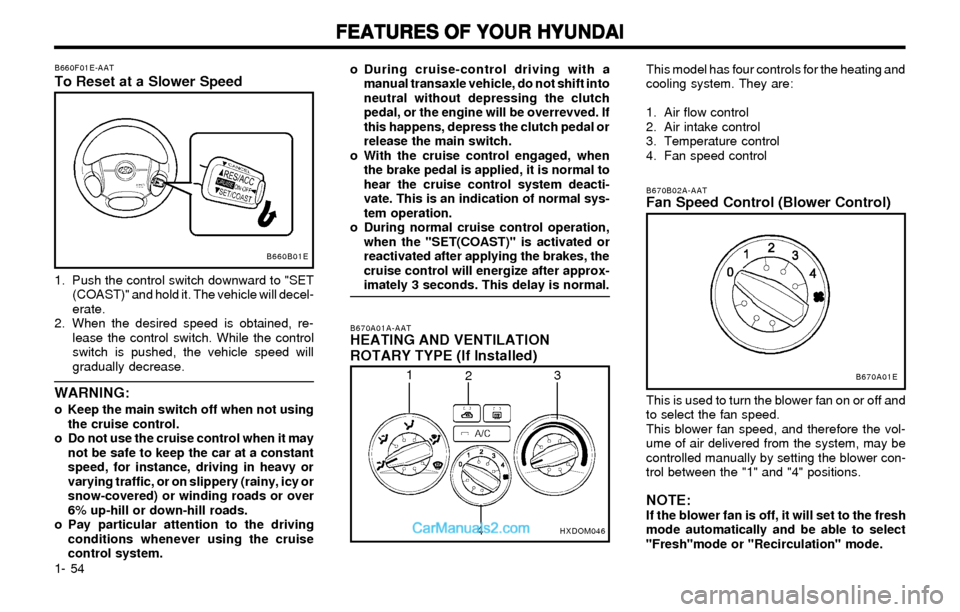
B670B02A-AATFan Speed Control (Blower Control)
B670A01E
This is used to turn the blower fan on or off and
to select the fan speed.
This blower fan speed, and therefore the vol-
ume of air delivered from the system, may be
controlled manually by setting the blower con-
trol between the "1" and "4" positions.
NOTE:If the blower fan is off, it will set to the fresh
mode automatically and be able to select
"Fresh"mode or "Recirculation" mode.
B670A01A-AATHEATING AND VENTILATION
ROTARY TYPE (If Installed)
HXDOM046
This model has four controls for the heating and
cooling system. They are:
1. Air flow control
2. Air intake control
3. Temperature control
4. Fan speed control
1
23
4
B660F01E-AATTo Reset at a Slower Speed
B660B01E
1. Push the control switch downward to "SET
(COAST)" and hold it. The vehicle will decel-
erate.
2. When the desired speed is obtained, re-
lease the control switch. While the control
switch is pushed, the vehicle speed will
gradually decrease.
WARNING:
o Keep the main switch off when not using
the cruise control.
o Do not use the cruise control when it may
not be safe to keep the car at a constant
speed, for instance, driving in heavy or
varying traffic, or on slippery (rainy, icy or
snow-covered) or winding roads or over
6% up-hill or down-hill roads.
o Pay particular attention to the driving
conditions whenever using the cruise
control system.
Page 109 of 172

DRIVING YOUR HYUNDAI DRIVING YOUR HYUNDAIDRIVING YOUR HYUNDAI DRIVING YOUR HYUNDAI
DRIVING YOUR HYUNDAI
2- 8
C120A02A-AATANTI-LOCK BRAKE SYSTEM ANTI-LOCK BRAKE SYSTEMANTI-LOCK BRAKE SYSTEM ANTI-LOCK BRAKE SYSTEM
ANTI-LOCK BRAKE SYSTEM
(If Installed) (If Installed)(If Installed) (If Installed)
(If Installed)
The Anti-Lock Brake System (ABS) is designed
to prevent wheel lock-up during sudden braking
or on hazardous road surfaces. The ABS control
module monitors the wheel speed and controls
the pressure applied to each brake. Thus, in
emergency situations or on slick roads, ABS will
increase vehicle control during braking.
NOTE: NOTE:NOTE: NOTE:
NOTE:During ABS operation, a slight pulsation may During ABS operation, a slight pulsation mayDuring ABS operation, a slight pulsation may During ABS operation, a slight pulsation may
During ABS operation, a slight pulsation may
be felt in the brake pedal when the brakes are be felt in the brake pedal when the brakes arebe felt in the brake pedal when the brakes are be felt in the brake pedal when the brakes are
be felt in the brake pedal when the brakes are
applied. Also, a noise may be heard in the applied. Also, a noise may be heard in theapplied. Also, a noise may be heard in the applied. Also, a noise may be heard in the
applied. Also, a noise may be heard in the
engine compartment while braking. These engine compartment while braking. Theseengine compartment while braking. These engine compartment while braking. These
engine compartment while braking. These
conditions are normal and indicate that the conditions are normal and indicate that theconditions are normal and indicate that the conditions are normal and indicate that the
conditions are normal and indicate that the
anti-lock brake system is functioning prop- anti-lock brake system is functioning prop-anti-lock brake system is functioning prop- anti-lock brake system is functioning prop-
anti-lock brake system is functioning prop-
erly. erly.erly. erly.
erly.
WARNING: WARNING:WARNING: WARNING:
WARNING:ABS will not prevent accidents due to im- ABS will not prevent accidents due to im-ABS will not prevent accidents due to im- ABS will not prevent accidents due to im-
ABS will not prevent accidents due to im-
proper or dangerous driving maneuvers. Even proper or dangerous driving maneuvers. Evenproper or dangerous driving maneuvers. Even proper or dangerous driving maneuvers. Even
proper or dangerous driving maneuvers. Even
though vehicle control is improved during though vehicle control is improved duringthough vehicle control is improved during though vehicle control is improved during
though vehicle control is improved during
emergency braking, always maintain a safe emergency braking, always maintain a safeemergency braking, always maintain a safe emergency braking, always maintain a safe
emergency braking, always maintain a safe
distance between you and objects ahead. distance between you and objects ahead.distance between you and objects ahead. distance between you and objects ahead.
distance between you and objects ahead.
Vehicle speeds should always be reduced Vehicle speeds should always be reducedVehicle speeds should always be reduced Vehicle speeds should always be reduced
Vehicle speeds should always be reduced
during extreme road conditions. during extreme road conditions.during extreme road conditions. during extreme road conditions.
during extreme road conditions.
The braking distance for cars equipped with The braking distance for cars equipped withThe braking distance for cars equipped with The braking distance for cars equipped with
The braking distance for cars equipped with
an anti-lock braking system may be longer an anti-lock braking system may be longeran anti-lock braking system may be longer an anti-lock braking system may be longer
an anti-lock braking system may be longer
than for those without it in the following road than for those without it in the following roadthan for those without it in the following road than for those without it in the following road
than for those without it in the following road
conditions. conditions.conditions. conditions.
conditions.o oo o
o
Driving on rough, gravel or snow-covered Driving on rough, gravel or snow-coveredDriving on rough, gravel or snow-covered Driving on rough, gravel or snow-covered
Driving on rough, gravel or snow-covered
roads. roads.roads. roads.
roads.
o oo o
o
Driving with tire chains installed. Driving with tire chains installed.Driving with tire chains installed. Driving with tire chains installed.
Driving with tire chains installed.
o oo o
o
Driving on roads where the road surface is Driving on roads where the road surface isDriving on roads where the road surface is Driving on roads where the road surface is
Driving on roads where the road surface is
pitted or has different surface height. pitted or has different surface height.pitted or has different surface height. pitted or has different surface height.
pitted or has different surface height.
During these conditions the vehicle should During these conditions the vehicle shouldDuring these conditions the vehicle should During these conditions the vehicle should
During these conditions the vehicle should
be driven at reduced speeds. The safety fea- be driven at reduced speeds. The safety fea-be driven at reduced speeds. The safety fea- be driven at reduced speeds. The safety fea-
be driven at reduced speeds. The safety fea-
tures of an ABS equipped vehicle should not tures of an ABS equipped vehicle should nottures of an ABS equipped vehicle should not tures of an ABS equipped vehicle should not
tures of an ABS equipped vehicle should not
be tested by high speed driving or cornering. be tested by high speed driving or cornering.be tested by high speed driving or cornering. be tested by high speed driving or cornering.
be tested by high speed driving or cornering.
This could endanger the safety of yourself or This could endanger the safety of yourself orThis could endanger the safety of yourself or This could endanger the safety of yourself or
This could endanger the safety of yourself or
others. others.others. others.
others.
C300A02Y-GATTRACTION CONTROL SYSTEM (TCS) TRACTION CONTROL SYSTEM (TCS)TRACTION CONTROL SYSTEM (TCS) TRACTION CONTROL SYSTEM (TCS)
TRACTION CONTROL SYSTEM (TCS)
(If Installed) (If Installed)(If Installed) (If Installed)
(If Installed)
C370A01E-2
On slippery road surfaces, the traction control
system (TCS) limits the drive wheels from spin-
ning excessively, thus helping the car to acceler-
ate. It also provides sufficient driving force and
steering performance as the car turns at acceler-
ated speeds. o Use caution when parking on a hill. Engage
the parking brake and place the gear selector
lever in "P" (automatic transaxle) or in first or
reverse gear (manual transaxle). If your car is
facing downhill, turn the front wheels into the
curb to help keep the car from rolling. If your
car is facing uphill, turn the front wheels away
from the curb to help keep the car from rolling.
If there is no curb or if it is required by other
conditions to keep the car from rolling, block
the wheels.
o Under some conditions your parking brake
can freeze in the engaged position. This is
most likely to happen when there is an accu-
mulation of snow or ice around or near the
rear brakes or if the brakes are wet. If there is
a risk that the parking brake may freeze,
apply it only temporarily while you put the
gear selector lever in "P" (automatic) or in first
or reverse gear (manual transaxle) and block
the rear wheels so the car cannot roll. Then
release the parking brake.
o Do not hold the vehicle on the upgrade with
the accelerator pedal. This can cause the
transmission to overheat. Always use the
brake pedal or parking brake.
Page 111 of 172
DRIVING YOUR HYUNDAI DRIVING YOUR HYUNDAIDRIVING YOUR HYUNDAI DRIVING YOUR HYUNDAI
DRIVING YOUR HYUNDAI
2- 10
C160C01A-AATUse High Quality Ethylene Glycol Use High Quality Ethylene GlycolUse High Quality Ethylene Glycol Use High Quality Ethylene Glycol
Use High Quality Ethylene Glycol
Coolant CoolantCoolant Coolant
Coolant
Your Hyundai is delivered with high quality ethyl-
ene glycol coolant in the cooling system. It is the
only type of coolant that should be used because
it helps prevent corrosion in the cooling system,
lubricates the water pump and prevents freezing.
Be sure to replace or replenish your coolant in
C150A01A-AAT
SMOOTH CORNERING SMOOTH CORNERINGSMOOTH CORNERING SMOOTH CORNERING
SMOOTH CORNERINGAvoid braking or gear changing in corners, espe-
cially when roads are wet. Ideally, corners should
always be taken under gentle acceleration. If you
follow these suggestions, tire wear will be held to
a minimum.
C160A01A-AAT
WINTER DRIVING WINTER DRIVINGWINTER DRIVING WINTER DRIVING
WINTER DRIVINGThe more severe weather conditions of winter
result in greater wear and other problems. To
minimize the problems of winter driving, you
should follow these suggestions:
C160B01A-AAT
Snowy or Icy Conditions Snowy or Icy ConditionsSnowy or Icy Conditions Snowy or Icy Conditions
Snowy or Icy ConditionsTo drive your vehicle in deep snow, it may be
necessary to use snow tires or to install tire
chains on your tires. If snow tires are needed, it
is necessary to select tires equivalent in size and
type to the original equipment tires. Failure to do
so may adversely affect the safety and handling
of your car. Speeding, rapid acceleration, sud-
den brake applications, and sharp turns are
potentially very hazardous practices.
During deceleration, use engine braking to the
fullest extent. Sudden brake applications on
snowy or icy roads may cause skids to occur.
You need to keep sufficient distance between the
vehicle in front and your vehicle. Also, apply the
brake gently. It should be noted that installing tire
chains on the tire will provide a greater driving
force, but will not prevent side skids.
NOTE: NOTE:NOTE: NOTE:
NOTE:Tire chains are not legal in all states. Check Tire chains are not legal in all states. CheckTire chains are not legal in all states. Check Tire chains are not legal in all states. Check
Tire chains are not legal in all states. Check
state laws before fitting tire chains. state laws before fitting tire chains.state laws before fitting tire chains. state laws before fitting tire chains.
state laws before fitting tire chains. o Remember, your Hyundai does not require
extended warm-up. As soon as the engine is
running smoothly, you can drive away. In
very cold weather, however, give your engine
a slightly longer warm-up period.
o Don't "lug" or "over-rev" the engine. Lugging
is driving too slowly in too high a gear result-
ing in the engine bucking. If this happens, shift
to a lower gear. Over-revving is racing the
engine beyond its safe limit. This can be
avoided by shifting at the recommended
speeds.
o Use your air conditioning sparingly. The air
conditioning system is operated by engine
power so your fuel economy is reduced when
you use it. o Take care of your tires. Keep them inflated to
the recommended pressure. Incorrect infla-
tion, either too much or too little, results in
unnecessary tire wear. Check the tire pres-
sures at least once a month.
o Be sure that the wheels are aligned correctly.
Improper alignment can result from hitting
curbs or driving too fast over irregular surfac-
es. Poor alignment causes faster tire wear
and may also result in other problems as well
as greater fuel consumption.
o Keep your car in good condition. For better
fuel economy and reduced maintenance
costs, maintain your car in accordance with
the maintenance schedule in Section 5. If you
drive your car in severe conditions, more
frequent maintenance is required (see Sec-
tion 5 for details).
o Keep your car clean. For maximum service,
your Hyundai should be kept clean and free of
corrosive materials. It is especially important
that mud, dirt, ice, etc. not be allowed to
accumulate on the underside of the car. This
extra weight can result in increased fuel con-
sumption and also contribute to corrosion.
o Travel lightly. Don't carry unnecessary weight
in your car. Weight reduces fuel economy.
o Don't let the engine idle longer than neces-
sary. If you are waiting (and not in traffic), turn
off your engine and restart only when you're
ready to go.
Page 112 of 172

DRIVING YOUR HYUNDAI DRIVING YOUR HYUNDAIDRIVING YOUR HYUNDAI DRIVING YOUR HYUNDAI
DRIVING YOUR HYUNDAI
2- 11 accordance with the maintenance schedule in
Section 5. Before winter, have your coolant test-
ed to assure that its freezing point is sufficient for
the temperatures anticipated during the winter.
C160D01A-AAT
Check Battery and Cables Check Battery and CablesCheck Battery and Cables Check Battery and Cables
Check Battery and CablesWinter puts additional burdens on the battery
system. Visually inspect the battery and cables
as described in Section 6. The level of charge in
your battery can be checked by your Hyundai
dealer or a service station.
C160E01A-AATChange to "Winter Weight" Oil if Change to "Winter Weight" Oil ifChange to "Winter Weight" Oil if Change to "Winter Weight" Oil if
Change to "Winter Weight" Oil if
Necessary NecessaryNecessary Necessary
Necessary
In some climates it is recommended that a lower
viscosity "winter weight" oil be used during cold
weather. See Section 9 for recommendations. If
you aren't sure what weight oil you should use,
consult your Hyundai dealer.
C160F01A-AATCheck Spark Plugs and Ignition Check Spark Plugs and IgnitionCheck Spark Plugs and Ignition Check Spark Plugs and Ignition
Check Spark Plugs and Ignition
System SystemSystem System
System
Inspect your spark plugs as described in Section
6 and replace them if necessary. Also check all
ignition wiring and components to be sure they
are not cracked, worn or damaged in any way.
C160G01A-AAT
To Keep Locks from Freezing To Keep Locks from FreezingTo Keep Locks from Freezing To Keep Locks from Freezing
To Keep Locks from FreezingTo keep the locks from freezing, squirt an ap-
proved de-icer fluid or glycerine into the key
opening. If a lock is covered with ice, squirt it with
an approved de-icing fluid to remove the ice. If
the lock is frozen internally, you may be able to
thaw it out by using a heated key. Handle the
heated key with care to avoid burning the fingers.
C160H01A-AATUse Approved Anti-Freeze in Window Use Approved Anti-Freeze in WindowUse Approved Anti-Freeze in Window Use Approved Anti-Freeze in Window
Use Approved Anti-Freeze in Window
Washer System Washer SystemWasher System Washer System
Washer System
To keep the water in the window washer system
from freezing, add an approved anti-freeze solu-
tion in accordance with instructions on the con-
tainer. Window washer anti-freeze is available
from Hyundai dealers and most auto parts out-
lets. Do not use engine coolant or other types of
anti-freeze as these may damage the finish.
C160I01A-AAT
Don't Let Your Parking Brake Freeze Don't Let Your Parking Brake FreezeDon't Let Your Parking Brake Freeze Don't Let Your Parking Brake Freeze
Don't Let Your Parking Brake FreezeUnder some conditions your parking brake can
freeze in the engaged position. This is most likely
to happen when there is an accumulation of snow
or ice around or near the rear brakes or if the
brakes are wet. If there is a risk the parking brake
may freeze, apply it only temporarily while you
put the gear selector lever in "P" (automatic) or in
first or reverse gear (manual transaxle) and
block the rear wheels so the car cannot roll. Then
release the parking brake.
C160K01A-AAT
Carry Emergency Equipment Carry Emergency EquipmentCarry Emergency Equipment Carry Emergency Equipment
Carry Emergency EquipmentDepending on the severity of the weather where
you drive your car, you should carry appropriate
emergency equipment. Some of the items you
may want to carry include tire chains, tow straps
or chains, flashlight, emergency flares, sand, a
shovel, jumper cables, a window scraper, gloves,
ground cloth, coveralls, a blanket, etc.
C160J01A-AAT
Don't Let Ice and Snow Accumulate Don't Let Ice and Snow AccumulateDon't Let Ice and Snow Accumulate Don't Let Ice and Snow Accumulate
Don't Let Ice and Snow Accumulate
Underneath UnderneathUnderneath Underneath
Underneath
Under some conditions, snow and ice can build
up under the fenders and interfere with the steer-
ing. When driving in severe winter conditions
where this may happen, you should periodically
check underneath the car to be sure the move-
ment of the front wheels and the steering compo-
nents is not obstructed.
C170A01A-AAT
HIGHER SPEED MOTORING HIGHER SPEED MOTORINGHIGHER SPEED MOTORING HIGHER SPEED MOTORING
HIGHER SPEED MOTORING
Pre-Trip Inspections Pre-Trip InspectionsPre-Trip Inspections Pre-Trip Inspections
Pre-Trip Inspections
1. Tires:
Adjust the tire inflation pressures to specifica-
tion. Low tire inflation pressures will result in
overheating and possible failure of the tires.
Avoid using worn or damaged tires which may
result in reduced traction or tire failure.