weight Hyundai Elantra 2003 Owner's Manual
[x] Cancel search | Manufacturer: HYUNDAI, Model Year: 2003, Model line: Elantra, Model: Hyundai Elantra 2003Pages: 172, PDF Size: 2.82 MB
Page 10 of 172
FEATURES OF YOUR HYUNDAI FEATURES OF YOUR HYUNDAIFEATURES OF YOUR HYUNDAI FEATURES OF YOUR HYUNDAI
FEATURES OF YOUR HYUNDAI
1- 1
1. 1.1. 1.
1.
FEA FEAFEA FEA
FEA
TURES OF TURES OFTURES OF TURES OF
TURES OF
Y YY Y
Y
OUR HYUND OUR HYUNDOUR HYUND OUR HYUND
OUR HYUND
AI AIAI AI
AI
UNLEADED
FUEL ONLY
B020A01S-AATBREAKING IN YOUR NEW HYUNDAI
During the First 1,200 Miles (2,000 Km)
No formal "break-in" procedure is required with
your new Hyundai. However, you can contrib-
ute to the economical operation and durability
of your Hyundai by observing the following
recommendations during the first 1,200 miles
(2,000 km).
B010A02A-AAT
FUEL RECOMMENDATIONS
Use Unleaded GasolineCAUTION: CAUTION:CAUTION: CAUTION:
CAUTION:
o oo o
o
Do not "TOP-OFF" after the first nozzle Do not "TOP-OFF" after the first nozzleDo not "TOP-OFF" after the first nozzle Do not "TOP-OFF" after the first nozzle
Do not "TOP-OFF" after the first nozzle
shut off when refueling. shut off when refueling.shut off when refueling. shut off when refueling.
shut off when refueling.
o oo o
o
The fuel cap must be tightened at least 3 The fuel cap must be tightened at least 3The fuel cap must be tightened at least 3 The fuel cap must be tightened at least 3
The fuel cap must be tightened at least 3
clicks, otherwise " " light may illu- clicks, otherwise " " light may illu-clicks, otherwise " " light may illu- clicks, otherwise " " light may illu-
clicks, otherwise " " light may illu-
minate. minate.minate. minate.
minate.
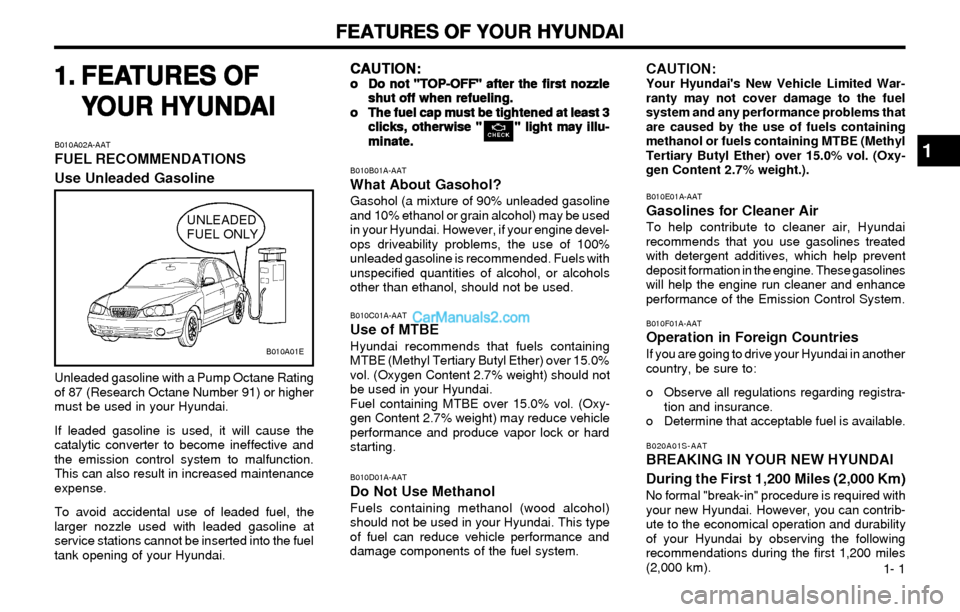
Unleaded gasoline with a Pump Octane Rating
of 87 (Research Octane Number 91) or higher
must be used in your Hyundai.
If leaded gasoline is used, it will cause the
catalytic converter to become ineffective and
the emission control system to malfunction.
This can also result in increased maintenance
expense.
To avoid accidental use of leaded fuel, the
larger nozzle used with leaded gasoline at
service stations cannot be inserted into the fuel
tank opening of your Hyundai.
B010B01A-AATWhat About Gasohol?Gasohol (a mixture of 90% unleaded gasoline
and 10% ethanol or grain alcohol) may be used
in your Hyundai. However, if your engine devel-
ops driveability problems, the use of 100%
unleaded gasoline is recommended. Fuels with
unspecified quantities of alcohol, or alcohols
other than ethanol, should not be used.
B010C01A-AATUse of MTBE
Hyundai recommends that fuels containing
MTBE (Methyl Tertiary Butyl Ether) over 15.0%
vol. (Oxygen Content 2.7% weight) should not
be used in your Hyundai.
Fuel containing MTBE over 15.0% vol. (Oxy-
gen Content 2.7% weight) may reduce vehicle
performance and produce vapor lock or hard
starting.
B010D01A-AATDo Not Use Methanol
Fuels containing methanol (wood alcohol)
should not be used in your Hyundai. This type
of fuel can reduce vehicle performance and
damage components of the fuel system.
CAUTION:Your Hyundai's New Vehicle Limited War-
ranty may not cover damage to the fuel
system and any performance problems that
are caused by the use of fuels containing
methanol or fuels containing MTBE (Methyl
Tertiary Butyl Ether) over 15.0% vol. (Oxy-
gen Content 2.7% weight.).
B010F01A-AATOperation in Foreign Countries
If you are going to drive your Hyundai in another
country, be sure to:
o Observe all regulations regarding registra-
tion and insurance.
o Determine that acceptable fuel is available.
B010E01A-AATGasolines for Cleaner AirTo help contribute to cleaner air, Hyundai
recommends that you use gasolines treated
with detergent additives, which help prevent
deposit formation in the engine. These gasolines
will help the engine run cleaner and enhance
performance of the Emission Control System.
B010A01E
1
Page 16 of 172
FEATURES OF YOUR HYUNDAI FEATURES OF YOUR HYUNDAIFEATURES OF YOUR HYUNDAI FEATURES OF YOUR HYUNDAI
FEATURES OF YOUR HYUNDAI
1- 7
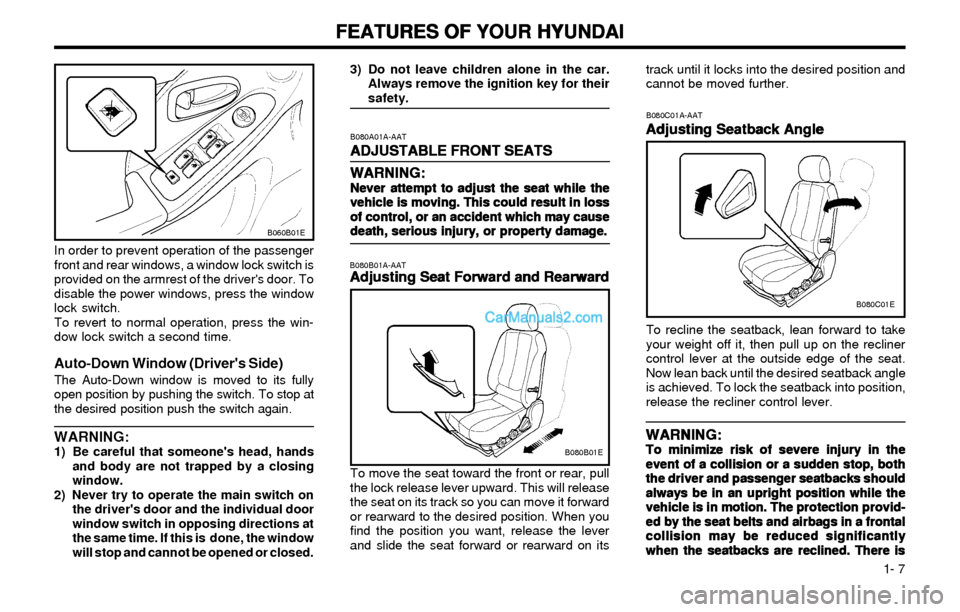
B080B01A-AATAdjusting Seat Forward and Rearward Adjusting Seat Forward and RearwardAdjusting Seat Forward and Rearward Adjusting Seat Forward and Rearward
Adjusting Seat Forward and Rearward
To move the seat toward the front or rear, pull
the lock release lever upward. This will release
the seat on its track so you can move it forward
or rearward to the desired position. When you
find the position you want, release the lever
and slide the seat forward or rearward on its
B080A01A-AAT
ADJUSTABLE FRONT SEATS ADJUSTABLE FRONT SEATSADJUSTABLE FRONT SEATS ADJUSTABLE FRONT SEATS
ADJUSTABLE FRONT SEATS
WARNING: WARNING:WARNING: WARNING:
WARNING:
Never attempt to adjust the seat while the Never attempt to adjust the seat while theNever attempt to adjust the seat while the Never attempt to adjust the seat while the
Never attempt to adjust the seat while the
vehicle is moving. This could result in loss vehicle is moving. This could result in lossvehicle is moving. This could result in loss vehicle is moving. This could result in loss
vehicle is moving. This could result in loss
of control, or an accident which may cause of control, or an accident which may causeof control, or an accident which may cause of control, or an accident which may cause
of control, or an accident which may cause
death, serious injury, or property damage. death, serious injury, or property damage.death, serious injury, or property damage. death, serious injury, or property damage.
death, serious injury, or property damage.
In order to prevent operation of the passenger
front and rear windows, a window lock switch is
provided on the armrest of the driver's door. To
disable the power windows, press the window
lock switch.
To revert to normal operation, press the win-
dow lock switch a second time.
Auto-Down Window (Driver's Side)
The Auto-Down window is moved to its fully
open position by pushing the switch. To stop at
the desired position push the switch again.
WARNING:1) Be careful that someone's head, hands
and body are not trapped by a closing
window.
2) Never try to operate the main switch on
the driver's door and the individual door
window switch in opposing directions at
the same time. If this is done, the window
will stop and cannot be opened or closed.3) Do not leave children alone in the car.
Always remove the ignition key for their
safety.B080B01E
B080C01A-AAT
Adjusting Seatback Angle Adjusting Seatback AngleAdjusting Seatback Angle Adjusting Seatback Angle
Adjusting Seatback Angle
To recline the seatback, lean forward to take
your weight off it, then pull up on the recliner
control lever at the outside edge of the seat.
Now lean back until the desired seatback angle
is achieved. To lock the seatback into position,
release the recliner control lever.
WARNING: WARNING:WARNING: WARNING:
WARNING:To minimize risk of severe injury in the To minimize risk of severe injury in theTo minimize risk of severe injury in the To minimize risk of severe injury in the
To minimize risk of severe injury in the
event of a collision or a sudden stop, both event of a collision or a sudden stop, bothevent of a collision or a sudden stop, both event of a collision or a sudden stop, both
event of a collision or a sudden stop, both
the driver and passenger seatbacks should the driver and passenger seatbacks shouldthe driver and passenger seatbacks should the driver and passenger seatbacks should
the driver and passenger seatbacks should
always be in an upright position while the always be in an upright position while thealways be in an upright position while the always be in an upright position while the
always be in an upright position while the
vehicle is in motion. The protection provid- vehicle is in motion. The protection provid-vehicle is in motion. The protection provid- vehicle is in motion. The protection provid-
vehicle is in motion. The protection provid-
ed by the seat belts and airbags in a frontal ed by the seat belts and airbags in a frontaled by the seat belts and airbags in a frontal ed by the seat belts and airbags in a frontal
ed by the seat belts and airbags in a frontal
collision may be reduced significantly collision may be reduced significantlycollision may be reduced significantly collision may be reduced significantly
collision may be reduced significantly
when the seatbacks are reclined. There is when the seatbacks are reclined. There iswhen the seatbacks are reclined. There is when the seatbacks are reclined. There is
when the seatbacks are reclined. There is track until it locks into the desired position and
cannot be moved further.
B080C01E
B060B01E
Page 20 of 172
FEATURES OF YOUR HYUNDAI FEATURES OF YOUR HYUNDAIFEATURES OF YOUR HYUNDAI FEATURES OF YOUR HYUNDAI
FEATURES OF YOUR HYUNDAI
1- 11
B150A01S-AAT
SEAT BELT PRECAUTIONS SEAT BELT PRECAUTIONSSEAT BELT PRECAUTIONS SEAT BELT PRECAUTIONS
SEAT BELT PRECAUTIONS
WARNING: WARNING:WARNING: WARNING:
WARNING:
All occupants of the vehicle must wear their All occupants of the vehicle must wear theirAll occupants of the vehicle must wear their All occupants of the vehicle must wear their
All occupants of the vehicle must wear their
seat belts at all times. Note that this vehicle seat belts at all times. Note that this vehicleseat belts at all times. Note that this vehicle seat belts at all times. Note that this vehicle
seat belts at all times. Note that this vehicle
is equipped with a Supplemental Restraint is equipped with a Supplemental Restraintis equipped with a Supplemental Restraint is equipped with a Supplemental Restraint
is equipped with a Supplemental Restraint
(Airbag) System as discussed beginning on (Airbag) System as discussed beginning on(Airbag) System as discussed beginning on (Airbag) System as discussed beginning on
(Airbag) System as discussed beginning on
page 1-21. The seat belts must be used in page 1-21. The seat belts must be used inpage 1-21. The seat belts must be used in page 1-21. The seat belts must be used in
page 1-21. The seat belts must be used in
conjunction with the supplemental airbag conjunction with the supplemental airbagconjunction with the supplemental airbag conjunction with the supplemental airbag
conjunction with the supplemental airbag
system. State laws may require that some or system. State laws may require that some orsystem. State laws may require that some or system. State laws may require that some or
system. State laws may require that some or
all occupants of the vehicle use seat belts. all occupants of the vehicle use seat belts.all occupants of the vehicle use seat belts. all occupants of the vehicle use seat belts.
all occupants of the vehicle use seat belts.
The possibility of increased injury or sever- The possibility of increased injury or sever-The possibility of increased injury or sever- The possibility of increased injury or sever-
The possibility of increased injury or sever-
ity of injury in an accident will be increased ity of injury in an accident will be increasedity of injury in an accident will be increased ity of injury in an accident will be increased
ity of injury in an accident will be increased
if this elementary safety precaution is not if this elementary safety precaution is notif this elementary safety precaution is not if this elementary safety precaution is not
if this elementary safety precaution is not
observed. In addition, the following recom- observed. In addition, the following recom-observed. In addition, the following recom- observed. In addition, the following recom-
observed. In addition, the following recom-
mendations are made: mendations are made:mendations are made: mendations are made:
mendations are made:
WARNING:o Before folding the seatback, place the
rear seat belt buckles in the buckle clips
on the seatback. This will prevent the
seat belt buckles from becoming cov-
ered by the seat cushion when it is re-
turned to the seating position.
o When you return the folded down seat
back to its upright position, make sure
the seat belts are in position to be acces-
sible and to function properly.
o WARNING LABEL: When returning the
seat cushion to the seating position, place
the seat belt buckles on top of the cush-
ion.
o The purpose of the fold down rear seat
back and the fold forward rear seat cush-
ion is to increase cargo space. Do not
allow passengers to sit in the cargo area
while the car is moving. This is not a
proper seating position and no seat belts
are available for use when the seat back
is folded down. Passengers who are not
properly seated and wearing seat belts
could sustain serious injuries or death in
case of an accident or a sudden stop.
o Objects should not extend higher than
the top of the front seatbacks. This could
allow cargo to slide forward and cause
injury or damage during sudden stops.
o When you return the folded down seat
back to its upright position, always be
sure to place the rear seat belt buckles
on the seat cushion below the seatback.o When you return the folded down
seatback to its upright position, always
be sure to install the headrests in their
proper positions. Headrests are impor-
tant to the safety of occupants in a rear
collision. If the headrests are not in-
stalled in their proper position, serious
injury or death could result if a rear end
collision occurs.
B150B03Y-AATInfant or Small ChildAll 50 states have child restraint laws. You
should be aware of the specific requirements in
your state. Child and/or infant safety seats
must be properly placed and installed in the
rear seat. Information about the use of these
restraints begins on page 1-16.
WARNING:Every person in your vehicle needs to be
properly restrained at all times, including
infants and children. In a collision, an unre-
strained child can become a "missile" in-
side the car. The force required to hold a
child on your lap could be so great that you
could not hold the child. Any child riding in
the vehicle should always be in a proper
restraint in the rear seat of the vehicle.
NOTE:Small children are best protected from in-
jury in an accident when properly restrained
in the rear seat by a child restraint system
that meets the requirements of the Federal
Motor Vehicle Safety Standards. Before buy-
ing any child restraint system, make sure
that it has a label certifying that it meets
Motor Vehicle Safety Standard 213. The re-
straint must be appropriate for your child's
height and weight. Check the label on the
child restraint for this information. See page
1-16.
Page 33 of 172
FEATURES OF YOUR HYUNDAI FEATURES OF YOUR HYUNDAIFEATURES OF YOUR HYUNDAI FEATURES OF YOUR HYUNDAI
FEATURES OF YOUR HYUNDAI
1- 24
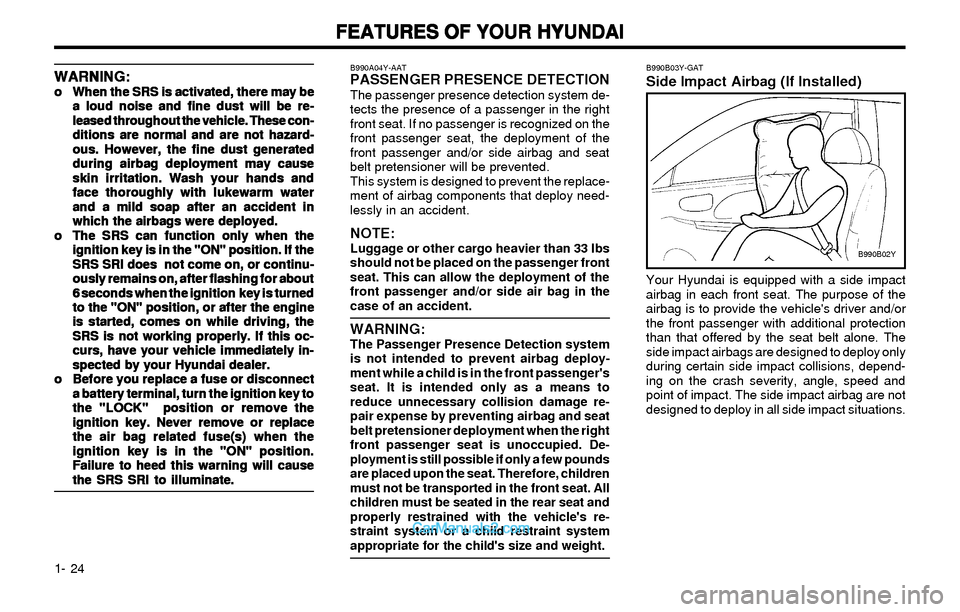
B990B03Y-GATSide Impact Airbag (If Installed)
B990B02Y
Your Hyundai is equipped with a side impact
airbag in each front seat. The purpose of the
airbag is to provide the vehicle's driver and/or
the front passenger with additional protection
than that offered by the seat belt alone. The
side impact airbags are designed to deploy only
during certain side impact collisions, depend-
ing on the crash severity, angle, speed and
point of impact. The side impact airbag are not
designed to deploy in all side impact situations.
WARNING: WARNING:WARNING: WARNING:
WARNING:o oo o
o
When the SRS is activated, there may be When the SRS is activated, there may beWhen the SRS is activated, there may be When the SRS is activated, there may be
When the SRS is activated, there may be
a loud noise and fine dust will be re- a loud noise and fine dust will be re-a loud noise and fine dust will be re- a loud noise and fine dust will be re-
a loud noise and fine dust will be re-
leased throughout the vehicle. These con- leased throughout the vehicle. These con-leased throughout the vehicle. These con- leased throughout the vehicle. These con-
leased throughout the vehicle. These con-
ditions are normal and are not hazard- ditions are normal and are not hazard-ditions are normal and are not hazard- ditions are normal and are not hazard-
ditions are normal and are not hazard-
ous. However, the fine dust generated ous. However, the fine dust generatedous. However, the fine dust generated ous. However, the fine dust generated
ous. However, the fine dust generated
during airbag deployment may cause during airbag deployment may causeduring airbag deployment may cause during airbag deployment may cause
during airbag deployment may cause
skin irritation. Wash your hands and skin irritation. Wash your hands andskin irritation. Wash your hands and skin irritation. Wash your hands and
skin irritation. Wash your hands and
face thoroughly with lukewarm water face thoroughly with lukewarm waterface thoroughly with lukewarm water face thoroughly with lukewarm water
face thoroughly with lukewarm water
and a mild soap after an accident in and a mild soap after an accident inand a mild soap after an accident in and a mild soap after an accident in
and a mild soap after an accident in
which the airbags were deployed. which the airbags were deployed.which the airbags were deployed. which the airbags were deployed.
which the airbags were deployed.
o oo o
o
The SRS can function only when the The SRS can function only when theThe SRS can function only when the The SRS can function only when the
The SRS can function only when the
ignition key is in the "ON" position. If the ignition key is in the "ON" position. If theignition key is in the "ON" position. If the ignition key is in the "ON" position. If the
ignition key is in the "ON" position. If the
SRS SRI does not come on, or continu- SRS SRI does not come on, or continu-SRS SRI does not come on, or continu- SRS SRI does not come on, or continu-
SRS SRI does not come on, or continu-
ously remains on, after flashing for about ously remains on, after flashing for aboutously remains on, after flashing for about ously remains on, after flashing for about
ously remains on, after flashing for about
6 seconds when the ignition key is turned 6 seconds when the ignition key is turned6 seconds when the ignition key is turned 6 seconds when the ignition key is turned
6 seconds when the ignition key is turned
to the "ON" position, or after the engine to the "ON" position, or after the engineto the "ON" position, or after the engine to the "ON" position, or after the engine
to the "ON" position, or after the engine
is started, comes on while driving, the is started, comes on while driving, theis started, comes on while driving, the is started, comes on while driving, the
is started, comes on while driving, the
SRS is not working properly. If this oc- SRS is not working properly. If this oc-SRS is not working properly. If this oc- SRS is not working properly. If this oc-
SRS is not working properly. If this oc-
curs, have your vehicle immediately in- curs, have your vehicle immediately in-curs, have your vehicle immediately in- curs, have your vehicle immediately in-
curs, have your vehicle immediately in-
spected by your Hyundai dealer. spected by your Hyundai dealer.spected by your Hyundai dealer. spected by your Hyundai dealer.
spected by your Hyundai dealer.
o oo o
o
Before you replace a fuse or disconnect Before you replace a fuse or disconnectBefore you replace a fuse or disconnect Before you replace a fuse or disconnect
Before you replace a fuse or disconnect
a battery terminal, turn the ignition key to a battery terminal, turn the ignition key toa battery terminal, turn the ignition key to a battery terminal, turn the ignition key to
a battery terminal, turn the ignition key to
the "LOCK" position or remove the the "LOCK" position or remove thethe "LOCK" position or remove the the "LOCK" position or remove the
the "LOCK" position or remove the
ignition key. Never remove or replace ignition key. Never remove or replaceignition key. Never remove or replace ignition key. Never remove or replace
ignition key. Never remove or replace
the air bag related fuse(s) when the the air bag related fuse(s) when thethe air bag related fuse(s) when the the air bag related fuse(s) when the
the air bag related fuse(s) when the
ignition key is in the "ON" position. ignition key is in the "ON" position.ignition key is in the "ON" position. ignition key is in the "ON" position.
ignition key is in the "ON" position.
Failure to heed this warning will cause Failure to heed this warning will causeFailure to heed this warning will cause Failure to heed this warning will cause
Failure to heed this warning will cause
the SRS SRI to illuminate. the SRS SRI to illuminate.the SRS SRI to illuminate. the SRS SRI to illuminate.
the SRS SRI to illuminate.
B990A04Y-AATPASSENGER PRESENCE DETECTIONThe passenger presence detection system de-
tects the presence of a passenger in the right
front seat. If no passenger is recognized on the
front passenger seat, the deployment of the
front passenger and/or side airbag and seat
belt pretensioner will be prevented.
This system is designed to prevent the replace-
ment of airbag components that deploy need-
lessly in an accident.
NOTE:Luggage or other cargo heavier than 33 lbs
should not be placed on the passenger front
seat. This can allow the deployment of the
front passenger and/or side air bag in the
case of an accident.
WARNING:The Passenger Presence Detection system
is not intended to prevent airbag deploy-
ment while a child is in the front passenger's
seat. It is intended only as a means to
reduce unnecessary collision damage re-
pair expense by preventing airbag and seat
belt pretensioner deployment when the right
front passenger seat is unoccupied. De-
ployment is still possible if only a few pounds
are placed upon the seat. Therefore, children
must not be transported in the front seat. All
children must be seated in the rear seat and
properly restrained with the vehicle's re-
straint system or a child restraint system
appropriate for the child's size and weight.
Page 111 of 172
DRIVING YOUR HYUNDAI DRIVING YOUR HYUNDAIDRIVING YOUR HYUNDAI DRIVING YOUR HYUNDAI
DRIVING YOUR HYUNDAI
2- 10
C160C01A-AATUse High Quality Ethylene Glycol Use High Quality Ethylene GlycolUse High Quality Ethylene Glycol Use High Quality Ethylene Glycol
Use High Quality Ethylene Glycol
Coolant CoolantCoolant Coolant
Coolant
Your Hyundai is delivered with high quality ethyl-
ene glycol coolant in the cooling system. It is the
only type of coolant that should be used because
it helps prevent corrosion in the cooling system,
lubricates the water pump and prevents freezing.
Be sure to replace or replenish your coolant in
C150A01A-AAT
SMOOTH CORNERING SMOOTH CORNERINGSMOOTH CORNERING SMOOTH CORNERING
SMOOTH CORNERINGAvoid braking or gear changing in corners, espe-
cially when roads are wet. Ideally, corners should
always be taken under gentle acceleration. If you
follow these suggestions, tire wear will be held to
a minimum.
C160A01A-AAT
WINTER DRIVING WINTER DRIVINGWINTER DRIVING WINTER DRIVING
WINTER DRIVINGThe more severe weather conditions of winter
result in greater wear and other problems. To
minimize the problems of winter driving, you
should follow these suggestions:
C160B01A-AAT
Snowy or Icy Conditions Snowy or Icy ConditionsSnowy or Icy Conditions Snowy or Icy Conditions
Snowy or Icy ConditionsTo drive your vehicle in deep snow, it may be
necessary to use snow tires or to install tire
chains on your tires. If snow tires are needed, it
is necessary to select tires equivalent in size and
type to the original equipment tires. Failure to do
so may adversely affect the safety and handling
of your car. Speeding, rapid acceleration, sud-
den brake applications, and sharp turns are
potentially very hazardous practices.
During deceleration, use engine braking to the
fullest extent. Sudden brake applications on
snowy or icy roads may cause skids to occur.
You need to keep sufficient distance between the
vehicle in front and your vehicle. Also, apply the
brake gently. It should be noted that installing tire
chains on the tire will provide a greater driving
force, but will not prevent side skids.
NOTE: NOTE:NOTE: NOTE:
NOTE:Tire chains are not legal in all states. Check Tire chains are not legal in all states. CheckTire chains are not legal in all states. Check Tire chains are not legal in all states. Check
Tire chains are not legal in all states. Check
state laws before fitting tire chains. state laws before fitting tire chains.state laws before fitting tire chains. state laws before fitting tire chains.
state laws before fitting tire chains. o Remember, your Hyundai does not require
extended warm-up. As soon as the engine is
running smoothly, you can drive away. In
very cold weather, however, give your engine
a slightly longer warm-up period.
o Don't "lug" or "over-rev" the engine. Lugging
is driving too slowly in too high a gear result-
ing in the engine bucking. If this happens, shift
to a lower gear. Over-revving is racing the
engine beyond its safe limit. This can be
avoided by shifting at the recommended
speeds.
o Use your air conditioning sparingly. The air
conditioning system is operated by engine
power so your fuel economy is reduced when
you use it. o Take care of your tires. Keep them inflated to
the recommended pressure. Incorrect infla-
tion, either too much or too little, results in
unnecessary tire wear. Check the tire pres-
sures at least once a month.
o Be sure that the wheels are aligned correctly.
Improper alignment can result from hitting
curbs or driving too fast over irregular surfac-
es. Poor alignment causes faster tire wear
and may also result in other problems as well
as greater fuel consumption.
o Keep your car in good condition. For better
fuel economy and reduced maintenance
costs, maintain your car in accordance with
the maintenance schedule in Section 5. If you
drive your car in severe conditions, more
frequent maintenance is required (see Sec-
tion 5 for details).
o Keep your car clean. For maximum service,
your Hyundai should be kept clean and free of
corrosive materials. It is especially important
that mud, dirt, ice, etc. not be allowed to
accumulate on the underside of the car. This
extra weight can result in increased fuel con-
sumption and also contribute to corrosion.
o Travel lightly. Don't carry unnecessary weight
in your car. Weight reduces fuel economy.
o Don't let the engine idle longer than neces-
sary. If you are waiting (and not in traffic), turn
off your engine and restart only when you're
ready to go.
Page 112 of 172

DRIVING YOUR HYUNDAI DRIVING YOUR HYUNDAIDRIVING YOUR HYUNDAI DRIVING YOUR HYUNDAI
DRIVING YOUR HYUNDAI
2- 11 accordance with the maintenance schedule in
Section 5. Before winter, have your coolant test-
ed to assure that its freezing point is sufficient for
the temperatures anticipated during the winter.
C160D01A-AAT
Check Battery and Cables Check Battery and CablesCheck Battery and Cables Check Battery and Cables
Check Battery and CablesWinter puts additional burdens on the battery
system. Visually inspect the battery and cables
as described in Section 6. The level of charge in
your battery can be checked by your Hyundai
dealer or a service station.
C160E01A-AATChange to "Winter Weight" Oil if Change to "Winter Weight" Oil ifChange to "Winter Weight" Oil if Change to "Winter Weight" Oil if
Change to "Winter Weight" Oil if
Necessary NecessaryNecessary Necessary
Necessary
In some climates it is recommended that a lower
viscosity "winter weight" oil be used during cold
weather. See Section 9 for recommendations. If
you aren't sure what weight oil you should use,
consult your Hyundai dealer.
C160F01A-AATCheck Spark Plugs and Ignition Check Spark Plugs and IgnitionCheck Spark Plugs and Ignition Check Spark Plugs and Ignition
Check Spark Plugs and Ignition
System SystemSystem System
System
Inspect your spark plugs as described in Section
6 and replace them if necessary. Also check all
ignition wiring and components to be sure they
are not cracked, worn or damaged in any way.
C160G01A-AAT
To Keep Locks from Freezing To Keep Locks from FreezingTo Keep Locks from Freezing To Keep Locks from Freezing
To Keep Locks from FreezingTo keep the locks from freezing, squirt an ap-
proved de-icer fluid or glycerine into the key
opening. If a lock is covered with ice, squirt it with
an approved de-icing fluid to remove the ice. If
the lock is frozen internally, you may be able to
thaw it out by using a heated key. Handle the
heated key with care to avoid burning the fingers.
C160H01A-AATUse Approved Anti-Freeze in Window Use Approved Anti-Freeze in WindowUse Approved Anti-Freeze in Window Use Approved Anti-Freeze in Window
Use Approved Anti-Freeze in Window
Washer System Washer SystemWasher System Washer System
Washer System
To keep the water in the window washer system
from freezing, add an approved anti-freeze solu-
tion in accordance with instructions on the con-
tainer. Window washer anti-freeze is available
from Hyundai dealers and most auto parts out-
lets. Do not use engine coolant or other types of
anti-freeze as these may damage the finish.
C160I01A-AAT
Don't Let Your Parking Brake Freeze Don't Let Your Parking Brake FreezeDon't Let Your Parking Brake Freeze Don't Let Your Parking Brake Freeze
Don't Let Your Parking Brake FreezeUnder some conditions your parking brake can
freeze in the engaged position. This is most likely
to happen when there is an accumulation of snow
or ice around or near the rear brakes or if the
brakes are wet. If there is a risk the parking brake
may freeze, apply it only temporarily while you
put the gear selector lever in "P" (automatic) or in
first or reverse gear (manual transaxle) and
block the rear wheels so the car cannot roll. Then
release the parking brake.
C160K01A-AAT
Carry Emergency Equipment Carry Emergency EquipmentCarry Emergency Equipment Carry Emergency Equipment
Carry Emergency EquipmentDepending on the severity of the weather where
you drive your car, you should carry appropriate
emergency equipment. Some of the items you
may want to carry include tire chains, tow straps
or chains, flashlight, emergency flares, sand, a
shovel, jumper cables, a window scraper, gloves,
ground cloth, coveralls, a blanket, etc.
C160J01A-AAT
Don't Let Ice and Snow Accumulate Don't Let Ice and Snow AccumulateDon't Let Ice and Snow Accumulate Don't Let Ice and Snow Accumulate
Don't Let Ice and Snow Accumulate
Underneath UnderneathUnderneath Underneath
Underneath
Under some conditions, snow and ice can build
up under the fenders and interfere with the steer-
ing. When driving in severe winter conditions
where this may happen, you should periodically
check underneath the car to be sure the move-
ment of the front wheels and the steering compo-
nents is not obstructed.
C170A01A-AAT
HIGHER SPEED MOTORING HIGHER SPEED MOTORINGHIGHER SPEED MOTORING HIGHER SPEED MOTORING
HIGHER SPEED MOTORING
Pre-Trip Inspections Pre-Trip InspectionsPre-Trip Inspections Pre-Trip Inspections
Pre-Trip Inspections
1. Tires:
Adjust the tire inflation pressures to specifica-
tion. Low tire inflation pressures will result in
overheating and possible failure of the tires.
Avoid using worn or damaged tires which may
result in reduced traction or tire failure.
Page 114 of 172

DRIVING YOUR HYUNDAI DRIVING YOUR HYUNDAIDRIVING YOUR HYUNDAI DRIVING YOUR HYUNDAI
DRIVING YOUR HYUNDAI
2- 13 Tongue
187.4 (85)
100 (45.3)
C190E01E-AAT
Trailer Weight Limit Trailer Weight LimitTrailer Weight Limit Trailer Weight Limit
Trailer Weight Limit
Tongue load Total trailer weightSSA2200B
o Keep the tongue load 10% of the total trailer
load.
Tongue load
Total trailer weight
o Tongue loads can be increased or decreased
by redistributing the load in the trailer.
This can be verified by checking the total
weight of the loaded trailer and then checking
the load on the tongue.
NOTE: NOTE:NOTE: NOTE:
NOTE:1. 1.1. 1.
1.
Never load the trailer with more weight in Never load the trailer with more weight inNever load the trailer with more weight in Never load the trailer with more weight in
Never load the trailer with more weight in
the back than in the front. About 60% of the back than in the front. About 60% ofthe back than in the front. About 60% of the back than in the front. About 60% of
the back than in the front. About 60% of
the trailer load should be in the front half the trailer load should be in the front halfthe trailer load should be in the front half the trailer load should be in the front half
the trailer load should be in the front half
on the trailer and the remaining 40% in the on the trailer and the remaining 40% in theon the trailer and the remaining 40% in the on the trailer and the remaining 40% in the
on the trailer and the remaining 40% in the
rear. rear.rear. rear.
rear.
2. 2.2. 2.
2.
The total gross vehicle weight with trailer The total gross vehicle weight with trailerThe total gross vehicle weight with trailer The total gross vehicle weight with trailer
The total gross vehicle weight with trailer
must not exceed the Gross Vehicle Weight must not exceed the Gross Vehicle Weightmust not exceed the Gross Vehicle Weight must not exceed the Gross Vehicle Weight
must not exceed the Gross Vehicle Weight
Rating (GVWR) shown on the vehicle iden- Rating (GVWR) shown on the vehicle iden-Rating (GVWR) shown on the vehicle iden- Rating (GVWR) shown on the vehicle iden-
Rating (GVWR) shown on the vehicle iden-tification plate (see page 8-1). The total tification plate (see page 8-1). The totaltification plate (see page 8-1). The total tification plate (see page 8-1). The total
tification plate (see page 8-1). The total
gross vehicle weight is the combined gross vehicle weight is the combinedgross vehicle weight is the combined gross vehicle weight is the combined
gross vehicle weight is the combined
weight of the vehicle, driver, all passen- weight of the vehicle, driver, all passen-weight of the vehicle, driver, all passen- weight of the vehicle, driver, all passen-
weight of the vehicle, driver, all passen-
gers and their luggage, cargo, hitch, trailer gers and their luggage, cargo, hitch, trailergers and their luggage, cargo, hitch, trailer gers and their luggage, cargo, hitch, trailer
gers and their luggage, cargo, hitch, trailer
tongue load and other optional equip- tongue load and other optional equip-tongue load and other optional equip- tongue load and other optional equip-
tongue load and other optional equip-
ment. ment.ment. ment.
ment.
3. 3.3. 3.
3.
The front or rear axle weight must not The front or rear axle weight must notThe front or rear axle weight must not The front or rear axle weight must not
The front or rear axle weight must not
exceed the Gross Axle Weight Rating exceed the Gross Axle Weight Ratingexceed the Gross Axle Weight Rating exceed the Gross Axle Weight Rating
exceed the Gross Axle Weight Rating
(GAWR) shown on the vehicle identifica- (GAWR) shown on the vehicle identifica-(GAWR) shown on the vehicle identifica- (GAWR) shown on the vehicle identifica-
(GAWR) shown on the vehicle identifica-
tion plate (see page 8-1). It is possible that tion plate (see page 8-1). It is possible thattion plate (see page 8-1). It is possible that tion plate (see page 8-1). It is possible that
tion plate (see page 8-1). It is possible that
your towing package does not exceed the your towing package does not exceed theyour towing package does not exceed the your towing package does not exceed the
your towing package does not exceed the
GVWR but exceeds the GAWR. GVWR but exceeds the GAWR.GVWR but exceeds the GAWR. GVWR but exceeds the GAWR.
GVWR but exceeds the GAWR.
Improper trailer loading and/or too much Improper trailer loading and/or too muchImproper trailer loading and/or too much Improper trailer loading and/or too much
Improper trailer loading and/or too much
luggage in the trunk can overload the rear luggage in the trunk can overload the rearluggage in the trunk can overload the rear luggage in the trunk can overload the rear
luggage in the trunk can overload the rear
axle. Redistribute the load and check the axle. Redistribute the load and check theaxle. Redistribute the load and check the axle. Redistribute the load and check the
axle. Redistribute the load and check the
axle weight again. axle weight again.axle weight again. axle weight again.
axle weight again.Gross axle weight Gross vehicle weightSSA2200D
CAUTION: CAUTION:CAUTION: CAUTION:
CAUTION:The following specifications are recommend- The following specifications are recommend-The following specifications are recommend- The following specifications are recommend-
The following specifications are recommend-
ed when towing a trailer. The loaded trailer ed when towing a trailer. The loaded trailered when towing a trailer. The loaded trailer ed when towing a trailer. The loaded trailer
ed when towing a trailer. The loaded trailer
weight cannot safely exceed the values in the weight cannot safely exceed the values in theweight cannot safely exceed the values in the weight cannot safely exceed the values in the
weight cannot safely exceed the values in the
following chart. following chart.following chart. following chart.
following chart.Lbs. (kg)
Maximum Towable Weight
Trailer
1874(850)
1000(453)
WARNING: WARNING:WARNING: WARNING:
WARNING:Improperly loading your car and trailer can Improperly loading your car and trailer canImproperly loading your car and trailer can Improperly loading your car and trailer can
Improperly loading your car and trailer can
seriously affect its steering and braking per- seriously affect its steering and braking per-seriously affect its steering and braking per- seriously affect its steering and braking per-
seriously affect its steering and braking per-
formance causing a crash which could cause formance causing a crash which could causeformance causing a crash which could cause formance causing a crash which could cause
formance causing a crash which could cause
serious injury or death. serious injury or death.serious injury or death. serious injury or death.
serious injury or death.
o x 100 = 10% (MAX)
C190F01S-AAT
Trailer or Vehicle Towing Tips Trailer or Vehicle Towing TipsTrailer or Vehicle Towing Tips Trailer or Vehicle Towing Tips
Trailer or Vehicle Towing Tips1. Before towing, check hitch and safety chain
connections as well as proper operation of
the trailer running lights, brake lights, and turn
signals.
2. Always drive your vehicle at a moderate
speed. (Less than 60 mph)
3. Trailer towing requires more fuel than normal
conditions.
4. To maintain engine braking efficiency and
electrical charging performance, do not use
fifth gear (manual transaxle) or overdrive
(automatic transaxle).
5. Always secure items in the trailer to prevent
load shift while driving.
6. Check the condition and air pressure of all
tires on the trailer and your car. Low tire
pressure can seriously affect the handling.
Also check the spare tire.
With Brake
Without Brake
Page 155 of 172
DO-IT-YOURSELF MAINTENANCE DO-IT-YOURSELF MAINTENANCEDO-IT-YOURSELF MAINTENANCE DO-IT-YOURSELF MAINTENANCE
DO-IT-YOURSELF MAINTENANCE
6-19
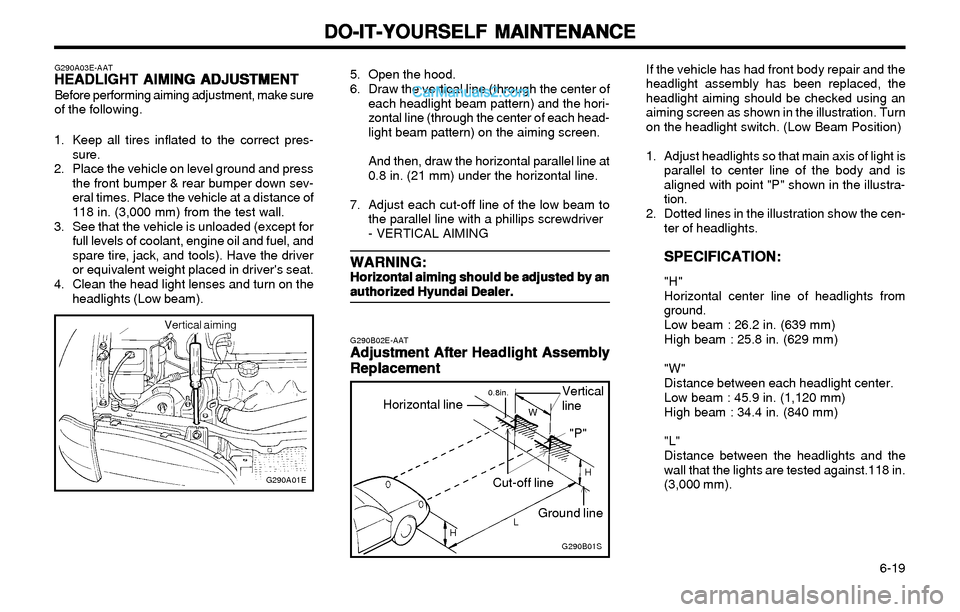
If the vehicle has had front body repair and the
headlight assembly has been replaced, the
headlight aiming should be checked using an
aiming screen as shown in the illustration. Turn
on the headlight switch. (Low Beam Position)
1. Adjust headlights so that main axis of light is
parallel to center line of the body and is
aligned with point "P" shown in the illustra-
tion.
2. Dotted lines in the illustration show the cen-
ter of headlights.
SPECIFICATION: SPECIFICATION:SPECIFICATION: SPECIFICATION:
SPECIFICATION:
"H"
Horizontal center line of headlights from
ground.
Low beam : 26.2 in. (639 mm)
High beam : 25.8 in. (629 mm)
"W"
Distance between each headlight center.
Low beam : 45.9 in. (1,120 mm)
High beam : 34.4 in. (840 mm)
"L"
Distance between the headlights and the
wall that the lights are tested against.118 in.
(3,000 mm).
G290B02E-AATAdjustment After Headlight Assembly Adjustment After Headlight AssemblyAdjustment After Headlight Assembly Adjustment After Headlight Assembly
Adjustment After Headlight Assembly
Replacement ReplacementReplacement Replacement
Replacement
G290A03E-AATHEADLI HEADLIHEADLI HEADLI
HEADLI
GHT AIMING ADJUSTMENT GHT AIMING ADJUSTMENTGHT AIMING ADJUSTMENT GHT AIMING ADJUSTMENT
GHT AIMING ADJUSTMENTBefore performing aiming adjustment, make sure
of the following.
1. Keep all tires inflated to the correct pres-
sure.
2. Place the vehicle on level ground and press
the front bumper & rear bumper down sev-
eral times. Place the vehicle at a distance of
118 in. (3,000 mm) from the test wall.
3. See that the vehicle is unloaded (except for
full levels of coolant, engine oil and fuel, and
spare tire, jack, and tools). Have the driver
or equivalent weight placed in driver's seat.
4. Clean the head light lenses and turn on the
headlights (Low beam).
G290A01E
G290B01S
Vertical
line
Cut-off line
Ground line Horizontal line
LW
H
H
"P"
0.8in.
Vertical aiming
5. Open the hood.
6. Draw the vertical line (through the center of
each headlight beam pattern) and the hori-
zontal line (through the center of each head-
light beam pattern) on the aiming screen.
And then, draw the horizontal parallel line at
0.8 in. (21 mm) under the horizontal line.
7. Adjust each cut-off line of the low beam to
the parallel line with a phillips screwdriver
- VERTICAL AIMING
WARNING: WARNING:WARNING: WARNING:
WARNING:Horizontal aiming should be adjusted by an Horizontal aiming should be adjusted by anHorizontal aiming should be adjusted by an Horizontal aiming should be adjusted by an
Horizontal aiming should be adjusted by an
authorized Hyundai Dealer. authorized Hyundai Dealer.authorized Hyundai Dealer. authorized Hyundai Dealer.
authorized Hyundai Dealer.