section 9 Hyundai Elantra 2004 User Guide
[x] Cancel search | Manufacturer: HYUNDAI, Model Year: 2004, Model line: Elantra, Model: Hyundai Elantra 2004Pages: 241, PDF Size: 6.5 MB
Page 189 of 241
6DO-IT-YOURSELF MAINTENANCE
5
HXDFL009
CHANGING THE OIL AND FILTER
!
If the oil level is close to or below the "LOW"
mark, add oil until it reaches the "FULL" mark.
To add oil:
1. Remove the oil filler cap by turning it counter-
clockwise.
2. Add oil, then check the level again. Do not
overfill.
3. Replace the cap by turning it clockwise.
The distance between the "FULL" and "LOW"
marks is equal to about 1 quart of oil.
G040A02E-AAT2. Open the hood and remove the engine oil
filler cap.
3. Slide underneath the car and loosen the
drain plug by turning it counterclockwise with
a wrench of the proper size. Be sure that a
drain pan is in position to catch the oil as it
drains out, then remove the drain plug.
WARNING:Be very careful when draining the engine oil
as it may be hot enough to burn you!
G030D01A-AAT
Adding Oil
The engine oil and filter should be changed at
those intervals specified in the maintenance
schedule in Section 5. If the car is being driven
in severe conditions, more frequent oil and filter
changes are required.
The procedure for changing the oil and filter is
as follows:
1. Park the car on level ground and set the
parking brake. Start the engine and let it
warm up until the needle on the coolant
temperature gauge moves above the lowest
mark. Turn the engine off and place the gear
selector lever in "P" (automatic) or reverse
gear (manual transaxle). Set the parking
brake.4. When the oil has stopped draining, replace
the drain plug using a new washer and
retighten by turning it clockwise.
Drain plug tightening torque:
4.0 ~ 4.5 kgf.m
5. Remove the oil filter. You should be able to
unscrew the filter with your hands. (If your
hands are slippery, try to use a cloth be-
tween your hands and the filter to give
yourself a better grip.) A certain amount of oil
will come out when you remove the filter, so
be sure to have your drain pan in place
underneath it.
6. Install a new oil filter in accordance with the
instructions on the carton or on the filter itself.
Do not over-tighten.
G040A03E
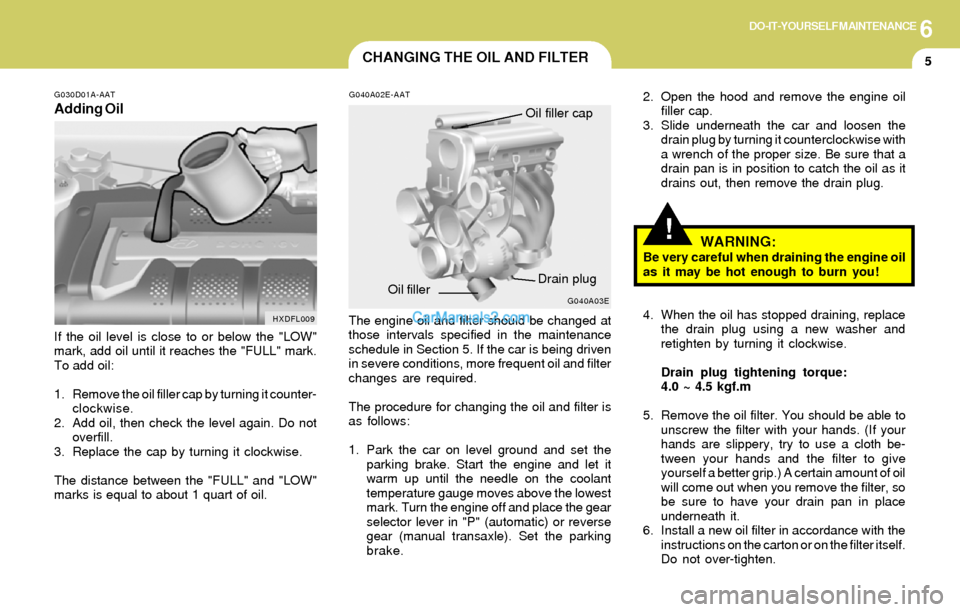
Oil filler cap
Drain plug
Oil filler
Page 192 of 241
6DO-IT-YOURSELF MAINTENANCE
8
G050D02A-AAT
To Change the Engine Coolant
The engine coolant should be changed at those
intervals specified in the vehicle maintenance
schedule in Section 5.
CAUTION:Engine coolant can damage the finish of
your car. If you spill engine coolant on the
car, wash it off thoroughly with clean water.
1. Park the car on level ground, set the park-
ing brake and remove the radiator cap when
cool.
2. Be sure your drain receptacle is in place.
Open the drain cock on the radiator. Allow all
the engine coolant to drain from the cooling
system, then securely close the drain cock.
3. Check Section 9 for the capacity of the
cooling system in your car. Then, following
the manufacturer's directions on the engine
coolant container, add the appropriate quan-
tity of coolant to the radiator.
!
5. Start the engine, top off the radiator with
water and then add engine coolant to the
reservoir until the level is between "LOW"
and "FULL".
6. Replace the radiator and reservoir caps and
check to be sure the drain cocks are fully
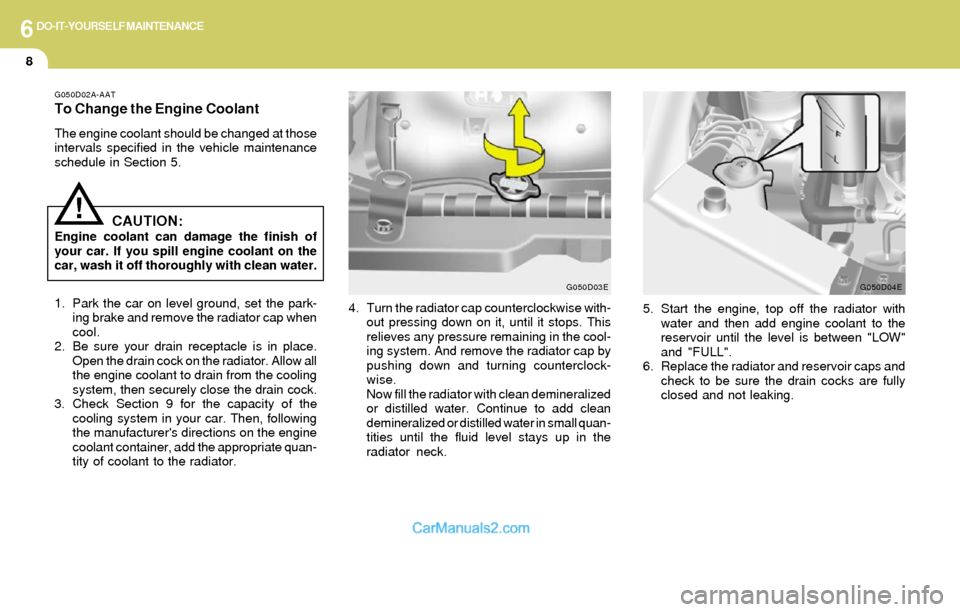
closed and not leaking. 4. Turn the radiator cap counterclockwise with-
out pressing down on it, until it stops. This
relieves any pressure remaining in the cool-
ing system. And remove the radiator cap by
pushing down and turning counterclock-
wise.
Now fill the radiator with clean demineralized
or distilled water. Continue to add clean
demineralized or distilled water in small quan-
tities until the fluid level stays up in the
radiator neck.
G050D03E G050D04E
Page 193 of 241
6DO-IT-YOURSELF MAINTENANCE
9SPARK PLUGS
G060B02E-AAT
Replacing the Spark Plugs
The spark plugs should be changed at the
intervals specified in the vehicle maintenance
schedule in Section 5 or whenever engine
performance indicates they should be changed.
Symptoms that suggest poor spark plug perfor-
mance include engine misfiring under load, loss
of fuel economy, poor acceleration, etc. When
spark plugs are replaced, always use spark
plugs recommended by Hyundai. The use of
other spark plugs can result in loss of perfor-
mance, radio interference or engine damage.
NOTE:When replacing the spark plugs, genuine
Hyundai replacement parts are recom-
mended.
Recommended Spark Plugs:
* 2.0L SULEV Only.CHAMPION
NGK
RC10PYP4
PFR5N-11
IFR5G-11PLATINUM
PLATINUM
IRIDIUM*
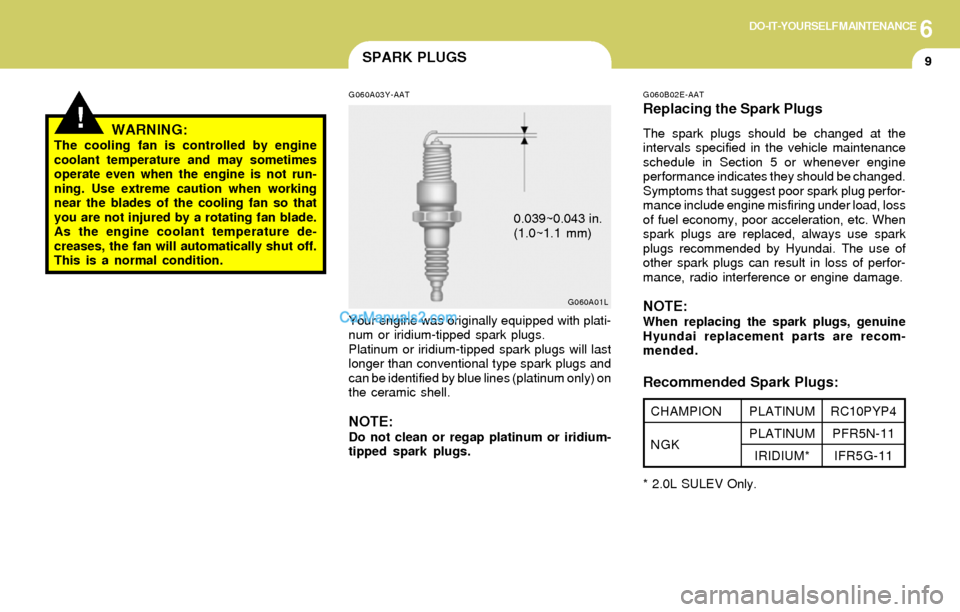
G060A03Y-AAT
Your engine was originally equipped with plati-
num or iridium-tipped spark plugs.
Platinum or iridium-tipped spark plugs will last
longer than conventional type spark plugs and
can be identified by blue lines (platinum only) on
the ceramic shell.
NOTE:Do not clean or regap platinum or iridium-
tipped spark plugs.
G060A01L
0.039~0.043 in.
(1.0~1.1 mm)
!WARNING:The cooling fan is controlled by engine
coolant temperature and may sometimes
operate even when the engine is not run-
ning. Use extreme caution when working
near the blades of the cooling fan so that
you are not injured by a rotating fan blade.
As the engine coolant temperature de-
creases, the fan will automatically shut off.
This is a normal condition.
Page 196 of 241
6DO-IT-YOURSELF MAINTENANCE
12FILLING THE WASHER RESERVOIR
G090A01A-AAT
The washer fluid reservoir supplies fluid to the
windshield washer system.
A good quality washer fluid should be used to fill
the washer reservoir. The fluid level should be
checked more frequently during inclement
weather or whenever the washer system is in
more frequent use.
The capacity of the washer reservoir is 3.2 U.S.
quarts (3.0 Liters).
G090A01E
CHECKING THE TRANSAXLE OIL
CAUTION:
o Radiator anti-freeze (engine coolant)
should not be used in the washer system
because it will damage the car's finish.
o The washer lever should not be pulled
and the washer should not be operated
if the washer reservoir is empty. This can
damage the washer fluid pump.
!
G100A04A-AAT
MANUAL TRANSAXLE
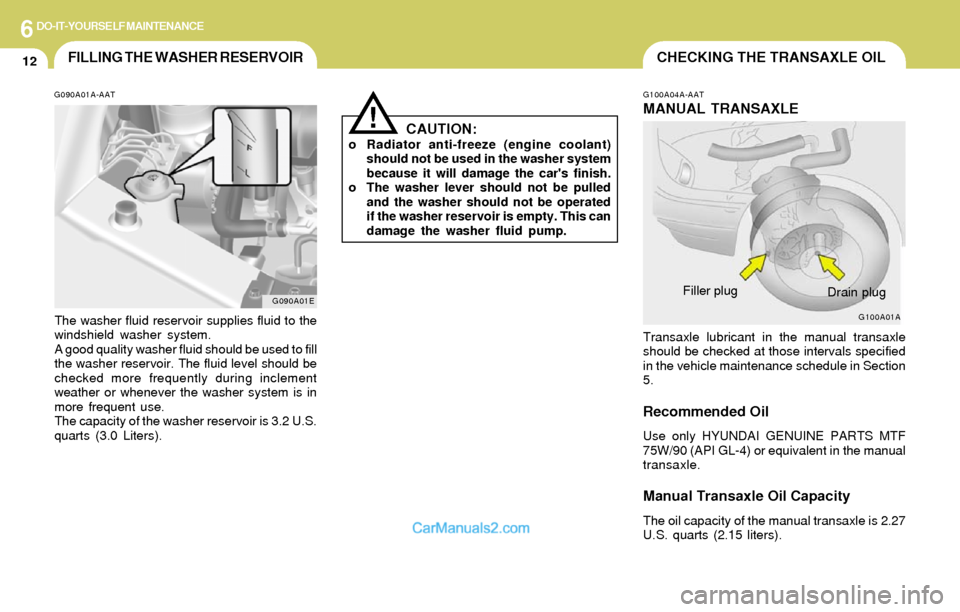
Transaxle lubricant in the manual transaxle
should be checked at those intervals specified
in the vehicle maintenance schedule in Section
5.
Recommended Oil
Use only HYUNDAI GENUINE PARTS MTF
75W/90 (API GL-4) or equivalent in the manual
transaxle.
Manual Transaxle Oil Capacity
The oil capacity of the manual transaxle is 2.27
U.S. quarts (2.15 liters).
G100A01A
Drain plug Filler plug
Page 197 of 241
6DO-IT-YOURSELF MAINTENANCE
13
G110A01E-AAT
AUTOMATIC TRANSAXLE
Transaxle fluid in the automatic transaxle should
be checked at those intervals specified in the
vehicle maintenance schedule in Section 5.
NOTE:Basically automatic transaxle fluid is red
color.
As driving distance increases, the fluid
color turns darkish red gradually.
It is normal condition and you should not
judge replacing by changing color.
You must replace the automatic transaxle
fluid in accordance with intervals specified
in the vehicle maintenances schedule in
section 5.
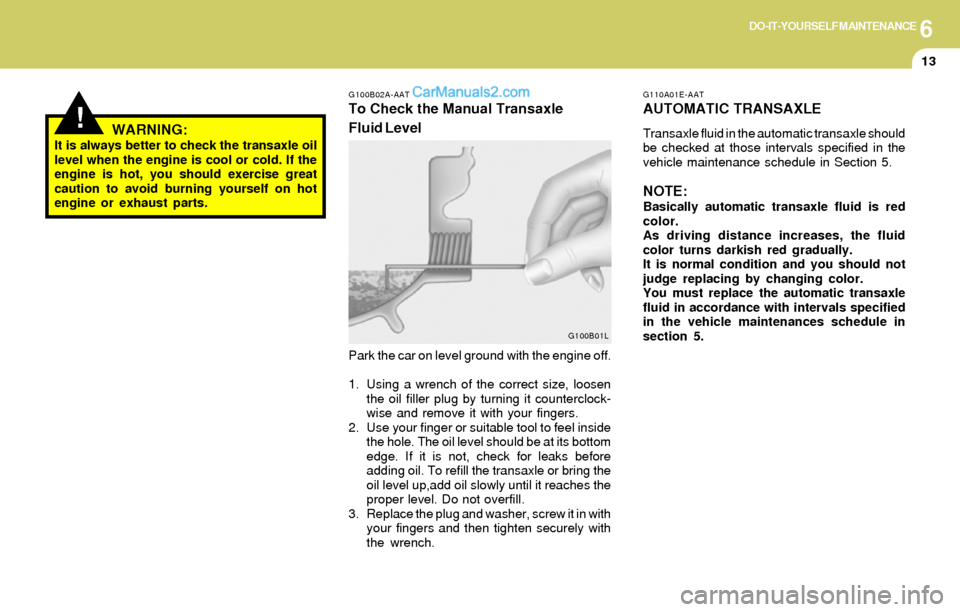
G100B02A-AAT
To Check the Manual Transaxle
Fluid Level
Park the car on level ground with the engine off.
1. Using a wrench of the correct size, loosen
the oil filler plug by turning it counterclock-
wise and remove it with your fingers.
2. Use your finger or suitable tool to feel inside
the hole. The oil level should be at its bottom
edge. If it is not, check for leaks before
adding oil. To refill the transaxle or bring the
oil level up,add oil slowly until it reaches the
proper level. Do not overfill.
3. Replace the plug and washer, screw it in with
your fingers and then tighten securely with
the wrench.
G100B01L
!WARNING:It is always better to check the transaxle oil
level when the engine is cool or cold. If the
engine is hot, you should exercise great
caution to avoid burning yourself on hot
engine or exhaust parts.
Page 199 of 241
6DO-IT-YOURSELF MAINTENANCE
15CHECKING THE BRAKES
G120D01A-AATTo Check the Fluid Level
The fluid level in the brake fluid reservoir should
be checked periodically. The level should be
between the "MIN" and "MAX" marks on the side
of the reservoir. If the level is at or below the
"MIN" mark, carefully add fluid to bring it up to
"MAX". Do not overfill.
!
G120C02A-AAT
Recommended Brake Fluid
Use only hydraulic brake fluid conforming to
DOT 3 or DOT 4 specifications in your braking
system. Follow the instructions printed on the
container.
G120B01A-AATChecking the Brake Fluid Level
G120A01A-AAT
CAUTION:Because brakes are essential to the safe
operation of the car, it is suggested that
they be checked and inspected by your
Hyundai dealer. The brakes should be
checked and inspected for wear at those
intervals specified in the vehicle mainte-
nance schedule in Section 5.
WARNING:Use caution when handling brake fluid. It
can damage your vision if it gets into your
eyes. It will also damage your vehicle's
paint if spilled on it and not removed imme-
diately.
!
!
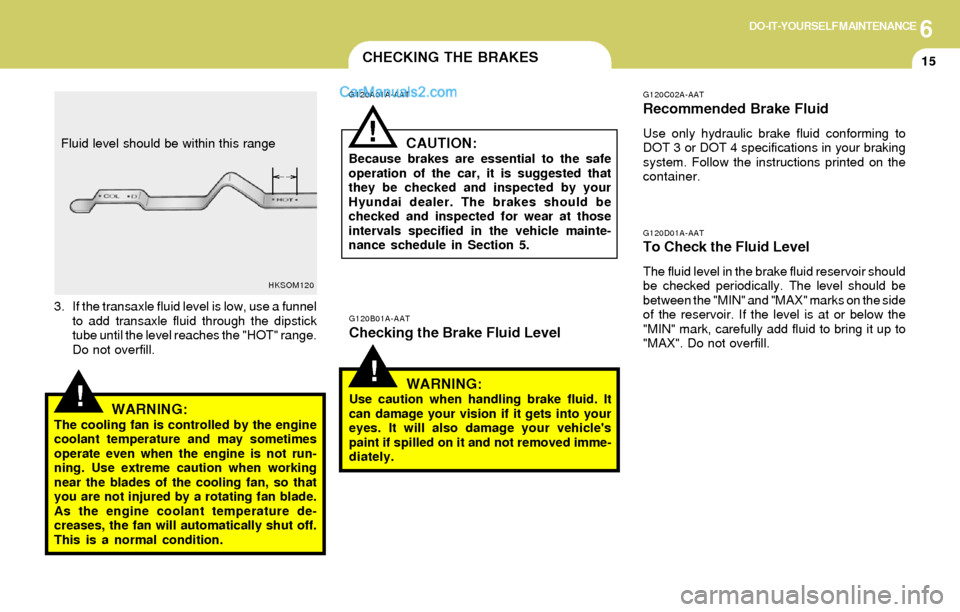
3. If the transaxle fluid level is low, use a funnel
to add transaxle fluid through the dipstick
tube until the level reaches the "HOT" range.
Do not overfill.
WARNING:The cooling fan is controlled by the engine
coolant temperature and may sometimes
operate even when the engine is not run-
ning. Use extreme caution when working
near the blades of the cooling fan, so that
you are not injured by a rotating fan blade.
As the engine coolant temperature de-
creases, the fan will automatically shut off.
This is a normal condition.
HKSOM120
Fluid level should be within this range
Page 229 of 241
8CONSUMER INFORMATION & REPORTING SAFETY DEFECTS
7
!
from the norm due to variations in driving habits,
service practices and differences in road char-
acteristics and climate.
Traction AA, A, B, C - The traction grades, from
highest to lowest, are AA, A, B, and C. Those
grades represent the tire's ability to stop on wet
pavement as measured under controlled con-
ditions on specified government test surfaces
of asphalt and concrete. A tire marked C may
have poor traction performance.
WARNING:The traction grade assigned to this tire is
based on straight-ahead braking traction
tests, and does not include acceleration,
cornering, hydroplaning, or peak traction
characteristics.
Temperature A, B, C - The temperature grades
are A (the highest), B, and C, representing the
tire's resistance to the generation of heat and
its ability to dissipate heat when tested under
controlled conditions on a specified indoor labo-
ratory test wheel. Sustained high temperature
can cause the material of the tire to degenerate
and reduce tire life, and excessive temperature
can lead to sudden tire failure. The grade C
corresponds to a level of performance which all
WARNING:The temperature grade for this tire is estab-
lished for a tire that is properly inflated and
not overloaded. Excessive speed,
underinflation, or excessive loading, either
separately or in combination, can cause
heat buildup and possible tire failure.
I130D01A-AATHyundai motor vehicles are designed and manu-
factured to meet or exceed all applicable safety
standards.
For your safety, however, we strongly urge you
to read and follow all directions in this Owner's
Manual, particularly the information under the
headings "NOTE", "CAUTION" and "WARN-
ING".
If, after reading this manual, you have any
questions regarding the operation of your ve-
hicle, please contact your nearest Hyundai
Motor America Regional Office as listed below:
Eastern Region : Connecticut, Delaware,
Maine, Maryland, Massachusetts, New Hamp-
shire, New Jersey, New York, Pennsylvanina,
Rhode Island, Vermont, Virginia, West Virginia.
Eastern Region
1100 Cranbury South River Road
Jamesburg, NJ 08831
(800) 633-5151
Southern Region : Alabama, Arkansas, Florida,
Georgia, Louisiana, Mississippi, North Caro-
lina, South Carolina, Oklahoma, Tennessee,
Texas.
!
Uniform Tire Quality Grading - Quality grades
can be found on the tire sidewall between the
tread shoulder and the maximum section width.
For example:
Treadwear 200 Traction AA
Temperature A passenger car tires must meet under the Fed-
eral Motor Vehicle Safety Standard No. 109.
Grades B and A represent higher levels of
performance on the laboratory test wheel than
the minimum required by law.