heating Hyundai Elantra 2004 Owner's Guide
[x] Cancel search | Manufacturer: HYUNDAI, Model Year: 2004, Model line: Elantra, Model: Hyundai Elantra 2004Pages: 241, PDF Size: 6.5 MB
Page 155 of 241
2DRIVING YOUR HYUNDAI
16
C170A01A-AAT
HIGHER SPEED MOTORING
Pre-Trip Inspections
1. Tires:
Adjust the tire inflation pressures to specifica-
tion. Low tire inflation pressures will result in
overheating and possible failure of the tires.
Avoid using worn or damaged tires which may
result in reduced traction or tire failure.
NOTE:Never exceed the maximum tire inflation
pressure shown on the tires.
2. Fuel, engine coolant and engine oil:
High speed travel consumes more fuel than
urban motoring. Do not forget to check both
engine coolant and engine oil.
3. Drive belt:
A loose or damaged drive belt may result in
overheating of the engine.
C180A01A-AATUSE OF LIGHTS
Check your lights regularly for correct opera-
tion and always keep them clean. When driving
during the day in conditions of poor visibility, it
is helpful to drive with headlights on low beam.
This enables you to be seen as well as to see.
C160J01A-AAT
Don't Let Ice and Snow Accumulate
Underneath
Under some conditions, snow and ice can build
up under the fenders and interfere with the
steering. When driving in severe winter condi-
tions where this may happen, you should peri-
odically check underneath the car to be sure the
movement of the front wheels and the steering
components is not obstructed.
C160K01A-AATCarry Emergency Equipment
Depending on the severity of the weather where
you drive your car, you should carry appropri-
ate emergency equipment. Some of the items
you may want to carry include tire chains, tow
straps or chains, flashlight, emergency flares,
sand, a shovel, jumper cables, a window scraper,
gloves, ground cloth, coveralls, a blanket, etc.
C160H01A-AAT
Use Approved Anti-Freeze in Window
Washer System
To keep the water in the window washer system
from freezing, add an approved anti-freeze
solution in accordance with instructions on the
container. Window washer anti-freeze is avail-
able from Hyundai dealers and most auto parts
outlets. Do not use engine coolant or other types
of anti-freeze as these may damage the finish.
C160I01A-AATDon't Let Your Parking Brake Freeze
Under some conditions your parking brake can
freeze in the engaged position. This is most
likely to happen when there is an accumulation
of snow or ice around or near the rear brakes
or if the brakes are wet. If there is a risk the
parking brake may freeze, apply it only tempo-
rarily while you put the gear selector lever in "P"
(automatic) or in first or reverse gear (manual
transaxle) and block the rear wheels so the car
cannot roll. Then release the parking brake.
Page 158 of 241
2DRIVING YOUR HYUNDAI
19
!WARNING:Improperly loading your car and trailer can
seriously affect its steering and braking
performance causing a crash which could
cause serious injury or death.
C190F01S-AAT
Trailer or Vehicle Towing Tips
1. Before towing, check hitch and safety chain
connections as well as proper operation of
the trailer running lights, brake lights, and
turn signals.
2. Always drive your vehicle at a moderate
speed. (Less than 60 mph)
3. Trailer towing requires more fuel than normal
conditions.
4. To maintain engine braking efficiency and
electrical charging performance, do not use
fifth gear (manual transaxle) or overdrive
(automatic transaxle).
5. Always secure items in the trailer to prevent
load shift while driving.
6. Check the condition and air pressure of all
tires on the trailer and your car. Low tire
pressure can seriously affect the handling.
Also check the spare tire.7. The vehicle/trailer combination is more af-
fected by crosswind and buffeting.
When being passed by a large vehicle, keep
a constant speed and steer straight ahead.
If there is too much wind buffeting slow down
to get out of the other vehicle's air turbulence.
8. When parking your car and trailer, especially
on a hill, be sure to follow all the normal
precautions. Turn your front wheel into the
curb, set the parking brake firmly, and put the
transaxle in 1st or Reverse (manual) or Park
(automatic). In addition, place wheel chocks
at each of the trailer's tires.
9. If the trailer has electric brakes, start your
vehicle and trailer moving, and then apply the
trailer brake controller by hand to be sure the
brakes are working. This lets you check
your electrical connection at the same time.
10. During your trip, occasionally check to be
sure that the load is secure, and that the
lights and any trailer brakes are still work-
ing.
11. Avoid jerky starts, sudden acceleration or
sudden stops.
12. Avoid sharp turns and rapid lane changes.
13. Avoid holding the brake pedal down too long
or too frequently. This could cause the
brakes to overheat, resulting in reduced
braking efficiency.
!
14. When going down a hill, shift into a lower
gear and use the engine braking effect.
When ascending a long grade, downshift
the transaxle to a lower gear and reduce
speed to reduce chances of engine over-
loading and/or overheating.
15. If you have to stop while going uphill, do not
hold the vehicle in place by pressing on the
accelerator. This can cause the automatic
transaxle to overheat. Use the parking
brake or footbrake.
NOTE:When towing check transaxle fluid more
frequently.
CAUTION:If overheating should occur when towing,
(the temperature gauge reads near red zone),
taking the following action may reduce or
eliminate the problem.
1. Turn off the air conditioner.
2. Reduce highway speed.
3. Select a lower gear when going uphill.
4. While in stop and go traffic, place the
gear selector in park or neutral and idle
the engine at a higher speed.
Page 162 of 241
3WHAT TO DO IN AN EMERGENCY
4IF THE ENGINE OVERHEATS
!
!WARNING:While the engine is running, keep hair,
hands, and clothing away from moving
parts such as the fan and drive belts to
prevent injury.
5. If the water pump drive belt is broken or
engine coolant is leaking out, stop the engine
immediately and call the nearest Hyundai
dealer for assistance.
WARNING:Do not remove the radiator cap when the
engine is hot. This can allow coolant to be
blown out of the opening and cause seri-
ous burns.
6. If you cannot find the cause of the overheat-
ing, wait until the engine temperature has
returned to normal. Then, if coolant has been
lost, carefully add coolant to the reservoir
(page 6-9) to bring the fluid level in the
reservoir up to the halfway mark.
7. Proceed with caution, keeping alert for fur-
ther signs of overheating. If overheating
happens again, call a Hyundai dealer for
assistance.
D030A01A-AAT
If your temperature gauge indicates overheat-
ing, you experience a loss of power, or hear loud
pinging or knocking and the engine is probably
too hot. If this happens and, you should:
1. Pull off the road and stop as soon as it is safe
to do so.
2. Place the gear selector lever in "P" (auto-
matic), or neutral (manual transaxle) and set
the parking brake. If the air conditioning is on,
turn it off.
3. If engine coolant is running out under the car
or steam is coming out from the hood, stop
the engine. Do not open the hood until the
engine coolant has stopped running or the
steaming has stopped. If there is no visible
loss of engine coolant and no steam, leave
the engine running and check to be sure the
engine cooling fan is operating. If the fan is
not running, turn the engine off.
4. Check to see if the water pump drive belt is
missing. If it is not missing, check to see that
it is tight. If the drive belt seems to be
satisfactory, check for engine coolant leak-
ing from the radiator, hoses or under the car.
(If the air conditioning had been in use, it is
normal for cold water to be draining from it
when you stop). post or cable of the booster battery. Then
attach the other end of that cable to a solid
metal part of the engine away from the
battery. Do not connect the cable to any
moving part.
4. Start the engine in the car with the booster
battery and let it run for a few minutes. This
will help to assure that the booster battery is
fully charged. During the jumping operation,
run the engine in this vehicle at about 2,000
rpm.
5. Start the engine in the car with the dis-
charged battery using the normal starting
procedure. After the engine starts, leave the
jumper cables connected and let the engine
run at fast idle or about 2,000 rpm for several
minutes.
6. Carefully remove the jumper cables in the
reverse order of attachment.
If you do not know why your battery became
discharged (because the lights were left on,
etc.), have the charging system checked by
your Hyundai dealer.
Page 187 of 241
6DO-IT-YOURSELF MAINTENANCE
3GENERAL CHECKS
G020C01A-AAT
Vehicle Interior
The following should be checked each time
when the vehicle is driven:
o Lights operation
o Windshield wiper operation
o Horn operation
o Defroster, heating system operation (and air
conditioning, if installed)
o Steering operation and condition
o Mirror condition and operation
o Turn signal operation
o Accelerator pedal operation
o Brake operation, including parking brake
o Manual transaxle operation, including clutch
operation
o Automatic transaxle operation, including
"Park" mechanism operation
o Seat control condition and operation
o Seat belt condition and operation
o Sunvisor operation
If you notice anything that does not operate
correctly or appears to be functioning incor-
rectly, inspect it carefully and seek assistance
from your Hyundai dealer if service is needed.
G020B01A-AAT
Vehicle Exterior
The following should be checked monthly:
o Overall appearance and condition
o Wheel condition and wheel nut torque
o Exhaust system condition
o Light condition and operation
o Windshield glass condition
o Wiper blade condition
o Paint condition and body corrosion
o Fluid leaks
o Door and hood lock condition
o Tire pressure and condition (including spare
tire)
G020A01A-AAT
Engine Compartment
The following should be checked regularly:
o Engine oil level and condition
o Transaxle fluid level and condition
o Brake fluid level
o Clutch fluid level
o Engine coolant level
o Windshield washer fluid level
o Accessory drive belt condition
o Engine coolant hose condition
o Fluid leaks (on or below components)
o Power steering fluid level
o Battery conditio
o Air filter condition
Page 219 of 241
6DO-IT-YOURSELF MAINTENANCE
35
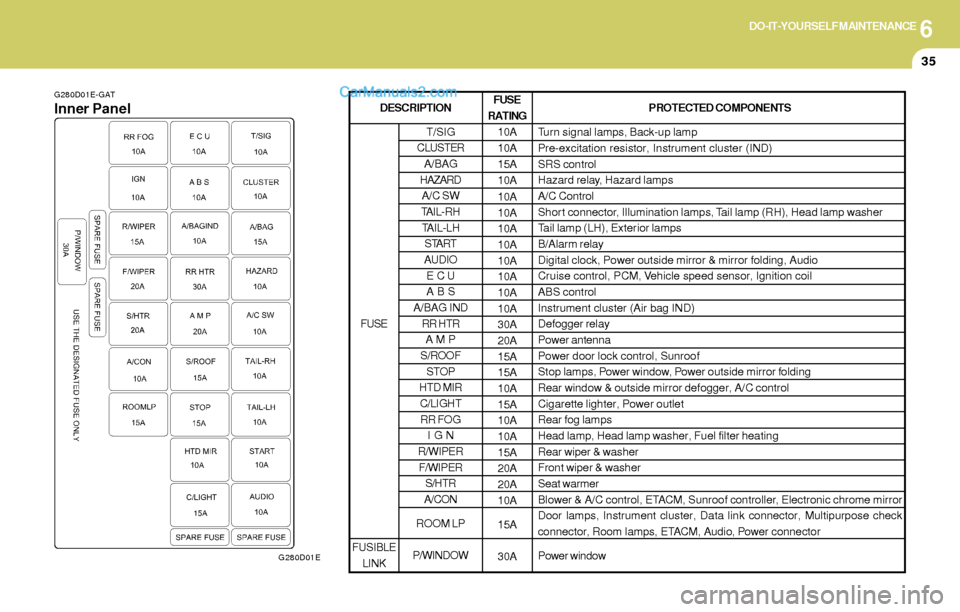
G280D01E-GAT
Inner Panel
G280D01E
FUSE
RATING
10A
10A
15A
10A
10A
10A
10A
10A
10A
10A
10A
10A
30A
20A
15A
15A
10A
15A
10A
10A
15A
20A
20A
10A
15A
30APROTECTED COMPONENTS
Turn signal lamps, Back-up lamp
Pre-excitation resistor, Instrument cluster (IND)
SRS control
Hazard relay, Hazard lamps
A/C Control
Shor t connector, Illumination lamps, Tail lamp (RH), Head lamp washer
Tail lamp (LH), Exterior lamps
B/Alarm relay
Digital clock, Power outside mirror & mirror folding, Audio
Cruise control, PCM, Vehicle speed sensor, Ignition coil
ABS control
Instrument cluster (Air bag IND)
Defogger relay
Power antenna
Power door lock control, Sunroof
Stop lamps, Power window, Power outside mirror folding
Rear window & outside mirror defogger, A/C control
Cigarette lighter, Power outlet
Rear fog lamps
Head lamp, Head lamp washer, Fuel filter heating
Rear wiper & washer
Front wiper & washer
Seat warmer
Blower & A/C control, ETACM, Sunroof controller, Electronic chrome mirror
Door lamps, Instrument cluster, Data link connector, Multipurpose check
connector, Room lamps, ETACM, Audio, Power connector
Power window
T/SIG
CLUSTER
A/BAG
HAZARD
A/C SW
TAIL-RH
TAIL-LH
START
AUDIO
E C U
A B S
A/BAG IND
RR HTR
A M P
S/ROOF
STOP
HTD MIR
C/LIGHT
RR FOG
I G N
R/WIPER
F/WIPER
S/HTR
A/CON
ROOM LP
P/WINDOW FUSE
FUSIBLE
LINK
DESCRIPTION
Page 237 of 241
10INDEX
3
D
Defrosting / Defogging ......................................................................1-87
Door
Locking, unlocking front door with a key ...................................... 1-5
Drink Holder ......................................................................................1-61
Drive Belts.........................................................................................6-20
Driving
Driving for economy .....................................................................2-13
Smooth cornering.........................................................................2-14
Winter driving...............................................................................2-15
E
Emission Control System ................................................................... 7-2
Engine
Before starting the engine .............................................................. 2-3
Compartment................................................................................. 6-2
Coolant........................................................................................... 6-8
Coolant temperature gauge .........................................................1-49
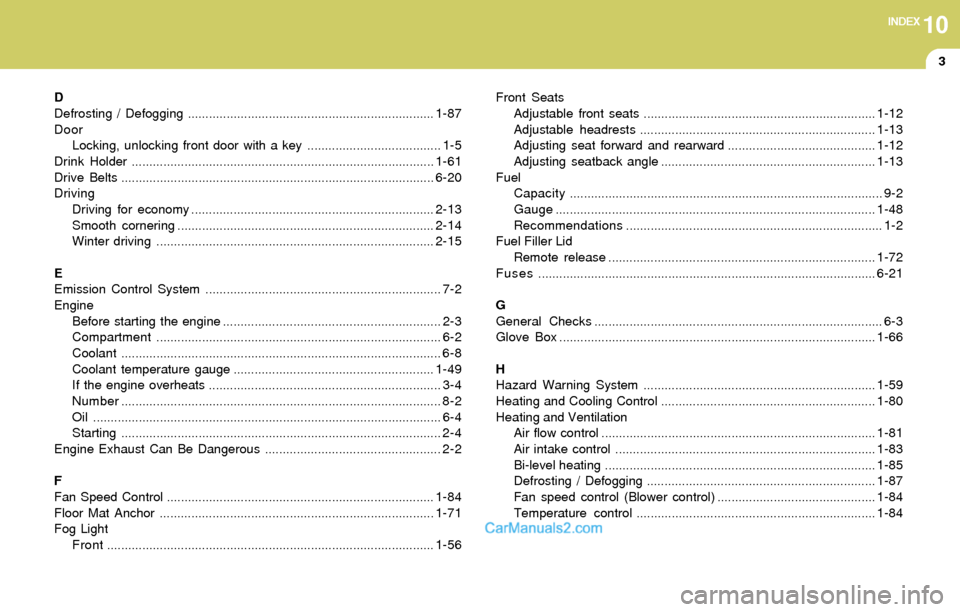
If the engine overheats .................................................................. 3-4
Number........................................................................................... 8-2
Oil ................................................................................................... 6-4
Starting........................................................................................... 2-4
Engine Exhaust Can Be Dangerous .................................................. 2-2
F
Fan Speed Control............................................................................1-84
Floor Mat Anchor ..............................................................................1-71
Fog Light
Front.............................................................................................1-56Front Seats
Adjustable front seats..................................................................1-12
Adjustable headrests...................................................................1-13
Adjusting seat forward and rearward ..........................................1-12
Adjusting seatback angle .............................................................1-13
Fuel
Capacity......................................................................................... 9-2
Gauge...........................................................................................1-48
Recommendations......................................................................... 1-2
Fuel Filler Lid
Remote release............................................................................1-72
Fuses................................................................................................6-21
G
General Checks.................................................................................. 6-3
Glove Box..........................................................................................1-66
H
Hazard Warning System ..................................................................1-59
Heating and Cooling Control.............................................................1-80
Heating and Ventilation
Air flow control..............................................................................1-81
Air intake control ..........................................................................1-83
Bi-level heating.............................................................................1-85
Defrosting / Defogging .................................................................1-87
Fan speed control (Blower control).............................................1-84
Temperature control....................................................................1-84