lock Hyundai Elantra 2004 Workshop Manual
[x] Cancel search | Manufacturer: HYUNDAI, Model Year: 2004, Model line: Elantra, Model: Hyundai Elantra 2004Pages: 241, PDF Size: 6.5 MB
Page 169 of 241
3WHAT TO DO IN AN EMERGENCY
11
D080D02E-AD080C02E
EMERGENCY TOWING
NOTE:
Before towing, check the level of the
transaxle fluid. If it is below the "HOT" mark
on the dipstick, add fluid. If you cannot add
fluid, a towing dolly must be used as de-
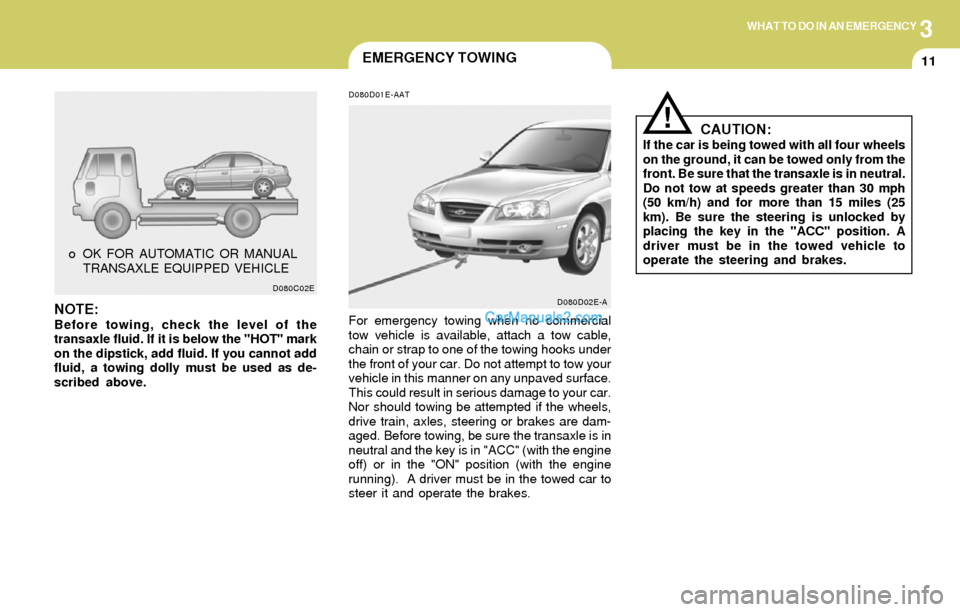
scribed above. o OK FOR AUTOMATIC OR MANUAL
TRANSAXLE EQUIPPED VEHICLE
!
D080D01E-AAT
For emergency towing when no commercial
tow vehicle is available, attach a tow cable,
chain or strap to one of the towing hooks under
the front of your car. Do not attempt to tow your
vehicle in this manner on any unpaved surface.
This could result in serious damage to your car.
Nor should towing be attempted if the wheels,
drive train, axles, steering or brakes are dam-
aged. Before towing, be sure the transaxle is in
neutral and the key is in "ACC" (with the engine
off) or in the "ON" position (with the engine
running). A driver must be in the towed car to
steer it and operate the brakes.
CAUTION:If the car is being towed with all four wheels
on the ground, it can be towed only from the
front. Be sure that the transaxle is in neutral.
Do not tow at speeds greater than 30 mph
(50 km/h) and for more than 15 miles (25
km). Be sure the steering is unlocked by
placing the key in the "ACC" position. A
driver must be in the towed vehicle to
operate the steering and brakes.
Page 170 of 241
3WHAT TO DO IN AN EMERGENCY
12IF YOU LOSE YOUR KEYS
D120A01A-AAT
If you lose your keys, many Hyundai dealers
can make you a new key if you have your key
number.
If you lock the keys inside your car and you
cannot obtain a new key, many Hyundai dealers
can use special tools to open the door for you.
Page 187 of 241
6DO-IT-YOURSELF MAINTENANCE
3GENERAL CHECKS
G020C01A-AAT
Vehicle Interior
The following should be checked each time
when the vehicle is driven:
o Lights operation
o Windshield wiper operation
o Horn operation
o Defroster, heating system operation (and air
conditioning, if installed)
o Steering operation and condition
o Mirror condition and operation
o Turn signal operation
o Accelerator pedal operation
o Brake operation, including parking brake
o Manual transaxle operation, including clutch
operation
o Automatic transaxle operation, including
"Park" mechanism operation
o Seat control condition and operation
o Seat belt condition and operation
o Sunvisor operation
If you notice anything that does not operate
correctly or appears to be functioning incor-
rectly, inspect it carefully and seek assistance
from your Hyundai dealer if service is needed.
G020B01A-AAT
Vehicle Exterior
The following should be checked monthly:
o Overall appearance and condition
o Wheel condition and wheel nut torque
o Exhaust system condition
o Light condition and operation
o Windshield glass condition
o Wiper blade condition
o Paint condition and body corrosion
o Fluid leaks
o Door and hood lock condition
o Tire pressure and condition (including spare
tire)
G020A01A-AAT
Engine Compartment
The following should be checked regularly:
o Engine oil level and condition
o Transaxle fluid level and condition
o Brake fluid level
o Clutch fluid level
o Engine coolant level
o Windshield washer fluid level
o Accessory drive belt condition
o Engine coolant hose condition
o Fluid leaks (on or below components)
o Power steering fluid level
o Battery conditio
o Air filter condition
Page 189 of 241
6DO-IT-YOURSELF MAINTENANCE
5
HXDFL009
CHANGING THE OIL AND FILTER
!
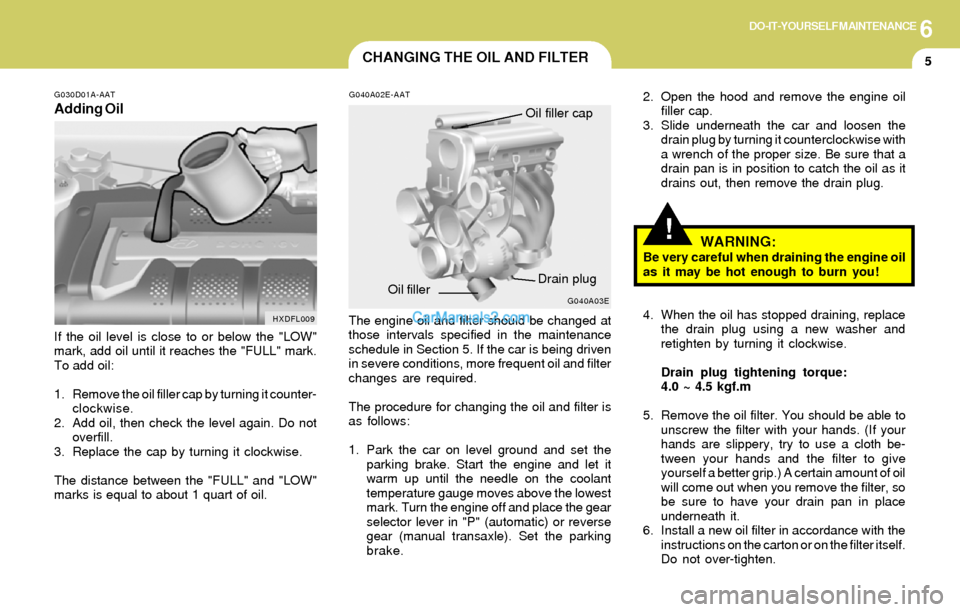
If the oil level is close to or below the "LOW"
mark, add oil until it reaches the "FULL" mark.
To add oil:
1. Remove the oil filler cap by turning it counter-
clockwise.
2. Add oil, then check the level again. Do not
overfill.
3. Replace the cap by turning it clockwise.
The distance between the "FULL" and "LOW"
marks is equal to about 1 quart of oil.
G040A02E-AAT2. Open the hood and remove the engine oil
filler cap.
3. Slide underneath the car and loosen the
drain plug by turning it counterclockwise with
a wrench of the proper size. Be sure that a
drain pan is in position to catch the oil as it
drains out, then remove the drain plug.
WARNING:Be very careful when draining the engine oil
as it may be hot enough to burn you!
G030D01A-AAT
Adding Oil
The engine oil and filter should be changed at
those intervals specified in the maintenance
schedule in Section 5. If the car is being driven
in severe conditions, more frequent oil and filter
changes are required.
The procedure for changing the oil and filter is
as follows:
1. Park the car on level ground and set the
parking brake. Start the engine and let it
warm up until the needle on the coolant
temperature gauge moves above the lowest
mark. Turn the engine off and place the gear
selector lever in "P" (automatic) or reverse
gear (manual transaxle). Set the parking
brake.4. When the oil has stopped draining, replace
the drain plug using a new washer and
retighten by turning it clockwise.
Drain plug tightening torque:
4.0 ~ 4.5 kgf.m
5. Remove the oil filter. You should be able to
unscrew the filter with your hands. (If your
hands are slippery, try to use a cloth be-
tween your hands and the filter to give
yourself a better grip.) A certain amount of oil
will come out when you remove the filter, so
be sure to have your drain pan in place
underneath it.
6. Install a new oil filter in accordance with the
instructions on the carton or on the filter itself.
Do not over-tighten.
G040A03E
Oil filler cap
Drain plug
Oil filler
Page 192 of 241
6DO-IT-YOURSELF MAINTENANCE
8
G050D02A-AAT
To Change the Engine Coolant
The engine coolant should be changed at those
intervals specified in the vehicle maintenance
schedule in Section 5.
CAUTION:Engine coolant can damage the finish of
your car. If you spill engine coolant on the
car, wash it off thoroughly with clean water.
1. Park the car on level ground, set the park-
ing brake and remove the radiator cap when
cool.
2. Be sure your drain receptacle is in place.
Open the drain cock on the radiator. Allow all
the engine coolant to drain from the cooling
system, then securely close the drain cock.
3. Check Section 9 for the capacity of the
cooling system in your car. Then, following
the manufacturer's directions on the engine
coolant container, add the appropriate quan-
tity of coolant to the radiator.
!
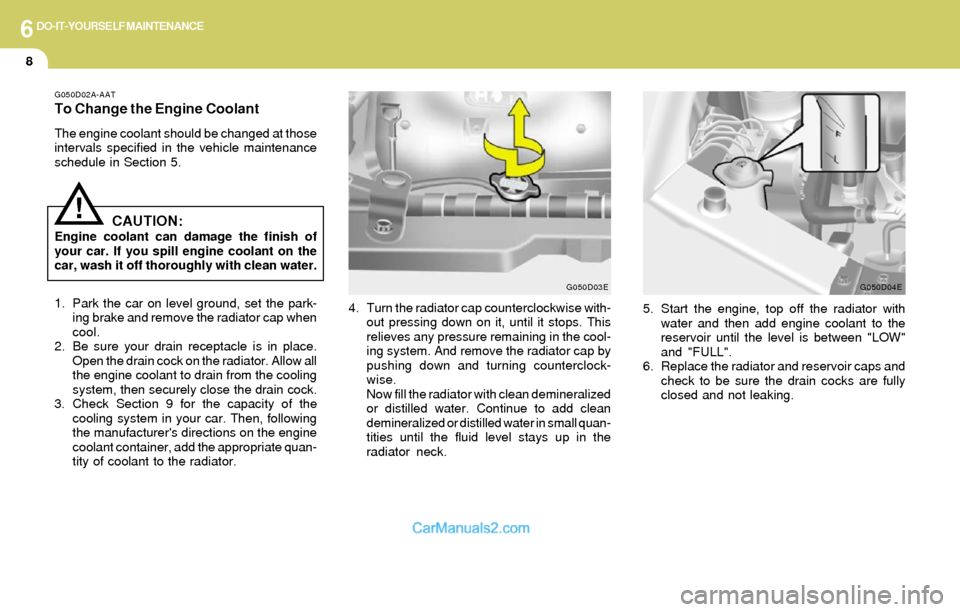
5. Start the engine, top off the radiator with
water and then add engine coolant to the
reservoir until the level is between "LOW"
and "FULL".
6. Replace the radiator and reservoir caps and
check to be sure the drain cocks are fully
closed and not leaking. 4. Turn the radiator cap counterclockwise with-
out pressing down on it, until it stops. This
relieves any pressure remaining in the cool-
ing system. And remove the radiator cap by
pushing down and turning counterclock-
wise.
Now fill the radiator with clean demineralized
or distilled water. Continue to add clean
demineralized or distilled water in small quan-
tities until the fluid level stays up in the
radiator neck.
G050D03E G050D04E
Page 194 of 241
6DO-IT-YOURSELF MAINTENANCE
10
G060C01S-AAT
Changing the Spark Plugs
You will find it easier to change spark plugs if the
engine is cold. Always change one spark plug
at a time. This helps avoid getting the wires
mixed up.
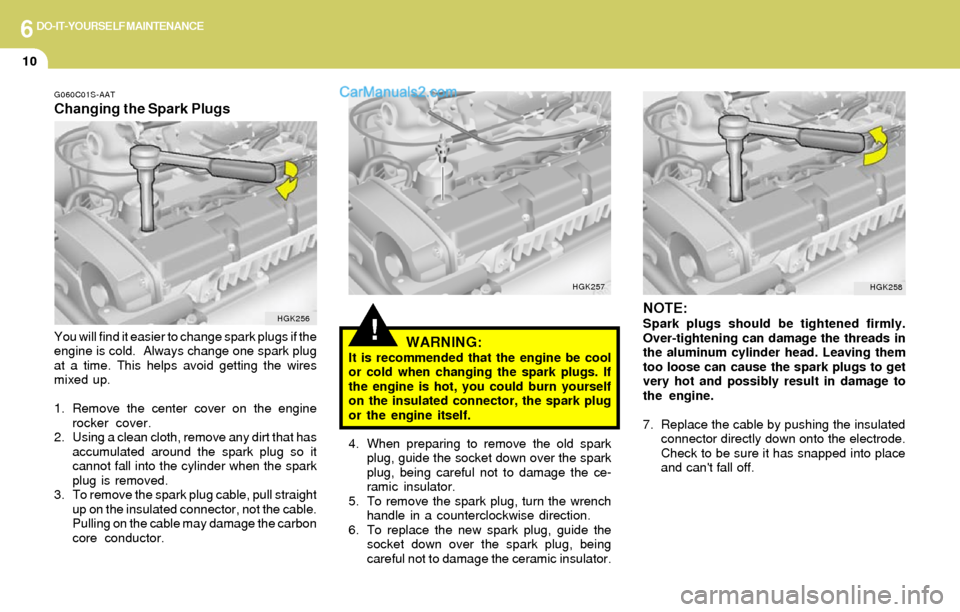
1. Remove the center cover on the engine
rocker cover.
2. Using a clean cloth, remove any dirt that has
accumulated around the spark plug so it
cannot fall into the cylinder when the spark
plug is removed.
3. To remove the spark plug cable, pull straight
up on the insulated connector, not the cable.
Pulling on the cable may damage the carbon
core conductor.
HGK256
!WARNING:It is recommended that the engine be cool
or cold when changing the spark plugs. If
the engine is hot, you could burn yourself
on the insulated connector, the spark plug
or the engine itself.
4. When preparing to remove the old spark
plug, guide the socket down over the spark
plug, being careful not to damage the ce-
ramic insulator.
5. To remove the spark plug, turn the wrench
handle in a counterclockwise direction.
6. To replace the new spark plug, guide the
socket down over the spark plug, being
careful not to damage the ceramic insulator.
NOTE:Spark plugs should be tightened firmly.
Over-tightening can damage the threads in
the aluminum cylinder head. Leaving them
too loose can cause the spark plugs to get
very hot and possibly result in damage to
the engine.
7. Replace the cable by pushing the insulated
connector directly down onto the electrode.
Check to be sure it has snapped into place
and can't fall off.
HGK257
HGK258
Page 197 of 241
6DO-IT-YOURSELF MAINTENANCE
13
G110A01E-AAT
AUTOMATIC TRANSAXLE
Transaxle fluid in the automatic transaxle should
be checked at those intervals specified in the
vehicle maintenance schedule in Section 5.
NOTE:Basically automatic transaxle fluid is red
color.
As driving distance increases, the fluid
color turns darkish red gradually.
It is normal condition and you should not
judge replacing by changing color.
You must replace the automatic transaxle
fluid in accordance with intervals specified
in the vehicle maintenances schedule in
section 5.
G100B02A-AAT
To Check the Manual Transaxle
Fluid Level
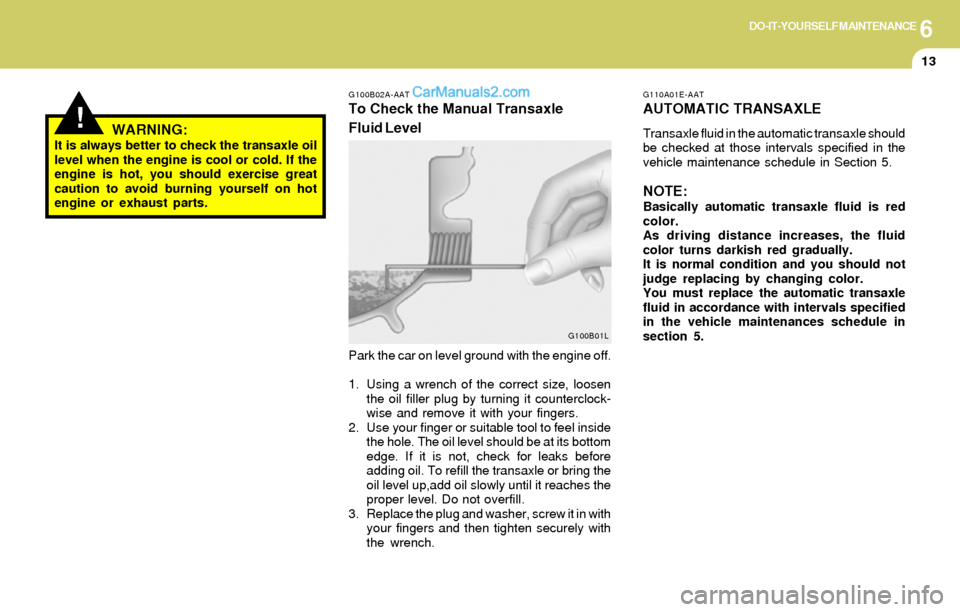
Park the car on level ground with the engine off.
1. Using a wrench of the correct size, loosen
the oil filler plug by turning it counterclock-
wise and remove it with your fingers.
2. Use your finger or suitable tool to feel inside
the hole. The oil level should be at its bottom
edge. If it is not, check for leaks before
adding oil. To refill the transaxle or bring the
oil level up,add oil slowly until it reaches the
proper level. Do not overfill.
3. Replace the plug and washer, screw it in with
your fingers and then tighten securely with
the wrench.
G100B01L
!WARNING:It is always better to check the transaxle oil
level when the engine is cool or cold. If the
engine is hot, you should exercise great
caution to avoid burning yourself on hot
engine or exhaust parts.
Page 211 of 241
6DO-IT-YOURSELF MAINTENANCE
27
!WARNING:This halogen bulb contains gas under pres-
sure and if impacted could shatter, result-
ing in flying fragments. Always wear eye
protection when servicing the bulb. Protect
the bulb against abrasions or scratches
and against liquids when lighted. Turn the
bulb on only when installing in a headlight.
Replace the headlight if damaged or cracked.
Keep the bulb out of the reach of children
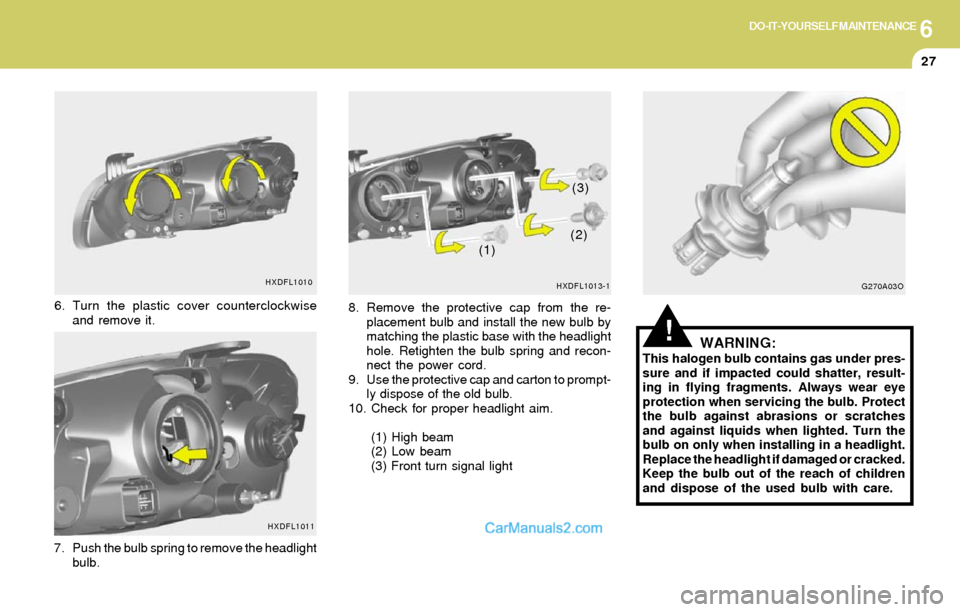
and dispose of the used bulb with care. 8. Remove the protective cap from the re-
placement bulb and install the new bulb by
matching the plastic base with the headlight
hole. Retighten the bulb spring and recon-
nect the power cord.
9. Use the protective cap and carton to prompt-
ly dispose of the old bulb.
10. Check for proper headlight aim.
(1) High beam
(2) Low beam
(3) Front turn signal light
7. Push the bulb spring to remove the headlight
bulb. 6. Turn the plastic cover counterclockwise
and remove it.
HXDFL1011 HXDFL1010
HXDFL1013-1
(1)(2)(3)
G270A03O
Page 219 of 241
6DO-IT-YOURSELF MAINTENANCE
35
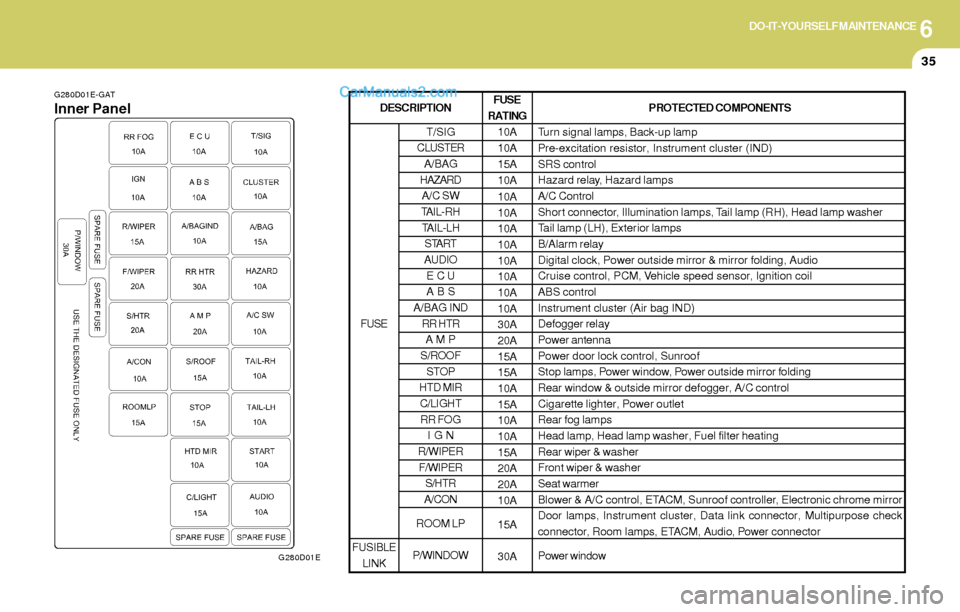
G280D01E-GAT
Inner Panel
G280D01E
FUSE
RATING
10A
10A
15A
10A
10A
10A
10A
10A
10A
10A
10A
10A
30A
20A
15A
15A
10A
15A
10A
10A
15A
20A
20A
10A
15A
30APROTECTED COMPONENTS
Turn signal lamps, Back-up lamp
Pre-excitation resistor, Instrument cluster (IND)
SRS control
Hazard relay, Hazard lamps
A/C Control
Shor t connector, Illumination lamps, Tail lamp (RH), Head lamp washer
Tail lamp (LH), Exterior lamps
B/Alarm relay
Digital clock, Power outside mirror & mirror folding, Audio
Cruise control, PCM, Vehicle speed sensor, Ignition coil
ABS control
Instrument cluster (Air bag IND)
Defogger relay
Power antenna
Power door lock control, Sunroof
Stop lamps, Power window, Power outside mirror folding
Rear window & outside mirror defogger, A/C control
Cigarette lighter, Power outlet
Rear fog lamps
Head lamp, Head lamp washer, Fuel filter heating
Rear wiper & washer
Front wiper & washer
Seat warmer
Blower & A/C control, ETACM, Sunroof controller, Electronic chrome mirror
Door lamps, Instrument cluster, Data link connector, Multipurpose check
connector, Room lamps, ETACM, Audio, Power connector
Power window
T/SIG
CLUSTER
A/BAG
HAZARD
A/C SW
TAIL-RH
TAIL-LH
START
AUDIO
E C U
A B S
A/BAG IND
RR HTR
A M P
S/ROOF
STOP
HTD MIR
C/LIGHT
RR FOG
I G N
R/WIPER
F/WIPER
S/HTR
A/CON
ROOM LP
P/WINDOW FUSE
FUSIBLE
LINK
DESCRIPTION
Page 224 of 241
8CONSUMER INFORMATION & REPORTING SAFETY DEFECTS
2
SSA8010B
VEHICLE IDENTIFICATION
NUMBER (VIN)TIRE
I020A01A-AAT
TIRE INFORMATION
The tires supplied on your new Hyundai are
chosen to provide the best performance for
normal driving.
I010B01A-AAT
Engine Number
I010A01A-AAT
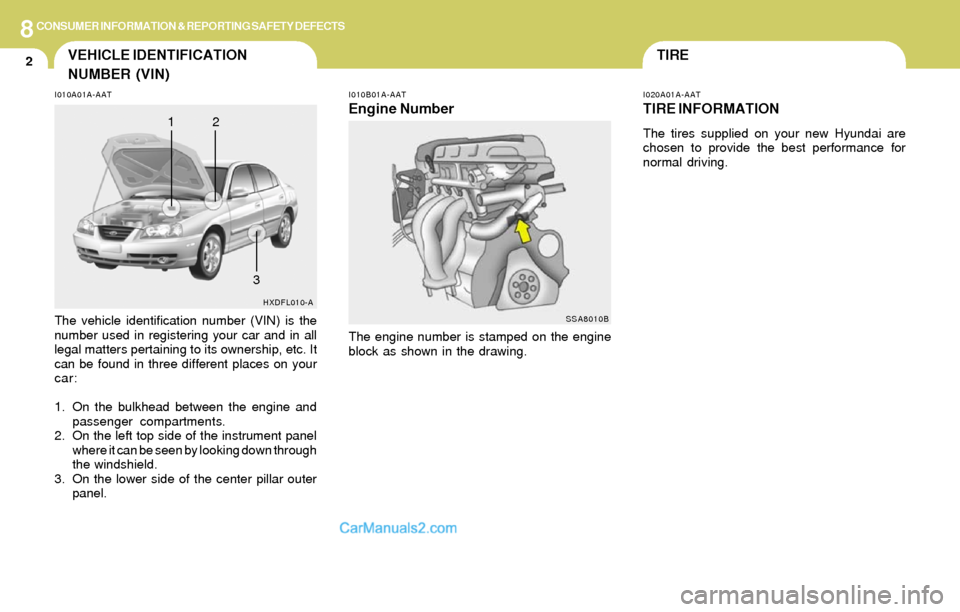
The vehicle identification number (VIN) is the
number used in registering your car and in all
legal matters pertaining to its ownership, etc. It
can be found in three different places on your
car:
1. On the bulkhead between the engine and
passenger compartments.
2. On the left top side of the instrument panel
where it can be seen by looking down through
the windshield.
3. On the lower side of the center pillar outer
panel.The engine number is stamped on the engine
block as shown in the drawing.
HXDFL010-A
12
3